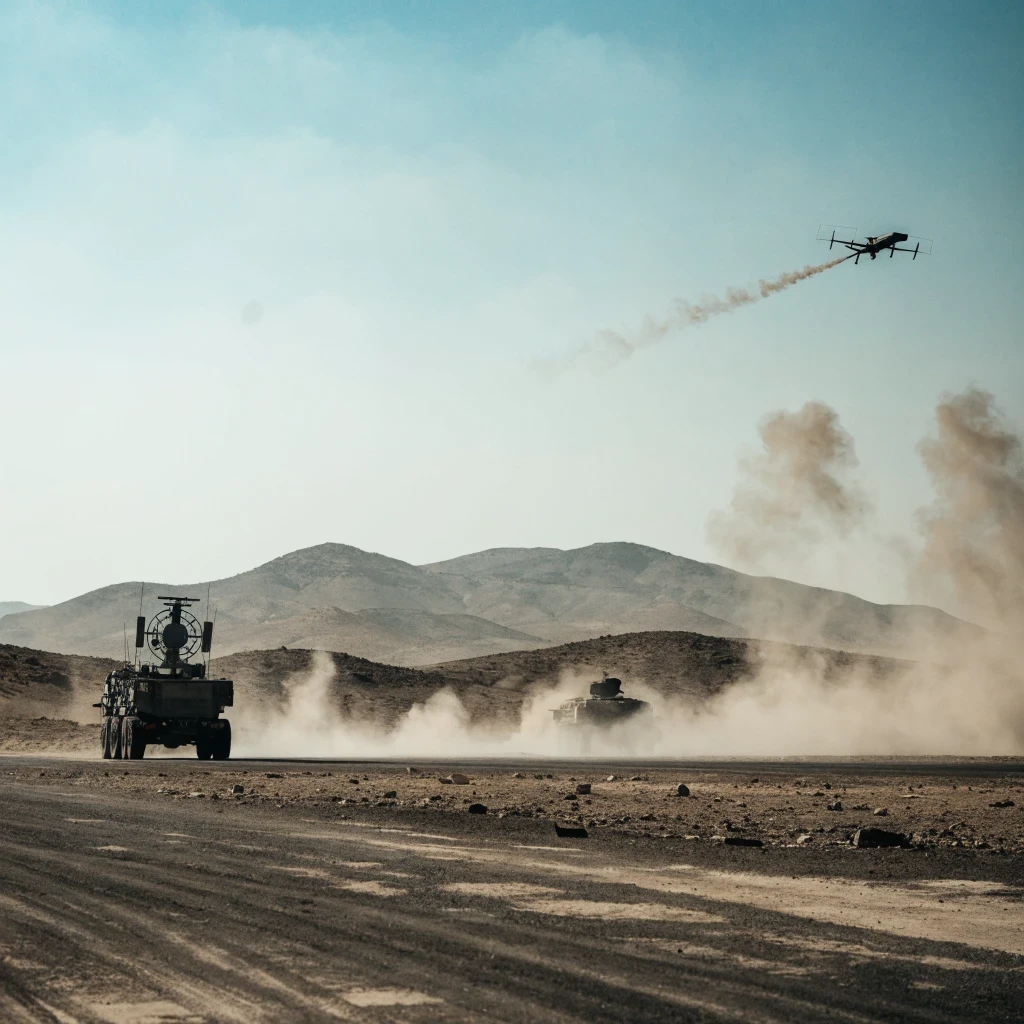
The drone has ceased to be a mere surveillance tool and has become the defining weapon of modern conflict. In the Middle East, where state borders blur with proxy battlefields, the proliferation of low-cost, one-way attack drones has rewritten the calculus of military power.
The recent launch of "Task Force Falcon Strike" by the US military marks a pivotal acknowledgment that no single nation can counter this aerial threat alone.
This new collaborative framework signals a strategic departure from unilateral operations toward a networked defense architecture. By partnering directly with Middle East allies, Washington is not just sharing technology; it is co-developing countermeasures and offensive drone capabilities tailored to regional realities. The initiative reflects a hard truth learned from recent conflicts: cheap drones can neutralize expensive conventional assets with devastating efficiency.
On This Page
Understanding this shift requires examining the tactical evolution of drone warfare, the strategic logic behind joint task forces, and the industrial implications for defense innovation. The era of the lone superpower projecting air dominance is yielding to a more complex, collaborative, and asymmetric battlefield where agility trumps mass.
TL;DR The US military's launch of Task Force Falcon Strike represents a strategic pivot toward collaborative drone warfare in the Middle East. This initiative partners American forces with regional allies to develop one-way attack drones and countermeasures against the growing threat of low-cost aerial systems. The task force model reflects a broader defense transformation where asymmetric capabilities, rapid innovation, and coalition-based development are becoming essential to maintaining battlefield superiority.
The Asymmetric Threat That Changed Defense Doctrine
The modern battlefield has witnessed a dramatic inversion of military economics. A drone costing a few thousand dollars can now disable a main battle tank worth millions, forcing defense planners to fundamentally rethink force protection. This cost asymmetry has become the central challenge for conventional militaries operating in the Middle East.
Iranian-designed Shahed drones and Houthi-modified cruise missiles have demonstrated how state and non-state actors can project power without traditional air forces. These attacks have targeted critical infrastructure, naval vessels, and civilian population centers with alarming precision. The psychological impact of these weapons extends far beyond their physical destruction, creating persistent uncertainty across the region.
The Evolution of One-Way Attack Drones
One-way attack drones, often called loitering munitions, represent a distinct category of weaponry designed for single-use precision strikes. Unlike reusable platforms, these systems are engineered for expendability, allowing commanders to employ them in high-risk scenarios without concern for recovery. Their small radar signatures and low-altitude flight profiles make them exceptionally difficult to detect and intercept.
The proliferation of these systems has accelerated dramatically since the Nagorno-Karabakh conflict in 2020, where Azerbaijani forces demonstrated their devastating effectiveness against Armenian armor. That conflict served as a global demonstration of how drone swarms could overwhelm traditional air defense networks. Military analysts worldwide took immediate notice of this paradigm shift.
Middle Eastern nations have been particularly attentive students of this evolution, recognizing both the offensive potential and the defensive vulnerabilities these systems create. Countries like Saudi Arabia, the UAE, and Israel have invested heavily in both drone development and counter-drone technologies. The threat landscape continues to evolve as new actors acquire and adapt these capabilities.
The technical sophistication of one-way attack drones has advanced rapidly, incorporating artificial intelligence for autonomous target recognition and improved navigation systems resistant to GPS jamming. These enhancements have made the weapons more reliable and more difficult to counter with traditional electronic warfare measures. The result is a constantly escalating technological arms race.
Why Traditional Air Defense Is Struggling
Conventional air defense systems were designed to counter fast-moving, high-altitude aircraft, not slow, low-flying drones with minimal heat signatures. The radar cross-section of a small drone can be smaller than that of a bird, making detection exceptionally challenging. Patriot batteries and similar systems often struggle to acquire and track these diminutive threats effectively.
The cost-effectiveness equation further complicates defense planning. Intercepting a $20,000 drone with a $3 million missile creates an unsustainable economic burden over prolonged engagements. This financial asymmetry has driven the search for directed energy weapons, electronic jammers, and kinetic interceptors that offer more favorable exchange ratios.
Defense contractors have responded with a wave of innovation, developing laser systems capable of destroying drones at the speed of light and microwave weapons that fry their electronics. These directed energy solutions promise virtually unlimited engagement capacity at minimal per-shot costs. However, their deployment remains limited by power requirements and atmospheric conditions.
The integration of artificial intelligence into air defense networks offers another promising avenue, enabling faster threat classification and automated engagement decisions. Machine learning algorithms can distinguish between birds, commercial aircraft, and hostile drones with increasing accuracy. This cognitive layer represents the next frontier in counter-drone warfare.
The Collaborative Response Framework
Task Force Falcon Strike embodies a recognition that no single military possesses all the answers to the drone challenge. By formalizing collaboration with Middle East partners, the initiative creates a platform for sharing tactical lessons, technical expertise, and operational intelligence. This collective approach accelerates the development of effective countermeasures.
The task force structure also facilitates joint training exercises that build interoperability between allied forces. These exercises allow participating nations to test their systems against realistic drone threats and refine their tactics accordingly. The shared experience creates a common operational picture that enhances collective defense capabilities.
Information sharing represents perhaps the most valuable component of this collaborative framework. Real-time threat data, electronic signatures, and attack pattern analysis can be disseminated across the coalition, providing early warning to all partners. This networked intelligence approach transforms individual vulnerabilities into collective resilience.
The industrial dimension of the task force cannot be overlooked, as it opens pathways for co-development and technology transfer. Partner nations gain access to American defense technology while contributing their own innovations and manufacturing capabilities. This two-way exchange strengthens the entire alliance's industrial base.
We Also Published
Strategic Implications for Regional Defense Posture
The establishment of Task Force Falcon Strike signals a broader strategic realignment in how the United States approaches Middle East defense. Rather than maintaining a massive permanent footprint, Washington is moving toward a model of capacity building and partnership enablement. This approach reduces American exposure while increasing regional self-sufficiency.
The timing of this initiative reflects lessons learned from recent conflicts, particularly the Red Sea shipping crisis where Houthi drones and missiles disrupted global commerce. The inability of naval forces to fully neutralize these threats highlighted the need for integrated, land-based counter-drone networks. The task force directly addresses this identified capability gap.
Redefining the US Military Presence
The shift toward task force-based collaboration represents a departure from the large-scale basing model that characterized American involvement in the region for decades. Smaller, more agile formations can respond to emerging threats without the political complications of permanent bases. This approach aligns with broader US strategic priorities of reducing overseas commitments.
Partner nations gain increased ownership of their defense architecture, reducing their dependence on American forces for day-to-day security. This empowerment aligns with the desires of regional governments to demonstrate sovereignty and military competence. The task force model provides a pathway toward that goal while maintaining essential American support.
The rotational nature of task force deployments also distributes the burden across multiple allied nations, creating a more resilient defense network. No single country bears the full weight of counter-drone operations, and the loss of any one node does not cripple the overall system. This redundancy is essential in a region characterized by persistent instability.
Critics argue that this approach may signal American disengagement, but the reality is more nuanced. The task force model actually enables sustained engagement through lower-cost, higher-value partnerships. It represents a strategic adaptation to both fiscal constraints and changing geopolitical priorities.
Regional Power Dynamics and Deterrence
The collaborative drone defense initiative inevitably reshapes the balance of power among Middle Eastern nations. Countries participating in the task force gain enhanced defensive capabilities that alter their strategic calculations. This shift may either stabilize the region through deterrence or provoke an arms race among non-participating states.
Iran, as the primary source of drone technology proliferation in the region, will likely view this initiative as a direct challenge to its asymmetric warfare strategy. Tehran has invested heavily in drone capabilities as a means of projecting power without confronting superior conventional forces. The task force directly targets this strategic advantage.
Israel, while not formally part of the task force, maintains its own sophisticated drone defense systems and intelligence-sharing relationships with the United States. The initiative complements rather than replaces these existing arrangements. Israeli expertise in counter-drone operations may eventually be integrated into the broader framework.
The Gulf states, particularly Saudi Arabia and the UAE, stand to benefit most immediately from enhanced counter-drone capabilities. Both nations have suffered attacks on critical infrastructure and have invested heavily in defensive systems. Their participation in the task force provides access to cutting-edge technology and operational expertise.
Economic and Industrial Consequences
The drone arms race has created a booming market for both offensive and defensive systems, with global defense spending on counter-drone technology projected to exceed $5 billion annually by 2030. This demand has stimulated innovation across the defense industrial base, from established prime contractors to agile startups. The economic opportunities are substantial.
Middle Eastern nations are increasingly seeking to develop domestic defense manufacturing capabilities rather than relying solely on imports. The task force framework supports this industrialization by facilitating technology transfer and joint production agreements. This development creates high-skilled jobs and reduces dependence on foreign suppliers.
The competition between American, Turkish, Israeli, and Chinese drone manufacturers adds another layer of complexity to the regional market. Each nation offers distinct capabilities at different price points, giving Middle Eastern buyers unprecedented choice. The task force may influence procurement decisions by standardizing certain technologies and interfaces.
Investment in counter-drone technology also has civilian applications, particularly in protecting airports, critical infrastructure, and public events from malicious drone use. The dual-use nature of these technologies expands their market potential beyond military applications. This commercial dimension makes the sector attractive to private investors.
The Future of Collaborative Drone Warfare
Task Force Falcon Strike represents more than a tactical response to an immediate threat; it embodies a template for future military cooperation in an era of rapid technological change. The collaborative model it establishes may well become the standard for addressing other emerging challenges, from cyber warfare to autonomous systems. The lessons learned will shape defense policy for decades.
The pace of drone technology evolution shows no signs of slowing, with each new development creating both opportunities and vulnerabilities. Swarm tactics, artificial intelligence, and hypersonic drones represent the next wave of challenges that will require continuous adaptation. The task force structure provides the agility needed to stay ahead of these threats.
Artificial Intelligence and Autonomous Operations
The integration of artificial intelligence into drone systems is transforming both offensive and defensive capabilities. Autonomous drones can now conduct complex missions with minimal human oversight, navigating contested environments and identifying targets independently. This autonomy raises profound ethical and legal questions about the conduct of warfare.
Defensive systems are also becoming smarter, using machine learning to predict drone behavior and optimize interception strategies. These cognitive systems can process vast amounts of sensor data in real time, identifying threats that would overwhelm human operators. The human-machine teaming model enhances rather than replaces human decision-making.
The development of AI-powered counter-drone systems requires massive datasets of drone flight patterns, signatures, and attack tactics. The collaborative task force framework facilitates the sharing of this critical data across allied nations. This collective intelligence creates a defensive capability greater than the sum of its parts.
However, the reliance on AI also introduces new vulnerabilities, including the possibility of adversarial attacks on the algorithms themselves. Sophisticated adversaries may attempt to poison training data or exploit identified weaknesses in autonomous systems. Defending against these attacks requires continuous monitoring and updating of AI models.
International Cooperation and Arms Control
The proliferation of drone technology has outpaced international efforts to regulate its use, creating a governance vacuum that the task force partially addresses. While military cooperation enhances defensive capabilities, it does not resolve the underlying questions about drone proliferation and arms control. These issues require diplomatic engagement beyond the military sphere.
The United Nations has struggled to develop meaningful frameworks for drone regulation, with member states divided on the appropriate scope of restrictions. The dual-use nature of drone technology complicates export controls and verification mechanisms. The task force may provide a model for how like-minded nations can cooperate on these challenges.
There is growing concern about the transfer of drone technology to non-state actors, including terrorist organizations. The task force's focus on countermeasures addresses the symptoms of this problem but not its root causes. Addressing proliferation requires intelligence cooperation and export control enforcement across a broader coalition.
The ethical dimension of drone warfare remains contentious, with critics raising concerns about the dehumanization of conflict and the lowering of the threshold for military action. These concerns are unlikely to halt the technological trend but may shape how drone capabilities are employed. The task force's commitment to lawful and ethical operations is essential to maintaining legitimacy.
- 01
- 02
- 03
- 04
Industrial Innovation and the Path Ahead
The defense industrial response to the drone threat has been remarkable, with companies large and small racing to develop effective countermeasures. This innovation ecosystem benefits from the clear requirements and funding signals provided by initiatives like Task Force Falcon Strike. The public-private partnership model accelerates the transition from concept to deployed capability.
Open architecture approaches are gaining traction, allowing systems from different manufacturers to interoperate seamlessly. This standardization reduces integration costs and enables rapid upgrades as new threats emerge. The task force can drive these standards by specifying common interfaces and protocols for its partner nations.
The export market for counter-drone systems is expanding rapidly, with demand from both military and civilian customers worldwide. American manufacturers face strong competition from Israeli, Turkish, and Chinese companies offering capable systems at competitive prices. Maintaining technological leadership requires sustained investment in research and development.
The ultimate measure of success for Task Force Falcon Strike will be its ability to prevent attacks and protect lives across the Middle East. While the threat will continue to evolve, the collaborative framework established by this initiative provides a solid foundation for meeting future challenges. The drone arms race is far from over, but the defenders now have a more effective organizational structure.
The drone arms race in the Middle East represents a fundamental transformation of military power that no nation can ignore. Task Force Falcon Strike provides a collaborative framework for meeting this challenge, but its ultimate success depends on sustained commitment and continuous adaptation. The future of regional defense will be written by those who master the intersection of technology, strategy, and partnership.
As the threat landscape evolves, so too must the response. The task force model offers the flexibility and collective intelligence needed to stay ahead of adversaries who are constantly developing new tactics and technologies. The investment in collaborative drone defense is not merely a military necessity but a strategic imperative for regional stability.
From our network :
- CISA’s Ten-Advisory Wave: Why Generic Patching Fails in OT and How to Build Product-Specific PlaybooksCISA released ten ICS advisories in one week, exposing critical infrastructure risks. Generic patching fails in OT. Learn to build product-specific remediation playbooks.
- Committed Mediterranean Precipitation Decline: Why Emissions Cuts Alone Cannot Restore Winter RainsNew NOAA research reveals that Mediterranean winter rains may decline irreversibly even with emissions cuts. Explore the science of committed climate change and regional impacts.
- The Hidden Cost of AI Convenience: Why Over-Permissioned Agents Are a Security Time BombDiscover why AI agents with excessive permissions create dangerous single points of failure, and learn how implementing least privilege principles can protect your organization from exploitation.
- The Final Descent: How ESA Retired the Legendary Cluster Constellation After 24 Years of Space Weather ScienceAfter 24 years mapping Earth’s magnetosphere, ESA’s Cluster mission concluded with a precisely controlled reentry over the South Pacific. This analysis explores the scientific legacy, engineering decisions, and debris mitigation principles behind one of space exploration’s most responsible retirements.
- Former Soap Stars Embark on Ambitious Writing Projects and Theatrical StagesDiscover how former soap opera actors are transitioning into independent scriptwriting and high-profile theatrical stage productions.
- How AI Agents Will Change the Way We Manage Personal FinancesExplore how AI agents are transforming personal finance through automated budgeting, bill payment, and investment management, while examining the critical security protocols and governance frameworks required for safe deployment.
- Analyzing Hoya Corporation’s Midday Volume Shifts and Financial FundamentalsExamine Hoya Corporation’s midday trading volume contraction, technical moving averages, robust solvency ratios, and stellar quarterly earnings performance.
- Forbidden Matrix Patterns and Visible Lattice Points: A Geometric DictionaryExplore how multidimensional 0–1 matrices encode geometric truths, linking forbidden patterns to visible lattice points and hypergraph theory, with applications in combinatorics and computational geometry.
- Norbert’s Uncertain Path: Why Hawaii’s Storm Watch Demands Patience Over PanicTropical Storm Norbert strengthens in the Eastern Pacific with winds near 50 mph, forecast to reach Category 1 hurricane status by Friday. Long-range models disagree sharply on whether Hawaii faces any threat around September 19–23, making official guidance essential.
RESOURCES
- Centcom Launches First-Ever Multinational Attack Drone Task Forcewar.gov2 days ago ... ... military's first dedicated one-way attack drone squadron in the Middle East. ... "Task Force Falcon Strike will expand on…
- Centcom creates first 'multinational' attack drone task force after ...defensescoop.com3 days ago ... “As regional partners formally join, Task Force Falcon Strike will scale attack drone capabilities across the Middle East into a…
- CENTCOM Launches First-Ever Multinational Attack Drone Task Forcecentcom.mil3 days ago ... ... military's first dedicated one-way attack drone squadron in the Middle East. ... Task Force Falcon Strike will scale attack…
- CENTCOM Launches First-Ever Multinational Attack Drone Task ...facebook.com3 days ago ... As regional partners formally join, Task Force Falcon Strike will scale attack drone capabilities across the Middle East into a…
- CENTCOM launches multinational attack drone task forcedefensenews.com2 days ago ... Task Force Falcon Strike will utilize one-way attack drones ... defense industry, national security, military/veteran affairs and more.
- CENTCOM Officially Launches First-Ever Multinational Attack Drone ...military.com3 days ago ... ... military's first dedicated one-way attack drone squadron in the Middle East. “Task Force Falcon Strike will expand on Scorpion…
- CENTCOM launches multinational one-way attack drone forcebreakingdefense.com2 days ago ... “As regional partners formally join, Task Force Falcon Strike will scale attack drone capabilities across the Middle East into a…
- The US Central Command (CENTCOM) announced efforts to ...instagram.com3 days ago ... Task Force Falcon Strike to Scale Attack Drone Capabilities Across the Middle East Visit: https://smebusinessreview.com/defense-technology/task ...
- CENTCOM touts multinational attack-drone task forcestripes.com3 days ago ... “Task Force Falcon Strike will expand on Scorpion ... drones designed to rival an infamous Iranian counterpart was sent to…
- CENTCOM announced Task Force Falcon Strike, the ... - Instagraminstagram.com3 days ago ... The announcement comes amid heightened military tensions across the Middle East, highlighting the growing role of unmanned systems and drone ...
- US Launches Multi-national Drone Attack Taskforce In The Middle ...rttnews.com2 days ago ... The United States has launched the first-ever multi-national drone attack taskforce in the Middle East to bolster its defense capabilities ...
- U.S. Centcom Forms NATO-Style Military Drone Force In The Middle ...forbes.com2 days ago ... U.S. Central Command has unveiled Task Force Falcon Strike, a new multinational attack drone force for the Middle East. This…
- US CENTCOM Forms First Multinational Kamikaze Drone Task ...thedefensepost.com2 days ago ... The US Central Command has announced the creation of Task Force “Falcon Strike,” its first multinational, multi-domain suicide drone unit ...
- U.S. Central Command launches Falcon Strike, first multinational ...defence-industry.eu3 days ago ... ... attack drone task force linking air, surface and undersea systems in Middle East. By Martin Chomsky (Defence Industry Europe).…
- CENTCOM Plans Multinational Attack Drone Task Force U.S. ...x.com3 days ago ... ... task force designed to integrate U.S. and regional military capabilities across the Middle East. ... DefenseTechnology #DefenseNews · Global ...
- 01
- 02
- 03
- 04
- 05
- 06
- 07
- 08
0 Comments