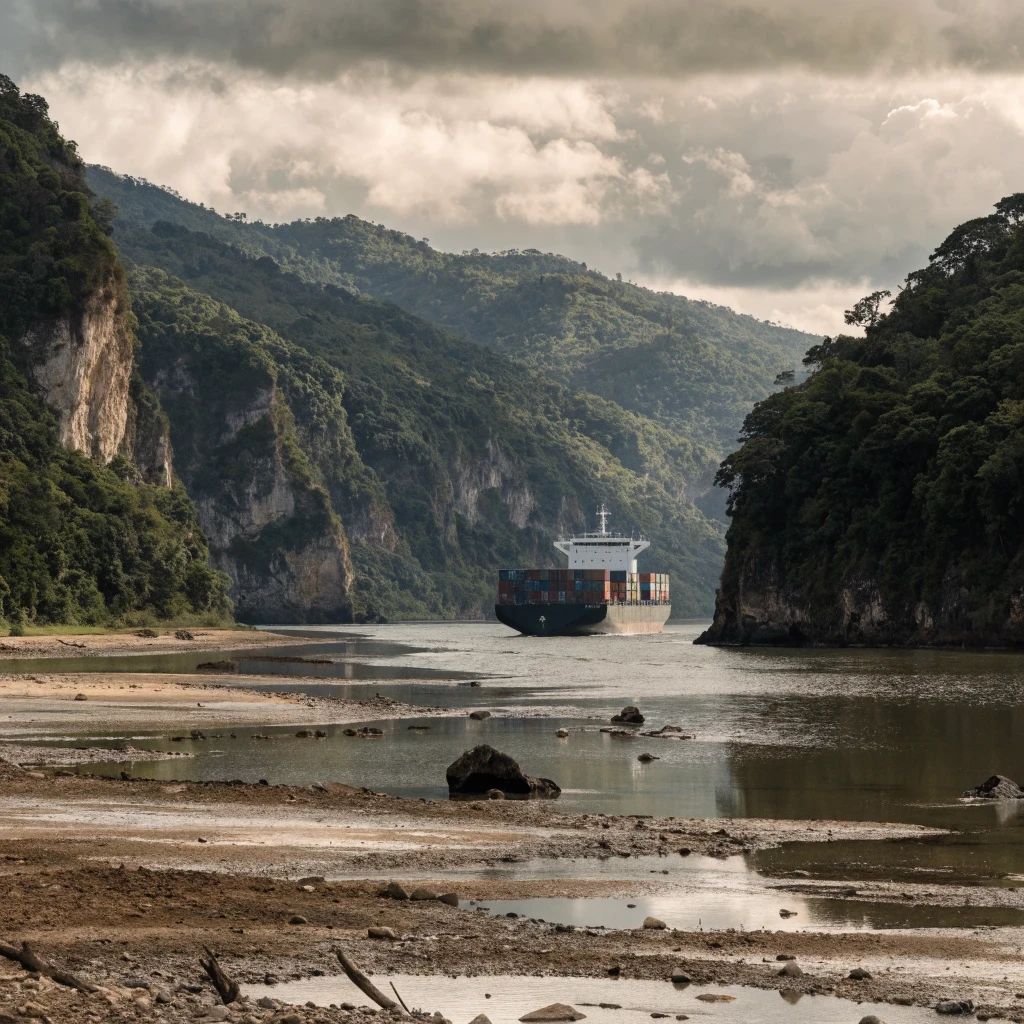
The world's maritime arteries are seizing up, and the symptoms are impossible to ignore. A single vessel now pays up to $4 million merely to skip the queue at the Panama Canal, a figure that would have been dismissed as absurd fantasy just two years ago.
This is not an isolated logistical hiccup; it is the visible symptom of a systemic breakdown where climate chaos and geopolitical warfare have converged to strangle the most critical trade routes on Earth.
What we are witnessing is a rare and dangerous confluence. On one side, El Niño has drained the reservoirs that feed the Panama Canal, forcing authorities to slash daily transits and auction off scarce passage slots to the highest bidder.
On This Page
On the other, Houthi attacks in the Red Sea have turned the Suez Canal into a war zone, compelling carriers to reroute around the Cape of Good Hope. The result is a compounding crisis that is rewriting the economics of global shipping and threatening to reignite inflation across every major economy.
This analysis dissects the mechanics of this perfect storm, examining how environmental degradation and geopolitical instability are not separate problems but intertwined forces reshaping maritime commerce. We will explore the financial carnage, the strategic responses of shipping giants, and the brutal reality that these choke points are becoming permanent vulnerabilities rather than temporary disruptions.
TL;DR The global shipping industry is facing a dual-pronged crisis as El Niño-induced drought cripples the Panama Canal and Middle East conflicts render the Suez route perilous. Transit fees have skyrocketed to $4 million for queue-jumping, freight costs are surging, and supply chains are fragmenting. This convergence of climate and conflict is not a temporary blip but a structural shift that demands urgent strategic adaptation from governments, corporations, and investors alike.
The Hydrological Collapse: How El Niño Broke the Panama Canal
The Panama Canal is not merely a ditch; it is a massive hydraulic machine that depends on fresh water to lift ships over the continental divide. Every transit consumes approximately 50 million gallons of freshwater from Gatun Lake, a reservoir that has been pushed to historic lows by the most severe drought in over a century.
El Niño has fundamentally altered precipitation patterns across Central America, delivering punishing heat and minimal rainfall to the canal's catchment area. The result is a stark operational reality: the canal authority has been forced to reduce daily crossings from a pre-crisis average of 36 vessels to barely 22, with further cuts looming if conditions do not improve.
The Auction of Desperation
When supply collapses and demand remains stubbornly high, prices do not merely rise; they explode. The Panama Canal Authority has responded to the capacity crunch by implementing a booking system that allows carriers to pay premiums for guaranteed passage, effectively creating a secondary market for transit slots.
In recent weeks, this market has gone haywire. A single auction for a slot to jump the queue fetched an astonishing $4 million, a figure that dwarfs the standard transit toll of roughly $400,000 for a large container ship. This is not a rational pricing mechanism; it is the economics of desperation.
Carriers are absorbing these costs because the alternative is worse. Waiting for weeks outside the canal means burning fuel, missing delivery windows, and breaching contracts with retailers who demand just-in-time inventory. The queue-jumping fee, however exorbitant, is often cheaper than the cascading penalties of delay.
The financial burden does not stop at the canal gates. These surcharges are being passed directly to importers and exporters, who in turn pass them to consumers. Every product that transits the Panama Canal—from Asian electronics to South American agricultural goods—now carries an invisible tax that will eventually appear on retail shelves.
Water Scarcity as a Permanent Constraint
The uncomfortable truth is that this is not a one-off weather event but a structural shift in the region's hydrology. Climate models consistently project that Central America will become drier and more volatile, meaning the canal's water problem is likely to worsen before it improves.
The canal authority has explored ambitious solutions, including building new reservoirs and even pumping water from other river basins. However, these projects are years away from completion and face significant environmental and political opposition. In the interim, the canal operates as a rationed resource, and rationing breeds inefficiency and cost.
This water crisis has also exposed the canal's strategic fragility. A nation's economic lifeline should not depend on a single reservoir that can be depleted by a single season of poor rainfall. Yet that is precisely the situation Panama faces, and by extension, so does the entire global trading system.
Shipping lines are already adapting by shifting cargo to transpacific routes or using West Coast ports in the United States. However, these alternatives have their own capacity constraints and cannot absorb the full volume that the canal traditionally handles. The system is stretched, and every adjustment creates new bottlenecks elsewhere.
The Ripple Effect on Global Freight Rates
The Panama Canal crisis is not occurring in isolation; it is amplifying cost pressures across the entire maritime freight market. The Baltic Dry Index and container freight rate benchmarks have both surged as capacity tightens and carriers exercise pricing power.
Analysts estimate that the combined effect of canal restrictions and rerouting has removed roughly 5% of global container shipping capacity from effective service. In an industry that operates on razor-thin margins, such a reduction is seismic, immediately translating into higher spot rates and longer contract negotiations.
The impact is particularly acute for routes between Asia and the US East Coast, which rely heavily on the Panama Canal. Shippers are now facing transit times that are 10 to 15 days longer, forcing them to carry more inventory to hedge against delays. This inventory build-up ties up working capital and increases warehousing costs.
For consumers, the message is grim: the era of cheap, frictionless global trade is over. The cost of moving goods has structurally increased, and those costs will be embedded in prices for years to come. This is not a temporary spike but a new baseline.
We Also Published
The Geopolitical Storm: Red Sea Conflict and the Suez Alternative
While the Panama Canal suffers from a lack of water, the Suez Canal suffers from a surfeit of violence. The Red Sea, which serves as the approach to this vital waterway, has become a battleground where Houthi militants, backed by Iran, are attacking commercial shipping with drones and missiles.
The attacks are not random acts of piracy; they are deliberate acts of geopolitical warfare designed to pressure Israel and its allies. By targeting vessels in the Bab el-Mandeb strait, the Houthis have effectively closed the shortest maritime route between Asia and Europe, forcing carriers to make a brutal choice between danger and distance.
The Cape of Good Hope Detour
The alternative to the Red Sea is the Cape of Good Hope, the historic route around the southern tip of Africa. This detour adds approximately 3,500 nautical miles and 10 to 14 days to a typical Asia-Europe voyage, consuming significantly more fuel and crew time.
Major carriers, including Maersk, MSC, and Hapag-Lloyd, have suspended Red Sea transits and rerouted their fleets around Africa. This is a rational safety decision, but it is also an economic one with profound consequences. The extra fuel alone adds hundreds of thousands of dollars to each voyage.
The rerouting has also created a cascading effect on port schedules and container availability. Vessels arriving late disrupt the delicate choreography of port operations, causing congestion at major hubs like Rotterdam and Singapore. Empty containers are piling up in the wrong places, creating shortages in export hubs.
The insurance industry has responded by dramatically increasing war-risk premiums for vessels entering the Red Sea. Some underwriters have refused to cover the route entirely, effectively blacklisting it for all but the most desperate or reckless operators. The risk premium has become a de facto toll that rivals the Panama Canal's auction fees.
The Fragility of Maritime Choke Points
The simultaneous crises at Panama and Suez expose a fundamental vulnerability in the global trading system: its dependence on a handful of narrow, easily disrupted choke points. The Strait of Hormuz, the Strait of Malacca, and the Turkish Straits join these two canals as critical arteries where a single disruption can paralyze world commerce.
This concentration of risk is a strategic liability that has been ignored for decades. The just-in-time revolution in manufacturing assumed that these routes would remain open and predictable. That assumption has now been shattered, and the consequences are rippling through every sector of the economy.
Military analysts have long warned that these choke points are the Achilles' heel of globalization. A determined adversary does not need to sink a navy to cripple an economy; it merely needs to threaten the shipping lanes that carry 90% of world trade. The Houthis have demonstrated this lesson with devastating effectiveness.
The response from major powers has been tepid and reactive. The US and UK have launched limited airstrikes against Houthi positions, but these have not deterred the attacks. A more robust naval escort operation would require resources that are already stretched thin by other commitments.
The Inflationary Feedback Loop
The shipping crisis is not merely a logistical problem; it is an inflationary engine that threatens to undo the progress central banks have made in taming price growth. Freight costs are a leading indicator of consumer prices, and the current surge will inevitably feed through to the inflation data.
Economists estimate that a sustained doubling of freight rates adds roughly 0.5 to 1 percentage point to core inflation over a 12-month period. Given that central banks are fighting to bring inflation down to 2% targets, this is a significant headwind that cannot be ignored.
The timing could not be worse. Just as supply chains were recovering from the pandemic-era disruptions, this new shock has hit. Businesses that had finally rebuilt their inventories are now facing a new round of cost increases and delivery delays, forcing them to make difficult pricing decisions.
Consumers, already weary from years of price increases, are showing signs of resistance. Retailers are finding it harder to pass on cost increases without losing market share to discounters. This tension between cost-push inflation and demand weakness is creating a volatile economic environment.
Strategic Responses: How the Industry Is Adapting to a Broken System
The shipping industry is not passive in the face of these crises; it is adapting with a mix of innovation, pragmatism, and, in some cases, profiteering. The responses range from operational tweaks to fundamental strategic shifts that will reshape the industry for years to come.
Carriers are diversifying their route portfolios, investing in alternative ports, and renegotiating contracts with shippers to include more flexible terms. The era of fixed, long-term contracts at stable prices is giving way to a more dynamic and volatile pricing environment.
Nearshoring and Supply Chain Redundancy
The most significant strategic response is the acceleration of nearshoring, the practice of moving production closer to end markets to reduce dependence on long, fragile supply chains. Companies that once sourced exclusively from Asia are now building factories in Mexico, Eastern Europe, and Southeast Asia.
This shift is not without costs. Nearshoring often means higher labor costs and less mature supplier ecosystems. However, when the alternative is a $4 million canal fee or a 14-day detour around Africa, these costs begin to look like prudent insurance rather than unnecessary expense.
The trend is particularly pronounced in industries with high value-to-weight ratios, such as electronics and pharmaceuticals, where the cost of delay far exceeds the cost of production. For bulk commodities like grain and coal, the calculus is different, and these goods remain exposed to the vagaries of maritime transport.
Governments are also getting involved, offering subsidies and tax incentives to encourage domestic production and reduce strategic dependence on foreign suppliers. The pandemic and the current shipping crisis have combined to create a political consensus that self-sufficiency is a national security imperative.
Investment in Alternative Infrastructure
The crisis has also spurred investment in alternative infrastructure, including rail corridors, pipelines, and overland trucking routes. The China-Europe rail network, which was once dismissed as a niche curiosity, is now being expanded to carry a larger share of high-value cargo.
Similarly, the US is investing heavily in its port infrastructure, including the expansion of West Coast facilities and the modernization of inland distribution networks. These investments are designed to provide alternatives to the Panama Canal and to handle the increased volume from transpacific trade.
However, these alternatives have their own limitations. Rail and trucking cannot match the scale and cost-efficiency of ocean shipping for most goods. They are complements, not substitutes, and they cannot fully replace the capacity that the canals provide.
The most ambitious proposals involve entirely new canals, such as a Nicaragua canal or a land bridge across the Isthmus of Tehuantepec in Mexico. These projects have been discussed for decades but have consistently failed to attract the necessary financing and political will. The current crisis may finally change that calculus.
The New Economics of Maritime Trade
The fundamental lesson of this crisis is that the economics of maritime trade have changed permanently. The assumption of cheap, reliable, and predictable shipping, which underpinned globalization for three decades, is no longer valid.
Shippers must now build resilience into their supply chains, which means accepting higher costs as the price of security. This is a profound shift that will affect everything from product pricing to corporate strategy to international relations.
For investors, the implications are clear: companies that can navigate this new environment will thrive, while those that cling to outdated models will struggle. Shipping lines with diversified fleets and flexible routing capabilities are well-positioned; retailers with lean inventory models are exposed.
The crisis also presents opportunities for those willing to adapt. Ports that can offer reliable, efficient service will capture market share from congested rivals. Logistics providers that can offer visibility and flexibility will win contracts from desperate shippers. The chaos is not uniform; it is a redistribution of risk and reward.
The Role of Speculation and Market Distortion
The crisis has also attracted speculators who are betting on continued volatility in freight rates. The shipping derivatives market, which allows investors to bet on future freight costs, has seen a surge in trading volume as hedge funds and institutional investors pile in.
This speculation can amplify price movements, creating a feedback loop where rising rates attract more speculative capital, which in turn drives rates higher. While derivatives provide a valuable hedging tool for legitimate shippers, the speculative element adds an unpredictable layer to an already volatile market.
Regulators are watching this development with concern, fearing that excessive speculation could destabilize the market and harm the real economy. However, the global nature of shipping makes regulation difficult, and attempts to curb speculation have historically been ineffective.
The fundamental driver of high freight rates remains the physical shortage of capacity, not speculation. As long as the canals remain constrained and the Red Sea remains dangerous, rates will stay elevated regardless of what happens in the derivatives market.
- 01
- 02
- 03
- 04
Government Intervention and Policy Responses
Governments are not standing idle as the shipping crisis unfolds. The United States has invoked the Defense Production Act to prioritize the movement of critical goods, while the European Union is considering similar measures to protect its strategic industries.
These interventions are a double-edged sword. While they can provide short-term relief, they also distort market signals and can lead to inefficient allocation of resources. The challenge for policymakers is to provide support without creating long-term dependency.
There is also growing pressure on the International Maritime Organization to establish new rules for routing and safety in conflict zones. However, the IMO's consensus-based decision-making process is slow, and any new regulations are unlikely to take effect before the current crisis resolves.
The most effective policy response would be a coordinated international effort to secure the Red Sea and to invest in climate resilience for the Panama Canal. Such an effort would require unprecedented cooperation between rival powers, which, given the current geopolitical climate, seems unlikely.
The Long-Term Outlook: A New Era of Maritime Fragility
The current crisis will eventually ease, but the conditions that created it will not disappear. Climate change will continue to stress the Panama Canal, and geopolitical tensions in the Middle East show no signs of abating. The shipping industry must learn to operate in a world of permanent fragility.
This new reality demands a fundamental rethink of how goods are produced, transported, and consumed. The era of maximizing efficiency at the expense of resilience is over. Companies that survive will be those that build redundancy into their operations and accept higher costs as the price of stability.
The Investment Case for Resilience
For investors, the shipping crisis presents both risks and opportunities. Companies that own diversified logistics assets, such as ports, warehouses, and rail networks, are well-positioned to benefit from the shift toward resilience. Conversely, companies with concentrated supply chains face significant downside risk.
The crisis has also accelerated the adoption of digital technologies that improve supply chain visibility. Artificial intelligence and blockchain are being deployed to track shipments in real time, predict disruptions, and optimize routing decisions. These technologies are no longer optional; they are essential tools for survival.
There is also a growing market for climate-resilient infrastructure. Investors are pouring money into projects that protect ports from sea-level rise, upgrade canals to withstand drought, and develop alternative energy sources for shipping. These investments offer attractive returns while addressing critical vulnerabilities.
The bottom line is that the shipping crisis is not a temporary aberration but a preview of the future. The world is entering an era of chronic disruption, and those who adapt will prosper while those who resist will be left behind.
Geopolitical Implications and the New World Order
The shipping crisis is also reshaping the geopolitical landscape. Countries that control critical choke points are gaining leverage over those that depend on them. This is creating new alliances and rivalries as nations jockey for position in the emerging order.
China's Belt and Road Initiative, which includes investments in ports and rail links across Asia, Africa, and Europe, is taking on new significance as a hedge against maritime disruption. Similarly, Russia's Arctic shipping routes are being developed as an alternative to the Suez Canal, though they remain ice-bound for much of the year.
The United States is responding by strengthening its alliances with India, Japan, and Australia through the Quad framework, which includes a focus on maritime security. The goal is to ensure that the Indo-Pacific shipping lanes remain open and free, even in the face of Chinese assertiveness.
These geopolitical maneuvers are not abstract power plays; they have direct consequences for the cost and availability of goods. Every new alliance, every infrastructure investment, and every military deployment affects the flow of trade and the prices consumers pay.
Preparing for the Next Shock
The most important lesson from this crisis is that the next shock is always coming. Whether it is a new drought, a new conflict, or a new pandemic, the global shipping system will face repeated tests in the coming years. The question is whether we will be prepared.
Preparation requires investment in redundancy, flexibility, and intelligence. It requires governments to prioritize supply chain security in their policy decisions and businesses to build resilience into their core strategies. It requires a recognition that the cheap, frictionless trade of the past was an anomaly, not the norm.
For consumers, the message is sobering: prices will be higher, choices will be more limited, and delivery times will be longer. The era of instant gratification, enabled by invisible supply chains, is coming to an end. We must adapt to a world where the cost of convenience is finally visible.
The perfect storm of El Niño and geopolitical conflict has exposed the fragility of our global trading system. It is a warning that we ignore at our peril. The choices we make now will determine whether the next shock is a manageable disruption or a catastrophic collapse.
From our network :
- The Hidden Cost of AI Convenience: Why Over-Permissioned Agents Are a Security Time BombDiscover why AI agents with excessive permissions create dangerous single points of failure, and learn how implementing least privilege principles can protect your organization from exploitation.
- Norbert’s Uncertain Path: Why Hawaii’s Storm Watch Demands Patience Over PanicTropical Storm Norbert strengthens in the Eastern Pacific with winds near 50 mph, forecast to reach Category 1 hurricane status by Friday. Long-range models disagree sharply on whether Hawaii faces any threat around September 19–23, making official guidance essential.
- The Final Descent: How ESA Retired the Legendary Cluster Constellation After 24 Years of Space Weather ScienceAfter 24 years mapping Earth’s magnetosphere, ESA’s Cluster mission concluded with a precisely controlled reentry over the South Pacific. This analysis explores the scientific legacy, engineering decisions, and debris mitigation principles behind one of space exploration’s most responsible retirements.
- Analyzing Hoya Corporation’s Midday Volume Shifts and Financial FundamentalsExamine Hoya Corporation’s midday trading volume contraction, technical moving averages, robust solvency ratios, and stellar quarterly earnings performance.
- How AI Agents Will Change the Way We Manage Personal FinancesExplore how AI agents are transforming personal finance through automated budgeting, bill payment, and investment management, while examining the critical security protocols and governance frameworks required for safe deployment.
- CISA’s Ten-Advisory Wave: Why Generic Patching Fails in OT and How to Build Product-Specific PlaybooksCISA released ten ICS advisories in one week, exposing critical infrastructure risks. Generic patching fails in OT. Learn to build product-specific remediation playbooks.
- Committed Mediterranean Precipitation Decline: Why Emissions Cuts Alone Cannot Restore Winter RainsNew NOAA research reveals that Mediterranean winter rains may decline irreversibly even with emissions cuts. Explore the science of committed climate change and regional impacts.
- Former Soap Stars Embark on Ambitious Writing Projects and Theatrical StagesDiscover how former soap opera actors are transitioning into independent scriptwriting and high-profile theatrical stage productions.
- Forbidden Matrix Patterns and Visible Lattice Points: A Geometric DictionaryExplore how multidimensional 0–1 matrices encode geometric truths, linking forbidden patterns to visible lattice points and hypergraph theory, with applications in combinatorics and computational geometry.
RESOURCES
- Panama canal fees soar due to Iran war and El Niño as ship 'pays ...theguardian.com4 days ago ... Commercial ships travelling through the Panama canal are facing a rise in costs amid disruption triggered by the Iran war…
- El Niño threatens a new wave of disruption across global container ...mykn.kuehne-nagel.comJun 18, 2026 ... Panama Canal risk moves back into focus. For container shipping, the biggest concern remains the Panama Canal. El Niño has…
- Drought behind Panama Canal's 2023 shipping disruption 'unlikely ...carbonbrief.orgMay 1, 2024 ... A lengthy drought affecting the Panama Canal in 2023 would have been “unlikely” without the influence of El Niño, attribution…
- Drought, Climate, and the Panama Canalwoodwellclimate.orgFeb 20, 2024 ... Drought, driven by a combination of El Niño and climate change, has disrupted shipping through the Panama Canal in recent…
- What a Possible 2026/27 Super El Niño Means for Commodity Marketsexpanamarkets.comMay 21, 2026 ... Despite the upcoming El Niño, the Panama Canal ... El Niño contributed to low water levels and shipping disruptions along…
- Panama Canal fees hit record high as El Niño and Iran war choke ...ft.com5 days ago ... Falling water levels caused by weather phenomenon could limit transit slots through crucial maritime passageway.
- Panama Canal sees El Nino slowing transits next year - Argus Mediaargusmedia.comJun 4, 2026 ... The Panama Canal Authority (ACP) does not anticipate the expected 2026 El Nino weather phenomenon to materially impact vessel transits…
- Panama Canal reduces maximum draught as El Niño concerns mountseatrade-maritime.comJun 7, 2026 ... In the latest potential disruption to supply chains the draught for neo-Panamax vessels is being cut from 1 July.
- El Nino Watch Puts Panama Canal Back In Focus | gCaptaingcaptain.comApr 9, 2026 ... El Nino Watch Puts Panama Canal Back In Focus. Panama Canal traffic, water levels, transit fees, and their impact on…
- Record El Niño Threatens Fragile Economies Squeezed by Warbloomberg.comAug 4, 2026 ... An El Niño-fueled drought ran into shipping disruptions sparked by ... prices low during the last El Niño in 2023.…
- Panama Canal Near Capacity as Hormuz Crisis Drives Surge in ...gcaptain.comMay 21, 2026 ... After severe El Niño-driven drought conditions in 2023–2024 forced the Panama ... If delays and costs continue rising, some ship…
- Panama Canal fees hit record high as El Niño and Iran war choke ...facebook.com5 days ago ... ... 2026- despite-drought-threat #Shipping #PanamaCanal ... shipping is severely disrupted by Houthi attacks on ships heading to the Suez Canal.
- With the Strait of Hormuz closed, the Panama Canal is busier than ...atlanticcouncil.orgMay 21, 2026 ... Amid the disruption, shipping companies have diverted their ... In 2023 and 2024, an El Niño plunged Panama into severe…
- Low water levels in Panama Canal due to increasing demand ...worldweatherattribution.orgMay 1, 2024 ... Low water levels in Panama Canal due to increasing demand exacerbated by El Niño event ... disruptions to global shipping…
- Eleven lessons in risk governance from the Panama Canal - UNDRRundrr.orgJun 23, 2026 ... The 1997-98 El Niño, the droughts of 2009 and 2024, the 2020-2022 ... disruptions on the world's other shipping routes…
- 01
- 02
- 03
- 04
- 05
- 06
- 07
- 08
0 Comments