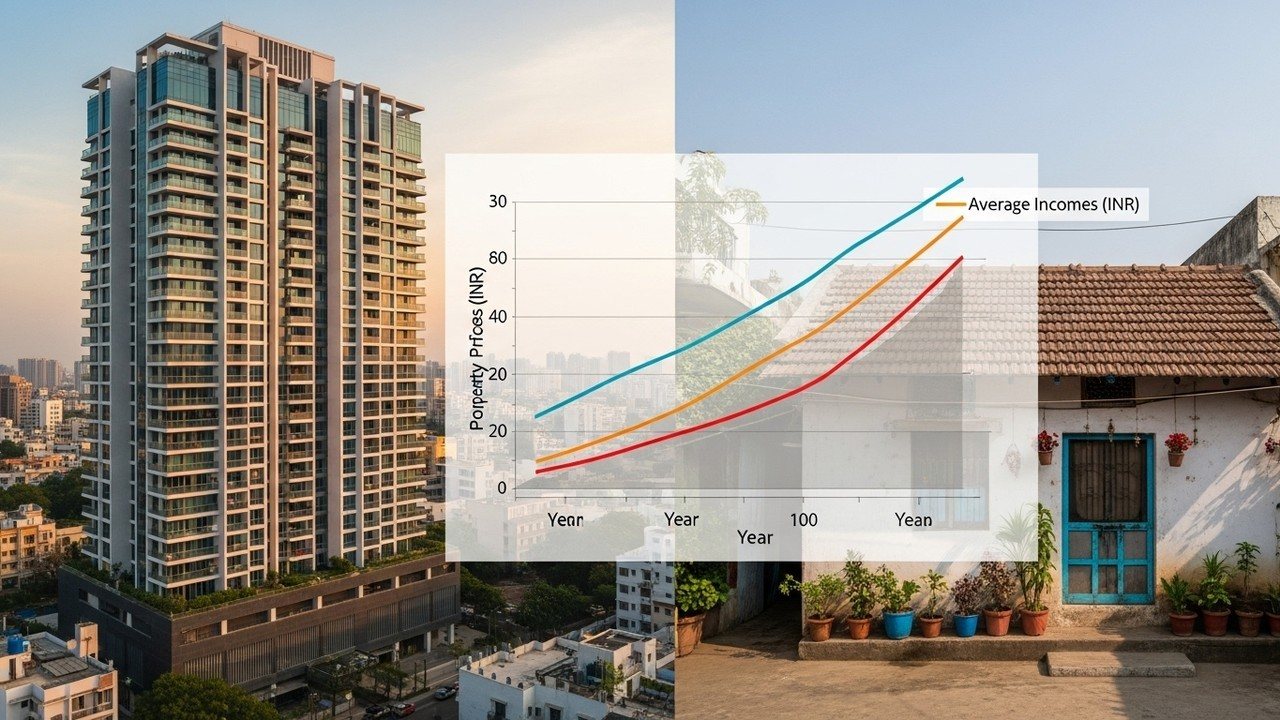
The dream of owning a home, once a cornerstone of the Indian middle-class aspiration, is rapidly fading for a significant portion of the population. Recent analyses indicate that a staggering 59% of Indians have relinquished their hope of purchasing a property. This widespread disillusionment stems from a stark imbalance: property prices have surged at an unprecedented rate, far outpacing the modest increments in average incomes. This widening chasm has inadvertently fostered an environment where speculative investment thrives, disproportionately benefiting those who profit from market volatility, while the aspirations of the average Indian remain perpetually out of reach.
The current trajectory of the Indian real estate market is increasingly being shaped by speculative activities, creating an environment that favors quick financial gains over genuine housing needs. This speculative frenzy is not merely a byproduct of market forces; it often appears to be intertwined with systemic issues, including the circulation of black money. When individuals or entities can leverage untaxed wealth to acquire properties, they artificially inflate prices. This practice effectively pushes genuine buyers, particularly those from the middle class who rely on legitimate income and formal financing, out of the market. The result is a skewed landscape where property ownership becomes less about providing shelter and more about accumulating wealth through rapid appreciation, often fueled by illicit financial flows.
Why Most Indians Are Giving Up on Homeownership: The Inequality Game
The dream of owning a home, once a cornerstone of the Indian middle-class aspiration, is rapidly fading for a significant portion of the population. Recent analyses indicate that a staggering 59% of Indians have relinquished their hope of purchasing a property. This widespread disillusionment stems from a stark imbalance: property prices have surged at an unprecedented rate, far outpacing the modest increments in average incomes. This widening chasm has inadvertently fostered an environment where speculative investment thrives, disproportionately benefiting those who profit from market volatility, while the aspirations of the average Indian remain perpetually out of reach.
The Unseen Hand: How Speculation Fuels Property Market Inequality
The current trajectory of the Indian real estate market is increasingly being shaped by speculative activities, creating an environment that favors quick financial gains over genuine housing needs. This speculative frenzy is not merely a byproduct of market forces; it often appears to be intertwined with systemic issues, including the circulation of black money. When individuals or entities can leverage untaxed wealth to acquire properties, they artificially inflate prices. This practice effectively pushes genuine buyers, particularly those from the middle class who rely on legitimate income and formal financing, out of the market. The result is a skewed landscape where property ownership becomes less about providing shelter and more about accumulating wealth through rapid appreciation, often fueled by illicit financial flows.
The Middle Class Squeeze: A Growing Economic Divide
The disparity between property price escalation and income growth is creating an unsustainable economic divide. For the average Indian, whose earnings increase incrementally year after year, keeping pace with the exponential rise in real estate values has become an insurmountable challenge. This situation forces many to either abandon their homeownership dreams altogether or take on crippling debt. The former leads to a sense of disenfranchisement and a feeling that the economic system is rigged against them. The latter can trap individuals in a cycle of debt, where a significant portion of their income is dedicated to mortgage payments, leaving little for other essential needs or future investments. This creates a two-tiered system, where those with existing wealth or access to speculative capital can continue to acquire assets, while the majority struggle to achieve basic financial security through homeownership.
- 01
- 02
- 03
- 04
Navigating the Real Estate Maze: Expert Insights and Future Outlook
Understanding the complex dynamics of the Indian property market requires a nuanced perspective. Experts suggest that a multi-pronged approach is necessary to address the growing inequality. This includes implementing stricter regulations to curb speculative practices, promoting greater transparency in property transactions, and enacting policies that encourage affordable housing development. Furthermore, fostering a more equitable income growth trajectory is crucial. Without addressing the root causes of this imbalance, the dream of owning a home will continue to elude millions of Indians, exacerbating social and economic disparities.
Key Takeaways: Reclaiming the Dream of Homeownership
The current state of the Indian real estate market presents a significant challenge to the aspirations of the common person. With nearly 59% of Indians reportedly giving up on buying a home, the issue is not just about affordability but also about the systemic inequalities that favor speculation over stable, long-term investment. Addressing this requires a concerted effort from policymakers, industry stakeholders, and the public to create a more balanced and inclusive property market. Only then can the dream of owning a home be restored as an attainable goal for all Indians, rather than a privilege for the few.
|
Aspect |
Details |
|
Percentage of Indians giving up homeownership |
59% |
|
Primary Reason for Disillusionment |
Rapid property price increase vs. modest income growth |
|
Consequence of Price-Income Imbalance |
Fosters speculative investment, benefits the wealthy |
|
Impact on Middle Class |
Aspirations out of reach, potential debt burden |
|
Underlying Systemic Issues |
Potential link to black money circulation and market manipulation |
|
Expert Recommendations |
Stricter regulations, transparency, affordable housing initiatives, equitable income growth |
From our network :
- Optimizing SQL Server Date Queries for Performance: A Comprehensive Guide
- How to Recover Your Gmail Account Without Phone Number or Backup Email
- Artificial Intelligence: Revolutionizing the World
- Exploring “Man on the Moon”: Apollo Missions Detailed
- Understanding Sequences and Limits: A Comprehensive Guide
- Russia’s Mars Mission: A Leading Engineer’s Vision and Technological Advancements
- 01
- 02
- 03
- 04
- 05
- 06
- 07
- 08
0 Comments