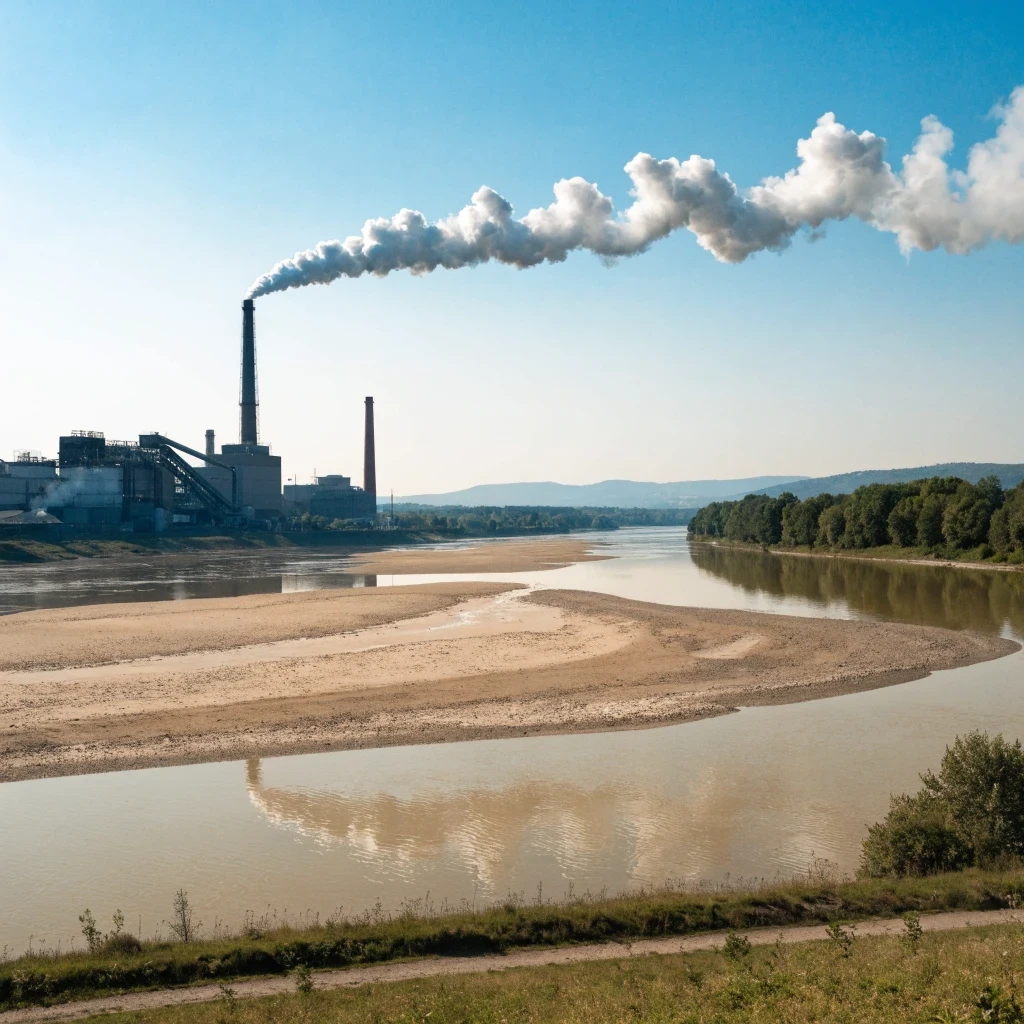
Europe has long treated its great rivers as silent industrial workhorses, carrying cargo, cooling reactors, and spinning turbines with dependable regularity. That assumption shattered last week when critically low water levels on the Danube forced a major Hungarian power plant into emergency conservation mode, exposing a fragility that policymakers have stubbornly ignored.
The crisis is not merely a shipping inconvenience; it is a direct strike on the continent's energy architecture, and the reverberations will be felt far beyond Budapest.
The Danube's decline is a stark reminder that climate change no longer operates in the abstract realm of melting glaciers and rising seas. It is here, now, throttling the mechanical heart of European industry with a precision that no sanctions package or trade war could replicate.
On This Page
When a river that powers nations becomes a trickle, the entire edifice of modern energy security begins to wobble, and Hungary is simply the first domino to fall.
This analysis dissects the Danube crisis as a systemic warning, tracing its roots through hydrological data, energy market mechanics, and the broader geopolitical chessboard. The evidence points to a sobering conclusion: Europe's climate-energy vulnerabilities are widening faster than its infrastructure can adapt, and the Rhine's troubles were merely a prelude to a continental symphony of disruption.
TL;DR The Danube's record-low water levels have forced Hungary's largest power plant into emergency conservation mode, revealing a systemic fragility in Europe's climate-energy nexus. This crisis transcends navigation disruptions, directly threatening power generation, industrial supply chains, and regional energy security. As hydrological extremes become the new normal, Europe's aging infrastructure and fragmented policy responses leave the continent dangerously exposed to climate-driven energy shocks that demand urgent, coordinated adaptation.
The Hydrological Emergency: How a Drying Danube Cripples Power Generation
Hungary's energy grid has been thrust into an unenviable position, forced to ration output while the Danube recedes to levels that defy historical records. The Paks Nuclear Power Plant, the nation's energy cornerstone, relies on the river's flow for critical cooling systems, and the dwindling water supply has triggered emergency protocols that reduce operational capacity. This is not a hypothetical scenario from a climate modeling exercise; it is a live operational crisis unfolding in real time.
The mechanics of this vulnerability are brutally simple yet devastatingly effective. Thermal power plants, whether nuclear or fossil-fueled, require vast quantities of water for cooling, and when river levels drop below intake thresholds, generation must be curtailed or halted entirely.
Hungary's predicament illustrates a broader European reality: the continent's energy infrastructure was designed for a hydrological regime that no longer exists, and the mismatch is becoming catastrophic.
The Paks Nuclear Plant: A Case Study in Climate Vulnerability
The Paks facility, responsible for roughly half of Hungary's electricity generation, has become the unwitting poster child for climate-infrastructure mismatch. Its cooling water intake, engineered decades ago under assumptions of reliable river flow, now faces periodic starvation as the Danube's volume fluctuates wildly. Each emergency conservation event forces grid operators to scramble for replacement capacity, often at exorbitant cost and with significant carbon penalties.
Nuclear power was supposed to be the bulwark of European energy independence, a zero-carbon workhorse immune to the vagaries of weather. Yet the Danube crisis reveals that even nuclear plants are hostage to hydrological cycles, and the cooling water paradox undermines the technology's reliability credentials. When a reactor must throttle down because its river is too shallow, the entire concept of baseload power begins to fracture.
The economic implications are staggering, as emergency power purchases and grid stabilization measures carry premium price tags that ultimately land on consumer bills. Hungarian households and businesses are already feeling the pinch, and the pattern threatens to repeat across the continent as other plants face similar constraints. The cost of climate adaptation is no longer a distant budgetary line item; it is an immediate operational expense.
Engineers at Paks are exploring mitigation strategies, from deeper intake pipes to recirculation systems, but these retrofits are expensive and time-consuming. The fundamental problem remains: a power plant designed for a stable river is now operating in a volatile hydrological environment, and no amount of band-aid engineering can fully compensate. The plant's future reliability is now contingent on climate outcomes, not just maintenance schedules.
Beyond Nuclear: The Wider Thermal Fleet Under Siege
Hungary's crisis extends far beyond Paks, as coal and gas-fired plants along the Danube face identical cooling water constraints. The entire thermal generation fleet is exposed to the same hydrological vulnerability, creating a systemic risk that grid operators cannot easily hedge against. When multiple plants compete for dwindling river water, the energy system enters a zero-sum game with no winners.
The Danube's low water levels also impair fuel supply chains, as coal barges and fuel transports struggle to navigate shallow channels. This dual pressure—reduced generation capacity and constrained fuel delivery—creates a compounding crisis that amplifies the initial shock. The river, once a reliable logistics artery, has become a bottleneck that chokes the entire energy ecosystem.
European energy planners have long focused on supply diversification, but the Danube crisis exposes a blind spot: the physical infrastructure that converts fuel into electricity is itself climate-vulnerable. A diversified fuel portfolio means little if the plants burning those fuels cannot operate due to water scarcity. The continent's energy strategy must now incorporate hydrological resilience as a core design principle, not an afterthought.
The industrial consumers along the Danube, from chemical plants to steel mills, are equally exposed to the cascading effects of power curtailments. Production halts, reduced output, and supply chain disruptions ripple through the regional economy, undermining competitiveness and eroding the industrial base. The crisis is not merely an energy story; it is an economic story with profound implications for European manufacturing.
Historical Context: The Rhine Crisis as a Harbinger
The Danube's troubles echo the Rhine's dramatic low-water events of 2018 and 2022, when German industrial output suffered billions in losses due to shipping disruptions. Those episodes were widely reported but largely treated as exceptional anomalies, prompting only modest policy adjustments. The recurrence of similar conditions on the Danube suggests that these are not anomalies but the emerging baseline of a warming continent.
Germany's experience with the Rhine offers a cautionary template for Hungary and its neighbors, demonstrating that hydrological crises can inflict severe economic damage with remarkable speed. The 2018 Rhine low-water event alone cost German industry an estimated 5 billion euros, and the 2022 recurrence confirmed that the problem was not a one-off. Europe's rivers are becoming unreliable partners in the continent's economic enterprise.
The comparison between Rhine and Danube reveals a pattern of systemic neglect, as policymakers have consistently underinvested in waterway infrastructure and climate adaptation measures. Dredging programs, reservoir construction, and alternative cooling technologies have all been discussed, but implementation has lagged far behind the pace of environmental change. The gap between rhetoric and action is widening with each passing drought.
Hydrological data from both river basins shows a clear downward trend in summer flows, with climate models projecting further declines under all but the most optimistic emissions scenarios. The scientific consensus is unambiguous: Europe's rivers will continue to shrink, and the energy systems dependent on them will face increasing stress. The only question is whether adaptation efforts will accelerate before the next crisis strikes.
We Also Published
The Geopolitical Ripple: Energy Security and Regional Power Dynamics
Hungary's Danube crisis is not contained within its borders; it reverberates through the intricate web of European energy interdependence and geopolitical maneuvering. The country's reliance on Russian gas imports, already a contentious issue in Brussels, becomes even more fraught when domestic generation falters. Every megawatt of lost nuclear capacity must be replaced, and the replacement options carry their own geopolitical baggage.
The crisis also exposes the uneven distribution of climate resilience across Europe, with wealthier nations better positioned to invest in adaptation while Eastern European states struggle with limited fiscal space. This divergence threatens to create a two-speed Europe in climate adaptation, where the most vulnerable nations become even more exposed to energy shocks. The solidarity mechanisms that underpin the European Union are being tested by climate-driven stress.
Energy Dependence and the Russian Question
Hungary's energy predicament intersects dangerously with its controversial relationship with Russian energy supplies, as the Danube crisis increases the country's short-term need for imported gas. Prime Minister Viktor Orbán's government has long resisted EU efforts to reduce Russian energy dependence, and the current crisis provides ammunition for both sides of that argument. The geopolitical stakes are rising alongside the river's falling levels.
The European Union's broader energy security strategy, which emphasizes diversification away from Russian supplies, is now colliding with the physical realities of climate-induced generation shortfalls. Countries facing immediate power deficits may be forced to accept whatever energy is available, regardless of its geopolitical provenance. The climate crisis is inadvertently strengthening the hand of energy exporters who have been targeted by sanctions.
Regional cooperation on energy sharing is being tested as neighboring countries assess their own hydrological vulnerabilities and capacity margins. The Danube crisis could either catalyze greater integration and mutual assistance or trigger a retreat into national energy autarky. The choice will shape European energy politics for decades, and the current trajectory is not encouraging.
The strategic implications extend to NATO and European defense planning, as energy infrastructure vulnerabilities become potential targets in hybrid warfare scenarios. A river that can be weaponized by climate change is also a river that can be exploited by adversaries seeking to destabilize member states. The security establishment is beginning to recognize that hydrological resilience is a defense priority, not just an environmental concern.
Economic Fallout: Supply Chains and Industrial Competitiveness
The Danube serves as a critical transportation corridor for Central European trade, and its low water levels are disrupting supply chains that extend far beyond Hungary's borders. Agricultural exports, manufactured goods, and raw materials all move along the river, and the reduced navigability is adding costs and delays to regional commerce. The economic damage is diffuse but cumulative, eroding competitiveness across multiple sectors.
Barge transport, the most fuel-efficient mode of freight movement, becomes impractical when water levels fall below navigational minimums, forcing cargo onto trucks and trains. This modal shift increases costs, congestion, and carbon emissions, creating a perverse outcome where climate-driven disruption worsens the very problem that caused it. The logistics sector is being forced to adapt to a new reality of unreliable waterways.
The insurance industry is also recalibrating its risk models, as climate-driven disruptions to river transport and power generation become more frequent and severe. Premiums for businesses dependent on river logistics are rising, and some coverage is becoming difficult to obtain at any price. The financial sector is beginning to price climate risk into its operations, with profound implications for the real economy.
Hungary's industrial base, heavily oriented toward automotive manufacturing and electronics, is particularly exposed to energy supply disruptions that can halt production lines. The just-in-time manufacturing model, which assumes reliable inputs of energy and materials, is ill-suited to a world of hydrological volatility. Companies are being forced to invest in resilience measures that add costs and reduce efficiency.
Policy Responses: Adaptation, Mitigation, and the Politics of Inaction
The European Union has announced ambitious climate adaptation strategies, but implementation has been slow and uneven across member states. Hungary's crisis demonstrates that adaptation cannot be deferred indefinitely, as the costs of inaction are mounting rapidly. The gap between policy ambition and operational reality is becoming a defining feature of European climate governance.
Investment in water infrastructure, including reservoir expansion, river dredging, and alternative cooling systems, is essential but politically difficult to prioritize. The long-term benefits of such investments are clear, but the short-term costs are immediate and visible, making them unattractive to politicians facing electoral cycles. The tragedy of the commons is playing out in real time across Europe's river basins.
Energy market reforms that reward flexibility and resilience, rather than just low cost, are needed to incentivize the investments that will protect against future shocks. The current market design, optimized for a stable climate, is ill-equipped to handle the volatility that is becoming the new normal. Regulatory frameworks must evolve to reflect the physical realities of a warming world.
The politics of climate adaptation are further complicated by populist movements that deny or downplay climate risks, making it difficult to build consensus for necessary investments. Hungary's own political climate, characterized by skepticism toward EU climate policies, illustrates the challenge of aligning national priorities with continental imperatives. The crisis may ultimately force a reckoning with these political obstacles.
Charting a Resilient Future: Lessons for European Energy Infrastructure
The Danube crisis offers a stark lesson: Europe's energy infrastructure must be redesigned for a climate that no longer resembles the one in which it was built. This is not a matter of incremental adjustment but of fundamental transformation, requiring investments on a scale that dwarfs current adaptation spending. The continent faces a choice between paying for resilience now or paying far more for disaster recovery later.
The path forward requires a multi-pronged strategy that addresses both the supply side and the demand side of the energy equation. Diversification of generation sources, including a greater role for renewables that do not require cooling water, is essential. Simultaneously, demand-side measures that improve efficiency and flexibility can reduce the system's vulnerability to supply disruptions.
Technological Solutions: Cooling Alternatives and Grid Modernization
Dry cooling systems, which use air instead of water for heat rejection, offer a viable alternative for thermal plants in water-stressed regions, albeit with efficiency penalties. The technology is mature but expensive, and retrofitting existing plants is a significant capital undertaking. However, the cost of inaction is now demonstrably higher than the cost of adaptation.
Grid modernization, including enhanced interconnection capacity and smart grid technologies, can help distribute the impact of localized generation shortfalls across a wider geographic area. A more integrated European grid would allow surplus power from water-rich regions to compensate for deficits in water-stressed areas. The infrastructure for such integration exists but requires political will to fully realize its potential.
Energy storage technologies, from pumped hydro to battery systems, can provide the flexibility needed to manage the variability introduced by climate-stressed generation. Storage allows excess generation during favorable conditions to be banked for use during shortages, smoothing the supply curve. Investment in storage is accelerating but remains far below what the climate risk profile demands.
Digital tools, including predictive analytics and real-time monitoring, can help operators anticipate and respond to hydrological conditions before they become crises. Machine learning models that integrate weather forecasts, river flow data, and plant performance metrics can optimize operations under constraint. The data infrastructure for such tools exists, but deployment has been uneven across the continent.
Policy Imperatives: Integrated Water-Energy Governance
The siloed governance of water and energy systems must be replaced by integrated planning that recognizes their deep interdependence. River basin management and energy policy are currently handled by separate institutions with limited coordination, leading to suboptimal outcomes. A unified approach would allow trade-offs to be managed explicitly rather than discovered through crisis.
European funding mechanisms, including the Just Transition Fund and the Recovery and Resilience Facility, should be redirected toward climate adaptation projects that protect critical infrastructure. The scale of investment required is substantial, but the cost of inaction is far greater. The financial architecture for adaptation exists; what is lacking is the political commitment to deploy it effectively.
Regulatory frameworks must be updated to require climate resilience assessments for all new energy infrastructure projects, ensuring that investments are future-proofed against hydrological change. Environmental impact assessments should incorporate climate projections, not just historical baselines. The precautionary principle demands that infrastructure be designed for the climate of 2050, not the climate of 1990.
International cooperation on river basin management, particularly for transboundary rivers like the Danube, is essential to avoid conflicts over scarce water resources. The Danube Commission and other multilateral bodies must be empowered to coordinate adaptation efforts across riparian states. Water is a shared resource, and its management must reflect that reality.
The Broader Implication: Climate as a Systemic Risk Multiplier
The Danube crisis is a microcosm of a broader pattern in which climate change amplifies existing vulnerabilities across interconnected systems. Energy, water, food, and security are not separate domains but components of a single complex system, and stress in one area cascades into others. The crisis mindset that treats climate as an environmental issue must give way to a systemic understanding of risk.
Europe's experience with the Danube should serve as a warning to other regions facing similar hydrological vulnerabilities, from the Colorado River in the United States to the Yangtze in China. The specific manifestations differ, but the underlying dynamics are universal: infrastructure built for a stable climate is failing in a changing one. The lessons from Hungary have global relevance.
The insurance and financial sectors are beginning to price these systemic risks, and their assessments are sobering. Climate-related losses are rising exponentially, and the models used to price risk are being revised to reflect the new reality. The financial system is becoming a transmission mechanism for climate impacts, channeling costs from the physical world into the balance sheets of companies and governments.
The ultimate lesson is that climate adaptation is not a luxury to be deferred but a necessity to be prioritized. The Danube crisis is a preview of the disruptions that await if the world fails to act with urgency and scale. The choice is stark: invest in resilience now or face cascading crises that will dwarf the current emergency.
The Danube crisis is a defining moment for European climate policy, a moment that will be remembered either as the wake-up call that catalyzed transformation or as the missed opportunity that preceded catastrophe. The evidence is unambiguous, the stakes are existential, and the window for action is closing. Europe's leaders must choose whether to lead the adaptation revolution or be consumed by it.
The river that once connected civilizations now threatens to divide them, as climate stress amplifies existing inequalities and tensions. The choice facing Europe is not between adaptation and inaction but between planned transformation and chaotic collapse. The Danube's falling waters are a warning that cannot be ignored, and the response will define the continent's future for generations.
From our network :
- The Hidden Cost of AI Convenience: Why Over-Permissioned Agents Are a Security Time BombDiscover why AI agents with excessive permissions create dangerous single points of failure, and learn how implementing least privilege principles can protect your organization from exploitation.
- Norbert’s Uncertain Path: Why Hawaii’s Storm Watch Demands Patience Over PanicTropical Storm Norbert strengthens in the Eastern Pacific with winds near 50 mph, forecast to reach Category 1 hurricane status by Friday. Long-range models disagree sharply on whether Hawaii faces any threat around September 19–23, making official guidance essential.
- The Final Descent: How ESA Retired the Legendary Cluster Constellation After 24 Years of Space Weather ScienceAfter 24 years mapping Earth’s magnetosphere, ESA’s Cluster mission concluded with a precisely controlled reentry over the South Pacific. This analysis explores the scientific legacy, engineering decisions, and debris mitigation principles behind one of space exploration’s most responsible retirements.
- Analyzing Hoya Corporation’s Midday Volume Shifts and Financial FundamentalsExamine Hoya Corporation’s midday trading volume contraction, technical moving averages, robust solvency ratios, and stellar quarterly earnings performance.
- Former Soap Stars Embark on Ambitious Writing Projects and Theatrical StagesDiscover how former soap opera actors are transitioning into independent scriptwriting and high-profile theatrical stage productions.
- Forbidden Matrix Patterns and Visible Lattice Points: A Geometric DictionaryExplore how multidimensional 0–1 matrices encode geometric truths, linking forbidden patterns to visible lattice points and hypergraph theory, with applications in combinatorics and computational geometry.
- How AI Agents Will Change the Way We Manage Personal FinancesExplore how AI agents are transforming personal finance through automated budgeting, bill payment, and investment management, while examining the critical security protocols and governance frameworks required for safe deployment.
- Committed Mediterranean Precipitation Decline: Why Emissions Cuts Alone Cannot Restore Winter RainsNew NOAA research reveals that Mediterranean winter rains may decline irreversibly even with emissions cuts. Explore the science of committed climate change and regional impacts.
- CISA’s Ten-Advisory Wave: Why Generic Patching Fails in OT and How to Build Product-Specific PlaybooksCISA released ten ICS advisories in one week, exposing critical infrastructure risks. Generic patching fails in OT. Learn to build product-specific remediation playbooks.
RESOURCES
- Record low Danube levels push countries to brink of energy ...latimes.comAug 3, 2026 ... Governments in Central and Eastern Europe are working to conserve electricity as low water levels on the Danube River threaten…
- EU Monitors Hungary Energy Situation as Low Danube Levels ...instagram.com6 days ago ... The spokesperson said some power plants have switched off because of low water levels or high water temperatures in several…
- Record low Danube levels push some countries in Eastern Europe ...apnews.comAug 3, 2026 ... ... electricity as low water levels on the Danube River threaten power plants ... low levels have pushed Hungary's only…
- Hungarian Prime Minister Péter Magyar said he is optimistic the ...instagram.comAug 6, 2026 ... ... low water levels in the Danube force shutdown of Hungary's only nuclear power plant. ... climate change, as record-low…
- Hungary plans to shut down only nuclear power plant amid droughtaljazeera.comAug 2, 2026 ... Officials say they must shut down nation's sole nuclear plant as record-low Danube water levels disrupt reactor cooling.
- Europe drought threatens energy, shipping and growth - CNBCcnbc.comAug 5, 2026 ... ... low water levels because climate change means this has become a recurring challenge. ... A view of the Paks…
- BUDAPEST: Hungarian Prime Minister Peter Magyar announced ...facebook.comAug 2, 2026 ... ... climate change, as record-low Danube levels ... Hungary's nuclear power plant to shut down due to record low Danube…
- Record-low Danube exposes climate risk to Hungary's and ... - Reutersreuters.com3 days ago ... Record low river levels have left Hungary straining to keep its nuclear power plant running while Romania was forced to…
- #MapoftheWeek: Europe's Rivers Are Drying Up ... - Facebookfacebook.comAug 6, 2026 ... ... water availability and energy generation. Parts of the ... low-water conditions could become the norm in Europe as the…
- Romania shuts its last nuclear reactor as drought-hit Danube river ...theguardian.com3 days ago ... ... energy crisis across Europe, which is facing a new summer heatwave. The drought-hit Danube, whose waters cool the Romanian…
- Drought in the Danube region deals a blow to electricity generationosw.waw.plAug 6, 2026 ... Owing to insufficient water for cooling nuclear reactors, Hungary temporarily shut down three of the four units at the Paks…
- Daily Briefing: Danube triggers nuclear 'crisis' | South Korea's hottest ...carbonbrief.orgAug 3, 2026 ... Hungary has been forced to shut down its only nuclear plant, which generates 40% of the country's electricity, due to…
- Atomic rivers. The (Un)sustainability of nuclear power in an age of ...sciencedirect.comWater resources are no longer guaranteed in some regions due to climate change ... Hungary to allow nuclear plant to exceed Danube water temperature…
- Drought and heat push Europe's power grid to breaking pointnewscientist.comAug 7, 2026 ... Low water levels on the Danube have affected the cooling infrastructure of the Paks nuclear power plant in Hungary. Bence…
- 01
- 02
- 03
- 04
- 05
- 06
- 07
- 08
0 Comments