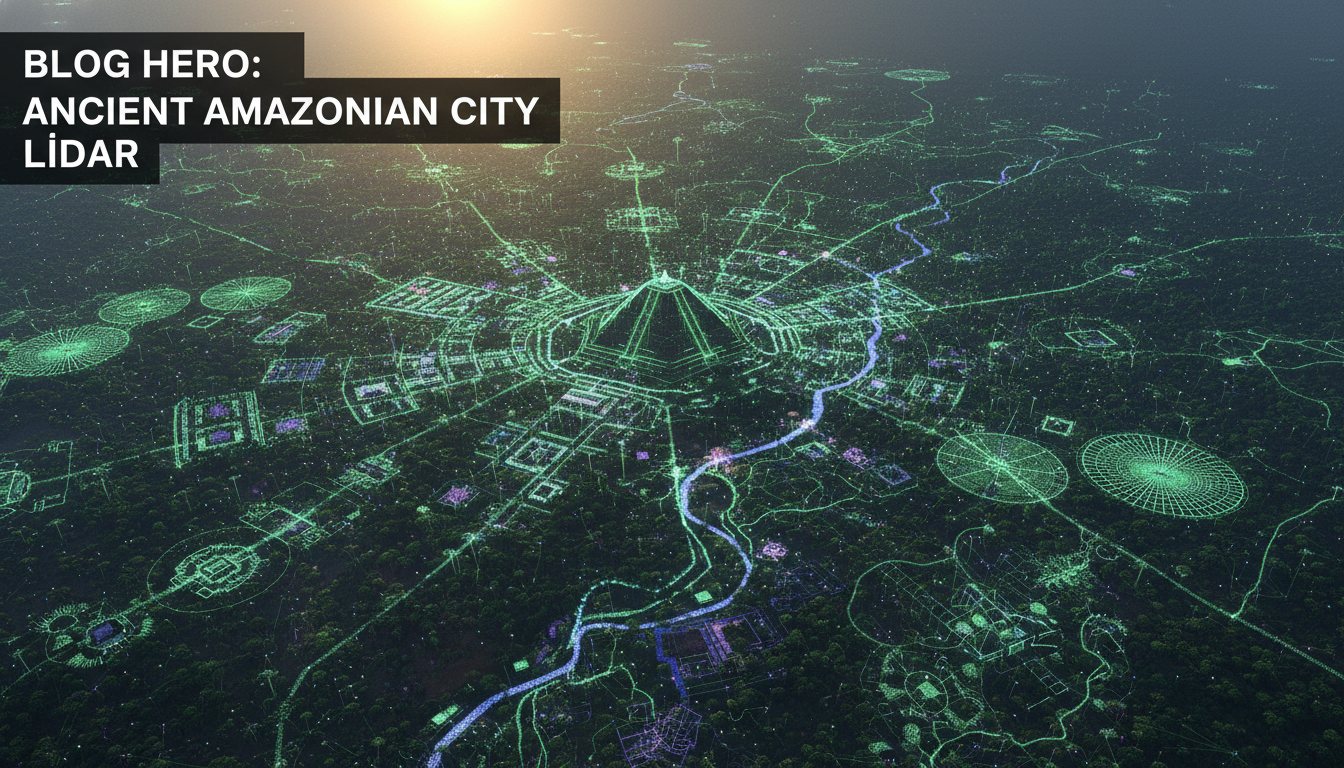
Recent archaeological breakthroughs have fundamentally altered our understanding of human history in South America. The Upano-2 LiDAR discovery has revealed a sprawling pre-Columbian megalopolis hidden beneath the dense canopy of the Ecuadorian Amazon. This massive urban network, larger than ancient Rome, challenges long-held myths of the Amazon as a pristine wilderness. Through advanced laser scanning technology, researchers are uncovering a sophisticated civilization defined by complex engineering, ceremonial plazas, and sustainable urban planning that once supported millions of inhabitants.
The dense, emerald canopy of the Amazon rainforest has long been viewed by historians as a “counterfeit paradise”—a vast wilderness once thought incapable of supporting large-scale urban civilizations. However, the recent Upano-2 LiDAR discovery has decisively shattered this primitive myth. Using Light Detection and Ranging (LiDAR) technology, archaeologists have peered through the thick vegetation to uncover a massive, interconnected network of cities, roads, and agricultural terraces that rival the scale of the greatest empires of antiquity.
This sprawling megalopolis in the Upano Valley of eastern Ecuador dates back over 2,500 years, flourishing between 500 BC and 600 AD. The discovery reveals a society that was not only highly organized but also deeply integrated with its natural environment. With an estimated population reaching into the millions, this urban complex represents a pinnacle of pre-Columbian engineering, featuring raised causeways and sophisticated drainage systems that allowed for a thriving agrarian lifestyle in the heart of the jungle.
The Scale of the Upano-2 LiDAR Discovery
The sheer magnitude of the Upano-2 LiDAR discovery is difficult to overstate. Covering an area that dwarfs many modern metropolises, the site features over 6,000 earthen platforms distributed across a landscape of 300 square kilometers. These structures served as the foundations for residential homes, communal buildings, and grand ceremonial centers. Unlike the stone-heavy architecture of the Aztecs or Incas, the Upano people utilized the earth itself, sculpting the landscape into a functional urban grid.
Archaeologists have identified five major settlements and ten smaller sites within this complex, all linked by an intricate system of straight, wide roads. These thoroughfares, some stretching for tens of kilometers, suggest a high degree of political and social integration. The Upano-2 LiDAR discovery proves that this was not a collection of isolated villages, but a unified megalopolis that facilitated trade, movement, and defense on a scale previously thought impossible for this region.
Engineering the “Garden City”
One of the most striking features revealed by the Upano-2 LiDAR discovery is the sophisticated approach to land management. The civilization utilized a “Garden City” model, where urban living spaces were interspersed with agricultural zones. By creating raised fields and complex irrigation canals, the inhabitants managed the heavy Amazonian rainfall, preventing erosion while maximizing crop yields. This sustainable approach allowed them to support a population density that rivals some of the most famous cities of the ancient world, including Rome and Athens.
Shattering the Primitivist Myth
For centuries, the narrative of the Amazon was dominated by the “Primitivist Myth”—the idea that indigenous peoples lived in small, nomadic groups with little impact on the environment. The Upano-2 LiDAR discovery provides the physical evidence needed to dismantle this colonial-era perspective. It showcases a society capable of massive labor mobilization and long-term urban planning. The existence of ceremonial plazas and central high-points indicates a complex social hierarchy and a rich spiritual life that governed the daily activities of the megalopolis.
This discovery also highlights the resilience of ancient cultures. While European cities of the same era often struggled with sanitation and resource management, the Upano civilization thrived for over a thousand years. Their ability to engineer the rainforest without destroying its biodiversity offers a stark contrast to modern industrial practices, making the Upano-2 LiDAR discovery a subject of intense study for environmental historians and modern urban planners alike.
Digital Twins and the Future of Archaeology
In a move to bring these ancient ruins to the modern world, researchers are now creating “Digital Twins” of the Upano sites. Using the data from the Upano-2 LiDAR discovery, scientists have developed high-resolution 3D models that allow the public to explore the ruins through Virtual Reality (VR). This educational experience has become a global trend, allowing users to walk through the causeways and plazas of a city that has been hidden for nearly two millennia. This fusion of ancient history and cutting-edge technology is paving the way for a new era of “non-invasive” archaeology.
Lessons for Modern Sustainability
As modern cities face the increasing pressures of climate change and overpopulation, the Upano-2 LiDAR discovery provides a historical blueprint for climate resilience. The ancient Upano people demonstrated that high-density urbanism and environmental stewardship are not mutually exclusive. Their use of natural topography and water management systems offers valuable insights into how we might design future cities to better withstand extreme weather events.
- 01
- 02
- 03
- 04
The global conversation ignited by this find extends beyond archaeology. It touches on the rights of indigenous peoples and the preservation of the Amazon. By recognizing that the rainforest is a culturally shaped landscape—a “living artifact” of human ingenuity—we can better appreciate the importance of protecting it. The Upano-2 LiDAR discovery is not just a look into the past; it is a vital lesson for our collective future.
- 01
- 02
- 03
- 04
- 05
- 06
- 07
- 08
0 Comments