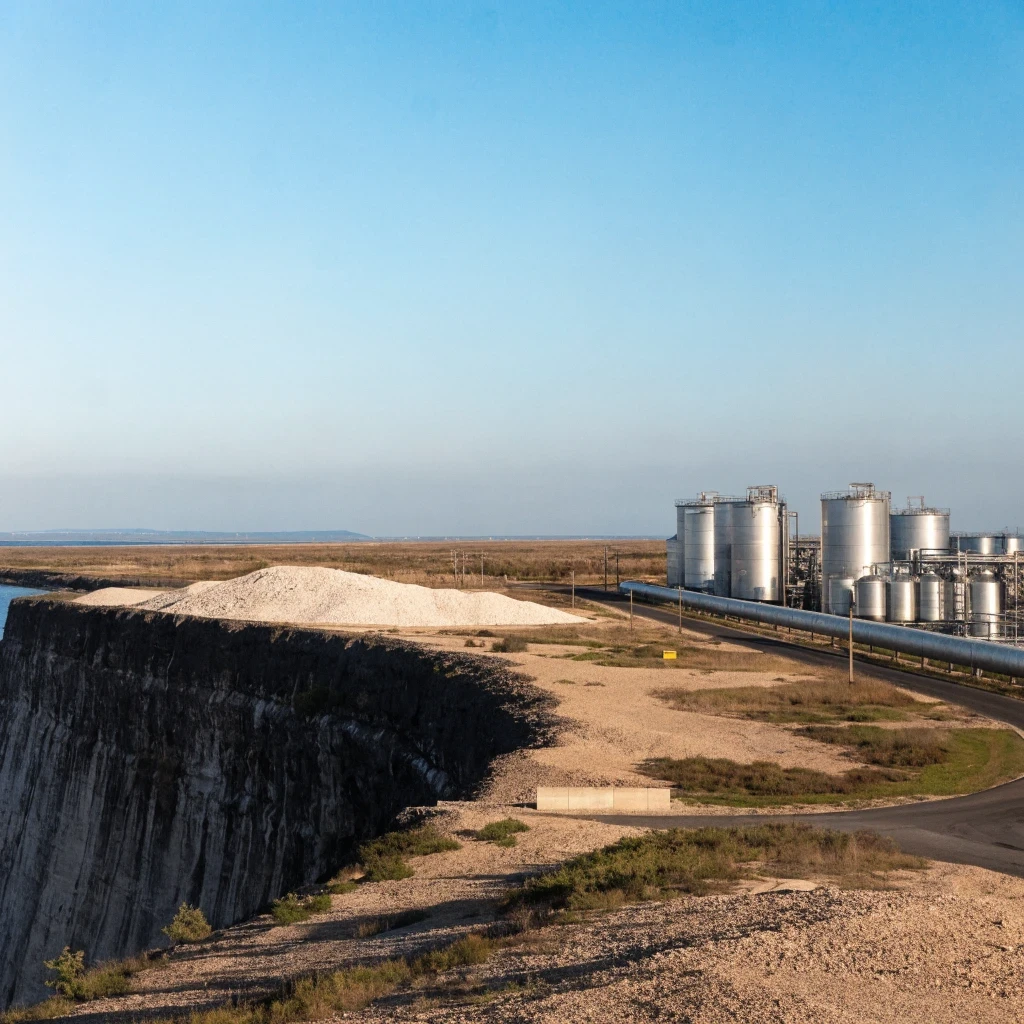
The United States has long prided itself on maintaining an energy fortress capable of weathering any global storm. That fortress now shows alarming cracks. The Department of Energy's latest inventory report confirms what energy analysts have dreaded for months: America's Strategic Petroleum Reserve has plunged below 300 million barrels, a threshold not seen since 1983. This is not merely a statistical curiosity; it is a seismic shift in the nation's defensive posture against geopolitical chaos.
For four decades, the SPR has functioned as the ultimate insurance policy against supply disruptions, price spikes, and hostile cartel behavior. Its cavernous salt domes along the Gulf Coast once held nearly 727 million barrels at peak capacity.
Today, those same caverns sit at roughly 40 percent of that historic high, drained by emergency releases, political expediency, and a failure to replenish during periods of relative stability. The implications ripple far beyond gasoline prices, touching military readiness, diplomatic leverage, and the credibility of American energy policy on the world stage.
On This Page
This analysis dissects the anatomy of the decline, the strategic vulnerabilities it creates, and the geopolitical chess game now unfolding as adversaries and allies alike recalibrate their assumptions about American resilience. The numbers tell a stark story, but the consequences tell an even starker one.
TL;DR The US Strategic Petroleum Reserve has fallen below 300 million barrels for the first time since 1983, representing a 60 percent drawdown from peak capacity. This depletion strips away the nation's primary buffer against supply shocks, weakens military fuel security, and emboldens adversaries who view American energy vulnerability as strategic leverage. The reserve's decline stems from massive emergency releases during the pandemic and Ukraine conflict, coupled with inadequate replenishment efforts. Restoring strategic depth requires a multi-decade commitment, substantial capital investment, and a clear-eyed reassessment of how the reserve fits into modern energy security frameworks.
The Anatomy of a Strategic Depletion: How America's Energy Cushion Evaporated
The Strategic Petroleum Reserve's decline is not the product of a single catastrophic event but rather a series of policy decisions, each rational in isolation yet collectively devastating in consequence. Understanding this trajectory requires examining the operational mechanics, the political pressures, and the market forces that converged to hollow out the nation's most critical energy asset.
Established in the wake of the 1973-74 Arab oil embargo, the SPR was designed as a bulwark against precisely the kind of supply weaponization that crippled Western economies half a century ago. Its mandate was unambiguous: maintain sufficient crude reserves to sustain the nation through a prolonged disruption without resorting to panic buying or diplomatic capitulation. That mandate has now been compromised to a degree that would have been unthinkable just a decade ago.
The Numbers Behind the Collapse
The arithmetic of decline is brutal and unforgiving. At its zenith in December 2009, the SPR held 726.6 million barrels of crude oil, a fortress of energy security carved into the salt domes of Texas and Louisiana.
By the end of 2023, that figure had collapsed to approximately 354 million barrels, and the latest Department of Energy data confirms the slide has continued unabated, pushing the reserve below the psychologically critical 300-million-barrel threshold.
This represents a drawdown of roughly 60 percent from peak capacity, a depletion rate that outpaces any previous period in the reserve's history. The releases during the COVID-19 pandemic and the Russia-Ukraine conflict alone accounted for over 300 million barrels of emergency sales, with only a fraction of that volume ever returned to the caverns.
The replenishment picture is equally grim. The Department of Energy has purchased just over 40 million barrels for refill since 2023, a trickle compared to the torrent of outflows. At current acquisition rates, restoring the reserve to even 500 million barrels would require more than a decade of sustained purchasing, assuming no new emergencies arise to drain it further.
Market dynamics compound the problem. The SPR's depletion coincided with record domestic production, creating a false sense of security that masked the reserve's deteriorating condition. When production inevitably plateaus or declines, the absence of strategic buffer will be felt with acute severity.
Policy Decisions That Hollowed Out the Fortress
The political calculus behind SPR releases has shifted from emergency response to routine price management. The Biden administration's decision to release 180 million barrels in 2022 was framed as a necessary response to Putin's energy weaponization, yet critics argue it crossed a dangerous line by using strategic reserves to suppress domestic gasoline prices ahead of midterm elections.
This politicization of the reserve represents a fundamental break from its original purpose. The SPR was never designed to be a price stabilization tool for consumers at the pump; it was designed to be a strategic asset for national security. Each time it is deployed for political convenience, its credibility as a deterrent diminishes, and adversaries take note.
Congress has compounded the problem through mandatory sales provisions embedded in budget legislation. These forced divestments, totaling over 100 million barrels since 2015, were sold to fund unrelated government programs, treating a national security asset as a piggy bank for deficit reduction. The practice continues despite bipartisan acknowledgment of its shortsightedness.
The result is a reserve that has been simultaneously weaponized, politicized, and cannibalized, leaving the nation with a hollowed-out defense against the very scenarios it was built to withstand.
Operational Realities and Infrastructure Constraints
Replenishing the SPR is not simply a matter of writing a check and buying crude. The physical infrastructure of the reserve imposes hard constraints on how quickly and efficiently oil can be returned to the caverns. The four primary storage sites—Bryan Mound, Big Hill, West Hackberry, and Bayou Choctaw—have finite injection rates determined by geological and mechanical factors.
Maximum injection capacity across all sites is approximately 4.5 million barrels per day, though sustained operations typically run at far lower rates due to maintenance requirements and cavern integrity concerns. At realistic operational levels of 1-2 million barrels per day, refilling 300 million barrels would take between 150 and 300 days of continuous injection, assuming no disruptions.
Contractual and logistical hurdles further complicate the picture. The Department of Energy must negotiate purchase agreements, arrange transportation, and coordinate with pipeline operators and terminal facilities. Each step introduces delays and costs that extend the replenishment timeline well beyond theoretical calculations.
Maintenance backlogs add another layer of complexity. Years of drawdowns have taken a toll on pumping equipment, valves, and monitoring systems. The infrastructure that once moved oil out at record speed must now be reconfigured for the slower, more deliberate process of moving it back in, requiring investments that have not been prioritized in recent budgets.
Geopolitical Shockwaves: How Adversaries Exploit American Energy Vulnerability
The depletion of the SPR does not occur in a vacuum. It unfolds against a backdrop of intensifying great-power competition, volatile energy markets, and a global order increasingly defined by resource nationalism. Every barrel drained from American caverns sends a signal to Moscow, Beijing, and Tehran about the limits of US strategic endurance.
Energy security has always been a cornerstone of national power. Nations that can withstand supply shocks without economic collapse or military degradation possess a strategic advantage that transcends conventional military capabilities. The erosion of that advantage fundamentally alters the calculus of adversaries contemplating aggressive action.
The Russia Factor: Energy as a Weapon of War
Moscow has demonstrated a sophisticated understanding of energy leverage, weaponizing its natural gas exports against European allies while simultaneously exploiting divisions within the Western alliance. The Kremlin's calculus now includes the diminished state of American strategic reserves as a factor constraining US response options in future crises.
Russian energy strategists have long argued that the SPR's depletion represents a structural weakness that cannot be quickly remedied. Their assessments, reflected in Kremlin policy documents and academic publications, view the reserve's decline as evidence of American overextension and domestic political dysfunction.
The Ukraine conflict provided a live demonstration of these dynamics. When the US released 180 million barrels in 2022, Moscow interpreted the move not as a show of strength but as an admission of vulnerability. The release depleted a finite asset to manage a crisis that US sanctions policy had helped create, a trade-off that Russian analysts believe weakens future American credibility.
This perception gap matters enormously. Deterrence operates on perceptions as much as capabilities. If adversaries believe the US lacks the strategic patience and reserve capacity to sustain prolonged energy confrontations, they will be more willing to test American resolve in other domains.
OPEC+ and the New Cartel Calculus
The OPEC+ alliance has watched the SPR's decline with keen interest, recalibrating its production decisions in light of America's diminished buffer. Saudi Arabia and Russia, the cartel's dominant players, now possess greater latitude to tighten markets without triggering massive US strategic releases that would undermine their pricing power.
This shift in leverage is already visible in market behavior. OPEC+ production cuts that would have provoked immediate SPR releases in previous years now proceed with minimal American response, reflecting both the reserve's depleted state and the political costs of further drawdowns.
The cartel's calculus extends beyond immediate pricing. Longer-term, OPEC+ members recognize that a diminished SPR reduces America's ability to influence global energy markets through strategic stockpiles, shifting the balance of power back toward producers who control physical supply at the source.
For American consumers, this translates into higher price volatility and reduced protection against supply disruptions. For American policymakers, it means fewer tools to counter cartel behavior without resorting to diplomatic pressure or military threats, both of which carry their own risks and costs.
China's Strategic Stockpiling Advantage
While America's reserve has been draining, China has been quietly building its own strategic petroleum stockpiles with characteristic strategic patience. Beijing's SPR capacity, estimated at over 500 million barrels across multiple sites, continues to expand even as American reserves contract.
This divergence represents a fundamental shift in the energy security balance between the world's two largest economies. China's growing reserves provide a buffer against supply disruptions that America increasingly lacks, enhancing Beijing's negotiating position in energy diplomacy and reducing its vulnerability to maritime blockades or supply cutoffs.
Chinese energy planners have studied the American SPR model extensively, learning from both its successes and its failures. They have avoided the politicization that has plagued the American reserve, maintaining a disciplined approach to stockpile management that prioritizes strategic objectives over domestic political considerations.
The asymmetry is stark: America's reserve is being depleted at the exact moment China's is being expanded. This reversal of strategic fortunes has profound implications for the balance of power in the Indo-Pacific, where energy security underpins military readiness and economic resilience.
We Also Published
- 01
- 02
- 03
- 04
The Road to Recovery: Rebuilding Strategic Depth in a Volatile Era
Restoring the SPR to a credible strategic level is not merely a matter of purchasing crude; it requires a fundamental reassessment of the reserve's role in American energy policy and national security strategy. The path forward demands political will, sustained investment, and a willingness to make unpopular choices in the service of long-term resilience.
The challenges are formidable but not insurmountable. America has rebuilt its strategic capabilities before, and it can do so again if policymakers demonstrate the discipline and foresight that have been conspicuously absent in recent years. The question is whether the political system can overcome its chronic short-termism to address a threat that does not demand immediate attention.
Refill Strategies and Fiscal Realities
The most direct path to replenishment involves aggressive crude purchases during market downturns, when prices are low and the fiscal cost of refilling is minimized. The Department of Energy has articulated a strategy of buying when prices fall below $70 per barrel, but execution has been halting and inconsistent.
Budgetary constraints complicate the picture. Refilling 300 million barrels at $70 per barrel would cost approximately $21 billion, a substantial outlay that competes with other priorities in a constrained fiscal environment. Congress has shown little appetite for appropriating such sums, preferring to fund the reserve through in-kind royalty payments from federal oil leases.
Alternative approaches include leasing spare capacity to commercial entities, allowing private companies to store crude in SPR caverns in exchange for maintenance funding. This model has been proposed repeatedly but has never gained sufficient political traction to overcome concerns about operational security and market distortion.
The most realistic path forward combines multiple approaches: sustained purchases during price troughs, royalty-in-kind transfers, and potential public-private partnerships that leverage private capital for public strategic purposes. Each element carries trade-offs, but the alternative—continued depletion—is strategically untenable.
Modernizing the Reserve for 21st Century Threats
The SPR's mission must evolve beyond its Cold War origins to address contemporary threats. Cyberattacks on energy infrastructure, extreme weather events, and the transition to renewable energy all present challenges that the reserve's original designers never contemplated.
Cybersecurity represents a particularly acute vulnerability. The SPR's control systems, like much of America's critical infrastructure, were designed in an era before sophisticated state-sponsored hacking became a routine tool of geopolitical competition. Hardening these systems against digital attack must be a priority.
Climate resilience is equally important. The Gulf Coast sites that house the SPR are increasingly exposed to hurricanes, flooding, and sea-level rise. Investments in flood defenses, backup power systems, and redundant communications infrastructure are essential to ensure the reserve can function when it is needed most.
The energy transition introduces a different set of questions. As the world moves toward electrification and renewable sources, the role of crude oil reserves becomes less central to daily energy consumption but potentially more critical as a backup for intermittent renewable generation and as a feedstock for petrochemical production.
Strategic Alternatives and Complementary Assets
The SPR is not America's only energy security tool, but it is the most visible and most directly controllable. Complementary assets include the Northeast Home Heating Oil Reserve, the Naval Petroleum Reserves, and the nation's vast commercial crude inventories, which typically hold 400-500 million barrels.
Commercial inventories provide a market-based buffer that responds to price signals without government intervention. However, they are not a strategic asset in the same sense as the SPR; they are held by private companies seeking profit, not by the government seeking security, and they can be exported or sold in ways that undermine their strategic value.
International coordination offers another layer of protection. The International Energy Agency requires member nations to hold oil stocks equivalent to 90 days of net imports, and the US has historically met this obligation through a combination of SPR and commercial inventories. The SPR's decline threatens America's ability to meet this commitment.
Ultimately, no single asset can replace the SPR's unique combination of scale, government control, and strategic purpose. The reserve's decline must be reversed not because it is a symbol of American power, but because it is a functional necessity for navigating an increasingly volatile and contested global energy landscape.
The decline of America's strategic petroleum reserve is a self-inflicted wound that demands immediate attention. The nation that once built the world's most formidable energy fortress has allowed it to crumble through neglect, politicization, and strategic myopia. The consequences will be measured not in barrels but in geopolitical leverage, military readiness, and economic resilience.
Rebuilding the reserve will require sacrifice, discipline, and a willingness to prioritize long-term security over short-term political convenience. The alternative is a future in which America's energy destiny is dictated by adversaries who have studied our vulnerabilities and are prepared to exploit them. The choice is clear, but the window for action is narrowing with every barrel that drains from the caverns.
From our network :
- CISA’s Ten-Advisory Wave: Why Generic Patching Fails in OT and How to Build Product-Specific PlaybooksCISA released ten ICS advisories in one week, exposing critical infrastructure risks. Generic patching fails in OT. Learn to build product-specific remediation playbooks.
- How AI Agents Will Change the Way We Manage Personal FinancesExplore how AI agents are transforming personal finance through automated budgeting, bill payment, and investment management, while examining the critical security protocols and governance frameworks required for safe deployment.
- The Final Descent: How ESA Retired the Legendary Cluster Constellation After 24 Years of Space Weather ScienceAfter 24 years mapping Earth’s magnetosphere, ESA’s Cluster mission concluded with a precisely controlled reentry over the South Pacific. This analysis explores the scientific legacy, engineering decisions, and debris mitigation principles behind one of space exploration’s most responsible retirements.
- Committed Mediterranean Precipitation Decline: Why Emissions Cuts Alone Cannot Restore Winter RainsNew NOAA research reveals that Mediterranean winter rains may decline irreversibly even with emissions cuts. Explore the science of committed climate change and regional impacts.
- Former Soap Stars Embark on Ambitious Writing Projects and Theatrical StagesDiscover how former soap opera actors are transitioning into independent scriptwriting and high-profile theatrical stage productions.
- The Hidden Cost of AI Convenience: Why Over-Permissioned Agents Are a Security Time BombDiscover why AI agents with excessive permissions create dangerous single points of failure, and learn how implementing least privilege principles can protect your organization from exploitation.
- Analyzing Hoya Corporation’s Midday Volume Shifts and Financial FundamentalsExamine Hoya Corporation’s midday trading volume contraction, technical moving averages, robust solvency ratios, and stellar quarterly earnings performance.
- Forbidden Matrix Patterns and Visible Lattice Points: A Geometric DictionaryExplore how multidimensional 0–1 matrices encode geometric truths, linking forbidden patterns to visible lattice points and hypergraph theory, with applications in combinatorics and computational geometry.
- Norbert’s Uncertain Path: Why Hawaii’s Storm Watch Demands Patience Over PanicTropical Storm Norbert strengthens in the Eastern Pacific with winds near 50 mph, forecast to reach Category 1 hurricane status by Friday. Long-range models disagree sharply on whether Hawaii faces any threat around September 19–23, making official guidance essential.
RESOURCES
- How Declining Oil Production Could Weaken Russia's Geopolitical ...bakerinstitute.org... geopolitically unstable Russia. Global Impacts of Russia's Reduced Oil Production. Declining Russian oil output will affect China, India, Canada, the U.S. ...
- Tight Oil in the United States: Recent Developments and Future ...carnegieendowment.orgNov 1, 2014 ... Our work covers topics from the geopolitical implications of ... U.S. oil reserves. The former group increased reserves by 771.6…
- Renewable energy and geopolitics: A review - ScienceDirect.comsciencedirect.com... effect as the concentrated nature of oil reserves. The question is ... The role of the US in the geopolitics of climate policy…
- Venezuela: The Rise and Fall of a Petrostatecfr.orgJul 31, 2024 ... What has been the impact of U.S. sanctions? Is there a path away from the oil curse? Recommended Resources. Introduction.
- The geopolitics of energy transition in MENA - Middle East Institutemei.eduFeb 14, 2023 ... ... oil demand will decline, and the pattern will shift across geographies, with strategic geopolitical implications. Alongside a decline in ...
- Ten Inconvenient Truths About the Energy Implications of the Iran ...theglobalist.comApr 20, 2026 ... U.S. shale oil production is high-cost, operationally fragile and has been in secular decline since late 2023. The period of…
- Market Brief: Venezuela, Geopolitical Flashpoints and Investment ...am.gs.comJan 9, 2026 ... ... oil price impacts depend on how US policy on Venezuela evolves. While the country accounts for nearly 1/5 of…
- How will the US attacking Venezuela affect the world economy? Will ...reddit.comJan 3, 2026 ... On a geopolitical level what is likely happening here is that the US is trying to either force a regime…
- A Legislative ATM: Oil Crisis Exposes How Washington Drained the ...ntu.orgMar 12, 2026 ... The U.S. Strategic Petroleum Reserve (SPR), the nation's emergency ... geopolitical conflict, natural disasters, or other emergencies.
- Why the US cannot afford to lose dollar dominance - Atlantic Councilatlanticcouncil.orgMay 20, 2025 ... It would accelerate the decline in the dollar's reserve status ... Additionally, strategic alliances and security arrangements with key oil ...
- The Strait of Hormuz: Security Developments and Impacts on Oil ...congress.govAug 7, 2026 ... ... crude oil held in the U.S. Strategic Petroleum Reserve (SPR). The ... U.S. prices declined by 6%. (By comparison,…
- Op-ed: What China is thinking about U.S. strikes against Iran - CNBCcnbc.comMar 2, 2026 ... Oil storage tanks at a petrochemical production base on the ... But the most important strategic consequences may unfold far…
- Experts React: What the Epic Fury Iran Strikes Signal to the Worldstimson.orgFeb 28, 2026 ... ... geopolitical consequences of the U.S.–Israel strikes on Iran ... impact some of the world's most important oil transit routes.…
- De-dollarization: The end of dollar dominance? - J.P. Morganjpmorgan.comJul 1, 2025 ... “This reduces the need for precautionary reserves of U.S. dollars, U.S. Treasuries and oil, which might in turn free up…
- Geopolitical Implications of New Arctic Shipping Lanesthearcticinstitute.orgMar 18, 2021 ... ... geopolitical competition amongst the US, China, and Russia. 1 ... strategic ports throughout the region as well as sending…
- 01
- 02
- 03
- 04
- 05
- 06
- 07
- 08
0 Comments