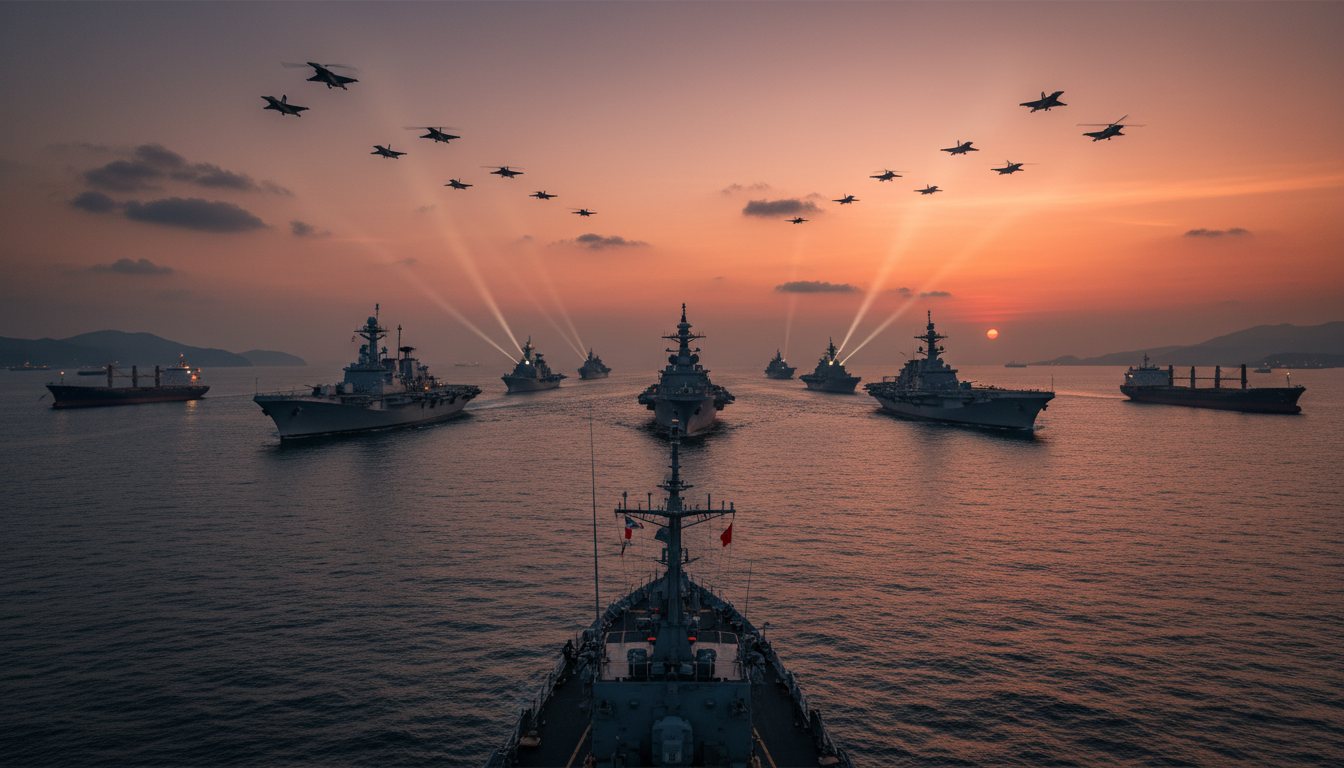
The geopolitical landscape of the Indo-Pacific has shifted into a volatile new phase following the convergence of a domestic political upheaval in Taipei and an aggressive maritime encirclement by the People’s Liberation Army. As the global community monitors the fallout of the PLA blockade drills and Taiwan impeachment crisis, the region faces an unprecedented “perfect storm” where democratic internal friction meets external authoritarian pressure. The recent legislative move to impeach President William Lai has not only fractured the island’s unified front but has provided Beijing with a strategic narrative to intensify its “Justice Mission 2025” military posturing across the Taiwan Strait.
This escalating situation represents a significant departure from previous gray-zone tactics, as the PLA blockade drills and Taiwan impeachment crisis now threaten the very continuity of governance in Taipei. With the People’s Liberation Army maintaining a high-alert blockade posture around primary ports, the economic and security implications are echoing through global supply chains and diplomatic corridors. The following analysis explores the intricate layers of this crisis, from the legislative gridlock in the Legislative Yuan to the tactical maneuvers of the Type 055 destroyers currently contesting the median line, providing a comprehensive look at a region on the brink of a transformative conflict.
Is the Taiwan Impeachment Crisis the Ultimate Regional Destabilizer?
The sudden acceleration of impeachment proceedings against President William Lai Ching-te has introduced a dangerous vacuum of leadership at a time when external threats are at their peak. On January 2, 2026, the Legislative Yuan’s 60-51 vote to initiate the process signaled a deep-seated ideological divide within Taiwan’s political infrastructure. Opposition parties have cited “provocative foreign policy” and “unauthorized defense spending” as the primary drivers for this constitutional challenge, effectively paralyzing the executive branch’s ability to coordinate a swift response to maritime incursions. For the average observer, the PLA blockade drills and Taiwan impeachment crisis are no longer separate events but two halves of a singular existential threat to the island’s status quo.
From a constitutional perspective, the impeachment process in Taiwan is a multi-stage ordeal that requires significant consensus, yet the mere initiation of the vote has served Beijing’s interests by projecting an image of a “failed democratic experiment.” The internal friction has forced the Ministry of National Defense (MND) to operate under a cloud of political uncertainty, where long-term strategic decisions regarding the $11 billion U.S. arms package are being questioned by legislative committees. This domestic gridlock directly undermines the “porcupine strategy” intended to deter cross-strait aggression, as budgetary allocations for Harpoon missile systems and F-16V upgrades remain caught in the crossfire of partisan bickering.
Furthermore, the social fabric of Taiwan is showing signs of significant strain as disinformation campaigns capitalize on the political divide. Social media platforms are flooded with competing narratives, some framing the impeachment as a necessary correction to avoid war, while others view it as a decapitation strike orchestrated by external influences. This “cognitive warfare” is a key component of the broader PLA blockade drills and Taiwan impeachment crisis, as it seeks to erode public confidence in the democratic process. When the populace is divided on the legitimacy of its own leader, the collective will to resist external military coercion is significantly weakened, a fact that Beijing’s Taiwan Affairs Office (TAO) has been quick to highlight in its daily briefings.
The regional implications extend far beyond the shores of Taipei. Neighbors such as Japan and the Philippines are recalibrating their security postures as the “First Island Chain” experiences this structural instability. If the impeachment succeeds in removing William Lai, the resulting special election or transitional government could lead to a radical shift in Taiwan’s defense policy, potentially favoring de-escalation at the cost of sovereignty. Investors are already reacting to this uncertainty, with the TAIEX experiencing sharp volatility as the “geopolitical risk premium” for Taiwanese assets reaches levels not seen since the 1996 missile crisis. The next 48 hours, leading up to the formal roll call vote, will determine whether Taiwan maintains a coherent command structure or enters a period of prolonged political paralysis.
Analyzing the PLA Blockade Drills and Justice Mission 2025
The military dimension of the current tension is defined by “Justice Mission 2025,” a comprehensive exercise that transitioned from a training scenario into a functional blockade. Unlike previous drills that focused on precision strikes, these maneuvers are designed to test the PLA’s ability to sever Taiwan’s “lifeblood”—its maritime trade routes. By deploying dozens of J-20 stealth fighters and Type 055 destroyers, Beijing is demonstrating a capability to enforce a “no-fly/no-sail” zone that effectively encompasses the island’s primary ports, including Kaohsiung and Keelung. The PLA blockade drills and Taiwan impeachment crisis have thus created a dual-front pressure campaign that tests both the physical and political resilience of the nation.
Tactical Implications of Total Port Blockades
In this scenario, the “Justice Mission 2025” forces leverage a numerical and technological advantage that forces the defending Taiwanese navy into a defensive crouch. The blockade aims to reduce the “fighting strength” of the island by depleting its fuel and ammunition reserves, which are heavily dependent on open sea lanes. Without a constant influx of energy resources, Taiwan’s high-tech manufacturing and military readiness would decay exponentially over a matter of weeks, a variable that Beijing is currently calculating with high precision.
Gray Zone Warfare and the New Normal in the Strait
import pandas as pd
import numpy as np
from sklearn.cluster import DBSCAN

def detect_blockade_clusters(ais_data):
    # Extracting coordinates and vessel types
    coords = ais_data[['latitude', 'longitude']].values
    vessel_types = ais_data['type'].values

    # Using DBSCAN to find dense clusters of military vessels (Type 'Warship')
    warships = coords[vessel_types == 'Warship']
    db = DBSCAN(eps=0.05, min_samples=5).fit(warships)

    # Marking clusters as potential blockade points
    ais_data['blockade_alert'] = False
    labels = db.labels_

    return labels

# Example data processing
# data = pd.read_csv('strait_traffic_jan_2026.csv')
# alert_zones = detect_blockade_clusters(data)
This type of analytical tool is essential for the U.S. Navy and regional allies to distinguish between routine exercises and actual offensive positioning.
- 01
- 02
- 03
- 04
Does Beijing View the William Lai Impeachment as a Strategic Opening?
For the leadership in Beijing, the impeachment of William Lai is a windfall that validates their narrative of Taiwan’s internal decay. State media outlets like the People’s Daily have characterized the legislative move as a “popular uprising against separatist tyranny,” framing the opposition parties as the “voice of reason” seeking to restore stability through closer ties with the mainland. By aligning their military “Justice Mission 2025” with the domestic political crisis, Beijing is attempting to position itself as the guarantor of order in a chaotic region. This strategic opportunistic approach is a classic example of “using the enemy’s internal contradictions to one’s advantage.”
The PLA blockade drills and Taiwan impeachment crisis have allowed Beijing to test the “threshold of intervention” for the United States. While the U.S. State Department has issued statements calling for restraint, the complexity of an impeachment makes a clear-cut military response more difficult for Washington. Is the U.S. defending a democratically elected leader who is being legally removed by his own legislature? This legal ambiguity is precisely what Beijing hopes to exploit to prevent a unified international front. If the impeachment is seen as a legitimate constitutional process, it becomes much harder for foreign powers to frame their support for Lai as “defending democracy.”
wp:html
| Political Actor | Stance on Impeachment | View on PLA Drills |
|---|---|---|
| DPP (Ruling Party) | Opposed; terms it a “Political Coup” | Direct Existential Threat |
| KMT (Opposition) | In Favor; cites “Diplomatic Recklessness” | Result of President’s Provocation |
| Beijing (PRC) | Supportive; “Will of the People” | Legitimate Sovereignty Protection |
| U.S. State Dept | Neutral; “Internal Democratic Process” | Unjustified Military Pressure |
/wp:html
Moreover, the PLA blockade drills and Taiwan impeachment crisis serves as a testing ground for China’s Global Security Initiative (GSI). By successfully managing the “Taiwan problem” through a combination of domestic destabilization and military coercion, Beijing hopes to offer a model of “conflict resolution” that does not rely on Western liberal norms. If they can force a change in Taipei’s leadership without a shot fired, it would be a massive blow to the credibility of the U.S.-led security architecture in Asia. This would effectively signal that the “Pax Americana” is over, replaced by a regional order where Beijing dictates the terms of sovereignty and governance.
The strategic window is also timed with the 2026 global economic outlook, where many Western nations are grappling with inflation and domestic social issues. Beijing calculates that the international appetite for a major conflict in the Taiwan Strait is at an all-time low. By intensifying the PLA blockade drills and Taiwan impeachment crisis now, they are forcing the world to choose between upholding a democratic principle in Taipei or maintaining economic stability at home. It is a high-stakes game of geopolitical chicken, where the “Strait of Fire” is the primary arena and the future of the global world order is the ultimate prize.
International Reactions and the Role of U.S. Arms Packages
The response from the international community has been a mix of alarm and calculated caution. The United States, while embroiled in its own legislative debates, recently approved a landmark $11 billion arms package for Taiwan, including long-range strike capabilities and advanced drone swarms. This move was intended to bolster the island’s “asymmetric warfare” capabilities, yet the timing has been criticized by some regional analysts who believe it gave Beijing the necessary pretext to launch “Justice Mission 2025.” The PLA blockade drills and Taiwan impeachment crisis have now put this arms package in jeopardy, as the impeachment proceedings could result in a new administration that cancels or delays these critical defense acquisitions.
In Europe, the reaction has been more fragmented. Major powers like France and Germany are wary of being drawn into a Pacific conflict that would sever their vital economic ties with China. However, the European Union has expressed “grave concern” over the blockade, noting that any disruption to the flow of semiconductors from Taiwan would cause a global industrial collapse. The PLA blockade drills and Taiwan impeachment crisis highlight the world’s dangerous dependency on a single geography for its most advanced technology. Diplomatic efforts in Brussels are currently focused on “de-risking” rather than “de-coupling,” a strategy that may be too slow to account for the rapid escalation currently seen in the Strait.
wp:html
| System Category | Key Component | Strategic Purpose |
|---|---|---|
| Maritime Strike | RGM-84 Harpoon Blocks | Coastal Defense against Blockade Hulls |
| Air Superiority | F-16V Viper Upgrades | Contesting J-20 Air Presence |
| Surveillance | MQ-9B SeaGuardian Drones | Real-time Blockade Monitoring |
| Anti-Armor | Javelin & TOW Systems | Repelling Potential Amphibious Landing |
/wp:html
Regional powers like Australia and India are also monitoring the PLA blockade drills and Taiwan impeachment crisis with increasing anxiety. For the Quad members, the integrity of the Taiwan Strait is a litmus test for the “Free and Open Indo-Pacific” concept. India’s strategic community is particularly concerned that a Chinese victory in Taiwan would embolden the PLA along the Line of Actual Control (LAC). This interconnectedness of global security threats means that what happens in the Legislative Yuan in Taipei has direct consequences for the Himalayas and the South China Sea. The lack of a unified regional military response, however, remains Beijing’s greatest tactical advantage.
Ultimately, the role of the U.S. arms package is not just about physical hardware but about signaling commitment. If the PLA blockade drills and Taiwan impeachment crisis lead to the suspension of these transfers, it will be viewed as a strategic retreat by the United States. This would trigger a “domino effect” among other allies who may begin to question the reliability of U.S. security guarantees. The crisis is therefore a crucible for the very concept of collective defense in the 21st century, pitting a centralized, fast-moving authoritarian strategy against a slower, more deliberate, and currently fractured democratic response.
Assessing the Economic Fallout of a Contested Taiwan Strait
The economic ramifications of the PLA blockade drills and Taiwan impeachment crisis are already being felt in the global markets. As a hub for over 90% of the world’s most advanced semiconductor manufacturing, any threat to Taiwan’s export capacity is a threat to the global tech economy. Shipping insurers have already hiked premiums for vessels transiting the strait, and several major logistics firms have begun rerouting ships around the eastern coast of the island, adding significant costs and delays to global trade. This “economic siege” is a deliberate feature of the blockade, intended to pressure the Taiwanese business elite—the “Taishang”—to support a political resolution that favors Beijing.
From a fiscal perspective, Taiwan’s government is facing a double-edged sword. The military high-alert posture required by “Justice Mission 2025” is draining the national treasury, even as the political crisis threatens to stall the budget for the following year. If the impeachment leads to a protracted period of governance by a caretaker cabinet, the ability to manage a financial crisis or a run on the New Taiwan Dollar will be severely compromised. Foreign direct investment (FDI) is already showing signs of flight, with venture capital firms pausing investments in Taipei-based startups. The PLA blockade drills and Taiwan impeachment crisis are effectively creating an “uninvestable” environment in what was once one of Asia’s most stable markets.
Furthermore, the disruption of the Taiwan Strait affects global energy markets. A significant portion of the LNG (Liquefied Natural Gas) destined for Japan and South Korea passes through these waters. If the PLA continues to enforce “security zones” that restrict commercial traffic, the resulting energy price spikes could trigger a recession in East Asia. This would have a “bullwhip effect” on the global economy, impacting everything from automotive manufacturing in Germany to consumer electronics in the United States. The PLA blockade drills and Taiwan impeachment crisis are not just a regional dispute; they are a systemic shock to the globalized world order that has relied on peaceful maritime transit for decades.
As the Legislative Yuan prepares for the critical roll call vote, the world remains on high alert. The intersection of political instability and military aggression has created a “Strait of Fire” that could ignite at any moment. Whether through a successful impeachment that reshapes Taiwan’s trajectory or a blockade that forces a strategic surrender, the status quo has been irrevocably shattered. The coming days will reveal whether the democratic world can navigate this complex crisis or if a new “normal” dictated by Beijing will take hold in the heart of the Indo-Pacific. The PLA blockade drills and Taiwan impeachment crisis represent the most significant challenge to regional peace in a generation, and the resolution of this conflict will define the geopolitical landscape for decades to come.
- 01
- 02
- 03
- 04
- 05
- 06
- 07
- 08
0 Comments