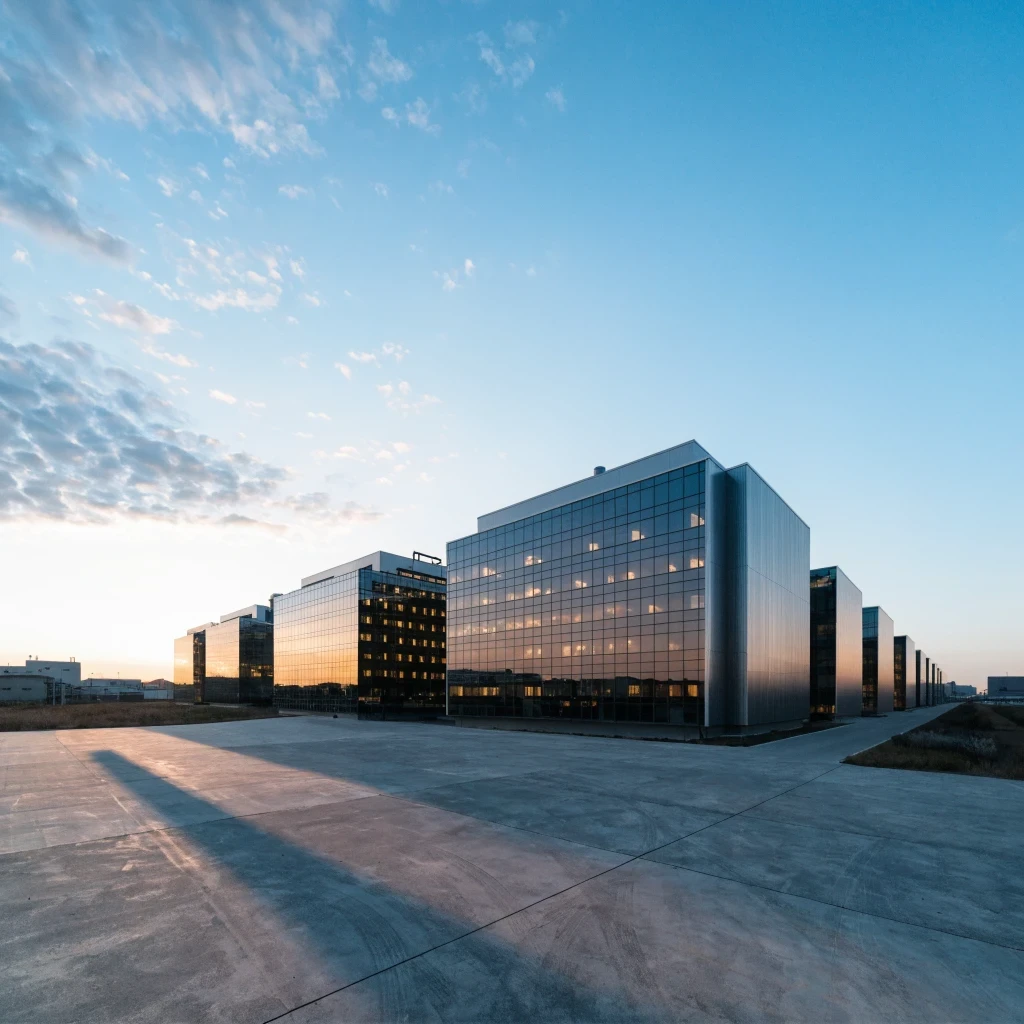
The tectonic plates of global investing have shifted beneath our feet, and the epicenter is no longer a Silicon Valley garage or a Wall Street trading floor. It is a sprawling, humming, windowless fortress of concrete and steel, packed with thousands of servers consuming megawatts of power.
The data center has emerged from the IT department's shadows to become the single most coveted asset class of the artificial intelligence era, transforming how institutional capital views physical infrastructure.
This is not merely a technological story; it is a profound real estate revolution. As hyperscalers like Microsoft, Amazon, and Google wage an unprecedented arms race for computational supremacy, they are discovering that the scarcest resource is not silicon chips or software engineers, but physical land with access to reliable power and fiber connectivity.
On This Page
The market has taken notice, rewarding data center property companies with robust gains as investors scramble for exposure to this digital gold rush.
The convergence of cloud computing ubiquity and generative AI's insatiable appetite for processing power has created a perfect storm of demand. Every ChatGPT query, every autonomous vehicle simulation, and every enterprise cloud migration requires physical infrastructure that must be built, powered, and maintained.
For the discerning investor, this represents a paradigm shift where the traditional boundaries between technology stocks and real estate investment trusts have dissolved into a lucrative hybrid asset class.
TL;DR Data centers have become the premier physical asset class of the AI boom, driven by relentless corporate demand for cloud and artificial intelligence infrastructure. Property companies specializing in computational real estate posted strong weekly gains, signaling a structural shift in investment strategy. This analysis dissects the market dynamics, the financial mechanics of data center REITs, and the long-term viability of this emerging asset class, offering a bold perspective on why physical infrastructure now rivals digital innovation as the true bottleneck of technological progress.
The Computational Land Grab: Why Physical Infrastructure Now Dictates AI's Trajectory
The artificial intelligence revolution has a dirty secret that Wall Street is only beginning to fully price: it is fundamentally a physical problem. Training a single frontier-level large language model requires thousands of specialized GPUs running for months, consuming electricity equivalent to a small city and generating heat that demands industrial-scale cooling systems. This computational appetite has transformed data centers from back-office utilities into strategic national assets.
The investment thesis has evolved accordingly. When corporate giants announce billion-dollar AI initiatives, the immediate beneficiaries are no longer just chip designers like NVIDIA, but the real estate trusts that own and operate the physical facilities housing those chips.
This realization has triggered a fundamental repricing of data center properties, with investors recognizing that the digital economy's foundation is, quite literally, concrete, copper, and cooling towers.
The Hyperscaler Arms Race and Its Real Estate Consequences
The competitive dynamics among cloud providers have created an insatiable demand for data center capacity. Microsoft, Amazon Web Services, and Google Cloud are engaged in a capital expenditure war, collectively committing hundreds of billions of dollars annually to expand their infrastructure footprints.
This spending spree flows directly into the coffers of data center REITs and property developers who control the scarce land and power access these giants desperately need.
What makes this cycle particularly compelling is its self-reinforcing nature. As AI models grow more sophisticated, they demand more computational power, which requires more data centers, which drives up the value of existing facilities and the land on which they sit.
This virtuous cycle has created a pricing dynamic where data center properties now command premium valuations comparable to prime Manhattan office towers or Beverly Hills retail spaces.
The geographic implications are equally significant. Northern Virginia's "Data Center Alley" has become the epicenter of global internet traffic, while emerging markets in Texas, Ohio, and even international locations like Ireland and Singapore compete for hyperscaler investment. Each new facility represents not just a technological installation, but a long-term economic anchor that transforms local real estate markets and creates thousands of high-paying operational jobs.
Investors who recognized this trend early have been rewarded handsomely. Data center REITs have consistently outperformed traditional commercial real estate benchmarks, delivering total returns that rival the technology sector itself. This performance has attracted a new class of investors who view computational infrastructure as a defensive play on technological progress, offering the stability of real estate with the growth profile of tech.
Power, Water, and the New Scarcity Economics
The most critical constraint on data center expansion is no longer capital or land, but access to electricity and water. A single hyperscale facility can consume as much power as 80,000 homes, and the cooling systems require millions of gallons of water annually. This has created a new form of infrastructure arbitrage, where locations with abundant, cheap, and preferably renewable energy command significant premiums.
Utilities and grid operators are struggling to keep pace with this unprecedented demand surge. Some regions have imposed moratoriums on new data center connections, while others are fast-tracking transmission line upgrades to accommodate hyperscaler requirements. This regulatory friction has paradoxically increased the value of existing facilities with secured power contracts, making them trophy assets in the truest sense.
The sustainability angle adds another layer of complexity and opportunity. Tech giants have made aggressive carbon neutrality commitments, forcing them to pair new data centers with solar farms, wind installations, and innovative cooling technologies. This has spawned a secondary investment ecosystem focused on clean energy infrastructure, battery storage, and water recycling systems specifically designed for computational facilities.
Forward-thinking investors are now evaluating data center properties through a triple-bottom-line lens, assessing not just financial returns but also environmental impact and community relations. Facilities that demonstrate genuine sustainability credentials command premium valuations and face fewer regulatory hurdles, creating a clear competitive advantage in an increasingly crowded market.
REITs, Private Equity, and the Democratization of AI Real Estate
The investment vehicles for data center exposure have multiplied dramatically, democratizing access to this once-institutional asset class. Publicly traded REITs like Digital Realty and Equinix offer retail investors liquid, transparent exposure to computational real estate, while private equity funds and sovereign wealth vehicles pursue massive build-to-suit developments with hyperscaler anchor tenants.
The financial mechanics are compelling. Data center leases typically run 10 to 15 years with built-in escalation clauses, providing predictable, inflation-protected cash flows that rival the best corporate bonds. Occupancy rates remain exceptionally high, often exceeding 90 percent, and the barriers to entry for new competitors are formidable given the capital intensity and technical expertise required.
This structural advantage has translated into impressive financial performance. Leading data center REITs have delivered compound annual growth rates in funds from operations that outpace traditional real estate by a wide margin, while maintaining conservative balance sheets and investment-grade credit ratings. The combination of growth and stability has made these securities a cornerstone allocation for income-focused and growth-oriented portfolios alike.
The competitive landscape is evolving rapidly, with traditional real estate developers, energy companies, and even sovereign wealth funds entering the fray. This influx of capital has intensified competition for prime sites, driving up land prices and development costs, but also validating the asset class's strategic importance. The winners will be those with the operational expertise to navigate power procurement, construction complexity, and hyperscaler relationship management.
We Also Published
Market Dynamics and the Financial Architecture of Digital Landlords
The recent surge in data center property stocks reflects a broader recognition that the AI boom's physical manifestations are as valuable as its digital innovations. When major technology companies report earnings, their capital expenditure guidance has become a leading indicator for data center REIT performance, creating a transparent transmission mechanism between tech spending and real estate returns.
This correlation has not escaped the attention of quantitative investors and algorithmic traders. Data center REITs now trade with the volatility profile of growth stocks while offering the income characteristics of traditional real estate, a hybrid that has attracted sophisticated multi-strategy funds seeking diversification and uncorrelated returns. The result is a market that is both more liquid and more efficient than ever before.
Valuation Metrics and the Case for Premium Multiples
Traditional real estate valuation metrics require recalibration when applied to data centers. Price-to-FFO (funds from operations) ratios, net asset value calculations, and capitalization rates all need adjustment to account for the technological obsolescence risk and the extraordinary growth trajectory of the underlying demand drivers. Savvy investors have developed sophisticated models that incorporate GPU refresh cycles and AI adoption curves.
The market has responded by assigning data center REITs premium valuations relative to their traditional commercial real estate peers. This premium is justified by superior growth rates, longer lease durations, and the strategic importance of the assets to the global digital economy. However, it also introduces valuation risk if AI adoption slows or if technological breakthroughs reduce the need for centralized computational facilities.
Comparative analysis reveals the magnitude of this repricing. While traditional office REITs struggle with remote work headwinds and retail properties face e-commerce disruption, data center REITs enjoy tailwinds from every major technological trend. This divergence has made data centers the default "growth real estate" allocation for institutional portfolios seeking to balance stability with technological exposure.
The forward-looking investor must also consider the potential for edge computing to reshape the landscape. As latency-sensitive applications proliferate, demand is growing for smaller facilities located closer to population centers, creating new opportunities for developers who can navigate urban zoning and power constraints. This trend could democratize data center investment beyond the traditional hyperscale hubs.
Risk Factors and the Contrarian Perspective
No investment thesis is without its risks, and data center real estate has its share of potential pitfalls. The most significant is technological disruption, particularly the possibility that quantum computing or dramatic efficiency gains could reduce the physical footprint required for a given level of computational output. Such a development would strand assets and compress valuations.
Interest rate sensitivity is another critical consideration. Data center REITs carry substantial debt to finance their capital-intensive development pipelines, making them vulnerable to sustained high interest rates. The recent rate environment has tested this thesis, yet the sector has demonstrated remarkable resilience, suggesting that the underlying demand fundamentals are strong enough to absorb higher financing costs.
Regulatory and political risk cannot be overlooked. Data centers have become lightning rods for concerns about energy consumption, water usage, and community impact. Some jurisdictions have imposed taxes or moratoriums, while others are demanding more aggressive sustainability commitments. These factors introduce uncertainty that can affect project timelines and returns.
Competition from non-traditional players adds another layer of complexity. Cloud providers themselves are increasingly building and owning their own facilities, potentially reducing their reliance on third-party REITs. While this trend has not yet materialized as a significant threat, it represents a structural risk that investors must monitor as the market matures.
The Global Landscape and Emerging Market Opportunities
The data center boom is a global phenomenon, with significant investment opportunities emerging across every continent. Asia-Pacific, particularly Southeast Asia and India, is experiencing explosive growth driven by digital transformation and favorable demographics. Europe is balancing aggressive sustainability mandates with the need for computational sovereignty, creating a complex but opportunity-rich environment.
Emerging markets present a particularly compelling risk-reward profile. Countries like India, Brazil, and Vietnam are leapfrogging traditional infrastructure development, building data centers that serve both domestic demand and international cloud providers seeking geographic diversification. These markets offer higher growth rates but also carry currency, political, and construction execution risks.
The Middle East is emerging as an unexpected powerhouse, with nations like Saudi Arabia and the UAE investing heavily in computational infrastructure as part of their economic diversification strategies. These projects often benefit from sovereign wealth backing and access to abundant, low-cost energy, creating a unique competitive advantage in the global data center market.
Investors seeking global exposure must navigate a complex web of regulatory regimes, tax structures, and cultural considerations. The most successful strategies often involve partnerships with local developers and operators who understand the nuances of their markets, rather than attempting to impose a one-size-fits-all approach to international expansion.
Strategic Investment Frameworks for the Computational Real Estate Era
Building a robust data center investment portfolio requires a sophisticated understanding of the sector's unique characteristics and a disciplined approach to risk management. The most successful investors treat data centers not as a monolithic asset class but as a diverse ecosystem with distinct segments, each offering different risk-return profiles and growth trajectories.
The core of any data center allocation should be established, investment-grade REITs with diversified portfolios and strong tenant relationships. These provide stability, income, and liquidity while offering exposure to the sector's secular growth. Around this core, investors can add satellite positions in development-focused companies, specialized service providers, and international operators.
Portfolio Construction and Risk Allocation Strategies
The optimal data center allocation depends on an investor's risk tolerance, time horizon, and existing portfolio composition. For most investors, a 5 to 10 percent allocation to the sector provides meaningful diversification benefits without excessive concentration risk. This allocation can be adjusted based on conviction levels and market conditions.
Within the allocation, diversification across sub-segments is essential. Wholesale data center providers that lease to hyperscalers offer stability but lower growth, while retail colocation providers serving enterprise customers offer higher margins but more cyclicality. Edge computing specialists and international operators provide additional diversification but carry higher execution risk.
Timing considerations are also important. Data center REITs have historically performed well during periods of technological transition and digital transformation, but they are not immune to broader market corrections. Dollar-cost averaging and maintaining dry powder for opportunistic purchases during market dislocations can enhance long-term returns.
The integration of environmental, social, and governance (ESG) factors has become increasingly important in data center investing. Facilities with strong sustainability credentials attract premium tenants, face fewer regulatory hurdles, and command higher valuations. Investors who prioritize ESG factors are not just being virtuous; they are making financially astute decisions.
Monitoring Key Performance Indicators and Market Signals
Successful data center investing requires diligent monitoring of a specific set of key performance indicators. Occupancy rates, average lease durations, and renewal spreads provide insight into the health of existing portfolios. Development pipelines, pre-leasing activity, and construction costs indicate future growth potential and margin trends.
Macroeconomic signals are equally important. Cloud provider capital expenditure guidance, AI adoption metrics, and electricity demand forecasts all provide leading indicators for data center demand. Monitoring these signals allows investors to position their portfolios ahead of market trends rather than reacting to them.
The competitive landscape requires constant vigilance. New entrants, technological shifts, and changing tenant requirements can rapidly alter the competitive dynamics of the sector. Investors must stay informed about industry developments through conferences, research reports, and direct engagement with company management teams.
Finally, investors must maintain a long-term perspective. The data center boom is a multi-decade secular trend driven by the digitization of the global economy and the emergence of artificial intelligence. Short-term volatility is inevitable, but the fundamental demand drivers remain intact, rewarding patient investors who maintain their convictions through market cycles.
The data center investment thesis is not merely a passing market fad but a fundamental restructuring of how the global economy values physical infrastructure. As artificial intelligence continues its relentless march into every sector, the facilities that house its computational engines will only grow in strategic importance. The investors who recognize this transformation and position themselves accordingly will be rewarded with outsized returns.
The convergence of technological innovation and real estate fundamentals has created an asset class that defies traditional categorization. Data centers are simultaneously technology infrastructure, commercial property, and critical utility, drawing investment characteristics from each domain. This hybrid nature makes them uniquely positioned to benefit from multiple secular trends while offering diversification benefits to portfolios constructed along traditional asset class lines.
Looking forward, the data center boom shows no signs of abating. The demand for computational capacity continues to outpace supply, driving up both occupancy rates and rental prices. The barriers to entry remain formidable, protecting existing players from competitive threats while ensuring that the sector's growth is disciplined and sustainable. This is the rare investment opportunity where the fundamentals, the narrative, and the momentum all align in the same direction.
The message for investors is clear: the real estate of AI is not a niche play but a core holding for any portfolio seeking exposure to the technological revolution. Whether through public REITs, private funds, or direct ownership, data center properties represent the physical manifestation of the digital future. Those who understand this will not just participate in the AI boom; they will own the ground upon which it is built.
From our network :
- Committed Mediterranean Precipitation Decline: Why Emissions Cuts Alone Cannot Restore Winter RainsNew NOAA research reveals that Mediterranean winter rains may decline irreversibly even with emissions cuts. Explore the science of committed climate change and regional impacts.
- Former Soap Stars Embark on Ambitious Writing Projects and Theatrical StagesDiscover how former soap opera actors are transitioning into independent scriptwriting and high-profile theatrical stage productions.
- How AI Agents Will Change the Way We Manage Personal FinancesExplore how AI agents are transforming personal finance through automated budgeting, bill payment, and investment management, while examining the critical security protocols and governance frameworks required for safe deployment.
- Analyzing Hoya Corporation’s Midday Volume Shifts and Financial FundamentalsExamine Hoya Corporation’s midday trading volume contraction, technical moving averages, robust solvency ratios, and stellar quarterly earnings performance.
- Norbert’s Uncertain Path: Why Hawaii’s Storm Watch Demands Patience Over PanicTropical Storm Norbert strengthens in the Eastern Pacific with winds near 50 mph, forecast to reach Category 1 hurricane status by Friday. Long-range models disagree sharply on whether Hawaii faces any threat around September 19–23, making official guidance essential.
- The Hidden Cost of AI Convenience: Why Over-Permissioned Agents Are a Security Time BombDiscover why AI agents with excessive permissions create dangerous single points of failure, and learn how implementing least privilege principles can protect your organization from exploitation.
- CISA’s Ten-Advisory Wave: Why Generic Patching Fails in OT and How to Build Product-Specific PlaybooksCISA released ten ICS advisories in one week, exposing critical infrastructure risks. Generic patching fails in OT. Learn to build product-specific remediation playbooks.
- Forbidden Matrix Patterns and Visible Lattice Points: A Geometric DictionaryExplore how multidimensional 0–1 matrices encode geometric truths, linking forbidden patterns to visible lattice points and hypergraph theory, with applications in combinatorics and computational geometry.
- The Final Descent: How ESA Retired the Legendary Cluster Constellation After 24 Years of Space Weather ScienceAfter 24 years mapping Earth’s magnetosphere, ESA’s Cluster mission concluded with a precisely controlled reentry over the South Pacific. This analysis explores the scientific legacy, engineering decisions, and debris mitigation principles behind one of space exploration’s most responsible retirements.
RESOURCES
- Data Center Investment: Decoding Opportunitiescbreim.comJul 17, 2024 ... Are data center investments real estate or infrastructure? The first ... investing in power-hungry and AI-focused data centers. Looking ...
- The AI Data Center Stock Boom: How To Invest Wisely in July 2026forbes.comMar 18, 2026 ... Data centers, the essential infrastructure for AI, represent a compelling investment opportunity amid explosive growth.
- Data Centers: A Global Investment Opportunitycbreim.comAug 8, 2025 ... This unique sector blends both infrastructure and real estate investment characteristics. ... Slide 2 - Record investment in data centers…
- Where to Build a Data Center in an AI Gold Rush - EQT Groupeqtgroup.comAug 22, 2025 ... ... data center solutions at CBRE, the world's largest commercial real estate firm. ... The Different Ways of Investing in…
- The cost of compute: A $7 trillion race to scale data centers - McKinseymckinsey.comApr 28, 2025 ... AI is fueling high demand for compute power, with companies investing billions in infrastructure. We look at how to approach…
- 7 Best Data Center Stocks, ETFs and REITs | Investing | U.S. Newsmoney.usnews.comJul 20, 2026 ... ... infrastructure that makes AI possible: data centers. "Investors ... real estate investment trust will do, however. Here are seven…
- What the real estate industry needs to know about data centersmckinsey.comOct 15, 2024 ... But the digital and cloud revolutions—and the scale-up of AI—are fueling truly enormous demand for data centers. In turn, there…
- Investing in Datacenters? - Redditreddit.comJun 22, 2024 ... In terms of risk/reward for an AI or Digitak infrastructure play ... real estate too. Yeah, the power company in…
- Brookfield Launches $100 Billion AI Infrastructure Programbam.brookfield.comNov 19, 2025 ... ... infrastructure, including land, power and data centers around the world. Radiant will build AI factories based on NVIDIA DSX…
- Best Data Center REITs for 2026 and How to Invest | The Motley Foolfool.comJul 17, 2026 ... Data center REITs own facilities that operate crucial data infrastructure. ... investing in data center REITs (real estate. Image source:…
- 2026 Market Outlook for Global Data Centers | JLL Researchjll.comJan 5, 2026 ... Data Center AI Revolution: Infrastructure ... Investment sales and advisoryData CentersData center propertyFuture of real estateGlobal.
- Data Center and AI Infrastructure Forum | NYU SPSsps.nyu.eduHosted by the NYU SPS Schack Institute of Real Estate, the 2026 Data Center ... infrastructure investors, technology firms, and policy organizations, including:.
- Data Center Real Estate Services | Buy, Sell, Build and Develop ...datacenterrealestate.comExplore Data Center Real Estate services designed for the digital economy. Buy, sell, or build data centers and acquire land that supports hyperscale, AI, ...
- RACK: The Building Block of the AI Infrastructure Boom - VanEckvaneck.comJun 2, 2026 ... Invest in Real Estate · Invest in ... investing in companies contributing to the buildout and operation of data center…
- Blackstone to Invest More Than $25 Billion in Pennsylvania's Digital ...blackstone.comJul 15, 2025 ... As the leading global investor in data centers, we are excited to help advance the nation's digital infrastructure goals.” Investment…
- 01
- 02
- 03
- 04
- 05
- 06
- 07
- 08
0 Comments