On This Page
Compositional Framework and Spatial Dynamics
Perspective and Linear Directives
The spatial arrangement of a dramatic realist composition relies heavily on geometric precision to establish a sense of depth. Floorboard orthogonals function as the primary perspective grid, running diagonally from the foreground into the center.
These parallel lines create a strong visual pull, guiding the viewer’s gaze toward the focal point of the scene. By anchoring the subject within a three-dimensional space, the orthogonals provide a necessary sense of realism.
The convergence of these lines suggests a vanishing point that lies beyond the immediate frame, extending the psychological boundaries of the room. This technique ensures that the viewer experiences the environment as a tangible, physical location.
Furthermore, the diagonal orientation of the floorboards introduces a dynamic tension that contrasts with the stillness of the subject. This movement within the static frame enhances the overall narrative weight of the visual composition.
The precision of these linear directives allows the artist to manipulate the viewer's perception of distance and scale. This mathematical approach to space is fundamental to the successful execution of complex chiaroscuro narratives.
Vertical Anchors and Structural Stability
To balance the dynamic diagonals of the perspective grid, strong vertical elements are strategically placed throughout the interior. The window frame on the left serves as a primary vertical anchor, providing a rigid structural boundary.
Similarly, the vertical legs of the furniture and the edges of the cabinet offer a counterpoint to the sloping floor. These elements ground the composition, preventing the diagonal lines from overwhelming the visual balance.
Structural stability is essential in scenes depicting heavy emotional or philosophical themes, as it provides a sense of permanence. The verticality of the environment reflects the stoic nature of the architecture surrounding the central figure.
By aligning these vertical anchors with the edges of the frame, the composition achieves a sense of order and containment. This containment mirrors the internal state of the subject, who remains trapped within the architectural confines.
The interplay between the vertical and diagonal lines creates a grid-like structure that organizes the visual field. This organization is crucial for maintaining clarity in scenes where light and shadow are highly volatile.
The Rule of Thirds and Focal Points
The central figure is meticulously positioned according to the rule of thirds to maximize visual impact and narrative focus. Placed along the vertical axis of the middle-left third, the subject commands immediate attention without being centered.
The narrative epicenter, often represented by the subject's clasped hands, rests near the lower-left intersection quadrant. This placement draws the eye directly to the physical manifestation of the figure's internal conflict and emotional state.
Utilizing the rule of thirds allows for a more naturalistic and aesthetically pleasing distribution of visual weight. It prevents the composition from feeling overly symmetrical, which would detract from the scene's inherent dramatic tension.
The surrounding negative space, filled with deep shadows and minimalist furniture, serves to emphasize the importance of the focal point. Every element within the frame is secondary to the psychological presence of the seated figure.
By adhering to these classical compositional principles, the narrative gains a sense of professional polish and timelessness. The viewer is led through the scene in a deliberate, controlled manner that enhances the story.
Geometric Logic in Narrative Spaces
The geometric logic of the room is not merely decorative but serves as a functional extension of the story. Every angle and line is calculated to direct the viewer’s understanding of the subject’s environment.
The relationship between the high-angle window and the floor creates a triangular zone of light that defines the workspace. This geometry establishes a clear hierarchy of visibility, highlighting what is important while obscuring the mundane.
Mathematical precision in the rendering of shadows ensures that the spatial relationships remain consistent and believable. The angle of the light rays follows a strict linear path, reinforcing the physical reality of the scene.
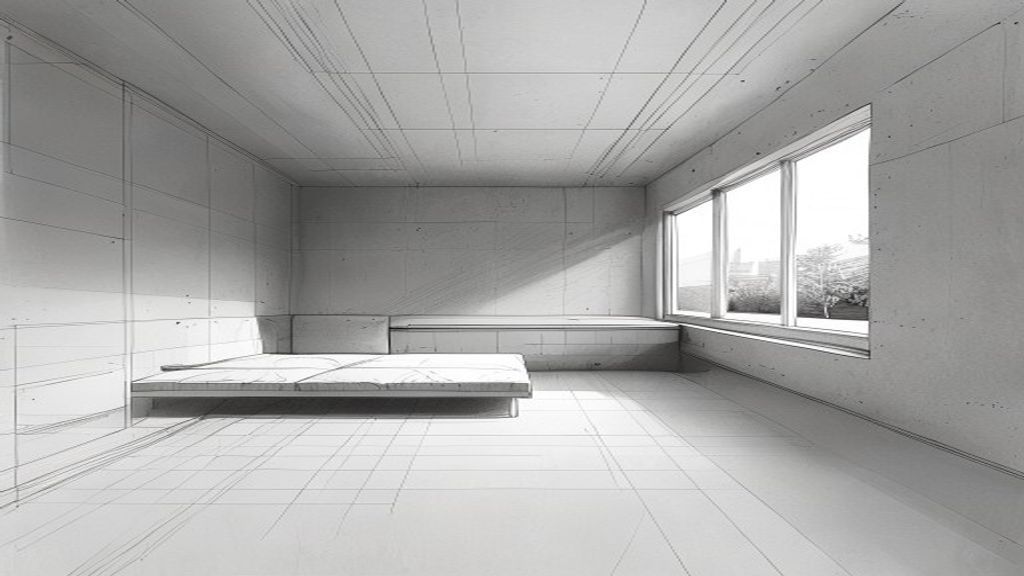
A technical architectural drawing of a minimalist room with a single window, showing perspective lines and the geometric placement of a chair and a cabinet in a classical style.
The interaction between the rectangular forms of the furniture and the organic curves of the human figure creates a visual contrast. This contrast highlights the vulnerability of the subject within the rigid, unyielding structure of the room.
Ultimately, the geometric framework provides the foundation upon which the narrative is built, ensuring that the emotional resonance is supported by structural integrity. This logic is the hallmark of sophisticated visual storytelling in art.
Lighting Architecture and Volumetric Modeling
The Primary Key Light and Atmospheric Haze
In chiaroscuro narratives, the primary key light acts as the soul of the composition, defining form through its absence and presence. Typically, a high-angle directional light enters from a single source, such as a window.
This light behaves as if passing through a slightly hazy or dusty atmosphere, creating a subtle volumetric glow. This phenomenon, known as the Tyndall effect, adds a layer of physical texture to the air itself.
The intensity of the light is governed by the inverse square law, which states that the illumination decreases as the distance from the source increases. This is mathematically represented as:
where ##I## is intensity and ##d## is distance.
As the light travels across the room, it illuminates the left side of the subject while leaving the right in darkness. This directional quality is essential for creating the "sculpted" look characteristic of classical realist paintings.
The volumetric beam serves to connect the subject to the external world, even if that world remains unseen. It acts as a bridge between the interior sanctuary and the source of natural, life-giving light.
High-Contrast Rendering and Chiaroscuro
The essence of chiaroscuro lies in the extreme value range between the brightest highlights and the deepest shadows. High-contrast rendering is used to model the volume of the subject, giving it a three-dimensional quality.
The light fall-off is rapid, meaning the transition from light to dark occurs over a very short distance. This creates sharp edges on some surfaces and soft, gradual gradients on others, depending on the texture.
While the cranium, shoulders, and hands are brightly lit, the chest and abdomen recede into near-impenetrable shadow. This selective illumination forces the viewer to focus on the expressive parts of the body, such as the face.
The deep blacks used in the recessed corners of the room provide a sense of infinite depth and mystery. These areas of "lost" detail invite the viewer to project their own emotions into the darkness.
By manipulating the value scale, the artist can control the mood of the piece with surgical precision. The contrast is not just a visual tool but a narrative device used to signify conflict.
We Also Published
Specular Highlights and Surface Textures
Specular highlights are crucial for defining the material properties of the objects within the scene. These bright spots of reflected light reveal the texture of the subject's hair and the weave of their clothing.
For instance, the coarse weave of a woolen jacket will catch the light differently than the smooth surface of a wooden chair. These subtle variations in light reflection provide the viewer with tactile information about the environment.
The raking light that skims across the floorboards accentuates the grain, cracks, and physical wear of the wood. This level of detail suggests a history of use and adds to the overall realism of the setting.
Mathematical models of reflection, such as the Phong reflection model, help describe how light interacts with different surfaces. The specular component ##k_s (R \cdot V)^n## determines the brightness and size of these highlights.
By carefully placing these highlights, the artist can make the scene feel lived-in and authentic. The textures become part of the narrative, telling a story of age, labor, and the passage of time.
Cast Shadows and Physical Volume
Cast shadows are the final component of lighting architecture, providing the necessary grounding for objects in the scene. The chair and the subject cast elongated, soft-edged shadows that mirror the angle of the light.
These shadows extend the sense of physical volume, showing that the objects occupy real space within the room. Without cast shadows, the subjects would appear to float, breaking the illusion of three-dimensional reality.
The edges of the shadows are often blurred, a phenomenon known as the penumbra, which occurs because the light source is not a single point. This softening adds a layer of naturalism to the composition.

A close-up study of light hitting a textured wooden surface and a piece of fabric, showing deep shadows and bright specular highlights in a realistic style.
Shadows also serve a narrative purpose, representing the "weight" of the subject's thoughts or the presence of the past. They anchor the figure not just to the floor, but to the emotional gravity of the situation.
The interaction between the light rays and the objects creates a complex web of shadows that defines the room's geometry. This interplay is what gives chiaroscuro its dramatic and cinematic quality, making it a powerful narrative tool.
- 01
- 02
- 03
- 04
Color Theory and Narrative Semiotics
Complementary Temperature and Color Strategy
The color strategy in a chiaroscuro narrative is often highly restricted, focusing on a complementary temperature contrast. Cool tones, such as slate blue and charcoal, are used to define the receding space and atmosphere.
These cool colors evoke a somber, melancholic mood, suggesting isolation and coldness. The light filtering through the window is often rendered in a pale, icy blue-white, reinforcing this sense of emotional detachment from the outside.
In contrast, warm tones like raw umber and burnt sienna are reserved for the wooden elements and areas directly hit by light. These warm accents prevent the image from feeling entirely monochromatic and provide a grounding effect.
The balance between cool and warm temperatures creates a visual vibration that keeps the eye engaged. This temperature shift is a subtle way to guide the viewer's emotional response to the different parts of the room.
By limiting the palette, the artist ensures that the focus remains on the interplay of light and shadow. The restricted color range emphasizes the structural and narrative elements over decorative or superficial details.
Somatic Posture and Psychological Weight
The somatic posture of the subject is a key element of the narrative semiotics within the composition. A bowed head, curved spine, and clasped hands are universal signs of intense internal conflict or deep grief.
This closed posture represents a withdrawal from the external world, signaling that the subject's focus is entirely internal. The physical body becomes a vessel for the psychological weight of the narrative being told.
The placement of the elbows near the thighs and the closed eyes suggest exhaustion or a state of prayerful contemplation. Every muscle and joint is positioned to convey a specific emotional state to the viewer.
The stillness of the posture contrasts with the dynamic light, creating a sense of "frozen time." This stillness invites the viewer to linger on the subject and contemplate the reasons for their distress or meditation.
Ultimately, the body language of the figure is the primary vehicle for the story's emotional resonance. It is the human element that breathes life into the cold, geometric structure of the interior setting.
Symbolic Interiors and Material Austerity
The interior setting is characterized by material austerity, with simple wooden furniture and bare walls. This lack of decorative elements emphasizes the internal state of the subject over their material surroundings.
A rustic cabinet or a simple wooden chair serves as a functional prop that grounds the scene in a specific social context. These items connote a sense of isolation, poverty, or perhaps a transient state of living.
The rumpled blankets on a cot suggest restlessness or a long period of confinement and mental distress. These details are not accidental but are carefully chosen to build the narrative of the subject's life.
The dark cabinet, standing silent in the shadows, may represent stored memories or the heavy weight of the past. Its weathered surface tells a story of age and secrets that are kept away from the light.
By stripping away the unnecessary, the artist focuses the viewer's attention on the essentials of the human condition. The austerity of the room becomes a mirror for the emptiness or burden felt by the subject.
The Closed Window and External Barriers
The closed window is a powerful semiotic element, serving as a barrier between the interior sanctuary and the outer world. Though it allows light to enter, it prevents any visible exterior details from being seen.
This lack of external context reinforces the theme of isolation, suggesting that the subject is trapped within their own mind. The window is a source of hope (light) but also a reminder of the subject's containment.
The multi-paned glass creates a grid that fragmentizes the light, adding to the structural complexity of the scene. It acts as a lens through which the world is filtered, but never fully accessed or understood.
In the narrative of chiaroscuro, the window often represents the boundary between the known and the unknown. It is the threshold where the physical world meets the psychological world of the solitary figure.
The light that passes through the window is the only connection to the "other," making it a precious and significant element. It highlights the subject's isolation while simultaneously offering a glimpse of a reality beyond the dark room.
From our network :
- Former Soap Stars Embark on Ambitious Writing Projects and Theatrical StagesDiscover how former soap opera actors are transitioning into independent scriptwriting and high-profile theatrical stage productions.
- Committed Mediterranean Precipitation Decline: Why Emissions Cuts Alone Cannot Restore Winter RainsNew NOAA research reveals that Mediterranean winter rains may decline irreversibly even with emissions cuts. Explore the science of committed climate change and regional impacts.
- The Hidden Cost of AI Convenience: Why Over-Permissioned Agents Are a Security Time BombDiscover why AI agents with excessive permissions create dangerous single points of failure, and learn how implementing least privilege principles can protect your organization from exploitation.
- Analyzing Hoya Corporation’s Midday Volume Shifts and Financial FundamentalsExamine Hoya Corporation’s midday trading volume contraction, technical moving averages, robust solvency ratios, and stellar quarterly earnings performance.
- The Final Descent: How ESA Retired the Legendary Cluster Constellation After 24 Years of Space Weather ScienceAfter 24 years mapping Earth’s magnetosphere, ESA’s Cluster mission concluded with a precisely controlled reentry over the South Pacific. This analysis explores the scientific legacy, engineering decisions, and debris mitigation principles behind one of space exploration’s most responsible retirements.
- Norbert’s Uncertain Path: Why Hawaii’s Storm Watch Demands Patience Over PanicTropical Storm Norbert strengthens in the Eastern Pacific with winds near 50 mph, forecast to reach Category 1 hurricane status by Friday. Long-range models disagree sharply on whether Hawaii faces any threat around September 19–23, making official guidance essential.
- Forbidden Matrix Patterns and Visible Lattice Points: A Geometric DictionaryExplore how multidimensional 0–1 matrices encode geometric truths, linking forbidden patterns to visible lattice points and hypergraph theory, with applications in combinatorics and computational geometry.
- How AI Agents Will Change the Way We Manage Personal FinancesExplore how AI agents are transforming personal finance through automated budgeting, bill payment, and investment management, while examining the critical security protocols and governance frameworks required for safe deployment.
- CISA’s Ten-Advisory Wave: Why Generic Patching Fails in OT and How to Build Product-Specific PlaybooksCISA released ten ICS advisories in one week, exposing critical infrastructure risks. Generic patching fails in OT. Learn to build product-specific remediation playbooks.
RESOURCES
- Chiaroscuro, Tenebrism, and Sfumato - The Art Storytheartstory.orgNov 5, 2019 ... Summary of Chiaroscuro, Tenebrism, and Sfumato. The grandeur of the Renaissance was mirrored by its equally lush style of artwork, ...
- Chiaroscuro and the visual defamiliarisation of the corporeal form in ...tandfonline.comJun 5, 2025 ... This visual essay analyses the use of chiaroscuro in photography to ... chiaroscuro, in particular, constructs corporeal narratives.
- Aesthetics exploration of chiaroscuro light: capturing the visual ...jurnal.isi-ska.ac.idVisual analysis of this photo denotatively this photo shows visually ... Wijaya, “Chiaroscuro in Visual Narrative of Sang. Pencerah Film by Hanung Bramantyo,” Adv ...
- Let's play God, imperfectly: BLOOD SIMPLE on the Criterion Channeldavidbordwell.netMar 23, 2021 ... Open secrets of classical storytelling: Narrative analysis 101 · The ... chiaroscuro lighting–in its narrative techniques it's closer to ...
- Photography study of chiaroscuro and decay - Facebookfacebook.comJun 24, 2025 ... Continuing my study in chiaroscuro and shadowed symbolism. Still learning, still experimenting but drawn to the quiet weight of light ...
- When Religious Art Isn't Sacred - by Hilary Whitehilarywhite.substack.comNov 7, 2025 ... Peter's analysis is, as we have come to ... Tintoretto's Last Supper belongs to this tradition: a masterful piece of…
- Exploring the Aesthetics of Dune's Visual Spectacle Through Effects ...pioneerpublisher.comFeb 3, 2024 ... ... analysis examines how the interplay of light and shadow serves as a narrative language, shaping the visual storytelling experience.…
- 20 inspired visual moments in Citizen Kane | BFIbfi.org.ukApr 29, 2016 ... An example of Gregg Toland's dazzling chiaroscuro lighting. ... It's brilliant visual storytelling… Citizen Kane (1941). 8. …as is a ...
- Visual Analysis of Raphael's 'Expulsion of Heliodorus' Study Guidequizlet.comApr 16, 2025 ... The use of chiaroscuro, a technique that contrasts light and shadow, enhances the three-dimensionality of figures and adds emotional depth…
- The girls don't know film history - by Ella Dorn - Fairyland - Substackfairyland.substack.comMay 31, 2025 ... When I first heard about the essay I was really excited, because I love visual pleasure in narrative cinema. ...…
- Chiaroscuro | Definition, Art, Examples, & Facts - Britannicabritannica.comMay 22, 2026 ... Chiaroscuro, technique employed in the visual arts to represent light and shadow as they define three-dimensional objects.
- The Influence of Visual Contrast and Perspective Techniques on ...repositories.lib.utexas.eduMay 10, 2025 ... ... narrative. Lighting, Bodily Sensation, and ... techniques outlined in the chiaroscuro analysis, this approach allows for more consistent.
- Detecting Literary Chiaroscuro in Eliot, Dickens, and other Victorian ...jonreeve.comMar 2, 2015 ... A computational analysis of light and dark ... “Bleak House and Victorian Art and Illustration: Charles Dickens's Visual Narrative Style.
- Creating Visual Narratives for Your Stories: ChatGPT & MidJourney ...medium.comSep 11, 2023 ... Based on your analysis, and understanding the tone and context of the article, recommend a creative style to apply to…
- How To Draw Noir Comics The Art And Technique Of Visual ...ftp.arcchurches.comMastering the visual techniques of chiaroscuro, ... How To Draw Noir Comics The Art And Technique Of Visual Storytelling eBooks support consistent study routines.
- 01
- 02
- 03
- 04
- 05
- 06
- 07
- 08
0 Comments