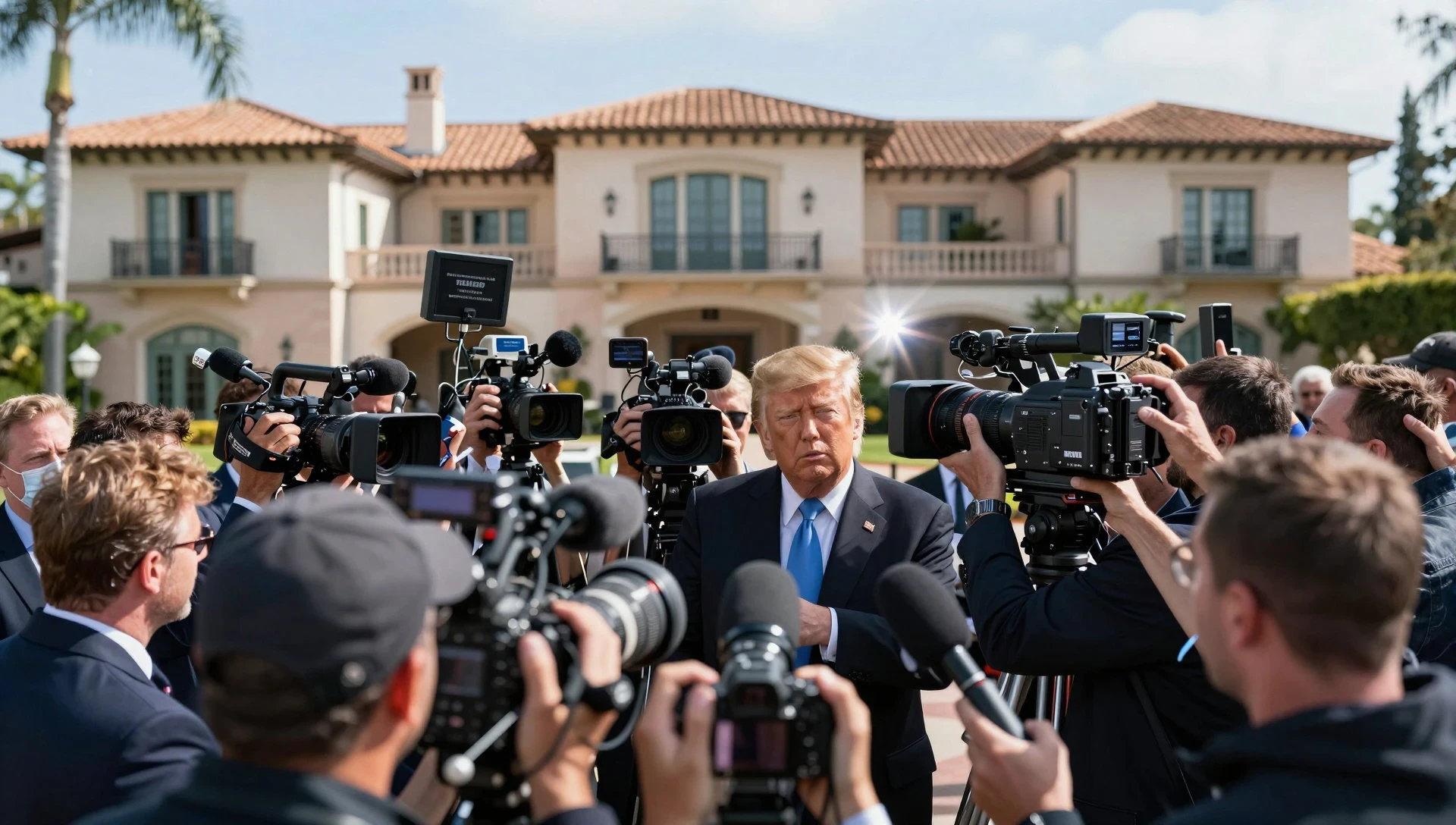
The convergence of broadcast journalism, partisan political alignment, and private elite sociability constitutes one of the more consequential structural features of contemporary American public life. The marriage of Fox News personalities Sean Hannity and Ainsley Earhardt, celebrated with a pre-wedding rehearsal dinner at Mar-a-Lago on a Friday evening in October 2026, offers an unusually legible case study of how these domains interpenetrate.
The event was not merely a private ceremony; it functioned as a visible instantiation of a media-political network whose contours are otherwise inferred from indirect evidence.
Reporting by CNN confirmed that President Donald Trump and First Lady Melania Trump attended the Friday celebration, alongside senior administration officials and prominent Fox News figures. The guest list, which included Secretary of State Marco Rubio, Health and Human Services Secretary Robert F.
On This Page
Kennedy Jr., Senators Tim Scott and Lindsey Graham, and Fox News Media chief executive Suzanne Scott, is analytically significant. It demonstrates the degree to which personnel overlap between the executive branch and the dominant conservative cable network has become institutionalised rather than incidental.
Hannity's own statement, published by Fox, emphasised a personal relationship with the president spanning more than three decades and disclosed that the couple "paid fair market value for the venue." That disclosure is telling.
It anticipates, and attempts to pre-empt, scrutiny of the financial and ethical dimensions of holding a private celebration at a property owned by a sitting president. The following analysis examines the event's media, political, and ethical implications in systematic detail.
TL;DR The Hannity–Earhardt pre-wedding dinner at Mar-a-Lago illustrates the consolidation of conservative media and executive power into a single social network. Attendance by cabinet secretaries, senators, and Fox executives, combined with Hannity's pre-emptive disclosure of market-rate venue payment, signals both the normalisation of media-political intimacy and an awareness of its ethical vulnerabilities. The episode is best understood not as gossip but as evidence of a structural realignment in American information governance.
The Architecture of Media-Political Convergence
The relationship between Fox News and the Trump administration has long exceeded conventional reporter-source dynamics. What distinguishes the 2026 wedding weekend is its explicit ceremonial dimension: a private life event became a venue for the public performance of an alliance.
Analysts of political communication have documented the progressive blurring of boundaries between partisan media and governing institutions across multiple democracies, yet the American case exhibits distinctive features of personalisation and celebrity.
From Interview Access to Social Embeddedness
Hannity's career trajectory illustrates a shift from journalistic access to genuine social embeddedness within political power. His 9 p.m. programme has for years functioned as a platform for administration messaging, but the relationship described in his statement is explicitly personal rather than professional. A thirty-year friendship, by his own account, precedes and arguably conditions the editorial posture of the programme.
This distinction matters for media ethics because it relocates the relevant conflict of interest from the newsroom to the dinner table. Traditional codes of conduct address gifts, payments, and editorial interference; they are less equipped to regulate enduring friendships that shape a broadcaster's worldview.
The pre-wedding dinner at Mar-a-Lago renders such friendships visible in a manner that formal disclosure regimes rarely capture.
Earhardt's position as co-host of "Fox & Friends," the network's influential morning programme, compounds the significance. The morning show has historically served as a scheduling and framing resource for administration officials, and its co-host's marriage into the president's social circle tightens that relationship further.
The couple were reportedly dubbed the "first couple of Fox News" during their early courtship, a phrase that captures their symbolic status within the network.
Comparative scholarship on media capture suggests that such social integration is a leading indicator of editorial convergence, often preceding measurable changes in coverage. The evidence here is qualitative rather than statistical, and causal claims should therefore be qualified.
Nevertheless, the pattern of personnel overlap between Fox News and the executive branch provides a plausible mechanism through which social ties translate into informational advantage for the administration.
The Mar-a-Lago Venue as Political Symbol
Mar-a-Lago occupies a dual status as private club and informal seat of executive power, a duality that makes it analytically distinctive among American political venues. During the second Trump administration it has functioned as a site for diplomacy, patronage, and now ceremonial sociability. Hosting a media wedding there collapses distinctions between state, commerce, and private life.
The choice of venue was, according to Hannity, deliberate and personal. Yet any event held at a property owned by the sitting president inevitably raises questions under emoluments-related norms and federal ethics guidance.
The disclosure that the couple paid fair market value appears designed to address precisely such questions, though the adequacy of that remedy remains contestable.
Scholars of executive ethics note that market-rate transactions do not fully neutralise concerns when the counterparty is the head of state. The reputational and relational benefits of hosting a prominent broadcaster at a presidential property cannot be priced conventionally. The transaction is therefore best characterised as formally compliant but substantively ambiguous.
Editorial Independence Under Social Pressure
The question of editorial independence arises whenever journalists maintain close personal ties to the subjects they cover. Fox News has consistently maintained that its programming is distinct from its personalities' private lives, a position that is defensible in principle.
In practice, however, the network's prime-time and morning programming are structured around the very individuals whose social integration is now documented.
Empirical media research offers qualified guidance here. Studies of embedded journalism and political parallelism suggest that social proximity correlates with favourable framing, though the causal pathways are complex and often indirect. Applied to the present case, the evidence supports a claim of heightened risk rather than demonstrated bias.
Hannity's statement that it was important to the couple that the president "could be part of this special time in our lives" is revealing of priorities. It frames presidential participation as a personal desideratum rather than a professional complication.
Such framing is consistent with a worldview in which the boundary between covering power and belonging to its social circle is not sharply drawn.
Comparative Perspectives on Media Elites
Media-political intermarriage is not uniquely American. In the United Kingdom, Italy, and India, prominent journalists have long moved within elite social circles that include senior politicians. Comparative analysis therefore cautions against treating the Hannity–Earhardt wedding as unprecedented.
What distinguishes the American case is the scale of the cable news ecosystem and its integration with electoral strategy.
Cross-national research on media systems identifies the United States as a case of high commercialisation combined with increasing partisan segmentation. In such systems, audience loyalty rewards perceived authenticity and social proximity to power, creating incentives for broadcasters to cultivate rather than distance elite relationships. The wedding weekend is consistent with these structural incentives.
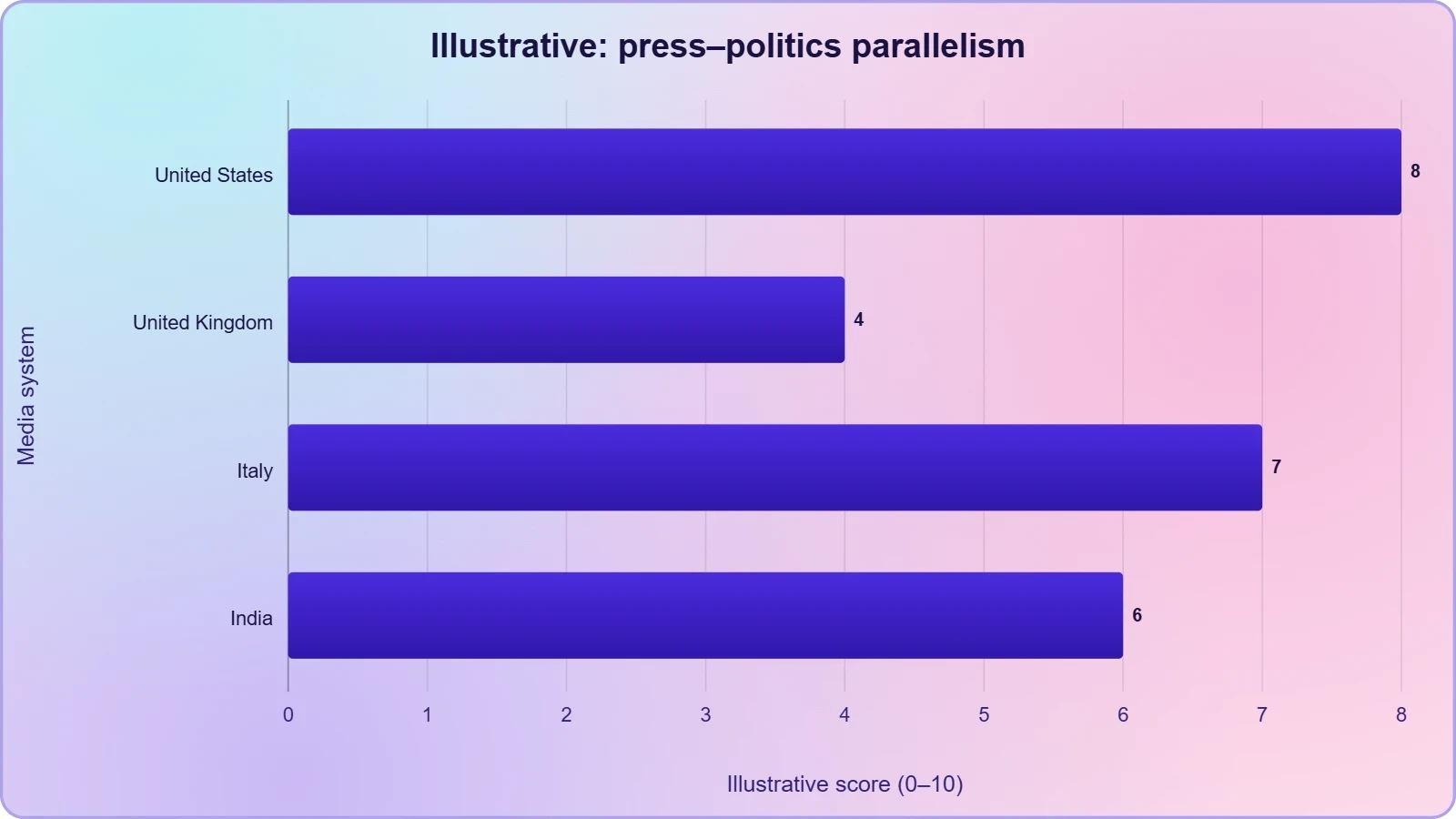
European public-service traditions, by contrast, impose stricter separation between political and journalistic elites, though enforcement varies considerably. The comparison suggests that the American pattern reflects institutional design rather than individual failing, a distinction with implications for reform. Regulatory responses targeting individuals would likely prove less effective than structural interventions.
The Financial and Ethical Dimensions of a Presidential Venue
Hannity's explicit reference to paying "fair market value" for Mar-a-Lago signals an awareness that the financial arrangement would attract scrutiny. The disclosure is unusual in its specificity and suggests prior legal or communications advice.
It also invites examination of what fair market value means when the lessor is the president and the lessee is a prominent media figure whose coverage touches the administration.
Emoluments, Valuation, and Disclosure Norms
The foreign and domestic emoluments clauses of the United States Constitution prohibit certain payments to the president without congressional consent. Their application to private events at presidential properties has been extensively debated, with courts generally reluctant to resolve the question definitively. The Hannity wedding therefore sits within a zone of legal ambiguity rather than clear prohibition.
Valuation presents a further complication. Mar-a-Lago's market rate for private events is not publicly benchmarked in a transparent manner, and comparable venues differ substantially in prestige and access. A payment characterised as market value may nonetheless confer non-monetary benefits, including proximity to the president, that resist quantification.
Disclosure norms compound the difficulty. The couple's statement was published by Fox rather than filed with any ethics authority, meaning that no independent verification of the payment exists in the public record. CNN's request for comment from the Trump Organization had, at the time of reporting, not produced a public response.
Patronage, Access, and the Political Economy of Proximity
Political economy offers a useful lens for interpreting the event. Access to senior officials is a scarce resource in any capital, and venues that reliably generate such access acquire premium value. Mar-a-Lago's transformation into a hub of administration activity has accordingly enhanced its commercial and symbolic standing.
For media organisations, proximity to power is simultaneously an asset and a liability. It yields sources, invitations, and information advantages, but it also creates dependencies that can compromise adversarial reporting.
The wedding weekend illustrates this tension in unusually concrete form, with network executives and on-air talent sharing a guest list with cabinet secretaries.
Public-choice theory predicts that such arrangements will persist where the benefits to participants exceed the reputational costs. Given the audience loyalty enjoyed by Fox News personalities, the costs appear manageable. The disclosure of market-rate payment may be sufficient to satisfy formal expectations without altering the underlying structure of access.
Transparency Deficits in Elite Transactions
The absence of an independent disclosure mechanism is perhaps the most consequential feature of the episode. Statements published by media organisations about their own personnel cannot substitute for external verification. This asymmetry between assertion and evidence is characteristic of elite transactions generally, where reputational capital often replaces formal audit.
Journalistic norms would ordinarily require that a news organisation report sceptically on financial arrangements involving its own staff. Where the organisation is itself a party to the arrangement, the capacity for sceptical self-reporting is structurally limited. Fox's publication of the couple's statements therefore functions as disclosure without independent scrutiny.
Regulatory frameworks for media ethics in the United States are notably permissive compared with those in several European jurisdictions. The Federal Communications Commission's remit does not extend to conflicts of interest among cable news personalities, and industry self-regulation is voluntary. The resulting transparency deficit is systemic rather than specific to this event.
Precedent and Normalisation Effects
Each high-profile instance of media-political social integration raises the baseline of what is considered acceptable. Normalisation theory suggests that repeated exposure to previously unusual arrangements reduces the salience of ethical objections over time. The Hannity–Earhardt wedding may therefore matter less for its immediate implications than for its precedential effect.
Historical comparison supports this concern. Earlier generations of American journalists maintained visible social distance from political leaders, a norm that has eroded gradually since the 1990s. The erosion has been driven by commercial competition, partisan realignment, and the rise of personality-driven programming rather than by any single decision.
Whether the current trajectory is reversible remains uncertain. Structural reforms, such as mandatory disclosure of senior media figures' political donations and social ties, have been proposed but not adopted. Absent such reforms, the pattern described here is likely to recur with diminishing public comment.
We Also Published
Media Framing and the Politics of Celebration
The reporting of the wedding weekend itself constitutes a secondary object of analysis. Coverage by CNN emphasised the guest list and the venue's political significance, while Fox's own statements foregrounded personal happiness and long-standing friendship.
These divergent framings illustrate how the same event can be rendered as either a governance concern or a human-interest story.
Framing Theory Applied to Elite Weddings
Framing theory holds that the selection and emphasis of certain aspects of an event shapes audience interpretation. Coverage emphasising the guest list invites readers to consider institutional relationships; coverage emphasising romance invites readers to consider the couple's private lives. Both framings are factually accurate, yet they direct attention differently.
The CNN report balances both dimensions, noting the political significance of attendance while also quoting Earhardt's statement about "this beautiful season of our lives." This dual framing is characteristic of mainstream political coverage, which seeks to inform without appearing gratuitously hostile. The balance, however, can obscure the structural questions at stake.
Fox's own framing, as conveyed through the couple's statements, is almost exclusively personal. The reference to fair market value is the sole concession to institutional concerns, and it is embedded within a narrative of gratitude and friendship. Such framing is consistent with the network's broader editorial approach to stories involving the president.
The Celebrity-Political Interface
The wedding also illustrates the broader phenomenon of celebrity-political convergence in American culture. Cable news personalities occupy a status analogous to entertainment figures, with public recognition, commercial endorsements, and cultural influence. Their private lives accordingly acquire public significance that would be inconceivable for ordinary journalists.
This status has commercial logic. Personality-driven programming generates audience loyalty that transcends individual stories, and the personal lives of presenters become part of the product. The wedding weekend is therefore not merely a private event but a brand-consistent narrative moment for the network and its personalities.
Scholars of celebrity studies note that such convergence tends to depoliticise structural questions by personalising them. Attention to the couple's happiness displaces attention to the institutional relationships that their guest list reveals. The depoliticising effect is not necessarily intentional, but it is analytically significant.
Audience Reception and Polarisation
Audience reception of the wedding coverage is likely to be strongly polarised along partisan lines. Fox's audience may interpret the event as a heartwarming affirmation of shared values, while other audiences may interpret it as evidence of media capture. Such polarisation is well documented in studies of selective exposure and motivated reasoning.
The polarisation has implications for accountability. If a substantial segment of the public does not regard media-political intimacy as problematic, then pressure for reform is unlikely to materialise from electoral or consumer channels. Accountability may therefore depend on professional norms and internal governance rather than external demand.
Survey evidence on public trust in media suggests declining confidence across the political spectrum, though the drivers differ by partisanship. Conservatives tend to distrust mainstream outlets, while liberals increasingly distrust partisan cable news. The wedding weekend is unlikely to alter these trends materially.
Comparative Coverage Across Outlets
Comparative analysis of coverage across outlets would require systematic content analysis beyond the scope of a single report. Nevertheless, the available evidence suggests a predictable pattern: outlets aligned with the administration emphasise personal narrative, while outlets critical of it emphasise institutional implications. This pattern is consistent with established findings on partisan media framing.
International outlets are likely to frame the event as evidence of democratic backsliding or media capture, reflecting different editorial traditions and audience expectations. Such framing may be analytically useful but risks overstating the significance of a single social event. Qualified interpretation is therefore essential.
The most defensible conclusion is that the wedding weekend is symptomatic rather than causal. It reveals an existing structure of media-political integration rather than creating one. Its analytical value lies in making visible what is ordinarily inferred, and in prompting reflection on the norms that govern elite sociability in a polarised information environment.
Institutional Implications for Journalism and Governance
Beyond the specific event, the wedding weekend raises broader questions about the institutional design of American journalism and its relationship to governing power. These questions are not new, but they acquire renewed urgency in a media environment characterised by partisan segmentation and declining trust. The following sections examine three institutional dimensions: professional norms, regulatory frameworks, and the political economy of access.
- 01
- 02
- 03
- 04
Professional Norms and Their Limits
Professional journalism ethics emphasise independence, transparency, and accountability to the public. These principles are codified in various codes of conduct, though enforcement is typically voluntary and uneven. The Hannity–Earhardt case tests the limits of such codes because the relevant relationships are personal rather than transactional.
Codes of conduct typically address gifts, payments, and outside employment, but rarely address friendships or marriages. This gap reflects the difficulty of regulating private life without intruding on personal autonomy. Yet the gap also creates space for relationships that materially affect editorial judgement to develop without scrutiny.
Some news organisations have begun to address this gap through expanded conflict-of-interest disclosures covering personal relationships with political figures. Adoption remains uneven, and cable news networks have been notably slower than legacy print outlets to implement such measures. The result is a patchwork of standards across the industry.
Regulatory Frameworks and Their Gaps
Regulatory oversight of media ethics in the United States is limited by the First Amendment and by a policy preference for industry self-regulation. The Federal Communications Commission's authority extends to broadcast licensing and content standards but not to the personal conduct of cable news personalities. Cable networks are largely unregulated in this respect.
Campaign finance law imposes disclosure requirements on political donations but not on social relationships. Ethics rules for executive branch employees address gifts from prohibited sources but do not reach private events hosted by media figures. The resulting regulatory landscape leaves significant gaps around the very relationships that most affect public information.
Comparative analysis suggests that some jurisdictions have adopted more robust frameworks. The United Kingdom's Independent Press Standards Organisation, while voluntary, provides a complaints mechanism that can address conflicts of interest. Whether such mechanisms would be constitutionally permissible in the United States is doubtful.
The Political Economy of Access
Access to political decision-makers is a scarce resource that media organisations compete to obtain. The competition creates incentives to cultivate relationships that may compromise adversarial reporting. This dynamic is not unique to Fox News but is particularly pronounced in personality-driven cable news formats.
Economic analysis of media markets suggests that audience segmentation rewards partisan alignment. Networks that align closely with a political coalition can build loyal audiences and command premium advertising rates. The resulting commercial logic reinforces the social integration described in this analysis.
Reform proposals have focused on structural interventions such as public funding for journalism, transparency requirements for platform algorithms, and strengthened public-service broadcasting. Each proposal has significant limitations and none addresses the specific phenomenon of elite sociability directly. The problem may therefore be resistant to conventional policy remedies.
Conclusion: Reading the Wedding as Evidence
The Hannity–Earhardt wedding weekend is best understood as a diagnostic event rather than a scandal. It reveals, in unusually concrete form, the social architecture that connects conservative media to executive power in the contemporary United States.
The guest list, the venue, and the disclosure of market-rate payment together constitute a legible record of that architecture.
Analytical caution is warranted. A single event cannot establish causation, and the participants' motives are not directly observable. What can be established is the existence of dense social ties between senior media figures and senior officials, and the awareness among participants that such ties require justification. That awareness is itself significant evidence of normative tension.
The broader implication is that media ethics frameworks designed for an earlier era of institutional separation are poorly adapted to a landscape of social integration. Reform, where it occurs, is likely to be incremental and contested.
In the interim, public understanding of the structural relationships revealed by events such as this wedding remains an essential component of informed citizenship.
From our network :
- Live Online English Classes for Kids: Do They Actually Reduce Anxiety?A ten-week study reveals that synchronous online English classes can significantly reduce child language anxiety while improving listening and reading skills. Discover what makes these programs effective and how parents can select the right one.
- CISA’s Ten-Advisory Wave: Why Generic Patching Fails in OT and How to Build Product-Specific PlaybooksCISA released ten ICS advisories in one week, exposing critical infrastructure risks. Generic patching fails in OT. Learn to build product-specific remediation playbooks.
- The Final Descent: How ESA Retired the Legendary Cluster Constellation After 24 Years of Space Weather ScienceAfter 24 years mapping Earth’s magnetosphere, ESA’s Cluster mission concluded with a precisely controlled reentry over the South Pacific. This analysis explores the scientific legacy, engineering decisions, and debris mitigation principles behind one of space exploration’s most responsible retirements.
- Committed Mediterranean Precipitation Decline: Why Emissions Cuts Alone Cannot Restore Winter RainsNew NOAA research reveals that Mediterranean winter rains may decline irreversibly even with emissions cuts. Explore the science of committed climate change and regional impacts.
- How AI Agents Will Change the Way We Manage Personal FinancesExplore how AI agents are transforming personal finance through automated budgeting, bill payment, and investment management, while examining the critical security protocols and governance frameworks required for safe deployment.
- Mobile Learning and VR in English: What Global Evidence Reveals About Effective Language TechnologyA systematic review across 14 countries reveals which language-learning technologies genuinely work. Mobile learning, AI, and VR show measurable benefits when pedagogically integrated. This evidence-based guide helps educators and learners select technology that delivers real return on investment.
- University Language Proficiency Exams: Why Institutional Tests Demand Different Preparation Than IELTS and TOEFLDiscover why university-specific language proficiency examinations differ fundamentally from IELTS and TOEFL, and learn strategic preparation approaches for institutional assessment success.
- Forbidden Matrix Patterns and Visible Lattice Points: A Geometric DictionaryExplore how multidimensional 0–1 matrices encode geometric truths, linking forbidden patterns to visible lattice points and hypergraph theory, with applications in combinatorics and computational geometry.
- The Hidden Cost of AI Convenience: Why Over-Permissioned Agents Are a Security Time BombDiscover why AI agents with excessive permissions create dangerous single points of failure, and learn how implementing least privilege principles can protect your organization from exploitation.
RESOURCES
- Watch World Leaders Converge at Mar-A-Lago - Fox Nationnation.foxnews.comPresident Trump meets Israeli Prime Minister Netanyahu on the next phase of the Gaza ceasefire, amid concerns he may be slow-walking peace as Iran…
- 'No Kings' protests against Trump policies set for Oct. 18 nationwidefoxnews.comOct 17, 2025 ... Protesters march in a 'No Kings' protest near Washington ... NEWYou can now listen to Fox News articles! "No Kings"…
- Marble, ice sculptures and optics: Trump's remote presidency draws ...washingtonpost.comJan 3, 2026 ... PoliticsWhite HouseDonald TrumpDemocracy in AmericaCourts & Law ... — On President Donald Trump's 14th consecutive day at Mar-a-Lago ...
- Nationwide 'No Kings' protests target Trump as crowds rally in cities ...foxnews.comOct 18, 2025 ... NYC 'No Kings' protesters march with signs labeling popular Democrats 'ANTIFA'. 'No Kings' protesters in New York City (Credit: Fox…
- Trump questions Harris' race in NABJ interview in Chicago, says VP ...abc7chicago.comJul 31, 2024 ... ABC News Senior Congressional Correspondent Rachel Scott, Fox News ... ' You've had dinner with a white supremacist at your…
- Sean Hannity's Wedding Celebrates the Blurring of Fox News and ...lavocedinewyork.com2 days ago ... The pre-wedding reception at Mar-a-Lago was attended by Donald and Melania. ... Fox News and the Trump political world converged…
- Opinion | The Brotherhood of the Philandering Oligarchsnytimes.comJun 15, 2023 ... I covered Donald Trump's political ascent more than a decade before ... Fox News and Fox Mulder.” (Jonathan Swiller, Highland…
- Piece of Mind: There's No Escaping Psychologist Barbara Held's ...bowdoin.eduMar 24, 2023 ... And it's not helping Donald Trump get MAGAs past the Epstein files either. How Congressional Republicans Quickly Lost their Way…
- How Trump Is Scrambling to Raise Cash - The New York Timesnytimes.comMar 19, 2024 ... Brian Ballard, a Republican lobbyist, fund-raiser and Mar-a-Lago member, said Mr. Trump was “incredibly engaged” in the political money fight.
- Trump's Loyalists Wed Back-to-Back in Floridachosun.comFeb 2, 2026 ... Trumps Loyalists Wed Back-to-Back in Florida MAGA Figures Gather for Consecutive Nuptials of Key Aides U.S. President Donald Trump boarded ...
- Trump and His Allies Must Be Held Accountable for the January 6 ...americanprogress.orgApr 20, 2023 ... It should be noted that Trump-aligned media outlets such as Fox News stoked the Dominion narrative and the general voter…
- #ThrowbackThursday when Eric and Lara Trump attended our State ...facebook.comDec 5, 2024 ... ... New York — two careers that converged at Mar-a-Lago and then on the campaign trail. This image of Eric…
- Trump and His Allies Must Be Held Accountable for the January 6 ...americanprogress.orgApr 18, 2023 ... 66 Select Committee to Investigate the January 6th Attack on the U.S. Capitol, “Final Report,” p. 216. 67 Melissa Quinn…
- Netanyahu meets Trump at Mar-a-Lago, mending a years-long riftcbsaustin.comJul 26, 2024 ... As president, Donald Trump went well beyond his predecessors in fulfilling Israeli Prime Minister Benjamin Netanyahu's top wishes from the ...
- The Evolution of President Donald Trump's Management of Foreign ...cejiss.orgMar 18, 2022 ... In 2016, Donald Trump ran for the presidency of the United States with the promise of overturning entrenched politics as…
- 01
- 02
- 03
- 04
- 05
- 06
- 07
- 08
0 Comments