
The case of Rafael Caro Quintero constitutes one of the most consequential episodes in the history of transnational narcotics enforcement, intertwining the violent expansion of Mexican trafficking organisations with the diplomatic and judicial machinery of the United States.
At its centre lies the 1985 abduction, torture, and murder of Enrique "Kiki" Camarena, an agent of the Drug Enforcement Administration, whose death became a foundational trauma for American drug policy and a lasting irritant in bilateral relations.
The reported plea negotiations in a Brooklyn federal court therefore represent far more than a routine procedural development; they signal the possible closure of a four-decade pursuit that has shaped institutional memory on both sides of the border.
On This Page
- The Historical Architecture of the Guadalajara Cartel and the Camarena Operation
- The Legal Mechanics of Plea Bargaining in United States Federal Courts
- Bilateral Relations and the Geopolitics of Extradition
- Accountability, Evidence, and the Limits of Penal Resolution
- Strategic Implications and the Future of Transnational Enforcement
- Synthesis and Concluding Observations
The defendant, aged seventy-four and born in Sinaloa in 1952, was among the founders of the Guadalajara Cartel, an organisation that exercised considerable influence over Mexican trafficking networks during the early 1980s.
His trajectory — arrest in Costa Rica in 1985, a forty-year sentence in 1989, release in 2013 following a Mexican judicial ruling, recapture in 2022, and transfer to the United States in 2025 — illustrates the fragility of legal outcomes when sovereignty, intelligence pressure, and political calculation intersect.
The proposed arrangement, in which responsibility for Camarena's killing would be acknowledged in exchange for improved detention conditions, raises substantive questions about the evidentiary record and the limits of penal accountability.
Analysis of this matter requires attention to three interlocking dimensions: the historical architecture of the Guadalajara Cartel and the Camarena operation; the legal mechanics of plea bargaining within the American federal system; and the geopolitical consequences for United States–Mexico cooperation on security.
The following examination addresses each dimension systematically, drawing on the documented chronology and on broader scholarship concerning extradition, sentencing, and the political economy of prohibition. The central contention is that the anticipated agreement, while legally pragmatic, exposes enduring tensions between retributive justice and the strategic imperatives of bilateral enforcement.
TL;DR Rafael Caro Quintero, a founding figure of the Guadalajara Cartel, is reportedly negotiating a plea agreement in a United States federal court concerning the 1985 kidnapping, torture, and murder of DEA agent Enrique Camarena. The proposed arrangement would involve an acknowledgement of responsibility in return for improved detention conditions, with trial proceedings scheduled for March 2027. The case encapsulates the intersection of cartel history, federal plea bargaining, and United States–Mexico security diplomacy, and it raises unresolved questions about accountability, evidentiary standards, and the political utility of long-delayed prosecutions.
The Historical Architecture of the Guadalajara Cartel and the Camarena Operation
The Guadalajara Cartel emerged during the late 1970s and early 1980s as a confederation of trafficking networks operating principally in the state of Jalisco, and it acquired a degree of operational sophistication that distinguished it from earlier, more fragmented organisations.
Its founders, including Caro Quintero, coordinated cultivation, processing, and transhipment functions across a substantial territorial base, thereby establishing logistical templates later adopted by successor groups. Scholarly accounts characterise this period as a formative moment in the professionalisation of Mexican trafficking, when rudimentary familial enterprises gave way to structured, paramilitary-style entities capable of resisting state pressure.
The Formation and Operational Logic of the Cartel
The cartel's rise must be situated within the broader political economy of Mexican agriculture and rural governance during the 1970s, when illicit cultivation offered economic alternatives in regions with limited state investment.
Coordination among regional bosses permitted the sharing of transport corridors and the management of risk, producing a form of horizontal governance that reduced internecine violence. This arrangement, however, depended on informal understandings with local authorities, an equilibrium that proved unstable once United States enforcement attention intensified.
Contemporary analyses emphasise that the Guadalajara Cartel functioned less as a rigid hierarchy than as a coalition of interests, with founders exercising influence through reputation and resource control rather than formal command.
Such a structure facilitated rapid expansion but complicated accountability, since operational decisions were frequently delegated to subordinate actors whose identities remained obscure. This diffusion of responsibility later became a central evidentiary obstacle in prosecutions relating to the Camarena case.
The organisation's revenue base rested predominantly on cannabis cultivation, supplemented by heroin and, subsequently, cocaine transit following Colombian partnerships. Diversification reduced exposure to single-market disruption and enabled the cartel to absorb enforcement losses without structural collapse.
Economists of illicit markets describe this portfolio strategy as characteristic of mature trafficking enterprises, which prioritise resilience over short-term maximisation.
Territorial control in Jalisco and adjacent states was maintained through a combination of patronage, intimidation, and selective violence, the last of which was calibrated to avoid provoking sustained federal intervention.
This calculus, however, proved fallible when the organisation confronted an external actor — the DEA — whose institutional interests transcended local political accommodation. The resulting confrontation transformed a regional trafficking dispute into an international crisis.
The Camarena Abduction and Its Immediate Context
On 8 February 1985, cartel operatives abducted Camarena outside the United States Consulate in Guadalajara, an act that represented an unprecedented escalation against a foreign state's personnel. The abduction followed the destruction of a large cannabis plantation in Chihuahua, which the cartel attributed to intelligence supplied by the agent.
The decision to target a United States official reflected a belief that such action would deter further interference.
Camarena was interrogated and tortured over several days before his death, and his body was subsequently discovered in the neighbouring state of Michoacán. Forensic accounts and witness testimony indicate sustained physical abuse intended to extract information about surveillance operations.
The brutality of the killing, widely reported in the American press, generated public outrage and intensified congressional scrutiny of drug enforcement policy.
The operational security failures surrounding the abduction — including the involvement of numerous participants and the eventual discovery of remains — provided investigators with substantial, if contested, evidence. Prosecutors later relied on cooperating witnesses whose credibility was repeatedly challenged, a pattern that has characterised narcotics prosecutions in both jurisdictions. The evidentiary record thus remains partially dependent on testimony of uncertain reliability.
Institutional responses were swift: the DEA launched an extensive investigation, and bilateral cooperation, previously informal, was placed on a more formal footing. The case became a symbol of the risks borne by enforcement personnel and a justification for expanded extraterritorial operations.
Its resonance persists in the agency's memorialisation of Camarena and in the priority accorded to his alleged killers.
Arrest, Conviction, and the Mexican Judicial Reversal
Caro Quintero was arrested in Costa Rica in April 1985 and subsequently transferred to Mexico, where in 1989 he received a forty-year sentence for kidnapping, homicide, trafficking, and criminal association. The conviction appeared to conclude the principal legal proceedings, yet its foundations were later subjected to sustained judicial scrutiny.
The length of the sentence reflected the gravity attributed to the offences and the political salience of the case.
In 2013, a Mexican court ruled that the defendant had been tried improperly, a determination grounded in procedural rather than substantive considerations, and ordered his release. The decision provoked sharp criticism from United States officials and raised questions about the robustness of judicial review in high-profile cases. Legal commentators noted that procedural defects, however technical, may invalidate convictions irrespective of underlying culpability.
Following release, Caro Quintero evaded recapture for nearly a decade, reportedly residing in remote areas of Sinaloa and relying on local networks for protection. His recapture in 2022 and subsequent transfer to the United States in 2025 reflected sustained pressure from American authorities and a recalibration of bilateral security cooperation. The transfer itself constituted a significant diplomatic concession by Mexico.
The sequence of release, evasion, and recapture illustrates the limitations of purely national legal responses to transnational criminality. It also demonstrates how procedural irregularities can produce outcomes that appear substantively unjust to external observers, thereby complicating international cooperation. The case has consequently become a reference point in debates concerning judicial reform and extradition policy.
The DEA's Institutional Memory and the Politics of Pursuit
The DEA maintains a memorial website for Camarena that identifies Caro Quintero as the principal individual responsible for the agent's kidnapping, torture, and murder. This institutional commemoration serves both as a tribute and as a statement of organisational resolve, reinforcing the agency's commitment to pursuing those it regards as responsible. Such memorialisation shapes internal culture and external expectations regarding accountability.
Successive administrations have treated the case as a benchmark of Mexican cooperation, linking it to broader assessments of security partnership. The pursuit of Caro Quintero thus acquired a symbolic function exceeding its operational significance, becoming a test of political will. Analysts observe that symbolic cases often distort resource allocation and complicate diplomatic negotiation.
Questions have been raised about whether United States pressure directly precipitated the 2022 recapture and the 2025 transfer, with Mexican officials emphasising sovereign discretion while American counterparts stressed cooperative arrangements. The precise causal chain remains contested, and available evidence does not permit definitive attribution. This ambiguity is characteristic of security diplomacy, where public claims and private understandings frequently diverge.
The agency's persistent focus on the case has also influenced prosecutorial strategy, encouraging reliance on cooperating witnesses and historical testimony. Such reliance carries inherent risks, including challenges to credibility and the possibility of evidentiary decay over four decades. These constraints inform the current plea negotiations and the calculus of both parties.
The Legal Mechanics of Plea Bargaining in United States Federal Courts
Plea bargaining occupies a central position in the administration of American criminal justice, resolving the overwhelming majority of federal cases without trial. In high-profile prosecutions, agreements serve to conserve judicial resources, manage evidentiary uncertainty, and secure outcomes that both parties regard as preferable to the risks of litigation.
The reported negotiations in the Caro Quintero matter must therefore be understood within this institutional context rather than as an exceptional departure.
Procedural Framework and Judicial Oversight
Federal plea agreements are governed by Rule 11 of the Federal Rules of Criminal Procedure, which requires that the defendant's plea be knowing, voluntary, and supported by an adequate factual basis.
The presiding judge must verify these conditions before accepting an agreement, and may reject arrangements that appear contrary to the interests of justice. Judicial discretion thus remains a meaningful constraint on prosecutorial and defence bargaining.
In the present matter, the presiding judge, aged ninety-two, has reportedly urged both parties to proceed expeditiously toward resolution, a direction consistent with concerns about the age of the defendant and the antiquity of the evidence. Judicial encouragement of settlement reflects pragmatic considerations, including docket management and the welfare of ageing participants. Such encouragement does not, however, determine the substantive terms of any agreement.
The proposed exchange — an acknowledgement of responsibility for Camarena's killing in return for improved detention conditions and the possible termination of solitary confinement — illustrates the non-monetary currency of contemporary plea negotiations.
Conditions of confinement have become negotiable elements in cases involving elderly or infirm defendants, particularly where sentences are effectively determined by age. This development raises questions about the commensurability of penal burdens.
Sentencing following a plea typically involves calculations under the Federal Sentencing Guidelines, which assign offence levels based on conduct and criminal history. In cases involving homicide, the applicable levels are severe, and any agreement must reconcile guideline calculations with statutory maxima and the defendant's age. The resulting sentence may therefore be substantially shorter than a literal application of the guidelines would suggest.
Evidentiary Challenges and the Value of Cooperation
Prosecutions reliant on events occurring four decades ago confront formidable evidentiary difficulties, including the death or unavailability of witnesses, the degradation of physical evidence, and the unreliability of memory. Cooperating witnesses, often themselves implicated in criminal conduct, are subject to impeachment on grounds of bias and incentive. These vulnerabilities increase the attractiveness of negotiated outcomes for prosecutors.
The defence, conversely, must assess the probability of conviction and the likely sentence, weighing these against the certainty and conditions associated with a plea. For an elderly defendant, the marginal value of reduced confinement may exceed the benefit of acquittal achieved after prolonged litigation. Rational choice models of plea bargaining predict settlement where the parties' estimates of trial outcomes converge sufficiently.
Legal scholars have documented the phenomenon of "trial penalty," whereby defendants who proceed to trial receive substantially harsher sentences than those who plead guilty. This disparity exerts structural pressure toward settlement, independent of the merits of individual cases.
Its operation in high-profile matters raises concerns about the transparency of justice and the public's understanding of outcomes.
The Camarena case additionally involves potential foreign policy considerations, since the terms of any agreement may be interpreted as a statement about the value accorded to fallen enforcement personnel. Prosecutors must therefore balance evidentiary pragmatism against the symbolic expectations of the agency and the public. This tension is inherent in the prosecution of historically significant crimes.
Conditions of Confinement as Negotiable Consideration
Solitary confinement has attracted sustained criticism from human rights bodies, which cite psychological harm and the absence of meaningful review in many jurisdictions. Agreements addressing detention conditions therefore engage broader debates about the legality and humanity of restrictive regimes. Courts have increasingly scrutinised prolonged isolation, particularly for ageing or mentally vulnerable prisoners.
Negotiating improved conditions in exchange for cooperation is not unprecedented, though it remains controversial, as critics argue that such terms commodify basic dignities that should not require bargaining. Proponents contend that conditions are a legitimate subject of negotiation where they do not compromise public safety. The practice thus reflects unresolved questions about the boundaries of penal discretion.
For a defendant of advanced age, health considerations assume particular importance, and detention conditions may materially affect life expectancy and quality of life. Medical evidence concerning the effects of isolation on elderly prisoners is substantial, though contested in specific applications. These considerations may inform judicial assessment of whether an agreement is consistent with humane treatment.
The proposed arrangement also raises questions about the relationship between acknowledgement of responsibility and the legitimacy of the resulting sentence. If responsibility is accepted primarily to secure better conditions rather than as genuine contrition, the expressive function of the plea may be diminished. This concern is central to scholarly critiques of negotiated justice.
Timelines, Judicial Age, and the March 2027 Trial Date
The scheduling of trial for March 2027 introduces a temporal horizon against which both parties must assess risk, given the defendant's age and the presiding judge's advanced years. Delay increases the probability of intervening events, including incapacity or death, that would render proceedings moot. Such uncertainty strengthens incentives to conclude an agreement promptly.
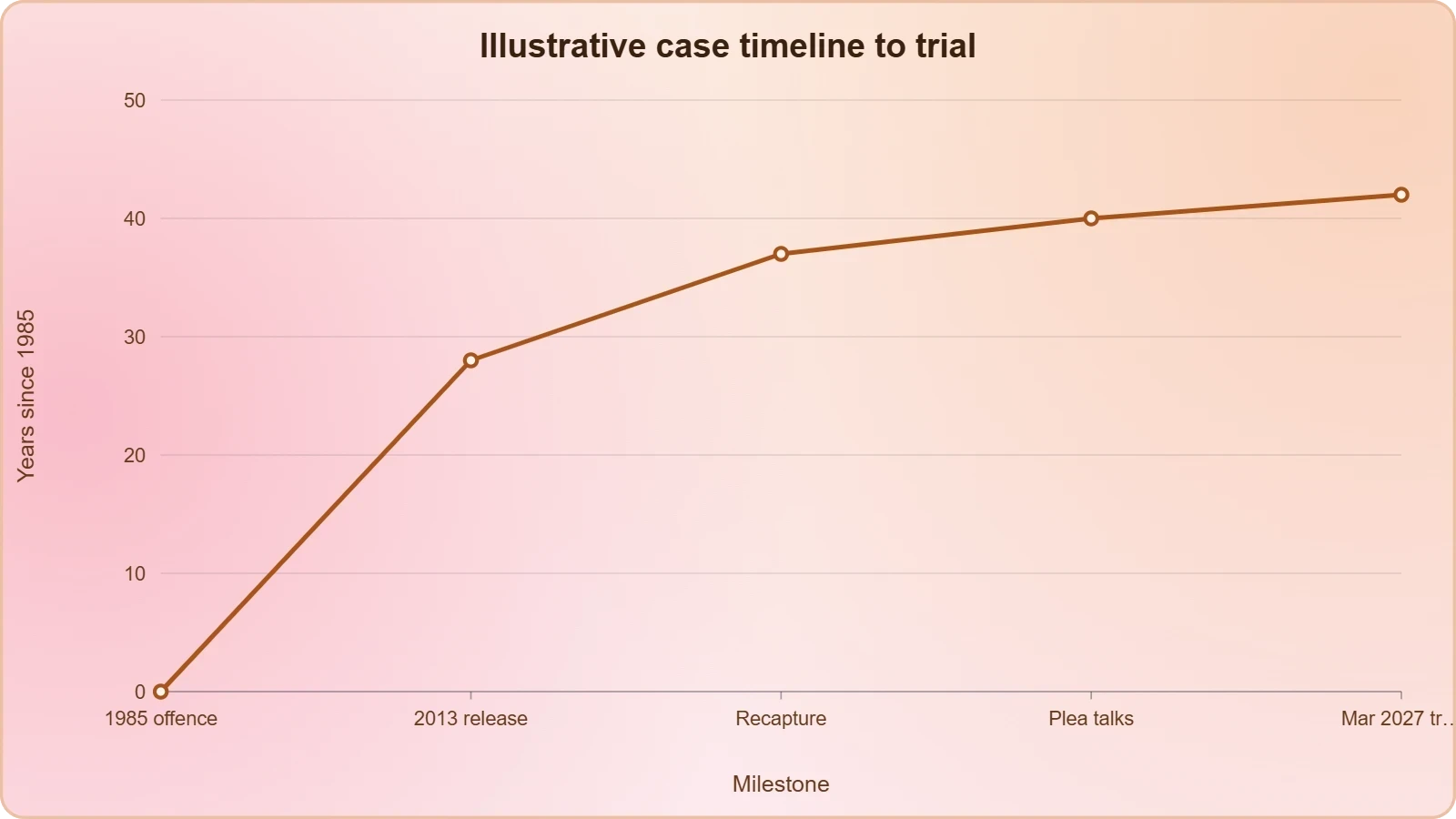
Judicial succession poses additional complications, as a new judge may adopt different views on evidentiary rulings or sentencing. The parties must therefore anticipate potential discontinuities in the management of the case. These considerations are routine in protracted litigation but acquire heightened significance where participants are elderly.
The following table summarises the principal chronological milestones and their legal significance, providing a structured basis for assessing the trajectory of the proceedings.
We Also Published
Bilateral Relations and the Geopolitics of Extradition
The Camarena case has functioned for four decades as a barometer of United States–Mexico security cooperation, shaping mutual expectations and institutional practices. Its resolution, whether by trial or agreement, will be interpreted as evidence of the durability of that partnership and of the willingness of each state to accommodate the other's priorities. The diplomatic stakes therefore extend well beyond the fate of a single defendant.
Sovereignty, Extradition, and Judicial Independence
Mexico's constitutional framework restricts extradition in certain circumstances, and the 2013 release demonstrated the capacity of domestic courts to override executive preferences. This tension between judicial independence and diplomatic obligation is characteristic of rule-of-law systems, yet it complicates bilateral arrangements. The 2025 transfer required legal and political accommodation on both sides.
Scholars of international law distinguish between extradition, rendition, and transfer, each carrying distinct legal consequences and political implications. The precise characterisation of Caro Quintero's transfer remains a matter of interpretation, with officials offering differing accounts. Such ambiguity is common in security cooperation, where legal form may be subordinated to operational outcomes.
The principle of dual criminality, central to extradition practice, is satisfied in this case given the gravity of the alleged offences under both legal systems. Procedural obstacles, however, may arise from statutes of limitation, evidentiary standards, and the availability of the death penalty, which Mexico opposes. These factors constrain the range of permissible arrangements.
Judicial independence in Mexico has been strengthened by constitutional reforms, yet it remains subject to political pressure and resource constraints. The 2013 ruling, whatever its merits, illustrated the capacity of courts to resist executive and foreign expectations. Such independence is normatively desirable but may generate friction in bilateral relations.
Security Cooperation and the Politics of Pressure
United States pressure on Mexico to recapture and transfer the defendant has been widely reported, though its precise mechanisms remain opaque. Diplomatic representations, intelligence sharing, and conditional assistance are among the instruments available to influence partner states. Their effectiveness depends on the target state's dependence on American cooperation.
The Mérida Initiative and its successors established frameworks for security assistance that link funding to performance on specified objectives. Whether the Camarena case featured explicitly in such conditionality is uncertain, though its symbolic prominence suggests it informed broader assessments. Analysts caution against attributing specific outcomes to single pressure points.
Mexican officials have emphasised sovereignty and the autonomy of judicial decisions, while acknowledging the importance of cooperation against transnational crime. This rhetorical balancing reflects domestic political sensitivities, particularly regarding perceived subordination to American interests. Public opinion in Mexico is divided on the appropriate posture toward United States demands.
The case also intersects with debates about the militarisation of drug enforcement and the human costs of prohibitionist policies. Critics argue that symbolic prosecutions divert attention from structural reforms, while proponents contend that accountability for violence against officials is indispensable. These competing perspectives shape the political environment in which negotiations occur.
Comparative Perspectives on Delayed Prosecutions
Delayed prosecutions of ageing defendants raise recurring questions about the purposes of punishment and the utility of incarceration at advanced ages. Retribution, deterrence, incapacitation, and rehabilitation each yield different implications when the defendant's remaining lifespan is limited. Jurisdictions vary considerably in their approaches to such cases.
International criminal tribunals have confronted similar dilemmas, developing doctrines concerning fitness to stand trial and the interests of justice in prolonged proceedings. These precedents offer instructive comparisons, though domestic systems are not bound by them. The Caro Quintero matter thus participates in a broader global conversation about temporal justice.
Comparative analysis of plea bargaining across common-law and civil-law systems reveals divergent assumptions about the proper role of negotiation in criminal adjudication. Civil-law jurisdictions traditionally favour judicial investigation and formal trial, though negotiated outcomes have become more common. The American approach, with its extensive reliance on bargaining, remains distinctive.
The following table compares selected dimensions of the case across legal and institutional perspectives, illustrating the range of considerations that inform the anticipated agreement.
Public Memory and the Symbolism of Camarena
The memorialisation of Camarena within American enforcement culture has endowed the case with a significance that transcends its legal particulars. Annual commemorations and institutional references sustain public awareness and generate expectations of accountability. Such symbolic weight constrains the discretion of prosecutors and complicates negotiated outcomes.
In Mexico, public memory of the case is more ambivalent, reflecting broader scepticism toward prohibitionist policies and their violent consequences. Some commentators regard the pursuit of ageing defendants as disproportionate, while others emphasise the gravity of the original offences. This divergence in collective memory shapes the political feasibility of various resolutions.
Media coverage has played a formative role in constructing the case's public meaning, with narrative frames emphasising brutality, impunity, and bilateral tension. Such framing influences public expectations and may constrain judicial and political actors. The relationship between media representation and legal process is therefore consequential.
Scholars of transitional justice note that symbolic cases often serve to consolidate institutional legitimacy, even where substantive outcomes are imperfect. The Camarena prosecution may function similarly, reaffirming norms against violence toward state officials. Whether such reaffirmation justifies the costs of prolonged proceedings remains contested.
- 01
- 02
- 03
- 04
Accountability, Evidence, and the Limits of Penal Resolution
The anticipated agreement invites scrutiny of what constitutes meaningful accountability in cases of extreme violence committed decades ago. Legal resolution, whether by trial or plea, addresses individual culpability but may leave broader questions about organisational responsibility and state complicity unaddressed. The adequacy of penal responses must therefore be assessed against multiple conceptions of justice.
Retribution and the Ageing Defendant
Retributive theories justify punishment in proportion to moral desert, yet the practical significance of incarceration diminishes as defendants approach the end of life. Critics argue that prolonged confinement of elderly prisoners serves neither deterrence nor public safety, while proponents emphasise the expressive value of proportionate sentences. The debate reflects deeper disagreements about the purposes of punishment.
Ageing prisoners present distinctive medical and humanitarian challenges, including elevated healthcare costs and diminished capacity for rehabilitation. Correctional systems increasingly confront questions about compassionate release and geriatric accommodation. These considerations inform negotiations over detention conditions in the present case.
The defendant's age at the time of the offences — approximately thirty-three — bears on assessments of culpability and capacity for reform. Courts have recognised that youthful offenders may warrant different treatment, though this principle applies less clearly to mature adults directing criminal enterprises. The moral calculus thus remains complex.
Comparative practice suggests that sentences for historical atrocities frequently reflect negotiated assessments rather than strict proportionality. This pragmatism may be defensible where evidence is uncertain, yet it risks conveying inconsistent messages about the value of victims' lives. The tension is inherent in transitional and delayed justice.
Evidentiary Decay and the Reliability of Testimony
Four decades between offence and adjudication inevitably degrade the evidentiary record, as witnesses die, memories fade, and physical evidence deteriorates. These processes disproportionately affect defendants, who may lack resources to reconstruct events. The resulting asymmetry raises questions about the fairness of delayed proceedings.
Cooperating witnesses, central to narcotics prosecutions, are particularly vulnerable to credibility challenges given their incentives to secure leniency. Courts have developed safeguards, including corroboration requirements and cautionary instructions, yet risks remain. The reliability of such testimony in historical cases is a matter of continuing scholarly debate.
Forensic advances, including DNA analysis and digital reconstruction, have occasionally revived cold cases, though their applicability to the Camarena matter is limited. The passage of time thus constrains the prosecution's ability to present a comprehensive account. This constraint informs the calculus favouring settlement.
The following table summarises evidentiary categories and their likely reliability after four decades, providing a structured assessment of the prosecution's position.
Organisational Responsibility and Structural Impunity
Individual prosecutions inevitably simplify complex organisational phenomena, attributing collective action to discrete actors whose culpability can be established in court. The Guadalajara Cartel's operations involved numerous participants whose roles remain undocumented or unprosecuted. This selectivity raises questions about the representativeness of any single conviction.
Structural impunity, whereby powerful networks evade accountability through political protection or evidentiary opacity, persists despite individual prosecutions. Scholars argue that focusing on charismatic figures may obscure the systemic conditions enabling trafficking. The Caro Quintero case thus illustrates the limits of personalised justice.
Institutional complicity, including allegations of collusion between traffickers and security forces, has been documented in various jurisdictions though rarely adjudicated. Such allegations complicate narratives of clear-cut villainy and heroism. Their absence from formal proceedings limits the historical record available to the public.
Truth commissions and historical inquiries offer alternative mechanisms for addressing systemic wrongdoing, though their applicability to narcotics-related violence is limited. The case may therefore leave unresolved questions about the broader architecture of impunity. This gap is significant for understanding the period.
Restorative and Transitional Alternatives
Restorative justice approaches emphasise repair of harm and recognition of victims, offering alternatives to purely punitive responses. Their application to cases of extreme violence remains controversial, particularly where victims' families seek retribution. Nevertheless, such frameworks illuminate dimensions of justice that penal proceedings neglect.
Victims' families in the Camarena case have reportedly sought acknowledgment and accountability rather than specific sentences, reflecting priorities common among survivors of political violence. Their perspectives are frequently marginalised in legal proceedings focused on defendants' rights. Greater attention to victim-centred outcomes may enhance the legitimacy of resolutions.
Transitional justice scholarship emphasises the importance of acknowledgment, memorialisation, and institutional reform alongside prosecution. These elements may be more consequential than individual sentences in addressing historical wrongs. The Camarena case presents opportunities for such measures, though political will remains uncertain.
The following table outlines potential justice mechanisms and their applicability to the present case, illustrating the range of responses beyond conventional prosecution.
Strategic Implications and the Future of Transnational Enforcement
The resolution of this case will inform expectations regarding the prosecution of historical trafficking offences and the willingness of states to transfer high-profile defendants. Its precedential value, though limited by the uniqueness of the circumstances, may shape future negotiations. Enforcement agencies and defence counsel alike will study the outcome for strategic guidance.
Deterrence and the Calculus of Violence Against Officials
Deterrence theory posits that credible punishment discourages future offences, yet the empirical evidence for deterrence in transnational criminal contexts remains contested. The prolonged pursuit of Caro Quintero may signal resolve, though its effect on cartel behaviour is uncertain. Scholars caution against overestimating the influence of individual prosecutions on organisational strategy.
Violence against enforcement personnel represents a category of offence that states treat with particular severity, reflecting institutional self-protection as well as public interest. The Camarena case established a template for sustained pursuit across decades and jurisdictions. Whether this template deters or merely satisfies institutional imperatives is debated.
Cartel decision-making is shaped by multiple factors, including market conditions, territorial competition, and state capacity, of which prosecution risk is only one. Attributing behavioural change to specific cases risks oversimplification. A more nuanced analysis considers the interaction of enforcement, economics, and politics.
The following table presents selected indicators relevant to enforcement outcomes, illustrating the complexity of assessing deterrence in transnational contexts.
Institutional Legitimacy and Public Trust
High-profile prosecutions serve expressive functions, affirming societal condemnation of particular conduct and reinforcing trust in institutions. The Camarena case has functioned in this manner for the DEA, sustaining internal cohesion and external support. Its resolution will be evaluated partly in these symbolic terms.
Public trust in judicial institutions depends on perceptions of fairness, transparency, and consistency, which negotiated outcomes may either enhance or undermine. Plea agreements can appear opaque, particularly where their terms are not fully disclosed. Courts must therefore balance confidentiality against public accountability.
Institutional legitimacy also depends on the perceived independence of prosecutors from political influence, a concern heightened in cases with diplomatic dimensions. Allegations of political motivation can erode confidence in outcomes, irrespective of their legal merits. Safeguards against improper influence are therefore essential.
The long duration of the case has itself become a subject of commentary, with observers questioning whether justice delayed can remain meaningful. This concern resonates with broader debates about the efficiency and fairness of criminal justice systems. The resolution may therefore be assessed against standards of timeliness as well as substance.
Lessons for Future Negotiations
The Caro Quintero negotiations offer instructive lessons regarding the management of historical cases involving ageing defendants and complex evidentiary records. Early engagement with victims' representatives, transparent communication of legal constraints, and realistic assessment of trial risks are among the practices that may improve outcomes. Institutional learning from such cases is essential.
International cooperation frameworks could be strengthened through clearer protocols for the transfer of defendants and the recognition of foreign judicial decisions. Such reforms would reduce the friction that has characterised this and similar cases. Their feasibility depends on political will and mutual trust.
Technological developments, including digital evidence preservation and secure archival systems, may mitigate future evidentiary decay in long-running investigations. Investment in such infrastructure is warranted given the increasing prevalence of historical prosecutions. These measures complement, rather than replace, traditional investigative practices.
The case ultimately illustrates the irreducible tension between legal form and political reality in transnational enforcement. Neither pure legalism nor pure expediency offers a satisfactory framework; instead, calibrated negotiation informed by principle appears most defensible. This conclusion, while modest, carries implications for the design of future mechanisms.
Synthesis and Concluding Observations
The anticipated plea agreement in the Caro Quintero matter represents a convergence of historical, legal, and diplomatic trajectories that have shaped United States–Mexico security relations for four decades. Its significance extends beyond the fate of an individual defendant to encompass questions about the purposes of punishment, the reliability of historical evidence, and the conditions under which states cooperate against transnational crime.
A measured assessment must acknowledge both the pragmatic rationale for settlement and the normative concerns that such pragmatism raises.
From a legal standpoint, the agreement reflects rational responses to evidentiary decay, the advanced age of participants, and the uncertainty inherent in protracted litigation. From a political standpoint, it signals the durability of bilateral cooperation while exposing persistent tensions over sovereignty and judicial independence.
From a normative standpoint, it invites reflection on whether negotiated outcomes can adequately express condemnation of extreme violence and acknowledge the suffering of victims and their families.
The broader lesson concerns the limits of penal resolution in addressing structural wrongdoing. Individual accountability, however symbolically important, cannot substitute for institutional reform, truth-telling, and the redress of systemic conditions that enable violence.
A comprehensive response to the legacy of the Guadalajara Cartel would require measures extending beyond the courtroom, including memorialisation, victim support, and sustained investment in the rule of law on both sides of the border.
Finally, the case underscores the importance of temporal considerations in the administration of justice. Delays that span generations erode evidence, diminish the meaningfulness of punishment, and complicate the pursuit of closure. Institutional reforms designed to accelerate proceedings, preserve evidence, and accommodate ageing participants merit serious consideration. Such reforms would enhance both the fairness and the effectiveness of responses to historical crimes.
In sum, the Caro Quintero proceedings constitute a case study in the intersection of law, diplomacy, and memory. Their resolution will be scrutinised for what it reveals about the capacity of legal institutions to address grave wrongs committed in distant contexts.
The conclusions drawn will inform not only the assessment of this case but also the design of future mechanisms for accountability across borders.
From our network :
- University Language Proficiency Exams: Why Institutional Tests Demand Different Preparation Than IELTS and TOEFLDiscover why university-specific language proficiency examinations differ fundamentally from IELTS and TOEFL, and learn strategic preparation approaches for institutional assessment success.
- Forbidden Matrix Patterns and Visible Lattice Points: A Geometric DictionaryExplore how multidimensional 0–1 matrices encode geometric truths, linking forbidden patterns to visible lattice points and hypergraph theory, with applications in combinatorics and computational geometry.
- The Hidden Cost of AI Convenience: Why Over-Permissioned Agents Are a Security Time BombDiscover why AI agents with excessive permissions create dangerous single points of failure, and learn how implementing least privilege principles can protect your organization from exploitation.
- The Final Descent: How ESA Retired the Legendary Cluster Constellation After 24 Years of Space Weather ScienceAfter 24 years mapping Earth’s magnetosphere, ESA’s Cluster mission concluded with a precisely controlled reentry over the South Pacific. This analysis explores the scientific legacy, engineering decisions, and debris mitigation principles behind one of space exploration’s most responsible retirements.
- Committed Mediterranean Precipitation Decline: Why Emissions Cuts Alone Cannot Restore Winter RainsNew NOAA research reveals that Mediterranean winter rains may decline irreversibly even with emissions cuts. Explore the science of committed climate change and regional impacts.
- How AI Agents Will Change the Way We Manage Personal FinancesExplore how AI agents are transforming personal finance through automated budgeting, bill payment, and investment management, while examining the critical security protocols and governance frameworks required for safe deployment.
- CISA’s Ten-Advisory Wave: Why Generic Patching Fails in OT and How to Build Product-Specific PlaybooksCISA released ten ICS advisories in one week, exposing critical infrastructure risks. Generic patching fails in OT. Learn to build product-specific remediation playbooks.
- Mobile Learning and VR in English: What Global Evidence Reveals About Effective Language TechnologyA systematic review across 14 countries reveals which language-learning technologies genuinely work. Mobile learning, AI, and VR show measurable benefits when pedagogically integrated. This evidence-based guide helps educators and learners select technology that delivers real return on investment.
- Live Online English Classes for Kids: Do They Actually Reduce Anxiety?A ten-week study reveals that synchronous online English classes can significantly reduce child language anxiety while improving listening and reading skills. Discover what makes these programs effective and how parents can select the right one.
RESOURCES
- Caro Quintero: The legendary drug lord with whom the US will ...english.elpais.com4 days ago ... The 'Narco of Narcos,' is seeking a deal to plead guilty and improve his prison conditions, where he could spend…
- Rafael Caro Quintero Known as 'El Narco de Narcos' in Plea Talks ...latintimes.comJun 18, 2026 ... ... Caro Quintero over the 1985 murder of DEA agent Kiki Camarena ... plea agreement (for Quintero), but there are…
- Alleged Mexican drug lord Rafael Caro Quintero in plea talks in USfacebook.comMar 19, 2026 ... He had spent 28 years in Mexican prison for the 1985 murder of DEA agent Enrique “Kiki” Camarena, a case…
- Miguel Angel Caro-Quintero pleads guilty to trafficking massive ...justice.govOct 23, 2009 ... The guilty pleas were tendered before U.S. District Court Judge Philip A. Brimmer. The plea agreement resolves indictments from the…
- Caro Quintero was one of the FBI's most wanted fugitives since he ...facebook.comJul 17, 2022 ... He had spent 28 years in Mexican prison for the 1985 murder of DEA agent Enrique “Kiki” Camarena, a case…
- Mexican Drug Lord Caro Quintero Weighs Plea | The Rio Timesriotimesonline.comOct 15, 2026 ... Unless a plea deal ends the case first, the Caro Quintero trial ... Camarena and has pleaded not guilty. When…
- Alleged Mexican drug lord Rafael Caro Quintero in plea talks in USreuters.comMar 20, 2026 ... The accused Mexican drug lord Rafael Caro Quintero is in talks with U.S. prosecutors over a potential plea agreement, his…
- Mexican drug lord charged with killing DEA agent could face death ...thewatch-journal.comApr 18, 2025 ... ... case that includes the 1985 killing of an agent of the U.S. ... Caro Quintero, who has pleaded not…
- Cartels, Conspiracies, and Camarena - Apple Podcastspodcasts.apple.com... Caro Quintero. In particular, I opine on the RCQ decision and what it does for the concept of closure in the Camarena case.…
- U.S. prosecutors won't seek death penalty for Mexican drug lords ...cbsnews.comAug 5, 2025 ... ... plea deal with either or both men. ... Sent from Mexico to the U.S. last winter along with Caro…
- US won't seek death penalty for Mexican drug lords Ismael 'El Mayo ...borderreport.comAug 5, 2025 ... ... plea deal with either or both men. ... Sent from Mexico to the U.S. last winter along with Caro…
- 2 SEIZED IN KILLING OF U.S. DRUG AGENT - The New York Timesnytimes.comDec 27, 1986 ... Caro Quintero is in jail in Mexico facing murder and kidnap charges in the Camarena case. ... Martinez had been…
- RAFAEL CARO QUINTERO BACK IN NEW YORK COURT The high ...instagram.comOct 15, 2026 ... ... Caro Quintero in a Brooklyn federal court concluded without a plea agreement. The judge labeled the case ... Camarena.…
- El Chapo Probably Hiding in Sinaloa, Mexico: DEA - InSight Crimeinsightcrime.orgAug 6, 2015 ... Caro Quintero was imprisoned in 1989 for drug trafficking, murder, and his role in the killing of Camarena. However, the…
- U.S. won't seek death penalty for Mexican drug lords Ismael 'El ...nbcnews.comAug 5, 2025 ... ... Caro Quintero. It's unclear whether taking the death penalty off the table signals any possibility of a plea deal…
- 01
- 02
- 03
- 04
- 05
- 06
- 07
- 08
0 Comments