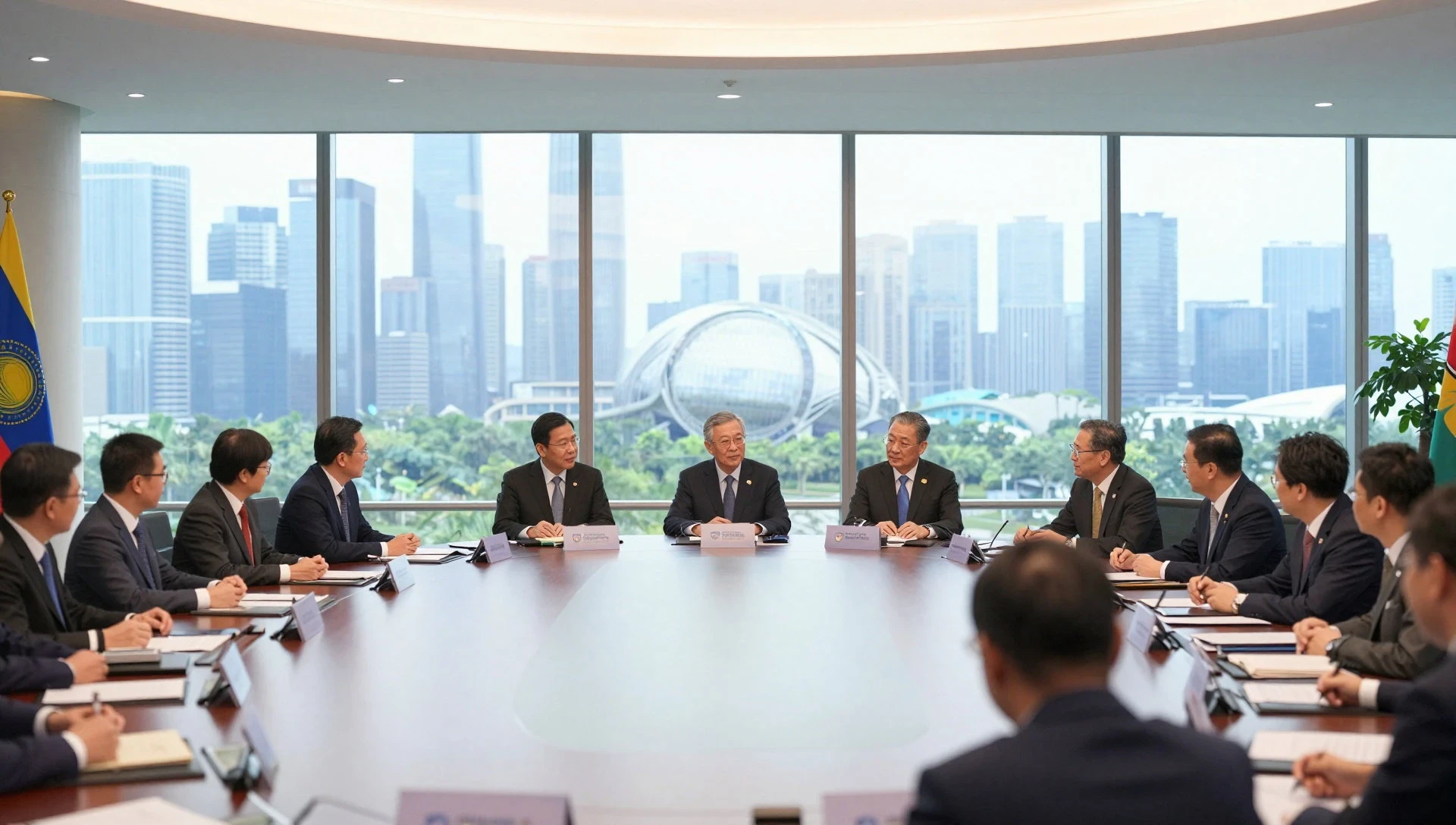
When the leaders of Southeast Asia convene in Manila for the 49th ASEAN Summit, scheduled for November 15–17, 2026, they will do so at a moment when the region's diplomatic calendar has become an instrument of leverage rather than a mere sequence of formal engagements.
The gathering sits directly ahead of the APEC Summit in Shenzhen, and the proximity of the two events has transformed what might otherwise be routine multilateral housekeeping into a carefully choreographed contest between Washington and Beijing. ASEAN's ten member states, individually modest in economic weight but collectively representing one of the world's most dynamic growth corridors, have learned to treat this compressed summit season as a negotiating window in which both superpowers feel compelled to bid for regional goodwill.
The presence of U.S. President Donald Trump on the Manila sidelines, alongside an anticipated meeting of Quad leaders and Japanese Prime Minister Sanae Takaichi's first visit to China since bilateral friction over Taiwan, gives the 2026 season an unusually dense cast of high-stakes bilateral encounters. Each of these engagements carries its own bilateral baggage, yet all of them converge on the same geographic space and the same short window of time.
On This Page
- The Architecture of Summit Season Diplomacy
- Washington's Offer: Technology Transfer and Security Guarantees
- Beijing's Counter-Offer: Infrastructure, Markets and Digital Standards
- The Takaichi Factor and Japan's Balancing Act
- Limits of the Middle-Power Strategy
- What the Two-Summit Dynamic Means for the Indo-Pacific Order
For Southeast Asian capitals, that convergence is not incidental. It is the structural condition that allows middle powers to extract concessions on technology transfer, market access and infrastructure financing from partners who might otherwise treat the region as a peripheral theatre in a larger rivalry.
The core insight behind what observers have begun calling the two-summit tug-of-war is that ASEAN has quietly shifted from being a venue where great powers announce their priorities to being a broker that sets the terms of engagement. Rather than receiving security ultimatums or being asked to choose sides, Southeast Asian states are increasingly framing their cooperation as a competitive prize.
The result is a diplomatic environment in which AI technology transfer, digital standards and trade terms become the currency of influence, and in which the region's collective bargaining position is stronger than the sum of its individual members. This analysis examines how that shift works, what each power stands to gain, and where the strategy's limits lie.
TL;DR ASEAN's 49th Summit in Manila (November 15–17, 2026) and the APEC Summit in Shenzhen form a compressed diplomatic window in which Southeast Asian states leverage U.S. and Chinese competition for AI technology transfer, trade terms and infrastructure financing, converting middle-power positioning into concrete concessions.
The Architecture of Summit Season Diplomacy
Summit season in the Indo-Pacific is rarely just a calendar of meetings. The sequencing of the ASEAN Summit, the East Asia Summit, APEC and the various sideline bilaterals creates a compressed period in which leaders, ministers and negotiating teams are all in motion at once, and in which the cost of being absent or unengaged rises sharply.
For the United States and China alike, the 2026 season presents a narrow window to demonstrate commitment to a region that both regard as strategically decisive, and that shared urgency is precisely what gives ASEAN its opening.
The Manila gathering carries particular weight because it precedes rather than follows the APEC meeting in Shenzhen. That ordering matters. Positions staked out in Manila will shape the atmosphere in Shenzhen, and both Washington and Beijing have incentives to arrive in the Philippine capital with tangible offers rather than rhetorical commitments.
ASEAN negotiators understand this dynamic and have grown adept at using the earlier meeting to set benchmarks that later meetings must then meet or exceed.
The Compressed Calendar as Leverage
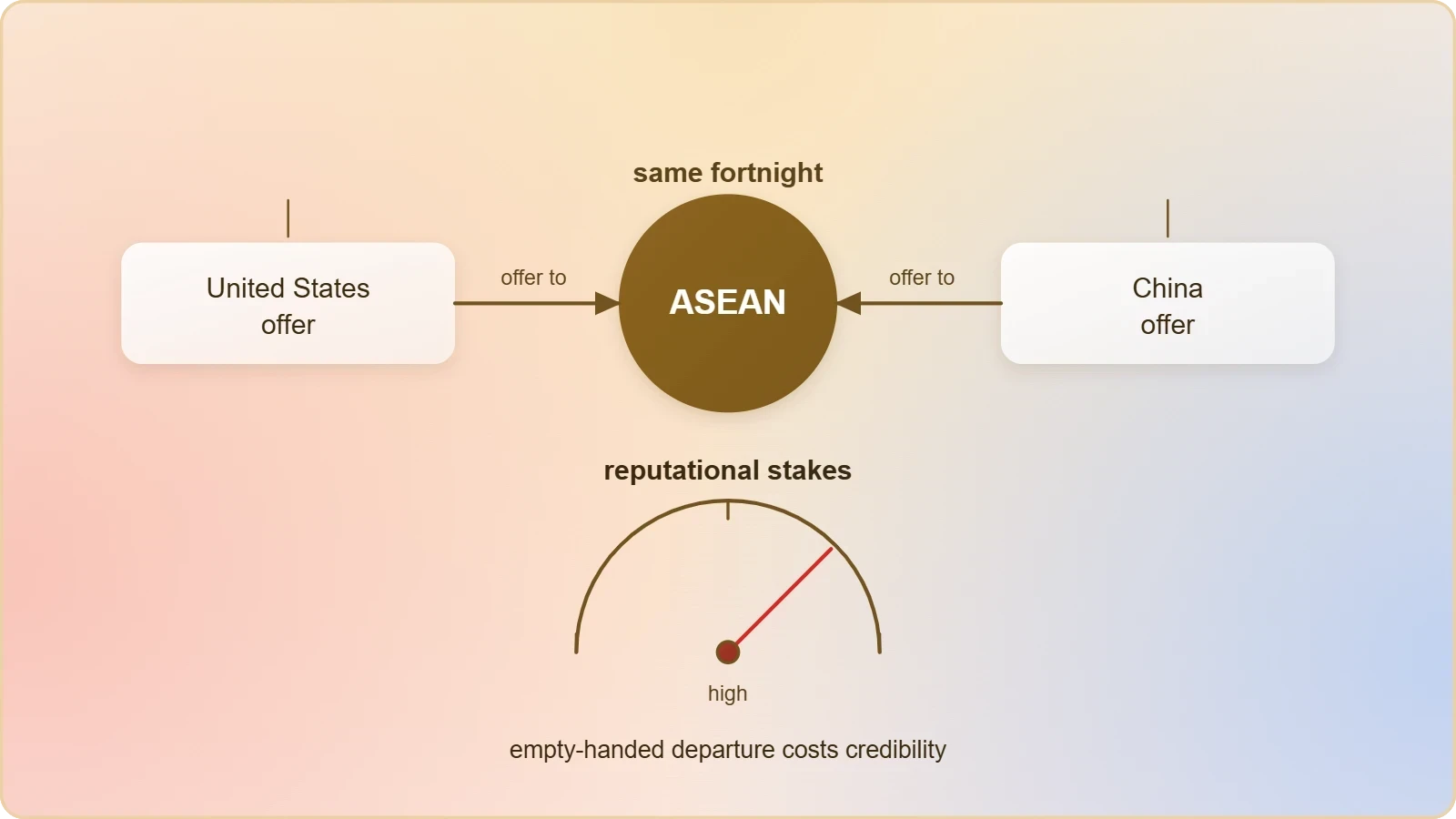
Diplomatic leverage is often a function of timing rather than raw power. When two major partners must both court the same group of states within the same fortnight, the group's ability to extract concessions rises measurably. ASEAN has institutionalised this advantage through its consensus-based model, which allows member states to present a unified front on procedural matters while pursuing differentiated bilateral deals on the margins, maximising the region's aggregate bargaining power without requiring any single member to formally choose a camp.
The compressed calendar also raises the reputational stakes for both superpowers. A U.S. president who travels to Manila and departs without a substantive technology or trade package risks signalling distraction, while a Chinese leadership that hosts APEC in Shenzhen without visible regional buy-in risks appearing to have lost ground. These reputational asymmetries are not lost on Southeast Asian negotiators, who can calibrate their demands to the level of anxiety each partner displays.
Sideline Meetings and the Quad Variable
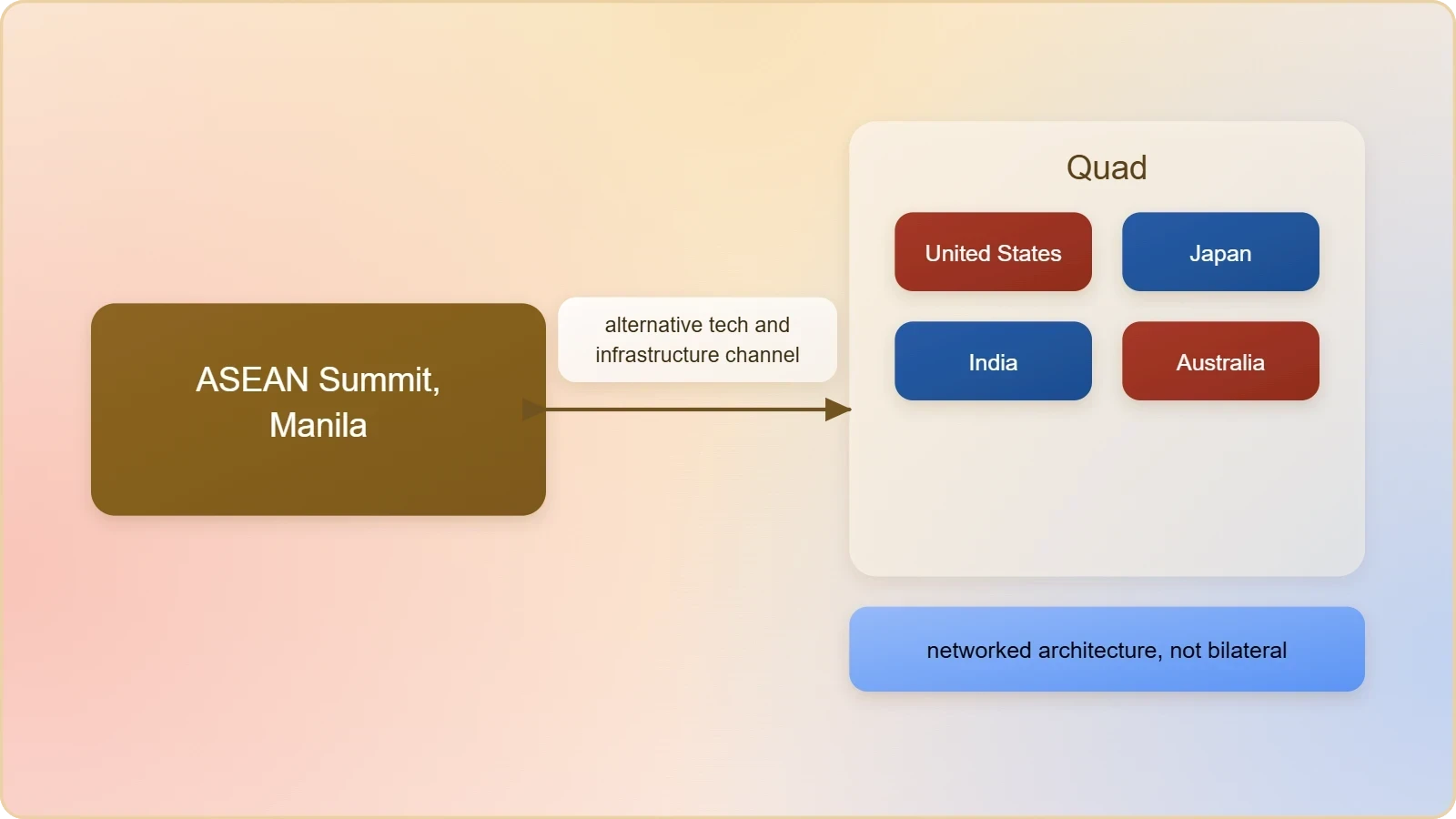
The anticipated Quad leaders' meeting on the Manila sidelines adds a further layer of complexity. The Quad, comprising the United States, Japan, India and Australia, has evolved from a consultative forum into a vehicle for practical cooperation on technology, maritime domain awareness and critical supply chains.
Its presence adjacent to ASEAN proceedings signals that Washington intends to frame its regional offer within a broader networked architecture rather than a purely bilateral one, which in turn gives ASEAN states additional options for engagement.
For Southeast Asian capitals, the Quad's proximity is useful precisely because it is not ASEAN. It offers an alternative channel for technology cooperation and infrastructure financing that does not require formal alignment, allowing member states to engage with Washington's wider network while maintaining the non-aligned posture that has long defined the region's diplomatic identity. That flexibility is a core component of the middle-power playbook.
Washington's Offer: Technology Transfer and Security Guarantees
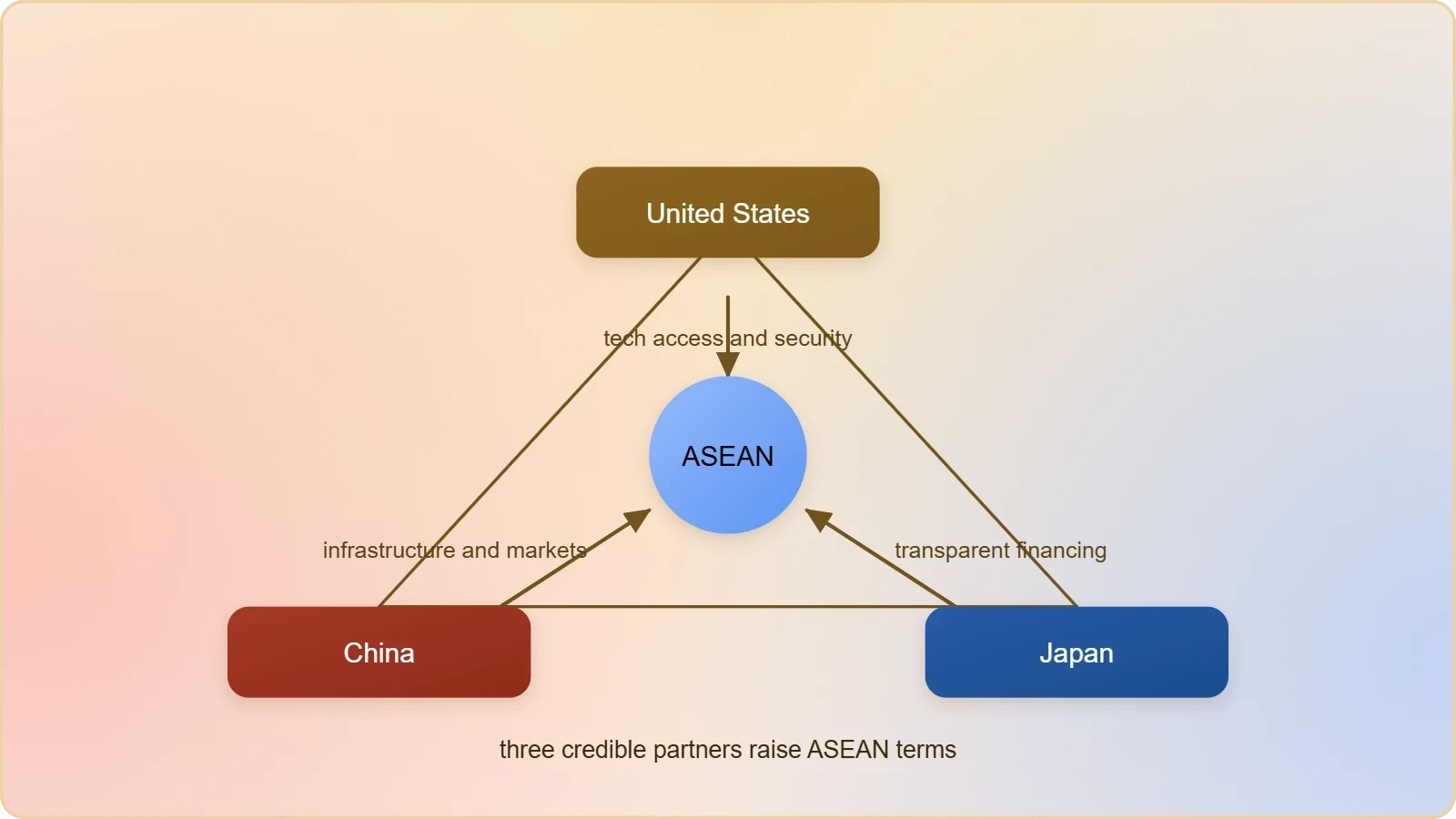
The American proposition to Southeast Asia has evolved considerably from the security-first framing that dominated the previous decade. Where Washington once led with defence commitments and freedom-of-navigation language, its 2026 posture places greater emphasis on AI technology transfer, semiconductor supply-chain diversification, digital infrastructure financing and critical minerals cooperation. This recalibration reflects a recognition that ASEAN states are more responsive to offers that build productive capacity than to appeals framed around strategic alignment.
The shift is partly structural. As U.S. supply chains diversify away from concentrated dependence on a single manufacturing base, Southeast Asia has become a natural destination for semiconductor assembly, data-centre investment and electronics manufacturing. That economic logic gives Washington a genuine commercial story to tell in Manila, one that does not require Southeast Asian leaders to frame their cooperation as a containment strategy. The technology dimension has thus become the most credible component of the American offer.
AI Cooperation as the New Currency
Artificial intelligence cooperation has emerged as the most contested and most valuable item on the negotiating table. Both Washington and Beijing can offer compute access, model licensing, talent exchange and joint research facilities, and both understand that the standards embedded in early deployments tend to persist.
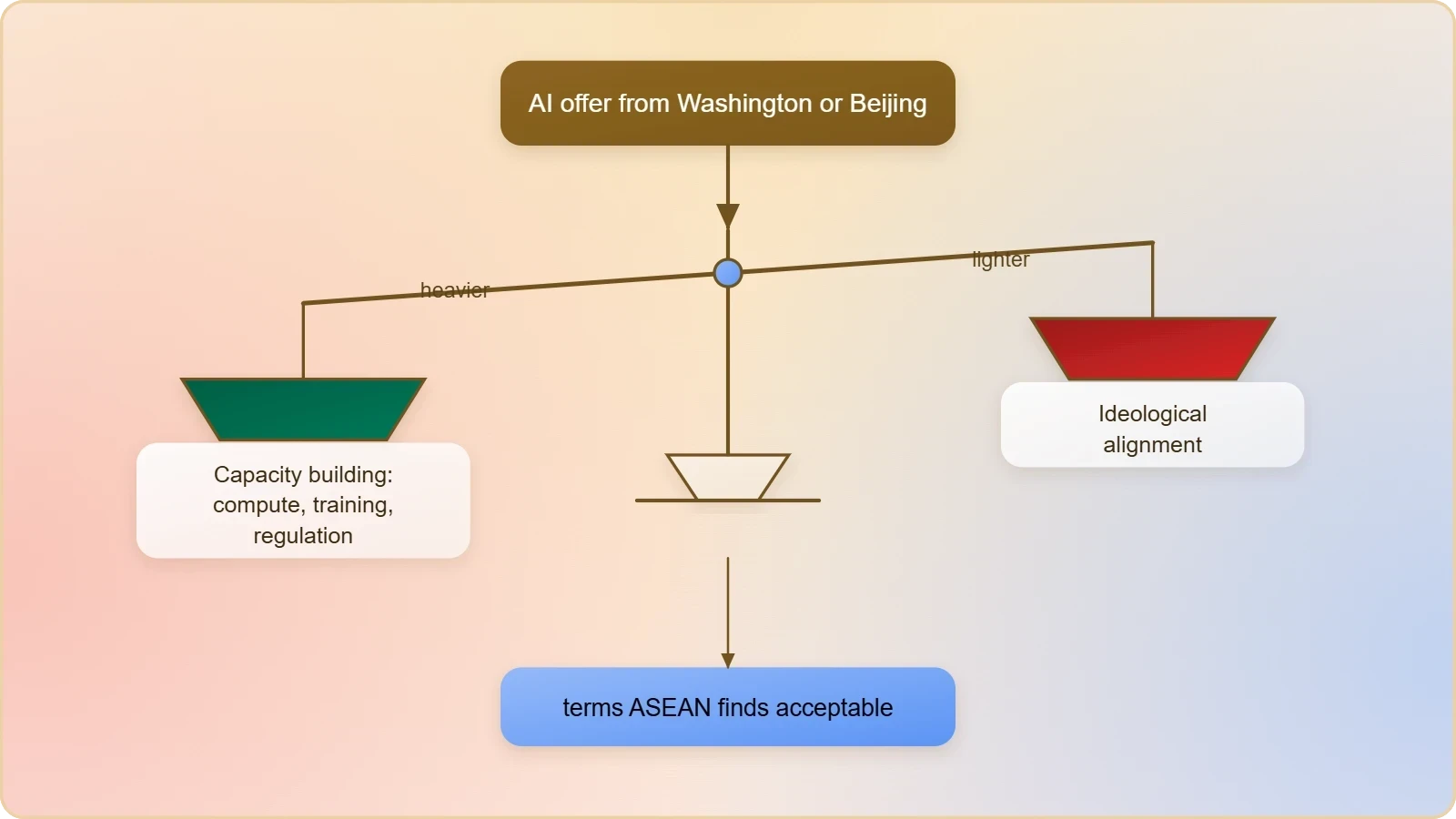
For ASEAN states, the appeal lies less in ideological alignment than in capacity building: access to AI infrastructure, training pipelines and regulatory frameworks that would otherwise take decades to develop domestically.
The competition is therefore less about which power has the superior technology than about which is willing to share it on terms Southeast Asian states find acceptable. Offers that include local capacity building, data sovereignty protections and technology transfer obligations carry more weight than those that merely provide access to foreign platforms. ASEAN negotiators have become skilled at distinguishing between genuine partnership and market capture dressed in cooperative language.
Trade Terms and Market Access
Trade terms form the second pillar of the American offer. Market access for Southeast Asian agricultural products, electronics and textiles remains a persistent demand, and the willingness of Washington to adjust tariff structures or streamline regulatory recognition carries significant weight. For member states with export-dependent economies, concrete trade concessions often matter more than security guarantees, and negotiators have learned to prioritise accordingly.
The trade dimension also intersects with supply-chain policy. Rules of origin, digital trade standards and investment screening mechanisms all shape how Southeast Asian firms can participate in regional production networks. When Washington offers to align these frameworks with ASEAN priorities, it is effectively offering integration into a preferred economic architecture, and that offer competes directly with Beijing's parallel vision of regional trade governance.
Beijing's Counter-Offer: Infrastructure, Markets and Digital Standards
China's proposition to Southeast Asia rests on a different foundation. Where Washington emphasises technology access and security partnership, Beijing leads with infrastructure delivery, consumer market access and digital standards harmonisation. The Belt and Road framework, now more than a decade old, has given Chinese firms and development banks deep operational experience in the region, and that experience translates into faster project delivery and lower transaction costs for partner governments.
The APEC Summit in Shenzhen provides Beijing with a natural platform to showcase this offer. Hosting APEC in a city synonymous with China's technology manufacturing base allows Chinese leaders to present the region's digital future as one built on Chinese hardware, Chinese platforms and Chinese standards. For Southeast Asian states, the appeal is practical: Chinese systems are often cheaper, faster to deploy and less encumbered by regulatory conditions than their Western counterparts.
Digital Standards and the Long Game
Standards are where the competition's long-term consequences are most visible. When a Southeast Asian government adopts a particular 5G architecture, cloud platform or AI governance framework, it creates path dependencies that persist for years. Beijing has invested heavily in promoting its digital standards through technical assistance, training programmes and joint ventures, understanding that early adoption shapes the region's technological trajectory far more durably than any single infrastructure contract.
Washington's counter-strategy emphasises interoperability with Western systems and the security assurances that accompany them. For ASEAN states, the choice is rarely binary; most prefer hybrid arrangements that preserve flexibility. That preference for hybridity is itself a form of leverage, allowing member states to extract better terms from each supplier by demonstrating credible alternatives.
Infrastructure Delivery and Financing Gaps
The infrastructure dimension remains China's strongest card. Southeast Asia's financing needs for transport, energy and digital connectivity consistently outstrip what multilateral institutions and Western development banks can supply, and Chinese financing fills that gap with fewer procedural conditions. For governments facing pressing infrastructure deficits, the speed and scale of Chinese delivery often outweigh concerns about debt sustainability or strategic dependence.
That said, the debt question has become more salient as several Belt and Road projects across the region have required renegotiation. The experience has made Southeast Asian finance ministries more cautious, and it has created an opening for Western and Japanese alternatives that emphasise transparency and fiscal sustainability. The competition has thus improved the terms available to borrower states, even if it has not resolved the underlying financing gap.
The Takaichi Factor and Japan's Balancing Act
Japanese Prime Minister Sanae Takaichi's first trip to China since bilateral friction over Taiwan introduces a further variable into the summit season. Japan has long occupied a distinctive position in Southeast Asia: a major investor, a trusted infrastructure partner and a security collaborator with Washington, yet one that maintains substantial economic ties with Beijing. Takaichi's Beijing visit signals an intent to stabilise relations without abandoning Japan's regional partnerships, a balancing act that mirrors ASEAN's own approach.
For Southeast Asian states, Japan's role is significant because it offers a third option in technology and infrastructure cooperation. Japanese firms are active in semiconductor equipment, advanced manufacturing and digital infrastructure, and Japanese financing often comes with fewer strategic conditions than either U.S. or Chinese alternatives. That makes Japan a valuable component of the region's diversification strategy, even if it cannot match the scale of the two larger powers.
Stabilisation After Taiwan Friction
The friction over Taiwan exposed the fragility of Japan-China relations and raised concerns across Southeast Asia about regional stability. Takaichi's visit is therefore watched closely for signs of de-escalation. A stabilised Japan-China relationship would reduce the risk of economic disruption in regional supply chains, while a continued deterioration would force Southeast Asian states to navigate an even more complex diplomatic environment.
The visit also carries symbolic weight. A Japanese leader travelling to Beijing during the same season as the Manila summit demonstrates that middle and major powers alike are seeking to manage their relationships with China rather than simply align against it. That framing reinforces ASEAN's preferred narrative of a multipolar region in which engagement, not confrontation, is the default mode.
Japan as a Third Option
Japan's value to ASEAN lies partly in its reliability. Japanese infrastructure financing is typically transparent, technically rigorous and accompanied by capacity-building commitments that partner governments value. For states wary of both U.S. policy volatility and Chinese debt exposure, Japan offers a middle path that combines quality with predictability, and that middle path is precisely what many Southeast Asian capitals are seeking.
The third-option dynamic also strengthens ASEAN's bargaining position. When three credible partners are competing for influence, the terms available to the region improve. Japan's active engagement therefore serves a structural function beyond its own bilateral interests, contributing to the competitive environment that allows Southeast Asian states to extract better technology and trade terms from all parties.
We Also Published
Limits of the Middle-Power Strategy
The two-summit tug-of-war is not without its vulnerabilities. ASEAN's consensus-based decision-making, long celebrated as a source of unity, can also become a constraint when member states have divergent relationships with the two superpowers. The Philippines, with its formal alliance with the United States, and Laos or Cambodia, with closer ties to China, do not always share the same priorities, and that divergence can dilute the region's collective bargaining power.
There is also the risk of overplaying the hand. If both Washington and Beijing conclude that ASEAN is extracting concessions without offering commensurate commitments, the willingness to compete for regional favour may diminish. The strategy works best when the region demonstrates that it can deliver on its side of the bargain, whether through regulatory harmonisation, investment facilitation or diplomatic support on contentious issues.
Consensus Constraints and Divergent Interests
The consensus model means that any single member can slow collective positions, and that reality limits how aggressively ASEAN can press either power. Divergent threat perceptions, different economic structures and varying domestic political constraints all shape how member states approach the competition. The result is a regional strategy that is often more reactive than proactive, responding to superpower initiatives rather than setting the agenda outright.
That said, the constraint is not absolute. ASEAN has developed informal mechanisms for managing divergence, including allowing member states to pursue bilateral arrangements while maintaining a unified public posture. This flexibility has allowed the region to preserve its collective leverage even when individual members pursue different paths, a pragmatic adaptation that reflects the group's long experience in managing diversity.
Risk of Overplaying the Hand
The most significant risk is that the strategy's success depends on continued competition between Washington and Beijing. If either power concludes that the region is not worth the cost of courting, or if bilateral relations between the superpowers stabilise in a way that reduces their need for regional allies, ASEAN's leverage could erode quickly. The region's bargaining position is therefore contingent on a geopolitical environment that it does not control.
There is also a reputational dimension. Repeatedly extracting concessions without delivering reciprocal commitments can damage credibility over time. Southeast Asian negotiators are aware of this risk and have increasingly emphasised concrete deliverables, such as regulatory reforms and investment facilitation measures, that demonstrate the region's seriousness as a partner rather than merely a beneficiary.
What the Two-Summit Dynamic Means for the Indo-Pacific Order
The deeper significance of the 2026 summit season lies in what it reveals about the evolving structure of the Indo-Pacific order. The region is no longer simply a stage on which great-power competition unfolds; it is increasingly an arena in which middle powers actively shape the terms of that competition.
ASEAN's ability to extract technology transfer and trade concessions by leveraging the proximity of the Manila and Shenzhen summits is a concrete demonstration of that shift, and it carries implications well beyond the region itself.
For Washington and Beijing, the lesson is that influence in Southeast Asia cannot be purchased through security guarantees or infrastructure financing alone. It requires sustained engagement on the terms that regional states themselves prioritise: technology capacity, market access, regulatory respect and predictable partnership. Powers that fail to offer these will find their influence diminishing, regardless of their military or economic weight.
A Multipolar Region in Practice
The two-summit dynamic offers a practical illustration of multipolarity. Rather than a world divided into competing blocs, Southeast Asia demonstrates a model in which states maintain relationships with multiple powers simultaneously, extracting benefits from each while avoiding formal alignment with any. That model is not without tensions, but it has proven remarkably durable, and it reflects a broader trend toward fluid, issue-based coalitions rather than rigid alliance structures.
This multipolar practice has implications for global governance as well. If middle powers can successfully demand technology transfer and equitable trade terms by leveraging competition among larger states, the same approach may be replicated in other regions and other domains. The ASEAN experience thus offers a template, however imperfect, for how smaller states can exercise influence in an era of renewed great-power rivalry.
Implications for Technology Governance
The competition over AI standards and digital infrastructure has consequences that extend far beyond trade. The frameworks adopted in Southeast Asia will shape how AI is governed, how data flows across borders and how digital economies develop. If the region succeeds in maintaining hybrid arrangements that draw on both Western and Chinese systems, it may contribute to a more pluralistic global technology order rather than one divided into rival blocs.
That outcome is not guaranteed. The pressure to choose sides is real, and it may intensify as technology competition sharpens. But the 2026 summit season suggests that Southeast Asian states are determined to preserve their room for manoeuvre, and that determination is itself a significant factor in shaping the region's technological future.
The two-summit tug-of-war is therefore about more than diplomatic tactics; it is about the kind of Indo-Pacific that will emerge from this decade of competition.
Disclaimer: This article is an analytical commentary on international diplomacy and does not constitute investment, legal or policy advice. The views expressed are interpretive and based on publicly reported information about the 2026 summit calendar; readers should consult primary sources and official statements for authoritative positions.
Disclaimer: This article is for general information and education only. It describes what historical prices and technical indicators showed on the date mentioned and does not predict future movements. It is not investment advice, a recommendation, or an offer to buy or sell any security. Indicators are calculated from past data and can mislead, and all investments carry risk. Please consult a SEBI-registered investment adviser before making any financial decision.
From our network :
- CISA’s Ten-Advisory Wave: Why Generic Patching Fails in OT and How to Build Product-Specific PlaybooksCISA released ten ICS advisories in one week, exposing critical infrastructure risks. Generic patching fails in OT. Learn to build product-specific remediation playbooks.
- Committed Mediterranean Precipitation Decline: Why Emissions Cuts Alone Cannot Restore Winter RainsNew NOAA research reveals that Mediterranean winter rains may decline irreversibly even with emissions cuts. Explore the science of committed climate change and regional impacts.
- Mobile Learning and VR in English: What Global Evidence Reveals About Effective Language TechnologyA systematic review across 14 countries reveals which language-learning technologies genuinely work. Mobile learning, AI, and VR show measurable benefits when pedagogically integrated. This evidence-based guide helps educators and learners select technology that delivers real return on investment.
- Forbidden Matrix Patterns and Visible Lattice Points: A Geometric DictionaryExplore how multidimensional 0–1 matrices encode geometric truths, linking forbidden patterns to visible lattice points and hypergraph theory, with applications in combinatorics and computational geometry.
- How AI Agents Will Change the Way We Manage Personal FinancesExplore how AI agents are transforming personal finance through automated budgeting, bill payment, and investment management, while examining the critical security protocols and governance frameworks required for safe deployment.
- The Final Descent: How ESA Retired the Legendary Cluster Constellation After 24 Years of Space Weather ScienceAfter 24 years mapping Earth’s magnetosphere, ESA’s Cluster mission concluded with a precisely controlled reentry over the South Pacific. This analysis explores the scientific legacy, engineering decisions, and debris mitigation principles behind one of space exploration’s most responsible retirements.
- Live Online English Classes for Kids: Do They Actually Reduce Anxiety?A ten-week study reveals that synchronous online English classes can significantly reduce child language anxiety while improving listening and reading skills. Discover what makes these programs effective and how parents can select the right one.
- The Hidden Cost of AI Convenience: Why Over-Permissioned Agents Are a Security Time BombDiscover why AI agents with excessive permissions create dangerous single points of failure, and learn how implementing least privilege principles can protect your organization from exploitation.
- University Language Proficiency Exams: Why Institutional Tests Demand Different Preparation Than IELTS and TOEFLDiscover why university-specific language proficiency examinations differ fundamentally from IELTS and TOEFL, and learn strategic preparation approaches for institutional assessment success.
RESOURCES
- The Next Step for APEC in Shenzhen - The Diplomatthediplomat.com6 days ago ... The Asia-Pacific Economic Cooperation (APEC) summit, to be held in Shenzhen, China on November 18–19, will take up the strengthening…
- President Donald Trump is pushing for a new meeting with North ...instagram.comAug 19, 2026 ... ... ASEAN summit in the Philippines and the APEC summit in Shenzhen, China. A potential meeting would revive high-stakes personal…
- Trump to visit Manila for ASEAN Summit in November By Darryl ...facebook.comOct 13, 2026 ... What is the schedule for the APEC Summit 2026 in Shenzhen ... Pacific diplomacy?** #ASEAN2026 #DonaldTrump #Philippines #UnitedStates #IndoPacific ...
- APEC China 2026 - Wikipediaen.wikipedia.orgThe APEC China 2026 will be a year-long hosting of the Asia-Pacific Economic Cooperation (APEC) meetings, which will conclude with the APEC Economic ...
- Member of the Political Bureau of the CPC Central Committee and ...fmprc.gov.cnMar 8, 2026 ... In 2026, President Xi Jinping will receive guests from around the world, host major diplomatic events such as the APEC…
- Trump, Xi, and Putin: What to expect from the APEC summitbrookings.edu2 days ago ... The 33rd Asia-Pacific Economic Cooperation (APEC) Leaders' Meeting will take place in Shenzhen, China, on November 18-19, 2026. With another ...
- China's Wang Yi in South Korea for talks amid Trump push to revive ...reuters.comAug 19, 2026 ... Seoul pursuing Lee-Xi summit on sidelines of November APEC meeting in Shenzhen ... Asia-Pacific Economic Cooperation summit in Shenzhen later…
- Trump-Xi Summit Diplomacy | Asia-Pacific Leadership Networkapln.networkSep 28, 2026 ... A potential Trump–Xi meeting at the APEC Leaders' Meeting in Shenzhen ... Asian Art in Washington, D.C., Thursday, September 24,…
- Indonesia's Korean Peninsula Diplomacy At APEC Shenzhen - OpEdeurasiareview.com20 hours ago ... A meeting between US President Donald Trump and North Korea's leader Kim Jong-un could take place on the sidelines of…
- Global powers head to Asia with trade, AI, security in focus | AFP.comafp.com3 days ago ... People walk past an advertisement for Asia-Pacific Economic Cooperation (APEC) China 2026 summit that will take place in Shenzhen from ...
- Trump's second Asean summit presence comes at a price for regionscmp.comOct 18, 2026 ... Published: 8:00am, 18 Oct 2026 Updated: 12:55pm, 20 Oct 2026 ... Asia-Pacific Economic Cooperation (Apec) summit in Shenzhen that same…
- Canada Still Without Ambassador to Chinaasiapacific.caSep 24, 2026 ... A crucial spell of Indo-Pacific diplomacy ... energy superpower,” and a bridge between Europe and Asia at autumn summits for…
- Summitry: APEC and Beyondicds.ee1 day ago ... The US has multiple goals heading in. Before President Donald Trump makes it to Shenzhen, he will stop off at…
- Beyond Summit Diplomacy: Sustaining US-China Cooperation After ...rsis.edu.sg19 hours ago ... ... Summit Diplomacy: Sustaining US-China Cooperation After APEC 2026 ... Asia and Asia Pacific / South Asia / Southeast Asia…
- Mark Carney's Asia Summit Swing: What's at Stake for ASEAN ...policymagazine.ca5 days ago ... China has confirmed discussions about a possible meeting between Donald Trump, Xi Jinping and Vladimir Putin at the APEC summit…
- 01
- 02
- 03
- 04
- 05
- 06
- 07
- 08
0 Comments