The United States House of Representatives convened on a Tuesday session that will be remembered less for its drama than for its procedural precision, voting 211 to 204 on a motion that redirected an impeachment resolution against Defense Secretary Pete Hegseth into committee review. On its surface, the tally reads as a routine legislative maneuver. Beneath that surface, however, the vote represents a decisive structural intervention: by referring the resolution to committee rather than allowing it to advance on the floor, the chamber effectively neutralized an effort that had been building momentum among the secretary's critics. The narrow seven-vote margin, in a chamber where Republicans hold the majority, underscores how carefully the outcome had to be engineered.
What makes this episode instructive is not simply the arithmetic of 211 against 204, but the institutional logic that produced it. Impeachment of a cabinet officer is among the rarest instruments available to Congress, and its invocation against a sitting defense secretary carries implications that extend well beyond partisan preference. The referral mechanism allowed the majority to absorb the political pressure of the moment without formally extinguishing the underlying grievance, a maneuver that preserves procedural options while denying opponents a floor fight. Understanding why this vote unfolded as it did requires attention to the rules of the House, the distribution of seats, and the broader climate in which the resolution emerged.
The resolution itself arrived against a backdrop of sustained scrutiny of the defense secretary's conduct, and the decision to route it to committee rather than table it outright reflects a deliberate calibration. A motion to table would have killed the measure cleanly but conspicuously; a referral signals that the matter remains alive in principle while ensuring it cannot advance without further committee action. This distinction matters enormously in legislative practice, because it shapes how both supporters and opponents can characterize the outcome to their constituencies. The vote therefore functions simultaneously as a verdict, a delay, and a message, and each of those dimensions deserves separate examination.
On This Page
TL;DR The US House voted 211-204 to refer an impeachment resolution against Defense Secretary Pete Hegseth to committee, a procedural move that effectively halts the effort while keeping it formally alive. Because Republicans control the chamber, the referral functioned as a controlled release valve rather than a genuine deliberation of the charges. The episode illustrates how House procedure, majority arithmetic, and committee routing combine to determine whether impeachment resolutions advance or stall, and it signals that oversight pressure on the defense secretary will continue through other channels even as this particular vehicle is parked.
The Anatomy of a Procedural Vote
Procedural votes in the House are frequently dismissed as inside baseball, yet they are precisely where legislative outcomes are often decided. A motion to refer a resolution to committee determines which panel will consider it, what timetable will govern its consideration, and whether it will ever reach the floor for a substantive vote. When the margin is as tight as 211 to 204, the procedural character of the vote does not diminish its significance; it amplifies it, because every member's choice becomes a visible signal of where they stand on the underlying question without requiring them to vote on the merits directly.
Why Referral Rather Than Rejection
Choosing referral over tabling or direct rejection is a strategic decision with distinct consequences. Tabling a resolution ends it for the session and forces supporters to start over; referral keeps the measure pending, allowing committee leadership to control its fate through scheduling, hearings, and markup. For the majority, this offers deniability: members can claim they honored the process without endorsing the substance. For the minority, it offers a foothold: the resolution exists, it has a number, and it can be revived if political conditions shift. Both sides gain something, which is precisely why such motions attract bipartisan cover.
The committee destination matters as much as the referral itself. Different panels carry different jurisdictions, different partisan compositions, and different appetites for confrontation. A referral to a committee whose leadership prefers quiet burial is functionally a kill; a referral to a committee inclined toward aggressive oversight is a launchpad. Observers of the House therefore read the choice of committee as a second, quieter vote, one that reveals leadership's true intentions more candidly than the floor tally does. In this instance, the referral effectively parked the resolution, confirming that the majority had no intention of allowing it to mature.
The Arithmetic of a Seven-Vote Margin
A 211-204 margin in a chamber of 435 seats implies a handful of absences and a near-perfect party-line alignment. Such narrowness is characteristic of votes where leadership whips aggressively and defections are costly. It also means the outcome was sensitive to attendance, timing, and last-minute persuasion, any of which could have flipped the result. For a resolution of this gravity, the thinness of the margin suggests that support for the underlying impeachment effort was not trivial, even if it was insufficient to overcome the majority's procedural control.
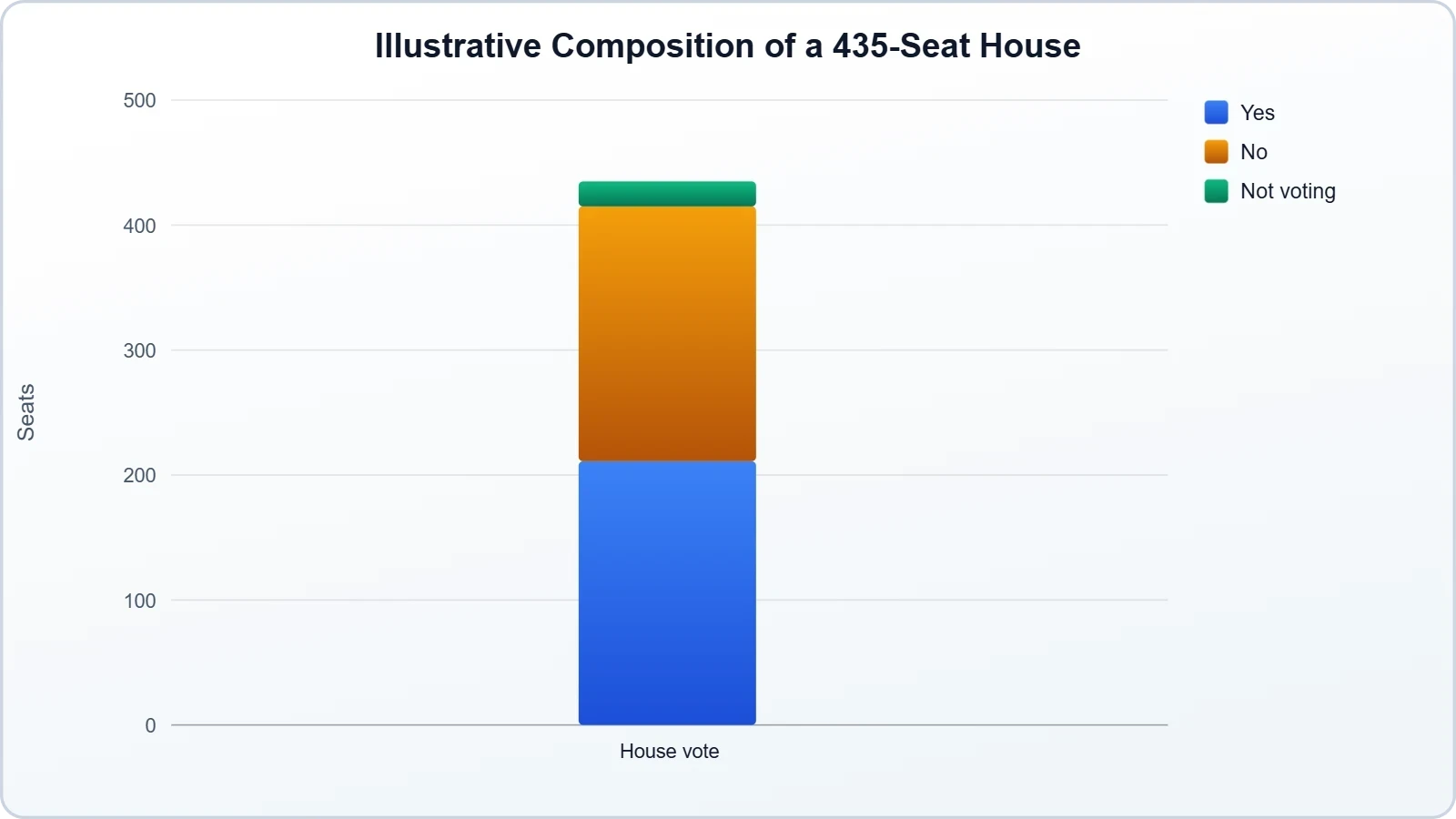
Margins of this size also carry interpretive weight beyond the immediate vote. They signal to the White House and the Pentagon that a meaningful bloc of members is willing to register dissatisfaction publicly, even if it stops short of forcing a confrontation. They signal to advocacy groups that the issue retains legislative traction. And they signal to future challengers that the procedural path exists, provided the political arithmetic changes. A seven-vote margin is simultaneously a defeat and an invitation, and how it is read depends heavily on which side is doing the reading.
Impeachment as a Constitutional Instrument
The power to impeach cabinet officers is embedded in the Constitution, but its practical use has been extraordinarily rare. The House has impeached only a handful of officials in the nation's history, and the Senate has convicted even fewer. This scarcity is not accidental: impeachment is a blunt instrument designed for grave misconduct, and its invocation against a sitting defense secretary raises questions about standards, evidence, and political motive that resist easy resolution. Understanding the Hegseth referral requires situating it within this longer constitutional tradition rather than treating it as an isolated partisan skirmish.
Standards and Thresholds
The constitutional standard of "high crimes and misdemeanors" has never been reduced to a precise legal test, and scholars continue to debate whether it encompasses abuses of power, gross incompetence, or only indictable offenses. This ambiguity gives Congress substantial discretion, which in turn makes impeachment inherently political even when it is procedurally regular. For a defense secretary, the relevant conduct might involve operational decisions, personnel management, or public statements, each of which sits at a different distance from the traditional categories of impeachable behavior. The referral to committee thus defers not only a vote but a definitional question.
Thresholds matter because they determine which allegations are serious enough to warrant the machinery of impeachment. Supporters of the resolution evidently believed the threshold had been crossed; the majority's procedural maneuver suggests they did not, or at least that they preferred not to say so on the record. This gap between allegation and action is a recurring feature of impeachment politics, and it explains why so many resolutions die in committee rather than on the floor. The committee stage becomes a place where thresholds are quietly tested and, more often than not, found wanting.
Historical Precedents
History offers few direct parallels, but the impeachment of a cabinet secretary is not unprecedented. The 1876 impeachment of Secretary of War William Belknap, though he resigned before conviction, established that cabinet officers are within the reach of the clause. More recent episodes involving cabinet-level officials have generally ended in resignation or censure rather than formal impeachment, reflecting a preference for political exits over constitutional confrontations. The Hegseth resolution therefore belongs to a lineage of attempts that test the boundary between oversight and removal, and its referral to committee places it squarely within that tradition of deferred accountability.
Precedent also shapes strategy. Members know that a failed impeachment can strengthen the target politically, and that a successful one can destabilize an administration. These calculations inform how leadership handles resolutions: whether to expedite, delay, or bury them. The referral in this case reflects a judgment that the risks of a floor fight outweighed the benefits, and that committee review offered a lower-variance path. Whether that judgment proves wise depends on what the committee does next, and on whether the underlying controversy fades or intensifies in the months ahead.
Majority Control and the Mechanics of Blocking
Control of the House confers control over the agenda, and agenda control is the most reliable tool for blocking unwanted measures. A majority can refuse to schedule a vote, refer a resolution to an unfriendly committee, or structure the rules under which debate occurs. The 211-204 vote on the Hegseth referral is a textbook demonstration of this principle: the majority did not need to defeat the resolution on its merits because it could defeat it procedurally. This is not a loophole; it is a designed feature of legislative organization, and it operates regardless of which party holds power.
Agenda Control as a Governing Tool
Agenda control shapes outcomes before any substantive argument is heard. By determining what reaches the floor and in what form, the majority filters which controversies receive sustained attention and which quietly expire. For the Hegseth resolution, the referral accomplished several objectives at once: it satisfied members who wanted to be seen taking the allegations seriously, it denied the minority a high-profile floor debate, and it preserved leadership's flexibility to revisit the matter if circumstances change. These are not cynical maneuvers so much as standard operating procedure in a chamber where floor time is scarce and political capital is finite.
The tool also has limits. Agenda control cannot erase an issue that has independent momentum in the press, in committee, or among the public. If the underlying controversy intensifies, the majority may find that parking a resolution merely delays an inevitable confrontation. This is why referrals are sometimes followed by hearings designed to demonstrate that the matter is being handled, and why committee chairs often prefer to hold at least one session before letting a resolution lapse. The procedural block buys time, but time is only valuable if it is used to change the political environment.
Committee Routing and Its Consequences
The choice of committee is a second-order decision with first-order consequences. A referral to a panel chaired by an ally of the defense secretary effectively guarantees inaction; a referral to a panel with an independent-minded chair creates genuine uncertainty. Observers therefore scrutinize not only the vote tally but the destination, because the destination reveals leadership's confidence. In this instance, the referral functioned as a controlled burial, consistent with the majority's evident preference to close the matter without a protracted fight that could expose divisions within its own ranks.
Committee routing also affects the public record. A resolution that dies in committee leaves behind whatever documentation the committee chooses to produce, which may be minimal. A resolution that reaches the floor generates debate, amendments, and a recorded vote that can be cited for years. By choosing the quieter path, the majority limited the documentary footprint of the controversy, a subtle but significant advantage. Whether that advantage holds depends on whether other oversight channels, such as inspector general reports or separate committee inquiries, keep the underlying questions alive.
Political Context Surrounding the Resolution
No procedural vote occurs in a vacuum, and the Hegseth referral is inseparable from the broader political climate in which it took place. A defense secretary sits at the intersection of military policy, budget priorities, and international commitments, and any controversy involving that office quickly acquires geopolitical significance. The resolution's supporters framed their effort around accountability; its opponents framed the referral as a responsible handling of a partisan stunt. Both framings are strategic, and both will shape how the episode is remembered as the 2026 midterm cycle approaches.
Partisan Dynamics and Messaging
Partisan messaging around impeachment votes tends to follow predictable patterns. Supporters emphasize the gravity of the allegations and the duty of Congress to investigate; opponents emphasize the absence of evidence and the political motives of the accusers. The 211-204 margin gives both sides material to work with: supporters can point to 204 members who voted against referral as evidence that the issue is live, while opponents can point to the majority's control as evidence that the effort lacks broad support. These competing narratives will persist long after the committee's disposition is known.
The messaging battle also extends to committee proceedings. If the committee holds hearings, supporters gain a platform; if it does not, opponents gain the argument that the process was a sham. Either outcome can be spun, which is why the referral itself is less an ending than a change of venue. The political context ensures that the resolution will remain a reference point in fundraising appeals, floor speeches, and campaign advertisements, regardless of whether it ever receives a substantive vote.
Public and Institutional Reactions
Public reaction to impeachment proceedings is typically muted relative to the intensity of elite debate, and there is little reason to expect otherwise here. Most voters prioritize economic and security concerns over procedural disputes in Washington, and the referral is unlikely to shift public opinion substantially. Institutional reactions, however, may be more consequential: the Pentagon, allied governments, and military leadership all have stakes in the stability of the defense secretary's position, and a prolonged controversy can complicate coordination on sensitive matters.
Institutional stakeholders therefore watch such votes closely, not because they expect removal but because they need to gauge the secretary's political durability. A narrow referral vote signals that the secretary retains majority support but faces a persistent minority willing to challenge him. That signal can affect everything from congressional testimony to international negotiations, as counterparts assess whether they are dealing with a secure or a vulnerable official. The referral thus reverberates beyond the chamber, shaping perceptions in ways that the vote tally alone does not capture.
- 01
- 02
- 03
- 04
We Also Published
What the Referral Signals About Accountability
The referral carries a message that extends beyond the specific allegations against the defense secretary. It signals that the House majority prefers to manage accountability through procedural channels rather than through the constitutional machinery of impeachment, at least for now. This preference is not unique to the current Congress; it reflects a broader pattern in which oversight is conducted through hearings, subpoenas, and inspector general reports rather than through removal proceedings. The pattern has consequences for how accountability is understood and pursued in American governance.
Oversight Versus Removal
Oversight and removal are distinct tools with different thresholds and different political costs. Oversight can proceed continuously, generating information and pressure without requiring a formal verdict; removal requires a discrete confrontation with a binary outcome. The referral effectively shifts the Hegseth matter from the removal track to the oversight track, where it can be pursued indefinitely without forcing members to choose sides on the ultimate question. This shift is characteristic of modern congressional practice, which tends to favor sustained investigation over dramatic confrontation.
The shift also has implications for the target. An official facing oversight can respond through document production, testimony, and procedural objections, buying time and shaping the narrative. An official facing removal must prepare for a trial-like proceeding with a defined end point. By choosing oversight, the majority spared the defense secretary the latter burden while preserving the former pressure. Whether this constitutes accountability or its deferral is a matter of interpretation, and reasonable observers will disagree depending on their assessment of the underlying allegations.
Implications for Future Resolutions
Future impeachment resolutions will be read against this precedent. Sponsors will know that a referral is a likely outcome unless they can secure a majority willing to force a floor vote, and they will calibrate their strategies accordingly. Some may seek to attach their measures to must-pass legislation, while others may pursue alternative accountability mechanisms such as censure or independent investigations. The referral thus shapes the tactical landscape for the remainder of the Congress, establishing expectations about how similar efforts will be handled.
The precedent also affects the calculus of the target's allies. Knowing that a referral can neutralize a resolution, allies may encourage the procedural route as a way to protect an embattled official without appearing to endorse the underlying conduct. This creates an incentive structure in which procedural maneuvers become the preferred instrument of political defense, and in which the merits of allegations are increasingly adjudicated through scheduling decisions rather than substantive debate. That development is worth watching, because it alters how constitutional accountability actually functions in practice.
Reading the Vote Through a Wider Lens
Zooming out from the chamber, the Hegseth referral illustrates a durable feature of American constitutional governance: the gap between formal power and practical effect. The Constitution grants the House the power to impeach, but the exercise of that power depends on agenda control, committee composition, and political will. When those factors align against a resolution, the formal power remains intact but unused, and accountability is pursued through other means. This gap is not a defect so much as a consequence of institutional design, and it recurs across administrations of every party.
Institutional Stability and Its Costs
Institutional stability is often cited as a virtue of the American system, and the referral can be read as an example of stability in action: a controversial measure was channeled through regular procedures rather than allowed to disrupt the chamber's business. The cost of that stability is that serious allegations may receive less scrutiny than their gravity warrants. Whether the trade-off is acceptable depends on one's view of the allegations and one's confidence that other oversight mechanisms will fill the gap. The referral does not resolve that debate; it merely relocates it.
The costs also fall unevenly. Supporters of the resolution may feel that their concerns were dismissed without a fair hearing, while opponents may feel that the process was manipulated to protect an ally. Both perceptions can erode trust in legislative institutions, and both can be mobilized in future political contests. The referral thus carries a long-term reputational cost that is easy to overlook in the immediate aftermath of a 211-204 vote, and that cost may prove more consequential than the procedural outcome itself.
What to Watch Next
Several developments will determine whether the referral marks the end of the Hegseth controversy or merely a pause. Committee scheduling is the first indicator: if hearings are announced, the matter remains active; if silence follows, the resolution is effectively dormant. A second indicator is whether separate oversight bodies, such as inspectors general or other committees, pursue related inquiries. A third is whether the political environment shifts in ways that make revival attractive to the majority. Each of these signals can be monitored, and each will shape how the episode is remembered.
The broader lesson is that procedural votes are rarely just procedural. They encode judgments about priorities, risks, and alliances, and they shape the terrain on which future battles are fought. The Hegseth referral is a case study in how a chamber can simultaneously acknowledge a controversy and decline to resolve it, and in how the machinery of Congress converts a demand for accountability into a scheduling decision. Understanding that conversion is essential for anyone who wants to read Washington accurately, because it is where the formal and the practical most visibly diverge.
From our network :
- Committed Mediterranean Precipitation Decline: Why Emissions Cuts Alone Cannot Restore Winter RainsNew NOAA research reveals that Mediterranean winter rains may decline irreversibly even with emissions cuts. Explore the science of committed climate change and regional impacts.
- CISA’s Ten-Advisory Wave: Why Generic Patching Fails in OT and How to Build Product-Specific PlaybooksCISA released ten ICS advisories in one week, exposing critical infrastructure risks. Generic patching fails in OT. Learn to build product-specific remediation playbooks.
- The Hidden Cost of AI Convenience: Why Over-Permissioned Agents Are a Security Time BombDiscover why AI agents with excessive permissions create dangerous single points of failure, and learn how implementing least privilege principles can protect your organization from exploitation.
- University Language Proficiency Exams: Why Institutional Tests Demand Different Preparation Than IELTS and TOEFLDiscover why university-specific language proficiency examinations differ fundamentally from IELTS and TOEFL, and learn strategic preparation approaches for institutional assessment success.
- Live Online English Classes for Kids: Do They Actually Reduce Anxiety?A ten-week study reveals that synchronous online English classes can significantly reduce child language anxiety while improving listening and reading skills. Discover what makes these programs effective and how parents can select the right one.
- Forbidden Matrix Patterns and Visible Lattice Points: A Geometric DictionaryExplore how multidimensional 0–1 matrices encode geometric truths, linking forbidden patterns to visible lattice points and hypergraph theory, with applications in combinatorics and computational geometry.
- How AI Agents Will Change the Way We Manage Personal FinancesExplore how AI agents are transforming personal finance through automated budgeting, bill payment, and investment management, while examining the critical security protocols and governance frameworks required for safe deployment.
- The Final Descent: How ESA Retired the Legendary Cluster Constellation After 24 Years of Space Weather ScienceAfter 24 years mapping Earth’s magnetosphere, ESA’s Cluster mission concluded with a precisely controlled reentry over the South Pacific. This analysis explores the scientific legacy, engineering decisions, and debris mitigation principles behind one of space exploration’s most responsible retirements.
- Mobile Learning and VR in English: What Global Evidence Reveals About Effective Language TechnologyA systematic review across 14 countries reveals which language-learning technologies genuinely work. Mobile learning, AI, and VR show measurable benefits when pedagogically integrated. This evidence-based guide helps educators and learners select technology that delivers real return on investment.
RESOURCES
- Fitzpatrick Makes Official Referral To House Judiciary Committee ...fitzpatrick.house.gov17 hours ago ... The actions of Secretary of War Pete Hegseth on multiple matters, to include Ukraine (which, unfortunately, is nowhere mentioned in…
- House opts to stall Hegseth impeachment vote, sending resolution ...breakingdefense.com18 hours ago ... ... Hegseth, House lawmakers today opted to refer the impeachment resolution to the House Judiciary Committee for further consideration. The ...
- House vote effectively ends impeachment push against Hegseth : NPRnpr.org17 hours ago ... The House has voted 211 to 204 to refer the articles of impeachment filed against Defense Secretary Pete Hegseth to…
- US House blocks bid to impeach Defence Secretary Pete Hegsethbbc.com5 hours ago ... All Republicans other than Massie voted to refer the resolution to the committee, meaning that the congressman's effort failed in…
- Ranking Member Raskin Statement on the Vote on the Motion to ...democrats-judiciary.house.govDec 11, 2025 ... ... impeachment Resolution but to refer it to the Judiciary Committee. ... House on successful impeachment resolutions in the past.…
- House tables Hegseth impeachment, effectively killing it in ... - abc7NYabc7ny.com23 hours ago ... The House of Representatives voted Tuesday to refer GOP Rep. Thomas Massie's resolution to impeach Secretary of Defense Pete Hegseth…
- House shelves Hegseth impeachment resolution - NBC Newsnbcnews.com16 hours ago ... Defense Secretary Pete Hegseth addresses a House impeachment threat and Republicans choose their leadership for the new Congress.
- House GOP derails Hegseth impeachment over Iran, Kelly and boat ...cronkitenews.azpbs.org16 hours ago ... Not one voted to refer the resolution to the Judiciary Committee, whose chairman, Rep. Jim Jordan of Ohio, was elected…
- Massie moves to force Hegseth impeachment vote - Roll Callrollcall.com2 days ago ... ... refer it to committee. If the House were to impeach ... House members urging a “yes” vote on Massie's…
- House sends Hegseth impeachment resolution to committee, 211-204qz.com11 hours ago ... Rep. Thomas Massie of Kentucky, who wrote the eight-article resolution, was the only Republican to oppose the referral.
- Hegseth Rails Against 'Sabotage' Impeachment Vote - TIMEtime.com2 days ago ... The House will also have the opportunity to refer the impeachment ... committee for investigation or offer a motion to…
- House Blocks Pete Hegseth Impeachment as 11 Democrats Miss Votelawcommentary.com16 hours ago ... Thomas Massie of Kentucky, who introduced the impeachment resolution, was the only Republican to oppose referring the charges to committee.
- Hegseth impeachment effort torpedoed in House - CNBCcnbc.com1 day ago ... ... impeach Defense Secretary Pete Hegseth. Hegseth railed against Rep ... refer the impeachment resolution to a committee. That will…
- The Republican-led House on Tuesday rejected an effort to impeach ...facebook.com17 hours ago ... The Republican-led House on Tuesday rejected an effort to impeach Defense Secretary Pete Hegseth, voting to refer the resolution to…
- How Kansas and Missouri lawmakers voted on Hegseth impeachmentkansascity.com17 hours ago ... All nine Republican House lawmakers from both states voted to refer the resolution to the Judiciary Committee, a move designed…
- 01
- 02
- 03
- 04
- 05
- 06
- 07
- 08
0 Comments