
The reported arrest of a 54-year-old woman in Delta State for allegedly staging her own kidnapping to extort ₦15 million from her younger brother reads, at first glance, like a bizarre outlier. Yet beneath the sensational surface lies a familiar anatomy of deception: a fabricated emergency, a ransom demand calibrated to a family's capacity to pay, and a confession framed in the language of moral failure. The case, first reported on 23 October 2026 at the Ogwashi-Uku Divisional Police Headquarters, moved quickly from a distress report to an intelligence-led investigation that concluded the abduction was choreographed rather than coerced.
What makes the episode analytically valuable is not the crime itself but the profile behind it. Nigerian police spokespersons have noted that staged kidnappings typically involve teenagers or young adults seeking quick money, which is precisely why a woman in her mid-fifties stands out. Her admission that she spent twelve days in supposed captivity before her arrest, and her claim that unseen captors would kill her if payment failed, reveal a script built on emotional leverage rather than physical violence. Investigators now believe she did not act alone, suggesting a small network rather than a solitary improvisation.
This analysis examines the case as a window into extortion economics, family trust as a vulnerability, and the investigative methods that unravel manufactured crime scenes. It weighs the legal exposure she now faces, the psychological mechanics of a confession described as "the devil's work," and the broader question of why fake kidnapping persists in a country where real abductions remain a live threat. The details matter because they show how ordinary kinship bonds can be weaponised, and how quickly a fabricated crisis collapses under disciplined police work.
On This Page
- The Anatomy of a Staged Abduction in Delta State
- Why a 54-Year-Old Suspect Breaks the Usual Pattern
- The Economics of Extortion and Family Vulnerability
- Investigative Method: How Intelligence Unravelled the Plot
- The Human Cost: Family Betrayal and Community Trust
- Comparative Context: Fake Kidnapping as a Recurring Phenomenon
- Conclusion: Lessons From a Fabricated Crisis
TL;DR A 54-year-old woman in Delta State was arrested after allegedly faking her own kidnapping to extort ₦15 million from her younger brother, claiming captors would kill her if he refused to pay. Police at Ogwashi-Uku received the report on 23 October 2026, and the Anti-Kidnapping Unit in Obu-Luku conducted an intelligence-led investigation that exposed the abduction as staged. The suspect admitted arranging the plot, said she was "held" for twelve days, asked for forgiveness, and called her actions "the devil's work." Investigators suspect accomplices and are tracking others involved. The case is notable because fake kidnapping prosecutions in the region have historically involved teenagers, not middle-aged women.
The Anatomy of a Staged Abduction in Delta State
The sequence of events, as disclosed by the Delta State Police Command, follows a recognisable pattern of manufactured emergency. A report reached the Ogwashi-Uku Divisional Police Headquarters on 23 October 2026, alleging that a woman had been abducted. The Commissioner of Police immediately directed the Anti-Kidnapping Unit in Obu-Luku, within Aniocha South Local Government Area, to take over the matter. That rapid escalation from divisional report to specialised unit reflects standard protocol in kidnapping cases, where the first hours determine whether a victim is recovered alive or a ransom is paid under duress.
What the investigation found inverted the premise entirely. Rather than a victim awaiting rescue, detectives encountered a suspect who had authored her own disappearance. The police spokesperson confirmed that an intelligence-led inquiry established the kidnapping was staged, leading directly to her arrest. In a video statement, the woman admitted to arranging her own abduction and demanding the money from her brother, describing how she told him she had been taken to the bush while out buying medicine and that her captors would kill her without payment.
The Ransom Demand and the Family Target
The choice of victim is instructive. The demand was directed not at a stranger, an employer, or an institution, but at her younger brother, a relationship that carries presumptive obligation and urgency. A sibling receiving a call about a kidnapped sister faces immediate emotional pressure: the fear of loss, the weight of family duty, and the absence of time to verify claims. Extortionists understand that kinship shortens the deliberation window, which is why family members are frequently the preferred target in fabricated abductions, where the goal is a fast transfer rather than a prolonged negotiation.
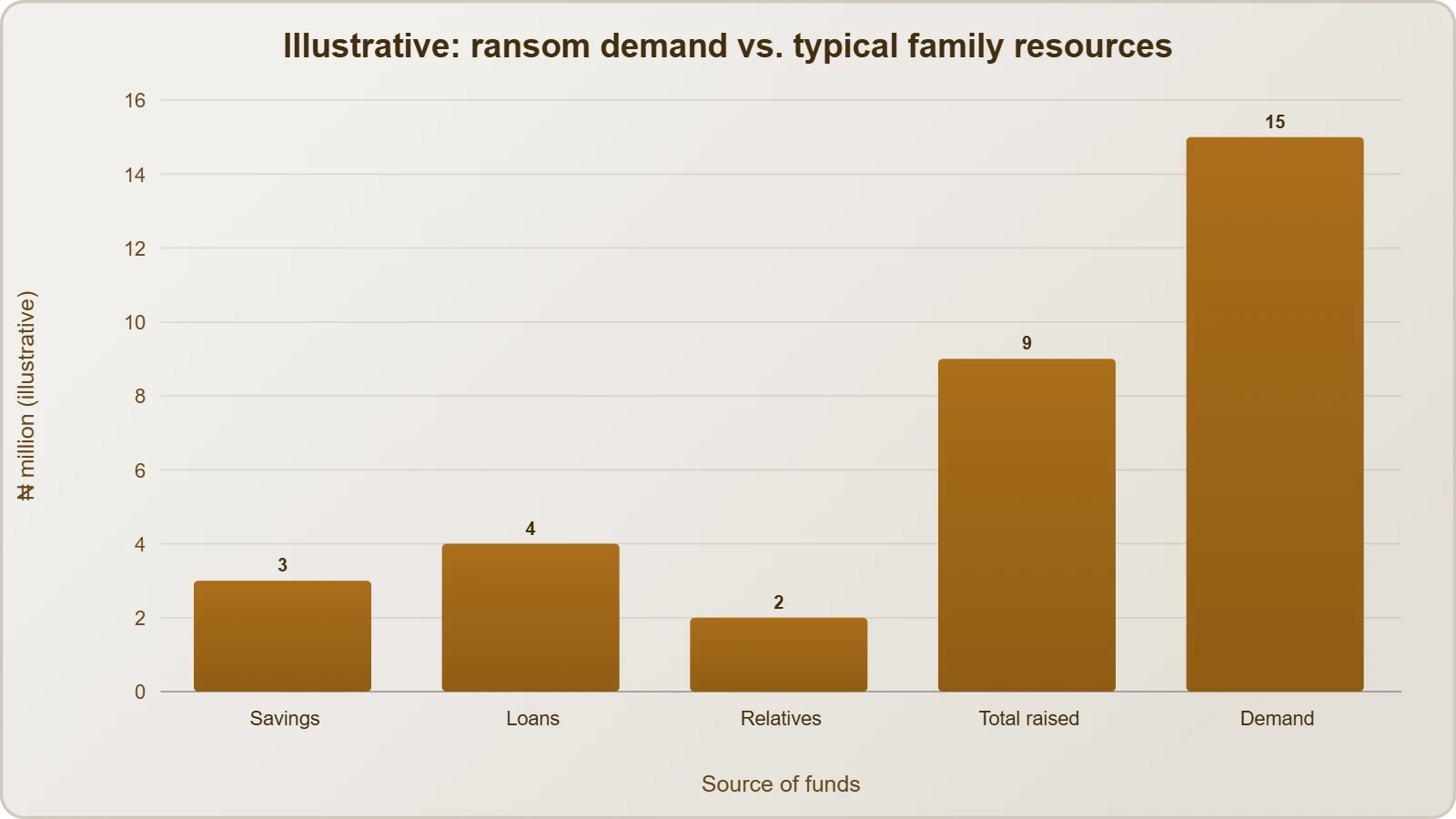
The sum demanded, ₦15 million, is substantial but not fantastical, a figure calibrated to sit within the realm of what a determined family might assemble through savings, loans, or contributions from relatives. That calibration is itself evidence of planning. A random figure would invite disbelief; a plausible one invites action. The woman's account that she had been taken to the bush while buying medicine added ordinary domestic texture to the story, the kind of mundane detail that makes a fabrication feel credible to a frightened relative receiving it by phone.
Twelve Days of Fabricated Captivity
According to the police spokesperson, the woman claimed she was held for twelve days before her arrest. That duration raises questions about the mechanics of the deception: how a person sustains a false captivity while remaining reachable enough to communicate demands, and how the story holds together as days pass without physical proof of life. In genuine abductions, captors typically provide evidence, a voice recording, a photograph, or a specific detail known only to the victim, to keep payment negotiations alive. A staged kidnapping must simulate those signals without the infrastructure of an actual hideout.
The twelve-day window also matters legally. A prolonged fabrication suggests deliberation rather than a momentary panic, which strengthens a prosecution case for extortion and related offences. It also implies coordination, since sustaining a false narrative across nearly two weeks requires someone to manage communications, field follow-up calls, and maintain the brother's belief that his sister's life hung in the balance. Investigators have signalled exactly this: the spokesperson stated that police believe she did not act alone and that others involved in the alleged plot are being tracked.
Why a 54-Year-Old Suspect Breaks the Usual Pattern
Police spokespersons in Delta State have handled staged kidnapping cases before, but the spokesperson explicitly noted that previous incidents involved teenagers. That detail is more than trivia; it points to a demographic assumption embedded in how law enforcement and the public imagine this crime. Fake abductions are typically associated with young people chasing fast money, often with limited planning and crude execution. A woman in her fifties inverts that expectation, and the inversion has practical consequences for detection, because investigators may initially extend greater credibility to an older complainant.
Age also shapes the social dynamics of the deception. A middle-aged woman reporting abduction mobilises community sympathy and family urgency in ways a teenage suspect might not. Relatives are less inclined to suspect a mother figure of orchestrating her own disappearance, and neighbours are more likely to accept distress at face value. That credibility premium is a form of camouflage, and it may explain why the plot survived twelve claimed days before intelligence work dismantled it. The case therefore illustrates a broader principle: the most effective frauds exploit the assumptions their targets never think to question.
Gender, Trust, and the Credibility Premium
The gendered dimension deserves careful treatment. Research on deception consistently finds that perceived trustworthiness varies with social role and expectation, and in many communities women are less readily associated with violent extortion. That asymmetry can be exploited by anyone willing to trade on it. The suspect's alleged strategy leaned on exactly this: a sister in peril, a brother duty-bound to act, and a story of captors in the bush that required no visual proof because the emotional stakes foreclosed scepticism. Whether the brother actually paid is not disclosed in the police account, but the demand itself reveals the calculation.
There is also a reputational cost that extends beyond the individual. When a woman is arrested for fabricating a kidnapping, genuine victims from similar backgrounds may face heightened suspicion when they report abductions. That spillover effect is one of the least discussed harms of extortion fraud: it corrodes the presumption of truth that real victims depend on when they approach police. Every confirmed fabrication gives future sceptics a reference point, and in a region where kidnapping is a genuine security concern, that erosion of trust carries real operational consequences for law enforcement.
The Confession and the Language of Moral Failure
In the video statement described by police, the woman admitted arranging her own abduction, asked for forgiveness, and characterised her conduct as "the devil's work." That phrasing is culturally familiar, a way of externalising responsibility onto a malevolent force rather than owning deliberate choice. From an investigative standpoint, a confession of this kind is valuable but incomplete: it establishes participation while leaving open the question of who else was involved and how the proceeds, had they been paid, would have been divided. Police have indicated they do not accept the lone-actor explanation.
The confession also raises evidentiary questions that any prosecution must address. Admissions made in video statements are persuasive in the court of public opinion but must be tested for voluntariness and accuracy. Defence counsel may argue coercion, confusion, or misrepresentation of the recording's context. The strength of the case will therefore rest on corroboration: communication records, financial traces, witness accounts from the brother, and any evidence of coordination with others. The spokesperson's statement that accomplices are being tracked suggests investigators are building precisely that corroborative layer rather than relying on the confession alone.
The Economics of Extortion and Family Vulnerability
Extortion is, at its core, a business model built on the credible threat of harm and the target's ability to pay. Fabricated kidnapping adds a distinctive twist: the threat is manufactured, but the fear it generates is entirely real. The economics favour the fraudster because the cost of staging a disappearance is low, a phone call, a rehearsed script, a period of deliberate absence, while the potential return is measured in millions of naira. When the target is a family member, transaction costs fall further, since the extortionist already knows the victim's finances, temperament, and emotional attachments.
That insider knowledge is the decisive advantage. A stranger demanding ransom must estimate what a family can raise; a sibling knows. The ₦15 million figure in this case likely reflected an informed guess about the brother's resources and willingness to liquidate assets under pressure. This is why family-targeted extortion is so difficult to defend against: the usual safeguards, verification, delay, consultation with authorities, run against the grain of kinship obligation. A brother who pauses to verify may be accused, by himself and others, of gambling with his sister's life.
Ransom Psychology and the Pressure to Pay
Behavioural research on ransom negotiations identifies time pressure as the single most powerful lever available to a demander. Genuine kidnappers use deadlines and threats of violence to compress deliberation; fabricated kidnappings simulate the same pressure without the underlying capacity for harm. The suspect's alleged claim that captors would kill her if payment failed is a textbook application of this lever, designed to move the brother from consideration to action. The absence of proof of life, normally a red flag, is explained away by the urgency of the supposed captors.
Families under this pressure often make decisions they would never endorse in calmer circumstances: borrowing at punitive rates, selling property at a discount, or transferring funds without documentation. Those decisions create secondary financial harm that persists long after the crisis resolves. In cases where the kidnapping turns out to be staged, the family faces a further injury, the knowledge that a relative manufactured their terror. That betrayal is difficult to quantify but frequently more damaging than the money involved, and it explains why these cases attract such intense public condemnation when they surface.
Investigative Method: How Intelligence Unravelled the Plot
The Delta State Police Command's handling of this case illustrates the value of intelligence-led policing over reactive response. When the report arrived at Ogwashi-Uku on 23 October 2026, the Commissioner of Police did not simply deploy officers to search for a missing woman; he directed the Anti-Kidnapping Unit in Obu-Luku to investigate. That distinction matters. A search operation assumes a victim exists; an investigation tests whether the premise itself is sound. By treating the report as a claim to be verified rather than a fact to be acted upon, detectives preserved the option of discovering the fabrication.
Intelligence-led investigation typically draws on communication metadata, financial monitoring, informant networks, and behavioural inconsistencies. In a staged kidnapping, the fraudster must communicate with the target to press the demand, and those communications leave traces. Location data can contradict claims of being held in the bush. Financial enquiries can reveal whether the supposed victim had made arrangements inconsistent with captivity. The spokesperson's statement that the kidnapping was exposed through intelligence work suggests at least some of these methods were applied, and the arrest followed once the evidence converged.
Coordination and the Search for Accomplices
Police have stated plainly that they believe the woman did not act alone. That conclusion likely rests on the practical difficulty of sustaining a twelve-day fabrication single-handedly, as well as on evidence gathered during the investigation. A solo fraudster must manage the target's calls, maintain a plausible absence from her normal life, and avoid the scrutiny of neighbours and relatives, all while appearing to be held captive. Accomplices could handle communications, provide a location for the supposed captivity, or reinforce the story through staged calls from supposed captors.
The search for accomplices expands the legal and investigative horizon. If others are identified, the case shifts from an individual fraud to a conspiracy, with different charging considerations and greater public interest. It also raises the possibility that the plot was not a one-off improvisation but part of a pattern, which would justify a broader review of similar reports in the region. Police have not disclosed the number of suspects being tracked, but the spokesperson's language indicates an active, ongoing inquiry rather than a closed file.
Evidentiary Standards and Prosecution Prospects
For a prosecution to succeed, the state must prove the elements of the offence beyond reasonable doubt, which in an extortion case means establishing the demand, the intent to obtain money by threat, and the falsity of the underlying premise. The video confession helps, but courts scrutinise such statements for voluntariness. Corroboration from the brother, who received the demand, will be central. Telephone records showing the pattern of calls, and any evidence of coordination with others, would strengthen the case considerably. The quality of the investigation, not the publicity, will determine the outcome.
There is also the question of what charges are appropriate. Depending on the applicable statutes, the conduct could be framed as extortion, false reporting, or obtaining money by false pretences, and the prosecution may pursue multiple counts. Each carries different evidentiary requirements and sentencing ranges. The decision on charges will signal how seriously the authorities treat fabricated kidnappings, which consume investigative resources that genuine abduction cases urgently need. A robust prosecution would serve as a deterrent; a weak one would invite imitation.
- 01
- 02
- 03
- 04
The Human Cost: Family Betrayal and Community Trust
Beyond the legal machinery, the case carries a quieter injury that rarely makes headlines: the rupture of a sibling relationship. The brother who received the demand believed his sister's life depended on his compliance. He may have borrowed, liquidated savings, or appealed to relatives for help. When the truth emerged, the money became secondary to the realisation that the terror was manufactured by someone he trusted. That kind of betrayal reshapes family dynamics for years, and it often leaves the victim of the fraud isolated, blamed by some relatives for not seeing through the deception.
Community trust suffers a parallel erosion. In Delta State and across Nigeria, kidnapping is not an abstract fear; it is a live security concern that shapes travel, business, and daily routines. When a fabricated case surfaces, it feeds a corrosive narrative that reports of abduction are sometimes self-serving inventions. That narrative is dangerous because it gives authorities and ordinary citizens an excuse for scepticism precisely when genuine victims need swift, unquestioning response. The harm of the fraud therefore radiates outward, touching strangers who will never know the woman's name.
Forgiveness, Accountability, and Public Sentiment
The suspect's plea for forgiveness, delivered alongside her admission, invites a moral question that legal proceedings cannot fully answer. Public sentiment in such cases tends toward condemnation, particularly when the target is a family member and the sums involved are large. Yet the request for forgiveness also reflects an awareness of the damage done, which is more than some fraudsters ever acknowledge. Whether forgiveness is granted is a private matter for the brother; whether accountability follows is a public matter for the courts, and the two should not be conflated.
There is a broader lesson in how communities respond to these cases. Punitive outrage alone does little to prevent recurrence; what deters fabricated kidnappings is the certainty of detection and consequence, combined with visible support for genuine victims. If the public concludes that reporting an abduction invites suspicion, the resulting underreporting would harm exactly the people the system exists to protect. The appropriate response is calibrated: firm prosecution of proven fabrications, and unwavering seriousness toward every genuine report until the facts say otherwise.
Prevention: What Families and Authorities Can Do
Families can reduce their exposure to this specific fraud by insisting on verification before any payment. A demand delivered solely through the supposed victim's own phone, without independent proof of life, warrants immediate contact with police and a request for evidence that only a genuine captor could provide. This is easier said than done under emotional pressure, which is why advance planning matters: agreed family protocols for emergencies, a designated point of contact, and awareness that verification is not betrayal but protection. The brother in this case had no such protocol, and the fraudster counted on that.
Authorities, for their part, can strengthen deterrence through consistent prosecution and public communication about outcomes. When fabricated kidnapping cases end in conviction and are publicised, the expected cost of the fraud rises. Intelligence-led units like the Anti-Kidnapping Unit in Obu-Luku also need resources proportionate to the caseload, since every hour spent unravelling a fabrication is an hour not spent on a genuine abduction. The Delta State case demonstrates that the investigative capability exists; the challenge is sustaining it across the many reports that arrive each year.
We Also Published
Comparative Context: Fake Kidnapping as a Recurring Phenomenon
Delta State is not alone in confronting fabricated abductions. Across Nigeria and in many other jurisdictions, police forces periodically report cases in which individuals stage their own kidnappings to extract money from relatives, employers, or communities. The motives vary: debt, business failure, gambling losses, or simple greed. What unites these cases is the exploitation of a genuine security fear for private financial gain. The phenomenon is parasitic on real crime, drawing its persuasive power from the public's well-founded belief that kidnappings do occur and that victims are sometimes killed.
The comparative record also shows a consistent demographic pattern that this case disrupts. Most prosecuted fabricators are young men, often students or unemployed individuals, sometimes acting with friends. Middle-aged women appear rarely, which is why the Delta State spokesperson highlighted the anomaly. That rarity has an investigative implication: profiles and heuristics built on past cases may fail when the offender does not match the template. The lesson for law enforcement is to treat every report on its evidence rather than its plausibility, a discipline that intelligence-led units are specifically designed to enforce.
Regional Security and the Kidnapping Economy
Nigeria's kidnapping economy is a grim reality that provides the backdrop for every fabrication. Criminal groups operate in various regions, demanding ransoms that range from modest sums to enormous figures, and the fear they generate is authentic and pervasive. This environment creates the conditions in which a fabricated abduction can seem credible: the public knows that real captors exist, that they make phone demands, and that they sometimes harm their victims. A fraudster needs only to borrow the grammar of that fear, and the target's imagination supplies the rest. The Delta State case is a reminder that this borrowed credibility is a resource criminals exploit.
Security responses to kidnapping have evolved accordingly, with specialised units, intelligence sharing, and community reporting mechanisms. Those same mechanisms can be turned to the task of detecting fabrications, provided investigators maintain the analytical discipline to question premises. The Anti-Kidnapping Unit's work in this case demonstrates the model: rapid escalation, intelligence gathering, and willingness to conclude that the reported crime did not occur as described. That willingness is not cynicism; it is the professional scepticism on which all serious investigation depends.
Media, Publicity, and the Deterrence Signal
Media coverage of this case, including the police spokesperson's public statements and the circulation of the suspect's video confession, serves a deterrence function that is easy to overlook. Publicity raises the perceived risk of attempting a similar fraud, because would-be imitators see that detection is possible and consequences follow. At the same time, publicity carries risks: it can sensationalise, stigmatise the suspect's family, or create the impression that fabricated kidnappings are more common than they are. Responsible reporting balances the deterrent value against these harms, focusing on verified facts and avoiding gratuitous detail.
The police communication strategy in this case leaned toward transparency, with the spokesperson disclosing the timeline, the ransom figure, the suspect's admissions, and the belief that accomplices exist. That level of disclosure supports public understanding and demonstrates institutional competence. It also sets expectations: the public will now expect follow-through, including the identification of others involved and a prosecution that tests the evidence in court. If those expectations go unmet, the credibility gained through transparency will erode, and future communications will carry less weight.
Conclusion: Lessons From a Fabricated Crisis
The Delta State case ends, for now, where many such cases do: with an arrest, a confession, and an ongoing search for accomplices. Its value as a case study lies in what it reveals about the mechanics of family-targeted extortion and the investigative discipline required to see through a manufactured emergency. The suspect's age, her choice of victim, and the twelve-day duration of her claimed captivity all mark the case as unusual, but the underlying logic, exploiting trust and urgency for financial gain, is entirely familiar. That familiarity is precisely what makes the case worth examining.
For families, the lesson is the importance of verification protocols that operate before emotion forecloses judgment. For authorities, it is the value of intelligence-led investigation that treats reports as claims to be tested. For the public, it is a reminder that genuine kidnapping remains a serious threat and that every fabricated case imposes costs on real victims. The woman's plea for forgiveness belongs to her family; the question of accountability belongs to the courts. What the rest of us can take from the episode is a clearer understanding of how trust is weaponised, and how it can be defended.
From our network :
- How AI Agents Will Change the Way We Manage Personal FinancesExplore how AI agents are transforming personal finance through automated budgeting, bill payment, and investment management, while examining the critical security protocols and governance frameworks required for safe deployment.
- The Final Descent: How ESA Retired the Legendary Cluster Constellation After 24 Years of Space Weather ScienceAfter 24 years mapping Earth’s magnetosphere, ESA’s Cluster mission concluded with a precisely controlled reentry over the South Pacific. This analysis explores the scientific legacy, engineering decisions, and debris mitigation principles behind one of space exploration’s most responsible retirements.
- Live Online English Classes for Kids: Do They Actually Reduce Anxiety?A ten-week study reveals that synchronous online English classes can significantly reduce child language anxiety while improving listening and reading skills. Discover what makes these programs effective and how parents can select the right one.
- Committed Mediterranean Precipitation Decline: Why Emissions Cuts Alone Cannot Restore Winter RainsNew NOAA research reveals that Mediterranean winter rains may decline irreversibly even with emissions cuts. Explore the science of committed climate change and regional impacts.
- University Language Proficiency Exams: Why Institutional Tests Demand Different Preparation Than IELTS and TOEFLDiscover why university-specific language proficiency examinations differ fundamentally from IELTS and TOEFL, and learn strategic preparation approaches for institutional assessment success.
- Forbidden Matrix Patterns and Visible Lattice Points: A Geometric DictionaryExplore how multidimensional 0–1 matrices encode geometric truths, linking forbidden patterns to visible lattice points and hypergraph theory, with applications in combinatorics and computational geometry.
- The Hidden Cost of AI Convenience: Why Over-Permissioned Agents Are a Security Time BombDiscover why AI agents with excessive permissions create dangerous single points of failure, and learn how implementing least privilege principles can protect your organization from exploitation.
- CISA’s Ten-Advisory Wave: Why Generic Patching Fails in OT and How to Build Product-Specific PlaybooksCISA released ten ICS advisories in one week, exposing critical infrastructure risks. Generic patching fails in OT. Learn to build product-specific remediation playbooks.
- Mobile Learning and VR in English: What Global Evidence Reveals About Effective Language TechnologyA systematic review across 14 countries reveals which language-learning technologies genuinely work. Mobile learning, AI, and VR show measurable benefits when pedagogically integrated. This evidence-based guide helps educators and learners select technology that delivers real return on investment.
RESOURCES
- Delta woman fakes kidnap to extort N15m from brother - Facebookfacebook.com17 hours ago ... #policeofficer The Delta State Police Command has arrested a 27- year-old lady identified as Merit Alice who confessed to kidnapping…
- Delta woman fakes kidnap to extort N15m from brotherpunchng.com16 hours ago ... The Delta State Police Command has arrested a 54-year-old woman for allegedly faking her own kidnapping to extort a N15m…
- A 54-year-old woman has been arrested in Delta State for allegedly ...facebook.com8 hours ago ... ... DELTA WOMAN ARRESTED FOR FAKING KIDNAP TO EXTORT N15M NAIRA FROM YOUNGER BROTHER ... woman from Delta State, who…
- Delta Police Command Arrests 54-Year-Old Woman For Faking Own ...saharareporters.com21 hours ago ... ... woman, Edafe said. “It is quite unfortunate that she faked her own kidnap because she wanted to extort her…
- Brothers charged with extortion in fake kidnapping plot - WREG.comwreg.comApr 30, 2026 ... The woman contacted the police, who determined it was all a hoax. Dashawn White (left, photo SCSO) and Deonta White…
- Delta Bride Fakes Kidnap To Repay N3.6m Bridal Shower Debtsthewhistler.ngJul 28, 2025 ... The Delta State Police Command has arrested a woman, Merit Eleh, 19, over who faked her kidnap to extort money…
- Delta Police Arrest Woman, 54, for Staging Fake N15m Kidnappingpulse.ng10 hours ago ... Delta State Police arrest a 54-year-old woman who staged her own kidnapping to extort N15 million from her younger brother.…
- Police arrest 54-year-old woman for faking her own k+dnapping to ...x.com1 day ago ... Police arrest 54-year-old woman for faking her own k+dnapping to extort ₦15 million from younger brother in Delta State The…
- As kidnapping continues to plague the country, a disturbing twist is ...instagram.comAug 29, 2026 ... Police in Delta State have rescued a woman ... The incident has raised concerns over the growing use of fake…
- Court Judgment: 4 to die by hanging for kidnapping a woman at ...thetownhall.com.ngSep 29, 2026 ... SHOCKING: 54-year-old Ogwashi Uku Woman narrates how she faked own kidnap to extort N15m from her junior brother ... Delta…
- Administrative List Updates: Addition of Secondary Sanctions ...ofac.treasury.govMar 28, 2025 ... 202112421 (Saudi Arabia) (individual) [SDGT] (Linked To: ISLAMIC STATE OF IRAQ AND THE LEVANT). ACHEKZAI, Abdul Samad (a.k.a. SAMAD, Abdul), ...
- Fake kidnap plot: Police arrest bride, accomplices in Deltaguardian.ngJul 29, 2025 ... Operatives of the Delta State Police Command have uncovered a staged abduction orchestrated by a newly-wed woman in a desperate…
- Delta Woman Allegedly Fakes Kidnapping To Demand ₦15m From ...nairaland.com11 hours ago ... A 54-year-old woman has been arrested in Delta State after police said she staged her own kidnapping and demanded ₦15m…
- Utah Code Section 77-36-1 - Utah Legislaturele.utah.govSection 76-5-302, aggravated kidnapping;. (N), Section 76-5-308, human ... 350 North State, Suite 320. PO Box 145115. Salt Lake City, Utah 84114 ...
- Enemies of the Public - Guernica Magazineguernicamag.comFeb 25, 2020 ... Aisha was abducted by the extremist group Boko Haram in 2014 and was held in captivity for nearly two years.…
- 01
- 02
- 03
- 04
- 05
- 06
- 07
- 08
0 Comments