
The 2026 United States midterm elections delivered a political shock whose tremors reached far beyond Capitol Hill. For decades, the American Israel Public Affairs Committee functioned as one of Washington's most disciplined and feared lobbying operations, capable of steering campaign cash toward friendly candidates and quietly extinguishing the ambitions of those who challenged the bipartisan consensus on Israel. That reputation now sits under unusual strain. Candidates who campaigned openly on cutting or conditioning American military support for Israel won competitive Senate races, and the group's affiliated super PAC discovered that tens of millions of dollars could not purchase the outcomes it once took for granted.
What makes this moment analytically significant is not a single upset but the convergence of three forces arriving simultaneously. First, grassroots Democratic opinion on Israel has shifted sharply, with favorability scores collapsing to record lows in long-running survey data. Second, dissent has migrated to the political right, where prominent media figures and elected libertarians now voice criticisms that would have been marginalised a decade ago. Third, the financial architecture of lobbying itself is being tested, as voters in Michigan and Texas demonstrated that saturation spending can be repelled by a compelling local narrative. Together, these currents suggest a structural realignment rather than a temporary dip in fortune.
This analysis examines the mechanics of that realignment with the precision it deserves. It traces the specific races that humbled the lobby, interrogates the polling evidence behind the erosion of support, weighs the significance of statements from the sitting president and vice president, and considers what the episode reveals about money, identity, and foreign policy in American electoral politics. The picture that emerges is neither the death of pro-Israel lobbying nor a mere public relations stumble, but a genuine recalibration of a relationship that has shaped Washington for generations.
On This Page
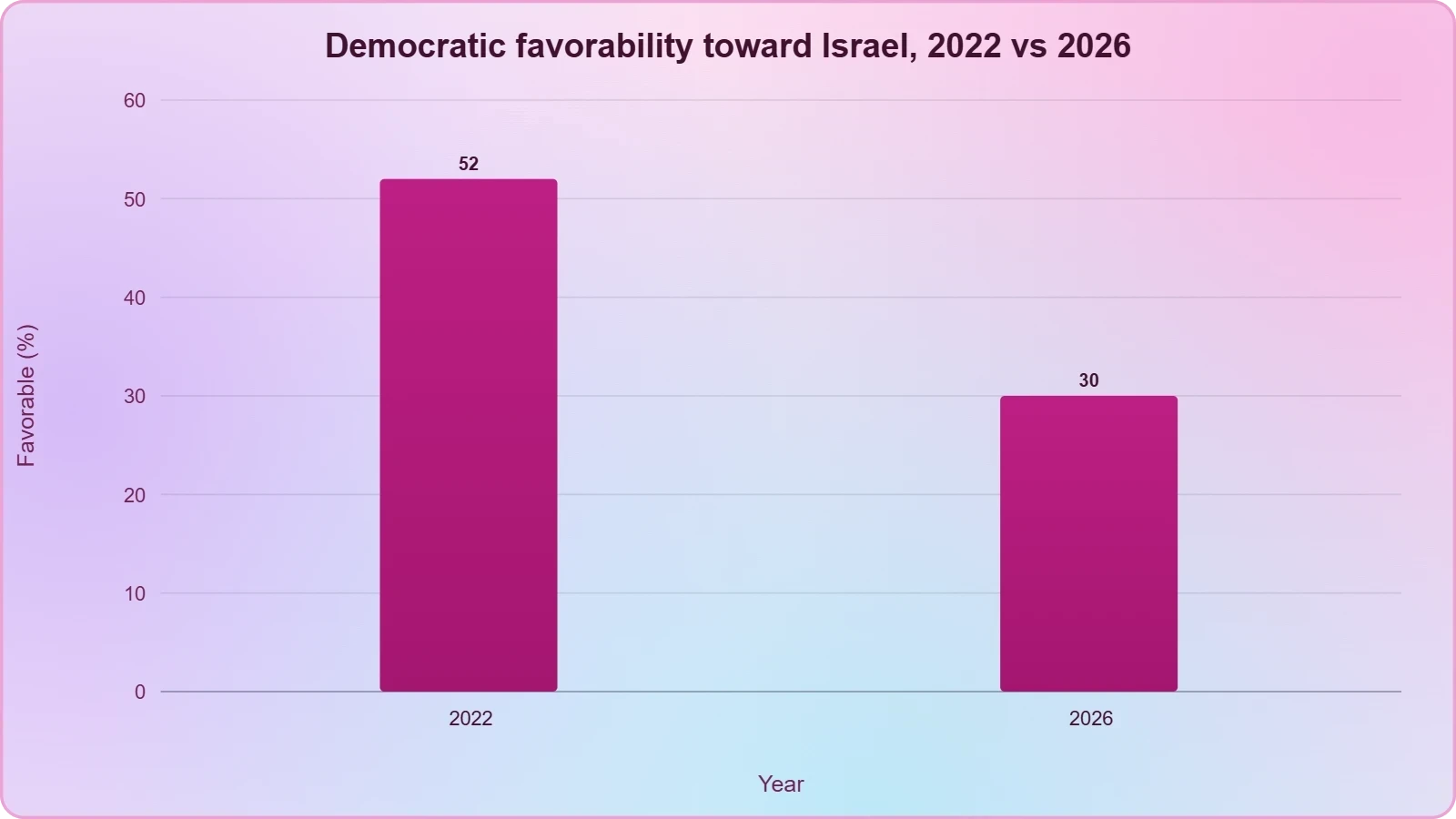
TL;DR AIPAC and its affiliated United Democracy Project suffered a consequential defeat in the 2026 midterms as candidates openly critical of unconditional US military support for Israel won Senate seats in Michigan and Texas despite enormous opposition spending. Long-running Chicago Council data shows American favorability toward Israel at a record low of 44 out of 100, with Democratic support falling from 52 to 30 since 2022. Criticism has also intensified on the right, including presidential and vice-presidential remarks about ending major aid. The lobby remains formidable, but its ability to dictate electoral outcomes is now demonstrably contestable.
The Anatomy of an Electoral Setback
The midterm results represent the first clear, measurable instance in which the pro-Israel lobby's flagship electoral machinery failed on multiple fronts in the same cycle. AIPAC's affiliated super PAC, the United Democracy Project, deployed tens of millions of dollars across competitive primaries and general elections, yet watched its preferred candidates fall in both Michigan and Texas. The defeats were not narrow or ambiguous; they were decisive enough that allies of one Republican contender reportedly asked the group to stop spending, a remarkable admission that the money had become a liability rather than an asset. This is the language of a deterrent that has lost its deterrent effect.
Understanding why requires attention to the mechanics of modern campaign finance. Independent expenditure groups can flood a race with advertising, but they cannot manufacture authentic local credibility, and they cannot easily rebut a candidate who converts the spending itself into a symbol of outside interference. When voters perceive that a Washington-based entity is attempting to purchase their representation, the attack ads write themselves. The 2026 cycle demonstrated that saturation spending, once a reliable instrument of persuasion, can be inverted into a mobilising grievance, particularly in primaries where activist energy and low turnout magnify the resonance of a single compelling message.
Michigan: The El-Sayed Breakthrough
Abdul El-Sayed's path to the Senate stands as the cycle's most symbolically potent result. Campaigning directly on anger over American military funding for Israel, he defeated AIPAC-backed opponents in both the primary and the general election, becoming the first Muslim senator in United States history. His victory speech included a pointed, sarcastic thank-you to the group for affording him the opportunity to beat it twice, a line that captured how thoroughly the lobby's opposition had been absorbed into his political identity. The remark was more than rhetorical flourish; it signalled that association with AIPAC had become a usable electoral foil rather than a disqualifying endorsement.
The financial asymmetry in Michigan deserves emphasis. The United Democracy Project reportedly spent tens of millions of dollars attempting to deny El-Sayed a seat, an expenditure that would have been considered decisive in earlier cycles. Instead, the spending became evidence for his central argument: that entrenched interests would spare no expense to protect a status quo voters had come to reject. This inversion of the traditional logic of campaign spending is the cycle's most instructive lesson. Money still shapes the terrain of elections, but it no longer reliably determines their outcome when the underlying public mood has shifted decisively against the spender's position.
Texas: Talarico's Consistent Dissent
James Talarico's Senate victory in Texas reinforced the pattern with a different stylistic register. Where El-Sayed channelled anger, Talarico offered consistency, stating early in his campaign that he had never accepted money from the group and never would, and pairing that pledge with a commitment to end American funding for Israeli offensive weapons. His win demonstrated that the position was not confined to one state's particular demographics or one candidate's charisma. Texas, with its distinct political culture and Republican-leaning statewide environment, provided a second data point suggesting that distancing from AIPAC had become a viable general-election strategy rather than a primary-only gambit.
Taken together, the two races form a natural experiment. Different candidates, different states, different rhetorical approaches, yet the same core proposition: that unconditional military support for Israel should be reconsidered, and that association with the lobby that defends that support is a political vulnerability. Both propositions prevailed. For an organisation that has long cultivated an aura of invincibility, the loss of that aura may prove more consequential than the loss of any individual race, because deterrence in politics depends as much on reputation as on resources.
Polling Evidence: A Record Low in Favorability
The electoral results did not emerge from a vacuum; they tracked a measurable and sustained deterioration in public sentiment. The Chicago Council on Global Affairs has asked Americans to rate their favorability toward Israel since 1978, providing one of the longest continuous series available on the question. This year's average score of 44 out of 100 represents a record low, a decline of fourteen points from 58 in 2022. A drop of that magnitude over a single four-year interval is unusual in opinion research, where foreign-policy attitudes typically move slowly and revert toward long-run averages. The persistence of the decline suggests a genuine reorientation rather than a transient reaction to headlines.
The partisan decomposition of the data is even more striking. Among Democrats, favorability fell from 52 in 2022 to 30 this year, a collapse of twenty-two points that effectively reversed the majority sentiment of just four years earlier. Dina Smeltz, a former State Department official now at the council, characterised the shift as a sharp drop in Democratic support, language that understates the scale of the movement. For a lobbying organisation whose influence rested on bipartisan backing, the erosion of one coalition partner's enthusiasm removes the foundation on which its leverage was built. A lobby that can deliver only one party's votes is a lobby with half its former bargaining power.
Interpreting the Numbers
Survey data of this kind requires careful reading. Favorability toward a country is not identical to support for its government's policies, and respondents may hold warm feelings toward a nation's people while opposing specific military actions. Nevertheless, the direction and consistency of the trend matter more than any single reading. When a measure tracked for nearly five decades reaches its lowest point in the same cycle that candidates campaigning against the relationship win competitive races, the correlation is difficult to dismiss as coincidence. The polling and the ballots are telling the same story in different registers.
There is also a generational dimension that the aggregate figures obscure. Younger voters, who now constitute a substantial share of the Democratic coalition, have come of age during a period in which the Israeli-Palestinian conflict has been framed primarily through the lens of civilian suffering and military asymmetry. Their formative political experiences differ markedly from those of older Democrats whose views were shaped by earlier eras. This cohort effect implies that the decline may continue even if immediate circumstances change, because attitudes formed in early adulthood tend to persist. Lobbying strategies calibrated to a previous generation's assumptions will struggle against this demographic tide.
The Partisan Asymmetry
What distinguishes the current moment from earlier periods of friction is the simultaneous erosion on both flanks of American politics. Historically, criticism of Israel was concentrated on the left, while the right offered reliably strong support rooted in evangelical constituencies and hawkish foreign-policy doctrine. The 2026 cycle disrupted that arrangement. The defection of prominent right-wing voices, including broadcaster Tucker Carlson and libertarian Representative Thomas Massie, signals the emergence of a non-interventionist current on the right that regards unconditional aid as inconsistent with its broader skepticism of foreign entanglements. A lobby facing criticism from both directions loses the ability to play one coalition against the other.
This dual erosion is strategically more dangerous than a one-sided decline. When support is robust on one side, an organisation can afford to lose ground on the other, because it retains a viable path to influence through the surviving coalition. When both sides soften simultaneously, the organisation must defend its position on two fronts with diminished reserves of goodwill. The polling data and the electoral results together describe precisely this predicament. The question is no longer whether the lobby retains influence, but whether it can rebuild a bipartisan foundation before the erosion becomes self-reinforcing through the logic of electoral incentives.
We Also Published
Voices From the Right: A New Dissent
The most unexpected development of the cycle was the emergence of high-profile criticism from figures on the political right, a quarter where support for Israel had long been treated as a fixed article of faith. On election day itself, President Donald Trump stated on Fox & Friends that the United States would end a major annual aid package to Israel, a remark that would have been extraordinary from any recent occupant of the office. Vice President JD Vance added that a trusted pollster had told him his party's post-midterm recovery would require, in part, changing its relationship with Israel. These are not marginal commentators but the sitting executive leadership of the Republican Party.
Alongside these statements, broadcaster Tucker Carlson and libertarian Representative Thomas Massie have openly criticised Israel in recent years, giving voice to a strand of opinion that combines skepticism of foreign aid with a broader distrust of interventionist foreign policy. This current draws on longstanding libertarian and paleoconservative traditions that regard entangling alliances as costly and inconsistent with national interest narrowly defined. Its growing visibility within the Republican coalition complicates the assumption that support for Israel is a permanent feature of conservative politics. If the right's foreign-policy center of gravity continues to shift toward restraint, the lobby's bipartisan strategy loses one of its two pillars.
The Significance of Presidential Statements
Presidential rhetoric carries weight beyond its immediate policy content because it signals permission. When a president says publicly that a major aid package will end, he legitimises a position that ordinary legislators may have privately held but considered too risky to voice. The statement functions as a cue, lowering the perceived cost of dissent for others in the coalition. This is why the remarks matter even if no legislation immediately follows. The Overton window of acceptable discourse shifts when the most prominent figure in the party moves it, and subsequent candidates calibrate their positions accordingly. The midterm results suggest that calibration is already underway.
The vice president's reported conversation with a pollster adds a tactical dimension. If internal party analysis concludes that recovery requires changing the relationship with Israel, then electoral self-interest begins to push in the same direction as ideological conviction. Politicians respond to incentives, and when the polling data and the leadership signals align, the direction of travel becomes clearer. This does not guarantee a rapid policy shift, because institutional inertia, donor networks, and committee structures all exert countervailing pressure. But it does mean that the cost-benefit calculation for individual candidates has changed, and changed calculations eventually produce changed behaviour.
Libertarian and Populist Currents
The libertarian critique of foreign aid rests on a coherent intellectual foundation: that American resources should not be committed to conflicts that do not directly serve national security, and that entangling commitments generate obligations without corresponding benefits. This argument has circulated in libertarian circles for decades, but it remained electorally marginal until the broader populist realignment brought skepticism of foreign entanglement into the Republican mainstream. The fusion of libertarian restraint with populist suspicion of established institutions has created a constituency that is receptive to arguments previously confined to academic journals and think-tank seminars.
Populist currents add a different ingredient: distrust of lobbies as such. A movement that defines itself against entrenched interests naturally views a powerful Washington lobbying organisation with suspicion, regardless of the specific policy it advocates. This means the lobby faces a structural problem on the right that is not primarily about Israel at all, but about the legitimacy of organised influence in a populist era. The same logic that fuels hostility toward financial lobbies or pharmaceutical lobbies can be turned against foreign-policy lobbies, and once that frame is established, it is difficult to dislodge.
The Lobby's Structure and Its Limits
AIPAC describes itself as nonpartisan and has traditionally supported candidates from both parties, a posture that allowed it to function as a bridge between coalitions and to claim that its influence reflected consensus rather than faction. It states that it accepts money only from Americans and that its board is composed entirely of American citizens, assertions intended to preempt accusations of foreign alignment. These claims are legally and organisationally meaningful, but they do not resolve the political question. The group has become closely associated in public perception with Washington's strong ties to Israeli governments, including the outgoing far-right coalition of Benjamin Netanyahu, and perception in politics is often more consequential than formal structure.
The association creates a vulnerability that no amount of procedural propriety can fully neutralise. When voters disapprove of a foreign government's actions, they transfer that disapproval to the domestic organisation most visibly identified with supporting that government. The lobby's nonpartisan self-description cannot insulate it from this transfer, because the identification is emotional and symbolic rather than contractual. This is the structural limit that the midterm results exposed: an organisation can control its own conduct, but it cannot control the meaning voters assign to its conduct, and that meaning is shaped by events far beyond its reach.
Money as a Double-Edged Instrument
The United Democracy Project's expenditure of tens of millions of dollars in a single Senate race illustrates both the scale of the lobby's resources and the limits of their utility. In earlier cycles, such spending would have been treated as a decisive intervention, capable of defining a candidate before voters formed impressions. In 2026, the spending became part of the opponent's message, evidence that outside forces were attempting to purchase representation. The instrument was turned against its wielder, a phenomenon that campaign strategists will study for years. Money remains essential to modern campaigns, but its persuasive power depends on the credibility of the messenger and the receptivity of the audience.
There is a deeper lesson about the relationship between spending and legitimacy. Voters tolerate large expenditures when they perceive them as normal participation in the democratic process, but they react against them when they perceive them as attempts to override local preferences. The distinction is subjective and easily manipulated, which is precisely why saturation spending is risky. A campaign that spends heavily invites the accusation of buying influence, and in an era of heightened distrust toward institutions, that accusation lands with unusual force. The lobby's financial strength thus contains within it the seed of its rhetorical weakness.
What Persists and What Has Changed
The report notes that pro-Israel lobbyists are not expected to disappear from American politics, and this assessment is almost certainly correct. Organised interests with deep resources, established relationships, and decades of institutional knowledge do not vanish after a single adverse cycle. They adapt, recalibrate, and rebuild. The group retains substantial capacity to influence legislation, shape committee agendas, and support friendly candidates in districts where its message still resonates. The midterm setback is a setback, not a dissolution, and analysts who predict imminent collapse mistake a shift in fortunes for an extinction event.
What has changed is the presumption of inevitability. For years, the lobby's power rested partly on the belief that opposing it was futile, a belief that discouraged challengers before they entered races. That belief has now been empirically falsified in two high-profile contests, and once falsified it cannot be fully restored. Future candidates will know that the giant can be beaten, and that knowledge alters the calculus of ambition. The organisation may remain influential, but it will henceforth operate in a landscape where its endorsement is contestable and its opposition is survivable, which is a materially different environment from the one it dominated for decades.
Implications for American Foreign Policy
The midterm results carry implications that extend well beyond the fortunes of a single organisation. American foreign policy toward Israel has rested on a durable domestic consensus that spanned administrations of both parties for generations. That consensus is now visibly fracturing, and the fracture is occurring at the electoral level, where incentives are most directly felt by legislators. When candidates discover that questioning the relationship wins races, the composition of the next Congress shifts, and with it the range of policies that become politically conceivable. The consequences will unfold gradually, through committee hearings, aid votes, and the quiet recalibration of positions that precedes any formal change.
It is important to avoid overstating the pace of change. Foreign policy is characterised by institutional continuity, and the structures that sustain the relationship, including defence procurement arrangements, intelligence cooperation, and diplomatic coordination, are deeply embedded. A shift in public opinion does not automatically translate into a shift in policy, because many of the relevant decisions are made by officials insulated from electoral pressure. Nevertheless, democratic systems eventually respond to sustained changes in public sentiment, and the direction of that sentiment is now unmistakable. The question is one of timing and degree, not of ultimate direction.
The Domestic Politics of Aid
Military assistance to Israel has long been treated as a bipartisan constant, approved with minimal public debate and framed as a strategic necessity rather than a contested choice. The 2026 cycle challenged that framing by making aid a central campaign issue in competitive races. Once an expenditure becomes an object of electoral contestation, it acquires a political life that technocratic justifications cannot fully control. Legislators who previously voted without controversy now face constituents who ask specific questions about specific weapons and specific sums. This granular scrutiny is a new condition for a policy area that had grown accustomed to deference.
The fiscal dimension also deserves attention. Arguments for restraint increasingly draw on budgetary logic, framing aid as a cost to be weighed against domestic priorities. This framing has the advantage of appealing across ideological lines, uniting fiscal conservatives with progressives who oppose the aid on humanitarian grounds. Such coalitions are unstable in their motivations but effective in their votes, and they can force debates that the leadership of either party would prefer to avoid. The emergence of this cross-ideological configuration is one of the more consequential structural developments of the cycle.
Alliances and Credibility Debates
Defenders of the existing relationship argue that reducing aid would damage American credibility with allies worldwide, signalling that commitments are contingent on domestic political fashion. This is a serious argument with a long pedigree in international relations theory, and it will be deployed forcefully in the debates to come. Critics respond that credibility is better preserved by commitments that are sustainable and publicly supported than by commitments maintained against the evident will of the electorate. Both positions have internal coherence, and the contest between them will shape the next phase of American foreign policy debate.
The broader geopolitical context adds complexity. American attention is divided among multiple theaters, and every commitment carries an opportunity cost measured in resources and diplomatic capital. A public increasingly skeptical of foreign entanglement will scrutinise each commitment for its contribution to national security narrowly understood. This scrutiny applies not only to Israel but to alliance structures generally, and the outcome of the Israel debate may establish precedents for how other commitments are evaluated. The midterms thus function as a leading indicator for a wider reconsideration of America's role in the world.
Reading the Cycle Correctly
The temptation in the aftermath of any dramatic result is to overinterpret, to declare a permanent realignment on the basis of a single election. Intellectual honesty requires resisting that temptation while still acknowledging the genuine significance of what occurred. Two Senate races, however symbolically potent, do not by themselves constitute a transformation of American politics. But they do constitute evidence, and evidence accumulates. When electoral outcomes align with long-term polling trends and with signals from party leadership, the convergence is more persuasive than any single element considered alone. The responsible reading treats the midterms as a confirming data point in a trend that was already visible.
It is equally important to avoid the opposite error of dismissing the results as anomalous. The defeats were not flukes produced by peculiar local circumstances; they occurred in different states, with different candidates, employing different rhetorical strategies, against the same opposition. That pattern is the signature of a structural shift rather than a random fluctuation. Analysts who attribute the outcome entirely to candidate quality or campaign tactics miss the common variable: a public that had already changed its mind, and candidates who recognised and articulated that change before their opponents did.
Lessons for Organised Influence
The episode offers a general lesson about organised influence in democratic systems. Influence depends on three resources: money, relationships, and legitimacy. Money can be deployed quickly and measured precisely, which is why it receives disproportionate attention. Relationships endure and compound, which is why they are valuable. But legitimacy is the scarcest resource, because it cannot be purchased or manufactured, and it can be lost suddenly when an organisation becomes identified with a position the public has come to reject. The midterms demonstrated that abundant money and deep relationships cannot compensate for a deficit of legitimacy once that deficit becomes visible to voters.
For any advocacy organisation, the implication is that periodic investment in public persuasion is not optional. An operation optimised for legislative access and electoral spending may neglect the slower work of maintaining broad public sympathy, and that neglect can prove costly when circumstances change. The lobby's challenge going forward is not primarily financial or organisational but rhetorical: it must persuade a skeptical public that its position serves the national interest, in language that resonates with audiences that have grown distrustful of established institutions. Whether it can accomplish that task is the central question of its next chapter.
What to Watch Next
Several indicators will reveal whether the 2026 cycle marked a turning point or a temporary dip. The first is the behaviour of newly elected senators as they take office and confront actual votes on assistance packages. Campaign rhetoric and legislative conduct are different activities, and the gap between them will be instructive. The second is the stance of party leadership, which must balance the preferences of its base against institutional and international considerations. The third is the trajectory of public opinion, which will show whether the decline has stabilised or continues. Each of these indicators will provide evidence about the durability of the shift.
Beyond these immediate signals, the longer-term question concerns the generational composition of the electorate. If the cohort effects described earlier persist, the pressure on the relationship will intensify as younger voters replace older ones in the active electorate. Organisations that adapt early to demographic change often prosper; those that resist it often find themselves defending positions that no longer command majority support. The midterms may thus be remembered less for the specific races they decided than for the moment they revealed: that a relationship long treated as beyond debate had become, irreversibly, a subject of ordinary democratic contestation.
From our network :
- The Hidden Cost of AI Convenience: Why Over-Permissioned Agents Are a Security Time BombDiscover why AI agents with excessive permissions create dangerous single points of failure, and learn how implementing least privilege principles can protect your organization from exploitation.
- The Final Descent: How ESA Retired the Legendary Cluster Constellation After 24 Years of Space Weather ScienceAfter 24 years mapping Earth’s magnetosphere, ESA’s Cluster mission concluded with a precisely controlled reentry over the South Pacific. This analysis explores the scientific legacy, engineering decisions, and debris mitigation principles behind one of space exploration’s most responsible retirements.
- Live Online English Classes for Kids: Do They Actually Reduce Anxiety?A ten-week study reveals that synchronous online English classes can significantly reduce child language anxiety while improving listening and reading skills. Discover what makes these programs effective and how parents can select the right one.
- Committed Mediterranean Precipitation Decline: Why Emissions Cuts Alone Cannot Restore Winter RainsNew NOAA research reveals that Mediterranean winter rains may decline irreversibly even with emissions cuts. Explore the science of committed climate change and regional impacts.
- Forbidden Matrix Patterns and Visible Lattice Points: A Geometric DictionaryExplore how multidimensional 0–1 matrices encode geometric truths, linking forbidden patterns to visible lattice points and hypergraph theory, with applications in combinatorics and computational geometry.
- University Language Proficiency Exams: Why Institutional Tests Demand Different Preparation Than IELTS and TOEFLDiscover why university-specific language proficiency examinations differ fundamentally from IELTS and TOEFL, and learn strategic preparation approaches for institutional assessment success.
- How AI Agents Will Change the Way We Manage Personal FinancesExplore how AI agents are transforming personal finance through automated budgeting, bill payment, and investment management, while examining the critical security protocols and governance frameworks required for safe deployment.
- Mobile Learning and VR in English: What Global Evidence Reveals About Effective Language TechnologyA systematic review across 14 countries reveals which language-learning technologies genuinely work. Mobile learning, AI, and VR show measurable benefits when pedagogically integrated. This evidence-based guide helps educators and learners select technology that delivers real return on investment.
- CISA’s Ten-Advisory Wave: Why Generic Patching Fails in OT and How to Build Product-Specific PlaybooksCISA released ten ICS advisories in one week, exposing critical infrastructure risks. Generic patching fails in OT. Learn to build product-specific remediation playbooks.
RESOURCES
- Support for #Israel among Democratic voters in the #US continues to ...instagram.comMay 21, 2026 ... The US midterm elections delivered a major setback to the traditionally strong bipartisan support ... Israel or who boast about…
- AIPAC's electoral setback and Trump's announcement on military ...facebook.com6 days ago ... ... US support for "Israel". US-'Israel' alliance faces growing rupture after midterms. ENGLISH.ALMAYADEEN.NET. US-'Israel' alliance faces growing ...
- Is AIPAC's political standing declining in the US? - Al Jazeeraaljazeera.comAug 25, 2026 ... However, when it comes to recent efforts to sway US election results in favour of candidates who support Israel, AIPAC…
- Israel skeptics flood Congress in stinging defeat for AIPACnewsweek.com7 days ago ... This dealt a significant setback to the American Israel Public Affairs Committee (AIPAC) ... support the U.S.-Israel alliance. What the ...
- Support from pro-Israel group AIPAC becomes a dividing line in ...abcnews.comApr 29, 2026 ... Against the backdrop of polls showing declining Democratic support for Israel -- especially among young voters -- the American Israel…
- A bitter Michigan Senate race rattles Jewish and Muslim voters ...pbs.orgOct 19, 2026 ... ... American Israel Public Affairs Committee, or AIPAC. Stevens ... support for Israel. Trump won the city of nearly 100,000…
- Newsom Compares Israel to 'Apartheid State,' Questions Military ...gvwire.comMar 5, 2026 ... Public opinion polls have shown declining support for Israel among the American public, a trend that is especially stark among…
- Israel: Major Issues and U.S. Relations - Congress.govcongress.govJul 2, 2026 ... ... U.S. support to Israel if it were to do so. Israeli elections ... decreasing prospects for a safe return…
- AIPAC hails US midterm wins despite costly election defeatsnewarab.com6 days ago ... Latimer made his support for US military assistance to Israel a central dividing line with Bowman, rejecting his demand for…
- El-Sayed's victory sends tremors through Democratic Party - BBCbbc.comAug 5, 2026 ... ... Aipac - the American Israel Public Affairs Committee. Outside ... US support for Israel. He became the latest party…
- AIPAC's dwindling allies in Congress - Live Updates - Politicopolitico.com6 days ago ... More than 30 of the bipartisan group's preferred candidates lost in this week's midterm elections. ... Pro-Israel lobby AIPAC is…
- The American anti-Israel awakening - Middle East Monitormiddleeastmonitor.comNov 28, 2025 ... Israeli commentator links Republican election setback to declining support for Israel in US ... setback in the US midterm elections,…
- 6 Jewish takeaways as Democrats dominate US midterm electionstimesofisrael.com7 days ago ... ... support is dropping alongside Democrats'. And Tuesday's results suggest AIPAC's strong support for the US and Israeli military strikes ...
- Pro-Israel groups denounced after pouring funds into primary racetheguardian.comAug 4, 2022 ... J Street has called on Democratic candidates to decline Aipac's support, saying that it is intended to warn politicians against…
- El-Sayed, AIPAC, antisemitism and Israel: 5 US midterm races to ...timesofisrael.comNov 2, 2026 ... Tuesday's votes will test Jews' longstanding support for Democrats, weigh pro-Israel candidates from both parties, and measure the far ...
- 01
- 02
- 03
- 04
- 05
- 06
- 07
- 08
0 Comments