When Grab Holdings disclosed its third-quarter results on November 3, 2026, the market responded with an immediate and emphatic endorsement: shares climbed roughly nine percent as revenue surpassed the consensus estimates analysts had assembled, and management simultaneously lifted its outlook for the following year. The dual announcement — a beat on the top line paired with a raised forward forecast — is the kind of combination that equity markets reward disproportionately, because it signals not merely that a business performed well in a single quarter but that the trajectory of that performance is being revised upward by the people with the deepest visibility into it. For a Southeast Asian super-app operating across ride-hailing, food delivery, and digital financial services, that signal carries weight well beyond a single trading session.
The episode is instructive precisely because of what it reveals about how information moves through modern markets. Grab's shares trade on Nasdaq under the ticker GRAB, and the company sits at the intersection of several narratives that investors have been pricing and repricing for years: the viability of the super-app model, the durability of on-demand delivery economics after the pandemic-era boom, and the emergence of digital financial services as a genuine profit engine in emerging markets. A revenue beat does not resolve any of those debates on its own, but it does shift the burden of proof onto the skeptics, and the nine percent move reflects that shift in real time. The raised 2026 outlook compounds the effect, because it tells the market that the company's own internal models now point to a stronger future than they did three months earlier.
What follows examines the announcement from several angles: the mechanics of why revenue beats and guidance raises move share prices so forcefully, the specific business segments that likely drove the result, the competitive and macroeconomic context in which Grab operates, and the risks that could still derail the improved outlook. The analysis also considers what the market's reaction implies about investor expectations for Southeast Asia's digital economy more broadly, and how a single earnings release can function as a referendum on an entire business model. The goal is not to celebrate a one-day stock move but to understand the structural forces that made it possible and the questions it leaves unanswered.
On This Page
- The Anatomy of a Revenue Beat and Why It Moves Markets
- Grab's Business Model and the Segments Behind the Result
- Competitive Dynamics Across Southeast Asia's Digital Economy
- The Raised 2026 Outlook and What It Signals
- Risks That Could Undermine the Improved Trajectory
- What the Market Reaction Reveals About Southeast Asia's Digital Economy
TL;DR Grab Holdings shares rose approximately nine percent on November 3, 2026, after the company reported third-quarter revenue that exceeded analyst estimates and raised its outlook for 2026. The combination of a top-line beat and an upward guidance revision is among the most powerful catalysts in equity markets, because it simultaneously validates past execution and revises future expectations. For Grab, the result reflects the maturing economics of Southeast Asia's leading super-app across mobility, deliveries, and financial services, while leaving open questions about competition, regulatory pressure, and the sustainability of growth as the company scales. The market's reaction demonstrates how earnings releases function as periodic referenda on business models, not merely on quarterly numbers.
The Anatomy of a Revenue Beat and Why It Moves Markets
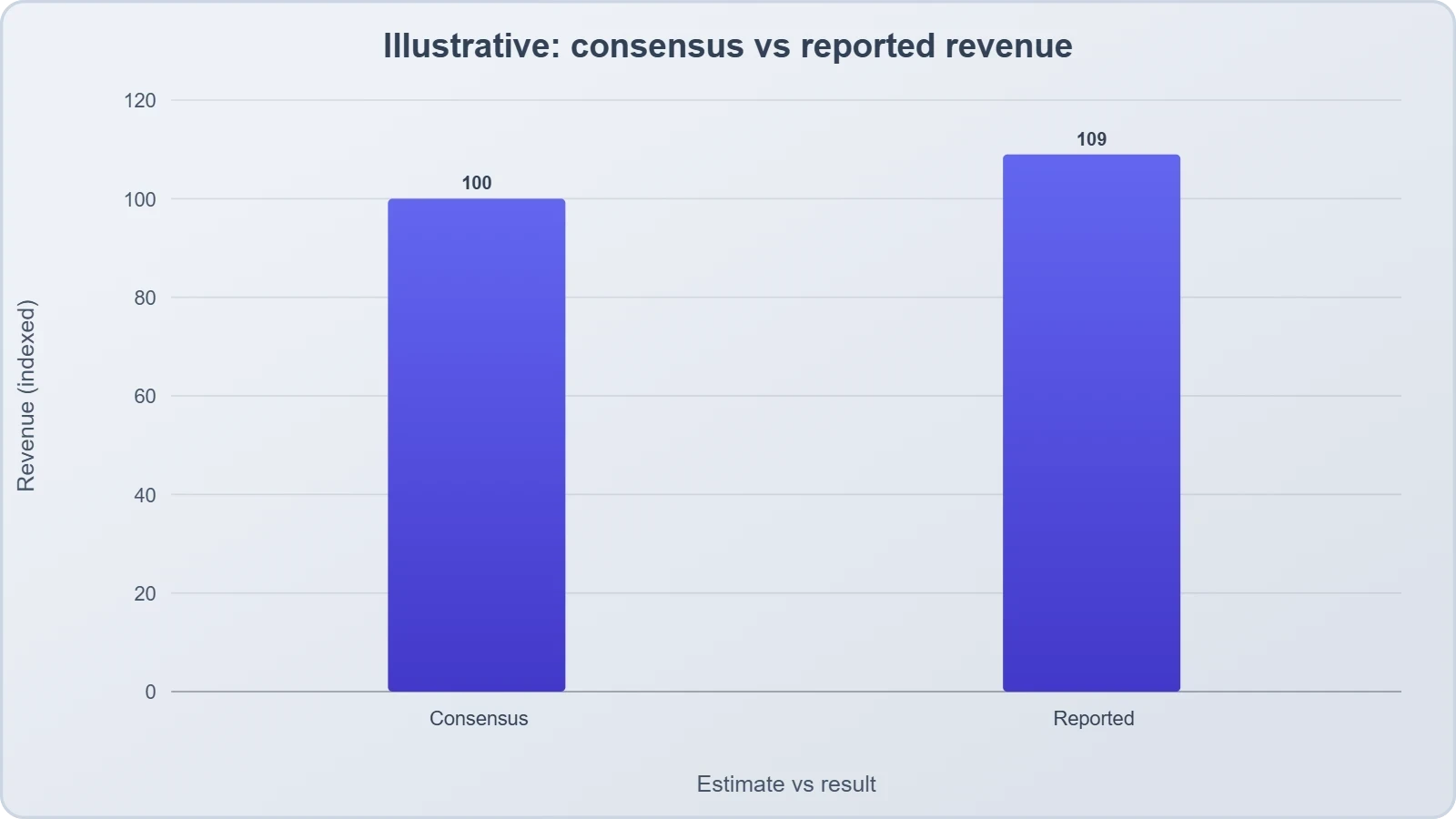
Equity markets are forward-looking pricing mechanisms, which means the number a company reports matters far less than the number the market had already assumed. Analysts publish consensus estimates precisely so that investors can measure reported results against a shared benchmark, and when a company like Grab clears that benchmark on revenue, the surprise element forces a rapid recalibration of models across the institutional investment community. A beat of even modest magnitude can trigger outsized price moves because it invalidates the assumptions embedded in thousands of spreadsheets simultaneously, and portfolio managers who were underweight the stock must decide quickly whether to chase the new information or dismiss it as noise.
The nine percent move in Grab's shares on the day suggests the market treated the beat as meaningful rather than marginal. Revenue is the top line for a reason: it reflects demand for a company's products and services before the distorting effects of cost management, one-time items, or accounting choices. For a platform business, revenue growth also carries information about user engagement, merchant adoption, and driver supply, because those operational metrics ultimately express themselves as transaction volume and take rate. When revenue exceeds expectations, the market infers that the underlying ecosystem is healthier than previously believed, and that inference is what drives the repricing.
Why the Combination of Beat and Raise Is So Potent
A revenue beat alone is a backward-looking event. It tells investors that the last ninety days went better than expected, but it says nothing definitive about the next ninety. A guidance raise is different in kind: it is a forward-looking statement made by management, carrying the weight of internal data, and it represents a voluntary assumption of risk. Executives who raise guidance are staking their credibility on the accuracy of their own forecasts, and markets know that missing raised guidance later is punished severely. When a beat and a raise arrive together, investors read the pairing as confirmation that the improvement is structural rather than seasonal or one-off.
This is why the two announcements compounded in Grab's case. The beat validated the quarter just completed; the raised 2026 outlook validated the trajectory beyond it. Together they shortened the timeline on which the company's growth story would be judged, converting a distant promise into a nearer-term expectation. For investors who had been waiting for evidence that Grab's diversification into financial services and advertising would translate into durable revenue growth, the combination provided exactly that evidence, and the nine percent gain reflects the speed with which conviction can be rebuilt when expectations are exceeded on both the present and the future.
The Role of Consensus Estimates in Price Discovery
Consensus estimates are not objective truths; they are aggregations of analyst forecasts, each shaped by proprietary models, channel checks, and conversations with management. When a company beats consensus, it is beating a human-constructed benchmark that may itself have been biased by recent momentum or by cautious guidance issued three months earlier. Companies often guide conservatively precisely so that they can clear the bar later, and sophisticated investors account for this sandbagging tendency when interpreting a beat. The question that determines the size of the price reaction is whether the beat reflects genuine operational outperformance or merely the clearing of a deliberately low hurdle.
In Grab's case, the market's willingness to bid the stock up nine percent suggests investors concluded the beat was substantive. That conclusion would have been reinforced by the guidance raise, because a company that was merely sandbagging would have little reason to lift its full-year outlook — doing so raises the bar for future quarters and invites disappointment if conditions deteriorate. The pairing of the two announcements therefore functioned as a credibility signal, telling the market that management's confidence extends beyond the quarter just reported and into the following fiscal year. That is a more durable form of information than any single quarter's revenue figure.
Grab's Business Model and the Segments Behind the Result
Grab operates one of Southeast Asia's most extensive digital ecosystems, spanning ride-hailing, food and grocery delivery, parcel logistics, and digital financial services including payments, lending, and insurance. The company began as a ride-hailing challenger and expanded aggressively into adjacent verticals, a strategy that transformed it into what the industry calls a super-app: a single platform through which users access multiple services. The model's appeal lies in cross-selling and shared infrastructure, but its challenge lies in the capital intensity required to defend multiple fronts simultaneously against well-funded competitors. Understanding Grab's revenue beat requires understanding which of these verticals contributed most to the growth.
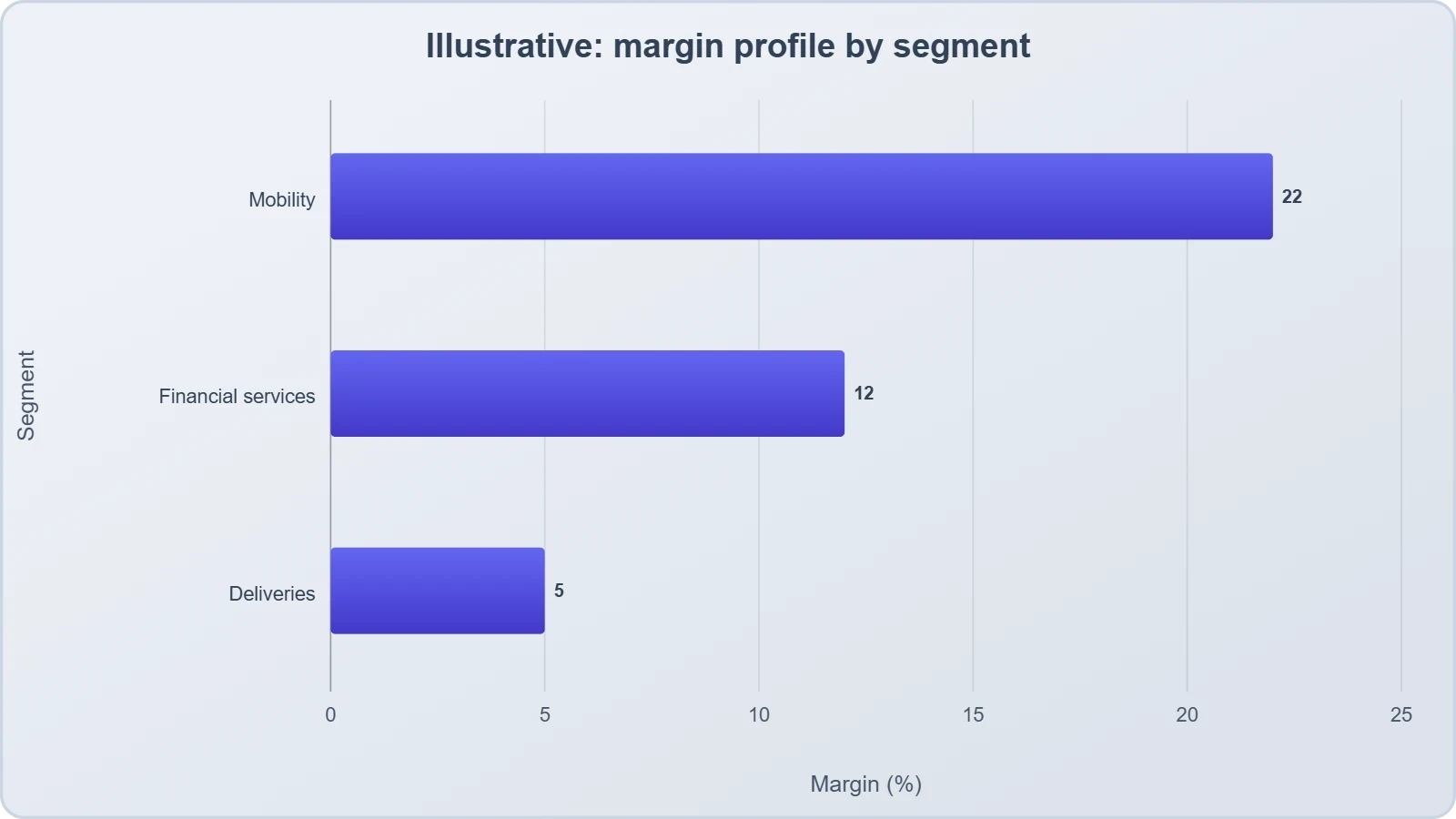
Mobility services have historically been Grab's most profitable segment, generating healthy margins on each ride because the marginal cost of matching a driver to a passenger is low once the platform is built. Deliveries, by contrast, operate on thinner margins and require continuous investment in driver incentives and merchant partnerships. Financial services represent the newest and most capital-hungry frontier, but also the one with the longest runway for growth, because large portions of Southeast Asia's population remain underbanked. A revenue beat at the group level could reflect strength in any of these segments, and the market's reaction implies that whatever the mix, the aggregate trajectory pleased investors.
Mobility, Deliveries, and the Economics of the Super-App
The super-app thesis rests on the proposition that a user acquired through one service can be monetized across many others at a lower marginal cost than a single-service competitor could achieve. Grab's data on user frequency and cross-vertical engagement is therefore central to its investment case, because it determines whether the platform's scale translates into a genuine cost advantage or merely into a larger collection of subsidized businesses. When revenue grows faster than expected, it suggests that cross-selling is working and that the platform is extracting more value per user than the market had assumed, which is precisely the kind of evidence that supports a higher valuation multiple.
Deliveries remain the volume driver for many super-apps, and Grab is no exception. Food delivery in Southeast Asia is a fiercely contested market, with competitors ranging from regional players to global entrants, and the segment's economics depend heavily on density: the more orders per square kilometer, the more efficient the routing and the lower the delivery cost per order. Revenue growth in this segment therefore carries information about market share and density, not merely about consumer spending. A beat at the group level may indicate that Grab has achieved better density in key markets, improving unit economics even as it expands.
Financial Services as the Next Growth Engine
Digital financial services represent Grab's most ambitious bet and its most consequential one for long-term valuation. Southeast Asia contains hundreds of millions of adults who lack full access to traditional banking, and mobile-first platforms are positioned to serve them through payments, micro-lending, and insurance products embedded in everyday transactions. Grab has built a financial services arm that leverages its ride and delivery data to underwrite credit, a structural advantage that pure-play fintechs cannot easily replicate. If this segment is contributing meaningfully to revenue growth, the market's willingness to pay a premium for the stock becomes easier to justify.
The economics of financial services differ fundamentally from those of mobility or deliveries. Lending generates interest income that compounds over time, but it also introduces credit risk and regulatory scrutiny that platform businesses are not always equipped to manage. Investors therefore watch this segment closely for signs of underwriting discipline as much as for growth. A revenue beat that includes strong financial services contributions would be read positively, but sophisticated analysts would immediately ask whether that growth came with deteriorating credit quality or looser lending standards, questions that a single headline number cannot answer.
Competitive Dynamics Across Southeast Asia's Digital Economy
Grab's results cannot be understood in isolation from the competitive environment in which they were achieved. Southeast Asia's digital economy is one of the world's most dynamic, driven by young populations, rapid smartphone adoption, and rising disposable incomes, but it is also one of the most contested. Grab faces competition from regional players, from global platforms seeking a foothold, and from local challengers in individual markets. Each of these competitors exerts pressure on pricing, on driver and merchant incentives, and on the marketing spend required to defend market share, all of which affect the revenue and margin trajectory that investors are trying to forecast.
The competitive landscape has shifted in recent years as the industry's focus moved from growth-at-all-costs to profitability. Investors who once rewarded companies for burning cash to acquire users now demand evidence of sustainable unit economics, and that shift has forced platforms across the region to rationalize incentives and raise take rates. Grab's revenue beat may partly reflect this industry-wide pivot: higher take rates and reduced subsidies translate directly into revenue growth even if transaction volumes are flat. Understanding whether the beat came from volume growth or from pricing power is essential to judging whether it is durable.
Pricing Power Versus Volume Growth
Revenue growth has two components: the number of transactions and the revenue captured per transaction. A company can grow revenue by expanding volume, by raising take rates, or by some combination of both, and the market interprets each path differently. Volume-driven growth suggests a healthy, expanding ecosystem with room to run, while take-rate-driven growth suggests pricing power that may be finite and could invite competitive response. When Grab reported its beat, analysts would have immediately begun dissecting which of these forces was dominant, because the answer determines whether the raised 2026 outlook rests on a solid foundation or on a lever that can only be pulled so far.
The distinction matters especially in deliveries, where merchants and consumers are highly price-sensitive and where competitors can undercut on commission rates. If Grab's revenue growth came primarily from higher take rates, competitors may respond by offering lower commissions to attract merchants, eroding Grab's gains. If it came from volume, the competitive position is more defensible because volume reflects genuine consumer preference and network density. The market's nine percent reaction implies investors believe the growth is at least partly volume-driven, but the absence of detailed segment disclosure in the initial report leaves room for interpretation.
The Regional Competitive Map
Southeast Asia's digital economy spans markets as different as Singapore, Indonesia, Vietnam, Thailand, the Philippines, and Malaysia, each with its own competitive dynamics, regulatory frameworks, and consumer preferences. Grab operates across most of these markets, which gives it diversification but also exposes it to a complex web of local competitors and regulators. In Indonesia, the region's largest market by population, local platforms and global entrants compete aggressively for riders and merchants. In Vietnam, domestic champions have built strong positions. Grab's ability to grow revenue across this patchwork is a testament to its scale, but it also means that a beat in one market can mask weakness in another.
The competitive map is further complicated by the rise of adjacent players. E-commerce platforms have moved into delivery, ride-hailing companies have expanded into payments, and banks have launched digital wallets. The boundaries between these categories are blurring, and Grab's super-app positioning places it in direct competition with a wider array of companies than its original ride-hailing rivals. A revenue beat in this environment suggests Grab is holding its own, but the durability of that position depends on continued investment in technology, incentives, and merchant relationships, all of which consume the cash that profitability requires.
We Also Published
- 01
- 02
- 03
- 04
The Raised 2026 Outlook and What It Signals
Management's decision to raise the 2026 outlook is arguably more significant than the third-quarter revenue beat itself. Guidance is a formal communication of management's expectations, and raising it means the company's internal forecasts have improved since the last update. For investors, this is valuable because management has access to real-time operating data that external analysts lack: booking trends, driver supply metrics, merchant sign-ups, and credit performance. When management raises guidance, it is effectively sharing a portion of that private information with the market, and the market responds by adjusting its own models upward.
The timing of the raise also matters. Announcing an improved 2026 outlook alongside third-quarter results gives investors a longer runway over which to hold the stock, because the improved forecast extends beyond the current fiscal year. This can attract investors with longer holding periods, such as institutional funds that build positions based on multi-year growth trajectories rather than quarterly momentum. The nine percent move may therefore reflect not just the immediate beat but the recalibration of longer-term expectations, which is a more durable source of price support than a single quarter's surprise.
How Guidance Raises Are Priced by the Market
Markets price guidance raises through a process of expectation revision. Analysts update their models, revise their price targets, and communicate the changes to clients, and the resulting flow of buy orders moves the stock. The magnitude of the move depends on how much the raise exceeds what was already anticipated. If the market had already priced in an improved outlook based on industry trends or competitor results, the raise may produce a muted reaction. If the raise surprises, as appears to have been the case with Grab, the reaction can be sharp and immediate, as the nine percent gain demonstrates.
The pricing process is also reflexive. A stock that rises sharply on good news attracts attention from momentum investors and from media coverage, which in turn attracts more buyers. This reflexivity can amplify the initial move beyond what fundamentals alone would justify, creating the possibility of a subsequent correction if the enthusiasm outpaces the underlying improvement. Sophisticated investors are aware of this dynamic and often use sharp post-earnings moves as opportunities to reassess rather than to chase, which is why the days and weeks following an earnings release often reveal more about the market's true assessment than the initial session does.
The Credibility Test That Follows
Every raised outlook creates a future credibility test. Management has now told the market that 2026 will be better than previously expected, and the market has priced that promise into the stock. If the company delivers, credibility rises and the stock may be rewarded with a higher multiple. If it falls short, the penalty can be severe, because investors punish broken guidance more harshly than they punish conservative guidance that was later exceeded. The nine percent gain therefore represents an advance on trust that Grab must now earn through execution over the coming quarters, and the company's management is surely aware of the stakes.
The credibility test is especially acute for a company operating in emerging markets, where currency fluctuations, regulatory changes, and competitive shocks can alter the trajectory of a business faster than in more mature economies. Grab's raised outlook implicitly assumes that conditions in its key markets will remain broadly favorable, that competition will not intensify beyond what it has modeled, and that its financial services arm will continue to grow without incurring unexpected credit losses. Each of these assumptions could be tested, and the market's confidence will be measured against how well the company navigates those tests.
Risks That Could Undermine the Improved Trajectory
Optimism following an earnings beat is warranted only to the extent that the underlying risks are understood. Grab faces a set of structural challenges that could erode the gains implied by its raised outlook, and investors who focus solely on the positive headline risk overlooking them. Competition remains intense across all of Grab's verticals, regulatory scrutiny of platform economics is increasing in several Southeast Asian markets, and the macroeconomic environment could shift in ways that reduce consumer spending on discretionary services like ride-hailing and food delivery. Each of these factors could pressure revenue growth in future quarters.
The financial services segment introduces additional risk that is qualitatively different from the risks in mobility and deliveries. Lending businesses are exposed to credit cycles, and a deterioration in borrower repayment behavior could force Grab to increase provisions, compressing margins and potentially requiring additional capital. Regulatory changes to lending practices, interest rate caps, or data privacy rules could also affect the segment's economics. Because financial services are central to the growth story that justifies Grab's valuation, any setback in this area would likely have an outsized effect on the share price, far beyond the direct financial impact.
Regulatory and Macroeconomic Pressures
Platform businesses across Southeast Asia operate under evolving regulatory frameworks, and governments in the region have shown increasing willingness to intervene in areas such as driver classification, commission rates, and data localization. A change in how regulators classify gig workers, for example, could raise Grab's labor costs substantially by requiring benefits or minimum pay guarantees. Similarly, caps on commission rates could compress take rates and reduce revenue per transaction. These regulatory risks are difficult to forecast and can materialize quickly, which is why investors typically apply a discount to platform businesses operating in multiple jurisdictions with varying rules.
Macroeconomic conditions also matter more than headline GDP figures suggest. Ride-hailing and food delivery are discretionary services, and demand for them is sensitive to household budgets. If inflation erodes real incomes or if employment conditions weaken, consumers may reduce their use of these services, pressuring transaction volumes. Currency movements add another layer of complexity, because Grab reports in US dollars while earning revenue in multiple local currencies, and a strengthening dollar can reduce reported revenue even if local-currency performance is strong. These macro factors are outside management's control but directly affect the company's ability to meet its raised guidance.
Execution Risk in a Multi-Vertical Strategy
Managing a super-app requires balancing the demands of multiple businesses with different economics, different competitive dynamics, and different capital requirements. Grab's management must allocate capital across mobility, deliveries, and financial services while defending market share in each, and misallocation can be costly. Overinvesting in a low-return vertical drains resources from higher-return ones, while underinvesting can cede ground to competitors. The raised outlook implies that management believes its current allocation is working, but execution risk remains, particularly as the company scales financial services, which requires capabilities that differ from those needed to run a ride-hailing platform.
Execution risk is amplified by the pace of change in Southeast Asia's digital economy. Consumer preferences shift quickly, new competitors emerge, and technology evolves. A strategy that works today may not work in two years, and companies that fail to adapt can lose relevance rapidly. Grab's history suggests it is capable of adaptation, having expanded from ride-hailing into deliveries and financial services, but past adaptability does not guarantee future success. The market's nine percent gain reflects confidence in management's ability to execute, and that confidence will be tested repeatedly over the coming quarters as the raised guidance is either validated or undermined.
What the Market Reaction Reveals About Southeast Asia's Digital Economy
The nine percent move in Grab's shares is a data point not just about one company but about investor sentiment toward Southeast Asia's digital economy as a whole. When a bellwether platform beats expectations and raises guidance, it signals that the region's consumer demand remains resilient and that the shift toward digital services continues. That signal can lift sentiment across the sector, benefiting other platforms and encouraging capital flows into the region. Conversely, a miss would have raised questions about whether the region's growth story was losing momentum, which is why Grab's result carries significance beyond its own shareholders.
The reaction also reflects a broader reassessment of the super-app model. For years, investors questioned whether conglomerate-style digital platforms could generate sustainable returns, given the complexity of managing multiple businesses and the capital intensity required. Grab's improving trajectory provides evidence that the model can work when executed well, and that evidence supports valuations across the sector. The market's willingness to reward the company suggests that the debate has shifted from whether the super-app model is viable to how much of its potential is already priced in, a meaningful evolution in investor thinking.
Implications for Regional Capital Flows
Capital flows into Southeast Asia's digital economy are sensitive to signals about growth and profitability. When a major platform demonstrates that it can grow revenue and raise guidance, it encourages venture capital and public market investors to allocate more capital to the region. This can create a virtuous cycle, in which successful companies attract capital that funds new ventures, which in turn generate further growth. Grab's result may therefore have implications beyond its own valuation, contributing to a more favorable fundraising environment for startups and growth-stage companies across Southeast Asia.
The flip side is that capital flows can reverse quickly if sentiment sours. Southeast Asia's digital economy has experienced cycles of enthusiasm and retrenchment, and a single strong quarter does not guarantee a sustained upswing. Investors will look for confirmation in subsequent results from Grab and its peers before concluding that the region's growth trajectory has durably improved. The nine percent move is a signal, not a verdict, and its significance will depend on whether it is followed by further evidence of strengthening fundamentals across the region's digital economy.
The Long-Term Investment Case
For long-term investors, the relevant question is not what Grab's shares did on November 3 but whether the company can compound revenue and earnings over the next decade. The raised 2026 outlook provides a nearer-term anchor, but the longer-term case rests on the penetration of digital services in Southeast Asia, the durability of Grab's competitive position, and the profitability of its financial services arm. If those factors align, the company could grow into a valuation that today looks ambitious; if they do not, the current enthusiasm may prove to have been premature. The earnings release is a checkpoint on that longer journey, not its conclusion.
The long-term case also depends on capital allocation discipline. Grab has historically invested heavily in growth, and the transition toward profitability requires that those investments generate returns. Investors will watch for evidence that the company can grow revenue while improving margins, a combination that is difficult to achieve and highly valued when it occurs. The raised outlook suggests management believes this combination is achievable, and the market's reaction suggests investors are willing to give the company the benefit of the doubt. Whether that trust is rewarded will depend on execution over multiple years, not on a single quarter's results.
The announcement of November 3, 2026, will ultimately be remembered less for the nine percent move it produced than for what it revealed about Grab's trajectory. A revenue beat and a raised outlook are meaningful because they shift expectations, and shifted expectations are the raw material of long-term returns. The company has now set a higher bar for itself, and the market has priced that bar into its shares. The coming quarters will determine whether Grab can clear it, and in doing so, whether the optimism of that November session was prescient or merely premature.
From our network :
- Mobile Learning and VR in English: What Global Evidence Reveals About Effective Language TechnologyA systematic review across 14 countries reveals which language-learning technologies genuinely work. Mobile learning, AI, and VR show measurable benefits when pedagogically integrated. This evidence-based guide helps educators and learners select technology that delivers real return on investment.
- CISA’s Ten-Advisory Wave: Why Generic Patching Fails in OT and How to Build Product-Specific PlaybooksCISA released ten ICS advisories in one week, exposing critical infrastructure risks. Generic patching fails in OT. Learn to build product-specific remediation playbooks.
- The Hidden Cost of AI Convenience: Why Over-Permissioned Agents Are a Security Time BombDiscover why AI agents with excessive permissions create dangerous single points of failure, and learn how implementing least privilege principles can protect your organization from exploitation.
- The Final Descent: How ESA Retired the Legendary Cluster Constellation After 24 Years of Space Weather ScienceAfter 24 years mapping Earth’s magnetosphere, ESA’s Cluster mission concluded with a precisely controlled reentry over the South Pacific. This analysis explores the scientific legacy, engineering decisions, and debris mitigation principles behind one of space exploration’s most responsible retirements.
- University Language Proficiency Exams: Why Institutional Tests Demand Different Preparation Than IELTS and TOEFLDiscover why university-specific language proficiency examinations differ fundamentally from IELTS and TOEFL, and learn strategic preparation approaches for institutional assessment success.
- Live Online English Classes for Kids: Do They Actually Reduce Anxiety?A ten-week study reveals that synchronous online English classes can significantly reduce child language anxiety while improving listening and reading skills. Discover what makes these programs effective and how parents can select the right one.
- Committed Mediterranean Precipitation Decline: Why Emissions Cuts Alone Cannot Restore Winter RainsNew NOAA research reveals that Mediterranean winter rains may decline irreversibly even with emissions cuts. Explore the science of committed climate change and regional impacts.
- How AI Agents Will Change the Way We Manage Personal FinancesExplore how AI agents are transforming personal finance through automated budgeting, bill payment, and investment management, while examining the critical security protocols and governance frameworks required for safe deployment.
- Forbidden Matrix Patterns and Visible Lattice Points: A Geometric DictionaryExplore how multidimensional 0–1 matrices encode geometric truths, linking forbidden patterns to visible lattice points and hypergraph theory, with applications in combinatorics and computational geometry.
RESOURCES
- Stock Market Today, Nov. 3: Grab Holdings Jumps 9% on Q3 ...finance.yahoo.com7 hours ago ... 3: Grab Holdings Jumps 9% on Q3 Revenue Beat and Raised 2026 Outlook. Josh Kohn-Lindquist, The Motley Fool. Tue ...
- Grab Holdings Ltd (GRAB) Stock Price & News - Google Financegoogle.com3: Grab Holdings Jumps 9% on Q3 Revenue Beat and Raised 2026 Outlook. TradingView. ·. 7 hours ago. Grab Holdings Limited Stock 12‑Month Price…
- Bayer Q3 sales, EBITDA beat estimates; raises 2026 earnings and ...ca.finance.yahoo.comBayer Q3 sales, EBITDA beat estimates; raises 2026 earnings and cash flow outlook. Navamya Acharya. Mon, November 2, 2026 at 11:26 p.m. PST 3…
- Lufthansa Q3 profit beats forecasts, cuts 2026 outlook on €600 mln ...sg.finance.yahoo.com22 hours ago ... The German airline group now expects adjusted earnings before interest and tax (EBIT) of €1.70 billion to €2 billion in…
- Grab beats quarterly revenue estimates on resilient consumer ...reuters.comNov 3, 2025 ... Grab Holdings beat analysts' expectations for third-quarter revenue on Monday, supported by robust consumer spending on ride-hailing and ...
- Ferrari slips as 2026 guidance upgrade meets estimates; Q3 profit ...sg.finance.yahoo.com17 hours ago ... ... 2026 outlook, with the new targets only roughly in line with analyst estimates. The luxury automaker also beat third-quarter…
- Grab Raises Revenue Forecast After Profit Beat - WSJwsj.comIts U.S.-listed shares jumped in after-hours trading ... Grab Holdings on Tuesday reported a net profit of ...
- Viatris Gears Up to Report Q3 Earnings: Is a Beat in the Cards?uk.finance.yahoo.com15 hours ago ... America; 2026 outlook kept. Investing.com • 25 days ago. FAGR.BR ... SHOP Shopify Inc. 141.47 -14.75 (-9.44%) · GRAB Grab…
- FinancialContent: Stocksfinancialcontent.comInsurance holding company American Financial Group (NYSE:AFG) reported Q3 ... 3: Grab Holdings Jumps 9% on Q3 Revenue Beat and Raised 2026 Outlook fool.com.
- AMD Third-Quarter Revenue Rises 45% as Data Center Sales ...primexbt.com7 hours ago ... Grab Holdings Jumps 9% on Q3 Revenue Beat and Raised 2026 Outlook. Grab Holdings stock closed up 9.09% at $3.12…
- Grab Holdings Ltd. Stock Quote (U.S.: Nasdaq) - MarketWatchmarketwatch.com3: Grab Holdings Jumps 9% on Q3 Revenue Beat and Raised 2026 Outlook. 33 minutes ago on Motley Fool. GRAB Maintained by JP Morgan…
- Grab Holdings Limited Class A Ordinary Shares (GRAB) - Nasdaqnasdaq.comThe stock rose after Grab reported Q3 revenue above estimates and raised its full-year 2026 outlook. ... (RDDT) Q3 Earnings and Revenues Beat Estimates ...
- Grab Q3 Earnings Call Highlights - TradingViewtradingview.com1 day ago ... GRAB. Grab logo. Grab Holdings Stock Forms Bottom After Strong Beat-and-Raise Quarter. Grab GRAB said its third-quarter 2026 adjusted EBITDA ...
- #FMTBusiness Grab Holdings raised its full-year revenue and profit ...instagram.com1 day ago ... Holdings raised its full-year revenue and profit forecasts after quarterly earnings beat ... https://lsn.news/article/grab-lifts-2026-outlook-as- ...
- 01
- 02
- 03
- 04
- 05
- 06
- 07
- 08
0 Comments