The resignation of Jensen Huang from Nvidia, triggered by revelations of an extramarital relationship with a businesswoman reportedly suspected of espionage for Beijing, has become far more than a corporate governance footnote. It has exposed the fragile intersection where semiconductor commerce, national security doctrine, and great-power rivalry collide.
The episode arrives at a moment when Washington and Beijing are both treating artificial intelligence as the decisive technology of the coming decade, and when every chip shipment carries geopolitical weight.
What makes the controversy instructive is how quickly a private matter became a public proxy for the broader contest over advanced computing. Huang, born in Taiwan and long celebrated in China as a model entrepreneur, had also become a pivotal adviser to President Donald Trump, lobbying for lighter restrictions on AI chip sales to Chinese buyers.
On This Page
His sudden exit removed a bridge figure precisely when the two governments were sharpening their positions ahead of the Asia-Pacific Economic Cooperation summit in Shenzhen.
The story below examines the export-control architecture that shaped this dispute, the economics of the H200 chip line, the espionage allegations and their denials, and the strategic logic driving both capitals. It also weighs what the scandal reveals about corporate leadership risk in an industry where technology, intelligence, and diplomacy are now inseparable.
TL;DR A scandal surrounding Nvidia's former chief executive Jensen Huang, involving an alleged affair with a woman suspected by US authorities of spying for Beijing, has intensified the US-China contest over artificial intelligence chips. The affair itself matters less than what it symbolizes: Washington's determination to protect semiconductor advantages through export controls, and Beijing's insistence that such restrictions are arbitrary and damaging to global supply chains. Nvidia's H200 line, priced near $27,000 per unit with Chinese demand estimated at two million units, sits at the center of the commercial stakes. The episode also tests the credibility of corporate leadership, the boundaries of national security claims, and the diplomatic temperature before the Xi-Trump meeting at APEC.
The Geopolitical Backdrop of the Nvidia Controversy
The controversy did not emerge in a vacuum. It landed inside a technology rivalry that has been building since the first Trump administration and accelerated sharply under subsequent export-control regimes. Semiconductors are now treated by both governments as strategic assets rather than ordinary traded goods, and the language used to describe them has shifted from commerce to security.
Washington's Export-Control Doctrine
In 2023, the Biden administration restricted exports of advanced chips and chip-making equipment to China, invoking national security grounds. The measures targeted the most sophisticated processors and the tools needed to manufacture them, aiming to slow Chinese progress in AI training and military applications. Beijing responded by calling the restrictions unilateral and arbitrary, framing them as an attempt to freeze China out of the technological frontier.
Those controls have since been tightened and adjusted, with Washington reportedly planning further restrictions to close loopholes that allow Chinese firms to obtain advanced American semiconductors through intermediaries. The policy logic rests on the premise that compute capacity translates directly into military and intelligence capability, making chip flows a matter of national survival rather than commercial preference.
Beijing's Ambitions and the Role of Ding Xuexiang
China's counter-strategy is coordinated at the highest level. Vice Premier Ding Xuexiang chairs the Communist Party's Commission on Science and Technology, the body responsible for strengthening technological innovation and strategic competitiveness against the United States. His mandate spans AI development, advanced unmanned weapons systems, citizen monitoring infrastructure, and industrial automation through robotics.
Beijing has consistently rejected the framing that its AI ambitions are primarily military. Foreign Ministry spokesperson Mao Ning stated on November 13 that China has consistently opposed misuse of export controls that harm global industrial and supply chains. The official position casts American restrictions as a disruption to legitimate trade rather than a defensive necessity.
The H200 Chip and the Economics of Restricted Trade
At the center of the commercial dispute sits a single product line. The H200 is not Nvidia's highest-performance series, yet it remains substantially more efficient than competing Chinese alternatives. That gap explains why demand persists despite political friction, and why both governments treat the chip as a bargaining instrument rather than a simple export.
Pricing, Demand, and Revenue Exposure
Each H200 chip costs approximately $27,000. Nvidia estimates Chinese demand at two million units, implying roughly $5.4 billion in sales from this product alone. Those figures explain why American chipmakers have been attracted to China's large and fast-growing market even as Washington tightens restrictions, creating tension between commercial interest and security policy.
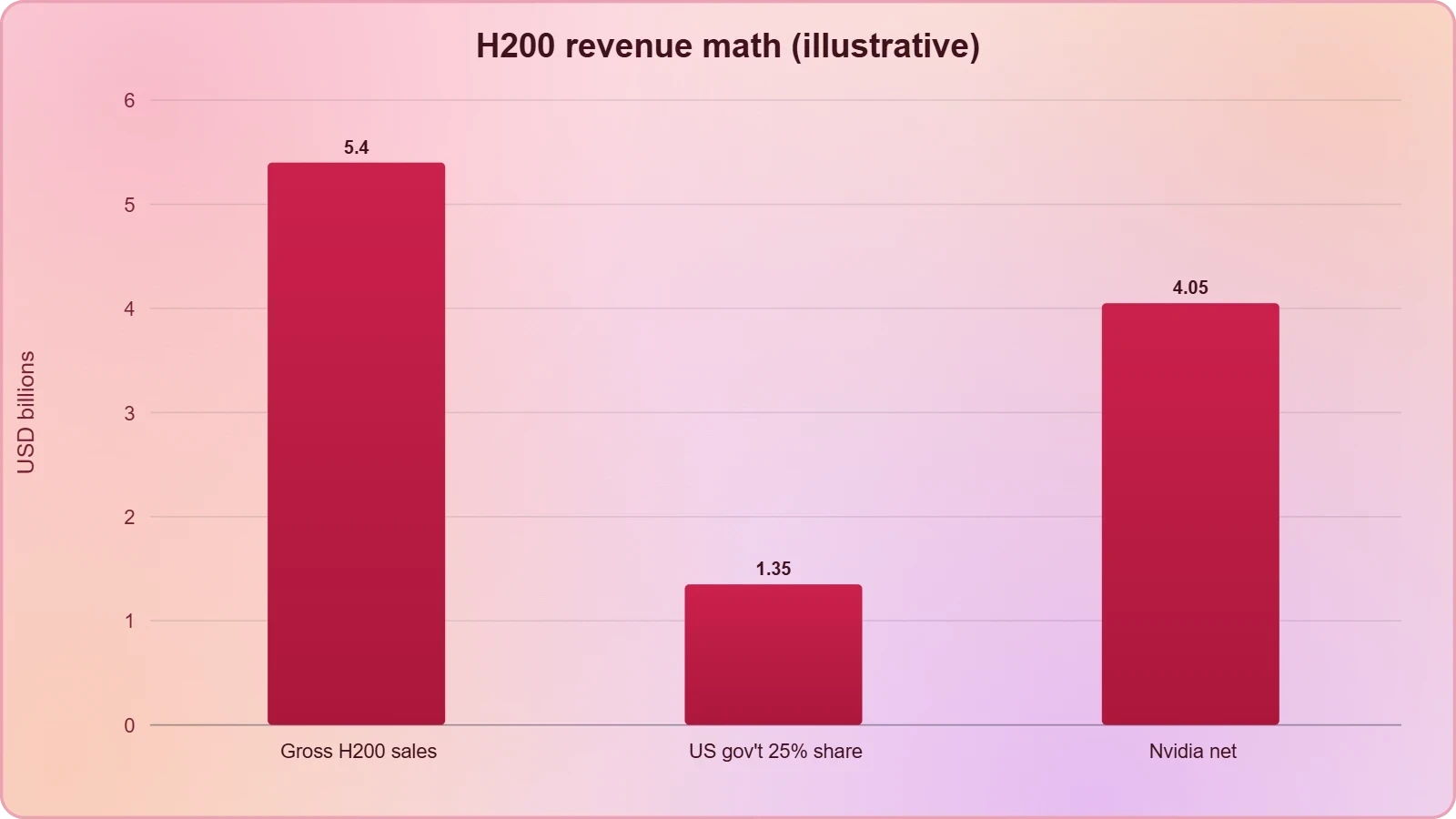
In December, the Trump administration allowed Nvidia to ship H200 chips to China on the condition that the US government receive 25% of sales. The arrangement is unusual in trade policy, effectively converting a portion of private revenue into a public levy while preserving market access for the manufacturer.
Huang's Advocacy and Its Limits
Huang, 63, had become a key AI adviser to Trump in his second term, pushing for looser rules and fewer restrictions on selling AI chips to China. His argument rested on the view that engagement preserves American influence over global standards, while isolation accelerates Chinese self-sufficiency. That position placed him between two powerful constituencies.
His resignation last week, following reports of extramarital relationships including one with a businesswoman suspected by the US of spying for Beijing, removed that voice from the policy debate. The scandal shook the global AI and semiconductor industries and fueled political debate in both countries, leaving the advocacy position vacant at a delicate moment.
We Also Published
The Espionage Allegation and the Denials
The espionage dimension transformed a personal scandal into a security question. Reports indicated that the businesswoman involved in the relationship was suspected by US authorities of spying for Beijing, a claim that carries enormous weight in an environment where technology transfer and intelligence gathering are treated as intertwined threats.
What the Allegation Implies
If substantiated, the allegation would suggest that personal vulnerabilities around senior technology executives can be exploited to access strategic information. That prospect explains why the story resonated so strongly in Washington, where lawmakers have grown increasingly attentive to the human dimension of technology leakage rather than purely technical controls.
The timing compounded the sensitivity. The reports surfaced as Washington was reportedly planning further restrictions on China to close loopholes that let Chinese firms obtain advanced American semiconductors. A spy scandal involving the industry's most prominent executive gave those efforts a vivid, human illustration.
Beijing's Rejection of the Claims
China denied any attempt to entrap Huang, describing the spying allegations as unsubstantiated and a smear campaign. Some Chinese media criticized the reporting sharply. A state-run newspaper editorial asked what Huang's affair had to do with China and accused US media of turning the episode into a Hollywood thriller without hard evidence.
Many Chinese citizens also commented on the controversy on Weibo, reflecting the unusual public attention the story attracted. The official rebuttal formed part of a broader rhetorical push before the Xi-Trump meeting at the APEC summit in Shenzhen, where trade and technology were expected to dominate the agenda.
Corporate Leadership Risk in Strategic Industries
The Huang episode raises a question that boards across the technology sector are now confronting: how much personal exposure can a chief executive carry when the company sits at the center of national security policy? In most industries, an extramarital relationship is a private matter. In semiconductors, it can become a vector for intelligence concern.
When Private Conduct Becomes Public Risk
Huang was widely admired in China as a successful entrepreneur, a status that made him unusually effective in cross-border advocacy. That same prominence increased his vulnerability. The scandal demonstrated that reputation built across rival jurisdictions can be undone quickly when personal conduct intersects with security suspicions that neither government can easily dismiss.
For Nvidia, the resignation removes a leader who understood both the Chinese market and the American policy apparatus. The company must now navigate export rules, a proposed 25% revenue-sharing arrangement, and intensifying scrutiny without the executive who helped design its China strategy.
Implications for Boards and Investors
Investors are beginning to price leadership continuity as a geopolitical variable rather than a governance formality. Companies with concentrated exposure to restricted markets face heightened risk when their leadership becomes entangled in security disputes. The lesson extends beyond Nvidia to any firm whose products sit on the frontier of strategic competition.
Boards will likely revisit due-diligence protocols around executive relationships, travel, and foreign contacts. Such measures carry their own costs and civil-liberties questions, but the alternative, discovering a vulnerability after it becomes a diplomatic incident, is now demonstrably more expensive.
Diplomatic Fallout Before the APEC Summit
The scandal arrived at a diplomatically charged moment. Beijing sharpened its rhetoric before the meeting between President Xi Jinping and Trump at the Asia-Pacific Economic Cooperation summit in Shenzhen, using the episode to reinforce its broader critique of American export controls and media conduct.
- 01
- 02
- 03
- 04
Rhetoric, Timing, and the Xi-Trump Meeting
Mao Ning's November 13 statement that China has consistently opposed misuse of export controls harming global industrial and supply chains was calibrated for an international audience. It framed China as the defender of the trading system and the United States as the disruptor, a narrative designed to resonate with third countries dependent on semiconductor supply chains.
The summit setting in Shenzhen, itself a symbol of China's technology ambitions, amplified the symbolism. Any agreement reached there on chip flows would carry consequences far beyond the two economies, shaping access for allies, intermediaries, and downstream manufacturers across Asia and Europe.
What Each Side Wants From the Encounter
Washington seeks enforceable commitments that close loopholes and preserve its technological lead, ideally without inflicting excessive damage on American chipmakers. Beijing wants relief from restrictions it considers illegitimate, alongside recognition of its role in global supply chains and its stated right to develop indigenous capacity.
The Huang affair gives neither side a decisive advantage, but it changes the atmosphere. It strengthens the hand of those in Washington who argue that personal and intelligence vulnerabilities justify stricter controls, while giving Beijing a fresh example of what it calls unsubstantiated accusations driving policy.
Reading the Broader Signal for AI and Semiconductors
Beyond the personalities and the headlines, the episode clarifies several structural realities. The AI race is no longer a contest between companies alone; it is a contest between states that use companies as instruments. Chip design, manufacturing equipment, and executive conduct have all been absorbed into the security domain.
The Limits of Export Controls
Export controls can slow an adversary, but they also stimulate domestic substitution. Every restriction creates an incentive for Chinese firms to develop alternatives, and the H200's continued demand shows how difficult it is to sever commercial ties when performance gaps persist. Controls buy time rather than permanent advantage.
The 25% revenue-sharing arrangement illustrates the improvisational nature of current policy. It blends industrial policy, fiscal extraction, and security screening into a single instrument, an approach that may prove difficult to administer consistently across products and companies.
What Comes Next for Nvidia and Its Peers
Nvidia must now manage a leadership transition while preserving relationships in both capitals. Its competitors face the same structural dilemma: China's market is too large to abandon and too sensitive to treat casually. The firms that navigate this best will be those with clear governance and diversified exposure.
For the wider industry, the Huang affair is a reminder that geopolitical risk is not confined to tariffs and statutes. It travels through people, relationships, and reputations. Companies that treat security as a compliance checkbox rather than a cultural discipline will remain exposed to shocks they cannot anticipate.
From our network :
- The Final Descent: How ESA Retired the Legendary Cluster Constellation After 24 Years of Space Weather ScienceAfter 24 years mapping Earth’s magnetosphere, ESA’s Cluster mission concluded with a precisely controlled reentry over the South Pacific. This analysis explores the scientific legacy, engineering decisions, and debris mitigation principles behind one of space exploration’s most responsible retirements.
- Mobile Learning and VR in English: What Global Evidence Reveals About Effective Language TechnologyA systematic review across 14 countries reveals which language-learning technologies genuinely work. Mobile learning, AI, and VR show measurable benefits when pedagogically integrated. This evidence-based guide helps educators and learners select technology that delivers real return on investment.
- Live Online English Classes for Kids: Do They Actually Reduce Anxiety?A ten-week study reveals that synchronous online English classes can significantly reduce child language anxiety while improving listening and reading skills. Discover what makes these programs effective and how parents can select the right one.
- How AI Agents Will Change the Way We Manage Personal FinancesExplore how AI agents are transforming personal finance through automated budgeting, bill payment, and investment management, while examining the critical security protocols and governance frameworks required for safe deployment.
- University Language Proficiency Exams: Why Institutional Tests Demand Different Preparation Than IELTS and TOEFLDiscover why university-specific language proficiency examinations differ fundamentally from IELTS and TOEFL, and learn strategic preparation approaches for institutional assessment success.
- CISA’s Ten-Advisory Wave: Why Generic Patching Fails in OT and How to Build Product-Specific PlaybooksCISA released ten ICS advisories in one week, exposing critical infrastructure risks. Generic patching fails in OT. Learn to build product-specific remediation playbooks.
- Forbidden Matrix Patterns and Visible Lattice Points: A Geometric DictionaryExplore how multidimensional 0–1 matrices encode geometric truths, linking forbidden patterns to visible lattice points and hypergraph theory, with applications in combinatorics and computational geometry.
- The Hidden Cost of AI Convenience: Why Over-Permissioned Agents Are a Security Time BombDiscover why AI agents with excessive permissions create dangerous single points of failure, and learn how implementing least privilege principles can protect your organization from exploitation.
- Committed Mediterranean Precipitation Decline: Why Emissions Cuts Alone Cannot Restore Winter RainsNew NOAA research reveals that Mediterranean winter rains may decline irreversibly even with emissions cuts. Explore the science of committed climate change and regional impacts.
RESOURCES
- The Nvidia scandal is heightening America's AI rivalry with China ...pbs.org23 hours ago ... FILE PHOTO: Chip tensions loom over Trump-Xi summit, as US and China ... China from accessing advanced U.S. chip and…
- Chip tensions loom over Trump-Xi summit, as US and China push AI ...reuters.com1 day ago ... The prospect of tighter US curbs on China's access to advanced AI chips will likely overshadow talks when US President…
- Chip tensions loom over Trump-Xi summit, as US and China push AI ...ca.finance.yahoo.com1 day ago ... The scandal has spurred a push by US lawmakers to tighten China's access to advanced AI chips, a move analysts…
- Nvidia: The AI chip giant caught between US and China - BBCbbc.comApr 18, 2025 ... Computer chip giant Nvidia has once again found itself at the centre of US-China tensions over trade and technology. On…
- Despite Huang Scandal, US-China AI Safety Dialogue Still Seems ...techpolicy.press4 days ago ... ... Chinese spy will likely increase tensions between the US and China. ... Nvidia's advanced AI chips to China. Despite…
- China pushed back against renewed calls from U.S. lawmakers to ...facebook.com5 days ago ... US-China chip tensions flaring up again!. ... Nvidia Struggles to Maintain Presence in China's AI Chip Market Amid U.S. Restrictions…
- China Approves Purchases of Nvidia's H200 Chip, Easing ... - WSJwsj.comJan 28, 2026 ... China Approves Purchases of Nvidia's H200 Chip, Easing Tension With U.S. ... Nvidia's could widen the AI gap between China…
- Nvidia spy scandal fuels debate over chip exports to Chinaaljazeera.com7 days ago ... US lawmakers call for tighter restrictions on chip sales amid inquiry into Nvidia CEO's relationship with alleged spy.
- A scandal involving Nvidia CEO Jensen Huang and questions about ...facebook.com3 days ago ... US officials raise alarm over restricted Nvidia AI chips reaching China. A scandal involving Nvidia CEO Jensen Wong and q...…
- US moves to block China's remote access to AI chips amid Nvidia ...aljazeera.com11 hours ago ... The Trump administration introduces export licence requirements for Malaysia, Thailand, Indonesia, Singapore and Brazil.
- Could the Jensen Huang Scandal Push Washington to Close ...moderndiplomacy.eu5 days ago ... Could the Jensen Huang Scandal Push Washington to Close China's Nvidia AI Chip Loophole? ... AI chips last month despite…
- Trump's treasury and commerce secretaries feud as Nvidia scandal ...nbcnews.com4 days ago ... ... Nvidia, a major U.S. chip manufacturer. A diptych image showing Howard Lutnick; Scott Bessent. Commerce ... AI chips out…
- As Trump Goes to China, A.I. Tensions Surge Amid Spying and ...nytimes.com7 hours ago ... Nvidia Scandal · China's Challenges. Advertisement. SKIP ... Nvidia, the U.S. technology giant that supplies computer chips fueling the A.I. ...
- Trump says 'would not mind' Huang being reinstated at Nvidiaafp.com24 hours ago ... The Nvidia scandal has caused tensions in the White House over the sale of advanced American AI chips to China.…
- 'Face-Off' podcast tells the story of growing tension between the U.S. ...wbur.orgMay 13, 2024 ... Amid Nvidia scandal, lawmakers push for tighter controls on AI ...
- 01
- 02
- 03
- 04
- 05
- 06
- 07
- 08
0 Comments