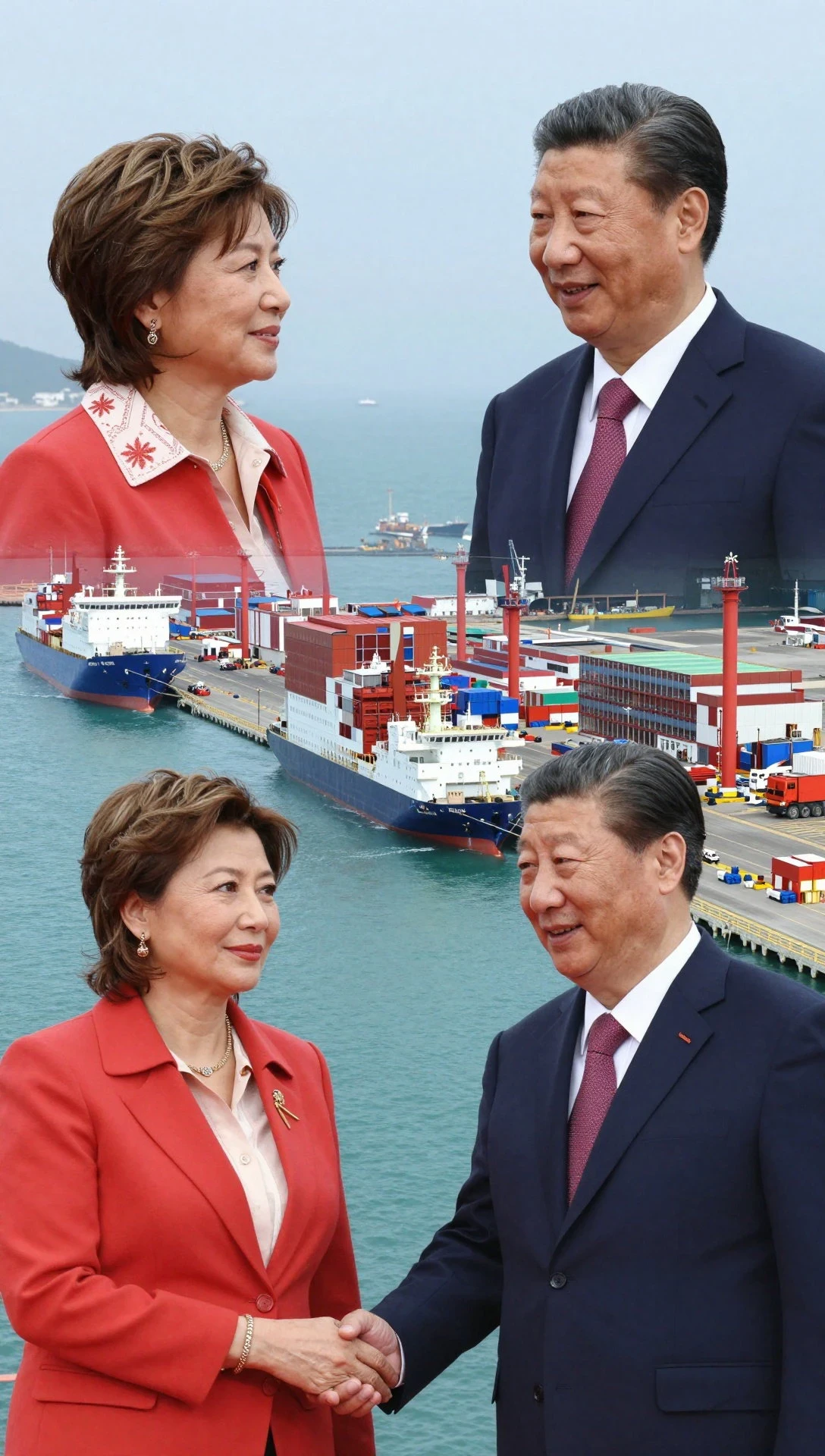
When Keiko Fujimori travels to Shenzhen to sit down with Xi Jinping one day before the APEC summit opens, the encounter will carry far more weight than a routine diplomatic courtesy. The meeting marks fifty-five years of Peru–China relations, yet its real significance lies in what it reveals about how a mid-sized South American economy manages two competing superpowers at once. Lima is simultaneously deepening security cooperation with Washington and expanding trade and infrastructure ties with Beijing, a balancing act that demands precision.
The backdrop is the Chancay megaport, a deep-water terminal controlled by Chinese state-owned Cosco Shipping that opened in 2024 and compresses sea travel to Asia. Supporters in Lima frame it as Peru's pathway to becoming a genuine South Pacific maritime hub. Critics in Washington see Chinese ownership of strategic infrastructure inside a region long treated as an American sphere of influence. Fujimori's answer, delivered plainly in September, is that Peru will not take sides in the dispute between the two powers.
This analysis unpacks the diplomatic choreography behind the Shenzhen meeting, the commercial stakes embedded in Chancay, and the domestic political calculations shaping Fujimori's foreign policy. It also examines why analysts read her current posture as a return to Peru's traditional equidistance rather than a departure from it, and what that means for Latin America's wider contest over strategic sectors.
On This Page
- The Shenzhen Meeting and the Architecture of APEC Diplomacy
- Chancay Megaport: Infrastructure as Strategic Leverage
- Fujimori's Non-Alignment Doctrine in Practice
- Latin America as the Arena of Superpower Competition
- Reading the Signals from Shenzhen
- Economic Stakes: Mining, Energy and Export Corridors
- Diplomatic Tradition and the Limits of Hedging
- What the Meeting Means for the Wider Region
TL;DR Peru's President Keiko Fujimori meets Chinese President Xi Jinping in Shenzhen ahead of the APEC summit, marking 55 years of diplomatic relations while Washington presses Latin America to curb Chinese influence. China remains Peru's dominant trading partner and is expanding investment in mining, energy and infrastructure. The Chancay megaport, operated by Cosco Shipping, sits at the center of the strategic contest. Fujimori insists Peru will not choose sides, a stance analysts describe as consistent with traditional Peruvian diplomacy despite her early tilt toward Washington.
The Shenzhen Meeting and the Architecture of APEC Diplomacy
Summit-adjacent bilaterals rarely generate headlines on their own, yet the timing here is deliberate. Meeting Xi one day before APEC convenes allows both governments to frame their partnership before the wider Pacific conversation begins. It also lets Fujimori arrive at the summit with a bilateral achievement already secured, strengthening her hand in multilateral discussions on trade facilitation and supply chains.
The Symbolism of Fifty-Five Years of Relations
The exchange of letters commemorating fifty-five years of diplomatic ties provided convenient diplomatic cover for the meeting. Xi expressed willingness to keep strengthening ties and looked forward to receiving Fujimori in Shenzhen. Such anniversary framing matters in Chinese diplomacy, where continuity and mutual respect are treated as foundations for deeper economic engagement and long-term institutional trust.
Fujimori's reply struck a notably warm tone, emphasizing strong bonds of friendship and mutual respect while committing to continued political dialogue and cooperation. The language was carefully calibrated: warm enough to satisfy Beijing, general enough to avoid signaling any strategic alignment that could complicate Peru's security relationship with the United States.
Why Shenzhen Rather Than Beijing
Hosting the meeting in Shenzhen carries its own message. The city stands as China's emblem of export-led growth and technological ambition, a fitting backdrop for a conversation about ports, mining and energy. For Lima, the setting implicitly reinforces the commercial rather than military character of the relationship, which helps defuse criticism from Washington about strategic dependence.
Chinese officials have consistently used regional visits to showcase investment capacity, and Shenzhen offers a visible demonstration of what infrastructure-led development can produce. For a Peruvian delegation seeking capital for mining, energy and transport projects, the symbolism is difficult to ignore and reinforces Beijing's pitch as a reliable long-term financier.
Chancay Megaport: Infrastructure as Strategic Leverage
No single asset defines the Peru–China relationship more sharply than Chancay. The deep-water terminal north of Lima, controlled by Chinese state-owned Cosco Shipping, opened in 2024 and materially shortens maritime routes between South America and Asian markets. For Peruvian exporters, that translates into lower logistics costs and faster access to Chinese consumers of copper, fishmeal and agricultural goods.
The Economic Case for a South Pacific Hub
Supporters argue Chancay could reposition Peru as a genuine maritime gateway for the wider region, with cargo from Brazil, Bolivia and Ecuador potentially transiting Peruvian ports. That vision implies transcontinental rail links and warehouse corridors, generating construction employment and customs revenue. For a government seeking visible economic wins, the megaport offers a concrete narrative of growth rather than abstract geopolitical alignment.
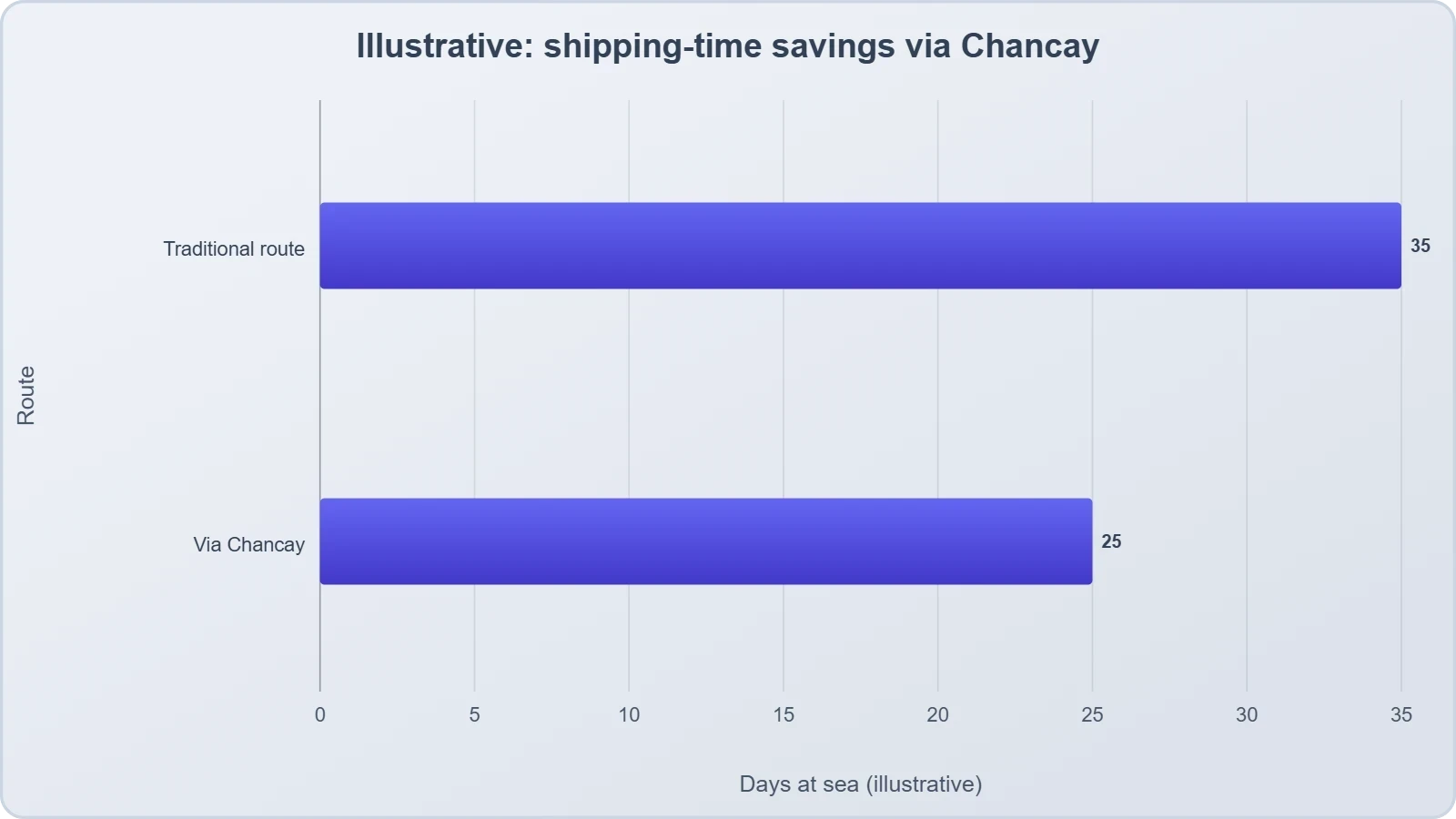
The commercial logic is difficult to dispute on its own terms. Shipping time reductions of roughly ten days on Asian routes improve margins across export sectors, and port-adjacent industrial zones could attract processing and assembly activity. Economists caution, however, that gains depend on complementary road and rail investment that Peru has historically struggled to finance and deliver on schedule.
Washington's Infrastructure Anxiety
Critics in Washington worry about Chinese control of key infrastructure in a region the United States has long considered its backyard. That concern is not purely rhetorical: port operating data, shipping patterns and logistics dependencies all carry intelligence and security implications. American officials have increasingly framed such investments as strategic footholds rather than neutral commerce.
The tension is structural rather than personal. Peru needs capital and market access that Beijing readily supplies, while the United States offers security cooperation and political alignment. Managing both simultaneously requires Lima to separate commercial from strategic domains, a distinction that becomes harder to sustain as infrastructure and security interests increasingly overlap.
Fujimori's Non-Alignment Doctrine in Practice
Fujimori has articulated her position with unusual directness for a head of state navigating superpower rivalry. After meeting U.S. Secretary of State Marco Rubio in Lima in September, she stated plainly that she would not get involved in the fight between the two countries. That formulation, simple on its surface, encodes a deliberate strategy of maintaining productive relations with both Washington and Beijing.
From Early Atlanticism to Equilibrium
Her government's opening moves pointed in a different direction. Lima moved closer to Washington, joined the Shield of the Americas initiative against transnational organized crime, and cut diplomatic ties with Iran. Those steps signaled a clear Western orientation. The Shenzhen meeting suggests a recalibration toward balance rather than a reversal of those commitments.
Analyst José Carlos Requena observes that Fujimori appears to have chosen to maintain good relations with both powers, consistent with a traditional approach in Peruvian diplomacy. That tradition treats flexibility as a national asset, allowing successive governments to extract benefits from multiple partners without formal alliance commitments that could constrain future options.
Domestic Politics and the Cost of Choosing Sides
Peruvian domestic politics reinforces the incentive for caution. Export industries, mining regions and port-dependent communities all benefit directly from Chinese demand and investment. A visible rupture with Beijing would carry immediate economic costs, while a rupture with Washington would forfeit security cooperation against organized crime and drug trafficking networks.
Public opinion, meanwhile, tends to reward governments that deliver investment and employment rather than ideological clarity. Fujimori's non-alignment therefore serves both foreign and domestic purposes: it preserves commercial access while avoiding the appearance of subordination to either power, a posture that resonates with voters skeptical of external pressure.
We Also Published
Latin America as the Arena of Superpower Competition
Peru's dilemma is regional rather than unique. Across Latin America, governments face mounting American pressure to limit Chinese influence in ports, telecommunications, energy grids and critical minerals. Washington has framed these sectors as matters of hemispheric security, while Beijing presents its investments as commercial partnerships without political conditions attached.
The Wider Pattern of Hedging
Brazil, Chile and Ecuador have all pursued similar strategies, welcoming Chinese capital while maintaining security ties with the United States. The pattern reflects a broader Latin American preference for autonomy in foreign policy, rooted in a diplomatic tradition that resists formal alignment with any single great power and prizes flexibility in negotiating terms.
That preference is being tested as infrastructure becomes strategically legible. Ports, data cables and power networks are no longer viewed as neutral commercial assets but as instruments of influence. As a result, Latin American governments increasingly find that hedging requires active management rather than passive avoidance of commitment.
What Washington's Pressure Actually Achieves
American lobbying can slow Chinese projects and raise political costs for host governments, but it rarely reverses economic logic. Peru's export profile is oriented toward Asian demand, and Chinese financing fills gaps that Western lenders and multilateral institutions have been slow to close. Pressure without competitive alternatives tends to produce resentment rather than compliance.
The more effective American approach has involved security cooperation and technical assistance, areas where Washington retains clear comparative advantage. Fujimori's participation in the Shield of the Americas demonstrates that such offers resonate. Whether they can offset Chinese infrastructure financing in scale remains an open question across the hemisphere.
Reading the Signals from Shenzhen
The Shenzhen meeting should be interpreted as a signal of continuity rather than rupture. Fujimori is not abandoning her security cooperation with Washington; she is rebalancing toward the pragmatic center that has characterized Peruvian foreign policy for decades. The optics of meeting Xi immediately before APEC project confidence and independence rather than deference.
What to Watch After the Summit
Concrete deliverables will matter more than communiqués. New commitments on mining, energy or infrastructure financing would indicate that Beijing intends to deepen its footprint despite American objections. Conversely, a meeting heavy on symbolism and light on signed agreements would suggest caution on both sides pending the broader trajectory of U.S.–China relations.
Watch also for follow-through on Chancay's connecting infrastructure. If Peru secures financing for rail and road links that extend the port's hinterland, the strategic significance of Chinese involvement grows considerably. If those links stall, the megaport remains an impressive terminal with limited regional reach.
The Durability of Non-Alignment
Non-alignment is easier to declare than to sustain. As infrastructure dependencies deepen and American pressure intensifies, Peru's room for maneuver may narrow. Fujimori's approach depends on both powers accepting her terms, and neither has shown much appetite for restraint when strategic sectors are at stake.
For now, the strategy appears to be working. Peru retains access to Chinese markets and capital while preserving American security cooperation. Whether that equilibrium survives the next phase of great-power competition will depend less on Peruvian diplomacy than on how aggressively Washington and Beijing choose to press their advantages in the region.
- 01
- 02
- 03
- 04
Economic Stakes: Mining, Energy and Export Corridors
China's interest in Peru extends well beyond a single port. Beijing is seeking to expand investment in mining, energy and infrastructure, sectors where Peruvian reserves and geography align closely with Chinese industrial demand. Copper, in particular, anchors the relationship, with Chinese smelters and manufacturers relying on Peruvian ore to sustain domestic production.
The Mining Relationship and Its Dependencies
Chinese companies have acquired significant stakes in Peruvian mining assets over the past two decades, integrating extraction, processing and shipping into vertically coordinated supply chains. That integration lowers costs for Chinese industry but also concentrates Peruvian export exposure. A slowdown in Chinese construction or manufacturing transmits quickly into Peruvian fiscal revenue and regional employment.
Diversification remains difficult because alternative buyers lack comparable scale. Peruvian policymakers acknowledge the dependency while arguing that demand diversification through Asian markets beyond China offers partial mitigation. In practice, the gravitational pull of Chinese consumption continues to shape investment decisions across the sector.
Energy and the Longer Horizon
Energy cooperation is less mature but expanding. Chinese firms have shown interest in transmission networks, renewable generation and hydroelectric projects, areas where Peru's infrastructure deficit is acute. Financing terms from Chinese policy banks often prove more accessible than those offered by Western lenders, particularly for projects with long construction timelines.
The strategic implication is that energy infrastructure, like ports, becomes a channel of influence. Control over transmission assets or generation capacity creates leverage in ways that trade relationships alone do not. Peruvian regulators will face increasing pressure to design frameworks that attract capital while preserving oversight of critical systems.
Diplomatic Tradition and the Limits of Hedging
Peru's approach draws on a diplomatic tradition that predates the current rivalry. Successive governments have cultivated relationships across ideological lines, treating foreign policy as a tool for economic development rather than a statement of values. That tradition explains why Fujimori's apparent shift toward balance reads as continuity to seasoned observers.
Why Analysts See Continuity
Requena's assessment that Fujimori has chosen to maintain good relations with both powers aligns with a long-standing Peruvian preference for pragmatic engagement. The early tilt toward Washington, including the Iran rupture and the Shield of the Americas participation, now appears as an opening position rather than a permanent orientation.
This reading matters because it suggests the Shenzhen meeting is not a dramatic reversal but a correction. Governments often begin with clear signals to one partner before settling into a more balanced posture once domestic and commercial realities assert themselves. Fujimori's trajectory fits that pattern closely.
Structural Pressures That Could Break the Balance
Hedging has limits. If Washington escalates demands for exclusivity in strategic sectors, or if Beijing conditions future investment on political alignment, Peru's room to maneuver narrows sharply. The Chancay model, where Chinese state-owned capital controls critical infrastructure, makes such pressure more likely over time.
Domestic political instability adds another variable. Peruvian presidencies have historically been fragile, and a change in government could reset foreign policy priorities abruptly. The durability of non-alignment therefore depends on institutional continuity that Peru has struggled to maintain, leaving the strategy vulnerable to shocks beyond Lima's control.
What the Meeting Means for the Wider Region
The Shenzhen bilateral will be read closely in Brasília, Santiago, Bogotá and Quito, where governments face similar choices. A successful Fujimori visit that yields investment commitments without visible American retaliation would strengthen the case for hedging across the region. A meeting followed by U.S. countermeasures would signal that neutrality carries costs.
Signals for Other Latin American Governments
Regional capitals are watching whether Peru can extract concrete benefits from both powers simultaneously. If Fujimori secures Chinese financing while retaining American security cooperation, her model becomes a template. If either relationship deteriorates, the lesson shifts toward the difficulty of sustaining balance under pressure from Washington.
The outcome also affects how APEC functions as a venue. If bilateral meetings on the summit's margins consistently produce substantive deals, the forum's value as a platform for Pacific economic diplomacy strengthens. If they produce only communiqués, the summit's relevance to strategic competition diminishes.
The Long View on U.S.–China Rivalry in the Hemisphere
Structural forces favor continued Chinese economic expansion in Latin America. Demand for minerals, agricultural products and energy underpins investment flows that American policy cannot easily redirect. Washington's advantage lies in security, technology standards and institutional relationships, areas where it retains credibility and capability.
Peru's balancing act therefore reflects a broader equilibrium in which economic gravity pulls toward Beijing and security architecture remains anchored in Washington. Managing that tension will define Latin American foreign policy for the remainder of the decade, and Fujimori's Shenzhen meeting offers an early test of whether it can be sustained.
From our network :
- Mobile Learning and VR in English: What Global Evidence Reveals About Effective Language TechnologyA systematic review across 14 countries reveals which language-learning technologies genuinely work. Mobile learning, AI, and VR show measurable benefits when pedagogically integrated. This evidence-based guide helps educators and learners select technology that delivers real return on investment.
- University Language Proficiency Exams: Why Institutional Tests Demand Different Preparation Than IELTS and TOEFLDiscover why university-specific language proficiency examinations differ fundamentally from IELTS and TOEFL, and learn strategic preparation approaches for institutional assessment success.
- How AI Agents Will Change the Way We Manage Personal FinancesExplore how AI agents are transforming personal finance through automated budgeting, bill payment, and investment management, while examining the critical security protocols and governance frameworks required for safe deployment.
- The Hidden Cost of AI Convenience: Why Over-Permissioned Agents Are a Security Time BombDiscover why AI agents with excessive permissions create dangerous single points of failure, and learn how implementing least privilege principles can protect your organization from exploitation.
- Forbidden Matrix Patterns and Visible Lattice Points: A Geometric DictionaryExplore how multidimensional 0–1 matrices encode geometric truths, linking forbidden patterns to visible lattice points and hypergraph theory, with applications in combinatorics and computational geometry.
- Committed Mediterranean Precipitation Decline: Why Emissions Cuts Alone Cannot Restore Winter RainsNew NOAA research reveals that Mediterranean winter rains may decline irreversibly even with emissions cuts. Explore the science of committed climate change and regional impacts.
- CISA’s Ten-Advisory Wave: Why Generic Patching Fails in OT and How to Build Product-Specific PlaybooksCISA released ten ICS advisories in one week, exposing critical infrastructure risks. Generic patching fails in OT. Learn to build product-specific remediation playbooks.
- Live Online English Classes for Kids: Do They Actually Reduce Anxiety?A ten-week study reveals that synchronous online English classes can significantly reduce child language anxiety while improving listening and reading skills. Discover what makes these programs effective and how parents can select the right one.
- The Final Descent: How ESA Retired the Legendary Cluster Constellation After 24 Years of Space Weather ScienceAfter 24 years mapping Earth’s magnetosphere, ESA’s Cluster mission concluded with a precisely controlled reentry over the South Pacific. This analysis explores the scientific legacy, engineering decisions, and debris mitigation principles behind one of space exploration’s most responsible retirements.
RESOURCES
- Keiko Fujimori to meet with Xi Jinping amid Trump's pressure on Peruenglish.elpais.com9 hours ago ... ... APEC summit after having strengthened relations with Washington. ... Two weeks before boarding a plane to China, Peru's president,…
- Peru: A New Target in US–China Competition for Global Influencesites.rutgers.eduMay 1, 2025 ... During the summit, Peru inaugurated the Chancay megaport, with China being the focus of the summit. While Xi Jinping got…
- Peru vows to apply Hong Kong trade deal, but is silent on mainland ...scmp.comAug 21, 2026 ... ... China or the Chinese-operated Chancay megaport. Prime Minister Luis Galarreta told lawmakers on Thursday that commercial openness would ...
- US pressures Peru to ditch China on security, economic investmentcsmonitor.comApr 21, 2026 ... Peruvians say they welcome U.S. investment – but not at the expense of their relationship with China.
- As Xi Visits Trump: Five Charts on China's Latin America Tiesas-coa.orgSep 22, 2026 ... Beijing's economic relations with Brazil, Chile, Mexico, and Peru reveal the region's role in the U.S.-China competition.
- Strategic Asia Agenda: Peru's President Targets $83 Billion in ...facebook.com3 days ago ... ... China, exemplified by the Chancay mega-port project ... President Xi Jinping will inaugurate the $ 3.5-billion Chancay Port during…
- US raises concern with Peru over Chinese control of infrastructureft.comOct 2, 2023 ... ... Xi Jinping visits Peru for the APEC summit. Cosco has a 60 per cent stake in the megaport, while…
- The Man Running Peru While Fujimori Flies to China - Latin Timeslatintimes.com3 days ago ... ... Fujimori attends the APEC ... A direct meeting between Fujimori and Xi Jinping carries the potential to shape that…
- Peru: Beijing's Global Media Influence 2022 Country Reportfreedomhouse.orgPeruvian media and journalism regarding China has largely concentrated on business, investment, and development. Peruvian journalists covering China usually ...
- Fujimori's Asian Roots and Peru's Mineral Wealth Fuel ... - Latin Timeslatintimes.com7 days ago ... Peru's President Keiko Fujimori will attend the APEC Economic Leaders' Meeting in Shenzhen, China on November 18–19, followed immediately by ...
- Peru's Fujimori Looks to Both China and Trump's US - Bloomberg.combloomberg.comJul 10, 2026 ... Exhibit A is the $1.3 billion Chancay megaport inaugurated by President Xi Jinping. ... The nation's investment “restaurant” will be…
- US Moves to Counter China's $1.3 Billion Megaport in… - inklinkl.com3 days ago ... Peruvian President Keiko Fujimori has sought closer security cooperation with Washington while maintaining the country's economic relationship ...
- Fujimori Legacy Shows Limits of Trump's Push Against China in Perubloomberg.comJul 9, 2026 ... ... Xi Jinping in late 2024. Extortion Gangs Are Circling Peru's Ambitious $1.3 Billion Megaport. The Chancay Port under construction…
- Peru's rupture with Iran was never about Tehran - bne IntelliNewsintellinews.comSep 3, 2026 ... ... China remained the country's largest export market. Chinese state shipping group Cosco also holds a 60% stake in the…
- Presidency of Dina Boluarte - Wikipediaen.wikipedia.orgThe presidency of Dina Boluarte began with her inauguration as the president of Peru on 7 December 2022, immediately following the removal of Pedro…
- 01
- 02
- 03
- 04
- 05
- 06
- 07
- 08
0 Comments