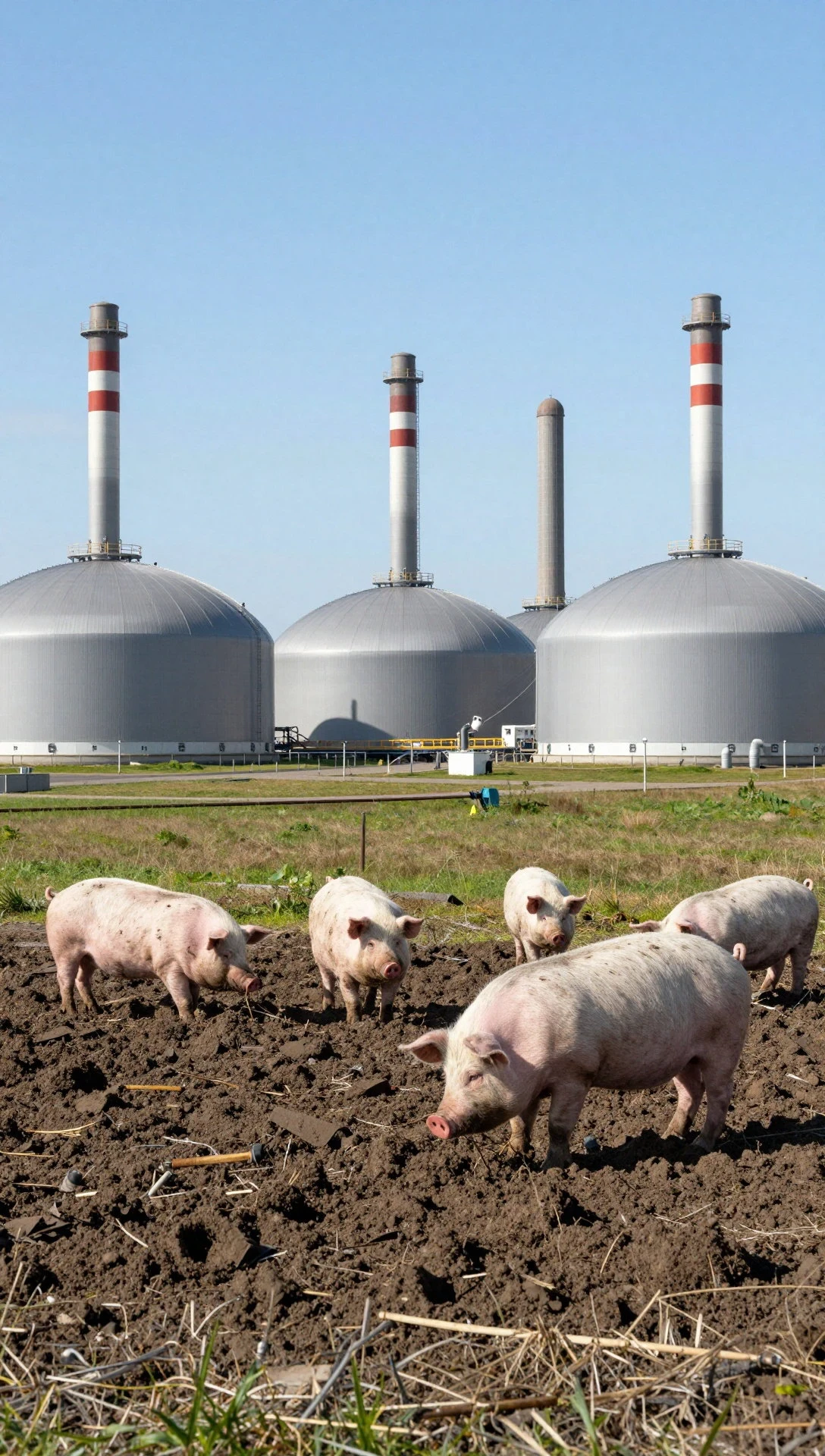
Denmark has quietly built one of Europe's most consequential energy experiments, and its raw material is livestock waste. The country now converts pig and cattle manure into refined biogas injected directly into the national gas grid, powering homes, transport and industrial processes while returning digestate to farmland as fertiliser.
What began as a handful of small farm-scale operations has matured into roughly 150 industrial plants processing millions of tonnes of slurry annually.
The numbers are striking. Denmark maintains about 12 million breeding pigs at any moment, more than twice its human population, and the pig sector generates over 17 million tonnes of manure each year. Rather than treating that slurry as pure liability, Danish engineers and policymakers have reframed it as a strategic energy reserve.
On This Page
Biogas now accounts for approximately 40 percent of the gas in the national grid, the highest share in Europe, a figure that carries real weight when oil and gas markets remain hostage to geopolitical shocks.
Yet the model is contested. Environmental groups argue that monetising manure entrenches industrial livestock farming rather than reforming it, creating what critics call a factory farm trap. This analysis examines how the Danish system works, why Sonderborg's ProjectZero has become a reference point for local energy independence, and where the genuine tensions lie between circular economics, climate accounting and agricultural reform.
TL;DR Denmark converts roughly 17 million tonnes of pig and cattle manure annually into biogas, supplying about 40 percent of its national gas grid through some 150 industrial plants. The southern town of Sonderborg, via ProjectZero, has cut energy-related carbon emissions by 79 percent since 2007 by combining renewables, industrial waste heat and biogas. Supporters frame the model as climate action plus energy security; critics argue it subsidises factory farming and delays the transition to wind, solar and geothermal power.
The Mechanics of Manure-to-Grid Energy
Biogas production rests on anaerobic digestion, a biological process in which microorganisms break down organic matter in oxygen-free tanks. The resulting raw gas is roughly 60 percent methane and 40 percent carbon dioxide, requiring upgrading to pipeline-quality biomethane before injection. Danish plants co-digest livestock slurry with food waste and crop residues, smoothing feedstock supply and improving yield per tonne processed.
From Slurry to Pipeline-Quality Gas
Fresh pig slurry arrives at plant gates by tanker, is macerated and fed into sealed digesters held at controlled temperatures for several weeks. Bacteria convert volatile solids into methane-rich gas while the residual digestate is separated and returned to fields as a nutrient-rich fertiliser substitute. This closed loop matters because it displaces synthetic fertiliser production, itself an energy-intensive industrial process.
Upgrading removes carbon dioxide and trace contaminants so the gas meets grid specifications. The captured CO2 can itself be sold or sequestered, adding a revenue stream. Denmark's regulatory framework guarantees grid access and provides feed-in premiums, which de-risked early investment and allowed the sector to scale from pilot projects to industrial infrastructure within a single decade.
The Feedstock Arithmetic Behind the Model
Scale is everything in digestion economics. The two facilities serving the Sonderborg region, Glansager and Kvaers, together process about 850,000 tonnes of organic material annually, drawn mainly from livestock slurry supplemented by food waste and crop residues. That volume produces enough biogas to meet the area's entire annual gas demand, a remarkable concentration of local supply.
Nationally, up to 70 percent of raw material processed by Danish biogas plants originates from pig and cattle manure. The remainder comes from industrial food waste, sewage sludge and straw. This blend stabilises gas output across seasons, since slurry supply fluctuates with herd cycles and harvest calendars, and it maximises methane yield per hectare of agricultural land committed.
ProjectZero and the Sonderborg Blueprint
Sonderborg, a coastal town in southern Denmark, launched ProjectZero in 2007 with an audacious mandate: a carbon-neutral energy system by the end of 2029. The initiative coordinates municipal government, local industry and utilities around a shared decarbonisation ledger. Its progress is measurable rather than rhetorical, with energy-related carbon emissions down 79 percent over the programme's lifetime.
How a Town Cut Emissions by 79 Percent
The strategy layers three interventions. First, renewable electricity displaces fossil generation. Second, industrial waste heat from local manufacturing is captured and piped into district heating networks. Third, biogas from the Glansager and Kvaers plants substitutes for natural gas across heating, transport and process heat, closing the loop on residual demand that electrification cannot yet reach.
ProjectZero's chief executive, Allan Pilgaard-Jensen, frames energy as critical infrastructure in an era of geopolitical uncertainty. Local production insulates the region from price shocks transmitted through international markets, particularly those linked to conflicts in Ukraine and Iran. The town's experience suggests that energy independence and climate ambition can reinforce rather than contradict each other.
Energy Security as a Local Public Good
Denmark's exposure to volatile gas markets is not theoretical. European gas prices have swung violently since 2022, and supply routes remain politically fragile. Domestic biomethane provides a hedge, priced in local currency and insulated from maritime chokepoints. For municipalities, that translates into predictable heating bills and industrial continuity during external disruptions.
The Sonderborg model also demonstrates that decarbonisation can be governed at a human scale. Rather than waiting for national or continental policy, the town assembled its own coalition of stakeholders, set a deadline and tracked outcomes publicly. That governance architecture, more than any single technology, is what other regions seek to replicate.
The Factory Farm Trap Argument
Not everyone reads Denmark's biogas expansion as environmental progress. A report by NOAH Friends of the Earth Denmark and Foodrise contends that monetising manure creates a structural incentive to maintain high livestock numbers. If slurry becomes a revenue stream, the argument runs, farmers face less pressure to reduce herd sizes, and industrial agriculture is effectively subsidised under a green label.
Why Critics Say Biogas Locks In Pollution
Jacob Sorensen of NOAH argues that Denmark must cut pig numbers to meet climate obligations and protect public health and biodiversity. In this view, biogas captures methane that should never have been generated in the first place, treating a symptom while leaving the underlying system intact. The critique is fundamentally about counterfactuals and baseline assumptions.
There is also a fiscal dimension. Critics contend that subsidies directed at biogas infrastructure could instead fund wind, solar, geothermal heat and energy-efficiency retrofits, which deliver permanent emission reductions without perpetuating concentrated animal feeding operations. The question is whether marginal abatement through manure digestion is the most efficient use of public capital.
The Industry Counterargument on Unavoidable Emissions
Biogas Denmark, the sector's trade body, responds that agricultural emissions are unavoidable as long as food production continues, and that capturing methane from slurry delivers immediate climate benefits while addressing energy security. The industry frames digestion as complementary to electrification rather than a substitute, particularly for heavy transport and high-temperature process heat.
Industry representatives also note that emissions regulations are tightening, making manure management an economic priority for farmers regardless of energy policy. If methane capture becomes mandatory, biogas infrastructure converts a compliance cost into a revenue stream. That framing shifts the debate from whether digestion happens to who pays for it and how tightly livestock ceilings are enforced.
We Also Published
Europe's Energy Crisis and the Biogas Hedge
Denmark's biogas build-out did not occur in a vacuum. Russia's invasion of Ukraine shattered assumptions about cheap, reliable pipeline gas, and subsequent disruptions involving Iran compounded market anxiety. Countries across Europe scrambled for alternatives, and biomethane emerged as one of the few domestically producible substitutes requiring no new combustion technology at the point of use.
Volatile Markets and Domestic Supply
Gas prices in Europe have repeatedly spiked on supply fears, transmitting inflation through electricity bills, fertiliser costs and food prices. Domestic biogas cushions that transmission because production costs are largely fixed and denominated locally. Denmark's 40 percent grid share represents a meaningful buffer, though not full insulation from continental price formation.
The strategic logic extends beyond economics. Energy infrastructure that cannot be blockaded or sanctioned carries political value. Biogas plants distributed across agricultural regions are harder to disrupt than single import terminals, and their feedstock renews annually. That resilience argument resonates with policymakers who watched supply chains fracture under geopolitical pressure.
Comparing Denmark with European Peers
Denmark leads Europe in biogas grid penetration, but other countries are scaling quickly. Germany operates the largest absolute biomethane capacity, France has accelerated injection projects, and Italy has expanded agricultural digestion. Denmark's distinction lies in the concentration of its share and the integration of biogas into municipal decarbonisation planning rather than standalone energy policy.
Cross-country comparison reveals that policy design matters more than resource endowment. Feed-in tariffs, grid access guarantees and digestate regulation determine whether manure becomes energy or waste. Denmark's early regulatory clarity attracted capital and engineering expertise, creating a cluster effect that lowered costs for subsequent plants and made the sector exportable as a technology package.
- 01
- 02
- 03
- 04
Circular Economy and Fertiliser Value
Biogas is only half the output. Digestate, the nutrient-rich residue left after digestion, returns to farmland as fertiliser, displacing synthetic ammonia and phosphate products whose manufacture depends on fossil gas and mined minerals. This circularity is central to the Danish business case, because it converts a waste disposal problem into two revenue streams from a single feedstock.
Closing the Nutrient Loop
Digestate contains nitrogen, phosphorus and potassium in plant-available forms, often outperforming raw slurry because digestion mineralises nutrients. Farmers applying it reduce purchased fertiliser costs while meeting tightening nutrient management rules. The loop is not perfectly closed, since nutrients concentrate in livestock regions and must sometimes be transported, but it materially improves agricultural efficiency.
Denmark's regulatory framework caps nitrogen application per hectare, which constrains how much digestate any farm can absorb. This creates a market for digestate processing, including separation, drying and pelletisation for export. Those downstream industries add value and employment, extending the economic footprint of what began as a manure management obligation.
Economic Multipliers for Rural Regions
Biogas plants anchor rural employment, from tanker logistics to plant operations and maintenance. They also generate local tax revenue and provide farmers with gate fees or feedstock payments. In regions where agricultural margins are thin, that diversification matters, and it explains why farmer cooperatives have been among the most enthusiastic investors in digestion capacity.
The multiplier effects extend to equipment manufacturing. Danish suppliers of digesters, upgrading membranes and control systems now export globally, turning domestic deployment into an industrial export story. That trajectory mirrors the country's earlier success in wind turbines, where early adoption created a technology cluster with durable competitive advantage.
What the Danish Model Means for Global Agriculture
Denmark's experiment carries lessons well beyond Scandinavia. Countries with large livestock sectors, from the Netherlands to Brazil and parts of Asia, face the same fundamental question: what to do with concentrated manure that emits methane and pollutes waterways. Denmark demonstrates that technical solutions exist, but also that technology alone does not resolve the underlying land-use and herd-size debates.
Transferable Lessons and Limits
The transferable elements are regulatory clarity, guaranteed grid access and farmer participation through cooperatives. The limits are equally instructive. Denmark's small land area, high gas prices and dense livestock concentration create conditions that may not replicate elsewhere. Scale, logistics and subsidy capacity all shape feasibility, and copying plant designs without copying governance rarely works.
For developing economies, decentralised digestion at smaller scale may offer more realistic entry points than industrial plants. Community digesters serving clusters of farms can capture methane while producing cooking fuel and fertiliser locally. The Danish experience suggests that policy stability over a decade, rather than any single breakthrough, is what converts pilots into infrastructure.
Balancing Climate Targets with Food Production
The deepest question is whether livestock production can be reconciled with climate targets at current volumes. Biogas improves the emissions profile of existing herds but does not alter the arithmetic of land, feed and methane. If global demand for animal protein rises, digestion becomes a mitigation tool within an expanding system rather than a pathway to contraction.
Policymakers therefore face a sequencing choice. Should biogas investment precede or accompany herd reduction targets? Denmark's critics argue the former entrenches the latter's delay; its defenders argue that waiting for structural reform forfeits immediate abatement. Resolving that tension requires explicit baselines, transparent accounting and a willingness to set livestock ceilings alongside energy incentives.
Reading the Numbers Critically
Headline figures deserve scrutiny. A 40 percent grid share sounds transformative, but Denmark's total gas demand has fallen as electrification advances, so the percentage rises partly because the denominator shrinks. Similarly, a 79 percent emissions cut in Sonderborg reflects a specific baseline and boundary; different accounting choices yield different percentages without any change in physical reality.
Baselines, Boundaries and Attribution
Methane captured from slurry would otherwise escape to the atmosphere, where it traps far more heat than carbon dioxide over short horizons. The climate benefit depends on leakage rates across the entire chain, from storage tanks to upgrading units. If fugitive emissions are high, the net gain shrinks, which is why measurement and monitoring standards matter as much as plant capacity.
Attribution is equally delicate. When a town cuts emissions, how much credit belongs to biogas versus district heating, industrial efficiency or grid decarbonisation? Rigorous accounting separates these contributions rather than bundling them. Denmark's transparency in publishing municipal data provides a model, even if the underlying attribution methodology remains debated among specialists.
What to Watch Next
Three indicators will reveal the trajectory. First, whether Denmark sets binding livestock reduction targets alongside biogas incentives. Second, whether biomethane's grid share continues rising as total gas demand falls. Third, whether digestate processing scales enough to manage nutrient surpluses in concentrated livestock regions. Each carries implications for the model's replicability elsewhere.
Investors and policymakers should also monitor technology costs. Upgrading membranes, biological methanation and carbon capture at digesters could improve economics, while falling battery storage and heat pump prices raise the opportunity cost of biogas subsidies. The sector's future depends less on engineering than on comparative advantage within a rapidly evolving energy system.
From our network :
- The Hidden Cost of AI Convenience: Why Over-Permissioned Agents Are a Security Time BombDiscover why AI agents with excessive permissions create dangerous single points of failure, and learn how implementing least privilege principles can protect your organization from exploitation.
- Forbidden Matrix Patterns and Visible Lattice Points: A Geometric DictionaryExplore how multidimensional 0–1 matrices encode geometric truths, linking forbidden patterns to visible lattice points and hypergraph theory, with applications in combinatorics and computational geometry.
- The Final Descent: How ESA Retired the Legendary Cluster Constellation After 24 Years of Space Weather ScienceAfter 24 years mapping Earth’s magnetosphere, ESA’s Cluster mission concluded with a precisely controlled reentry over the South Pacific. This analysis explores the scientific legacy, engineering decisions, and debris mitigation principles behind one of space exploration’s most responsible retirements.
- University Language Proficiency Exams: Why Institutional Tests Demand Different Preparation Than IELTS and TOEFLDiscover why university-specific language proficiency examinations differ fundamentally from IELTS and TOEFL, and learn strategic preparation approaches for institutional assessment success.
- Mobile Learning and VR in English: What Global Evidence Reveals About Effective Language TechnologyA systematic review across 14 countries reveals which language-learning technologies genuinely work. Mobile learning, AI, and VR show measurable benefits when pedagogically integrated. This evidence-based guide helps educators and learners select technology that delivers real return on investment.
- CISA’s Ten-Advisory Wave: Why Generic Patching Fails in OT and How to Build Product-Specific PlaybooksCISA released ten ICS advisories in one week, exposing critical infrastructure risks. Generic patching fails in OT. Learn to build product-specific remediation playbooks.
- Committed Mediterranean Precipitation Decline: Why Emissions Cuts Alone Cannot Restore Winter RainsNew NOAA research reveals that Mediterranean winter rains may decline irreversibly even with emissions cuts. Explore the science of committed climate change and regional impacts.
- How AI Agents Will Change the Way We Manage Personal FinancesExplore how AI agents are transforming personal finance through automated budgeting, bill payment, and investment management, while examining the critical security protocols and governance frameworks required for safe deployment.
- Live Online English Classes for Kids: Do They Actually Reduce Anxiety?A ten-week study reveals that synchronous online English classes can significantly reduce child language anxiety while improving listening and reading skills. Discover what makes these programs effective and how parents can select the right one.
RESOURCES
- Powering towns on pig manure: How Denmark has transformed ...aljazeera.com7 hours ago ... ... biogas, which powers the national grid ... So far, the combined use of renewables, industrial waste heat and biogas…
- Denmark Powers Energy Grid With Pig Manure Biogas as Carbon ...facebook.com6 hours ago ... The Danish Gas Grid Could be Filled with Green Gas in 2035 | News | State of Green. Katrien Verwimp…
- Al Jazeera English on X: "Pigs are big business in Denmark and ...x.com4 hours ago ... Pigs are big business in Denmark and their waste is being turned into biogas, which powers the national grid and…
- Powering towns on pig manure: How Denmark has transformed ...facebook.com6 hours ago ... A microgrid in North Carolina integrates renewable biogas from swine waste, solar generation, and energy storage, and can power 28…
- Deep Dive Into Danish Biogas | BioCyclebiocycle.netFeb 1, 2019 ... Receiving hall for deep litter (non-liquid manure) at the Midtfyn Biogas Plant (right). ... waste, and injection of biogas to…
- 5 things you should know about biogas and biomethaneenergy.ec.europa.euOct 9, 2025 ... In the coastal region of Køge Bay, Denmark, for example, biogas production from pig slurry, pulp and algae has helped…
- GOVERNANCE OF ENVIRONMENTAL SUSTAINABILITYieabioenergy.comfor biogas production in Denmark, but linkage to energy ... Manure and slurries represent the main feedstock in manure-based centralised biogas production in ...
- Animal Waste to Energy in Denmark | The Pig Sitethepigsite.comOct 20, 2009 ... For the Danish agriculture sector, the production of biogas through anaerobic digestion is more than just a means of producing…
- Denmark Biogas Energy Co-operative Farming & Biomethaneblog.anaerobic-digestion.comJun 28, 2025 ... Denmark Biogas cooperatives convert agricultural waste into renewable energy, supplying 11% of national gas needs via co-op farmers.
- Is biomethane the long term solution to stabilising EU energy markets?europeandatajournalism.euMar 28, 2023 ... About one-third of Danish biogas comes from slurry, with pig slurry representing 10 percent of biogas production. The remaining two-thirds ...
- Could Renewable Natural Gas Be the Next Big Thing in Green ...e360.yale.eduJul 25, 2019 ... Biogas systems could produce enough renewable energy to power 3 million homes in the U.S. ... electricity from swine and…
- Biogas provides world-class sector coupling to benefit the climateniras.comMay 25, 2022 ... ... biogas and contributes to the green transformation of the gas grid ... Denmark's total manure production was sent to…
- Biogas in Denmarkens.dkBiogas production can thus be perceived as a combined green energy production and a waste treatment technology. When manure is used for biogas production ...
- Biogas production - insights from the Danish biogas sectorstateofgreen.comJan 31, 2020 ... ... energy content and fertilizer value of manure. A large number of Danish pig and dairy farmers are involved in…
- gas network planning for green gases - Fortes Media Groupfortesmedia.comEnergy source: manure 40 cows, 40 pigs. Farm: Højbogård, Nr. Åby, Fyn. Biogas ... Source: Biogas in Denmark | Energistyrelsen (ens.dk). • Until 2012 ...
- 01
- 02
- 03
- 04
- 05
- 06
- 07
- 08
0 Comments