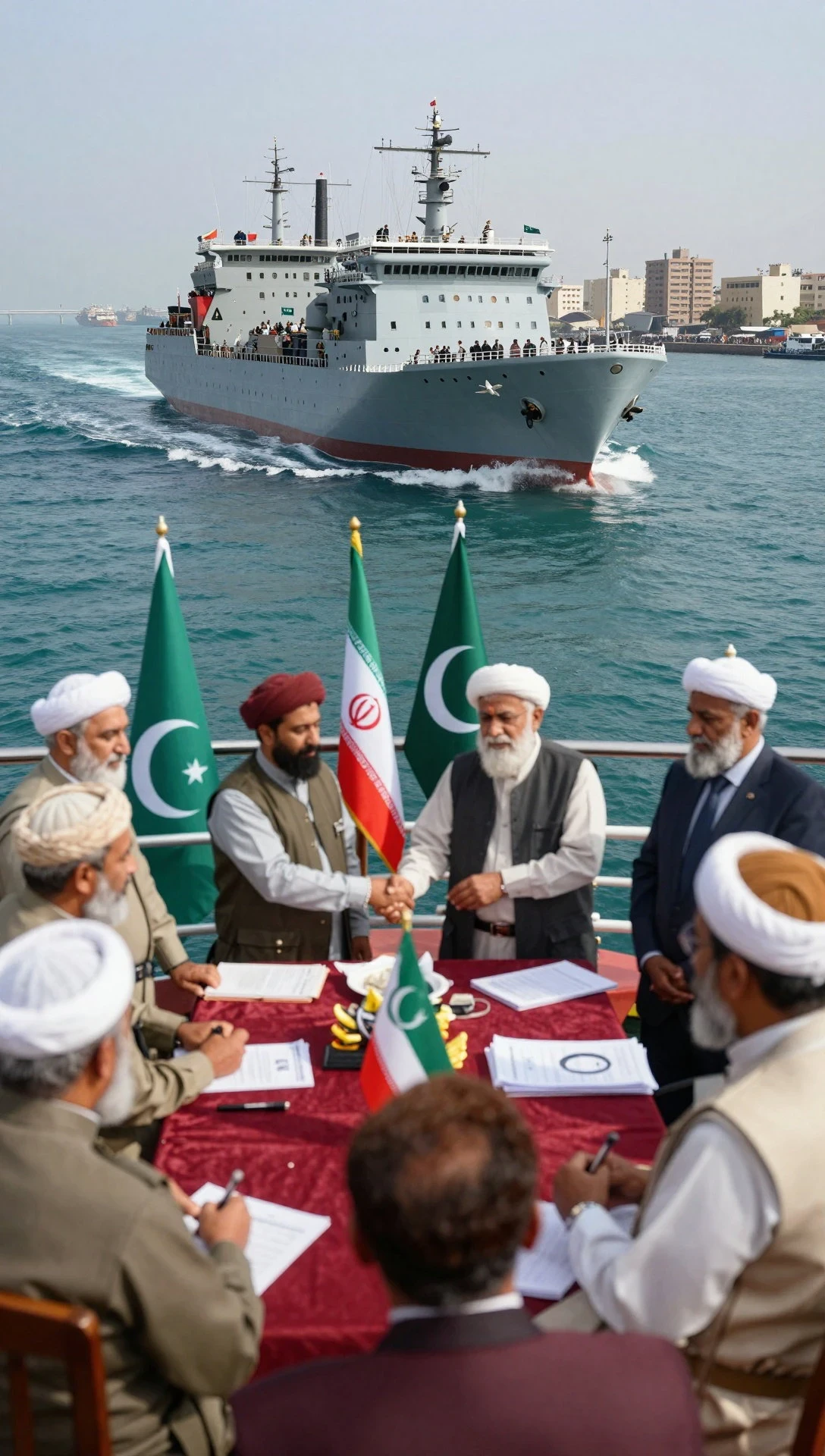
When Pakistan's army chief, Asim Munir, sat down with Iran's foreign minister, Abbas Araghchi, in Tehran, the encounter signalled far more than a routine diplomatic courtesy. It marked a deliberate attempt by a nuclear-armed military establishment to insert itself into one of the most volatile standoffs in the contemporary Middle East.
The meeting, confirmed by Pakistan's military on a Tuesday, centred on regional security and on efforts to halt the war between the United States and Iran, a conflict that has reshaped energy markets and alliance calculations across the Gulf.
Pakistan's role here is neither accidental nor purely altruistic. Earlier in June, Islamabad helped broker a temporary ceasefire that included a plan to reopen the Strait of Hormuz and to initiate talks on Iran's nuclear programme. That truce later collapsed, with Washington and Tehran trading accusations of violations.
On This Page
Since then, Qatar and Pakistan have jointly led diplomatic efforts to restore the arrangement, positioning Islamabad as a rare intermediary acceptable to both a Western superpower and an isolated Islamic republic.
The stakes extend well beyond bilateral relations. Iranian retaliatory strikes have hit US allies in the Gulf, global energy prices have climbed, and the Strait of Hormuz remains a chokepoint whose closure would convulse world trade. Iran has conditioned reopening the strait on Washington releasing frozen assets, lifting sanctions and ending a naval blockade of Iranian ports. Understanding this diplomatic triangle, and Pakistan's calculated place within it, reveals how middle powers convert geography and relationships into leverage.
TL;DR Pakistan's army chief Asim Munir met Iran's foreign minister Abbas Araghchi in Tehran to discuss regional security and efforts to end the US-Iran war. Pakistan previously helped arrange a June ceasefire that included reopening the Strait of Hormuz and nuclear talks, but that truce collapsed amid mutual recriminations. Qatar and Pakistan now lead efforts to restore it. Iran has proposed a two-day plan to reopen the strait, contingent on Washington releasing frozen assets, lifting sanctions and ending a naval blockade. The episode illustrates how Pakistan leverages diplomatic neutrality and military weight to secure relevance in a conflict that drives global energy prices.
The Diplomatic Architecture Behind the Tehran Meeting
The Tehran meeting did not emerge from a vacuum. It followed a carefully sequenced set of diplomatic moves that began with Araghchi's arrival in Pakistan on Sunday for a meeting of the Economic Cooperation Organization, a grouping spanning Central Asia, South Asia and the Middle East.
That multilateral cover gave the bilateral encounter a legitimacy that a standalone visit might have lacked, allowing both sides to frame the talks as regional consultation rather than crisis bargaining.
Why Pakistan Hosts the Conversation
Pakistan occupies a distinctive position that few states can replicate. It shares a long border with Iran, maintains deep security ties with Gulf monarchies, and has historically served as a conduit between Washington and Tehran. That triangulation gives Islamabad credibility with parties who otherwise refuse to speak directly. Its army chief, rather than its civilian foreign ministry, fronted the message, underscoring where real decision-making authority resides.
The choice of Asim Munir as interlocutor is itself instructive. In Pakistan's civil-military balance, the army chief commands foreign-policy weight that often exceeds formal diplomatic channels. By dispatching Munir, Islamabad signalled that its commitments carry enforcement behind them. For Tehran, meeting a military commander rather than a career diplomat implies security guarantees and operational coordination, not merely political sympathy.
The Economic Cooperation Organization as Cover
The ECO framework provided diplomatic camouflage for sensitive discussions. Regional summits routinely host sideline meetings that never appear on official agendas, and the Araghchi visit fit that pattern. Pakistan's foreign minister, Ishaq Dar, described his own talks with Araghchi as open and direct, confirming that Iran had proposed a two-day plan to reopen the Strait of Hormuz and that Washington had not yet responded.
That disclosure matters. By publicly acknowledging the Iranian proposal while noting American silence, Dar positioned Pakistan as a transparent broker rather than a partisan. It also gently pressured Washington to respond, using public diplomacy as a lever. Such calibrated disclosure is a hallmark of states that trade in influence rather than coercion, and it keeps Islamabad relevant to both capitals simultaneously.
The Strait of Hormuz as Strategic Leverage
No body of water carries more geopolitical weight per square kilometre than the Strait of Hormuz. Roughly a fifth of global petroleum liquids consumption transits its narrow channels, and any credible threat to that flow reverberates through insurance markets, freight rates and consumer prices worldwide. Iran's willingness to close it, and its insistence on conditions for reopening, converts geography into a bargaining chip of extraordinary value.
Iran's Conditions and Their Logic
Tehran has been explicit about its terms. It will reopen the strait only if Washington releases frozen assets, lifts sanctions and ends a naval blockade of Iranian ports. Each demand addresses a distinct pressure point: liquidity, trade access and military encirclement. Bundling them into a single package transforms a maritime concession into a comprehensive sanctions-relief negotiation, raising the price of any deal.
The sequencing also serves domestic politics. Iranian leadership can present any reopening as a victory extracted from an adversary rather than a capitulation. By anchoring the demand in tangible, verifiable concessions, Tehran ensures that its negotiators return with deliverables rather than vague assurances. This is classic brinkmanship, and it explains why the two-day proposal has languished without an American reply.
Global Energy Consequences
The conflict's economic footprint is already visible. Iranian retaliatory strikes on US allies in the Gulf have driven up global energy prices, and markets have priced in a persistent risk premium. Every diplomatic signal from Tehran or Washington moves crude benchmarks. A durable ceasefire would deflate that premium; a renewed escalation would send it sharply higher, with consequences for inflation everywhere.
For import-dependent economies in South Asia, the stakes are immediate. Pakistan itself faces balance-of-payments pressure that worsens with every barrel-price spike. Its mediation is therefore partly self-interested: stabilising the Gulf stabilises its own import bill. That alignment of diplomatic ambition and economic necessity gives Islamabad a credibility that purely altruistic brokers often lack.
We Also Published
Pakistan's Calculated Neutrality
Islamabad's diplomacy rests on a paradox: it is simultaneously a close security partner of the United States and a neighbour with deep ties to Iran. Rather than choose, Pakistan has converted ambiguity into an asset. Its officials speak to both capitals, carry messages, and host summits, all while avoiding formal alignment. This posture is not indecision but a deliberate strategy of indispensability.
Balancing Washington and Tehran
Pakistan's relationship with Washington has weathered decades of fluctuation, from Cold War alliance to post-9/11 friction. Its ties with Tehran, meanwhile, are anchored in geography, trade and a shared border. Managing both requires precision. Too much warmth toward one capital invites suspicion from the other; too little engagement renders Islamabad irrelevant to both.
The army chief's direct involvement helps manage this balance. Military-to-military channels often carry more weight than civilian diplomacy in the region, and Munir's meeting with Araghchi signals that Pakistan's commitments are backed by its security establishment. That credibility is precisely what makes Islamabad useful to Washington as a conduit and to Tehran as a guarantor.
The Military's Foreign-Policy Role
In Pakistan, the army has long shaped foreign policy, particularly on matters touching India, Afghanistan and the Gulf. The Tehran meeting reinforces that reality. Civilian foreign minister Ishaq Dar conducted parallel talks, but it was Munir whose presence lent the encounter strategic weight. This division of labour lets Pakistan present both a diplomatic and a security face to different audiences.
Critics note that military dominance in diplomacy can complicate democratic accountability. Supporters counter that in a crisis, only the army can deliver credible assurances. Whatever one's view, the arrangement has produced results: Pakistan helped arrange the June ceasefire and remains central to restoration efforts. Its model of military-led mediation may prove instructive for other middle powers seeking influence.
The Collapse of the June Truce and Its Lessons
The June ceasefire represented a genuine diplomatic achievement, bundling a strait reopening with nuclear talks. Its collapse, with Washington and Tehran blaming each other for violations, exposed the fragility of arrangements built on mutual suspicion. Understanding why it failed is essential to any restoration effort, because the same structural weaknesses persist and will undermine a second attempt unless addressed.
Why the Truce Unravelled
Ceasefires between adversaries with no shared enforcement mechanism tend to erode quickly. Each side interprets ambiguous terms in its own favour, then accuses the other of bad faith. The June arrangement lacked independent monitoring, leaving compliance a matter of self-reporting. Once the first disputed incident occurred, trust collapsed and the political cost of restraint rose sharply for both governments.
Domestic pressures compounded the problem. Hardliners in Tehran and Washington alike benefit politically from confrontation, and any concession invites accusations of weakness. A truce that requires leaders to absorb domestic criticism needs visible, early dividends to survive. The June deal produced no such dividends before disputes emerged, leaving its architects exposed and its provisions abandoned.
Prospects for Restoration
Restoration efforts led by Qatar and Pakistan face the same obstacles, but with one advantage: experience. Negotiators now know where the previous arrangement failed and can build in monitoring, phased implementation and dispute-resolution mechanisms. Iran's two-day strait proposal suggests a willingness to test incremental steps rather than commit to a comprehensive package upfront.
Washington's silence remains the critical variable. Without an American response, the proposal cannot advance, and the diplomatic momentum Pakistan has cultivated will dissipate. The longer the delay, the more entrenched the conflict becomes and the higher the price of any settlement. Islamabad's challenge is to convert its access into pressure that moves Washington toward engagement.
- 01
- 02
- 03
- 04
Regional and Global Ramifications
The US-Iran war has already reshaped the Middle East's security landscape. Iranian retaliatory strikes have hit US allies in the Gulf, forcing monarchies to reassess their defence postures and their exposure to escalation. The conflict has also accelerated realignments, with Gulf states hedging between Washington and Tehran while quietly expanding their own diplomatic channels to avoid being drawn into a wider war.
Gulf States and the Energy Economy
Gulf economies depend on uninterrupted export routes, and the Strait of Hormuz is their lifeline. Any closure, even temporary, threatens revenue and investor confidence. The monarchies have therefore supported mediation efforts, viewing Pakistan and Qatar as useful intermediaries who can speak to Tehran without the baggage of direct confrontation. Their quiet backing strengthens the brokers' hand.
Energy markets, meanwhile, have priced in persistent risk. Insurance premiums for tanker traffic have risen, freight routes have adjusted, and refiners have diversified sourcing. These adaptations are costly but manageable in the short term. A prolonged closure, however, would overwhelm them, sending prices to levels that could tip importing economies into recession and reignite global inflation.
Implications for South Asia
South Asia sits at the receiving end of Gulf instability. Pakistan, India and Bangladesh all import substantial energy volumes, and price spikes strain their current-account balances. For Pakistan, the pressure is acute given its existing fiscal constraints. Its mediation is thus partly defensive, aimed at protecting its own economy by stabilising the region that supplies its fuel.
The conflict also affects remittances and labour migration. Millions of South Asians work in the Gulf, and any escalation threatens their employment and the flows they send home. These economic linkages give South Asian states a direct interest in de-escalation, even if their diplomatic leverage is limited. Pakistan's mediation role is, in this sense, a regional public good.
What the Munir-Araghchi Meeting Really Signals
Beneath the diplomatic language lies a clear message: Pakistan intends to remain a consequential actor in Middle Eastern security, not a bystander. By sending its army chief to Tehran while its foreign minister conducted parallel talks, Islamabad demonstrated that it can operate across multiple channels simultaneously. That versatility is rare and valuable in a region where trust is scarce and intermediaries are few.
Signals to Washington and Tehran
To Washington, the meeting signals that Pakistan remains a useful conduit capable of delivering messages to Iran's leadership. To Tehran, it signals that Pakistan can advocate its case in Western capitals while offering security assurances. Both messages enhance Islamabad's value, positioning it as a broker whose continued engagement serves everyone's interests, even if no party fully trusts it.
The meeting also subtly reminds both capitals that Pakistan has options. Its relationships with China and Gulf states give it alternatives if Western engagement falters. That implicit leverage strengthens its diplomatic hand without requiring explicit threats. In the quiet arithmetic of mediation, the broker who can walk away often commands the most attention.
The Limits of Mediation
Mediation has boundaries. Pakistan can convene, convey and cajole, but it cannot compel Washington or Tehran to compromise. The core disputes, over nuclear enrichment, sanctions and regional influence, remain beyond its reach. Its value lies in keeping channels open and reducing the risk of miscalculation, not in resolving the underlying conflict.
That limitation should temper expectations. The June truce collapsed despite Pakistan's efforts, and a second attempt may fare no better. Yet even imperfect mediation has value: it buys time, prevents accidental escalation and preserves the possibility of a settlement. In a conflict with global economic consequences, that is no small contribution.
From our network :
- Forbidden Matrix Patterns and Visible Lattice Points: A Geometric DictionaryExplore how multidimensional 0–1 matrices encode geometric truths, linking forbidden patterns to visible lattice points and hypergraph theory, with applications in combinatorics and computational geometry.
- CISA’s Ten-Advisory Wave: Why Generic Patching Fails in OT and How to Build Product-Specific PlaybooksCISA released ten ICS advisories in one week, exposing critical infrastructure risks. Generic patching fails in OT. Learn to build product-specific remediation playbooks.
- Mobile Learning and VR in English: What Global Evidence Reveals About Effective Language TechnologyA systematic review across 14 countries reveals which language-learning technologies genuinely work. Mobile learning, AI, and VR show measurable benefits when pedagogically integrated. This evidence-based guide helps educators and learners select technology that delivers real return on investment.
- Committed Mediterranean Precipitation Decline: Why Emissions Cuts Alone Cannot Restore Winter RainsNew NOAA research reveals that Mediterranean winter rains may decline irreversibly even with emissions cuts. Explore the science of committed climate change and regional impacts.
- University Language Proficiency Exams: Why Institutional Tests Demand Different Preparation Than IELTS and TOEFLDiscover why university-specific language proficiency examinations differ fundamentally from IELTS and TOEFL, and learn strategic preparation approaches for institutional assessment success.
- The Final Descent: How ESA Retired the Legendary Cluster Constellation After 24 Years of Space Weather ScienceAfter 24 years mapping Earth’s magnetosphere, ESA’s Cluster mission concluded with a precisely controlled reentry over the South Pacific. This analysis explores the scientific legacy, engineering decisions, and debris mitigation principles behind one of space exploration’s most responsible retirements.
- The Hidden Cost of AI Convenience: Why Over-Permissioned Agents Are a Security Time BombDiscover why AI agents with excessive permissions create dangerous single points of failure, and learn how implementing least privilege principles can protect your organization from exploitation.
- Live Online English Classes for Kids: Do They Actually Reduce Anxiety?A ten-week study reveals that synchronous online English classes can significantly reduce child language anxiety while improving listening and reading skills. Discover what makes these programs effective and how parents can select the right one.
- How AI Agents Will Change the Way We Manage Personal FinancesExplore how AI agents are transforming personal finance through automated budgeting, bill payment, and investment management, while examining the critical security protocols and governance frameworks required for safe deployment.
RESOURCES
- Iran, US receive plan to end hostilities, immediate ceasefire, source ...reuters.comApr 6, 2026 ... Ceasefire could reopen Strait of Hormuz immediately; Final deal in 15 ... They have said Iran has received messages from…
- Historic U.S. and Iran negotiations in Pakistan end without agreementpbs.orgApr 11, 2026 ... ... Iranian delegation, but Pakistani mediators called on both countries to maintain the ceasefire. ... Iran's grip on the Strait…
- Trump says US to 'blockade' Strait of Hormuz after talks failed ... - BBCbbc.comApr 11, 2026 ... ... Iran and the US in Pakistan, has issued a statement upon his return to Iran. Responding to comments from…
- The US–Iran agreement on a ceasefire is a step back from the brink ...facebook.comApr 8, 2026 ... The Strait of Hormuz must be open for passage again. I spoke to Pakistani Foreign Minister Ishaq Dar and thanked…
- Iran mediators push new ceasefire as Trump eyes all-out war - Axiosaxios.comJul 20, 2026 ... Ten straight nights of U.S. bombing have failed to break Iran's grip on the Strait of Hormuz.
- Pakistan's role in brokering Iran deal; will Iranian hardliners ... - NPRnpr.orgJul 21, 2026 ... ... ceasefire deal over control of the Strait of Hormuz. Pakistan, the country that helped mediate the first ceasefire between…
- Iran says no talks with US for now, casting doubt over Pakistan effortsaljazeera.comApr 20, 2026 ... He accused Iran of a “Total Violation of our Ceasefire Agreement” after Iranian gunboats fired on vessels in the Strait…
- China and Pakistan present new Iran deal: Ceasefire for opening ...axios.comMar 31, 2026 ... ... Iran that includes an immediate ceasefire and the reopening of the Strait of Hormuz. The intrigue: Pakistan's foreign minister…
- Iran sends response to US proposal to end war via mediator Pakistanaljazeera.comMay 18, 2026 ... Iran demands the release of assets frozen abroad, the lifting of sanctions and control over the Strait of Hormuz.
- Statement by the High Representative on behalf of the EU on the ...consilium.europa.euApr 9, 2026 ... The EU welcomes the ceasefire agreed by the United States and Iran. We commend Pakistan and other regional partners for…
- I warmly congratulate the US and Iran for having reached a peace ...instagram.comJun 14, 2026 ... ... ceasefire, the reopening of the Strait of Hormuz, as well as a framework for further negotiations. This represents a…
- How Pakistan brokered a US-Iran ceasefire, and what's nextdw.comApr 8, 2026 ... Iran's Foreign Minister Abbas Araghchi says the passage through the Strait of Hormuz will be allowed under the supervision of…
- U.S. beginning effort to guide stranded ships through Strait of Hormuzcbsnews.comMay 4, 2026 ... ... Pakistani mediators, which Iran was reviewing. By AFP. 8:31 PM / May ... Head of Iranian parliament's National Security…
- Foreign Ministry Spokesperson Mao Ning's Regular Press ...fmprc.gov.cnApr 7, 2026 ... The closure of the Strait of Hormuz drew widespread concern. There is a growing call for a ceasefire and safe…
- China urges Pakistan to step up US-Iran mediation as Trump set to ...aa.com.trMay 12, 2026 ... ... Strait of Hormuz, according to a statement from the Pakistani Foreign Ministry. ... Pakistan brokered a two-week ceasefire between…
- 01
- 02
- 03
- 04
- 05
- 06
- 07
- 08
0 Comments