When Australian Climate Change Minister Chris Bowen released an eighteen-page negotiating draft at the COP31 summit in Türkiye, he handed nearly two hundred delegations a document that reads less like a compromise and more like a moral ledger.
Assembled from submissions by 160 countries and structured around 144 distinct provisions, the text calls for an immediate transition away from fossil fuels, demands that developed nations reach net zero by 2030, and proposes tripling adaptation finance to at least $120 billion by 2035. It is, by any measure, an unusually assertive opening bid for a conference presidency.
The draft matters because it reframes what a COP decision can plausibly say out loud. It expresses deep concern that warming will exceed 1.5°C above pre-industrial levels, links climate change directly to human health through disease and heat stress, and asks developed economies to move beyond neutrality into net-negative emissions by 2040.
On This Page
- The Architecture of the COP31 Draft Agreement
- Fossil Fuel Language and the Phase-Out Question
- The Finance Arithmetic Behind $120 Billion
- Negotiation Dynamics Among 200 Delegations
- Measuring the Gap Between Draft and Trajectory
- Australia's Credibility Test as Summit President
- Reading the Draft as a Signal for Global Climate Policy
Climate advocates were startled by the strength of the fossil fuel language, even as they questioned how much of it will survive the negotiating room. The gap between drafting ambition and diplomatic reality is the real story here.
Australia's own position adds a sharp irony to the proceedings. At least 37 coal, oil and gas projects have been approved since 2022, and Bowen has defended those exports by arguing that buyer nations still need the fuel while they transition. Greenpeace activists staged a protest in Antalya to press the point.
What follows examines the draft's architecture, its financing math, the politics of the presidency, and the measurable distance between its promises and the emissions trajectory the world is actually on.
TL;DR Australia's COP31 presidency has tabled an 18-page draft agreement drawn from 160 national submissions and 144 provisions, urging an immediate fossil fuel exit, net zero for developed nations by 2030, net-negative emissions by 2040, and a tripling of adaptation finance to $120 billion by 2035. The language on coal, oil and gas is among the strongest ever seen in a draft COP decision, but negotiators must now decide how much survives. Australia's own approval of 37 fossil fuel projects since 2022 keeps the credibility question alive.
The Architecture of the COP31 Draft Agreement
The document is best understood as a negotiating instrument rather than a treaty. Bowen has been explicit that the text will guide discussions over the coming week and will not be the final version, and that not every party will endorse every element.
Its 144 provisions are organised around a central premise: that electrification and emissions reduction must move together, with 35 percent of global energy use drawn from electricity.
What the 144 Provisions Actually Cover
Broadly, the provisions cluster into four families. The first covers fossil fuel phase-out language and the timeline for developed economies. The second addresses adaptation finance and the $120 billion target by 2035. The third concerns electrification and energy system restructuring. The fourth handles transparency, reporting obligations, and the net-negative emissions pathway that developed countries are asked to reach by 2040.
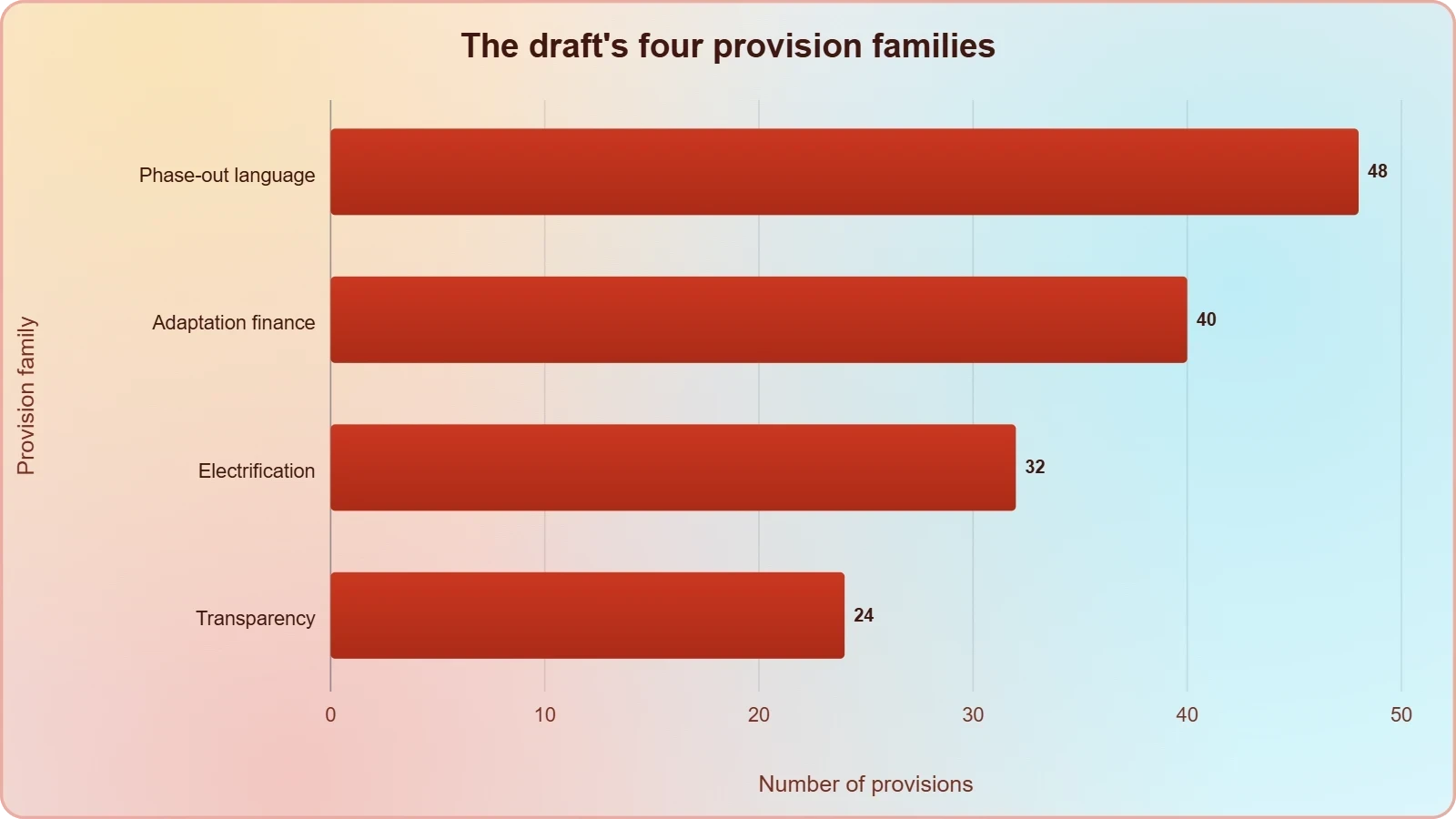
Each family carries different political weight. Phase-out language is the most contested, because it touches sovereign resource decisions. Finance is the most quantifiable, because it can be counted. Electrification is the most technical, because it depends on grid investment. Transparency is the most procedural, yet it determines whether any of the other three can be verified by independent observers.
Why the 1.5°C Framing Is Politically Loaded
The draft states deep concern that warming is expected to exceed 1.5°C above pre-industrial levels. That phrasing matters because it implicitly concedes that the threshold may be breached rather than preserved. For vulnerable states, this is an admission that adaptation is no longer optional. For major emitters, it is a pressure point that makes stronger mitigation commitments harder to avoid.
The health dimension sharpens the argument. By naming disease and heat stress as present-day consequences, the text moves climate policy out of the abstract and into public health budgets. That framing gives finance ministers, not just environment ministers, a reason to engage with the negotiations, which historically has been where ambition either gains traction or stalls.
We Also Published
Fossil Fuel Language and the Phase-Out Question
Simon Bradshaw of Greenpeace Australia Pacific described the fossil fuel wording as some of the strongest ever seen in a draft COP decision, while cautioning that the real question is how much of it survives. That tension defines the summit. A draft can be bold precisely because it is not yet binding, and the negotiating week exists to test which sentences hold.
Reading the "Immediate Transition" Clause
The phrase "immediate transition away from fossil fuels" is doing heavy lifting. It does not specify a date for peak production, nor does it name coal, oil and gas individually. Its power is directional rather than prescriptive, which is why advocates welcomed it and why producer economies will attempt to soften it with qualifiers about energy security and just transition.
Andreas Sieber of 350.org made the complementary critique: the draft centres the energy transition and adaptation finance, yet lacks a clear roadmap to end fossil fuels. That absence is structural. A roadmap requires sequencing, sectoral targets, and accountability mechanisms, none of which appear in full. The draft sets a destination without publishing the route.
Australia's Domestic Record Under Scrutiny
The presidency's credibility rests on an uncomfortable contrast. At least 37 coal, oil and gas projects have been approved in Australia since 2022, a figure campaigners have raised repeatedly in Türkiye. Bowen's defence is that Australia sells fuel to nations still transitioning and needing it in the interim, a position that treats exports as a bridge rather than a contradiction.
Whether that argument persuades depends on the audience. For importing economies with limited alternatives, it has practical force. For small island states and climate-vulnerable nations, it reads as a wealthy exporter outsourcing the emissions accounting while retaining the revenue. The draft's own language on developed-country leadership makes this tension harder to manage.
The Finance Arithmetic Behind $120 Billion
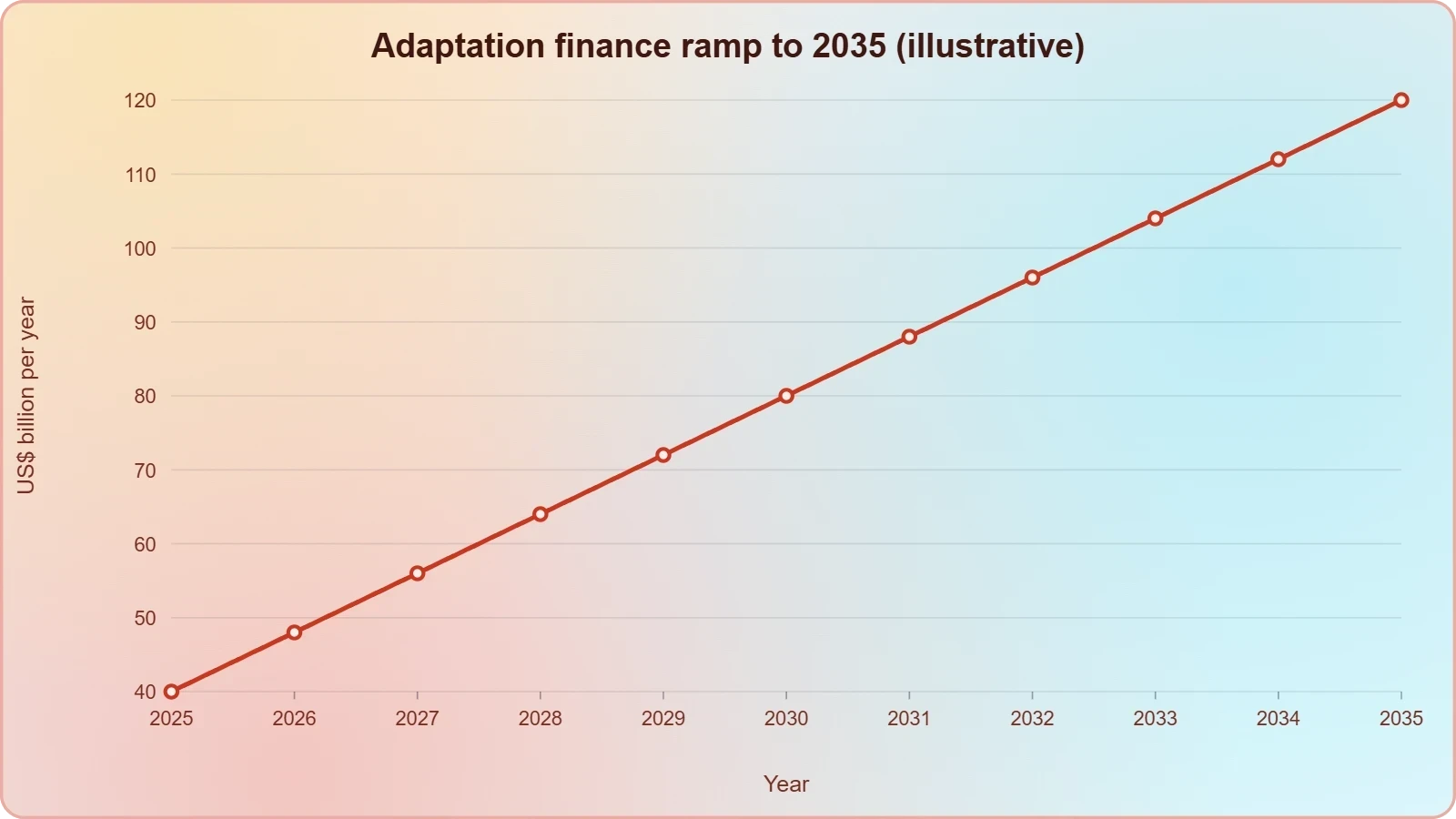
Tripling adaptation funding to at least $120 billion by 2035 is the draft's most concrete commitment, and the easiest to audit. Adaptation finance differs from mitigation finance because it funds defensive infrastructure, early warning systems, drought resilience and coastal protection rather than emissions reduction. It is also the category where delivery has historically lagged pledges most severely.
From Pledge to Disbursement
The arithmetic is straightforward but unforgiving. If current adaptation flows sit near $40 billion annually, tripling implies roughly $120 billion, and the timeline to 2035 gives a decade of ramp-up. The difficulty lies not in the target but in the accounting: grants versus loans, bilateral versus multilateral channels, and whether re-labelled development aid counts toward the total.
Recipient countries have learned to scrutinise these definitions closely. A loan that must be repaid is not equivalent to a grant, and adaptation projects often generate no revenue stream to service debt. The draft's credibility therefore depends on reporting standards as much as on headline numbers, and those standards are still being negotiated.
Electrification as an Emissions Strategy
The proposal that 35 percent of global energy use come from electricity reframes decarbonisation as an infrastructure problem. Electrifying transport, heating and industry only reduces emissions if the underlying grid is clean, which means the target is inseparable from renewable generation capacity and transmission investment.
This is where the draft's technical provisions carry practical weight. Grid expansion, storage deployment and interconnection are unglamorous but decisive. A country can electrify rapidly and still raise emissions if the added load is met by coal. The 35 percent figure is therefore a useful benchmark only when paired with generation-mix obligations.
Negotiation Dynamics Among 200 Delegations
Roughly 200 countries are attending COP31, and each arrives with a different red line. Bowen's stated method is to find common ground rather than force consensus, which is the standard presidential posture but also a signal that the boldest provisions are expected to be traded. The draft's function is to establish the outer boundary of what can be discussed.
Coalition Pressures and the Presidency's Dilemma
A presidency that tables ambitious text gains moral authority but also becomes the target of every delegation whose interests are threatened. Australia must simultaneously defend the draft's fossil fuel language abroad and its export approvals at home. That dual exposure weakens its leverage when producer economies push for softer verbs and longer timelines.
Public pressure compounds the difficulty. Greenpeace's protest in Antalya demonstrates that civil society will benchmark the final text against the draft, not against the lowest common denominator. Any dilution becomes a visible, attributable retreat, which raises the political cost of compromise and may paradoxically harden positions on both sides.
Where Consensus Is Most Likely
Adaptation finance and electrification are the most tractable areas. Both can be framed as investment rather than restriction, and both offer domestic political returns for donor and recipient governments alike. Transparency provisions are similarly likely to advance, since reporting obligations rarely provoke the same resistance as production limits.
The hardest ground remains the phase-out timeline and the 2030 net zero date for developed nations. A decade-long horizon compresses adjustment costs into a single political cycle, which few governments relish. Expect the final text to retain the direction while loosening the calendar, a familiar pattern in multilateral environmental agreements.
Measuring the Gap Between Draft and Trajectory
Ambition in a draft is measured against atmospheric reality, and the two remain far apart. The text itself concedes that warming is expected to exceed 1.5°C above pre-industrial levels, which means the provisions are designed for a world already in overshoot. That admission should shape how the agreement is judged.
Emissions Math and the Overshoot Problem
Net zero by 2030 for developed economies implies roughly a 90 percent reduction from 1990 baselines within four years of the summit. No major economy is currently on that path. The provision therefore functions as an aspirational anchor rather than a forecast, useful for ratcheting pressure but disconnected from published national plans.
Net-negative emissions by 2040 adds a further layer. Negative emissions depend on carbon removal at scale, a portfolio of technologies and land-use practices still far from deployment at the required volume. Writing the target into text does not create the capacity, and treating it as a substitute for near-term cuts is the central risk.
What Would Signal Real Follow-Through
Three indicators would demonstrate that the draft is more than rhetoric. First, a defined schedule for revising national commitments before the next summit. Second, adaptation finance reported in grant-equivalent terms with independent verification. Third, sectoral milestones for power generation that make the 35 percent electricity target auditable rather than aspirational.
Absent these, the agreement risks becoming a statement of shared concern rather than a plan of shared action. The draft's strength is that it names the problem with unusual clarity. Its weakness is the same as every predecessor: the mechanisms that convert language into measurable change remain underspecified and politically fragile.
- 01
- 02
- 03
- 04
Australia's Credibility Test as Summit President
Presiding over climate negotiations while expanding fossil fuel exports is a difficult combination, and the summit has made it visible. The 37 approvals since 2022 are a matter of public record, and Bowen has chosen to defend rather than disown them. That choice will shape how the final agreement is received.
Exports, Transition and the Interim Argument
The minister's argument is that Australia supplies fuel to nations still transitioning and needing it in the meantime. It is a defensible position in energy-security terms, particularly for import-dependent economies in Asia. But it treats the interim as open-ended, and the draft's own language demands an immediate transition, creating an internal inconsistency.
Critics note that approving new projects extends the interim rather than shortening it. Each approval carries multi-decade production assumptions, which sit awkwardly beside a 2030 net zero target for developed economies. The credibility question is not whether Australia exports, but whether new supply is compatible with the timeline it is championing.
What the Presidency Must Deliver
A successful presidency is judged by whether the final text preserves the draft's direction while securing broad participation. Bowen's stated focus on common ground suggests he will prioritise agreement over maximal ambition. That is a legitimate trade-off, but it places the burden of proof on the mechanisms that survive.
The most valuable outcome would be a durable reporting framework and a credible finance schedule, even if the phase-out language softens. Institutional machinery outlasts summit communiqués. If COP31 leaves behind auditable commitments on adaptation finance and electrification, the presidency will have achieved something concrete regardless of the headlines.
Reading the Draft as a Signal for Global Climate Policy
Beyond the negotiating room, the draft signals a shift in how climate diplomacy frames its central problem. By placing electrification, adaptation finance and health impacts alongside fossil fuel phase-out, it treats decarbonisation as an integrated public investment agenda rather than an environmental constraint. That reframing could outlast the summit itself.
Implications for Investors and Energy Markets
If the 35 percent electricity target gains traction, capital allocation shifts toward grids, storage and transmission rather than generation alone. Adaptation finance at $120 billion would create durable demand for resilience infrastructure, insurance instruments and early warning systems. Markets read drafts as forward guidance, even when the text is non-binding.
The fossil fuel language carries the opposite signal for upstream investment. Producers face a document that names their sector as the problem, which raises the political risk premium on long-cycle projects. Whether that translates into higher capital costs depends on how much of the wording survives, but the direction of travel is now explicit.
What to Watch in the Final Week
Three things will determine the outcome. First, whether the phase-out clause retains the word "immediate" or acquires a qualifier. Second, whether adaptation finance is specified in grant-equivalent terms. Third, whether the 2030 net zero date for developed nations remains in the operative text or migrates to the preamble, where commitments go to be admired rather than enforced.
Bowen has framed the draft as a starting point, and that is accurate. The document's value lies in what it makes sayable. Once a COP presidency has put immediate fossil fuel transition and net-negative emissions into an official draft, subsequent negotiations begin from a higher floor. That is a modest but real form of progress.
From our network :
- The Final Descent: How ESA Retired the Legendary Cluster Constellation After 24 Years of Space Weather ScienceAfter 24 years mapping Earth’s magnetosphere, ESA’s Cluster mission concluded with a precisely controlled reentry over the South Pacific. This analysis explores the scientific legacy, engineering decisions, and debris mitigation principles behind one of space exploration’s most responsible retirements.
- CISA’s Ten-Advisory Wave: Why Generic Patching Fails in OT and How to Build Product-Specific PlaybooksCISA released ten ICS advisories in one week, exposing critical infrastructure risks. Generic patching fails in OT. Learn to build product-specific remediation playbooks.
- University Language Proficiency Exams: Why Institutional Tests Demand Different Preparation Than IELTS and TOEFLDiscover why university-specific language proficiency examinations differ fundamentally from IELTS and TOEFL, and learn strategic preparation approaches for institutional assessment success.
- Committed Mediterranean Precipitation Decline: Why Emissions Cuts Alone Cannot Restore Winter RainsNew NOAA research reveals that Mediterranean winter rains may decline irreversibly even with emissions cuts. Explore the science of committed climate change and regional impacts.
- Live Online English Classes for Kids: Do They Actually Reduce Anxiety?A ten-week study reveals that synchronous online English classes can significantly reduce child language anxiety while improving listening and reading skills. Discover what makes these programs effective and how parents can select the right one.
- Mobile Learning and VR in English: What Global Evidence Reveals About Effective Language TechnologyA systematic review across 14 countries reveals which language-learning technologies genuinely work. Mobile learning, AI, and VR show measurable benefits when pedagogically integrated. This evidence-based guide helps educators and learners select technology that delivers real return on investment.
- How AI Agents Will Change the Way We Manage Personal FinancesExplore how AI agents are transforming personal finance through automated budgeting, bill payment, and investment management, while examining the critical security protocols and governance frameworks required for safe deployment.
- The Hidden Cost of AI Convenience: Why Over-Permissioned Agents Are a Security Time BombDiscover why AI agents with excessive permissions create dangerous single points of failure, and learn how implementing least privilege principles can protect your organization from exploitation.
- Forbidden Matrix Patterns and Visible Lattice Points: A Geometric DictionaryExplore how multidimensional 0–1 matrices encode geometric truths, linking forbidden patterns to visible lattice points and hypergraph theory, with applications in combinatorics and computational geometry.
RESOURCES
- Draft COP31 text suggests 'immediate' fossil fuel transitionsubscriber.politicopro.com1 day ago ... A draft version of the climate summit deal was published Monday. By: Zia Weise.
- Transcript of COP31 press conference with COP31 President of ...unfccc.int21 hours ago ... I'm thinking in particular of the agreement around fossil fuels, transition away from fossil fuels in energy systems in 2023,…
- COP31 draft deal calls for 'immediate' shift away from fossil fuelsdw.com1 day ago ... The preliminary agreement at UN climate talks in Turkey calls for a rapid reduction of planet-warming emissions and at least…
- Cop31 draft text is attempt to 'draw out parties' to find agreement ...theguardian.com24 hours ago ... ... transition away from fossil fuels”. Chris Bowen, Australia's climate and energy minister, said: “It's a genuine attempt to draw…
- COP30 climate summit deadlocked as EU rejects draft deal - Reutersreuters.comNov 21, 2025 ... Draft COP30 deal omits fossil fuel transition plans; Arab Group says energy industries off limits, sources say; Developing nations demand ...
- COP31: Draft deal calls for 'immediate' transition from fossil fuelsrapporteur.com1 day ago ... EU call for 'clean' electrification gets a nod in an early proposal for a global agreement.
- Colombia and The Netherlands Announce First International ...fossilfueltreaty.orgNov 21, 2025 ... ... Transition Away from Fossil Fuels as COP30 Text Drops with No Mention of Fossil Fuels ... Fossil Fuel Treaty…
- COP31: Environment MEPs set out priorities ahead of Antalya ...europarl.europa.euOct 1, 2026 ... The text urges all parties to advance the roadmap on transitioning away from fossil fuels, as agreed at the previous…
- Business coalition welcomes COP31 electrification target in draft ...wemeanbusinesscoalition.org1 day ago ... ... agreement designed to accelerate that transition. We need ... The transition is therefore reinforced from both sides: less fossil…
- COP 30 Outcome: What it means and what's nextiisd.org... transition away from fossil fuels in the final deal. Those who supported a stronger outcome on climate finance for developing countries were equally ...
- Draft COP31 text suggests 'immediate' fossil fuel transition - POLITICOpolitico.eu1 day ago ... A draft version of the climate summit deal was published Monday.
- Bonn climate talks: Key outcomes from the June 2026 ... - Carbon Briefcarbonbrief.orgJun 19, 2026 ... ... agreement at COP31. ... (The stocktake calls on all parties to contribute to the entire energy package, including the…
- Everything you need to know about COP - Global Witnessglobalwitness.orgSep 22, 2026 ... ... agreement to transition away from fossil fuels first set out in the COP28 text. (Global coordination on ending fossil…
- COP31 draft deal calls for 'accelerated action' to exit fossil fuelsafp.com1 day ago ... ... fossil fuels, including through the immediate transition away from fossil fuels in energy systems". This could be expected to…
- COP31 draft calls for immediate transition away from fossil fuelsfacebook.com8 hours ago ... The first draft of a possible #COP31 agreement calls for an immediate transition away from fossil fuels and measures to…
- 01
- 02
- 03
- 04
- 05
- 06
- 07
- 08
0 Comments