The Reserve Bank of New Zealand's November 2026 Financial Stability Report arrives at a moment when small, open economies are being asked to absorb an unusual concentration of external shocks. Middle East conflict, stretched sovereign bond markets, and richly valued artificial intelligence equities form a risk triangle that no domestic regulator can fully control.
Yet the central bank's central finding is reassuring: New Zealand's banking and insurance sectors hold enough capital and liquidity to keep functioning through severe stress.
What makes this report worth close reading is its honesty about asymmetry. Aggregate household stress has eased from its 2025 peak, but the relief is unevenly distributed across firms, regions, and income groups. Governor Anna Breman's framing captures that tension precisely, acknowledging improvement while flagging small businesses and discretionary-spending sectors as persistent weak points.
On This Page
- Reading the Reserve Bank's Core Stability Verdict
- Global Risk Channels Facing a Small Open Economy
- Household Stress, Housing, and Uneven Recovery
- The AI-Enabled Cyber Threat Landscape
- Stress Testing, Capital Buffers, and Institutional Readiness
- Implications for Banks, Insurers, and Policymakers
- Conclusion: Resilience With Open Eyes
The report also breaks newer ground by treating advanced AI models as a distinct cyber threat vector rather than a generic technology footnote.
This analysis unpacks the report's risk architecture, from offshore contagion channels to the quiet housing market and the operational resilience expectations now placed on financial institutions. It examines what the stress-test results actually demonstrate, where the vulnerabilities remain, and why the cyber dimension deserves board-level attention.
Readers will find structured comparisons, key metrics, and a clear reading of what the central bank is signalling to banks, insurers, and policymakers alike.
TL;DR The Reserve Bank of New Zealand's Financial Stability Report concludes that the country's financial system can withstand severe global shocks, supported by strong bank capital and liquidity and favourable stress-test results. It flags Middle East conflict, elevated bond yields, and stretched AI-linked equity valuations as correction risks, notes a subdued housing market that limits housing-related risk build-up, and warns that AI-enabled cyber threats require stronger institutional defences and recovery capability.
Reading the Reserve Bank's Core Stability Verdict
The headline judgement is one of qualified confidence. New Zealand's banks enter this period with capital buffers and liquidity positions that comfortably exceed regulatory minima, and the central bank's stress tests indicate both banks and insurers could survive severe financial shocks. That verdict matters because it converts an abstract assurance into a testable claim about loss absorption under adverse scenarios.
What the Stress Tests Actually Demonstrate
Stress testing is only as credible as the scenarios it imposes. The report indicates that simulated severe shocks, encompassing sharp asset price declines and funding pressure, did not breach the solvency of the tested institutions. For depositors and counterparties, that is the operative signal: the system's loss-absorbing capacity has been validated against deliberately harsh assumptions rather than benign baselines.
Equally important is the liquidity dimension. Capital protects solvency over time, but liquidity determines whether an institution survives a funding run within days. The report's emphasis on both suggests the central bank is satisfied that New Zealand banks can meet obligations under duress, a conclusion that underpins continued credit provision to the economy during downturns.
Why the Verdict Is Conditional, Not Complacent
A stability verdict is not a guarantee of immunity. The central bank's language carefully separates the capacity to withstand shocks from the likelihood that shocks occur. Strong capital cushions losses, but they do not prevent asset price corrections, funding squeezes, or confidence shocks from transmitting through an economy heavily reliant on offshore wholesale funding.
That distinction shapes how the report should be read by markets. The message is that New Zealand possesses shock absorbers, not shock eliminators. Institutions that treat the report as permission to relax risk discipline would misread its intent, which is to confirm resilience while sharpening vigilance on the specific channels most likely to transmit external stress.
Global Risk Channels Facing a Small Open Economy
New Zealand's financial system is structurally exposed to forces it cannot influence. Offshore wholesale funding, trade linkages, and the sensitivity of domestic asset prices to global risk appetite mean that foreign developments transmit quickly into local balance sheets. The report identifies several such channels with unusual specificity, treating them as live risks rather than distant hypotheticals.
Middle East Conflict and Geopolitical Tension
The central bank explicitly names conflict in the Middle East and broader geopolitical tensions as threats to global growth. For a commodity-exporting economy, the transmission runs through trade volumes, terms of trade, and risk sentiment. Prolonged instability can raise energy costs, disrupt shipping, and dampen demand in key export markets, all of which feed into domestic incomes and credit quality.
Geopolitical shocks also complicate monetary policy. Central banks facing supply-driven inflation must weigh price stability against growth support, and the resulting uncertainty can amplify market volatility. The report's inclusion of this channel signals that the Reserve Bank views geopolitical risk as a structural feature of the current environment rather than a transient disturbance.
Bond Yields, Valuations, and Correction Risk
Higher government bond yields and still-elevated asset valuations leave financial markets exposed to a correction, according to the report. The concern is most acute among firms linked to artificial intelligence, where valuations embed ambitious growth expectations. A repricing in that segment could cascade through equity markets and tighten financial conditions globally.
For New Zealand institutions, the exposure is indirect but real. Falling asset prices erode collateral values, raise borrowing costs, and can trigger margin calls across leveraged positions. The report's warning is a reminder that valuation risk in one market segment can become a liquidity event elsewhere when leverage and sentiment interact.
Household Stress, Housing, and Uneven Recovery
Domestic financial stress has generally eased from its peak last year, but the improvement is uneven. That single sentence from Governor Breman carries substantial analytical weight. It acknowledges genuine progress in aggregate indicators while refusing to generalise that progress across every borrower, business, and region, a nuance that matters for how lenders calibrate credit standards.
Smaller Businesses and Discretionary Spending
Smaller businesses and sectors dependent on discretionary household spending continue to face difficulties, according to the report. These segments typically operate with thinner buffers, less pricing power, and greater sensitivity to demand swings. When households tighten spending, the effect concentrates in hospitality, retail, and personal services rather than dispersing evenly across the economy.
For banks, this concentration creates a specific credit risk profile. Loan books weighted toward small and medium enterprises may experience higher arrears even as aggregate household stress declines. The report's language suggests supervisors expect institutions to distinguish between broad improvement and sector-specific fragility when setting provisioning and lending policy.
A Quiet Housing Market as a Stabiliser
The housing market remains quiet, particularly in Auckland and Wellington, and modest growth in mortgage lending has limited the build-up of housing-related risks. This is a stabilising development. Rapid credit growth against rising house prices historically precedes the most damaging banking losses, so subdued lending removes a familiar amplifier of financial cycles.
Quiet markets also carry their own implications. Weak turnover can reduce liquidity in property collateral, complicating recovery values in a downturn. The central bank appears to accept this trade-off, prioritising the absence of speculative credit expansion over the liquidity benefits of a more active market.
We Also Published
The AI-Enabled Cyber Threat Landscape
Among the report's most forward-looking passages is its treatment of cyber risk. The central bank points to a changing threat landscape linked to advanced artificial intelligence models, a development that alters both the sophistication and the tempo of attacks against financial institutions. This is not a peripheral concern appended to a stability report; it is an operational resilience issue with systemic implications.
Why AI Changes the Threat Calculus
Advanced models lower the cost and raise the speed of sophisticated attacks. Phishing content, social engineering, and vulnerability discovery can be automated at scale, compressing the time between intrusion and impact. For institutions accustomed to defending against human-paced adversaries, the shift toward machine-speed offence demands correspondingly faster detection and response.
The threat is also adaptive. AI systems can learn from failed attempts and refine tactics continuously, making static defences less effective over time. The report's emphasis on strengthening cyber defences reflects an understanding that security postures must evolve at the same rate as the threats they address.
Operational Continuity and Rapid Recovery
Beyond prevention, the report stresses the ability to keep critical services running and to recover quickly when disruptions occur. This reflects a mature regulatory view: some intrusions will succeed, so resilience depends on containment, failover capability, and tested recovery plans rather than perimeter defence alone.
For financial institutions, that means investing in redundancy, incident response drills, and third-party dependency mapping. A payment system that recovers within hours limits contagion; one that remains offline for days can trigger deposit flight and counterparty distrust. Recovery speed is therefore a stability variable, not merely an IT metric.
- 01
- 02
- 03
- 04
Stress Testing, Capital Buffers, and Institutional Readiness
Stress testing occupies a central place in the report's evidence base. By subjecting banks and insurers to severe financial shocks, the central bank converts resilience from an assertion into a measured outcome. The results indicate that tested institutions could absorb losses and continue operating, a finding that supports confidence among depositors, policyholders, and international counterparties.
What Capital and Liquidity Buffers Protect
Capital buffers absorb unexpected losses, protecting solvency when asset quality deteriorates. Liquidity buffers ensure obligations are met as they fall due, protecting against runs and funding freezes. The report's finding that both are strong implies institutions can endure a period of simultaneous credit losses and market stress without forced deleveraging.
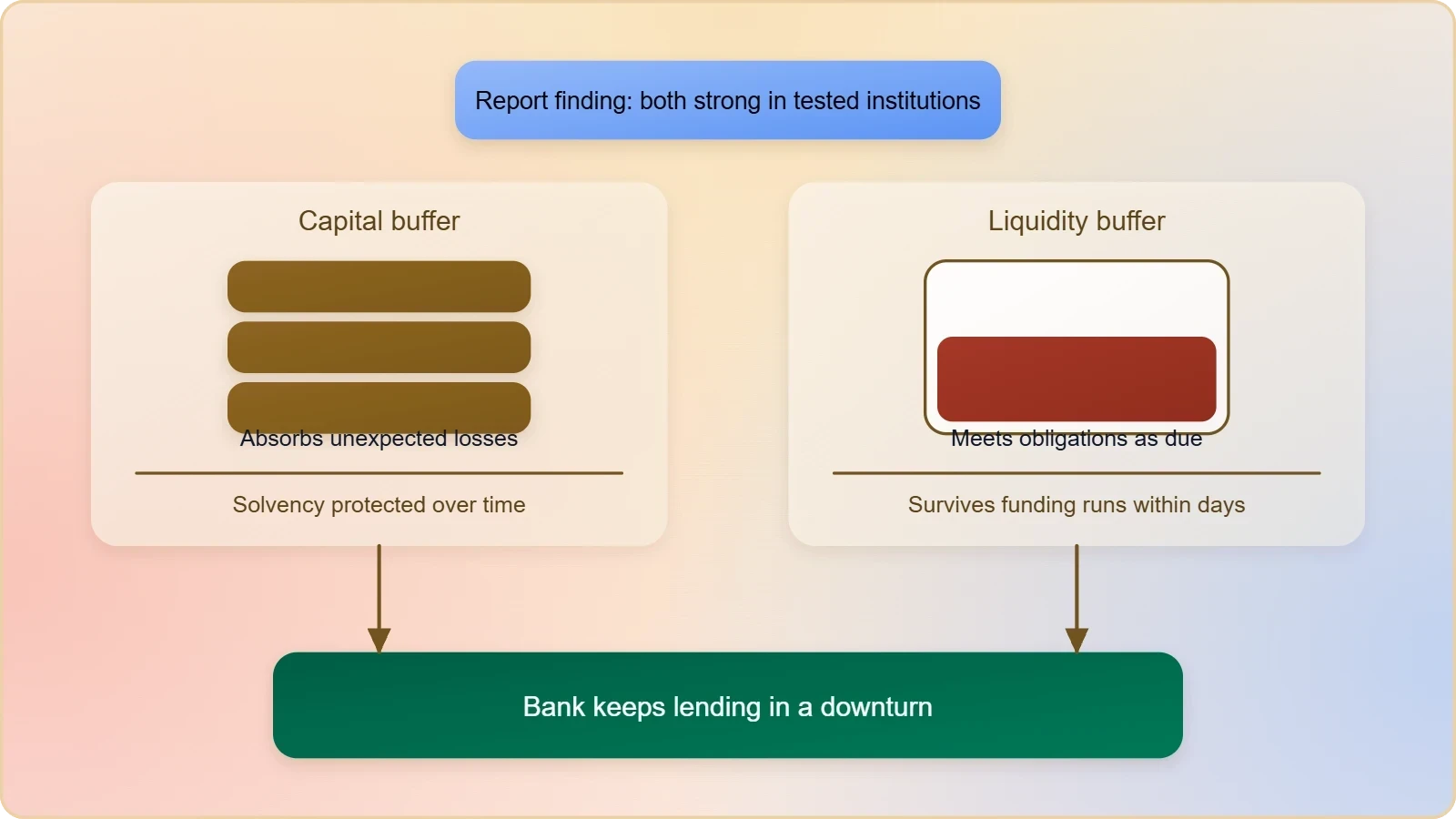
That combination matters for the real economy. Banks that remain solvent and liquid can continue lending when other funding sources withdraw, cushioning the downturn for households and businesses. Resilience within the financial system therefore functions as macroeconomic stabilisation, not merely institutional self-preservation.
Reading the Stress-Test Results Responsibly
Stress tests are models, and models simplify. Their value lies in disciplined scenario design and transparent assumptions rather than in any claim of certainty. The report's conclusion that institutions survive severe shocks should be read as evidence of substantial capacity, while acknowledging that real crises often combine shocks in ways no scenario fully anticipates.
Supervisors understand this limitation, which is why stress testing is iterative rather than definitive. Each cycle refines scenarios based on emerging risks, from cyber events to geopolitical escalation. The current results establish a baseline of confidence; future exercises will test whether that baseline holds as the risk environment evolves.
Implications for Banks, Insurers, and Policymakers
The report functions as a supervisory signal as much as a public assessment. Institutions reading it should recognise which risks supervisors consider live and where expectations for improvement are explicit. Cyber resilience stands out as the clearest call to action, while the uneven domestic recovery implies differentiated credit risk management across lending portfolios.
Priorities for Financial Institutions
Banks and insurers should treat AI-enabled cyber threats as a board-level risk rather than an IT concern. That means funding detection, response, and recovery capabilities at levels commensurate with machine-speed attacks, and testing those capabilities through realistic exercises. Third-party dependencies deserve particular scrutiny, since contagion often enters through vendors rather than direct systems.
On the credit side, institutions should avoid reading aggregate improvement as uniform relief. Small business and discretionary-spending exposures warrant closer monitoring, and provisioning assumptions should reflect sector-specific fragility. The quiet housing market offers breathing room, but collateral valuation discipline remains essential if turnover stays subdued.
Policy and Macroprudential Considerations
For policymakers, the report supports a steady rather than reactive stance. With buffers strong and housing-related risk contained, there is limited case for additional macroprudential tightening purely on domestic grounds. The greater challenge lies in maintaining readiness for external shocks that could arrive with little warning and transmit rapidly through funding markets.
Communication also matters. A stability report that acknowledges uneven stress while affirming systemic resilience helps anchor expectations. Markets and households can distinguish between aggregate strength and localised difficulty, reducing the risk that either complacency or alarm distorts behaviour in ways that amplify the next shock.
Conclusion: Resilience With Open Eyes
The Reserve Bank of New Zealand's report delivers a message that is simultaneously reassuring and demanding. Reassuring, because capital, liquidity, and stress-test evidence confirm that the financial system can absorb severe shocks. Demanding, because the same document identifies live external risks, uneven domestic stress, and a cyber threat landscape evolving faster than many defences.
Its most valuable contribution is precision. Rather than offering blanket comfort, it distinguishes between what is strong and what needs work, between aggregate improvement and sectoral difficulty, between capacity to withstand and likelihood of exposure. That clarity gives institutions and policymakers a usable map of where attention should concentrate in the months ahead.
For a small open economy, resilience is never a finished state. It is maintained through disciplined buffers, vigilant supervision, and continuous adaptation to new threats. The report affirms that New Zealand's financial system currently meets that standard, while making clear that meeting it tomorrow will require the same effort again.
From our network :
- University Language Proficiency Exams: Why Institutional Tests Demand Different Preparation Than IELTS and TOEFLDiscover why university-specific language proficiency examinations differ fundamentally from IELTS and TOEFL, and learn strategic preparation approaches for institutional assessment success.
- CISA’s Ten-Advisory Wave: Why Generic Patching Fails in OT and How to Build Product-Specific PlaybooksCISA released ten ICS advisories in one week, exposing critical infrastructure risks. Generic patching fails in OT. Learn to build product-specific remediation playbooks.
- Live Online English Classes for Kids: Do They Actually Reduce Anxiety?A ten-week study reveals that synchronous online English classes can significantly reduce child language anxiety while improving listening and reading skills. Discover what makes these programs effective and how parents can select the right one.
- How AI Agents Will Change the Way We Manage Personal FinancesExplore how AI agents are transforming personal finance through automated budgeting, bill payment, and investment management, while examining the critical security protocols and governance frameworks required for safe deployment.
- Committed Mediterranean Precipitation Decline: Why Emissions Cuts Alone Cannot Restore Winter RainsNew NOAA research reveals that Mediterranean winter rains may decline irreversibly even with emissions cuts. Explore the science of committed climate change and regional impacts.
- The Hidden Cost of AI Convenience: Why Over-Permissioned Agents Are a Security Time BombDiscover why AI agents with excessive permissions create dangerous single points of failure, and learn how implementing least privilege principles can protect your organization from exploitation.
- The Final Descent: How ESA Retired the Legendary Cluster Constellation After 24 Years of Space Weather ScienceAfter 24 years mapping Earth’s magnetosphere, ESA’s Cluster mission concluded with a precisely controlled reentry over the South Pacific. This analysis explores the scientific legacy, engineering decisions, and debris mitigation principles behind one of space exploration’s most responsible retirements.
- Mobile Learning and VR in English: What Global Evidence Reveals About Effective Language TechnologyA systematic review across 14 countries reveals which language-learning technologies genuinely work. Mobile learning, AI, and VR show measurable benefits when pedagogically integrated. This evidence-based guide helps educators and learners select technology that delivers real return on investment.
- Forbidden Matrix Patterns and Visible Lattice Points: A Geometric DictionaryExplore how multidimensional 0–1 matrices encode geometric truths, linking forbidden patterns to visible lattice points and hypergraph theory, with applications in combinatorics and computational geometry.
RESOURCES
- Financial system resilient amid heightened global risks - RBNZrbnz.govt.nzMay 6, 2026 ... ... Financial Stability Report this morning. “However, New Zealand's financial system is resilient and well positioned to support households and ...
- New Zealand: Financial Sector Assessment Programimf.orgMay 7, 2017 ... ... Despite these vulnerabilities, the banking system is resilient to severe shocks. Strengthening the macroprudential framework is important.
- Financial system remains resilient as global risks increaserbnz.govt.nz21 hours ago ... New Zealand's financial system remains resilient despite increasing global risks, the Reserve Bank of New Zealand – Te Pūtea Matua…
- Cyber security and operational systems resiliencefma.govt.nzWhile such attacks are typically industry and size agnostic, New Zealand's financial services are a popular target, recording the highest number of reported ...
- China Capital Injection Strengthens Financial System Resiliencefitchratings.comSep 7, 2026 ... ... financial-system resilience, Fitch Ratings says. The Ministry of ... For Australia, New Zealand, Taiwan and South Korea only: Fitch ...
- Safeguarding the future of our financial systemtreasury.govt.nzIntroducing depositor protection to New Zealand will make the current safety net more comprehensive, and the financial system and economy more resilient.
- Resilience of the Australian Financial Systemrba.gov.auApr 2, 2025 ... The financial crisis management preparedness of the Australian and New Zealand agencies was tested in a crisis simulation exercise in…
- Improving economic resilience - Productivity Commission inquiry ...treasury.govt.nzEconomic resilience is the capacity of industries and associated communities to anticipate, prepare, absorb, recover and learn from supply chain disruptions ...
- A pathway to the cloud: Analysis of the Reserve Bank of New ... - AWSaws.amazon.comJul 18, 2022 ... ... NZ financial sector's resilience to cyber incidents. Non–RBNZ ... TAGS: banking, Financial Services, Guidance on Cyber Resilience, New Zealand, ...
- ASFI and CSF welcome Australia and New Zealand cooperation to ...asfi.org.auJul 30, 2024 ... The Australian Sustainable Finance Institute (ASFI) is committed to realigning the finance sector to create a sustainable and resilient ...
- APRA's System Risk Outlook - November 2026apra.gov.au6 days ago ... ... resilience of Australia's financial system. Banks and insurers ... New Zealand banking systems would remain resilient to a severe…
- Cyber Security – Financial Stabilitycfr.gov.au... resilience of the Australian financial system. Recent cyber-attacks in ... New Zealand financial systems. Cyber operational resilience intelligence-led ...
- FS-ISAC | Advancing cybersecurity for the global financial systemfsisac.comFS-ISAC is the member-driven, not-for-profit organization that advances cybersecurity and resilience for the global financial system.
- Macroprudential policies to mitigate housing market risks - the BISbis.orgGiven the systemic nature of housing-related risks in New Zealand, macroprudential policy aims to build sufficient resilience in the financial system to cope, ...
- 01
- 02
- 03
- 04
- 05
- 06
- 07
- 08
0 Comments