
The Dangote Petroleum Refinery and Petrochemicals has just delivered one of the most consequential capital-markets events in African history. Applications for shares in its initial public offering reached approximately 5.85 trillion naira, or roughly $4.1 billion, according to people familiar with the matter — a figure that lands almost three times the $1.6 billion the company originally set out to raise. For a continent long accustomed to watching its largest enterprises list in London or New York, the scale of this domestic and pan-African demand carries a significance that extends well beyond the balance sheet of a single refinery.
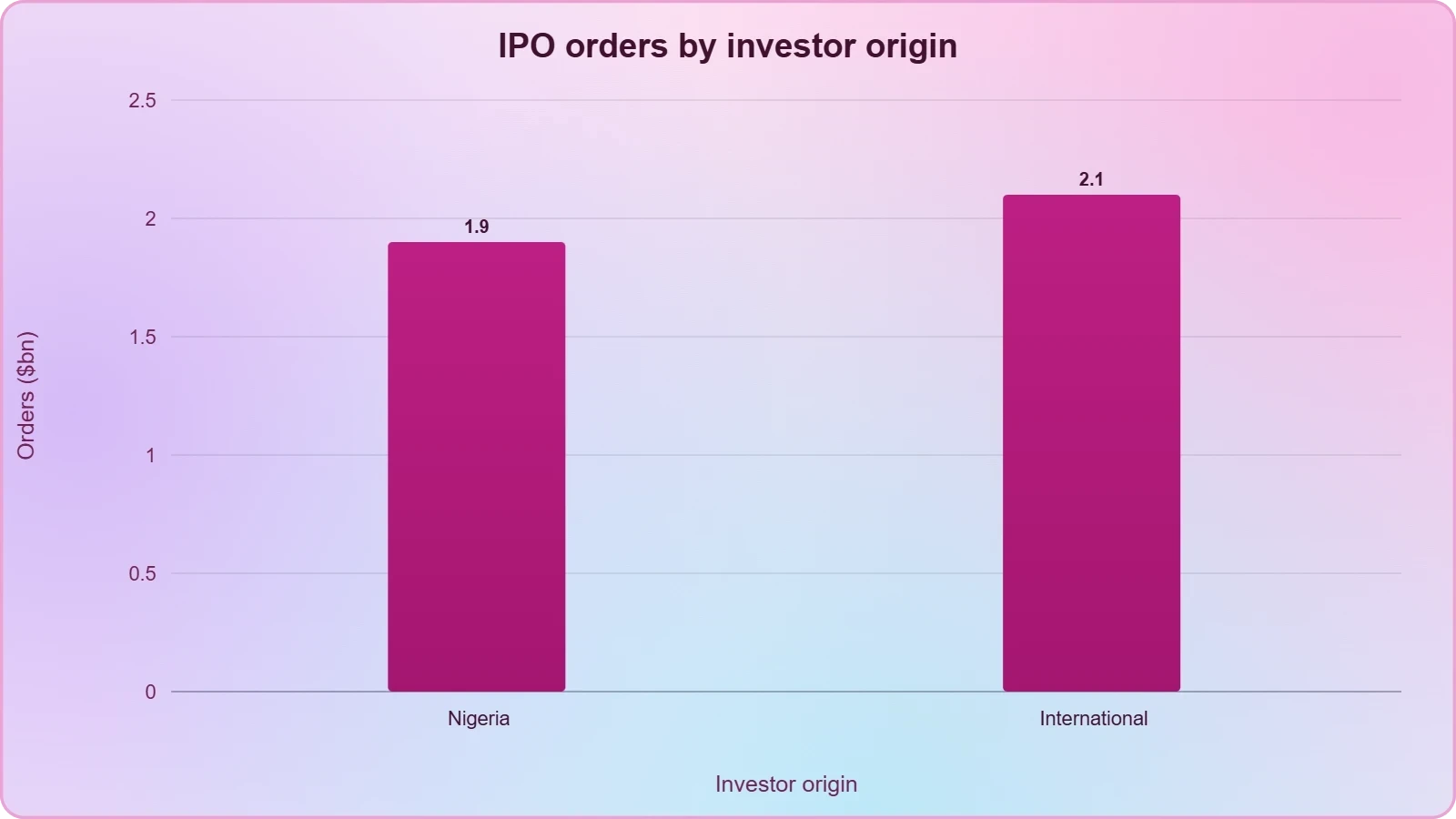
What makes the order book particularly instructive is its composition. Roughly $1.9 billion arrived from investors inside Nigeria, while about $2.1 billion came from prospective international buyers, the sources said, speaking on condition of anonymity because the information remains private. The Public Investment Corporation, Africa's largest money manager, overseeing about R3.657 trillion mainly in South African state workers' pensions, requested a large allocation, though the exact amount was not disclosed. Nigerian pension managers covering roughly 11 million members also sought shares, and exchanges across the continent built structures to give buyers access to the listing.
The transaction, which would become Africa's largest listing to date, is owned by Aliko Dangote, the continent's richest man, and sits at the intersection of industrial ambition, sovereign pension capital, and a genuine re-rating of African equity risk. Close to four million unique subscription applications were recorded, with pension funds indirectly representing tens of millions of contributors, against a company target of 10 million retail investors. This analysis examines the mechanics of the offer, the strategic logic behind the allocation, and what the outcome signals for capital formation across the region.
On This Page
TL;DR Dangote Petroleum Refinery and Petrochemicals drew roughly $4.1 billion in IPO orders against a $1.6 billion target, with demand split between Nigerian and international investors and anchored by major African pension funds. The listing, set to become Africa's largest, demonstrates that large-scale equity capital can be raised from African institutions rather than relying on Wall Street or London. A 30% over-allotment option could lift the fundraising to about $2.1 billion, yet foreign demand still exceeds available stock, underscoring how scarce quality African exposure remains for global portfolios.
The Anatomy of an Oversubscribed Offering
The headline number — 5.85 trillion naira, or approximately $4.1 billion — deserves careful reading because it represents applications rather than allotted capital. In a bookbuilding process of this kind, investors submit indications of interest at specified price levels, and the issuer and its advisers then determine how much stock each participant receives. The gap between the $4.1 billion requested and the $1.6 billion originally targeted is therefore a measure of appetite, not of proceeds. Even so, an oversubscription of nearly three times on a transaction of this size is a rare occurrence in African equity markets, where large deals have historically struggled to fill.
The split between domestic and foreign demand is equally revealing. About $1.9 billion of the orders originated in Nigeria and roughly $2.1 billion from prospective international buyers, according to the people familiar with the matter. That near-parity matters because it suggests the listing is not merely a patriotic retail phenomenon but a genuine institutional reallocation. The presence of the Public Investment Corporation, which manages South African state workers' pensions, alongside Nigerian pension managers representing some 11 million members, indicates that African institutional capital is now large enough to anchor a transaction of continental scale without depending on offshore lead orders.
Reading the Order Book Beyond the Headline
Subscription figures in a landmark IPO are frequently cited as proof of market confidence, but the more useful lens is structural. Close to four million unique subscription applications were recorded, a remarkable breadth of participation for an African listing, yet the company had targeted 10 million retail investors. That shortfall is not a weakness so much as a calibration point: retail distribution across 54 countries requires infrastructure that is still maturing, and the exchanges that built access structures for this offer were effectively prototyping pan-African retail connectivity in real time.
The institutional layer tells a different story. Pension funds do not submit speculative orders; they allocate against mandates, liquidity needs, and long-horizon return assumptions. When funds covering tens of millions of contributors seek shares in a single refinery, the signal is that the asset is being priced as core infrastructure exposure rather than as a cyclical trade. That distinction shapes aftermarket behaviour, because pension capital tends to hold through volatility rather than exit on the first drawdown, providing a stabilising shareholder base that retail-heavy books often lack.
The Over-Allotment Option and Its Strategic Purpose
Bloomberg reported last month that the company is expected to use an additional 30% over-allotment option, largely to make room for overseas investors. Exercised in full, that mechanism would take the fundraising to approximately $2.1 billion. The greenshoe exists precisely for situations like this one, where demand exceeds supply and the issuer wishes to accommodate institutional buyers without repricing the deal. Its deployment here signals that the company prioritised a diversified register over maximising proceeds per share.
Even with the expanded allocation, demand from foreign investors has exceeded available stock, the sources said. That excess is the most economically meaningful detail in the entire transaction. When global capital cannot obtain enough of an asset at the offered price, the implication is that the asset was priced conservatively relative to perceived value. For a refinery with long-dated cash flows and commodity exposure, conservative pricing is a deliberate choice: it builds goodwill with investors, supports first-day trading performance, and establishes a reference valuation that future African issuers can point to when negotiating their own listings.
We Also Published
Why This Listing Matters for African Capital Markets
Africa has produced world-class companies for decades, but its equity markets have rarely been able to absorb them at scale. The continent's largest enterprises have typically sought listings in London, New York, or Johannesburg, where liquidity pools are deeper and index inclusion is more attainable. The Dangote refinery offering challenges that pattern directly. A transaction approaching $2.1 billion in potential proceeds, anchored by African pension capital and distributed through exchanges across all 54 countries, demonstrates that domestic and regional institutions can now underwrite the continent's flagship assets.
The implications extend to price discovery. When a company of this stature lists locally, it creates a valuation benchmark against which other African industrial and energy assets can be measured. That benchmark is denominated in local currency and shaped by local risk premia, which is fundamentally different from a valuation set by offshore investors applying emerging-market discounts. Over time, a deeper pool of domestically anchored reference valuations reduces the information asymmetry that has historically penalised African issuers in global capital markets.
The Pension Capital Engine
The Public Investment Corporation's participation deserves particular attention. Managing roughly R3.657 trillion, predominantly on behalf of South African state workers, the PIC is the largest money manager on the continent and one of the largest in the emerging world. Its request for a large allocation, even without a disclosed amount, signals that African institutional investors are willing to cross borders within the region to access quality industrial exposure. That is a meaningful evolution from the historical tendency of African pension funds to concentrate holdings domestically and in government debt.
Nigerian pension managers covering about 11 million members add a second layer of domestic anchor demand. Pension capital is structurally long-term, regulated, and diversified, which makes it an ideal foundation for a capital-intensive asset like a refinery with multi-decade cash flow horizons. When pension funds become anchor investors in domestic infrastructure, the alignment of interests is unusually strong: the contributors who own the asset through their retirement savings are also citizens who benefit from the industrial activity, tax revenue, and energy security it generates.
Distribution Across Fifty-Four Markets
The logistical achievement of distributing a single offering across all 54 African countries should not be underestimated. Exchanges across the continent set up structures specifically to give buyers access to the listing, a coordination effort that required regulatory accommodation, cross-border settlement arrangements, and retail education at scale. Close to four million unique subscription applications resulted, falling short of the 10 million retail target but establishing infrastructure that future issuers can reuse at far lower marginal cost.
This distribution network has value beyond a single transaction. Once retail investors in Kenya, Ghana, or Zambia have participated in a pan-African listing, the friction of doing so again falls sharply. Market infrastructure exhibits strong network effects: each additional participant and each additional issuer makes the ecosystem more liquid and more attractive. The Dangote offering may therefore be remembered less for its oversubscription and more for proving that a genuinely continental retail distribution channel can be built and operated.
The Regulatory Pathway and Trading Timeline
The transaction now moves into its administrative phase, and the calendar matters for investors assessing entry points. The company is due to submit a draft allotment announcement to Nigeria's Securities and Exchange Commission this week. The regulator is expected to approve how shares will be distributed on November 17. Trading is scheduled to begin 15 business days after the allotment date, likely on December 8, according to the prospectus, though the company aims to start trading by the end of this month, subject to approvals.
That compression between stated and targeted timelines is worth noting. Issuers routinely build buffer into prospectus language, and an accelerated debut would signal both regulatory efficiency and strong issuer confidence in aftermarket conditions. For investors who submitted orders, the allotment decision is the critical variable: with demand at nearly three times supply, most applicants will receive only a fraction of what they requested. The allocation methodology — how the SEC and the issuer balance retail breadth against institutional size — will determine the shape of the shareholder register for years to come.
Allotment Mechanics Under Scrutiny
Allocation in an oversubscribed offering is never purely mechanical. Regulators typically favour broad retail participation to democratise access, while issuers value large institutional anchors for register stability. With close to four million retail applications and substantial pension and international demand, the SEC faces a genuine balancing act. A register weighted too heavily toward institutions may disappoint the retail base the company courted; one weighted too heavily toward small applicants may leave the stock thinly held by investors prone to early selling.
The prospectus framework and the regulator's approval on November 17 will reveal which priority prevailed. Market participants will watch the disclosed allocation ratios closely, because they signal the issuer's long-term ownership philosophy. A generous retail tranche suggests a commitment to building a domestic shareholder culture around the refinery; a larger institutional tranche suggests a focus on price stability and governance discipline. Both are defensible, and the eventual mix will shape liquidity, volatility, and index eligibility after listing.
Currency, Settlement, and Cross-Border Access
Cross-border participation in a Nigerian naira-denominated offering introduces currency and settlement complexity that offshore investors must price into their returns. Naira volatility affects the dollar value of both subscription capital and eventual proceeds, and repatriation rules determine how easily foreign holders can exit. The fact that roughly $2.1 billion in international orders materialised despite these frictions indicates that global investors view the underlying asset quality as sufficiently compelling to absorb the operational burden.
Settlement infrastructure across 54 markets adds another layer. Each participating exchange needed arrangements for collecting applications, converting currencies where necessary, and crediting allotted shares. The operational success of this process will influence whether future pan-African offerings replicate the model or retreat to single-market distribution. If settlement proves smooth, the template becomes reusable; if it produces friction, issuers may conclude that continental reach is more attractive in principle than in practice.
- 01
- 02
- 03
- 04
The Strategic Logic of Listing at Home
Aliko Dangote's decision to list the refinery on African exchanges rather than in London or New York is a strategic statement as much as a financial one. The offering is seen as a rare large-scale equity transaction for international investors seeking exposure to Africa, and it demonstrates that significant allocations can be secured from African investors rather than relying on Wall Street or London. That inversion of the traditional capital-raising hierarchy carries reputational weight for the continent's financial centres and practical weight for the company's cost of capital.
Listing domestically also aligns the company's ownership base with its customer base and its political environment. A refinery of continental scale operates within a dense web of regulation, pricing policy, and energy security considerations. Having pension funds, retail investors, and institutions across Africa as shareholders creates a constituency that understands and supports the asset's strategic role. That alignment can be worth more than a marginal valuation premium obtained from an offshore listing, particularly in an industry where policy risk is a persistent feature.
Valuation, Scarcity, and the African Risk Premium
The excess foreign demand that persisted even after the over-allotment expansion tells us something important about scarcity. Global portfolios remain structurally underweight Africa, and quality large-cap exposure is genuinely hard to find. When a single asset offers scale, hard-currency-linked revenue potential from refined product sales, and a dominant market position, it attracts capital that has few alternative routes into the region. That scarcity value supports pricing and explains why investors accepted the operational friction of cross-border subscription.
Over time, successful listings of this kind can compress the African risk premium by providing evidence that governance, disclosure, and settlement standards meet global expectations. Each well-executed transaction makes the next one easier, because investors update their priors based on observed outcomes rather than stereotypes. The refinery's aftermarket performance will therefore be watched not only by its own shareholders but by every African issuer contemplating a large domestic float in the coming decade.
What the Order Book Says About Global Appetite
The roughly $2.1 billion in international orders is a data point that challenges the narrative of waning global interest in African equities. It suggests that when asset quality is high and the issuer is credible, capital will cross borders and absorb currency and settlement risk. The caveat is selectivity: investors are not buying broad African exposure, they are buying a specific, dominant, strategically positioned asset. That distinction matters for smaller issuers who cannot command the same attention.
For policymakers and exchange operators, the lesson is that demand exists but must be met with supply of comparable quality. A pipeline of well-governed, large-cap African listings would allow global investors to build diversified positions rather than making single-asset bets. The refinery offering may thus serve as a proof of concept that stimulates further issuance, or as an isolated success that competitors fail to replicate. Which outcome materialises depends on the regulatory and governance follow-through across the continent's markets.
Risks, Caveats, and the Limits of a Headline Number
Enthusiasm around an oversubscribed listing should be tempered by a clear-eyed assessment of what the order book does not tell us. Applications are not cash, and the final proceeds depend on the allotment and the price at which shares are issued. The $4.1 billion figure reflects demand at the offer price; it says nothing about where the stock will trade once the market sets a clearing level. Investors who extrapolate from subscription multiples to aftermarket returns are making an inferential leap that history does not consistently support.
Commodity exposure is the second consideration. A refinery's cash flows are sensitive to crude prices, product cracks, and refining margins, all of which are cyclical and externally determined. The asset's scale provides competitive advantage, but it does not insulate earnings from global energy market swings. Investors receiving allocations should evaluate the offering on normalized margin assumptions rather than on the optimism embedded in a heavily oversubscribed book, and should size positions accordingly.
Concentration and Liquidity Considerations
A listing of this size will represent a substantial share of the domestic equity market's capitalisation, which raises concentration concerns for local institutional portfolios. Pension funds allocating to the refinery increase their exposure to a single industrial asset and to the energy sector more broadly. Prudent portfolio construction requires offsetting that concentration elsewhere, and regulators may need to monitor whether pension allocations to a single issuer approach prudential limits.
Liquidity is the mirror-image concern. A large free float does not automatically produce deep secondary trading, particularly when anchor investors are long-term holders. If pension funds and strategic investors retain their stakes, the tradeable float may be thinner than the headline offering suggests, amplifying price moves in both directions. Market makers and index providers will assess this carefully when determining eligibility and weighting, and their decisions will influence the stock's trading characteristics after debut.
What Comes Next for African Equity Markets
The refinery's debut will be judged in the weeks after trading begins, but its significance will be measured over years. If the stock trades firmly and the register proves stable, the transaction establishes a template that other large African enterprises can follow. If it stumbles, the lesson will be about pricing discipline and the limits of oversubscription as a signal. Either way, the offering has already changed perceptions about where African capital can be raised and who is willing to provide it.
The deeper structural question is whether this listing becomes an isolated landmark or the beginning of a pipeline. Africa's exchanges need scale, liquidity, and quality issuance to attract sustained global allocations, and a single refinery cannot supply all three. What it can do is demonstrate feasibility. The pension funds, exchanges, and regulators that collaborated on this transaction now possess operational knowledge that lowers the cost of the next one, and that accumulated capability may prove the most durable legacy of the entire exercise.
Lessons for Issuers and Policymakers
For issuers, the clearest lesson is that domestic and regional institutional capital is now deep enough to anchor transformative transactions. The historical assumption that African companies must list abroad to raise serious money no longer holds for assets of sufficient quality. For policymakers, the lesson is that regulatory coordination across borders, efficient allotment processes, and credible disclosure standards are prerequisites for attracting capital at this scale. The infrastructure built for this offering should be treated as public goods worth maintaining.
For investors, the lesson is about selectivity and patience. Oversubscription is a signal of demand, not a guarantee of returns, and the assets that attract the most attention are often priced accordingly. The refinery's long-term value will depend on operational performance, margin realization, and capital discipline, all of which unfold over years rather than weeks. Those who receive allocations should evaluate the investment on those fundamentals, and those who do not should watch the aftermarket for a more rationally priced entry point.
The Broader Signal for Global Capital Flows
Global capital allocation to Africa remains small relative to the continent's economic weight, and the reasons are well documented: liquidity constraints, currency risk, information gaps, and limited investable assets. A successful mega-listing addresses several of these simultaneously by creating a liquid, well-disclosed, large-capitalisation security that index funds and active managers can own. Each such asset makes the case for a dedicated African allocation marginally stronger, and the compounding effect over a decade could be substantial.
The refinery offering also illustrates how South-South capital flows are maturing. South African pension money seeking Nigerian industrial exposure, distributed through exchanges across 54 countries, is a configuration that would have been operationally implausible a generation ago. Its success suggests that regional capital markets are integrating from the bottom up, driven by institutional demand rather than by policy mandates. That organic integration is likely to prove more durable than top-down initiatives, because it reflects genuine risk-return calculations by the investors who bear the consequences.
From our network :
- Committed Mediterranean Precipitation Decline: Why Emissions Cuts Alone Cannot Restore Winter RainsNew NOAA research reveals that Mediterranean winter rains may decline irreversibly even with emissions cuts. Explore the science of committed climate change and regional impacts.
- The Hidden Cost of AI Convenience: Why Over-Permissioned Agents Are a Security Time BombDiscover why AI agents with excessive permissions create dangerous single points of failure, and learn how implementing least privilege principles can protect your organization from exploitation.
- Forbidden Matrix Patterns and Visible Lattice Points: A Geometric DictionaryExplore how multidimensional 0–1 matrices encode geometric truths, linking forbidden patterns to visible lattice points and hypergraph theory, with applications in combinatorics and computational geometry.
- Live Online English Classes for Kids: Do They Actually Reduce Anxiety?A ten-week study reveals that synchronous online English classes can significantly reduce child language anxiety while improving listening and reading skills. Discover what makes these programs effective and how parents can select the right one.
- University Language Proficiency Exams: Why Institutional Tests Demand Different Preparation Than IELTS and TOEFLDiscover why university-specific language proficiency examinations differ fundamentally from IELTS and TOEFL, and learn strategic preparation approaches for institutional assessment success.
- Mobile Learning and VR in English: What Global Evidence Reveals About Effective Language TechnologyA systematic review across 14 countries reveals which language-learning technologies genuinely work. Mobile learning, AI, and VR show measurable benefits when pedagogically integrated. This evidence-based guide helps educators and learners select technology that delivers real return on investment.
- How AI Agents Will Change the Way We Manage Personal FinancesExplore how AI agents are transforming personal finance through automated budgeting, bill payment, and investment management, while examining the critical security protocols and governance frameworks required for safe deployment.
- CISA’s Ten-Advisory Wave: Why Generic Patching Fails in OT and How to Build Product-Specific PlaybooksCISA released ten ICS advisories in one week, exposing critical infrastructure risks. Generic patching fails in OT. Learn to build product-specific remediation playbooks.
- The Final Descent: How ESA Retired the Legendary Cluster Constellation After 24 Years of Space Weather ScienceAfter 24 years mapping Earth’s magnetosphere, ESA’s Cluster mission concluded with a precisely controlled reentry over the South Pacific. This analysis explores the scientific legacy, engineering decisions, and debris mitigation principles behind one of space exploration’s most responsible retirements.
RESOURCES
- Three-times oversubscribed Dangote Refinery IPO closesafrican.businessOct 29, 2026 ... Continent-wide IPO participation. The IPO attempted to overcome Africa's fragmented financial markets to make investor participation continent- ...
- Dangote Petroleum Refinery and Petrochemicals has raised about ...facebook.comJul 24, 2026 ... ... Dangote pushes the refinery toward what is set to be the largest IPO in African capital markets history. Read…
- The planned October initial public offering (IPO) of Dangote ...instagram.comAug 17, 2026 ... Dangote Petroleum Refinery & Petrochemicals has secured approval from Nigeria's Securities and Exchange Commission (SEC) for a two-week ...
- Dangote Refinery's $5bn IPO coming soon, stirs marketafricancapitalmarketsnews.comAfrican Markets reports that it was oversubscribed 3.7 ... 7 responses. Pingback: Dangote Refinery to be Africa's biggest IPO - African Capital Markets News.
- Dangote Refinery's IPO is set to launch in the next 10-12 days ...facebook.comSep 4, 2026 ... This is a major development for Nigeria's capital market and economy. The Dangote Refinery IPO could attract more investment, ...
- African Capital Markets Newsafricancapitalmarketsnews.com... oversubscription for the initial public offering (IPO) ... Dangote refinery oil tank. Capital raising · How Africans outside Nigeria invest in Dangote IPO.
- Nigeria: Why Dangote is keeping an oversubscribed IPO opentheafricareport.comOct 13, 2026 ... Only just over 3% of the $49bn refinery is up for sale. Extending the offer to 27 October is about…
- Nigeria's Dangote says refinery IPO demand 'enormous' as Kenya ...reuters.comOct 1, 2026 ... ... capital markets until now, really, because we ... Dangote's lead financial advisers, could raise as much as $2.1 billion…
- IPO Investing 101: Lot Sizes, Oversubscription, and Allotment ...dabafinance.comAug 21, 2026 ... IPO Investing 101: Lot Sizes, Oversubscription ... Dangote Refinery IPO TrackerNewStrategiesPortfolio ManagementAfrican Capital MarketsNews.
- African Capital Markets: The Dangote IPO Is Not A Turning Pointafricapartners.substack.comOct 8, 2026 ... By Jeremy Gaines and Christian Hiller von Gaertringen. The Dangote Petroleum Refinery IPO is intended to open a new chapter…
- Africa's Richest Man Is Playing a Smart Game With 'People's IPO'bloomberg.com4 days ago ... Eager potential investors expect Nigeria's Dangote Refinery and Petrochemicals FZE to increase the market ... African equity markets ...
- Dangote Refinery IPO: A Test of African Capital Markets - LinkedInlinkedin.comSep 12, 2026 ... SEPLAT DID 25.9×. NOW DANGOTE IS TESTING THE NEXT LEVEL. In 2014, Seplat went public at ₦576 per share. Today,…
- The Dangote Refinery IPO: What You Should Know Before You Investlawritjournaloflaw.substack.comSep 23, 2026 ... ... oversubscription means you may receive fewer shares ... This is projected to be the largest IPO in the history…
- 01
- 02
- 03
- 04
- 05
- 06
- 07
- 08
0 Comments