Ranchi’s reported gold rates were unchanged on 10 November 2026: 24-carat gold was quoted at ₹1,44,520 per 10 grams, while 22-carat gold stood at ₹1,32,490. The figures give local buyers a clear price snapshot, but they are not a promise that a transaction will be completed at precisely those amounts.
The significance of a flat daily rate lies in what it does—and does not—say. It indicates that the quoted benchmark had not moved from the preceding update, while leaving broader influences such as international bullion prices, currency movements, jewellery charges and taxes relevant to the final cost paid by a customer.
On This Page
TL;DR On 10 November 2026, the cited Ranchi rates were ₹1,44,520 per 10g for 24K gold and ₹1,32,490 per 10g for 22K, with no reported daily change. The difference between the quotes is ₹12,030 per 10g. These are reference prices, not necessarily final jewellery or investment purchase prices: buyers should confirm the current local quote, purity, applicable charges and transaction terms before committing.
Ranchi gold rates: the reported snapshot
The central update is straightforward: the reported local benchmark did not change, and the page gave separate prices for two commonly quoted purities. Reading those figures with their date and unit intact matters, because a rate without a clear timestamp or weight basis can easily mislead a comparison.
What the 10 November figures say
According to the supplied report, 24-carat gold cost ₹1,44,520 per 10 grams in Ranchi, while 22-carat gold cost ₹1,32,490 per 10 grams. Both are city-specific quotations for the stated date, rather than universal prices applying to every seller or transaction.
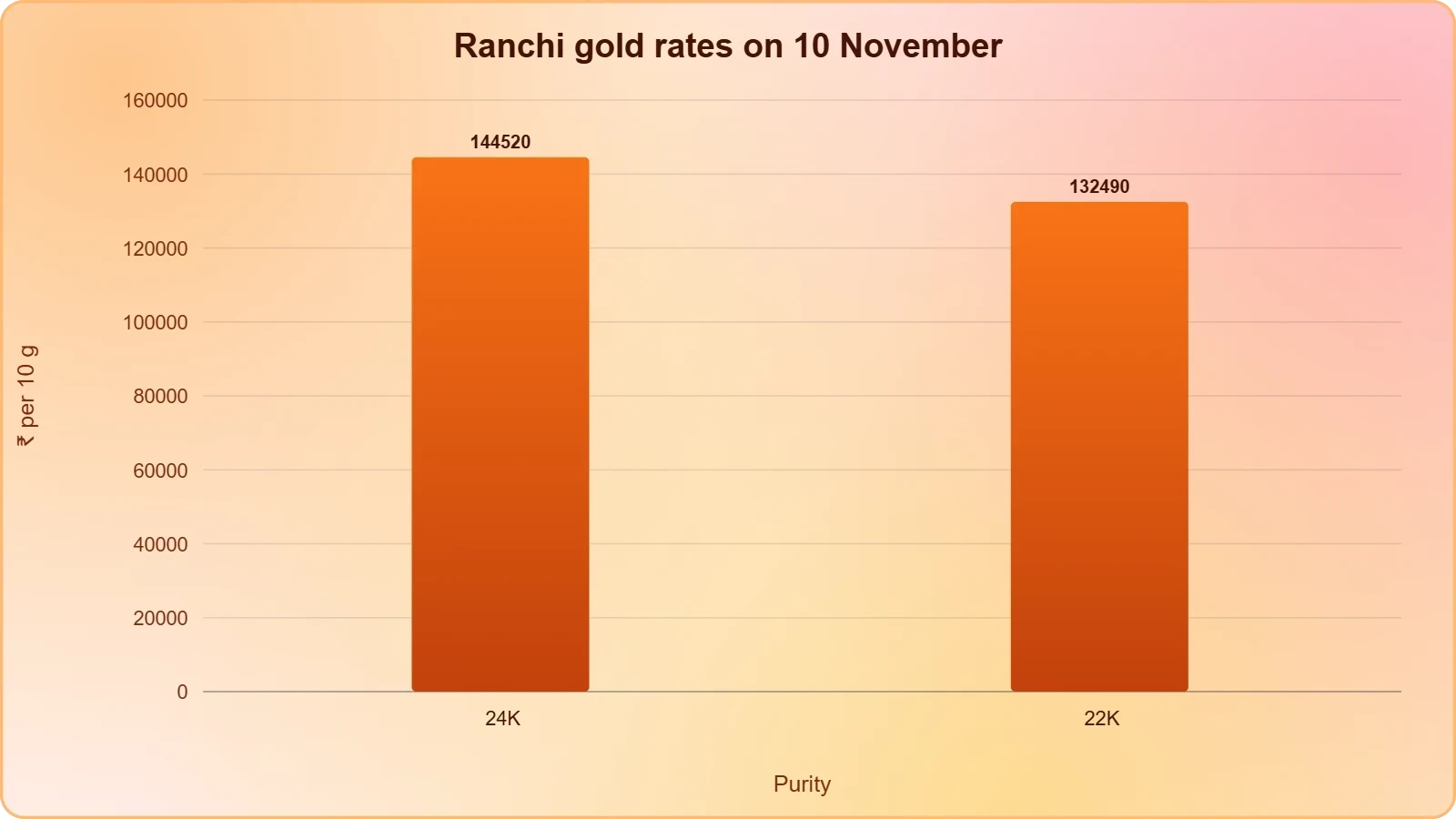
The report characterises the rates as unchanged. That description means the quoted figures were flat relative to the previous reported update; it does not mean gold’s price was unchanged across a longer period, nor that the market had no movement elsewhere.
Because each quotation is expressed per 10 grams, readers can compare the two figures directly on the same weight basis. A buyer considering a smaller quantity should verify how the seller calculates the applicable rate and whether the displayed quote is rounded.
The source also says rates are updated daily and follow prevailing industry benchmarks. Daily publication helps make a snapshot more useful, but the date remains essential: a price printed on one day should not be assumed to remain available the next.
Why the date and unit matter
The source carries a timestamp of 9 November 2026 at 18:22 UTC, while its headline and report describe prices for 10 November. That may reflect a publication schedule or time-zone convention, but the supplied text does not explain the difference.
Readers should therefore treat 10 November as the stated rate date and the timestamp as source-page metadata, rather than silently assuming that both refer to the same local publishing moment. Confirming the date on the original rate page is sensible before acting.
Weight units are just as important. A quote per 10 grams is not a per-gram price, and the figure should not be compared with a quotation stated per tola, ounce or other weight unless the units are converted consistently.
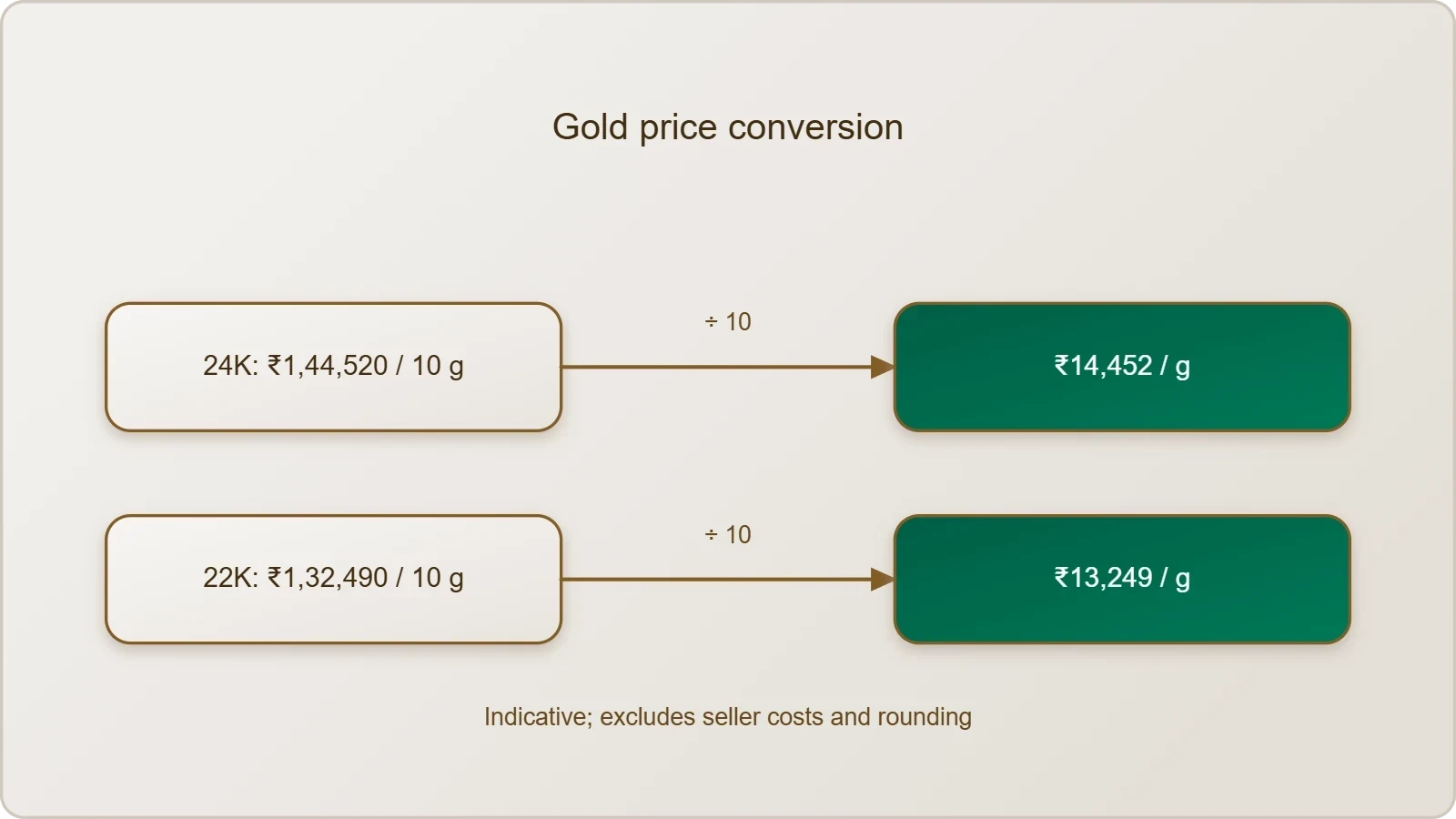
For a quick arithmetic comparison, dividing the quoted 10-gram rate by ten gives an indicative per-gram benchmark. It does not account for seller-specific rounding, making charges, taxes or other costs that may apply to a real purchase.
Understanding the 24K and 22K comparison
Two purity grades are presented because they serve different practical purposes. The source supplies a direct price comparison, but interpreting it well requires distinguishing the stated purity labels from the price itself and recognising that the two quotations are not interchangeable products.
Purity labels and intended use
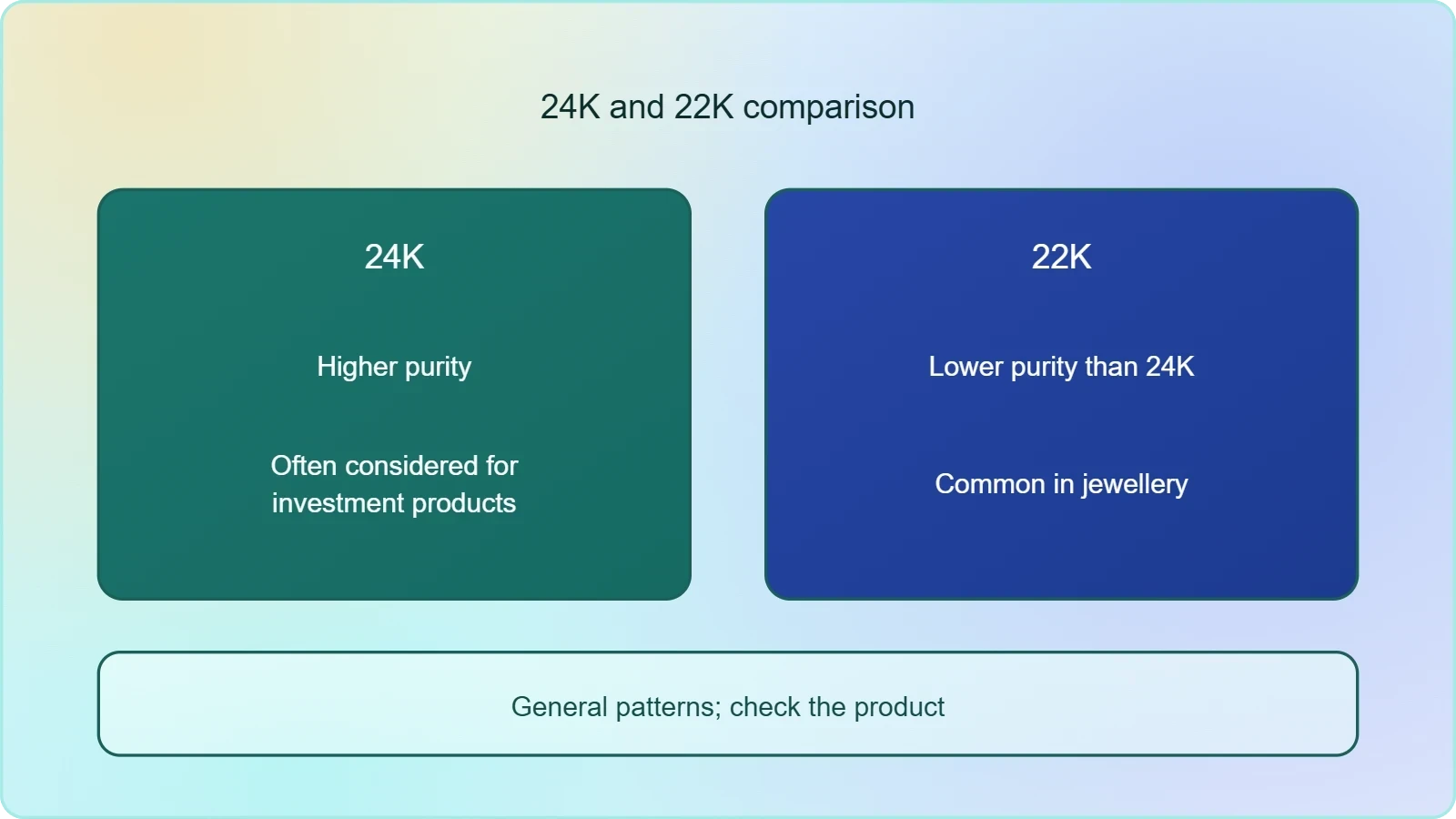
In standard jewellery terminology, 24-carat gold denotes a higher purity than 22-carat gold. The distinction helps explain why the 24K benchmark is higher in the report, although actual product composition and markings should be verified through the seller and relevant hallmarking information.
Jewellery buyers often encounter 22K quotes, while higher-purity gold is commonly considered for investment-oriented products. Those general patterns do not determine what a particular shop stocks or which product suits an individual; the buyer should assess the item and its documentation.
The quoted rates refer to gold by purity and weight, not to a finished ornament’s design, craftsmanship or retail presentation. A jewellery item can include costs beyond the underlying metal value, so the city benchmark alone cannot establish the final bill.
For coins or bars, the product’s stated purity, weight, seller terms and any premium should likewise be checked. Comparing a jewellery rate with an investment product quote without accounting for those differences can give an incomplete picture.
The price gap is informative, not a fee estimate
The direct difference between the two reported rates is ₹12,030 per 10 grams. This is the arithmetic gap between the 24K and 22K reference prices in the report, not a separate charge, discount or forecast of how either rate will move.
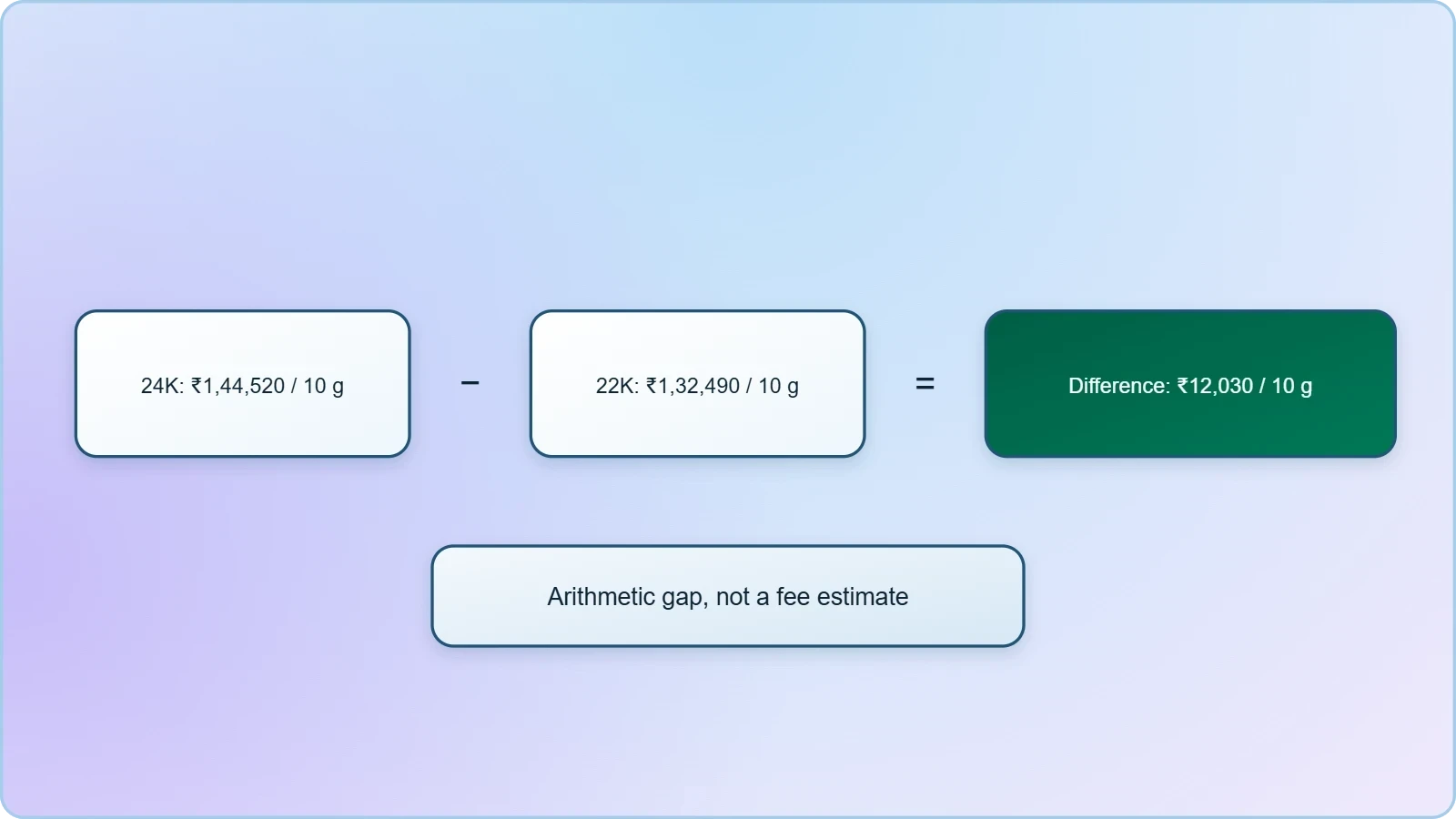
That gap can serve as a quick comparison point, particularly when reviewing city price pages that use the same date, weight and purity definitions. If any of those terms differ, the comparison needs clarification before the figures can be interpreted fairly.
It would be misleading to treat the price difference as a precise measure of purity alone. The source provides the two quoted amounts but does not explain its pricing methodology, component calculations or any product-specific premiums.
Buyers can use the comparison to frame questions for a jeweller: which purity is being sold, how the rate is calculated, and what additional costs apply? Clear answers make the quotation more useful than a headline rate viewed in isolation.
What a flat daily rate means
A “flat” price is a statement about change over a defined reporting interval, not a claim that gold is inexpensive, stable for the long term or insulated from market forces. The source describes a daily update, so its comparison is best read as short-term context.
Daily movement versus longer-term trends
An unchanged quote may offer a moment of continuity for someone checking prices, but it cannot establish whether the market is rising or falling over a week, month or year. That broader conclusion requires a consistent series of dated observations.
The source mentions a 15-day price table for Ranchi, which could help readers see a recent sequence rather than relying on a single day. However, the supplied material does not include those individual entries, so no specific 15-day trend can be verified here.
One flat reading can occur between upward or downward moves, or during a period when the quoted local benchmark changes little. Without the surrounding observations, it is not evidence of a lasting pause or a reliable signal about what happens next.
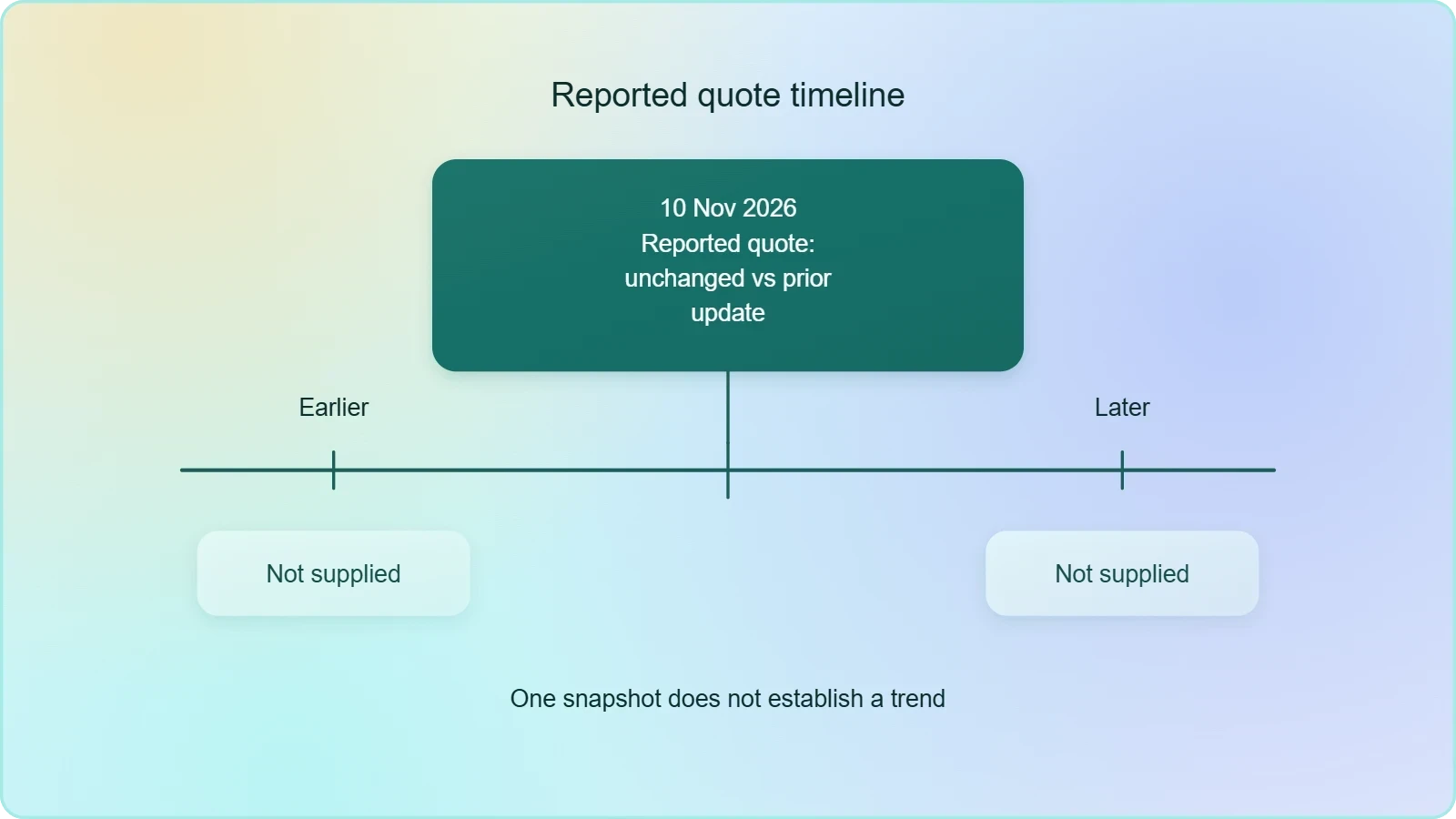
For responsible interpretation, distinguish the reported daily status from a forecast. A current price describes a stated snapshot; it cannot by itself establish a future price, the right moment to buy or the likely return from an investment.
Why local rates can reflect wider markets
The report says Ranchi rates reflect movements in global bullion markets and currency trends. This points to the international and exchange-rate context behind local quotes, while not specifying how much any one factor contributed to this particular day’s price.
Currency movements matter because internationally traded bullion and a domestic rupee price are not expressed in the same currency. The source notes this relationship in broad terms, but offers no exchange-rate data or calculation for the reported Ranchi figures.
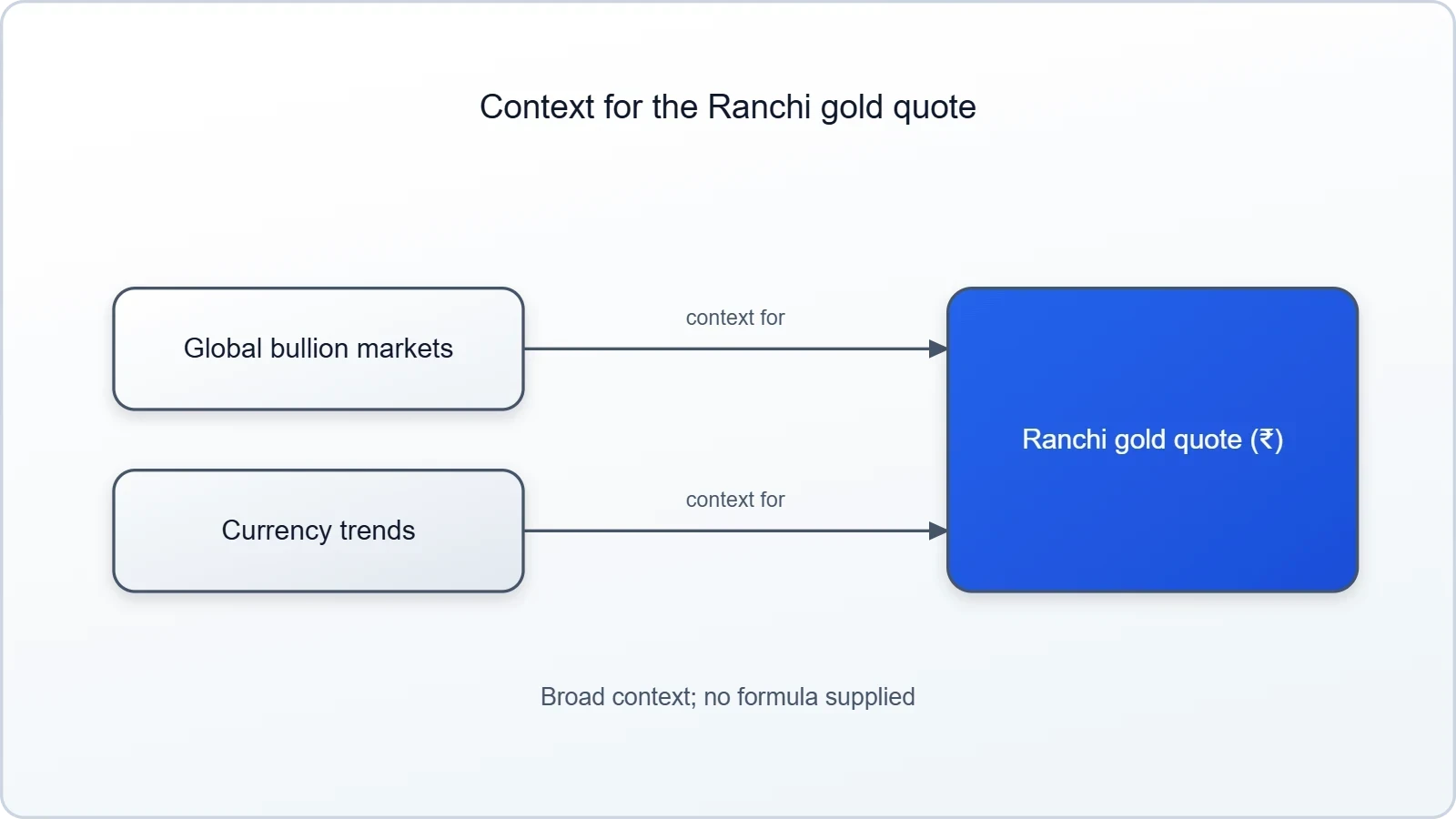
Local industry benchmarks can provide a basis for published city rates, yet the report does not name a specific benchmark, seller or pricing formula. Readers should not infer details that the source has not supplied.
A reported city rate is therefore useful as a reference point, not a guarantee that every retailer will quote the identical amount. Before purchase, confirm the current local price and ask how it applies to the specific item being considered.
- 01
- 02
- 03
- 04
From reference quote to the final purchase cost
The published rate is a starting point for comparison, not a complete invoice. Someone planning to buy jewellery, coins or another form of gold should identify what the headline includes, then check the seller’s item-level pricing and any additional costs before deciding.
Jewellery requires an item-level comparison
A jewellery purchase involves more than the amount of gold in an item. Design, workmanship and the retailer’s stated terms may affect the final bill, so the Ranchi benchmark should be treated as context rather than a complete price quotation for an ornament.
Ask for a clear breakdown of the metal rate, purity and weight, along with any making charges, taxes or other applicable amounts. The supplied report does not set out those costs, and their treatment can depend on the seller and product.
Two ornaments with similar metal content may not have the same total price if their designs, workmanship or seller terms differ. Comparing written quotations with the same assumptions helps isolate the factors that matter to the buyer.
Before paying, check the product description and documentation, and make sure the quoted purity corresponds to what is being sold. A headline rate alone cannot verify an item’s composition, quality or suitability for a particular purpose.
Coins, bars and digital gold are different offers
The source points readers toward a guide comparing jewellery, coins and digital gold before buying during Diwali. Those are distinct purchase formats, each with its own product terms; the brief does not give the guide’s recommendations or full cost comparisons.
For a physical coin or bar, buyers can review the stated purity and weight, seller premium, payment terms and any conditions affecting resale. These checks complement the benchmark rate but cannot be answered by the Ranchi quote alone.
Digital gold involves a different product structure from taking home a physical ornament. Customers should understand the platform’s terms, custody arrangements, fees and exit conditions directly from its documentation rather than assuming the displayed price tells the whole story.
The best comparison is therefore between like-for-like products, with the same purity, quantity and relevant charges. A lower displayed rate may not mean a lower overall cost if the product, service or transaction terms differ.
Comparing Ranchi with other city rates
The page’s related links place Ranchi within a wider set of city-rate updates, including Mumbai, Delhi, Chennai, Kolkata and Bengaluru. These references invite comparison, but the supplied source gives no figures for those cities and cannot support a numerical ranking.
Use consistent dates and quotation bases
A useful city comparison needs rates from the same date, the same purity and the same weight unit. Comparing Ranchi’s 10 November quote with another city’s 9 November figure could mix market movement with genuine local differences.
Readers should also check whether each page labels its rates in the same way and whether the figures represent reference benchmarks or specific retail offers. Without comparable definitions, a table of city prices may appear more precise than it is.
The related links mention rates in several metropolitan centres for both 9 and 10 November. That provides a route to further research, but those linked values are not reproduced in the source text supplied for this analysis.
Accordingly, no claim that Ranchi is cheaper or more expensive than another city can be established from the two Ranchi rates alone. A fair conclusion requires the actual corresponding quotations and their publication dates.
Local comparisons still need seller verification
Even when city pages share a date and unit, a published benchmark may not match a jeweller’s final offer. Retailer pricing and product-specific terms should be checked directly, especially when a buyer is comparing nearby stores or planning a substantial purchase.
For a practical comparison, record each seller’s quoted purity, weight, rate and additional charges. Written estimates help prevent a headline price from being mistaken for an all-inclusive amount, and make it easier to identify where the offers differ.
Timing also matters: the source says rates are updated daily, so buyers should confirm that any comparison remains current when they are ready to transact. A previously captured screenshot may not reflect the latest rate or terms.
City-rate pages are useful research aids, not substitutes for a transaction quote. Their strongest contribution is to help consumers ask informed questions and notice broad pricing context before assessing a specific seller’s offer.
Forecasts, headlines and informed decisions
The related material mentioned alongside the Ranchi update includes forecasts and broader market headlines. Those links may offer context, but they are distinct from the reported city prices; a prediction or dramatic headline should not be mistaken for a confirmed local rate.
Forecasts are not the same as observed prices
One related item is described as a JPMorgan forecast that gold could reach a record $6,000 by the end of 2026. The supplied text reports that forecast as a linked headline; it does not establish the prediction’s assumptions, probability or outcome.
Another linked item reportedly covers a 10-day price prediction, while a separate headline says gold rose above ₹1,44,000 and silver gained ₹4,300. These are references to other reports, not additional verified data in the Ranchi update itself.
A forecast expresses a view about a possible future, whereas the Ranchi quotation records a stated price for a particular date. Keeping those categories separate reduces the risk of treating a projection as a guaranteed target or a reason to rush into a purchase.
Before relying on a forecast, readers can examine its date, author, assumptions and intended time horizon. The source summary does not provide those details, so it cannot support an assessment of the forecast’s reliability or relevance to an individual buyer.
A measured checklist for buyers
Start with the latest Ranchi quote and confirm whether it is for 24K or 22K, per 10 grams, and still current. This small check anchors any comparison to the correct city, date, purity and unit.
Then ask the seller for the item’s purity, weight and full price breakdown. For jewellery, coins, bars or digital gold, review the product-specific terms rather than assuming the same reference rate produces an identical total cost.
Compare more than one offer on a like-for-like basis, and keep a record of the date and conditions attached to each quotation. If the decision is investment-related, consider personal circumstances and risk tolerance instead of treating a daily price update as advice.
The useful message of the report is measured: monitor current rates, compare options carefully and verify the details before buying. The flat Ranchi snapshot offers a clear starting point, while the final decision depends on current information and the terms of the actual transaction.
From our network :
- University Language Proficiency Exams: Why Institutional Tests Demand Different Preparation Than IELTS and TOEFLDiscover why university-specific language proficiency examinations differ fundamentally from IELTS and TOEFL, and learn strategic preparation approaches for institutional assessment success.
- Mobile Learning and VR in English: What Global Evidence Reveals About Effective Language TechnologyA systematic review across 14 countries reveals which language-learning technologies genuinely work. Mobile learning, AI, and VR show measurable benefits when pedagogically integrated. This evidence-based guide helps educators and learners select technology that delivers real return on investment.
- Forbidden Matrix Patterns and Visible Lattice Points: A Geometric DictionaryExplore how multidimensional 0–1 matrices encode geometric truths, linking forbidden patterns to visible lattice points and hypergraph theory, with applications in combinatorics and computational geometry.
- Committed Mediterranean Precipitation Decline: Why Emissions Cuts Alone Cannot Restore Winter RainsNew NOAA research reveals that Mediterranean winter rains may decline irreversibly even with emissions cuts. Explore the science of committed climate change and regional impacts.
- The Hidden Cost of AI Convenience: Why Over-Permissioned Agents Are a Security Time BombDiscover why AI agents with excessive permissions create dangerous single points of failure, and learn how implementing least privilege principles can protect your organization from exploitation.
- CISA’s Ten-Advisory Wave: Why Generic Patching Fails in OT and How to Build Product-Specific PlaybooksCISA released ten ICS advisories in one week, exposing critical infrastructure risks. Generic patching fails in OT. Learn to build product-specific remediation playbooks.
- Live Online English Classes for Kids: Do They Actually Reduce Anxiety?A ten-week study reveals that synchronous online English classes can significantly reduce child language anxiety while improving listening and reading skills. Discover what makes these programs effective and how parents can select the right one.
- How AI Agents Will Change the Way We Manage Personal FinancesExplore how AI agents are transforming personal finance through automated budgeting, bill payment, and investment management, while examining the critical security protocols and governance frameworks required for safe deployment.
- The Final Descent: How ESA Retired the Legendary Cluster Constellation After 24 Years of Space Weather ScienceAfter 24 years mapping Earth’s magnetosphere, ESA’s Cluster mission concluded with a precisely controlled reentry over the South Pacific. This analysis explores the scientific legacy, engineering decisions, and debris mitigation principles behind one of space exploration’s most responsible retirements.
RESOURCES
- 22K Gold Rate Today in Ranchi, Jharkhand 10 November 2026paytm.comAs of 10 November 2026, the gold rate in Ranchi is ₹11,128.68 per gram for 18K, ₹13,591.82 per gram for 22K, and ₹14,764.05 per…
- Todays Gold Rate in Ranchi, 22 & 24 Carat (10 November 2026)policybazaar.comThe highest price for gold in Ranchi in November 2026 was Rs. 13,535 per gram for 22 karat gold and Rs.14,212 per gram for…
- Todays Gold Rate in Ranchi for 14, 18, 24 & 22 Carat - Canderecandere.comGold Rate Today in Ranchi - 10th November, 2026 Get real-time gold rates for 14k, 18k, 22k & 24k in Ranchi and the gold…
- Gold Rate Today in India – 24Kt ,22Kt & 18Kt Gold Price | Tanishqtanishq.co.inDate, Rate. 10-11-2026, ₹ 13305. 09-11-2026, ₹ 13305. 08-11-2026, ₹ 13210. 07-11-2026, ₹ 13210. 06-11-2026, ₹ 13190. 05-11-2026, ₹ 13435.
- Courtyard by Marriott Ranchi | Hotel with Modern Rooms & Flexible ...marriott.comSun, Nov 08 Mon, Nov 09 Flexible in November 2026. Specific Dates Flexible ... October 8, 2026 - December 31, 2026. Member Exclusive Rate:…
- Gold Rate Today in Ranchi - 10 November, 2026 - Business Linethehindubusinessline.comGold price in Ranchi today is ₹13,405 per gram for 22 karat gold and ₹14,075 per gram for 24 carat gold. Stay informed with…
- Gold Rate in Ranchi Today (6th November 2026), 22 & 24 Carat ...cleartax.inAs of 6th November 2026, the gold rate today in Ranchi is ₹14,675 per gram for 24K gold and ₹13,442 per gram for 22K…
- Gold Rate Today in Ranchi, 10 Nov 2026 - Kotak Neokotakneo.com5 hours ago ... Today's gold rate in Ranchi is ₹14,361/g for 24K, ₹13,164/g for 22K, and ₹10,771/g for 18K. Retail gold price may…
- Today Silver Rate/Price in Ranchi - 10 November, 2026thehindubusinessline.comSilver Price in ranchi, 10 November, 2026 - Get 1 gram, 10 gram, 1kg silver price inranchi today. Compare yesterday & last 10 days…
- Today's Silver Rate in Ranchi: 1 Gram & 1 Kg Price - BankBazaarbankbazaar.comSilver Rate in Ranchi - Check live silver prices for 1 gram and 1 kg in Ranchi. View daily updates, historical price trends and…
- Gold Rate in Ranchi Today - The Economic Timeseconomictimes.indiatimes.comThe price of gold in Delhi today November 10, 2026 stands at Rs 141590.0 per 10 grams for 24-carat gold. The price has increased…
- Gold Price in Ranchi Today: 18K, 22K & 24K - - BankBazaarbankbazaar.comRead on to find out the current price of Gold in Ranchi. Know Your Credit Score for FREE. 10 Nov 2026.
- Gold Rates in Ranchi - CredBuddhacredbuddha.com10 Days Gold Rate History in Ranchi ; 2 Nov 2026, ₹13,937 (+₹49), ₹12,775 (+₹45), ₹10,453 (+₹37) ; 1 Nov 2026, ₹13,888 (+₹0), ₹12,730…
- Tournaments, Schedules of upcoming Hockey Matches - Hockey Indiahockeyindia.orgIncome Tax Gujarat Gold Cup 2026. Rajkot, Gujarat. Schedule results. Recent 04 Sep ... Ongoing 10 Nov, 2026 - 20 Nov, 2026. 44th All…
- Today's Gold and Silver Prices in Ranchi, Jharkhand (Updated on 7 ...rozkabhav.comAs of 07 November 2026, metal rates in Ranchi, Jharkhand stand at 22K Gold ₹140,550.00 per 10 grams, 24K Gold ₹147,580.00 per 10 grams,…
- 01
- 02
- 03
- 04
- 05
- 06
- 07
- 08
0 Comments