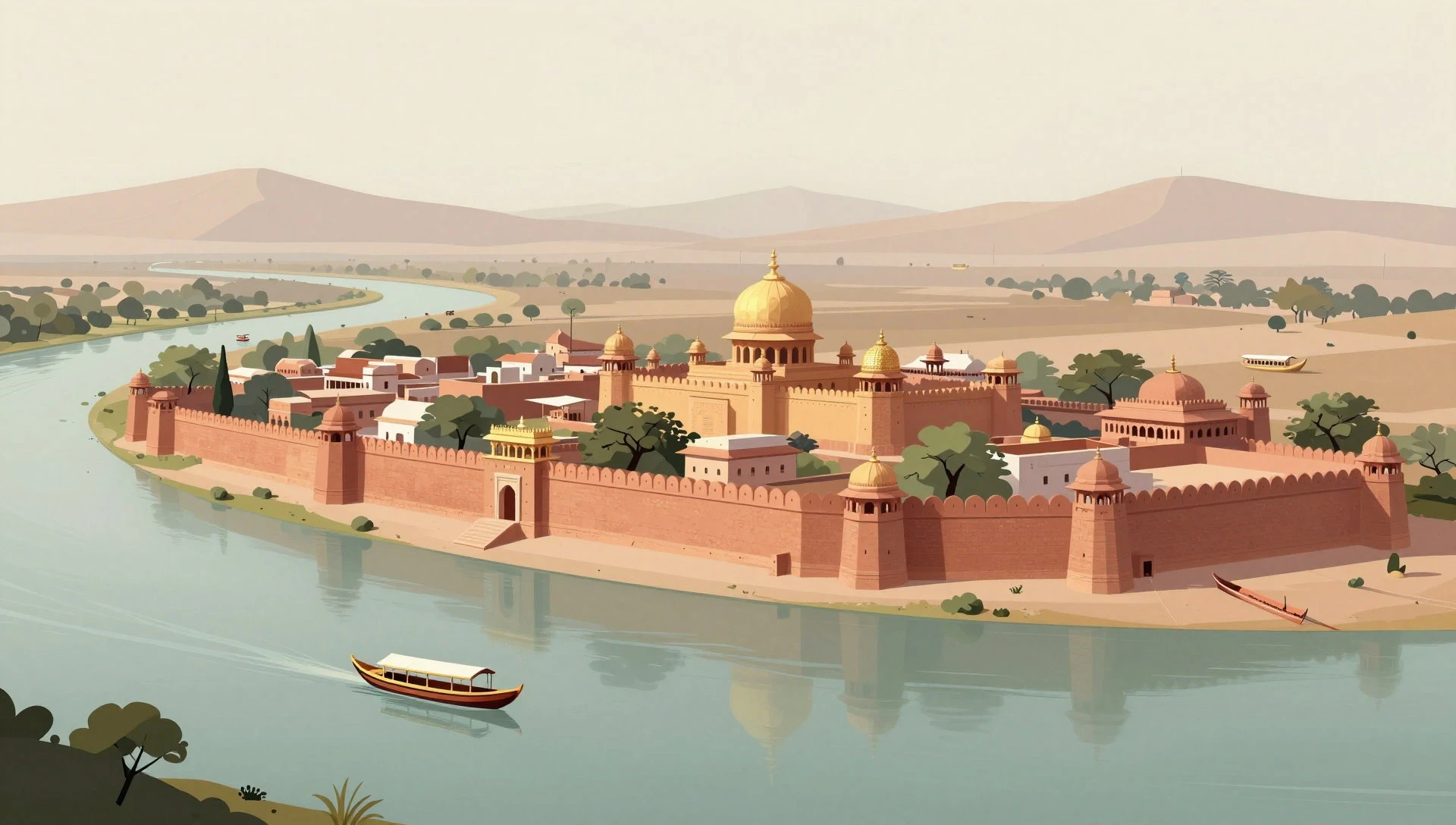
Magadh occupies a singular place in the political imagination of ancient India. Rising from the fertile plains of the middle Ganges valley in what is now Bihar, this kingdom transformed itself from one of many competing territorial states into the engine of India's first great imperial experiments. Its story is not merely a chronicle of dynasties and battles; it is the story of how geography, agriculture, trade, and ideas converged to produce a centre of power whose influence outlasted every ruler who governed it. Understanding Magadh means understanding the material and intellectual foundations on which later Indian civilisation would build.
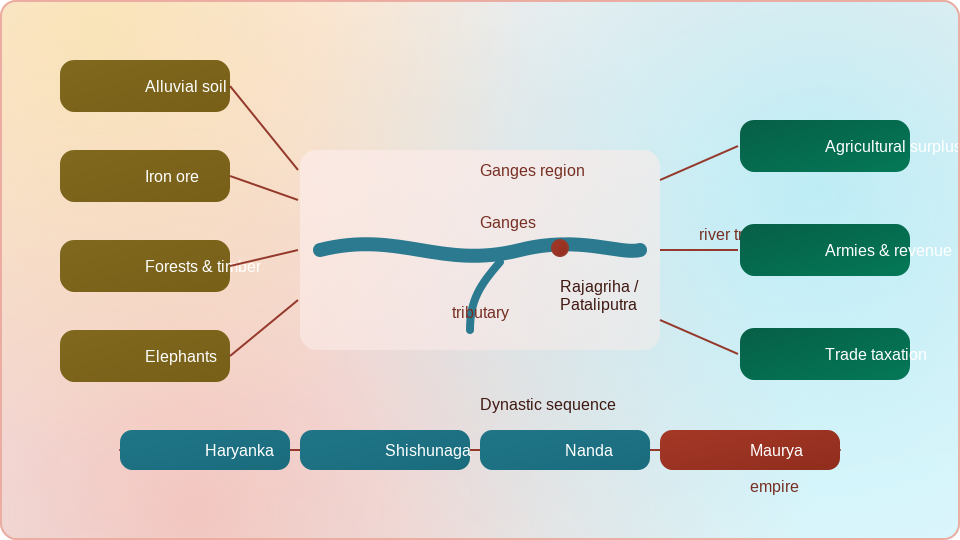
What makes Magadh especially instructive is the way it demonstrates how strategic location can compound into lasting advantage. The kingdom sat astride the Ganges, controlling riverine trade routes, iron-rich hinterlands, and some of the most productive agricultural land in the subcontinent. These assets allowed it to field larger armies, sustain denser populations, and fund ambitious campaigns of conquest. Yet Magadh's significance extends well beyond military expansion. It was also the crucible in which Buddhism and Jainism took shape, and the seat of the Mauryan Empire, the first polity to unify most of the Indian subcontinent under a single administration.
This analysis examines Magadh through several lenses: its early ruling houses, the geographic and economic logic of its rise, the intellectual ferment it hosted, and the administrative innovations that made empire possible. It also considers why a kingdom so central to Indian history remains comparatively underappreciated in popular accounts. By tracing Magadh's trajectory from regional power to imperial heartland, we can see how a single region's advantages, once consolidated, reshaped the political destiny of an entire civilisation.
On This Page
TL;DR Magadh was an ancient kingdom in the middle Ganges plain that rose from regional prominence to become the heartland of India's first empires. Its fertile land, iron resources, and command of river trade gave it decisive economic and military advantages. Under the Haryanka, Shishunaga, Nanda, and Mauryan dynasties, it consolidated power across northern India and hosted the emergence of Buddhism and Jainism. Its administrative innovations, including taxation and standing armies, set templates that later Indian states would follow. Magadh's story explains how geography and institutions together produced one of history's most consequential political centres.
The Geographic and Economic Foundations of Magadh's Rise
Magadh's ascent cannot be separated from the physical landscape it occupied. The kingdom lay in the middle Ganges valley, a region of alluvial soil replenished annually by monsoon floods, making it one of the most agriculturally productive zones in the ancient world. This surplus supported larger populations than rival states could sustain, and population density in turn translated into military manpower and tax revenue. The surrounding hills supplied iron ore, a resource of enormous strategic value in an age when iron weapons and tools were transforming warfare and agriculture alike.
Equally important was Magadh's position relative to trade. The Ganges and its tributaries formed a natural highway network, and Magadh's capital at Rajagriha, later Pataliputra, sat at the junction of routes connecting the eastern Gangetic plain to the west and to the ports of the east. Control of these arteries meant control of commerce, and commerce meant wealth that could be converted into political power. This combination of agricultural surplus, mineral wealth, and commercial access created a self-reinforcing cycle of growth that smaller, less favourably situated kingdoms could not match.
Riverine Trade and Agricultural Surplus
The Ganges system functioned as the economic spine of northern India. Goods moved by boat far more cheaply than by cart, and Magadh's riverside position allowed its merchants to dominate long-distance exchange. Rice, textiles, and iron products flowed outward, while luxury goods and raw materials flowed in. The state taxed this trade at river crossings and market towns, generating revenue that funded both administration and military expansion. Over time, this commercial dominance attracted artisans and merchants from across the region, further concentrating economic activity within Magadh's orbit.
Agricultural surplus underpinned everything else. With reliable harvests, Magadh could support a large non-farming population of soldiers, priests, artisans, and officials. This division of labour is a precondition for state formation, and Magadh achieved it earlier and more thoroughly than its neighbours. Land revenue, assessed on the produce of the soil, became the fiscal backbone of the kingdom, and the machinery developed to collect it would later be refined by the Mauryans into one of the ancient world's most sophisticated tax systems.
Iron, Forests, and Strategic Resources
Iron availability gave Magadh a decisive edge in military technology. Iron-tipped ploughs improved agricultural yields, while iron weapons and armour equipped armies that could outmatch opponents still reliant on copper or bronze. The forests of the region supplied timber for boats, chariots, and construction, and also harboured elephants, which became a formidable component of ancient Indian armies. Elephants, trained and deployed in numbers, gave Magadh's forces a shock capability that contemporary accounts repeatedly emphasise.
Resource control also shaped Magadh's relations with neighbouring states. Access to iron and timber meant the kingdom could sustain military campaigns over extended periods, outlasting adversaries whose supplies were more constrained. This logistical advantage, combined with the demographic weight of the Ganges plain, made Magadh a natural candidate for regional hegemony. The kingdom's rulers understood this, and the history of Magadh is in large part the history of how that latent advantage was converted into durable political dominance.
The Early Ruling Houses and Political Consolidation
The political history of Magadh is conventionally traced through a succession of dynasties, each building on the territorial gains of its predecessors. The Haryanka dynasty, associated with the celebrated king Bimbisara and his son Ajatashatru, established Magadh as the dominant power in the Gangetic plain. Bimbisara pursued a strategy of marriage alliances and diplomatic accommodation, while Ajatashatru resorted to sustained military campaigns, notably against the Vajji confederacy. Their reigns, spanning roughly the sixth and early fifth centuries BCE, transformed Magadh from a regional contender into the leading state of northern India.
Successive houses continued this trajectory. The Shishunaga dynasty briefly consolidated control before the Nanda dynasty, remembered for its vast wealth and enormous standing army, pushed Magadh's reach further still. The Nandas reportedly maintained a force of unprecedented size, and their fiscal apparatus extracted revenue on a scale that impressed later Greek observers. This accumulation of military and financial capacity set the stage for the Mauryan seizure of power, which would carry Magadh's dominance to its furthest extent.
Bimbisara, Ajatashatru, and the Haryanka Dynasty
Bimbisara is credited with laying the administrative foundations of the Magadhan state. He established a capital at Rajagriha, fortified it, and cultivated relationships with neighbouring kingdoms through marriage. His reign coincided with the careers of the Buddha and Mahavira, and tradition holds that he was a patron of the former. This patronage was not merely pious; it tied the emerging religious communities to the political centre, giving Magadh a cultural prestige that reinforced its material power and attracted scholars and merchants to its courts.
Ajatashatru, his son, is remembered for a more aggressive posture. He waged a prolonged campaign against the Vajji confederacy, deploying new siege engines and a minister credited with sowing discord among the enemy's ranks. The conquest of the Vajjis removed the last serious rival in the eastern Gangetic plain and confirmed Magadh's primacy. Ajatashatru also fortified Pataliputra on the southern bank of the Ganges, a settlement that would eventually eclipse Rajagriha as the imperial capital and become one of the great cities of the ancient world.
The Nandas and the Road to Empire
The Nanda dynasty represents the culmination of Magadh's pre-imperial consolidation. Ancient sources describe the Nandas as fabulously wealthy, with a treasury swollen by systematic taxation and a military establishment of extraordinary size. Greek accounts, drawing on reports from the time of Alexander's campaigns, mention a standing army numbering in the hundreds of thousands, including cavalry, chariots, and war elephants. Whether or not these figures are exaggerated, they reflect a state capable of mobilising resources on a scale unmatched elsewhere in the subcontinent.
The Nandas' concentration of power also generated internal tensions. Their rule is remembered in some traditions as harsh and avaricious, and their overthrow by Chandragupta Maurya, reportedly with the counsel of the strategist Chanakya, marked a decisive break. Yet the Mauryans inherited the Nanda fiscal and military machinery largely intact. The empire that Chandragupta built rested on foundations laid by his predecessors, and the continuity between Nanda and Mauryan administration is one of the most important, if least discussed, features of Magadhan history.
Magadh as a Crucible of Religion and Thought
Magadh's political rise coincided with one of the most fertile periods of intellectual activity in Indian history. The sixth century BCE witnessed the emergence of multiple heterodox movements that challenged the ritual-centred orthodoxy of the Vedic tradition. Buddhism and Jainism, the two most consequential of these movements, both originated in the Gangetic region and both found early patronage among Magadhan rulers and elites. The kingdom's wealth and urbanisation created the social conditions in which wandering teachers could attract followers and in which new religious communities could establish themselves permanently.
The relationship between political power and religious innovation was reciprocal. Rulers patronised new movements partly to legitimise their authority against established priestly hierarchies, while the movements gained the material support needed to build monasteries and consolidate doctrine. Magadh's cities, teeming with merchants and artisans, provided receptive audiences for teachings that emphasised individual effort over hereditary ritual status. This confluence of urban prosperity, political ambition, and spiritual experimentation made the kingdom a laboratory for ideas that would eventually spread across Asia.
Buddhism, Jainism, and Royal Patronage
Bimbisara's patronage of the Buddha is among the most frequently cited examples of early royal support for the new faith. According to tradition, the king donated land for the monastic community and maintained close relations with the Buddha throughout his reign. Ajatashatru, despite a more turbulent relationship with his father, also supported the Buddhist order and is associated with the first council held at Rajagriha shortly after the Buddha's death. These acts of patronage helped transform Buddhism from a wandering movement into an institutional religion with property, rules, and a settled monastic base.
Jainism likewise flourished in Magadh. Mahavira, the tradition's great teacher, spent much of his career in the region, and Jain communities received support from wealthy merchants and rulers alike. The Nanda dynasty is remembered in Jain sources with particular warmth, and the religion's emphasis on non-violence and ascetic discipline resonated with urban mercantile groups whose commercial ethics valued restraint and trustworthiness. The coexistence of multiple traditions within Magadh's sphere reflects a broader culture of intellectual pluralism that distinguished the region from more doctrinally rigid polities.
Universities, Councils, and Cultural Exchange
Magadh's role as a centre of learning extended beyond the lifetime of its founding teachers. The councils convened at Rajagriha and later at Pataliputra helped standardise Buddhist doctrine and monastic discipline, creating a textual and institutional foundation that would sustain the religion for centuries. These gatherings attracted monks from across the subcontinent, turning Magadh into a hub of scholarly exchange. The kingdom's cities became nodes in a network of pilgrimage and study that connected the Gangetic plain to regions as distant as Gandhara and the Deccan.
Cultural exchange also flowed along commercial channels. Merchants travelling Magadh's river routes carried not only goods but ideas, and the kingdom's cosmopolitan cities hosted communities from across India and beyond. This openness contributed to the sophistication of Magadhan art, architecture, and literature, and it reinforced the kingdom's reputation as a place where new ideas could take root. The intellectual capital accumulated during this period would prove as durable as any territorial conquest, shaping the religious landscape of Asia for millennia.
The Mauryan Empire and Magadh's Imperial Zenith
The Mauryan accession transformed Magadh from the leading kingdom of the Gangetic plain into the centre of an empire that stretched from the Hindu Kush to the Deccan. Chandragupta Maurya, with the guidance of his minister Chanakya, overthrew the Nandas and rapidly expanded westward, exploiting the political vacuum left by Alexander's retreat. By the end of his reign, Mauryan authority extended across northern and central India, and Magadh's capital at Pataliputra became the administrative heart of a polity comparable in scale to contemporary Hellenistic empires.
The empire's significance for Magadh lies in what it reveals about the scalability of the kingdom's institutions. The fiscal machinery, military organisation, and administrative practices developed over centuries of Gangetic state-building proved capable of governing a vastly larger territory. The Mauryan achievement was thus not a sudden rupture but an extension of Magadhan statecraft to an imperial scale. This continuity helps explain why Pataliputra remained the political centre of northern India long after the Mauryan dynasty itself had passed from the scene.
Chandragupta, Chanakya, and Administrative Innovation
Chandragupta's reign is associated with a remarkable burst of administrative codification. The Arthashastra, attributed to Chanakya, sets out in detail the principles of statecraft, taxation, espionage, and economic regulation that underpinned Mauryan rule. Whether or not the text reflects a single author's vision, it captures the administrative logic of the Magadhan state: centralised revenue collection, meticulous record-keeping, state supervision of key economic activities, and a professional bureaucracy. These features distinguished Mauryan governance from the looser arrangements of earlier polities.
The empire also maintained a large standing army and an extensive network of roads and communications. Megasthenes, the Seleucid ambassador to Chandragupta's court, described a well-ordered capital and a highly organised administration, though his account must be read with caution. What is clear is that Magadh under the Mauryans possessed the institutional capacity to govern a vast and diverse territory, and that this capacity rested on foundations laid during the kingdom's earlier centuries of consolidation.
Ashoka, Dhamma, and the Transformation of Power
Ashoka's reign marks the most celebrated phase of Magadhan history. After the bloody conquest of Kalinga, the emperor famously turned away from military expansion and embraced a policy of dhamma, a moral and social programme emphasising non-violence, tolerance, and welfare. His edicts, inscribed on rocks and pillars across the subcontinent, constitute the earliest substantial corpus of Indian political thought and remain among the most remarkable documents of ancient statecraft. They project an image of kingship grounded in ethical responsibility rather than mere conquest.
Ashoka's policies have been debated for centuries. Some scholars see in them a genuine transformation of political values, while others emphasise their propagandistic and administrative functions. What is undeniable is that his reign extended Magadh's cultural influence far beyond its borders. Buddhist missions dispatched during his reign carried the religion to Sri Lanka and Central Asia, and the Mauryan capital became a cosmopolitan centre of learning and diplomacy. The empire's decline after Ashoka did not erase this legacy; it embedded Magadh's cultural imprint across Asia.
Decline, Legacy, and Magadh's Enduring Influence
The Mauryan Empire declined in the decades after Ashoka, and Magadh's political centrality gradually diminished. Succession disputes, fiscal strain, and the difficulty of governing a vast territory from a single centre weakened imperial authority. The last Mauryan emperor was overthrown by Pushyamitra Shunga, whose dynasty presided over a much-reduced realm. Subsequent centuries saw the rise of new powers elsewhere in India, and Pataliputra's status as the imperial capital faded, though the city remained an important regional centre for centuries.
Yet political decline did not mean cultural eclipse. The institutions, texts, and religious communities that had taken root in Magadh continued to shape Indian civilisation long after the kingdom's rulers had lost their imperial reach. Buddhist monasteries founded in the region persisted for centuries, and the intellectual traditions associated with Magadhan courts and councils influenced philosophy, law, and literature across the subcontinent. The kingdom's legacy is thus less a matter of territorial boundaries than of institutional and cultural inheritance.
From Imperial Centre to Regional Memory
The memory of Magadh persisted in literature, inscriptions, and religious tradition. Later dynasties sought to associate themselves with its prestige, and the Mauryan model of centralised governance influenced rulers from the Guptas onward. The Arthashastra continued to be studied as a manual of statecraft, and Ashoka's edicts remained a reference point for ethical kingship. In this sense, Magadh functioned as a kind of political ancestor for later Indian states, its example invoked whenever rulers sought to legitimise centralised authority or moral governance.
Modern historical scholarship has also reshaped how Magadh is understood. Archaeological work at Rajagriha, Pataliputra, and Bodh Gaya has illuminated the material culture of the kingdom, while epigraphic and textual studies have refined the chronology of its dynasties. These investigations have revealed a society more complex and dynamic than older narratives suggested, with vibrant urban life, extensive trade networks, and sophisticated administrative practices. Magadh emerges not as a static backdrop to religious history but as a polity with its own institutional logic and developmental trajectory.
Why Magadh Still Matters to Indian History
Magadh matters because it demonstrates how a region can convert geographic advantage into durable institutional capacity. Its rulers built systems of taxation, military organisation, and administration that outlasted individual dynasties and provided templates for later empires. Its cities hosted the emergence of religious traditions that would spread across Asia. And its history illustrates a broader principle: that political power in the ancient world rested on the ability to mobilise agricultural surplus, control trade routes, and legitimise authority through cultural and religious patronage.
For contemporary readers, Magadh offers a case study in how geography, economics, and ideas interact over long periods. The kingdom's rise was not inevitable, nor was its decline; both were shaped by choices made by rulers and by the structural conditions they inherited. Understanding these dynamics enriches our appreciation of ancient Indian history and provides a more nuanced picture of how civilisations consolidate power. Magadh remains, in this sense, a foundational chapter in the story of Indian statecraft and culture.
Reading Magadh Through Evidence and Interpretation
Any account of Magadh rests on a mixture of textual, epigraphic, and archaeological evidence, each with its own limitations. Buddhist and Jain canonical texts preserve rich narratives about the kingdom's rulers and their patronage, but they were compiled by communities with their own doctrinal interests. Brahmanical sources offer a different perspective, often critical of the heterodox movements that flourished in the region. Greek accounts provide an external viewpoint, though filtered through cultural assumptions and second-hand reports. Reconciling these sources requires careful attention to their biases and purposes.
Archaeology has become increasingly important in reconstructing Magadhan history. Excavations at sites such as Rajagriha and Pataliputra have revealed fortifications, urban layouts, and artefacts that illuminate daily life and economic activity. The Northern Black Polished Ware associated with the period provides a marker for dating and for tracing trade networks. Together with numismatic evidence and inscriptions, these material remains allow historians to test and refine the picture presented by literary sources, producing a more grounded understanding of the kingdom's development.
Sources, Debates, and Historical Method
The chronology of early Magadhan dynasties remains a subject of scholarly debate. Traditional accounts place the Buddha's life in the sixth century BCE, but the precise dates of rulers such as Bimbisara and Ajatashatru are uncertain, and different traditions offer conflicting genealogies. Historians have attempted to correlate textual references with archaeological stratigraphy and with dated events in neighbouring regions, but significant gaps remain. These uncertainties do not undermine the broad outline of Magadh's rise, but they caution against treating any single narrative as definitive.
Interpretive debates also surround the nature of Magadhan state formation. Some scholars emphasise the role of coercion and military conquest, while others highlight the importance of trade, urbanisation, and ideological legitimation. The Arthashastra's detailed prescriptions suggest a highly interventionist state, but it is unclear how closely actual practice matched the text. These debates reflect broader methodological questions about how to reconstruct ancient states from fragmentary evidence, and they continue to shape scholarship on early Indian history.
Comparative Perspectives on Ancient State Formation
Magadh invites comparison with other ancient states that emerged in riverine environments, from Mesopotamia to Egypt to the Yellow River valley. In each case, agricultural surplus, water transport, and the need to manage irrigation or flood control contributed to centralised authority. Magadh's distinctive feature was the intensity of its urbanisation and the pluralism of its intellectual culture, which produced religious and philosophical movements of enduring global significance. These comparisons help situate Magadh within a broader pattern of state formation while highlighting what made it unique.
Comparative analysis also illuminates the limits of Magadhan power. Like other ancient empires, it struggled with the problem of governing vast territories from a single centre, and its decline followed patterns familiar from other imperial histories. The tension between central authority and local autonomy, the fiscal strain of maintaining large armies, and the challenge of succession all contributed to its eventual fragmentation. Recognising these parallels enriches our understanding of Magadh not as an isolated case but as part of a wider historical phenomenon.
From our network :
- University Language Proficiency Exams: Why Institutional Tests Demand Different Preparation Than IELTS and TOEFLDiscover why university-specific language proficiency examinations differ fundamentally from IELTS and TOEFL, and learn strategic preparation approaches for institutional assessment success.
- Committed Mediterranean Precipitation Decline: Why Emissions Cuts Alone Cannot Restore Winter RainsNew NOAA research reveals that Mediterranean winter rains may decline irreversibly even with emissions cuts. Explore the science of committed climate change and regional impacts.
- The Hidden Cost of AI Convenience: Why Over-Permissioned Agents Are a Security Time BombDiscover why AI agents with excessive permissions create dangerous single points of failure, and learn how implementing least privilege principles can protect your organization from exploitation.
- How AI Agents Will Change the Way We Manage Personal FinancesExplore how AI agents are transforming personal finance through automated budgeting, bill payment, and investment management, while examining the critical security protocols and governance frameworks required for safe deployment.
- Mobile Learning and VR in English: What Global Evidence Reveals About Effective Language TechnologyA systematic review across 14 countries reveals which language-learning technologies genuinely work. Mobile learning, AI, and VR show measurable benefits when pedagogically integrated. This evidence-based guide helps educators and learners select technology that delivers real return on investment.
- Live Online English Classes for Kids: Do They Actually Reduce Anxiety?A ten-week study reveals that synchronous online English classes can significantly reduce child language anxiety while improving listening and reading skills. Discover what makes these programs effective and how parents can select the right one.
- The Final Descent: How ESA Retired the Legendary Cluster Constellation After 24 Years of Space Weather ScienceAfter 24 years mapping Earth’s magnetosphere, ESA’s Cluster mission concluded with a precisely controlled reentry over the South Pacific. This analysis explores the scientific legacy, engineering decisions, and debris mitigation principles behind one of space exploration’s most responsible retirements.
- Forbidden Matrix Patterns and Visible Lattice Points: A Geometric DictionaryExplore how multidimensional 0–1 matrices encode geometric truths, linking forbidden patterns to visible lattice points and hypergraph theory, with applications in combinatorics and computational geometry.
- CISA’s Ten-Advisory Wave: Why Generic Patching Fails in OT and How to Build Product-Specific PlaybooksCISA released ten ICS advisories in one week, exposing critical infrastructure risks. Generic patching fails in OT. Learn to build product-specific remediation playbooks.
RESOURCES
- Magadha - Wikipediaen.wikipedia.orgMagadha was a region and kingdom in ancient India, based in the eastern Ganges Plain. It was one of the sixteen Mahajanapadas during the…
- From a regional kingdom to a growing power, Magadh's rise under ...facebook.comJan 14, 2026 ... Rajvansh Dynasties | Epic Tv Magadh Empire Rise | Shishunaga Rule | Ancient Indian Kingdoms | Magadh Expansion | Indian…
- Historical Dynasties and Kings of Magadh: just made this summaryreddit.comJun 16, 2026 ... Influential figures in ancient Indian history. Clear search. Search Reddit. Influential figures in ancient Indian history. Impact of the Mughal ...
- The Ancient Indian Kingdom of Magadha: Wars and Warfarebrewminate.comSep 22, 2019 ... Interestingly, it is all history. Political Setting. Magadha was one of 16 territorial units termed as mahajanapadas, which included both ...
- Why did Kuru-Panchala become the default face of "Ancient India ...reddit.comAug 9, 2026 ... For most of ancient history, Magadha was the superpower. It built ... kingdoms such as Magadha, Anga, Vanga, Videha, etc.…
- Ancient India - Magadha Under Different Dynasties - Instagraminstagram.comAug 23, 2024 ... MAGADHA EMPIRE TIMELINE | UPSC ANCIENT HISTORY 1. Haryanka Dynasty (c. 544–413 BCE) Bimbisara, Ajatashatru, Udayin Buddha, Mahavira, ...
- The Magadhas in Ancient India - IGNCAignca.gov.inthe history of ancient Indian tribes. I am grateful to the ... two kingdoms of Magadha and Kosala were once more closely united by…
- "Why are you silent, friends? What's happened in Magadh ...instagram.comMay 7, 2026 ... A chorus of narrators—commoners, statesmen, nameless wanderers—pieces together the histories of ancient cities and kingdoms on the Indian ...
- Magadha | Mauryan Empire, Ganges Valley, Buddhism - Britannicabritannica.comNov 11, 2026 ... Magadha, ancient kingdom of India, situated in what is now west-central Bihar state, in northeastern India. It was the nucleus…
- Magadha: Mighty Kingdom that Spawned Two of India's Most ...ancient-origins.netFeb 15, 2021 ... This ancient kingdom was centered around southern Bihar, in the northeastern part of India. Much of the information regarding Magadha's…
- Why was Magadha considered a key player among the ancient ...quora.comAug 22, 2026 ... If you remove magadh from indian history. There is no golden periods in indian empire. Magadh or foreigners ruled on…
- Rise of the Maurya Empire | World History - Lumen Learningcourses.lumenlearning.com... Dynasty. Chanakya swore revenge and vowed to destroy the Nanda Empire. The Nanda Empire originated from the region of Magadha in ancient India…
- Rise of Magadha Empire | Exotic India Artexoticindiaart.comUnder the maurya dynasty the Magadhan empire reached the apex of glory. This comprehensive book of history details the major dynasties of Magadh during…
- The History of India Podcast - Spotifyopen.spotify.com(www.historyofindiapodcast.com) The story of Bimbisara, ancient king of Magadha. He was a contemporary of the Buddha and Mahavira, and by cunning marriages ...
- Magadha - Simple English Wikipedia, the free encyclopediasimple.wikipedia.orgMagadha was an ancient Indian kingdom located in southern northeastern India and Nepal.It was succeeded by the Magadhan Empire . Over time, Magadha lost ...
Related By Tags
- 01
- 02
- 03
- 04
- 05
- 06
- 07
- 08
0 Comments