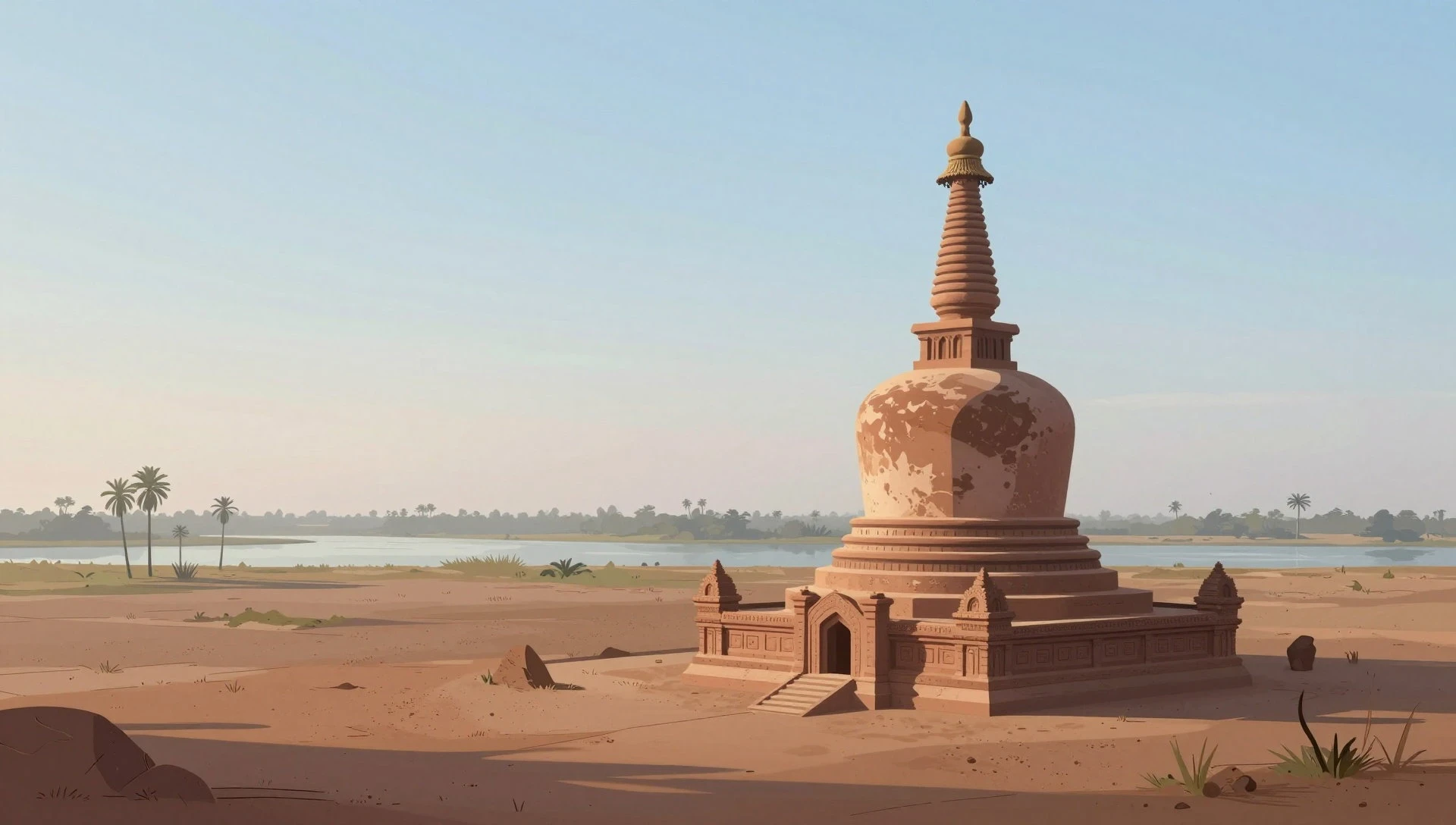
Magadh is one of those rare regions where the sheer weight of history is matched by the quietness of its present. Stretching across the fertile Gangetic plain of what is now south-central Bihar, this ancient territory was once the beating heart of empires, the cradle of two world religions, and the stage on which some of the most consequential ideas in human civilization were first articulated. For the traveller willing to look past the familiar headlines about the state, Magadh offers an itinerary of extraordinary depth: Buddhist stupas and monastic ruins, Jain pilgrimage sites, Mauryan and Gupta-era archaeology, and a living rural culture that has changed far less than the grand monuments suggest.
What makes the region genuinely rewarding is not any single landmark but the density of significance packed into a compact geography. Within a few hours' drive you can move from the site where the Buddha attained enlightenment to the capital of India's first great empire, from rock-cut caves carved for ascetics to a modern university town that still carries the intellectual ambitions of its ancient predecessor. This guide is written for travellers who want practical, grounded advice rather than glossy brochures: how to move between sites, where to base yourself, what to eat, when to go, and how to approach these places with the respect and curiosity they deserve.
The pages that follow treat Magadh as a coherent travel destination rather than a checklist of disconnected attractions. We will examine the region's historical logic, the major Buddhist and Jain circuits, the archaeological and architectural highlights, the realities of local transport and accommodation, and the food and seasonal considerations that shape any honest visit. The aim is to equip you with enough context and logistical clarity to plan a trip that is both efficient and meaningful, one that engages with Bihar's historical heartland on its own terms.
On This Page
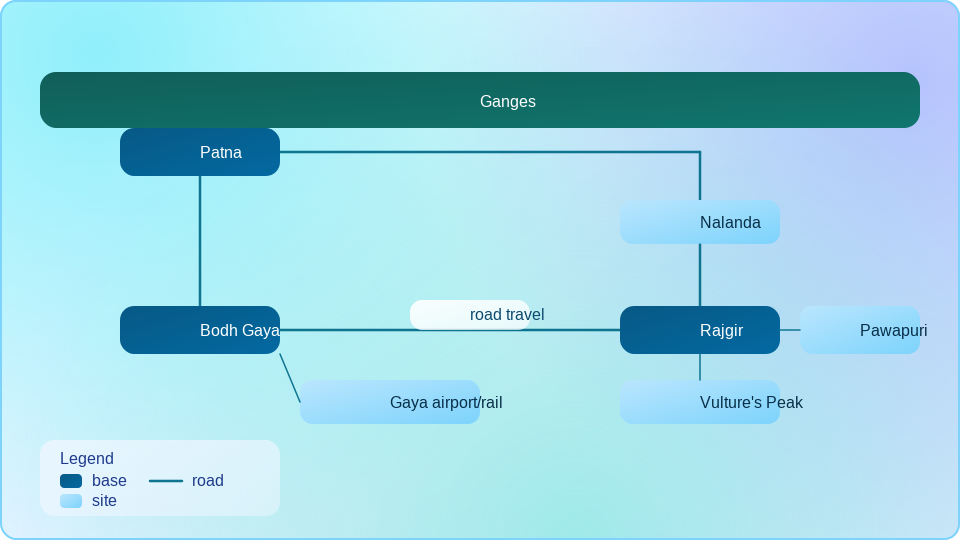
TL;DR Magadh, the historical heartland of south-central Bihar, concentrates an astonishing array of Buddhist, Jain, and imperial-era sites within a manageable radius. Base yourself in Bodh Gaya, Patna, or Rajgir depending on your focus, plan for road travel between clusters, and allow at least five to seven days to do the region justice. Expect modest infrastructure, warm hospitality, and profound historical rewards for those who prepare sensibly and travel with patience.
The Historical Logic of Magadh
Understanding why Magadh matters requires a brief reckoning with its geography. The region sits at the confluence of several rivers and ancient trade corridors, a position that gave it agricultural surplus, strategic depth, and access to both the Ganges artery and the routes leading south toward the Deccan. This combination allowed a succession of kingdoms and empires to flourish here long before the Common Era, and it explains why so many foundational events in Indian religious and political history cluster in such a small area. The land itself, flat and fertile, was the material basis for the region's outsized role.
The name Magadh refers to the ancient kingdom whose capital shifted over centuries between Rajgir and Pataliputra, the latter becoming modern Patna. Under the Haryanka, Shishunaga, Nanda, and Maurya dynasties, the region grew from a regional power into the seat of an empire that at its height stretched across much of the subcontinent. The Mauryan period in particular left an archaeological and administrative legacy that still shapes how historians understand early Indian statecraft, and the sites associated with it remain among the most compelling reasons to visit.
The Rise of Empires and Ideas
The sixth and fifth centuries BCE were a period of extraordinary intellectual ferment across Magadh. It was here, in the kingdoms and republics of the Gangetic plain, that the Buddha taught and that Mahavira organized the Jain community. The region's monasteries and courts became centres of debate, and the patronage of rulers like Bimbisara and Ajatashatru helped institutionalize these new movements. Travellers who understand this context will find that even modest ruins take on a vivid significance, because they mark the physical settings of ideas that would eventually spread across Asia.
The Mauryan consolidation under Chandragupta and his successors, most famously Ashoka, transformed Magadh into an imperial capital whose influence reached from Afghanistan to the Deccan. Ashoka's embrace of Buddhism after the Kalinga war gave the region a new religious centrality, and the pillars, stupas, and edicts he commissioned remain among the most recognizable monuments of ancient India. This layering of political and spiritual authority is what gives Magadh its distinctive character: it is simultaneously a place of empire and a place of renunciation.
Reading the Landscape Today
Modern Magadh is predominantly agricultural, dotted with small towns and villages whose rhythms are tied to the rice and wheat cycles. The grand monuments sit within this working landscape rather than apart from it, and that juxtaposition is part of the region's appeal. A visitor moving between sites will pass through fields, markets, and small settlements where the past is not curated but simply present, often unmarked and overgrown. This is not a polished heritage circuit, and approaching it with that expectation will lead to disappointment.
What the landscape rewards is patience and preparation. Many sites are poorly signposted, interpretation is limited, and the most evocative places are sometimes the least visited. Reading ahead, hiring a knowledgeable local guide where available, and allowing unstructured time to wander will yield far more than rushing between ticketed attractions. The historical logic of Magadh is best absorbed slowly, by noticing how the rivers, roads, and settlements still follow patterns established millennia ago.
The Buddhist Circuit
For most international visitors, the Buddhist sites are the primary draw, and with good reason. Bodh Gaya, where the Buddha is said to have attained enlightenment under the Bodhi tree, is the spiritual centre of the region and a UNESCO World Heritage Site. The Mahabodhi Temple complex, with its towering spire and surrounding monasteries built by Buddhist communities from across Asia, is both a pilgrimage destination and an architectural marvel. It is also a place of active worship, so visitors should dress modestly and observe the rhythms of prayer and meditation.
Beyond Bodh Gaya, the Buddhist circuit extends to Rajgir, where the Buddha taught and where the first Buddhist council is said to have been held, and to Nalanda, the site of the great monastic university that drew scholars from across Asia for centuries. Together these sites form a coherent itinerary that can be covered in three to four days at a comfortable pace. Each has a distinct character: Bodh Gaya is devotional and international, Rajgir is scenic and layered, and Nalanda is archaeological and contemplative.
Bodh Gaya and the Mahabodhi Complex
The Mahabodhi Temple is the anchor of any Buddhist visit, and it deserves at least a full day. The complex includes the temple itself, the descendant of the original Bodhi tree, and a surrounding precinct of monasteries representing Thailand, Bhutan, Japan, and other Buddhist nations. Early morning and evening are the most atmospheric times, when pilgrims chant and circumambulate the temple. Photography is restricted in some areas, and the site is best approached with quiet attention rather than as a sightseeing stop.
Accommodation in Bodh Gaya ranges from simple guesthouses to comfortable hotels, and the town is well served by restaurants catering to international pilgrims. The nearby town of Gaya, about thirteen kilometres away, has the nearest railway station and airport, making it the practical gateway. Many visitors use Bodh Gaya as a base for several days, taking day trips to Rajgir and Nalanda, though the road journey to each is roughly two to three hours depending on conditions.
Rajgir and Nalanda
Rajgir, set among hills and hot springs, was the capital of Magadh before Pataliputra and retains a remarkable concentration of sites. The Vulture's Peak, where the Buddha delivered several important discourses, offers a short hike and sweeping views. The ruins of the ancient city walls, the Bimbisara jail, and the Japanese-built Vishwa Shanti Stupa are among the highlights. The town is also a Jain pilgrimage centre, with several temples on the surrounding hills, and the hot springs at the foot of the hills are popular with locals.
Nalanda, about twelve kilometres from Rajgir, is the site of the great university that flourished from the fifth to the twelfth centuries CE. The excavated ruins, with their orderly rows of monastic cells and stupas, convey a sense of the scale of the institution, which at its height housed thousands of students and teachers. The nearby Nalanda Archaeological Museum holds sculptures and artefacts from the site, and a modern university has been established nearby as a symbolic revival. Allow half a day for the ruins and museum together.
Jain Heritage and Other Sacred Sites
Magadh is also a major centre of Jain pilgrimage, and travellers interested in the region's religious history should not overlook these sites. Rajgir in particular is sacred to Jains, associated with Mahavira, who is said to have spent time in the area. The hilltop temples, reached by a ropeway or a steep climb, offer both spiritual atmosphere and panoramic views. The Jain presence in the region is ancient and continues to shape the local landscape of worship, with several temples maintained by communities that trace their roots here.
Beyond the Buddhist and Jain circuits, Magadh contains a range of other sacred and historical sites that reward the curious traveller. Patna, the modern capital, holds museums with Mauryan and Gupta artefacts, including the Didarganj Yakshi, and the site of Pataliputra's ancient remains. The city is also a gateway to other parts of Bihar and a useful base for exploring the region's broader heritage. For those with time, the smaller sites scattered across the countryside offer quieter encounters with the past.
Pilgrimage Etiquette and Practicalities
Visiting active religious sites requires a degree of sensitivity that is easy to overlook in the rush of sightseeing. Dress modestly, remove shoes where required, and avoid photographing worshippers without permission. Many sites have specific rules about circumambulation direction, offerings, and the handling of sacred objects, and observing these is both respectful and enriching. Local guides can often explain customs and help visitors navigate without causing offence, and their knowledge adds considerable depth to the experience.
Practical considerations matter too. Some temples and monasteries have limited opening hours, and festival days can be extremely crowded. It is worth checking schedules in advance and, where possible, visiting early in the morning. Donations are customary at many sites, and small change is useful. The overall atmosphere at these places is welcoming, but the traveller who arrives informed and considerate will find the experience far more rewarding than one who treats them as mere backdrops for photographs.
Patna as a Cultural Base
Patna is often bypassed by travellers heading straight to Bodh Gaya, which is a pity, because the city offers context that the smaller sites cannot. The Bihar Museum, opened in 2015, is a world-class institution with well-curated galleries covering the region's history from prehistory to the modern era. The Patna Museum, older and more traditional, holds important sculptures and the famous Didarganj Yakshi. Together they provide an excellent grounding in the region's material culture before or after visiting the archaeological sites.
The city is also the most practical base for transport, with the best-connected railway station and airport in the region. Accommodation ranges from budget to business hotels, and the food scene is varied. Patna's riverside setting along the Ganges adds to its appeal, and the Gandhi Maidan and surrounding areas offer a sense of the city's civic life. For travellers who want to understand Magadh as a living region rather than a collection of ruins, a day or two in Patna is time well spent.
Getting There and Getting Around
Transport is the practical heart of any Magadh itinerary, and honest planning here will save considerable time and frustration. The region is served by Patna's Jay Prakash Narayan International Airport and by Gaya International Airport, the latter particularly useful for Bodh Gaya. Rail connections are extensive, with Patna and Gaya being major junctions on the Indian Railways network. Buses and shared taxis connect the smaller towns, but services can be slow and crowded, and private vehicles or hired cars are the most efficient way to move between sites.
Road conditions vary considerably. The main highways are generally good, but the smaller roads leading to archaeological sites can be narrow and uneven. Hiring a car with a driver for the duration of your stay is often the most practical solution, particularly if you plan to visit multiple sites in a day. Ride-hailing apps have limited coverage outside Patna, so arranging transport in advance through your hotel or a local operator is advisable. Allow generous buffers in your schedule, as journey times can be unpredictable.
Air, Rail, and Road Options
Flying into Patna is the most convenient option for most travellers, with regular connections to Delhi, Mumbai, Kolkata, and other major Indian cities. Gaya airport, primarily serving Buddhist pilgrimage traffic, has seasonal international flights and is very close to Bodh Gaya. Trains are frequent and affordable, with Patna and Gaya well connected to the rest of India. For those coming from within Bihar, the rail network is often the fastest option, though booking in advance is essential during peak seasons and festivals.
Once in the region, the choice between hired cars, taxis, and public transport depends on your budget and tolerance for unpredictability. Hired cars with drivers are the most comfortable and flexible, particularly for multi-site days. Shared taxis and buses are cheaper but slower and less comfortable. For short hops within towns, auto-rickshaws and cycle-rickshaws are widely available and inexpensive. The key is to build flexibility into your plans and to confirm arrangements clearly, including price and duration, before setting off.
Where to Base Yourself
The choice of base depends on your priorities. Bodh Gaya is ideal for Buddhist-focused visits, with a range of accommodation and a calm atmosphere. Rajgir is well placed for both Buddhist and Jain sites and offers a quieter alternative to Bodh Gaya. Patna is the best base for museums, transport connections, and a broader sense of the region, though it is further from the main Buddhist sites. Many travellers split their time between two bases to reduce daily travel, which is a sensible approach given the distances involved.
Accommodation standards vary, but there are comfortable options in all three locations. Bodh Gaya has the widest range for international visitors, including monasteries that offer simple rooms. Rajgir has a handful of good hotels and resorts, some with hot spring access. Patna has the broadest choice, from budget guesthouses to business hotels. Booking ahead is advisable, particularly during pilgrimage seasons and festivals, when demand can outstrip supply and prices rise accordingly.
Food, Seasons, and Local Realities
Bihari cuisine is one of the region's underappreciated pleasures, and travellers who engage with it will find a rich and varied food culture. The staples are rice, wheat, and lentils, with dishes like litti chokha, sattu paratha, and dal pitha offering a taste of the local repertoire. Street food is abundant and often excellent, particularly in Patna, where the chaat and kachori stalls are deservedly popular. Vegetarian food is widely available, and the region's sweets, including the famous khaja and tilkut, are worth seeking out.
Food hygiene is a reasonable concern for visitors, and common-sense precautions apply. Stick to freshly cooked food, drink bottled or filtered water, and be cautious with raw salads and unpeeled fruit. Street food is generally safe when it is hot and freshly prepared, but it is wise to choose busy stalls with high turnover. The region's restaurants range from simple local eateries to more polished establishments in Patna and Bodh Gaya, and the range should suit most budgets and preferences.
When to Visit
The best time to visit Magadh is from October to March, when the weather is cool and dry and the region is at its most comfortable. Temperatures during this period are pleasant, and the monsoon rains have passed, leaving the countryside green and the roads generally passable. December and January can be surprisingly cold, particularly in the early mornings and evenings, so warm clothing is advisable. This is also the peak pilgrimage season, so book accommodation in advance.
The summer months from April to June are extremely hot, with temperatures often exceeding 40°C, and travel during this period is best avoided unless necessary. The monsoon, from July to September, brings heavy rain and humidity, and while the landscape is at its most lush, travel can be disrupted by flooding and poor road conditions. Festival periods, particularly around Buddha Purnima and the Jain festivals, are vibrant but crowded, and visitors should plan accordingly.
Responsible Travel and Local Etiquette
Travelling responsibly in Magadh means recognizing that you are a guest in a region that is both proud of its heritage and sensitive to how it is portrayed. Dress modestly, ask before photographing people, and be mindful of the fact that many sites are places of active worship rather than tourist attractions. Supporting local guides, homestays, and businesses helps ensure that tourism benefits the communities whose heritage you are visiting, and it often leads to richer, more personal experiences.
Patience is perhaps the most valuable travel virtue in this region. Things may not run to schedule, information may be hard to find, and plans may need to change. Approaching these realities with good humour and flexibility will transform potential frustrations into part of the experience. The rewards, meanwhile, are considerable: a region of profound historical significance, warm and welcoming people, and landscapes that have witnessed some of the most important developments in human history.
Building a Practical Itinerary
A well-constructed Magadh itinerary balances depth with logistics, recognizing that the region rewards slow travel but demands efficient movement between sites. A minimum of five to seven days is advisable for a meaningful visit, allowing time for the Buddhist circuit, the Jain sites, Patna's museums, and the inevitable travel between them. Those with more time can add smaller sites, rural excursions, and the broader heritage of Bihar, but even a week will only scratch the surface of what the region offers.
The most sensible structure is to base yourself in two locations, typically Bodh Gaya and Patna, with a day or overnight in Rajgir. This reduces daily travel and allows for a more relaxed pace. Start in Bodh Gaya to acclimatize and explore the Buddhist sites, move to Rajgir for the Jain and archaeological highlights, and finish in Patna for museums and transport connections. This sequence also follows the historical arc of the region, from the Buddha's enlightenment to the imperial capital.
Sample Seven-Day Plan
Day one: arrive in Gaya or Patna and transfer to Bodh Gaya, settling in and visiting the Mahabodhi Temple in the evening. Day two: explore Bodh Gaya's monasteries and the surrounding area, with time for meditation or reflection. Day three: day trip to Rajgir, visiting Vulture's Peak, the Jain temples, and the hot springs. Day four: transfer to Rajgir or Nalanda, exploring the ruins and museum. Day five: travel to Patna, visiting the Bihar Museum in the afternoon. Day six: explore Patna's Patna Museum, riverside, and markets. Day seven: depart or add a final site visit.
This plan is deliberately flexible and can be adjusted according to interest and energy. Those focused on Buddhism may want to spend more time in Bodh Gaya and less in Patna, while those interested in archaeology and history may prefer more time at Nalanda and Patna. The key is to avoid over-scheduling and to leave room for the unexpected encounters and detours that often become the most memorable parts of a trip. Local guides and hotel staff can help refine the plan based on current conditions.
Budgeting and Practical Tips
Magadh is generally an affordable destination, with accommodation, food, and transport costing considerably less than in major Indian cities. Budget travellers can manage comfortably on a modest daily allowance, while mid-range travellers will find good value in hotels and hired cars. The main variable costs are transport between sites and guides, both of which are worth budgeting for generously, as they significantly enhance the experience. Tipping is customary for guides and drivers and should be factored in.
Practical tips worth remembering: carry cash, as card acceptance is limited outside major establishments; keep copies of important documents; and be prepared for intermittent connectivity. A local SIM card is useful for navigation and communication. Travel insurance is advisable, particularly if you plan to hike or visit remote sites. Finally, build in buffer time for journeys, as road conditions and traffic can be unpredictable, and a relaxed schedule is the best defence against frustration.
From our network :
- Mobile Learning and VR in English: What Global Evidence Reveals About Effective Language TechnologyA systematic review across 14 countries reveals which language-learning technologies genuinely work. Mobile learning, AI, and VR show measurable benefits when pedagogically integrated. This evidence-based guide helps educators and learners select technology that delivers real return on investment.
- Committed Mediterranean Precipitation Decline: Why Emissions Cuts Alone Cannot Restore Winter RainsNew NOAA research reveals that Mediterranean winter rains may decline irreversibly even with emissions cuts. Explore the science of committed climate change and regional impacts.
- Live Online English Classes for Kids: Do They Actually Reduce Anxiety?A ten-week study reveals that synchronous online English classes can significantly reduce child language anxiety while improving listening and reading skills. Discover what makes these programs effective and how parents can select the right one.
- University Language Proficiency Exams: Why Institutional Tests Demand Different Preparation Than IELTS and TOEFLDiscover why university-specific language proficiency examinations differ fundamentally from IELTS and TOEFL, and learn strategic preparation approaches for institutional assessment success.
- CISA’s Ten-Advisory Wave: Why Generic Patching Fails in OT and How to Build Product-Specific PlaybooksCISA released ten ICS advisories in one week, exposing critical infrastructure risks. Generic patching fails in OT. Learn to build product-specific remediation playbooks.
- The Hidden Cost of AI Convenience: Why Over-Permissioned Agents Are a Security Time BombDiscover why AI agents with excessive permissions create dangerous single points of failure, and learn how implementing least privilege principles can protect your organization from exploitation.
- The Final Descent: How ESA Retired the Legendary Cluster Constellation After 24 Years of Space Weather ScienceAfter 24 years mapping Earth’s magnetosphere, ESA’s Cluster mission concluded with a precisely controlled reentry over the South Pacific. This analysis explores the scientific legacy, engineering decisions, and debris mitigation principles behind one of space exploration’s most responsible retirements.
- Forbidden Matrix Patterns and Visible Lattice Points: A Geometric DictionaryExplore how multidimensional 0–1 matrices encode geometric truths, linking forbidden patterns to visible lattice points and hypergraph theory, with applications in combinatorics and computational geometry.
- How AI Agents Will Change the Way We Manage Personal FinancesExplore how AI agents are transforming personal finance through automated budgeting, bill payment, and investment management, while examining the critical security protocols and governance frameworks required for safe deployment.
RESOURCES
- MAGADH Tours | India, Nepal, Bhutan, Srilanka, Maldivesmagadhtours.comMAGADH Travels and Tours Pvt. Ltd is a Reputed Organization Engaged in ... Travel Guide. Tour Packages. Golden Triangle Tours · Exotic Kerala Tours…
- Magadha – Travel guide at Wikivoyageen.wikivoyage.orgMagadha (मगध Magadh) is the southern region of Bihar in India. Cities. edit. +−. Wikimedia. Mapnik. Relief map. Traffic line network. Cycling. Hiking. city.
- HOTEL MAGADH REGENCY Reviews, Deals & Photos 2026expedia.comHOTEL MAGADH REGENCY. Property class: 2. Choose dates to view prices. Where to? ... United States of America travel guide · Hotels in United…
- Bodhgaya - Magadh - The India's ancient glory - Tours by Localstoursbylocals.comI am Niraj an experienced Professional and Freelance Licensed Tour Guide from Nalanda, Bihar. ... I have done my graduation in Travel and Tourism…
- Magadh Library and Online Center Tickets [2026] - Nawada - Trip.comus.trip.comGandhi Nagar, adjacent to 3-no. Bus Stand, near A to Z Classes, Nawada, Bihar 805110, India.. Map. BookReviews & infoNearby. Trip Select. Official collab.
- Hotel O Magadh Deep - Guest Reservationsguestreservations.comGroups (9+ Rooms)Travel GuidesMy Booking. English. Call now. (833) 312-6166 ... Traveling with minimal luggage is achievable at Hotel O Magadh Deep due to…
- Magadh Express (Train No. 20801): Patna Junction (PNBE) to ...facebook.comJul 19, 2026 ... Magadh Express (Train No. 20801): Patna Junction (PNBE) to Vindhyachal (BDL) – Complete Travel Guide Magadh Express (Train No.
- Magadh Travels & Tours Pvt. Ltd - Tripadvisortripadvisor.inWhat Magadh charged us was reasonable for what they provided for our 8-day tour. We had no out of pocket expenses except of course…
- Hotel O Magadh Guest House BOOK Gaya Hotel - MakeMyTripmakemytrip.comTap to Login: Access Exclusive Deals & Bookings. OVERVIEW; LOCATION; REVIEWS. About This Property. Heading for a business trip anytime soon? Being a ...
- Magadh Travels & Tours Pvt.Ltd. - Thai Travel Agents Associationttaa.or.thName, : Mr.Anuj Kumar ; Title, : Founder & Managing Directory ; E-mail, : info@magadhtours.com ...
- MAGADH SAMRAT LIBRARY Tickets [2026] - Trip.comuk.trip.comH5VM+XCH, Chanakya Nagar Rd, Chanakya Nagar, Bhagwat Nagar, Kumhrar, Patna, Bihar 800026, India.. Map. BookReviews & infoNearby. Trip Select.
- MAGADH TRAVELS AND TOURS PRIVATE LIMITED | ZaubaCorpzaubacorp.comAlso included are tourist assistance activities, such as carried on by tourist guides]. Directors of MAGADH TRAVELS AND TOURS PRIVATE LIMITED are RAM ANUJ…
- How Does Magadh Sugar & Energy Limited (NSE:MAGADHSUGAR ...sports.yahoo.comMay 14, 2018 ... Travel guides · Travel news · Travel points and rewards · Travel resources ... Recently, Magadh Sugar & Energy Limited…
- Around the forgotten tracks of Ancient Magadha - Tripototripoto.comOne cannot find it on any website nor in any popular guide book. Lead from the locals or travel enthusiast can route you to…
- Gujarat Travel Guide - FootLoose Devfootloosedev.comWhat To See And Do In Gujarat. The state of Gujarat has been divided into three parts: Saurashtra, Magadh and Kutch. Saurashtra and Magadh,…
Related By Tags
- 01
- 02
- 03
- 04
- 05
- 06
- 07
- 08
0 Comments