
Every lead capture form is a negotiation conducted in miniature. The marketer asks for something of value — an email address, a first name, a mobile number — and in return offers a promise: a checklist, a webinar seat, a discount code, a research report. The size of that ask, measured in fields and seconds of a visitor's attention, determines how many people complete the exchange and how much the marketer learns about each one. The tension is structural rather than accidental, and it explains why two competent teams running near-identical campaigns can end up with wildly different list economics.
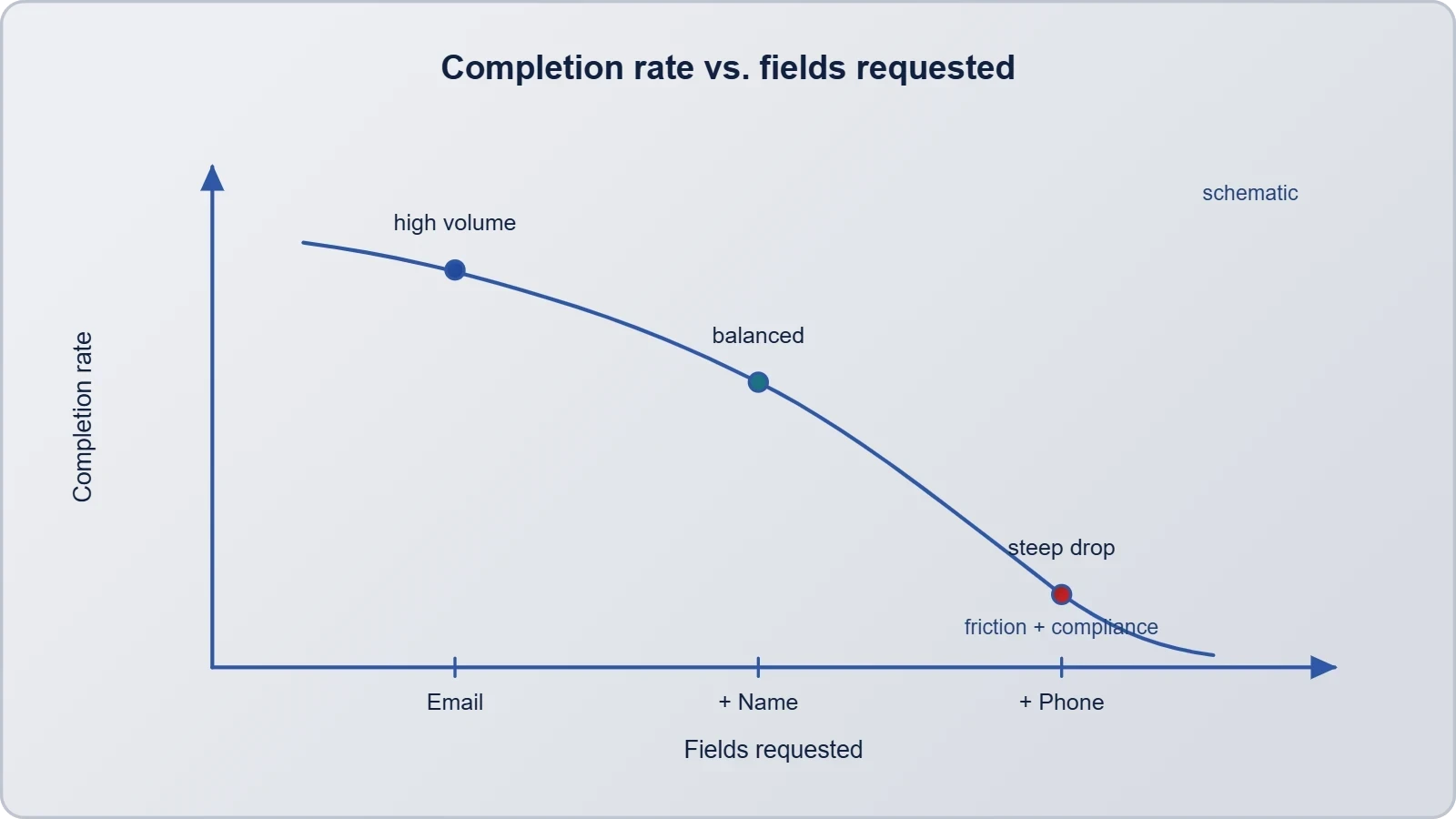
The instinct to collect everything is understandable. A full name personalises future messages, a phone number opens SMS and voice channels, and a company field enables segmentation by employer. Yet each additional input is a small friction tax, and friction compounds. Industry benchmarks consistently show completion rates falling as field counts rise, with the steepest drop occurring between the first and third required fields. The practical question is therefore not which details would be nice to have, but which details justify the conversion they cost — and that answer shifts depending on the audience, the offer, and the channel the list will ultimately serve.
This analysis works through that trade-off systematically. It examines what each field actually buys the marketer, how response rates behave as forms grow, where phone numbers earn their keep and where they quietly damage list quality, and how consent rules in different jurisdictions reshape the calculus. It closes with a decision framework that teams can apply to their own funnels rather than borrowing a universal template that fits no one in particular.
On This Page
- The Economics of Asking: What Each Field Actually Costs
- Email-Only Capture: Maximum Volume, Minimum Friction
- Name and Email: The Balanced Middle Ground
- Phone-Inclusive Capture: When the Channel Justifies the Cost
- Data Quality, Verification, and List Hygiene
- Testing, Measuring, and Choosing Your Form Configuration
- A Decision Framework for Choosing Your Fields
- Conclusion: The Right Ask Is the One Your Audience Will Answer
TL;DR Lead capture forms sit on a spectrum from minimal (email only) to expansive (name, email, phone, company). Each field added improves personalisation and channel reach but reduces completion rates, and the penalty is steepest for phone numbers, which carry both friction and compliance weight. Email-only forms maximise volume and suit content-led funnels; name-plus-email forms balance personalisation against friction; phone-inclusive forms make sense mainly for high-touch sales, appointment booking, and SMS-driven campaigns where the channel itself justifies the cost. The right configuration depends on offer value, audience expectations, traffic temperature, and the consent regime governing the list.
The Economics of Asking: What Each Field Actually Costs

Form fields are not neutral data containers; they are behavioural prompts that trigger micro-decisions in the visitor's mind. An email field asks for a low-stakes commitment that most people can satisfy from memory. A name field asks the visitor to type something they rarely type on mobile keyboards, introducing a small but measurable delay. A phone field asks for something considerably more intimate, and it invites the visitor to wonder who will call, when, and why — a chain of speculation that frequently ends in a closed tab rather than a completed form.
The cost side of the ledger is well documented across conversion research. Baymard Institute's form usability studies have repeatedly found that unnecessary fields are among the top causes of checkout and signup abandonment, and the same psychology applies to lead capture. Each field also carries a hidden maintenance cost: validation logic, error states, accessibility labelling, and the downstream data hygiene work of normalising inconsistent entries. A form that looks like four boxes on a page is, operationally, a small data pipeline with its own failure modes.
Response rates across common form configurations
Aggregated benchmarks from marketing platforms and conversion research firms converge on a consistent pattern. Single-field email forms typically convert in the high single digits to low double digits on cold traffic, while forms requiring four or more fields often fall below three percent. The decline is not linear; the first additional field costs relatively little, the second costs more, and phone numbers impose a disproportionate penalty because they combine typing effort with privacy anxiety and, in many markets, an expectation of unsolicited calls.
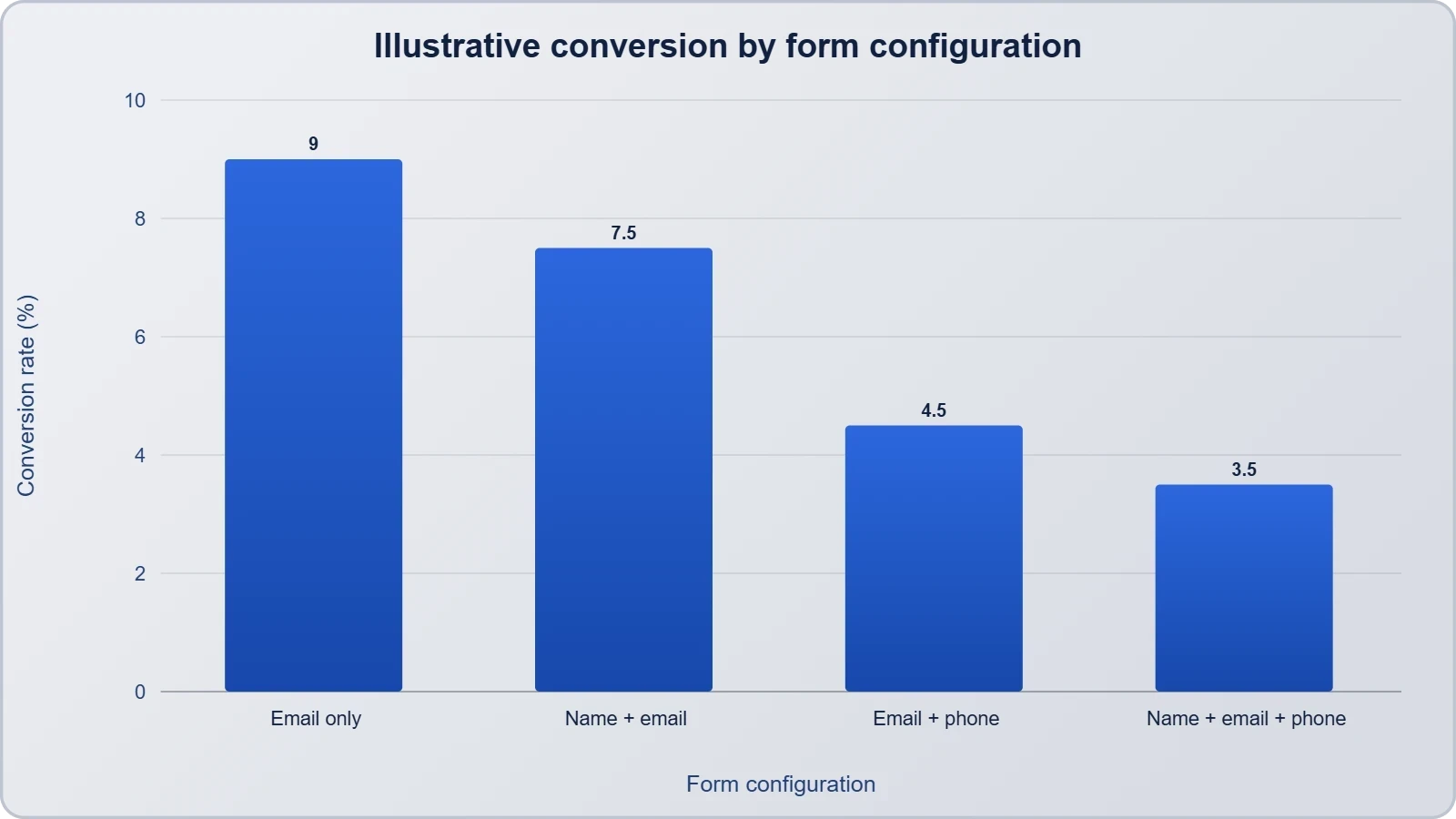
These figures should be read as directional rather than absolute. Offer quality dominates everything else: a genuinely valuable asset can sustain a longer form, while a thin lead magnet struggles even with a single field. Traffic temperature matters equally, since returning visitors and warm audiences tolerate more friction than first-time arrivals from paid social. The benchmark table below summarises the typical range teams should expect when testing each configuration against comparable offers.
Why the phone field carries outsized friction
Phone numbers occupy a different psychological category from email addresses. An email inbox is already crowded with marketing, so adding one more sender feels routine. A phone, by contrast, is a device people carry against their bodies, and the prospect of an unexpected call or text carries an intrusiveness that email does not. Research on consumer privacy attitudes repeatedly finds that mobile numbers rank among the most guarded personal identifiers, alongside home address and financial details, which explains why phone-inclusive forms shed respondents so sharply.
There is also a verification problem. Email addresses can be validated cheaply and in real time through syntax checks and domain verification, and deliverability tools catch typos before they pollute the list. Phone numbers are harder: formats vary by country, portability rules complicate validation, and a syntactically valid number may belong to a landline, a disconnected SIM, or someone entirely different from the person who filled the form. Teams that collect phones without a verification step routinely discover that a meaningful share of their numbers are unusable when the first SMS campaign goes out.
We Also Published
Email-Only Capture: Maximum Volume, Minimum Friction

The single-field email form remains the default for good reason. It imposes the smallest possible commitment, works comfortably on mobile keyboards, and produces the largest raw list per thousand visitors. For content-led businesses — newsletters, blogs, research publications — volume is the lifeblood of the model, and a large email list compounds over time as subscribers forward, share, and convert into customers at their own pace. The email address alone is sufficient to deliver the promised asset, nurture the relationship, and eventually make an offer.
The trade-off is personalisation depth. Without a name, every message must open generically, and segmentation must rely on behavioural signals — which links were clicked, which pages were visited, how recently the subscriber engaged — rather than demographic attributes. Modern email platforms have become remarkably good at behavioural segmentation, which has narrowed the gap. A well-instrumented email-only list can still deliver highly relevant messaging, provided the team invests in tracking and tagging discipline rather than leaning on first-name tokens as a substitute for genuine relevance.
Where email-only forms win decisively
Top-of-funnel content offers are the clearest case. A visitor downloading a checklist or subscribing to a weekly digest has made a casual commitment, and demanding a phone number for that exchange reads as disproportionate. The same logic applies to free trials of self-serve software, where the product itself will generate the behavioural data that a form could never capture. In both scenarios, the email address is the key that unlocks a relationship, and everything else can be learned later through usage and engagement.
Regulatory simplicity is another quiet advantage. Email marketing operates under well-established consent frameworks in most jurisdictions, and the compliance overhead of storing and processing email addresses is modest. Adding phone numbers pulls the organisation into a thicker web of rules governing SMS marketing, call timing, and do-not-call registries. For smaller teams without dedicated legal support, the email-only path keeps the compliance surface small and the operational focus where it belongs: on content and conversion.
Compensating for the missing name
Teams that choose email-only capture can recover much of the personalisation benefit through progressive profiling. Rather than asking for a name upfront, the form can request it later — after the subscriber has received value, opened several messages, and demonstrated engagement. A subscriber who has read six newsletters is far more willing to share a first name than a stranger who has just landed on a page. This staged approach converts the form from a single gate into a gradual conversation, and it typically produces higher-quality data because the people who supply it are genuinely invested.
Behavioural signals can also substitute for demographic ones. Click patterns reveal topic preferences, open timing reveals reading habits, and reply behaviour reveals intent. A subscriber who consistently opens pricing-related content is a warmer sales prospect than one whose job title suggests budget authority but who never engages. The lesson is that personalisation is ultimately about relevance, and relevance can be inferred from behaviour far more reliably than it can be declared in a form field.
Name and Email: The Balanced Middle Ground
Adding a first name to the email field represents the most common compromise in list building, and for many businesses it is the right one. The additional friction is modest — most people can type their first name without breaking flow — while the payoff is a measurable lift in email engagement. Personalised subject lines and greetings consistently outperform generic ones in split tests, and the effect is strongest in the early stages of a relationship when recognition matters most. The name also enables basic segmentation by inferred gender or cultural context, though teams should use such inferences cautiously.
The full name variant, requiring both first and last name, sits further along the friction curve. It supports formal correspondence, helps deduplicate records in CRM systems, and enables matching against external data sources for enrichment. For B2B contexts where the lead will eventually be handed to a sales representative, a full name is close to essential. For consumer newsletters, the last name rarely earns its keep, and many teams sensibly drop it to keep the form lean while retaining the first-name benefit.
Personalisation gains versus completion losses
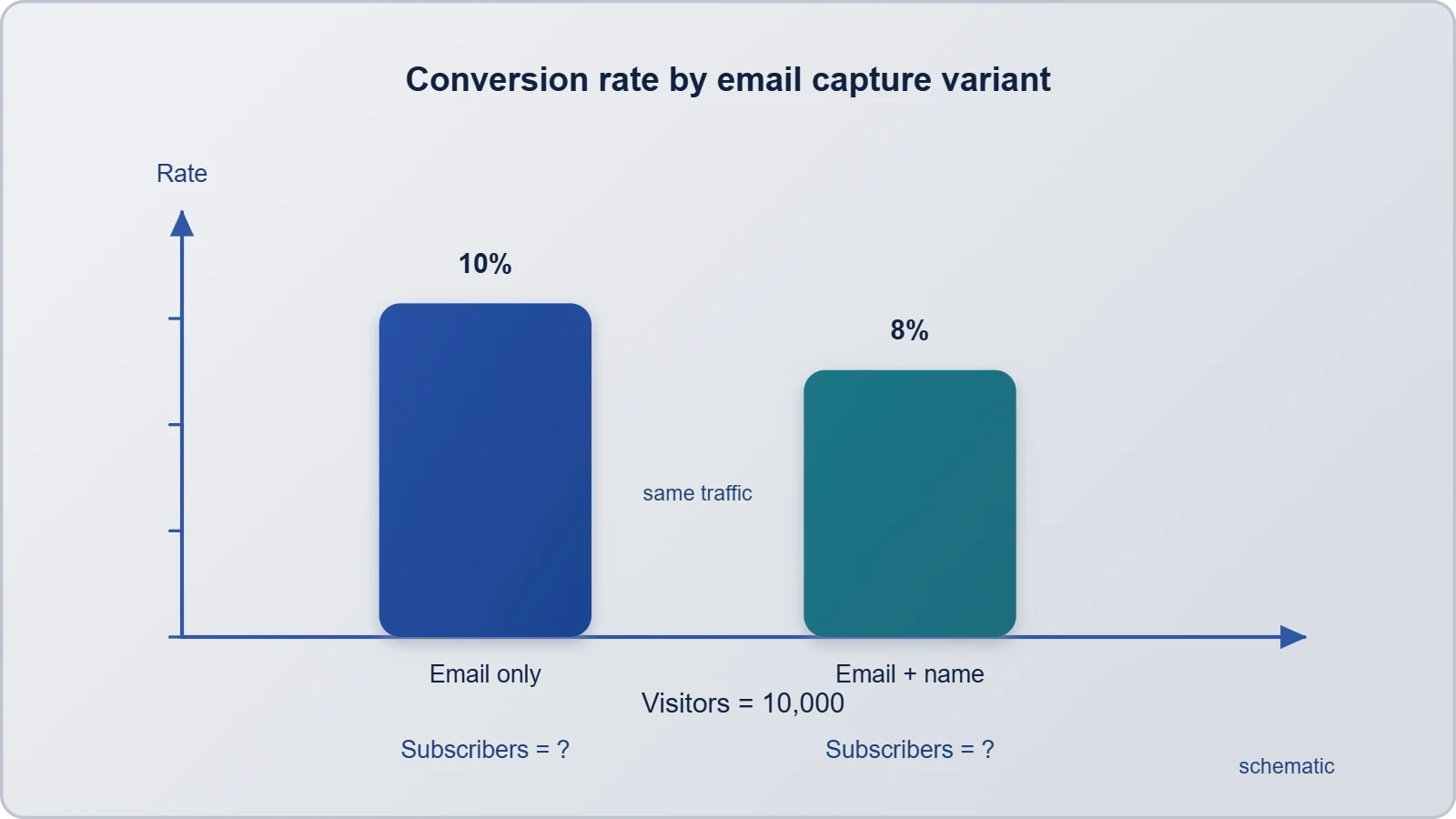
The arithmetic of this trade-off deserves explicit attention because it is frequently miscalculated. Suppose an email-only form converts ten percent of 10,000 visitors, yielding 1,000 subscribers. A name-plus-email form converting eight percent yields 800 subscribers, but each of those subscribers receives more engaging messages. If personalisation lifts click-through rates by twenty percent, the smaller list can generate more total clicks than the larger one. The calculation depends entirely on the size of the personalisation lift, which is why split testing rather than assumption should govern the decision.
In practice, the lift from first-name personalisation varies widely by audience and message type. Transactional and welcome messages benefit most, while long-form editorial content benefits least. Teams should measure the effect within their own list rather than importing benchmarks from elsewhere, because the same token that feels warm in one brand's voice can feel presumptuous in another's. The form decision and the messaging decision are linked, and treating them as separate optimisation problems leads to incoherent results.
When the middle ground becomes the default
For most consumer-facing businesses with a content or community orientation, the name-plus-email configuration is a sensible default. It captures enough identity to make messages feel human without imposing the privacy cost of a phone number. E-commerce brands use it to personalise order updates and recommendations; publishers use it to greet subscribers warmly; course creators use it to address students directly. In each case, the first name does real work in the relationship, and the friction it adds is repaid through engagement.
The configuration also plays well with progressive enrichment. Once a subscriber is on the list with a name and email, additional attributes can be gathered through surveys, preference centres, or behavioural inference. This layered approach keeps the initial ask modest while building a rich profile over time. The key discipline is to treat the form as the beginning of a data relationship rather than its entirety, and to design every subsequent touchpoint as an opportunity to learn a little more without demanding too much at once.
Phone-Inclusive Capture: When the Channel Justifies the Cost
There are genuine scenarios in which asking for a phone number is the correct decision, and they share a common characteristic: the phone channel itself is central to the value being delivered. Appointment-based services — clinics, salons, home repair, financial advice — need to reach people quickly and confirm timing, and SMS reminders dramatically reduce no-show rates. High-ticket sales conversations often begin with a call, and a prospect who volunteers a number is signalling seriousness in a way that an email address alone does not convey. In these contexts, the phone field filters for intent as much as it collects data.
Urgent or time-sensitive offers also justify the ask. A limited-seat event, a flash sale with a closing window, or a service disruption notification all benefit from a channel that reaches people immediately rather than whenever they next check their inbox. The marketing logic is straightforward: if the message loses most of its value when delayed, the phone number earns its friction. If the message would read equally well tomorrow, the phone number is probably an unnecessary tax on conversion.
High-touch sales and appointment-driven funnels
In B2B environments where a sales development representative will follow up within hours, phone numbers accelerate qualification. A form that captures name, email, phone, and company gives the representative multiple paths to reach the prospect and signals that the prospect expects contact. The conversion rate on the form will be lower, but the conversion rate from lead to meeting is often higher, because the people who complete a longer form have self-selected as serious. The correct metric is therefore cost per qualified opportunity rather than cost per lead, and the longer form frequently wins on that measure.
Appointment-driven consumer services follow similar logic. A dental practice or a tutoring service that collects a phone number can confirm bookings by text, send reminders, and reschedule efficiently. The operational savings from reduced no-shows often exceed the marketing cost of the lower form completion rate. The critical caveat is consent: the practice must obtain clear permission for SMS communication and honour opt-outs promptly, or the channel that was meant to build the relationship will damage it instead.
Compliance obligations that travel with phone data
Phone numbers activate a dense layer of regulation that email addresses largely avoid. In the United States, the Telephone Consumer Protection Act governs automated calls and texts, requires prior express written consent for marketing messages, and imposes statutory damages that have funded substantial class actions. In the European Union, the General Data Protection Regulation treats phone numbers as personal data subject to lawful basis, minimisation, and retention rules, while the ePrivacy Directive adds specific consent requirements for electronic marketing. India's telecom regulations and do-not-disturb registries impose their own constraints.
The practical implication is that phone collection should never be an afterthought bolted onto a form template. Teams need a documented consent mechanism, a clear record of when and how consent was given, an accessible opt-out path, and a retention policy that removes numbers no longer needed. These requirements are manageable, but they demand deliberate design. A form that collects phone numbers without a consent checkbox and a privacy notice is not merely a conversion risk; it is a legal exposure that can dwarf any marketing gain.
- 01
- 02
- 03
- 04
Data Quality, Verification, and List Hygiene
The quality of a list is not determined by its size but by the proportion of records that are accurate, reachable, and genuinely interested. A smaller list of verified, engaged contacts consistently outperforms a larger list riddled with typos, fake entries, and disengaged subscribers. This principle should shape form design directly: every field added should be paired with a validation strategy, and every record collected should have a defined path to verification. Forms that collect data without verification simply defer the cleanup cost to the first campaign.
Email verification has matured into a reliable discipline. Real-time syntax checks catch obvious errors, domain verification flags non-existent or disposable providers, and periodic list cleaning removes addresses that have gone dormant or hard-bounced. Phone verification is more involved but increasingly accessible through SMS one-time passcodes, which confirm both that the number is real and that the person holding the device consents to being contacted. The verification step adds friction, but it converts a speculative number into a usable channel.
Bounce rates, fake entries, and the cost of a dirty list
Unverified lists impose costs that compound quietly. High bounce rates damage sender reputation, which in turn reduces deliverability for legitimate messages, creating a downward spiral that can take months to reverse. Fake entries — often submitted by people who want the lead magnet without the follow-up — inflate list size while depressing engagement metrics, and they can trigger spam trap hits that further harm reputation. The economics are unforgiving: a list that looks impressive in a dashboard can be a liability in the inbox.
Phone lists carry analogous risks. Invalid numbers waste SMS credits, and repeated messages to wrong numbers generate complaints that can lead to carrier filtering. The remedy is the same as for email: verify at the point of collection where possible, clean periodically, and remove records that fail verification rather than retaining them in hope. List hygiene is unglamorous work, but it is the difference between a marketing channel that scales and one that quietly degrades.
Progressive profiling as a hygiene strategy
Progressive profiling improves both data quality and conversion by spreading the collection burden across multiple interactions. Instead of demanding four fields at once, the form asks for one, then another at a later touchpoint, and so on. Each request is smaller, each response is more considered, and the resulting profile is built from voluntary disclosures rather than forced compliance. The approach also creates natural verification points, since each new interaction confirms that the contact is still reachable and still interested.
The technique works best when the requests are contextual. Asking for a company name when someone downloads a B2B report feels natural; asking for it when someone subscribes to a recipe newsletter feels intrusive. Asking for a phone number when someone books a consultation is expected; asking for it when someone downloads a white paper is not. Contextual relevance is the lubricant that makes progressive profiling feel like a conversation rather than an interrogation, and it is the single most reliable way to build a rich list without sacrificing conversion.
Testing, Measuring, and Choosing Your Form Configuration
The only reliable way to choose a form configuration is to test it against your own audience, offer, and traffic. Benchmarks provide a starting hypothesis, but they cannot account for the specific value of your lead magnet, the expectations of your audience, or the temperature of your traffic. A disciplined testing programme replaces speculation with evidence, and it turns the form from a static template into a continuously optimised asset. The testing discipline matters more than any single configuration choice.
Effective testing begins with a clear primary metric. If the goal is list growth for a content business, completion rate and subscriber volume are the right measures. If the goal is qualified sales conversations, cost per opportunity and meeting-booking rate matter more. Mixing these metrics leads to confused conclusions, such as celebrating a higher completion rate on a form that produces fewer sales-ready leads. Define the metric before the test, and resist the temptation to reinterpret it afterwards.
Designing a clean split test for form fields
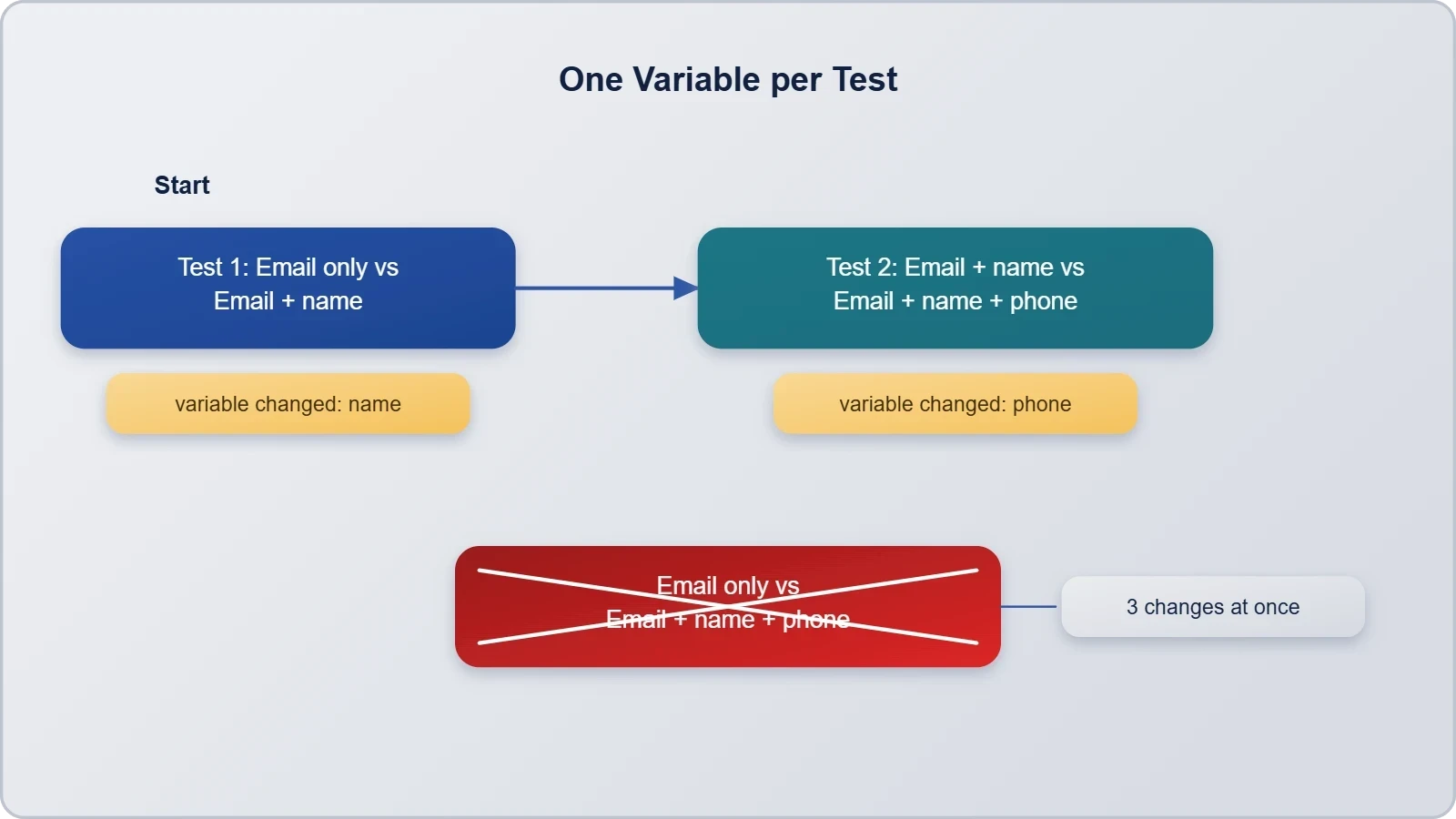
A clean test changes one variable at a time. Comparing an email-only form against a name-plus-email-plus-phone form conflates three changes and yields a result that cannot be attributed. A better sequence tests email-only against email-plus-name first, then introduces the phone field in a subsequent test once the name question is settled. Each test should run long enough to reach statistical significance, which typically means several thousand visitors per variant for forms converting in the single digits.
Traffic allocation deserves care. Randomising at the visitor level avoids the bias that arises when different traffic sources see different variants, and excluding returning visitors from the test prevents contamination from prior exposure. The measurement window should extend beyond the form submission to capture downstream behaviour — open rates, click rates, and conversion to purchase — because the variant that produces fewer but better subscribers may win on the metrics that matter. Testing the form alone without tracking downstream outcomes is a recipe for optimising the wrong thing.
Reading the results without fooling yourself
Statistical significance is necessary but not sufficient. A result can be significant and still misleading if the test period coincided with a seasonal shift, a paid campaign, or a site change. Teams should check for external confounds, run the test across multiple weeks where possible, and replicate any surprising result before rolling it out permanently. The most common error is to declare victory after a few days of favourable data, only to watch the effect evaporate once the sample grows.
Segment-level analysis often reveals more than the headline number. A form that performs worse overall may perform better among high-intent traffic, or among mobile users, or among visitors from a particular channel. These interactions are where the real insight lives, and they frequently suggest hybrid solutions — a short form for cold social traffic, a longer form for organic search visitors who arrive with clearer intent. The goal is not a single universal form but a configuration that matches each traffic segment's willingness to engage.
A Decision Framework for Choosing Your Fields
Choosing a form configuration becomes tractable once the decision is broken into a few structured questions. What is the value of the offer, and how much friction will it bear? What channel will the list serve, and does that channel require a phone number? How warm is the traffic, and how much trust has already been established? What consent regime applies, and what verification can be performed at the point of collection? Answering these questions honestly usually narrows the options to one or two sensible configurations.
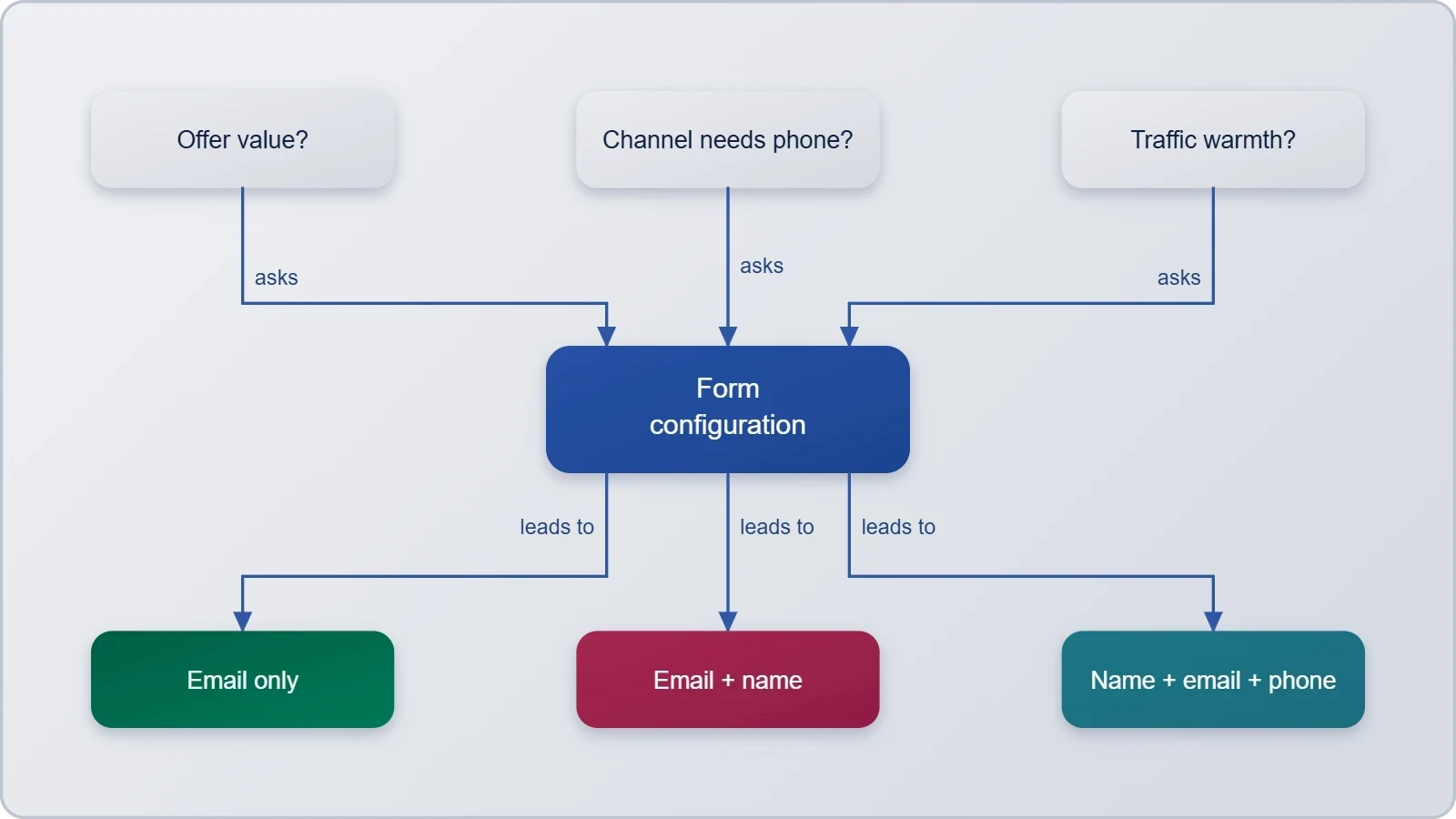
The framework should be applied per funnel rather than per company. A business may reasonably run an email-only newsletter form, a name-plus-email course registration, and a phone-inclusive consultation booking, each matched to its context. Treating the form as a single global setting forces compromises that serve no one. Treating it as a per-funnel design decision allows each capture point to optimise for its own audience and purpose, which is ultimately how the best-performing marketing operations are structured.
Matching fields to funnel stage and offer value
Top-of-funnel offers — checklists, guides, newsletters — should lean toward minimal fields. The visitor is making a casual commitment, and the relationship has not yet earned the right to ask for more. Mid-funnel offers — courses, webinars, templates — can justify a name alongside the email, since the visitor has demonstrated deeper interest. Bottom-of-funnel offers — consultations, demos, trials — can reasonably request a phone number, because the visitor is signalling intent to engage in a substantive conversation.
Offer value scales the calculus further. A genuinely scarce asset, such as original research or access to a limited cohort, can sustain a longer form because the perceived value justifies the effort. A generic ebook cannot. The mistake many teams make is to assume their offer is more valuable than it is, then blame the audience when the form underperforms. Honest assessment of offer value, ideally validated through testing, is the foundation on which every other form decision rests.
Segmenting forms by traffic source and intent
Traffic source carries strong signals about intent. Organic search visitors arrive with a specific question and often convert well on slightly longer forms because they are actively seeking the answer. Paid social visitors arrive with lower intent and respond better to minimal friction. Email subscribers clicking through from a previous relationship can be asked for more, since trust already exists. Referral traffic from a trusted partner sits somewhere in between, depending on the partner's credibility with the audience.
Segmenting forms by source is technically straightforward with modern landing page tools, and the gains can be substantial. A single form applied to all traffic forces a compromise that under-serves both the high-intent and low-intent segments. Two forms — a lean one for cold social, a fuller one for organic and email — allow each segment to be met where it is. The operational cost is modest, and the improvement in both volume and quality usually justifies the effort within a single quarter.
Building a form that respects the visitor
Beyond the mechanics of fields and conversion rates, there is a matter of respect that shapes long-term list health. A form that asks only for what it needs, explains why it needs it, and delivers on its promise builds trust that compounds across every subsequent interaction. A form that overreaches, hides its intentions, or buries consent in fine print may win a short-term conversion but loses the relationship that the conversion was meant to start. The most durable lists are built on forms that feel fair.
This principle has practical implications. Every field should have a stated purpose, visible to the visitor. Consent should be explicit rather than assumed. The promised asset should arrive promptly and match its description. Unsubscribe and opt-out mechanisms should be easy to find and immediate in effect. None of these practices is novel, but together they distinguish forms that build lists from forms that harvest data. The former produces subscribers who stay, engage, and buy; the latter produces a database that looks impressive and performs poorly.
Conclusion: The Right Ask Is the One Your Audience Will Answer
The question of which contact details to request has no universal answer, and that is precisely the point. Email-only forms maximise reach and suit content-led models; name-plus-email forms balance personalisation against friction; phone-inclusive forms earn their cost only when the phone channel is central to the value delivered. The correct choice emerges from a clear-eyed assessment of offer value, traffic intent, channel requirements, and compliance obligations, validated through disciplined testing rather than borrowed benchmarks.
What unites every good configuration is respect for the visitor's attention and privacy. A form that asks only for what it needs, explains why, delivers promptly, and honours opt-outs builds a list that grows in value over time. A form that overreaches may produce a larger database but a weaker relationship. In the long run, the list that answers is worth more than the list that merely exists, and the form is where that distinction is decided.
From our network :
- CISA’s Ten-Advisory Wave: Why Generic Patching Fails in OT and How to Build Product-Specific PlaybooksCISA released ten ICS advisories in one week, exposing critical infrastructure risks. Generic patching fails in OT. Learn to build product-specific remediation playbooks.
- The Hidden Cost of AI Convenience: Why Over-Permissioned Agents Are a Security Time BombDiscover why AI agents with excessive permissions create dangerous single points of failure, and learn how implementing least privilege principles can protect your organization from exploitation.
- The Final Descent: How ESA Retired the Legendary Cluster Constellation After 24 Years of Space Weather ScienceAfter 24 years mapping Earth’s magnetosphere, ESA’s Cluster mission concluded with a precisely controlled reentry over the South Pacific. This analysis explores the scientific legacy, engineering decisions, and debris mitigation principles behind one of space exploration’s most responsible retirements.
- Committed Mediterranean Precipitation Decline: Why Emissions Cuts Alone Cannot Restore Winter RainsNew NOAA research reveals that Mediterranean winter rains may decline irreversibly even with emissions cuts. Explore the science of committed climate change and regional impacts.
- Forbidden Matrix Patterns and Visible Lattice Points: A Geometric DictionaryExplore how multidimensional 0–1 matrices encode geometric truths, linking forbidden patterns to visible lattice points and hypergraph theory, with applications in combinatorics and computational geometry.
- How AI Agents Will Change the Way We Manage Personal FinancesExplore how AI agents are transforming personal finance through automated budgeting, bill payment, and investment management, while examining the critical security protocols and governance frameworks required for safe deployment.
- Live Online English Classes for Kids: Do They Actually Reduce Anxiety?A ten-week study reveals that synchronous online English classes can significantly reduce child language anxiety while improving listening and reading skills. Discover what makes these programs effective and how parents can select the right one.
- Mobile Learning and VR in English: What Global Evidence Reveals About Effective Language TechnologyA systematic review across 14 countries reveals which language-learning technologies genuinely work. Mobile learning, AI, and VR show measurable benefits when pedagogically integrated. This evidence-based guide helps educators and learners select technology that delivers real return on investment.
- University Language Proficiency Exams: Why Institutional Tests Demand Different Preparation Than IELTS and TOEFLDiscover why university-specific language proficiency examinations differ fundamentally from IELTS and TOEFL, and learn strategic preparation approaches for institutional assessment success.
RESOURCES
- Best way to capture leads at events with no internetcommunity.hubspot.comFeb 27, 2018 ... ... data, like complete missing emails, phone numbers, and postal addresses. ... Any recommendations for capturing lead data from a…
- The Lead Capture Form | Popl Help Centersupport.popl.coNov 12, 2026 ... Popl's standard fields, like name, email, phone, and company. Phone ... Messages you and your leads receive after Lead Capture…
- Capture Leads | Storylane Docsdocs.storylane.ioMay 13, 2026 ... Storylane's Native Lead Form. This form provides two configurable fields: email and name (optional). New: Add a lead form right…
- Capturing Leads and Contacts with Contact Formshelp.pixieset.comWhen a lead submits the form, Studio Manager will use the information provided in these fields to generate a contact profile. First Name and…
- Lead Capture - Chili Piperchilipiper.comSep 13, 2021 ... Learn about lead capture and the different ways to capture more leads ... and email address or phone number. Some…
- Lead Distribution & Routing — Sub-Second Webhook Deliveryleadcapture.ioCapture email and phone before form completion · Deliver partial leads with metadata flagging · Configurable delay before partial lead delivery · Deduplicate when ...
- Capturing Leads | MetaLocator Help Centersupport.metalocator.comMay 14, 2026 ... The lead form defines the fields users complete when ... Lead delivery and email formatting are controlled in the Lead…
- Capturing Leads from Facebook - Propertybase Salesforcehelp.propertybase.comSep 11, 2025 ... ... field names of the Facebook form fields to be in English in order to capture first and last name,…
- Setting Up Lead Capture/Collection for Your Website - Planning Podplanningpod.comEmail Address; Event Name. These are the elements you can customize in the form: Edit the headline and introductory text that ...
- How to capture leads at a trade show: the 2026 checklist - Swopiswopi.coSep 29, 2026 ... How to capture leads at a trade show: a before, during and after checklist, qualification questions, lead form fields and…
- Lead capture pricing | Blinq Help Centersupport.blinq.meBulk enrichment, where an admin uploads a list and Blinq adds verified emails and phone numbers, uses credits. ... Hidden fields on lead capture…
- Lead Generation by Email Parsing and Ready-To-Go Formhelp.arbostar.com... and customization options, making it easy to capture and process leads. ... Required fields for submission include Name, Phone Number, Email Address ...
- Use Form Enrichment to Capture More Leads with Deeper Insightsknowledge.apollo.ioJul 1, 2026 ... Apollo fills out known fields for the prospect based on the prospect's email address, saving your prospect time and effort…
- Facebook lead ads - Customer.io Documentationdocs.customer.ioNov 3, 2026 ... To take advantage of this integration: Your Facebook lead ad forms must have a required field mapped to email or…
- Lead Capture Form for Contractors - Projulprojul.comWhy Your Website Is Losing Leads. Most contractor websites have a “Contact Us” page with a phone number and maybe a generic email address.…
- 01
- 02
- 03
- 04
- 05
- 06
- 07
- 08
0 Comments