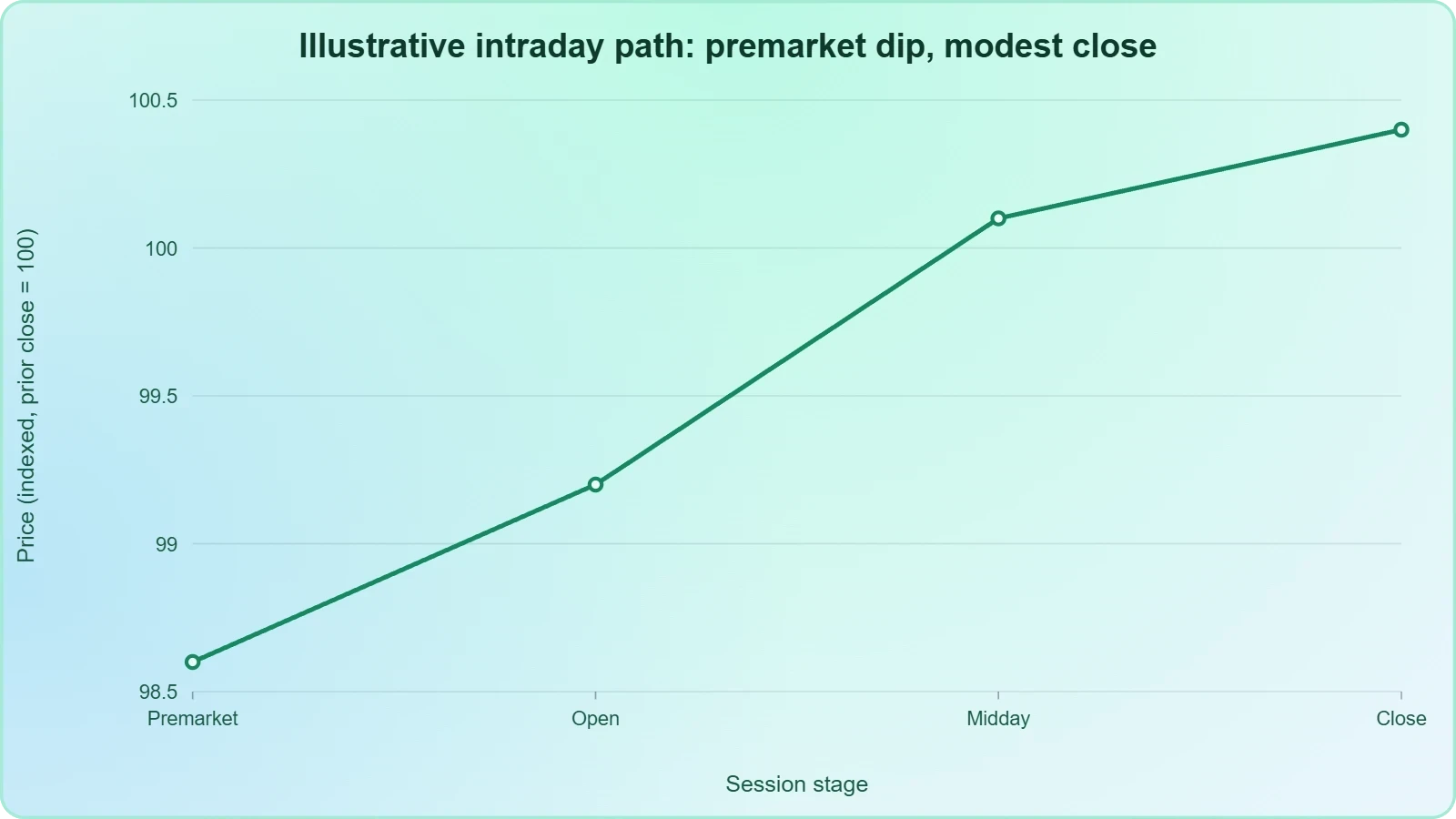
On November 3, 2026, a seemingly routine trading session for Marvell Technology carried an outsized narrative weight. The semiconductor and data-infrastructure specialist saw its shares slip in premarket activity, then reverse course and close modestly higher after the market absorbed news of a $115 billion transaction involving Lumentum. The intraday arc — early weakness followed by a quiet recovery — is the kind of price action that rewards careful reading rather than reflexive reaction. What matters here is not the size of the headline alone, but what the market's behavior reveals about how investors are pricing risk, integration, and strategic ambition in the optical and networking silicon supply chain.
The original report, drawn from The Globe and Mail's markets coverage, is deliberately sparse. It confirms the premarket decline, the eventual small gain, and the existence of a $115 billion deal involving Lumentum, yet it does not specify the cause of the early drop or detail the transaction's structure. That restraint is itself instructive. In financial journalism, the absence of explanation often signals that the market is still forming its view, and that the first price print reflects positioning and liquidity more than conviction. Investors reading such coverage should distinguish between the event and the interpretation, because the two frequently diverge in the opening hours of trading.
This analysis reconstructs the meaning behind that brief dispatch and situates it within the broader logic of semiconductor consolidation, optical networking demand, and the psychology of merger arbitrage. It examines why a multi-hundred-billion-dollar deal would produce a muted rather than euphoric response, how premarket moves can mislead, and what the episode teaches about evaluating corporate announcements that arrive with more scale than specificity. The goal is to convert a thin news item into a durable framework for reading similar market events with discipline and proportion.
On This Page
TL;DR Marvell Technology's shares fell in premarket trading on November 3, 2026, then recovered to close slightly higher after news of a $115 billion deal involving Lumentum. The muted reaction suggests investors were weighing integration risk, financing structure, and strategic fit rather than celebrating headline scale. The episode illustrates how premarket price action often reflects positioning and thin liquidity rather than informed judgment, and why disciplined readers should separate an announcement's magnitude from its economic substance. Understanding the optical networking context and merger-arbitrage dynamics turns a sparse report into a useful lens for evaluating future semiconductor consolidation.
The Anatomy of a Muted Market Reaction
A $115 billion transaction is, by any measure, a landmark event in the technology sector. Yet Marvell's shares responded with a premarket dip and a fractional close, a reaction that seems almost incongruous against the deal's scale. This dissonance is the central puzzle of the episode. Markets do not price headlines; they price expected cash flows, execution probability, and the cost of capital required to complete a transaction. When a deal of this magnitude produces only a modest move, the implication is that investors have already begun discounting the complexities — regulatory review, financing, and operational integration — that accompany such ambition.
The premarket session deserves particular scrutiny because it operates under conditions that amplify noise. Trading volumes are thin, market makers widen spreads, and overnight news from other regions can distort the opening print. A decline before the bell therefore carries less informational weight than the same move during regular hours. The recovery by the close suggests that as liquidity deepened and more participants formed views, the initial pessimism was tempered. This pattern — early overreaction followed by calibration — is a recurring feature of how markets digest complex corporate news.
Why Premarket Moves Mislead
Premarket trading is a peculiar environment where price discovery is incomplete and conviction is scarce. Institutional investors often refrain from committing size before the opening auction, leaving the field to algorithmic strategies and retail flow that react to headlines rather than fundamentals. A stock can therefore fall sharply on a single interpretation and recover entirely once the broader market weighs in. Marvell's trajectory on November 3 fits this template precisely, and it argues for treating premarket direction as a signal of sentiment rather than a verdict on value.
The recovery to a small gain also reveals something about the deal's perceived risk profile. Had investors judged the transaction as value-destructive, the stock would likely have remained depressed through the session. Instead, the market settled into a posture of cautious acceptance, implying that the strategic rationale was recognized even if the financial details remained opaque. That distinction — between skepticism about execution and rejection of the premise — is essential for interpreting how merger news is absorbed over subsequent sessions.
The Information Gap and Its Consequences
The source report explicitly notes that the reason for the premarket drop was not specified, and that no further details about the deal or its impact were provided. This information gap is not incidental; it shapes how every reader should interpret the event. When a transaction of this size is announced without granular disclosure of consideration, financing, or synergies, the market must price a range of outcomes rather than a point estimate. That uncertainty naturally compresses the immediate price reaction, because investors cannot confidently assign a premium or discount without knowing the structure.
For analysts, the gap creates a temporary vacuum that rumor and speculation rush to fill. Some participants may assume equity dilution, others may anticipate debt-funded accretion, and the resulting crosscurrents produce exactly the kind of choppy, indecisive price action observed. The lesson is that sparse disclosure is itself a market variable. Until the terms are clarified, the stock trades on narrative rather than arithmetic, and narrative-driven pricing is inherently unstable.
Marvell, Lumentum, and the Optical Networking Supply Chain
To understand why this deal matters, one must appreciate the strategic terrain on which Marvell and Lumentum operate. Marvell has spent years repositioning itself from a broad-based chipmaker into a focused supplier of data infrastructure silicon, with particular strength in custom compute, electro-optics, and networking. Lumentum occupies the optical components layer, producing lasers, photonic integrated circuits, and subsystems that underpin high-speed data transmission. A transaction linking these capabilities speaks directly to the insatiable bandwidth demands of artificial intelligence clusters and hyperscale data centers.
The $115 billion figure places the deal among the largest in semiconductor history, comparable in ambition to the industry's most consequential consolidations. Such scale reflects not merely the target's standalone value but the strategic premium attached to optical interconnect technology, which has become a bottleneck in scaling AI infrastructure. As compute density rises, the movement of data between chips, racks, and facilities becomes the limiting factor, and companies that control photonic components gain leverage over the entire stack. That logic explains why the market treated the announcement as significant even while hesitating on the details.
The Strategic Logic of Vertical Integration
Vertical integration in semiconductors has oscillated between fashion and folly over the decades, but the current cycle favors control over critical components. By bringing optical expertise in-house, a networking silicon vendor can co-design photonics with switching and compute silicon, shortening development cycles and capturing more value per system. This is the same rationale that has driven consolidation across the analog, automotive, and AI accelerator segments. The appeal is not merely cost synergy but architectural coherence — the ability to deliver integrated solutions that competitors sourcing components externally cannot easily match.
Yet integration carries well-documented hazards. Acquiring a large optical supplier introduces cultural friction, divergent process technologies, and customer conflicts, since Lumentum's components are sold to many of Marvell's own customers and rivals. Managing those relationships requires delicate commercial diplomacy. The market's muted response may partly reflect awareness that vertical integration promises architectural advantage while simultaneously creating channel complexity that can erode the very customer trust the deal is meant to deepen.
Demand Tailwinds and Cyclical Risk
The optical networking market is enjoying powerful tailwinds from AI infrastructure spending, cloud capacity expansion, and the migration to higher-speed optical links. These forces have lifted demand for lasers, transceivers, and photonic integrated circuits, making optical assets strategically scarce. A large acquisition timed to this cycle captures growth while assets are valued richly, which is both an opportunity and a risk. Paying a premium during a demand peak exposes the acquirer to cyclical reversal if hyperscale capital expenditure decelerates faster than expected.
Investors must therefore weigh structural demand against cyclical timing. The long-term case for optical interconnect is compelling, but the entry price matters enormously. A $115 billion commitment concentrates exposure to a single strategic bet, and the market's restrained reaction suggests participants are balancing enthusiasm for the thesis against concern about the price paid and the leverage required. That tension between secular conviction and cyclical caution is the defining feature of semiconductor M&A in the current era.
Reading Merger Arbitrage and Deal Psychology
Merger arbitrage is the discipline of pricing the probability that a proposed transaction will close, and it offers a useful lens for interpreting Marvell's session. When a deal is announced, the target's stock typically trades at a discount to the offer price, reflecting time value and completion risk. The acquirer's stock, by contrast, moves according to whether investors believe the deal creates or destroys value. A modest gain in the acquirer suggests the market assigns a slight positive expected value, tempered by meaningful uncertainty about terms and execution.
The psychology at work is subtle. Large acquisitions trigger a cascade of questions: How is the consideration structured? What leverage is involved? Which synergies are credible? Absent answers, arbitrageurs and long-only investors adopt defensive postures, and the resulting price action can look indecisive. The premarket drop may have reflected short-term traders positioning for dilution fears, while the recovery reflected longer-horizon investors recognizing strategic merit. Both reactions are rational within their respective time frames, which is why the same news can produce divergent interpretations.
Signaling and the Cost of Ambiguity
Corporate announcements are signaling events, and the signal's clarity matters as much as its content. A deal disclosed with full terms communicates confidence and allows precise valuation; a deal disclosed with scale but sparse detail invites ambiguity. The market penalizes ambiguity through wider spreads and lower conviction, which manifests as muted price moves rather than dramatic ones. Marvell's experience illustrates this principle: the headline was enormous, but the informational payload was thin, and the stock behaved accordingly.
There is also a reputational dimension. Management teams that announce transformative deals without accompanying detail risk eroding credibility if subsequent disclosures disappoint. Conversely, a disciplined communication strategy that pairs ambition with transparency can sustain investor trust through the integration period. The market's eventual verdict will depend less on the announcement day than on the cadence and quality of information that follows, which is why the coming quarters matter more than the initial print.
Valuation Under Uncertainty
When key terms are unknown, valuation becomes a probability-weighted exercise rather than a single calculation. Analysts construct scenarios — accretive, dilutive, and neutral — and assign likelihoods based on management's track record and industry norms. The expected value of these scenarios, discounted for risk, determines the fair price. A small positive close implies the market's probability-weighted assessment tilted modestly favorable, even as the variance around that estimate remained wide.
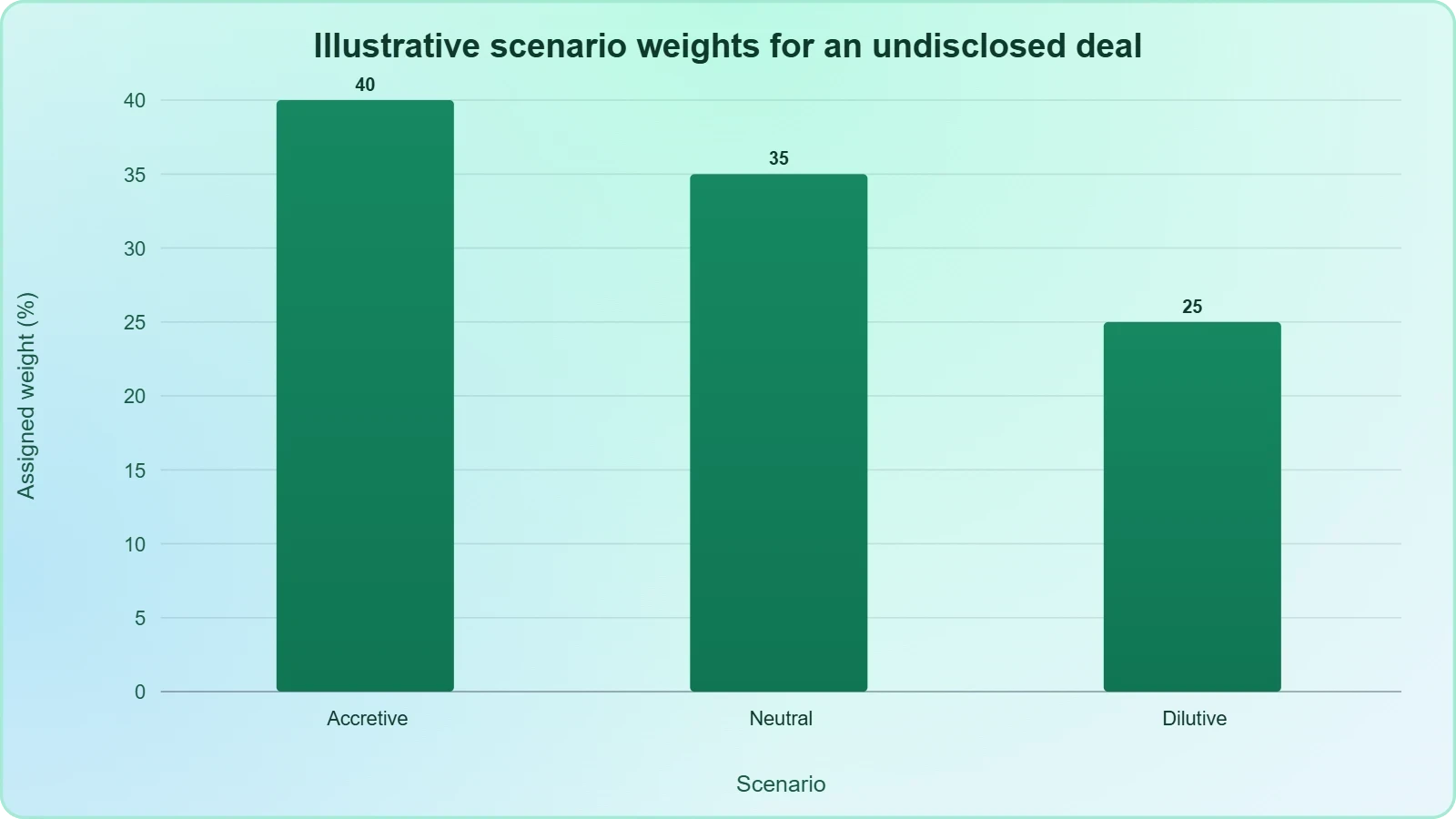
This scenario-based approach is more honest than pretending precision exists where it does not. Investors who demand exact figures before forming a view will often miss the window in which prices adjust. Those who reason in ranges and update as information arrives tend to navigate such events more effectively. The Marvell episode is a compact case study in that discipline, demonstrating how probabilistic thinking outperforms binary reaction when disclosure is incomplete.
Semiconductor Consolidation in a Strategic Context
The Marvell-Lumentum transaction belongs to a broader wave of consolidation reshaping the semiconductor industry. Scale has become a competitive necessity as research and development costs climb, fabrication capacity tightens, and customers demand integrated solutions rather than discrete components. Companies that once competed on individual chips now compete on platforms, and platforms require breadth. This structural shift explains why deals of extraordinary size keep appearing, and why markets have grown somewhat accustomed to them even as each announcement carries distinct risk.
Geopolitical considerations add another layer. Semiconductor supply chains are increasingly shaped by export controls, national industrial policy, and the desire for resilience over pure efficiency. Consolidation that concentrates optical and networking capabilities within a single firm can be viewed through both commercial and strategic lenses, and regulators may scrutinize such deals with heightened attention. The market's caution on announcement day may partly anticipate extended review periods, which delay synergy realization and prolong uncertainty for shareholders.
Lessons From Prior Mega-Deals
History offers instructive parallels. Large semiconductor acquisitions have sometimes delivered transformative value and sometimes destroyed it, with the difference often traceable to integration discipline and price paid. Deals struck at cyclical peaks have tended to underperform, while those executed with clear architectural logic and conservative financing have fared better. The pattern suggests that scale alone is neither virtue nor vice; what matters is whether the combined entity can innovate faster and serve customers better than the sum of its parts.
Investors would do well to track integration milestones rather than announcement-day theatrics. Retention of key engineering talent, continuity of customer relationships, and the pace of product co-development are the real indicators of success. These signals emerge over quarters, not hours, and they reward patience over reaction. The muted close on November 3 may ultimately prove wiser than either euphoria or panic, reflecting a market that has learned to wait for evidence.
Implications for the Optical Ecosystem
Consolidation at the top of the supply chain reverberates through the optical ecosystem. Smaller component suppliers may face pressure as a combined entity gains bargaining power, while customers may seek to diversify sourcing to avoid dependence on a single vendor. These second-order effects can reshape competitive dynamics in ways that announcement-day analysis rarely captures. The strategic consequences extend well beyond the two companies involved, touching equipment makers, hyperscalers, and the broader photonics innovation community.
For the industry, the deal signals that optical interconnect has moved from supporting role to strategic centerpiece. That elevation should attract capital and talent, accelerating innovation even as it concentrates market power. The balance between these forces will determine whether consolidation ultimately benefits customers through better-integrated products or harms them through reduced competition. Regulators and market participants alike will be watching closely, and their judgments will shape the next chapter of semiconductor strategy.
- 01
- 02
- 03
- 04
We Also Published
Investor Takeaways and Analytical Discipline
The most durable lesson from Marvell's November 3 session is methodological. A headline of extraordinary scale produced an ordinary price move, and that gap between magnitude and reaction is where analytical value resides. Investors who reflexively equate big deals with big moves will misread such events; those who ask why the reaction was muted will uncover the real variables — financing structure, integration risk, regulatory timing, and the market's prior expectations. The question is never simply what happened, but what was already priced.
Discipline also requires humility about information. The source report was candid that the cause of the premarket drop was unspecified and that further details were absent. Rather than inventing explanations, a rigorous reader acknowledges the gap and adjusts confidence accordingly. This posture — comfortable with uncertainty, resistant to narrative overreach — is precisely what distinguishes professional analysis from speculation. The market itself demonstrated that posture, absorbing the news without committing to an extreme view.
What to Monitor Next
Several developments deserve close attention in the weeks ahead. Formal disclosure of the transaction's structure will clarify whether the consideration is cash, stock, or a blend, and each carries different implications for dilution and leverage. Regulatory filings will reveal the jurisdictions involved and the likely review timeline. Management commentary on synergies and integration planning will indicate whether the strategic rationale is backed by operational specifics or remains aspirational. Each data point will refine the probability-weighted valuation.
Beyond the deal itself, investors should track end-market demand for optical components and the capital expenditure plans of major hyperscalers. These variables determine whether the acquired assets grow into their purchase price or face cyclical headwinds. The interplay between deal execution and market conditions will ultimately decide the transaction's verdict, and that verdict will be rendered over years rather than sessions.
Broader Lessons for Market Participants
The episode also illustrates the value of separating signal from noise in financial news. Premarket moves, headline figures, and speculative commentary often obscure rather than illuminate. A disciplined reader triangulates across sources, waits for confirmation, and reasons in probabilities. These habits are unglamorous but effective, and they compound over time. The Marvell session, brief as it was, offers a compact rehearsal of exactly these skills.
Finally, the event reminds us that corporate strategy and market pricing operate on different clocks. Strategy unfolds over quarters and years; pricing adjusts in minutes and hours. The tension between these time horizons creates both opportunity and hazard. Investors who respect the difference, and who resist the temptation to conflate a dramatic headline with a dramatic outcome, position themselves to interpret the next major announcement with greater clarity and composure.
Framing the Deal Within Market History
Placing the Marvell-Lumentum transaction in historical context sharpens its significance. Semiconductor history is punctuated by mega-deals that redefined competitive boundaries, some vindicated by subsequent growth and others remembered as cautionary tales of overreach. What distinguishes the successful from the regrettable is rarely the size of the premium but the coherence of the strategic logic and the discipline of integration. The current deal will be judged by the same standard, and the market's restrained initial reaction suggests investors are applying that standard rather than suspending it.
The optical networking dimension adds a contemporary twist. Earlier consolidation waves centered on digital logic, memory, and analog components; the present wave elevates photonics because data movement has become the binding constraint on computing performance. This shift gives the transaction a forward-looking rationale that resonates with the AI infrastructure buildout. Whether that rationale translates into shareholder value depends on execution, but the strategic premise is more defensible than many deals struck purely for scale.
The Role of Expectations
Markets are expectation machines, and the reaction to any announcement depends heavily on what was anticipated beforehand. If rumors of a Marvell-Lumentum combination had circulated, much of the news would already be embedded in prices, muting the response. Conversely, a genuine surprise would typically produce a larger move. The modest session suggests either that expectations were partially formed or that the informational gaps prevented a decisive repricing. Both explanations point to the same conclusion: context determines reaction.
This expectation-dependence is why identical headlines can produce opposite moves in different circumstances. A deal that looks transformative in isolation may be underwhelming if the market had priced something grander. Investors who track sentiment and positioning alongside fundamentals gain an edge in interpreting such events, because they understand that price is a function of surprise relative to consensus, not of absolute magnitude.
Concluding Perspective
The November 3 session will not be remembered as a dramatic market moment, and that is precisely its value. It demonstrates how a colossal transaction can be absorbed with equanimity when details are scarce and expectations are guarded. The premarket dip and the modest close together tell a story of a market doing its job: pricing uncertainty, withholding judgment, and waiting for evidence. For the careful observer, that story is more instructive than any dramatic swing could be.
What remains is to watch how the transaction develops and whether the strategic logic translates into operational reality. The framework outlined here — separating signal from noise, reasoning in scenarios, monitoring primary disclosures — applies well beyond this single event. It is a durable approach to any major corporate announcement, and it transforms a thin news report into a lasting lesson in market interpretation.
From our network :
- The Final Descent: How ESA Retired the Legendary Cluster Constellation After 24 Years of Space Weather ScienceAfter 24 years mapping Earth’s magnetosphere, ESA’s Cluster mission concluded with a precisely controlled reentry over the South Pacific. This analysis explores the scientific legacy, engineering decisions, and debris mitigation principles behind one of space exploration’s most responsible retirements.
- Live Online English Classes for Kids: Do They Actually Reduce Anxiety?A ten-week study reveals that synchronous online English classes can significantly reduce child language anxiety while improving listening and reading skills. Discover what makes these programs effective and how parents can select the right one.
- How AI Agents Will Change the Way We Manage Personal FinancesExplore how AI agents are transforming personal finance through automated budgeting, bill payment, and investment management, while examining the critical security protocols and governance frameworks required for safe deployment.
- The Hidden Cost of AI Convenience: Why Over-Permissioned Agents Are a Security Time BombDiscover why AI agents with excessive permissions create dangerous single points of failure, and learn how implementing least privilege principles can protect your organization from exploitation.
- University Language Proficiency Exams: Why Institutional Tests Demand Different Preparation Than IELTS and TOEFLDiscover why university-specific language proficiency examinations differ fundamentally from IELTS and TOEFL, and learn strategic preparation approaches for institutional assessment success.
- Mobile Learning and VR in English: What Global Evidence Reveals About Effective Language TechnologyA systematic review across 14 countries reveals which language-learning technologies genuinely work. Mobile learning, AI, and VR show measurable benefits when pedagogically integrated. This evidence-based guide helps educators and learners select technology that delivers real return on investment.
- Committed Mediterranean Precipitation Decline: Why Emissions Cuts Alone Cannot Restore Winter RainsNew NOAA research reveals that Mediterranean winter rains may decline irreversibly even with emissions cuts. Explore the science of committed climate change and regional impacts.
- Forbidden Matrix Patterns and Visible Lattice Points: A Geometric DictionaryExplore how multidimensional 0–1 matrices encode geometric truths, linking forbidden patterns to visible lattice points and hypergraph theory, with applications in combinatorics and computational geometry.
- CISA’s Ten-Advisory Wave: Why Generic Patching Fails in OT and How to Build Product-Specific PlaybooksCISA released ten ICS advisories in one week, exposing critical infrastructure risks. Generic patching fails in OT. Learn to build product-specific remediation playbooks.
RESOURCES
- Marvell doubles down on AI boom with costly $115 billion ... - Reutersreuters.com1 day ago ... Marvell Technology is buying optical components maker Lumentum in a $115 billion all-stock deal, including debt, one of the tech…
- This Is Such a Bad Time for a $115 Billion Tech Deal - Bloomberg.combloomberg.com1 day ago ... But Marvell's stock-market plunge means the deal is now worth less than $800 per Lumentum share — 10% of so…
- Marvell Stock Dips After $115 Billion Deal for Lumentum Holdingsbusinessinsider.com1 day ago ... Other finance pros have raised questions regarding the data center buildout, even before the market's response to the Marvell-Lumentum deal.
- Marvell to acquire Lumentum in $115B deal to dominate AI ...foxbusiness.com1 day ago ... Marvell Technology's $115 billion acquisition of Lumentum aims to create a semiconductor leader in AI connectivity. Marvell CEO Matt Murphy ...
- Marvell's $115-billion Lumentum acquisition sends both stocks ...finance.yahoo.com16 hours ago ... The exact value of the deal will depend on the price of Marvell shares at the time the purchase goes…
- Marvell to buy Lumentum in $115 billion deal in AI data-center betlive.euronext.com2 days ago ... Just three years ago, Marvell was a relatively little-known chipmaker. But its market value has since surged to more than…
- Marvell stock dips as the chip firm wagers $115 billion on the AI data ...uk.finance.yahoo.com1 day ago ... Other finance pros have raised questions regarding the data center buildout, even before the market's response to the Marvell-Lumentum deal.
- Marvell Slides 3%, Lumentum Drops 6% on $115 Billion All-Stock ...finance.yahoo.com2 days ago ... Marvell Technology (NASDAQ:MRVL) is acquiring Lumentum Holdings (NASDAQ:LITE). The all-stock agreement is reshaping the map of AI data ...
- Lumentum upgraded as market reaction to Marvell deal appears ...seekingalpha.com1 day ago ... Earlier Monday, Marvell disclosed it intends to acquire Lumentum (LITE) in an all-stock deal, with an enterprise value of $115…
- Marvell doubles down on AI boom with costly $115 billion ...live.euronext.com1 day ago ... Lumentum, vulnerable to swings in Marvell's shares under the deal, tumbled over 15%. Both the stocks lagged the wider market.…
- Marvell Buys Lumentum for $115 Billion: Mega-Deal for Optical A.I. ...trendingtopics.eu2 days ago ... The Market Has Doubts. Investors reacted unusually. Lumentum shares lost about 6 percent on Monday even though the company is…
- Marvell's $115 Billion Lumentum Deal Faces Immediate ... - MLQ.aimlq.ai15 hours ago ... The immediate market reaction left both companies with a difficult task: persuade investors that the strategic combination can justify the ...
- Marvell to Buy Lumentum for $115 Billion in AI Data-Centre Bet - Xx.com1 day ago ... ... Deal Values Lumentum's Equity at $102.5 Billion at $1132 a Share, a 23.9% Premium; Expands Combined Addressable Market to…
- The Rundown - Apple Podcastspodcasts.apple.comWhy Marvell Just Spent $115 Billion On Lasers. Market update for November 2, 2026 Limited Time Promo: Sign up for a Public account, deposit…
- Marvell to Buy Lumentum for $115 Billion in Major AI Infrastructure Betpymnts.com2 days ago ... Under the terms of the agreement, Lumentum shareholders will receive 4.5 Marvell ... The market reaction comes amid growing scrutiny…
- 01
- 02
- 03
- 04
- 05
- 06
- 07
- 08
0 Comments