The landscape of contemporary banking is undergoing an unprecedented structural realignment as federal authorities formally integrate digital dollar issuers into the prudential supervisory regime. The
(OCC) has promulgated its final regulations under 12 CFR Part 15, codified to implement the federal GENIUS Act. This regulatory shift decisively ends an era of regulatory ambiguity for non-bank issuers, effectively transforming commercial payment stablecoin entities into tightly supervised narrow banking institutions. By instituting strict liquidity backstops, capital buffers, and stringent portfolio rules, the federal government seeks to neutralize contagion risks while modernizing systemic settlement frameworks.
For years, market participants operated within an ad-hoc supervisory patchwork, where private stablecoin entities backed claims on fiat currencies through diverse arrays of cash equivalents, short-duration paper, and repo structures. The GENIUS Act codification eliminates subjective collateral practices by mandating unequivocal standards designed to protect end users against abrupt liquidity shortfalls. Moving digital dollar architectures beneath the primary federal banking umbrella fundamentally alters the business models of fintech pioneers, redefining the intersection between conventional treasury custody, commercial banking deposits, and permissionless digital ledgers. Institutions must now balance programmatic efficiency against traditional regulatory compliance.
Ahead of the statutory January 2027 compliance deadline, financial institutions, decentralized protocols, and fintech platforms must reassess how transaction liquidity is minted, cleared, and redeemed. Converting token sponsors into narrow banks removes systemic opacity, but simultaneously strips away yield-generating strategies that historically fueled rapid capitalization. Analyzing these new regulatory boundaries reveals the technical and financial architecture that will govern digital dollars across the next economic cycle, charting a path where distributed ledger technology converges with time-tested federal banking prudential safeguards.
TL;DR The OCC's final rules under 12 CFR Part 15 enforce the federal GENIUS Act, officially mandating that payment stablecoin issuers comply with 100% segregated reserve requirements, strict capital buffers, and direct liquidity backstops by January 2027. This regulatory milestone transforms non-bank digital dollar issuers into narrow banks, fundamentally eliminating unregulated reinvestment yields, elevating solvency baselines, and harmonizing fintech operations with core federal prudential frameworks.
On This Page
- Federal Oversight and the Narrow Banking Mandate
- Capital Buffers and Reserve Composition Rules Under 12 CFR Part 15
- Operational Liquidity Backstops and Redemption Architecture
- Systemic Risk Mitigations and Federal Banking Perimeter Expansion
- Yield Mechanics and Market Impacts on Decentralized Finance
- Commercial Banks Versus Digital Token Issuers: The 2027 Horizon
Federal Oversight and the Narrow Banking Mandate
The codification of 12 CFR Part 15 represents a watershed moment where decentralized payment instruments transition directly into the perimeter of national banking supervision. Under the GENIUS Act, the Office of the Comptroller of the Currency establishes that any entity issuing tokens denominated in sovereign currency must adhere to foundational safety and soundness principles. Rather than permitting entities to function as synthetic shadow banks with off-balance-sheet reinvestment vehicles, the framework enforces a conservative narrow-banking model that subordinates speculative profit motives to unassailable liquidity and systemic consumer solvency.
Legal Transformation of Private Dollar Equities
Historically, stablecoin sponsors registered primarily as state-licensed money services businesses, subjecting their operations to fragmented state-by-state money transmission statutes. Under 12 CFR Part 15, the federal government establishes a single supervisory umbrella. By requiring issuers of qualifying payment stablecoins to submit to OCC examinations, the law recharacterizes these digital assets. They are no longer viewed merely as prepaid store-of-value instruments; they are now recognized as specialized liabilities of federally bounded balance sheets, mandating comprehensive risk-weighted governance.
This recharacterization imposes substantial fiduciary obligations on corporate directors and technical operators alike. National bank examiners are legally empowered to audit smart contract architectures, third-party oracle integrations, and custodial trust arrangements. By closing the gap between decentralized rails and traditional financial infrastructure, the OCC ensures that any operational anomaly, counterparty failure, or cybersecurity breach is subject to immediate regulatory enforcement, bringing administrative remedies and civil monetary penalties directly into line with traditional commercial banking penalties.
Eliminating the Shadow Banking Arbitrage
Prior to this statutory intervention, certain payment token platforms capitalized on regulatory arbitrage by investing non-segregated client collateral into yield-bearing assets. By holding sovereign debt, commercial obligations, or term repurchase instruments, issuers generated substantial net interest margins without sharing returns or offering deposit protection to token holders. The GENIUS Act codifies the absolute prohibition of such practices, establishing that backing funds must remain segregated from corporate capital at all times under strict trust covenants.
This statutory separation explicitly targets systemic run risk. In conventional commercial banking, fractional reserves rely on central bank discount windows and deposit insurance schemes to absorb liquidity shocks. Stablecoins, operating within high-velocity automated market makers and cross-border payment tunnels, experience redemption velocity orders of magnitude faster than conventional banks. By eliminating balance sheet reinvestment leverage, federal authorities ensure that a sudden surge in redemptions cannot trigger an asset liquidation cycle capable of depressing broader money market prices.
Capital Buffers and Reserve Composition Rules Under 12 CFR Part 15

The core mechanism of the OCC's framework centers on quantitative reserve composition and minimum operational capitalization. Issuers must back all outstanding tokens against pristine collateral that exhibits virtually zero price volatility and negligible credit risk. The regulation delineates an explicit hierarchy of permitted assets, effectively curtailing the use of commercial paper, corporate bonds, or unsecured interbank credit. Furthermore, the framework introduces mandatory tier-one capital buffers to absorb minor operational friction, negative interest rate shocks, or custodial transfer overheads without endangering customer parity.
Quantitative Solvency Formulas and Reserve Ratios
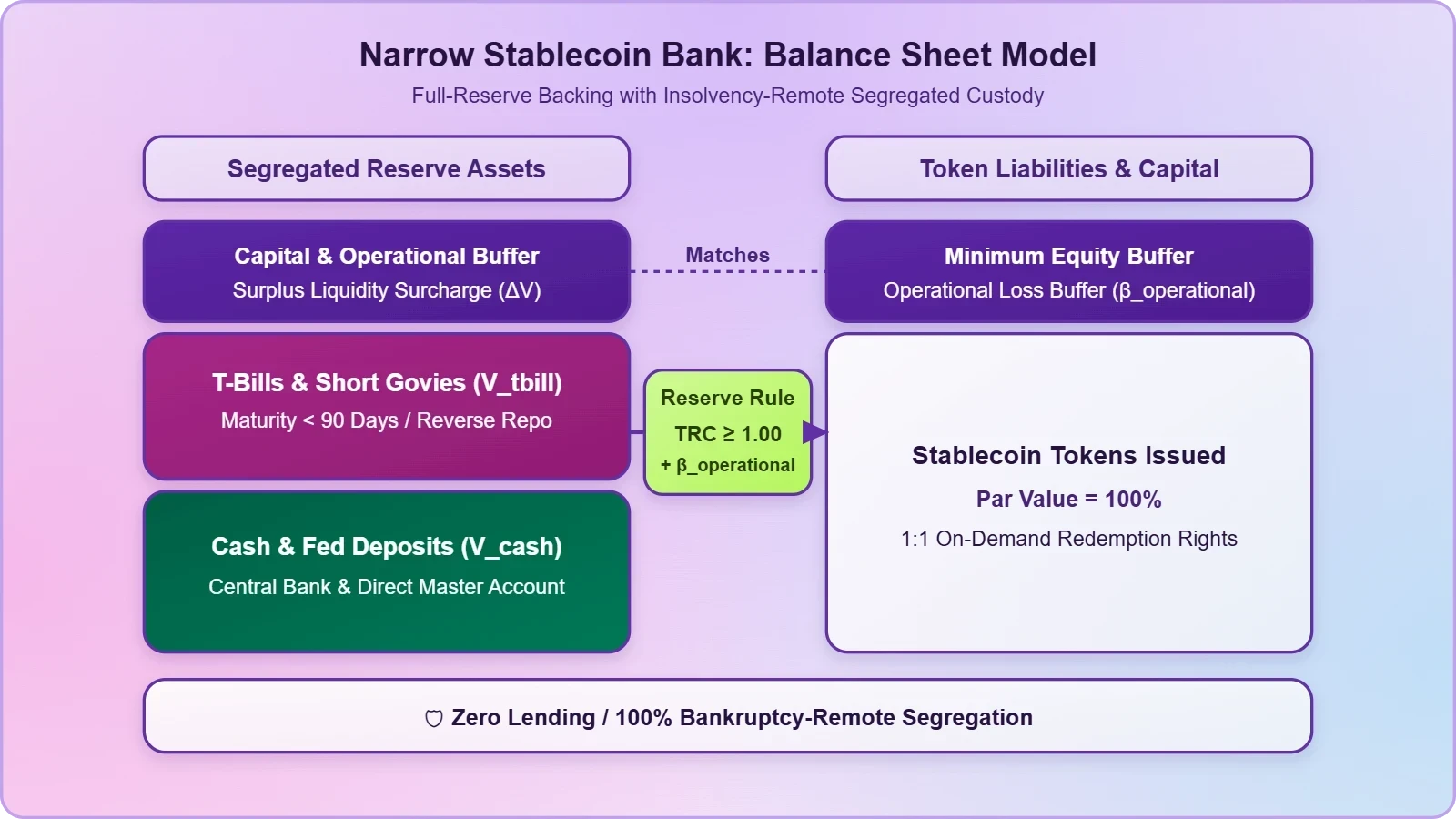
The regulatory mechanics establish an explicit mathematical definition for solvency and buffer adequacy. Under Section 15.204, an issuer must maintain a minimum Total Reserve Coverage ratio (##TRC##) strictly greater than or equal to 100%, calculated against total outstanding tokenized circulating liabilities. Additionally, an explicit Over-Collateralization Buffer (##OCB##) is mandated to absorb operational losses, such that:
Here, ##\beta_{\text{operational}}## represents a risk-sensitive equity cushion calibrated to the issuer’s rolling monthly redemption volume and technological network exposure. If an issuer processes extensive multi-chain settlements, the OCC reserves discretionary authority to expand ##\beta_{\text{operational}}## between 2% and 5% of total circulating value. This capitalization cannot be funded through token rehypothecation; it must consist of unrestricted common equity tier-one capital held in dedicated treasury escrow accounts, completely insulated from token balance pools.
Mark-to-Market Valuation and Segregation Standards
A frequent vulnerability in historical crypto models was the reliance on amortized cost accounting for reserve assets. In rising interest rate environments, duration mismatch creates substantial unrealized mark-to-market losses on longer-term instruments. The OCC's final regulations require daily mark-to-market valuations evaluated at the close of federal wire services. Any paper loss that reduces total assets below 100% of circulating claims triggers an automatic mandatory capital call on the issuer's tier-one reserves.
Moreover, the rule mandates uncompromised asset segregation. Issuers cannot commingle operating capital with customer redemption reserves. All qualifying assets must reside within bankruptcy-remote custodial trusts registered at OCC-regulated custodian banks or directly through designated sub-accounts at Federal Reserve Banks. This legal structure shields token holders from general creditor claims in the event of an issuer's corporate insolvency, permanently establishing stablecoins as senior, protected legal claims backed dollar-for-dollar by sovereign guarantees.
We Also Published
Operational Liquidity Backstops and Redemption Architecture
Beyond static reserve quality, 12 CFR Part 15 establishes strict requirements for the programmatic execution of redemptions. The OCC recognizes that digital dollar markets operate continuously across international boundaries, whereas conventional interbank clearing channels observe rigid business hours. To reconcile this operational friction, stablecoin issuers must construct sophisticated liquidity backstops capable of honoring high-volume, real-time redemptions without delaying settlement times or disrupting underlying money markets.
Direct Wholesale Parity and T+0 Requirements
Under the new standards, retail and institutional holders possess a legally enforceable right to redeem payment stablecoins directly with the issuer for sovereign currency at par value ($1.00 per token). The OCC explicitly outlaws gatekeeping mechanisms, redemption fee surcharges intended to throttle liquidity, and delayed queue processing. For institutional blocks exceeding statutory thresholds, settlement must conclude on a same-day (T+0) basis through national clearing networks, eliminating the multi-day settlement delays that historically characterized manual redemptions.
This stringent mandate compels issuers to re-engineer their treasury tech stacks. Issuers can no longer rely on batch settlement mechanisms or manual wire authorizations. Instead, they must deploy real-time balance reconciliation systems that coordinate on-chain burn events directly with automated fiat payout rails. If an authorized participant triggers a smart contract burn, the corresponding reserve cash must clear through the settlement gateway instantaneously, preventing imbalances between digital ledger states and commercial custodial records.
Mandatory Clearing Lines and Federal Reserve Direct Access
To eliminate liquidity bottlenecks during severe crypto market downturns, the rules mandate pre-arranged credit backstops. Issuers must secure committed, irrevocable liquidity lines with Tier-1 commercial banks, sized to cover at least 15% of their total circulating float. These credit lines ensure immediate liquidity if an unexpected surge in redemptions outpaces the overnight maturation of short-dated Treasury paper. This framework guarantees immediate liquidation capability without selling underlying bonds into stressed secondary markets.
Crucially, the GENIUS Act rules set the stage for qualifying narrow stablecoin issuers to petition the Federal Reserve for direct Master Account access and central bank settlement services. By maintaining complete narrow banking reserves, compliant issuers could bypass intermediate commercial banking rails altogether. Direct clearing at the central bank level reduces counterparty risk, insulates digital dollar operations from commercial bank failures, and guarantees that dollar-pegged tokens function as authentic digital cash representations within the federal payments nexus.
- 01
- 02
- 03
- 04
Systemic Risk Mitigations and Federal Banking Perimeter Expansion
The OCC's expansion of the banking perimeter represents a deliberate strategy to curb systemic financial contagion before digital payment instruments reach scale-dependent economic thresholds. Historically, private money innovations that grew outside formal prudential supervision—ranging from nineteenth-century wildcat banknotes to pre-2008 shadow asset-backed commercial paper—eventually incurred catastrophic balance sheet runs. By pulling stablecoin issuers into the perimeter, the OCC ensures these emerging payment networks integrate modern macroprudential defenses and anti-money laundering controls directly into their architectural stacks.
Interconnectedness With Short-Term Wholesale Debt Markets
As the aggregate market capitalization of stablecoins scales, their operational footprint within the United States Treasury market expands exponentially. Prior to uniform oversight, massive sudden liquidations by stablecoin issuers posed liquidity risks to short-term government debt markets. By mandating maximum duration limits of 90 days on Treasury bills, 12 CFR Part 15 ensures that issuers hold securities that can roll off naturally into pure sovereign cash, dramatically minimizing the need to execute disruptive secondary market sales during broader market crashes.
This dynamic stabilizes both sides of the ecosystem. For the sovereign debt market, payment stablecoins establish a reliable, structural buyer for short-dated Treasury debt obligations, locking up liquid capital within ultra-conservative instruments. For digital asset markets, limiting reserve holdings to the shortest maturity instruments prevents mark-to-market bond duration losses from impairing solvency. As a consequence, token issuers maintain structural resilience against violent interest rate spikes engineered by central bank monetary tightening campaigns, preventing collateral degradation.
Resolution Authority, Receivership, and FDIC Harmonization
A vital component of the GENIUS Act implementation is the establishment of an explicit statutory resolution regime for non-bank payment stablecoin sponsors. Prior to this legislation, an issuer collapse risked protracted, indeterminate corporate bankruptcy proceedings, entangling user assets in years of litigation. The OCC rules establish a streamlined administrative receivership structure, modeled closely on traditional FDIC resolutions, that designates stablecoin token holders as first-priority claimants who recover their funds ahead of all other creditors.
Under this receivership architecture, if an issuer's operational tier-one buffer breaches regulatory minimums and fails recapitalization within 48 hours, the OCC possesses the statutory authority to appoint a conservator. The conservator can seize custody of segregated reserve trusts, freeze minting endpoints, and execute orderly par redemption payouts directly to verified token holders. This rapid resolution mechanism prevents prolonged liquidity lockups, preserving market stability and eliminating systemic panic across the broader financial system.
Yield Mechanics and Market Impacts on Decentralized Finance
The transformation of stablecoin issuers into narrow banks introduces profound disruptions to yield generation models across decentralized finance (DeFi). In earlier market cycles, issuers and affiliated crypto platforms shared returns derived from reserve holdings with institutional partners, fueling double-digit staking returns and liquidity pool incentives. By classifying customer-directed yield sharing as an unauthorized deposit-taking activity, the OCC fundamentally alters the economic incentives underpinning crypto liquidity allocation.
The Demise of Synthetic High-Yield Dollar Protocols
The regulatory boundary established by the OCC clearly differentiates between transaction-oriented payment stablecoins and investment contracts. Under the GENIUS Act, any token that disburses interest, yields, or structural distributions directly to passive holders fails the payment stablecoin classification. Consequently, protocols that depend on native yield generation must either register under federal securities statutes or restructure their assets into non-yielding transactional media, causing a structural repricing of speculative automated market maker yields across DeFi platforms.
This dynamic ends the era of synthetic high-yield dollar tokens that sustained on-chain leverage loops. Capital allocators can no longer market payment tokens as alternative savings accounts that deliver both high sovereign yields and instant transactional liquidity. By enforcing this division, the OCC preserves clear distinctions between payment instruments and risk-bearing investment funds, compelling institutional treasuries to choose explicitly between capital preservation in narrow digital dollars or risk-adjusted yields in licensed asset-management vehicles.
Liquidity Fragmentation and Automated Market Maker Dynamics
Automated market makers (AMMs) on decentralized ledgers depend on massive pools of stable assets to facilitate low-slippage trading between digital tokens. Because compliant narrow stablecoins must feature administrative freezing functionality, sanction blacklisting, and explicit redemption verifications, permissionless liquidity pools face structural segmentation. Decentralized protocols must decide whether to adopt OCC-compliant narrow tokens that carry transaction-freezing mechanisms or migrate toward decentralized, non-sovereign algorithmic models that carry higher volatility risks.
This operational friction creates bifurcated liquidity venues. Institutional participants, corporate treasuries, and regulated financial intermediaries will exclusively route transactions through Part 15-compliant liquidity channels, accepting regulatory compliance in exchange for absolute settlement finality and sovereign par redemption guarantees. Conversely, unpermissioned protocols may experience reduced liquidity and wider bid-ask spreads as institutional market makers withdraw capital from non-compliant pools, establishing a two-tiered digital asset market structure.
Commercial Banks Versus Digital Token Issuers: The 2027 Horizon
The convergence of stablecoins into narrow banks poses significant strategic challenges for traditional commercial banking institutions. Historically, commercial banks relied on low-cost consumer checking deposits to fund long-term commercial loans and mortgages. As digital dollars achieve absolute federal regulatory clarity and 100% reserve backing, non-yield-bearing retail checking accounts face formidable competition from programmatic tokens that settle instantly, operate globally around the clock, and carry structural protections against balance sheet insolvency.
Deposit Disintermediation and Credit Availability Pressures
The primary concern voiced by conventional banking associations during the GENIUS Act rulemaking process centered on deposit disintermediation. If corporate treasuries and retail depositors transfer substantial cash allocations from standard non-interest-bearing checking accounts into 100% segregated narrow stablecoins, aggregate deposit funding across the commercial banking system could contract. When commercial deposits decline, regional and mid-sized banks are forced to rely on more expensive wholesale funding markets to support their commercial lending activities.
This dynamic could trigger an increase in borrowing costs throughout the broader economy. If banks must compete directly against narrow digital stablecoins that offer absolute collateral safety without exposure to insolvency runs, commercial institutions must offer higher interest rates on baseline transactional accounts. Consequently, fractional-reserve banks could face compressed net interest margins, forcing them to rebalance their asset portfolios and potentially constrain credit availability for small business lending and commercial real estate development.
The Emergence of Bank-Issued Tokenized Deposits
To defend against disintermediation, major commercial banking institutions are rapidly developing tokenized deposit solutions under their own national banking charters. Rather than watching liquidity migrate toward non-bank fintech issuers, institutions like JPMorgan Chase, Citigroup, and Wells Fargo are deploying tokenized representations of traditional deposits. These bank-issued tokens offer the programmable speed of public distributed ledgers while maintaining full eligibility for FDIC insurance, central bank liquidity windows, and existing commercial credit lines.
By the January 2027 statutory deadline, the competitive boundary between commercial banks and fintech stablecoin issuers will crystallize into two distinct models. Fintech issuers will operate as pure narrow payment utilities, earning modest margins on operational fees while maintaining pristine sovereign collateral. Concurrently, traditional national banks will utilize tokenized deposits to execute multi-asset fractional lending while automating settlement flows, effectively modernizing the fractional-reserve banking paradigm for the modern digital era.
From our network :
- Committed Mediterranean Precipitation Decline: Why Emissions Cuts Alone Cannot Restore Winter RainsNew NOAA research reveals that Mediterranean winter rains may decline irreversibly even with emissions cuts. Explore the science of committed climate change and regional impacts.
- The Hidden Cost of AI Convenience: Why Over-Permissioned Agents Are a Security Time BombDiscover why AI agents with excessive permissions create dangerous single points of failure, and learn how implementing least privilege principles can protect your organization from exploitation.
- University Language Proficiency Exams: Why Institutional Tests Demand Different Preparation Than IELTS and TOEFLDiscover why university-specific language proficiency examinations differ fundamentally from IELTS and TOEFL, and learn strategic preparation approaches for institutional assessment success.
- CISA’s Ten-Advisory Wave: Why Generic Patching Fails in OT and How to Build Product-Specific PlaybooksCISA released ten ICS advisories in one week, exposing critical infrastructure risks. Generic patching fails in OT. Learn to build product-specific remediation playbooks.
- Mobile Learning and VR in English: What Global Evidence Reveals About Effective Language TechnologyA systematic review across 14 countries reveals which language-learning technologies genuinely work. Mobile learning, AI, and VR show measurable benefits when pedagogically integrated. This evidence-based guide helps educators and learners select technology that delivers real return on investment.
- The Final Descent: How ESA Retired the Legendary Cluster Constellation After 24 Years of Space Weather ScienceAfter 24 years mapping Earth’s magnetosphere, ESA’s Cluster mission concluded with a precisely controlled reentry over the South Pacific. This analysis explores the scientific legacy, engineering decisions, and debris mitigation principles behind one of space exploration’s most responsible retirements.
- Live Online English Classes for Kids: Do They Actually Reduce Anxiety?A ten-week study reveals that synchronous online English classes can significantly reduce child language anxiety while improving listening and reading skills. Discover what makes these programs effective and how parents can select the right one.
- How AI Agents Will Change the Way We Manage Personal FinancesExplore how AI agents are transforming personal finance through automated budgeting, bill payment, and investment management, while examining the critical security protocols and governance frameworks required for safe deployment.
- Forbidden Matrix Patterns and Visible Lattice Points: A Geometric DictionaryExplore how multidimensional 0–1 matrices encode geometric truths, linking forbidden patterns to visible lattice points and hypergraph theory, with applications in combinatorics and computational geometry.
RESOURCES
- GENIUS Act Regulations: Final Rule - OCC.govocc.govOct 21, 2026 ... The GENIUS Act's effective date is January 18, 2027. The OCC published a notice of proposed rulemaking to implement GENIUS…
- Rule - Federal Registerfederalregister.govOct 23, 2026 ... The GENIUS Act will be effective on January 18, 2027, and it is important that the OCC's implementing regulations be…
- GENIUS Act Regulations: Notice of Proposed Rulemaking - OCC.govocc.govFeb 25, 2026 ... It establishes a regulatory framework for payment stablecoin activities. The GENIUS Act generally prohibits any person other than a permitted ...
- Proposed Rule - Federal Registerfederalregister.govMar 2, 2026 ... (GENIUS Act or the Act) was enacted on July 18, 2025. The Act establishes a regulatory framework for payment stablecoin…
- ABA Statement on OCC Final Rule Implementing the GENIUS Actaba.comOct 21, 2026 ... "The final rule removes the OCC's originally proposed safeguards that would have addressed indirect arrangements involving affiliates, exchanges ...
- OCC GENIUS Act Rule Leaves Room for Ambiguity on Yieldbpi.comOct 21, 2026 ... The GENIUS Act prohibits issuers from paying yield or interest on stablecoins and tasks the OCC and the other banking…
- OCC Finalizes GENIUS Act Rule: What You Need to Know - Skaddenskadden.comOct 29, 2026 ... The OCC has issued its final rule implementing the GENIUS Act, which goes into effect on January 18, 2027. Stablecoin…
- GENIUS Act Rulemaking and Reporting Trackerchapman.comThe GENIUS Act is defining how payment stablecoins are issued, regulated, and supervised in the United States. Understanding this evolving framework is critical ...
- The OCC's Final Rule on the Issuance of Payment Stablecoinarnoldporter.comOct 30, 2026 ... Implementing the GENIUS Act: The OCC's Final Rule on the Issuance of Payment Stablecoin.
- OCC Finalizes GENIUS Act Rules for Payment Stablecoin Issuerssheppard.comOct 22, 2026 ... The rule takes effect January 18, 2027. The final rule follows the OCC's February 2026 proposal and establishes a supervisory…
- U.S. Office of the Comptroller of the Currency Finalizes Regulatory ...sidley.comOct 29, 2026 ... The final rule and the GENIUS Act take effect January 18, 2027, and the OCC will announce separately when it…
- OCC Finalizes Rule Implementing the GENIUS Actfintechanddigitalassets.comNov 12, 2026 ... OCC Finalizes Rule Implementing the GENIUS Act ... Payment stablecoin issuers under OCC jurisdiction will be subject to reserve, redemption, ...
- OCC Issues Final GENIUS Act Rule, Establishing a Federal ...consumerfinancemonitor.com5 days ago ... Under the final rule, issuers must instead notify the OCC when that threshold is reached and seek approval for any…
- GENIUS Act Implementation | Sullivan & Cromwell LLPsullcrom.comOct 19, 2026 ... The Federal Reserve would also, unlike the OCC, amend regulations applicable to Federal Reserve-supervised banking organizations—including bank ...
- 01
- 02
- 03
- 04
- 05
- 06
- 07
- 08
0 Comments