When roughly fifteen million internal documents escape the vaults of a global lender, the resulting disclosures rarely stay confined to a single newsroom. The Deutsche Bank investigation, coordinated across Der Spiegel, the Financial Times, The New York Times and Le Monde, paints a portrait of an institution that allegedly weighed reputational risk against revenue and repeatedly chose the latter.
The central allegation is uncomfortable: compliance officers raised flags about high-risk clients, including prominent Russian oligarchs, and those flags were reportedly set aside to protect profits.
The story matters far beyond Frankfurt. It touches the machinery of anti-money-laundering enforcement, the moral boundaries of correspondent banking, and the uncomfortable question of whether "know your customer" rules function as genuine safeguards or as paperwork performed after commercial decisions are already made.
On This Page
- The Anatomy of a Leak: What Fifteen Million Documents Reveal
- Compliance Warnings, Commercial Pressure and the Profit Motive
- The Epstein Connection and the Trump Document Allegation
- Deutsche Bank's Defense and the Transformation Narrative
- Market Reaction, Regulatory Risk and Investor Calculus
- What This Episode Means for Banking Governance
The documents reportedly trace Russian flows between 2010 and 2015, describe a business that kept expanding until 2021, and suggest the bank resisted leaving Russia even after the February 2022 invasion before exiting in March that year.
This analysis examines what the leaked material reportedly shows, how Deutsche Bank has responded, and why the episode carries implications for regulators, investors and every institution that profits from cross-border finance. It also weighs the separate Epstein-linked scrutiny, the Trump tax-document allegation, and the market's immediate verdict, which arrived as a four percent slide in the bank's German-listed shares.
TL;DR A consortium of news organizations has published findings from an investigation built on roughly fifteen million leaked Deutsche Bank documents. The reports allege the bank overrode compliance warnings about high-risk clients, including Russian oligarchs, to protect profits, continued expanding its Russian business until 2021, and resisted exiting Russia even after the Ukraine invasion. Separate allegations involve nearly $600 million in suspicious Epstein-linked payments and the accidental leak of Donald Trump's tax documents. Deutsche Bank says the matters are historical, largely addressed, and that it has invested €7 billion in controls since 2019. Shares fell four percent following publication.
The Anatomy of a Leak: What Fifteen Million Documents Reveal
Leaks of this scale are not isolated whistleblower memos but entire operational archives, capturing emails, compliance assessments, client files and internal deliberations across years. The reporting consortium describes a documentary record that allows journalists to reconstruct decisions in sequence rather than infer them from fragments. That evidentiary depth is precisely what makes the allegations difficult to dismiss as anecdotal.
The material reportedly shows a bank already used to move billions of dollars for Russian criminals, spies and oligarchs between 2010 and 2015, yet still expanding its Russian business until 2021. Internal compliance officers allegedly warned repeatedly, even as NATO-Moscow tensions rose. The narrative that emerges is one of institutional momentum overriding individual caution.
The Compliance Function and Its Limits
Compliance departments exist to say no, but their authority depends entirely on whether senior leadership treats a "no" as binding. The reports suggest warnings were logged, discussed and then overridden in favor of commercial relationships. When risk officers become advisers to decisions already made, the control framework is decorative rather than functional.
This dynamic is familiar to regulators across jurisdictions. Enforcement actions frequently cite "willful blindness" and "deficient culture" rather than outright instruction to break laws. The distinction matters legally, but ethically the outcome is similar: warnings surfaced, and the institution proceeded anyway.
Why the Russian Portfolio Proved So Sticky
Russia represented a lucrative corridor for European banks, offering fees from commodity finance, wealth management and corporate lending. Competitive pressure from American institutions reportedly intensified the reluctance to retreat. A growth strategy under chief executive Christian Sewing is cited as one factor in the persistence of the business.
The reports describe a list of roughly fifty corporate clients ranked by proximity to the Kremlin and by other risks such as financial crime. Named entities reportedly include Gazprom, the petrochemicals group Sibur and oligarch Oleg Deripaska. Such a ranking implies the bank understood its exposure in granular detail.
Compliance Warnings, Commercial Pressure and the Profit Motive
The tension at the heart of this story is structural rather than personal. Banks earn fees by serving clients; compliance officers earn nothing by turning them away. When growth targets dominate performance reviews, the path of least resistance runs toward the client. The reports suggest competitive pressure from American banks reinforced that gravitational pull.
Christian Sewing's growth strategy is cited as one contributing factor, though attributing institutional behavior to a single executive oversimplifies matters. Large banks operate through committees, escalation chains and risk appetite statements. If warnings were overridden, the decision likely reflected a collective tolerance rather than one person's preference.
The Economics of Walking Away
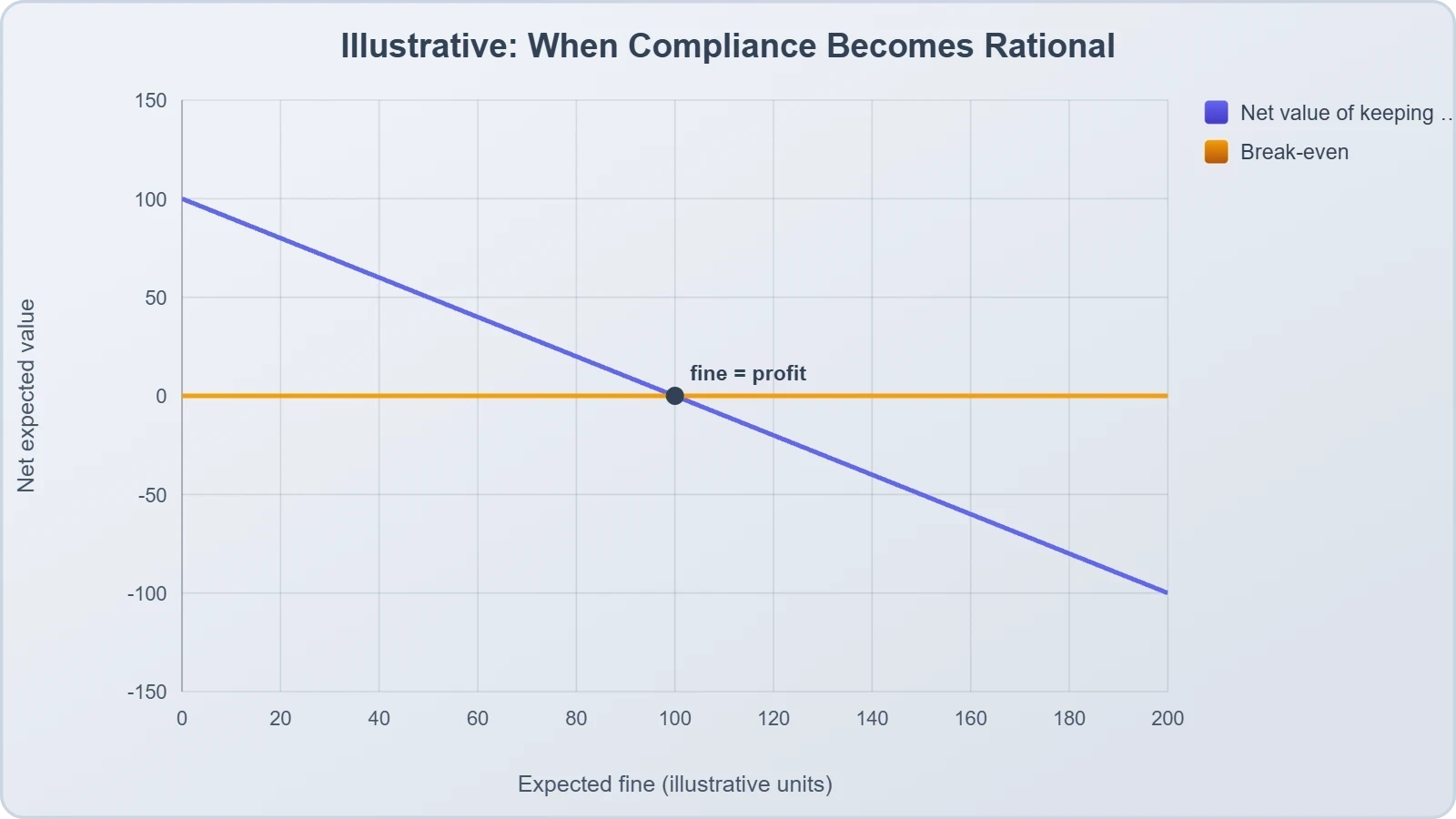
Exiting a profitable client relationship carries immediate, measurable costs: lost revenue, angry bankers, competitive disadvantage. The benefits, by contrast, are probabilistic and deferred, appearing only if a regulator later imposes a fine or a journalist later publishes a leak. This asymmetry systematically biases institutions toward retention.
Regulators have long argued that this calculus must be corrected through penalties large enough to alter expected value. The theoretical framework is straightforward. If the expected fine exceeds the expected profit, compliance becomes rational. In practice, detection is uncertain and penalties arrive years later, weakening deterrence.
What "High-Risk Client" Actually Means
The phrase covers a spectrum from politically exposed persons to entities in sanctioned jurisdictions to individuals with opaque ownership structures. Banks classify clients using risk-scoring models that weigh geography, industry, transaction patterns and adverse media. A client ranked by proximity to the Kremlin sits near the top of any credible scale.
The reported list of roughly fifty corporate clients, ranked by Kremlin proximity and financial-crime risk, suggests the bank possessed precisely the intelligence its compliance function needed. The question the documents raise is not whether the bank knew, but what it did with that knowledge.
The Epstein Connection and the Trump Document Allegation
Beyond Russia, the reports raise a second front: allegations that the bank processed almost $600 million in suspicious payments linked to Jeffrey Epstein, a figure higher than previously known. That number matters because it suggests the relationship was not incidental but substantial, and because suspicious-payment reporting obligations exist precisely to catch such patterns.
A third allegation concerns Donald Trump's tax documents, which the reports say were accidentally sent to another client during his first term and that the bank kept this from the White House. Deutsche Bank ended its relationship with Trump in 2021. Each allegation, taken alone, is serious; together they suggest control failures across distinct client categories.
Why the Epstein Figure Resonates
Epstein's banking relationships have drawn regulatory attention for years, and the scale of reported suspicious flows invites questions about monitoring thresholds. Banks file suspicious activity reports routinely, but the volume and persistence of flagged transactions determine whether a relationship should be exited rather than merely monitored.
Deutsche Bank has said it regrets its historical relationship with Epstein and has made considerable investments in strengthening controls. That acknowledgment is notable, though regret is not the same as accountability, and the reported figure will likely feature in any future regulatory or legal examination.
The Data-Handling Dimension
Accidentally transmitting a client's tax documents to another client is a confidentiality failure with legal exposure under data-protection regimes. Concealing the error from the affected party's administration compounds the problem. Banks hold sensitive information under strict obligations, and mishandling erodes the trust on which private banking depends.
The allegation also carries political resonance given Trump's long litigation history with financial institutions. Regardless of political context, the operational question is whether the bank's data-governance controls were adequate and whether escalation procedures functioned when they should have.
We Also Published
- 01
- 02
- 03
- 04
Deutsche Bank's Defense and the Transformation Narrative
The bank's response follows a recognizable pattern: acknowledge the age of the issues, note that leadership has changed, and point to investment in controls. Deutsche Bank says the matters date back many years, in some cases two decades, and were reviewed at the time with regulators consulted where relevant. It also declines comment on client relationships.
The most concrete element of the defense is financial. The bank says it has made €7 billion of direct investment in its control environment between 2019 and 2025 and remains committed to improving controls and a culture of integrity. That figure is substantial and verifiable in principle, though spending on controls does not by itself prove their effectiveness.
Assessing the "Historical" Defense
Timing arguments carry real weight in law, where statutes of limitation constrain liability. They carry less weight in reputational terms, because the question of whether an institution has genuinely changed depends on evidence of current behavior rather than assurances about past remediation.
The reported continuation of Russian business until 2021 complicates the historical framing, since that date is recent enough to fall within the tenure of current leadership. The bank's exit in March 2022, following the invasion, is a genuine data point in its favor, but the delay before it invites scrutiny.
What €7 Billion Buys
Control investment typically funds surveillance systems, transaction-monitoring platforms, staffing for financial-crime teams and data infrastructure. These are expensive and necessary, but their value depends on whether alerts translate into decisions. A monitoring system that generates warnings nobody acts upon is an expensive form of theater.
Investors will want evidence that escalation now produces consequences. Regulators will want the same. The bank's assertion of a transformed culture is ultimately a claim about decision rights: who can say no, and whether that no survives commercial pressure.
Market Reaction, Regulatory Risk and Investor Calculus
Deutsche Bank's German-listed shares fell four percent on Tuesday following the reports. A single-session decline of that magnitude is meaningful but not catastrophic, suggesting investors view the disclosure as a reputational and regulatory risk rather than an existential one. The bank's capital position and profitability remain the dominant valuation drivers.
Still, the episode arrives at a sensitive moment for European financial institutions, which face heightened supervisory attention on financial-crime controls. Any hint of renewed enforcement activity could translate into fines, remediation costs and restrictions on business lines, all of which affect earnings forecasts.
Reading a Four Percent Move
Market reactions to scandal reporting typically follow a pattern: an initial drop as algorithms and headline traders respond, followed by partial recovery as analysts assess materiality. The durability of the decline depends on whether regulators open formal investigations or existing probes expand.
For long-term holders, the relevant question is whether the reports change the bank's cost of compliance or its ability to serve certain client segments. A four percent move implies the market assigns modest probability to severe outcomes, while acknowledging that tail risks have grown.
The Broader Supervisory Context
European regulators have spent years pushing banks to strengthen anti-money-laundering frameworks, and enforcement has become more assertive. Germany's BaFin has previously imposed special monitors at Deutsche Bank, and any new revelations will be examined against that history of supervisory concern.
The consortium's reporting may also prompt parliamentary scrutiny, particularly in Germany where the bank's role carries national significance. Political attention often precedes regulatory action, and the combination can extend the timeline over which reputational costs accumulate.
What This Episode Means for Banking Governance
The Deutsche Bank disclosures arrive as a case study in the gap between stated values and operational reality. Every large bank publishes integrity commitments; the test is whether those commitments survive contact with a profitable client. The reported documents suggest that at this institution, for a period, they did not.
The lesson extends to governance design. Compliance authority must be structural, not advisory. Escalation must reach boards empowered to override revenue targets. Whistleblower channels must be credible. And compensation must penalize retention of clients whose risk profile exceeds appetite, not merely reward the revenue they generate.
Designing Controls That Actually Bind
Effective frameworks share common features: independent risk functions with veto power, board-level risk committees that meet frequently, and compensation clawbacks tied to control failures. These mechanisms convert compliance from a cost center into a constraint that shapes strategy before deals are signed.
Regulators increasingly assess culture through outcomes rather than policies. A bank that can demonstrate it exited profitable clients on risk grounds has evidence of a functioning framework. One that cannot invites the presumption that warnings are routinely absorbed.
The Accountability Question
Leaks of this kind rarely produce immediate legal consequences for individuals, but they shift the burden of explanation onto institutions. Deutsche Bank's response emphasizes historical remediation and investment. Whether that suffices will depend on regulators, litigants and, ultimately, the bank's own future conduct.
For the wider industry, the episode is a reminder that documents persist. Emails written a decade ago can surface in a consortium's inbox and reshape public understanding overnight. Institutions that assume otherwise are storing liabilities rather than records.
From our network :
- How AI Agents Will Change the Way We Manage Personal FinancesExplore how AI agents are transforming personal finance through automated budgeting, bill payment, and investment management, while examining the critical security protocols and governance frameworks required for safe deployment.
- The Final Descent: How ESA Retired the Legendary Cluster Constellation After 24 Years of Space Weather ScienceAfter 24 years mapping Earth’s magnetosphere, ESA’s Cluster mission concluded with a precisely controlled reentry over the South Pacific. This analysis explores the scientific legacy, engineering decisions, and debris mitigation principles behind one of space exploration’s most responsible retirements.
- CISA’s Ten-Advisory Wave: Why Generic Patching Fails in OT and How to Build Product-Specific PlaybooksCISA released ten ICS advisories in one week, exposing critical infrastructure risks. Generic patching fails in OT. Learn to build product-specific remediation playbooks.
- Mobile Learning and VR in English: What Global Evidence Reveals About Effective Language TechnologyA systematic review across 14 countries reveals which language-learning technologies genuinely work. Mobile learning, AI, and VR show measurable benefits when pedagogically integrated. This evidence-based guide helps educators and learners select technology that delivers real return on investment.
- Live Online English Classes for Kids: Do They Actually Reduce Anxiety?A ten-week study reveals that synchronous online English classes can significantly reduce child language anxiety while improving listening and reading skills. Discover what makes these programs effective and how parents can select the right one.
- Forbidden Matrix Patterns and Visible Lattice Points: A Geometric DictionaryExplore how multidimensional 0–1 matrices encode geometric truths, linking forbidden patterns to visible lattice points and hypergraph theory, with applications in combinatorics and computational geometry.
- University Language Proficiency Exams: Why Institutional Tests Demand Different Preparation Than IELTS and TOEFLDiscover why university-specific language proficiency examinations differ fundamentally from IELTS and TOEFL, and learn strategic preparation approaches for institutional assessment success.
- Committed Mediterranean Precipitation Decline: Why Emissions Cuts Alone Cannot Restore Winter RainsNew NOAA research reveals that Mediterranean winter rains may decline irreversibly even with emissions cuts. Explore the science of committed climate change and regional impacts.
- The Hidden Cost of AI Convenience: Why Over-Permissioned Agents Are a Security Time BombDiscover why AI agents with excessive permissions create dangerous single points of failure, and learn how implementing least privilege principles can protect your organization from exploitation.
RESOURCES
- Deutsche Bank dismissed warnings about dealings with risky clients ...theguardian.com3 hours ago ... ... leaked internal data allegedly shows German bank overlooked compliance ... investigation into a trove of leaked bank documents indicate.…
- When compliance takes a back seat: Deutsche Bank…transparency.org6 hours ago ... The Inside Deutsche Bank investigation, based on more than 15 million leaked documents ... warnings from its own compliance staff.…
- Deutsche Bank shares drop after reports on mass data leak - AFP.comafp.com6 hours ago ... The investigation, dubbed "Inside Deutsche Bank", was conducted by ... The documents reportedly detail, among other things, how Deutsche Bank ...
- Leak of 15mn Deutsche Bank files exposes systemic failuresft.com6 hours ago ... ... compliance and kept some of the bank's problems from shareholders. The Inside Deutsche Bank investigation also reveals accounting tricks ...
- Wall St Engine on X: "More than 15 million internal Deutsche Bank ...x.com6 hours ago ... RUSSIA Leaked documents show Deutsche Bank pursued an expansion of ... warnings from its compliance team about clients with Kremlin…
- 'Inside Deutsche Bank': Banking giant's secrets revealed by 15 ...lemonde.fr11 hours ago ... "Inside Deutsche Bank" is the largest banking investigation ever conducted. It is based on a leak of more than 15…
- New revelations from the Inside Deutsche Bank investigation raise ...facebook.com5 hours ago ... ... Papers and Offshore Leaks, by the ... Compliance records showed repeated alerts and structured transfers that were never investigated.
- Deutsche Bank Leak Reveals $582 Million In Epstein Payments ...forbes.com4 hours ago ... An investigation of leaked bank files also revealed previously undisclosed details about the lender's dealings with Russian oligarchs and ...
- Deutsche Bank protected Trump from scrutiny, leak showsftm.eu11 hours ago ... The files reveal warnings about money-laundering ... The investigation is based on a leak of more than 15 million confidential…
- Deutsche Bank faces renewed scrutiny as 15M leaked ... - Facebookfacebook.com4 hours ago ... Deutsche Bank faces renewed scrutiny as 15M leaked documents expose alleged compliance failures, Russia expansion plans despite ...
- Deutsche Bank Leak: 15 Million Confidential Documents Expose ...finance.biggo.com4 hours ago ... ... warnings. The investigation also found that the bank accidentally leaked Trump's tax return files without notifying the White House,…
- Deutsche Bank shares slide after alleged control failures leakedcnbc.com7 hours ago ... More than 15 million leaked Deutsche Bank files reviewed by an ... The leaks contain board minutes, emails, internal investigations…
- What happens when a bank's rules get in the way of doing business ...instagram.com6 hours ago ... A leak of more than 15 million internal Deutsche Bank files offers a ... The Inside Deutsche Bank investigation, coordinated…
- Inside Deutsche Bank: Secrets, scandals and double standards of ...newslaundry.com7 hours ago ... The files show Deutsche Bank repeatedly missed warning signs of possible money laundering and sanctions violations ... The leaked documents ...
- Global banks defy U.S. crackdowns by serving oligarchs, criminals ...icij.orgSep 20, 2020 ... Bank of New York Mellon. 210. Deutsche Bank. 136. Source: FinCEN Files data ... Documents in the FinCEN Files show…
- 01
- 02
- 03
- 04
- 05
- 06
- 07
- 08
0 Comments