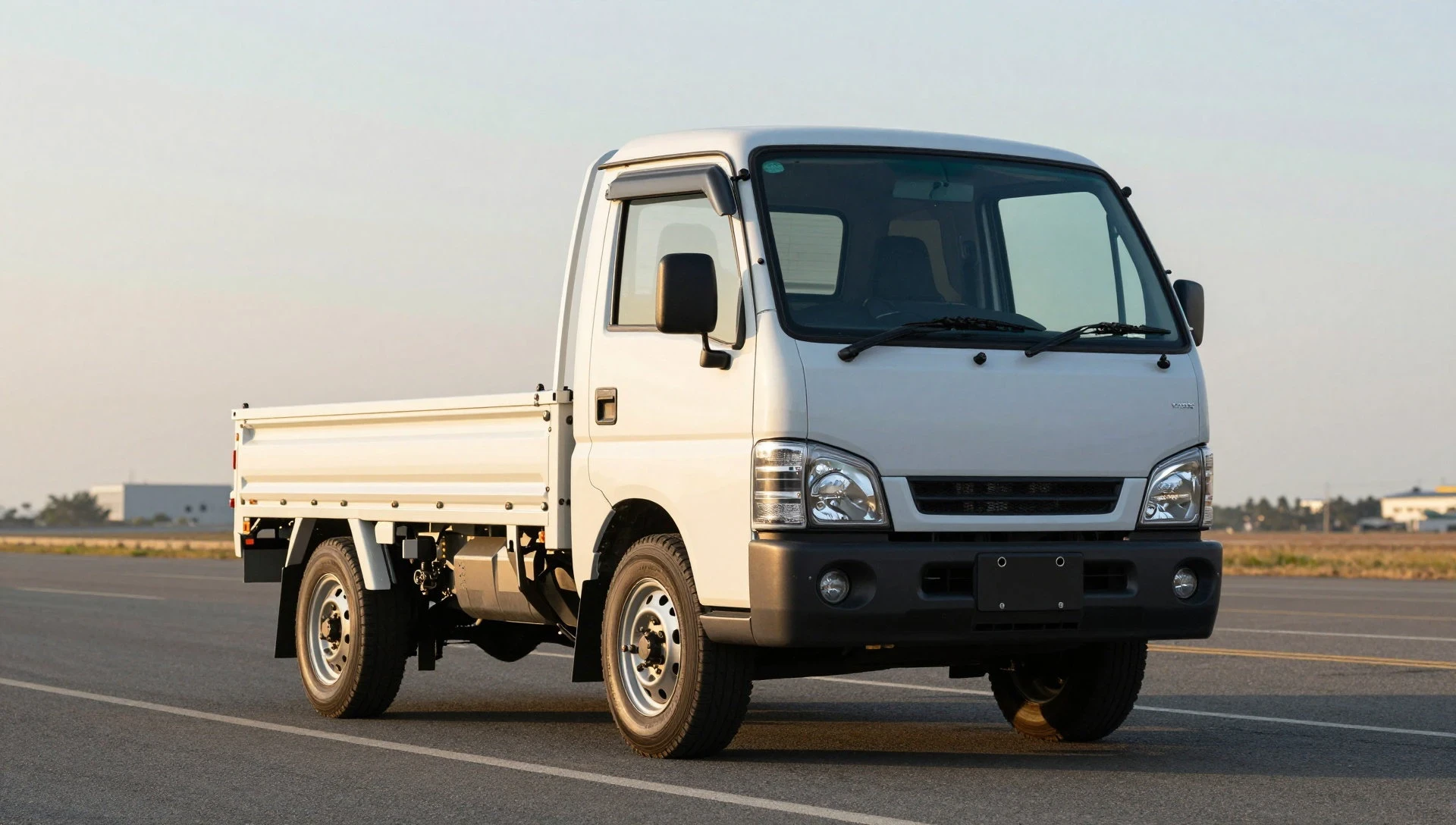
Across the American countryside, a quiet automotive insurgency is unfolding in farmyards, construction lots, and suburban driveways. The kei truck — a diminutive Japanese workhorse whose name derives from the word for "light" — has migrated from the narrow lanes of rural Japan to the wide-open spaces of the United States, where an estimated 30,000 units have been shipped over the past five years. These vehicles are not luxury imports or collector curiosities; they are pragmatic machines priced between $6,000 and $8,000, offering four-wheel drive, roughly 40 miles per gallon, and cargo beds that rival full-size American pickups in usable dimensions.
The phenomenon reveals something deeper than a passing enthusiasm for novelty. It exposes a structural mismatch between what American buyers increasingly need — affordable, efficient, right-sized utility — and what the domestic auto industry has chosen to produce. Dealers such as Jake Simpson of Lancaster Mini Truck in Pennsylvania have built thriving businesses on this gap, moving roughly 300 units in three years. Yet the same vehicles that delight their owners run headlong into a regulatory architecture designed for a different era, one in which imported vehicles must generally be at least 25 years old to enter the country without satisfying federal safety standards.
What follows is a close examination of the kei truck's American ascent: the economics that make it irresistible, the engineering that makes it distinctive, the patchwork of state laws that determines where it may legally travel, and the advocacy movement pressing lawmakers to reconsider restrictions rooted in assumptions about size, speed, and safety. The story touches on trade policy, consumer behavior, agricultural economics, and the perennial tension between regulatory caution and individual choice — a small vehicle carrying unusually large questions.
On This Page
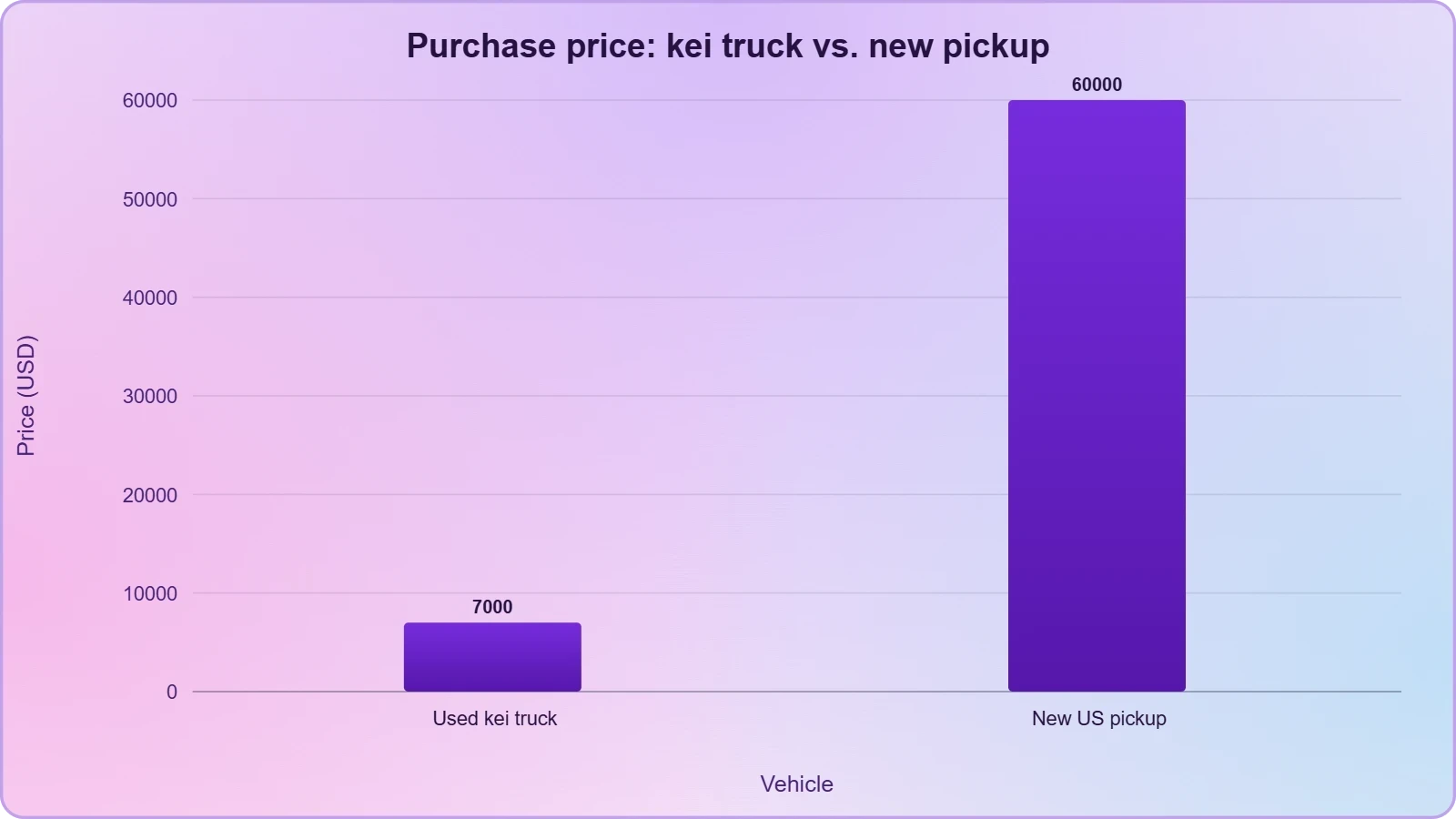
TL;DR Japanese kei trucks — compact, inexpensive, and remarkably practical — have surged in popularity across the United States, with more than 30,000 units imported in five years. Priced at $6,000–$8,000 against $60,000 for a typical American pickup, they offer four-wheel drive, about 40 mpg, and cargo beds comparable to far larger trucks. Their growth is constrained by a regulatory patchwork: federal rules generally require imported vehicles to be 25 years old, and state policies range from permissive registration in Pennsylvania to outright bans elsewhere. Regulators cite crash safety and speed limitations; enthusiasts and advocacy groups argue the concerns are overstated and are lobbying for relaxed restrictions.
The Economics of a $7,000 Workhorse
The kei truck's appeal begins with arithmetic that is difficult to argue with. A new American pickup routinely commands $60,000 or more, while a used kei truck lands in a driveway for somewhere between $6,000 and $8,000. That price gap is not a marginal discount; it is an order-of-magnitude difference in capital outlay for a vehicle that performs much of the same utilitarian work. For small farms, landscaping outfits, and tradespeople operating on thin margins, the calculation is less about brand loyalty than about whether the machine pays for itself within a season or two.
Operating costs reinforce the purchase economics. Owners report fuel economy around 40 miles per gallon, a figure that would be respectable for a sedan and is almost startling for a vehicle with a cargo bed. Because kei trucks are engineered to Japanese kei-class regulations — strict caps on physical dimensions and engine displacement — they carry minimal mass and small, efficient powertrains. Maintenance is generally simple and parts, while imported, are widely available through a growing aftermarket. The result is a total cost of ownership that undercuts nearly any alternative in the light-utility segment.
Why American Buyers Are Reaching for Smaller Machines
American pickups have grown steadily larger and more expensive over two decades, drifting away from the basic work-vehicle mission toward luxury and lifestyle positioning. That drift has left a vacuum at the bottom of the market. Buyers who need to haul feed, tools, or fencing materials — but who do not need to tow a horse trailer at highway speed — find themselves with few affordable options. The kei truck fills that vacuum precisely because it was never designed to compete on prestige; it was designed to do work efficiently within tight constraints.
The buyer profile reflects this pragmatism. Farmers use them for field errands and livestock chores. Construction workers value their maneuverability on tight sites. Hobbyists and rural homeowners appreciate a vehicle that fits in a shed and sips fuel. Simpson's observation that he "felt like a celebrity" driving his first kei truck captures the social dimension: these vehicles attract attention not because they are flashy but because they are conspicuously sensible, a quality that resonates with buyers who feel ill-served by the mainstream market.
The Dealer Network Behind the Boom
The import trade has matured from scattered enthusiasts into a recognizable dealer network. Lancaster Mini Truck, the Pennsylvania operation run by Simpson, is emblematic: a lot filled not with domestic pickups but with small Japanese imports, some still bearing the markings of their former lives — a red truck that once served a fire brigade in Kani City, Gifu Prefecture, is a typical arrival. Two more units arriving during a single press visit illustrate the cadence of the trade. Auction houses in Japan supply the vehicles, and American dealers handle shipping, customs, and state-level registration paperwork.
This supply chain matters because it determines what reaches American buyers. Japanese domestic auctions grade vehicles meticulously, and many kei trucks arrive with low mileage and documented service histories. The 25-year federal exemption means most imports are older models, which shapes both their pricing and their safety profile. Dealers operate in a regulatory gray zone that varies by state, and their business models depend on navigating registration rules that can differ sharply across a few hundred miles of highway.
We Also Published
Engineering Within Constraints: What Kei Actually Means
Kei is not a marketing label but a legal category. Japanese regulations cap kei-class vehicles on physical dimensions and engine displacement, forcing manufacturers to extract maximum utility from minimal footprint. That constraint produced a distinctive design philosophy: cab-over layouts that maximize cargo space, small efficient engines, and bodies engineered for narrow rural roads. The trucks are commonly deployed on farms, construction sites, and in light industry across Japan, where their compactness is an asset rather than a compromise.
For American buyers, the engineering translates into specific practical advantages. The cargo beds measure roughly 1.9 meters long and 1.4 meters wide — dimensions that approach those of much larger pickups. Side panels fold down on three sides, simplifying loading and unloading of bulky or awkward items. Drivers consistently praise visibility and maneuverability, qualities that matter on crowded job sites and in tight barnyards. Four-wheel drive is common, extending capability to muddy fields and snowy lanes where a rear-wheel-drive sedan would founder.
Dimensions, Payload, and the Physics of Small
The physics of a light vehicle cut both ways. Low mass and a small engine yield efficiency, but they also limit highway performance and crashworthiness. Kei trucks were designed for Japanese roads with lower speed limits and different traffic mixes; their ability to merge into a stream of 70-mph SUVs is genuinely constrained. Regulators point to the absence of features now standard in modern vehicles — airbags prominent among them — and to the limited crash protection inherent in a small, light body. These are not trivial concerns, and any honest assessment must acknowledge them.
Yet the engineering also delivers advantages that regulators rarely weigh. A vehicle that cannot travel at highway speed may simply not belong on highways, while remaining ideal for the low-speed, short-distance work that constitutes most farm and job-site driving. The question is not whether kei trucks are as safe as full-size pickups — they are not — but whether a regulatory framework built around a single safety standard can accommodate a vehicle class designed for a different use case entirely.
The Regulatory Patchwork Governing American Roads
Federal law sets the outer boundary: imported vehicles generally must be at least 25 years old to enter the United States without conforming to domestic safety standards. That exemption, originally intended for collector cars, has become the legal doorway through which kei trucks arrive. Once inside the country, however, the vehicles encounter a second layer of regulation — state motor vehicle codes — that varies dramatically. Pennsylvania permits kei trucks to be registered and driven on public roads, a policy that has made it a hub for the trade. Other jurisdictions restrict or outright ban them.
This patchwork creates a peculiar geography of legality. A vehicle that is perfectly street-legal in one state may be unusable a few hours' drive away. For dealers and owners, the result is uncertainty: registration decisions can hinge on the interpretation of individual clerks, and enforcement practices vary. The inconsistency also distorts the market, concentrating demand in permissive states and leaving buyers elsewhere to choose between off-road-only use and abandoning the purchase altogether.
Safety Arguments and Their Counterarguments
Regulators' concerns are grounded in real engineering differences. Many imported kei trucks were designed for Japan's narrower roads and lower speeds, and older models lack features now considered essential, airbags chief among them. Their small size, limited crash protection, and lower speed capabilities raise legitimate questions about compatibility with traffic dominated by much larger vehicles. In a collision between a 1,500-pound kei truck and a 5,000-pound pickup, physics is not neutral, and no amount of enthusiasm changes the outcome.
Enthusiasts counter that the concerns are overstated and misapplied. Most kei trucks are used for low-speed, short-distance work on farms and job sites, not highway commuting. Owners argue that the relevant comparison is not a modern pickup but the all-terrain vehicles and older tractors these trucks often replace — machines with far fewer safety provisions. The advocacy position is not that kei trucks are as safe as full-size vehicles, but that a differentiated regulatory approach could permit their use where the risk profile is genuinely modest.
Advocacy in the States: Empire State Kei Advocates
Where regulation constrains, advocacy follows. Joey Iorio, co-founder of Empire State Kei Advocates in New York, represents a new generation of organized enthusiasts working to change the rules through legislative engagement rather than mere complaint. The group's existence signals a shift in the kei truck story: what began as a niche import curiosity has developed the institutional infrastructure of a genuine constituency, complete with lobbyists, testimony, and proposed amendments to state vehicle codes.
The advocacy strategy appears to emphasize differentiation rather than deregulation. Rather than demanding that kei trucks be treated identically to full-size vehicles, groups like Iorio's argue for tailored rules that recognize the vehicles' actual use patterns — low-speed, short-distance, often off-highway work. That framing is politically astute, because it concedes the safety argument's premises while disputing its application. Whether lawmakers find it persuasive will determine how widely kei trucks can travel on American roads in the years ahead.
- 01
- 02
- 03
- 04
Consumer Demand, Market Signals, and the Auto Industry
The kei truck boom is a market signal that the American auto industry has been slow to read. Demand for small, affordable utility vehicles is demonstrably robust: 30,000 imports in five years, a growing dealer network, and waiting lists for popular models all point to unmet appetite. Yet domestic manufacturers have largely ceded the low end of the pickup market, preferring higher-margin full-size trucks and SUVs. The gap between what buyers want and what Detroit offers has been filled by imports from Japan, one container at a time.
This dynamic echoes broader patterns in consumer markets where incumbents optimize for margin and leave price-sensitive segments underserved. The kei truck's success suggests that affordability is not a niche preference but a mainstream concern, particularly among rural and small-business buyers who need functional equipment rather than lifestyle statements. If domestic manufacturers eventually respond with compact utility vehicles of their own, the kei truck's role may prove to have been that of a market catalyst — proof that the demand exists.
Who Is Buying, and Why It Matters
The buyer base spans farmers, construction workers, and hobbyists, a coalition united by practical need rather than demographic similarity. Farmers value the trucks for field chores and livestock management, where a small footprint and low operating cost matter more than towing capacity. Construction workers appreciate maneuverability on tight sites and the ability to load materials from three sides. Hobbyists and rural homeowners treat them as versatile second vehicles that fit in a shed and cost little to run.
This diversity matters for the regulatory debate because it complicates simple characterizations. Kei trucks are not toys, nor are they highway commuters; they are tools deployed in specific contexts where their limitations are largely irrelevant and their advantages are decisive. A regulatory framework that recognizes this contextual reality — distinguishing between highway operation and off-road or low-speed use — could serve both safety and economic interests more effectively than blanket restrictions.
Safety, Trade Policy, and the Road Ahead
The kei truck's future will be shaped by two forces operating on different timescales. In the near term, state legislatures will decide whether to relax, maintain, or tighten restrictions, and each decision will redraw the map of legal operation. In the longer term, federal trade and safety policy will determine whether the 25-year exemption remains the primary doorway for these vehicles or whether a new pathway emerges. Both processes are slow, incremental, and highly sensitive to organized advocacy.
There is also a technological dimension. Modern kei trucks sold in Japan incorporate safety features that older imports lack, and if regulatory pathways existed for newer models, the safety calculus would shift. Some advocates have floated the idea of allowing newer kei vehicles that meet enhanced standards, a proposal that would require rethinking the blanket 25-year rule. Such a change would be significant, because it would transform kei trucks from a used-vehicle phenomenon into a legitimate new-vehicle segment.
What a Differentiated Regulatory Framework Might Look Like
A workable compromise would likely distinguish by use rather than by vehicle class. Kei trucks could be permitted for off-highway and low-speed road operation — farm-to-field, job-site-to-yard — while remaining restricted from high-speed highways where their crash incompatibility is most acute. Such a framework would require new vehicle categories, revised registration rules, and enforcement mechanisms, but it would align regulation with actual risk rather than treating all road use as equivalent.
The political feasibility of such an approach depends on how the debate is framed. If kei trucks are presented as a threat to highway safety, restrictions will tighten. If they are presented as a practical tool for specific low-risk applications, tailored rules become plausible. The advocacy groups now emerging in states like New York are betting on the latter framing, and their success or failure will determine whether the kei truck remains a curiosity of permissive states or becomes a recognized category of American utility vehicle.
What the Kei Truck Reveals About Regulation and Choice
Beneath the specific question of whether a small Japanese truck may legally travel on a Pennsylvania road lies a broader inquiry into how modern societies regulate risk. The kei truck is neither obviously dangerous nor obviously safe; its risk profile depends entirely on context. On a highway at 70 miles per hour, it is a poor match for American traffic. On a farm lane at 15 miles per hour, it is a sensible tool. A regulatory system that cannot distinguish between these contexts will inevitably produce outcomes that are either unnecessarily restrictive or insufficiently protective.
The kei truck's American story also illustrates how consumer demand can outpace institutional adaptation. Buyers discovered a product that served their needs, importers built a supply chain, and regulators are now catching up. This sequence — market innovation followed by regulatory adjustment — is familiar across industries, and it usually resolves through negotiation rather than decree. The advocacy groups now forming are the mechanism through which that negotiation will occur, translating scattered owner preferences into organized political pressure.
Lessons for Importers, Owners, and Policymakers
For importers and owners, the practical lesson is that regulatory diligence is not optional. State rules vary, interpretations shift, and a vehicle legal today may face obstacles tomorrow. Buyers should verify registration requirements before purchase, understand the distinction between on-road and off-road use, and recognize that the 25-year federal exemption governs importation, not operation. Dealers who invest in compliance expertise will likely outperform those who treat regulation as an afterthought.
For policymakers, the kei truck offers a case study in the costs of regulatory uniformity. A single safety standard designed for full-size vehicles cannot sensibly govern a class of small, low-speed utility machines, and forcing it to do so produces evasion, inconsistency, and frustrated constituents. A differentiated framework — one that matches requirements to actual use — would serve safety, economic efficiency, and administrative clarity simultaneously. Whether such a framework emerges depends on the willingness of legislators to see the kei truck not as an anomaly to be suppressed but as a category to be understood.
From our network :
- University Language Proficiency Exams: Why Institutional Tests Demand Different Preparation Than IELTS and TOEFLDiscover why university-specific language proficiency examinations differ fundamentally from IELTS and TOEFL, and learn strategic preparation approaches for institutional assessment success.
- Committed Mediterranean Precipitation Decline: Why Emissions Cuts Alone Cannot Restore Winter RainsNew NOAA research reveals that Mediterranean winter rains may decline irreversibly even with emissions cuts. Explore the science of committed climate change and regional impacts.
- How AI Agents Will Change the Way We Manage Personal FinancesExplore how AI agents are transforming personal finance through automated budgeting, bill payment, and investment management, while examining the critical security protocols and governance frameworks required for safe deployment.
- The Hidden Cost of AI Convenience: Why Over-Permissioned Agents Are a Security Time BombDiscover why AI agents with excessive permissions create dangerous single points of failure, and learn how implementing least privilege principles can protect your organization from exploitation.
- Mobile Learning and VR in English: What Global Evidence Reveals About Effective Language TechnologyA systematic review across 14 countries reveals which language-learning technologies genuinely work. Mobile learning, AI, and VR show measurable benefits when pedagogically integrated. This evidence-based guide helps educators and learners select technology that delivers real return on investment.
- The Final Descent: How ESA Retired the Legendary Cluster Constellation After 24 Years of Space Weather ScienceAfter 24 years mapping Earth’s magnetosphere, ESA’s Cluster mission concluded with a precisely controlled reentry over the South Pacific. This analysis explores the scientific legacy, engineering decisions, and debris mitigation principles behind one of space exploration’s most responsible retirements.
- Live Online English Classes for Kids: Do They Actually Reduce Anxiety?A ten-week study reveals that synchronous online English classes can significantly reduce child language anxiety while improving listening and reading skills. Discover what makes these programs effective and how parents can select the right one.
- CISA’s Ten-Advisory Wave: Why Generic Patching Fails in OT and How to Build Product-Specific PlaybooksCISA released ten ICS advisories in one week, exposing critical infrastructure risks. Generic patching fails in OT. Learn to build product-specific remediation playbooks.
- Forbidden Matrix Patterns and Visible Lattice Points: A Geometric DictionaryExplore how multidimensional 0–1 matrices encode geometric truths, linking forbidden patterns to visible lattice points and hypergraph theory, with applications in combinatorics and computational geometry.
RESOURCES
- President Donald Trump Has Apparently Given Kei Cars the ... - Redditreddit.comDec 4, 2025 ... Like in Japan. The US also has sense urban centers. There are already a class of vehicles for this in…
- Kei Truck Legality in the US: Federal and State | JDMBUYSELLjdmbuysell.comA 2026 BMV working group report treats Japanese kei mini trucks as off-road vehicles and unanimously suggests no changes to current laws and standards.
- What States allow Kei Trucks to be registered? : r/keitruck - Redditreddit.comDec 15, 2021 ... So I have been searching to see if the Nevada DMV or DOT has a written regulation that declares kei…
- Trump Wants Kei Cars in America, but Don't Hold Your Breathcaranddriver.comDec 5, 2025 ... These little cars, trucks, and vans aren't adapted to U.S. regulations and sold here because the demand simply doesn't exist.…
- Will kei trucks be legal in the US? - Facebookfacebook.comFeb 17, 2026 ... In the US, laws regarding kei trucks on public roads vary by state, with some states banning them entirely, while…
- State Restrictions for Kei Truckskei-trucks.comNew Kei trucks are not street legal in the U.S. and are restricted to ... The regulations governing driving kei trucks older than 25…
- It's Time To Legalize Kei Trucks: News Article - Independent Instituteindependent.orgJun 30, 2026 ... Federal law prevents newer kei models because imported vehicles must comply with the same crashworthiness, lighting, and emissions standards ...
- Kei Trucks and U.S. Regulation: Opportunities and Obstacles Aheadcov.comDec 19, 2025 ... Covington's vehicle safety team is well-positioned to assist Kei truck manufacturers develop and implement a regulatory reform strategy aimed at ...
- Every State Where You Can Drive A Kei Truck On Public Roadsjalopnik.comApr 14, 2025 ... Alaska, Delaware and Washington, D.C. don't have any laws on the books specific to kei cars, so if you live…
- Dems and GOP Unite in Oregon In Bid To Legalize Kei Trucksusa.streetsblog.orgJan 22, 2026 ... A bipartisan bill would allow finally make small-format “kei” trucks street legal in Oregon — and offer other U.S. communities…
- Arizona Japanese Mini (Kei) Truck Laws 2025azkeitrucks.comJun 1, 2025 ... 2025 guide to Arizona laws for 25-year-old Japanese mini trucks: safety rules, titles, registration, OHV decals, and how to drive…
- Kei truck - Wikipediaen.wikipedia.orgA kei truck, kei-class truck, or Japanese mini truck, known in Japan as a keitora (軽トラ 'light truck'), is a style of pickup truck…
- Trump May Have Just Opened the Path for Kei Truck Sales in the US ...tfltruck.comDec 4, 2025 ... To qualify as a kei vehicle, any car or truck must be no larger than 3.4 meters (134 inches) long,…
- USA Kei trucks legalization status | Japan Car Directjapancardirect.com... Kei truck laws and updates. (Updated Oct 2025). 1. Introduction. Japanese kei trucks have evolved from clever city workhorses into beloved tools for…
- Can we cross the US with kei truck? 25year rule..minitrucktalk.comMar 17, 2018 ... With the truck registered as that, there should be NO " Kei restrictions " since Kei vehicles do not officially…
- 01
- 02
- 03
- 04
- 05
- 06
- 07
- 08
0 Comments