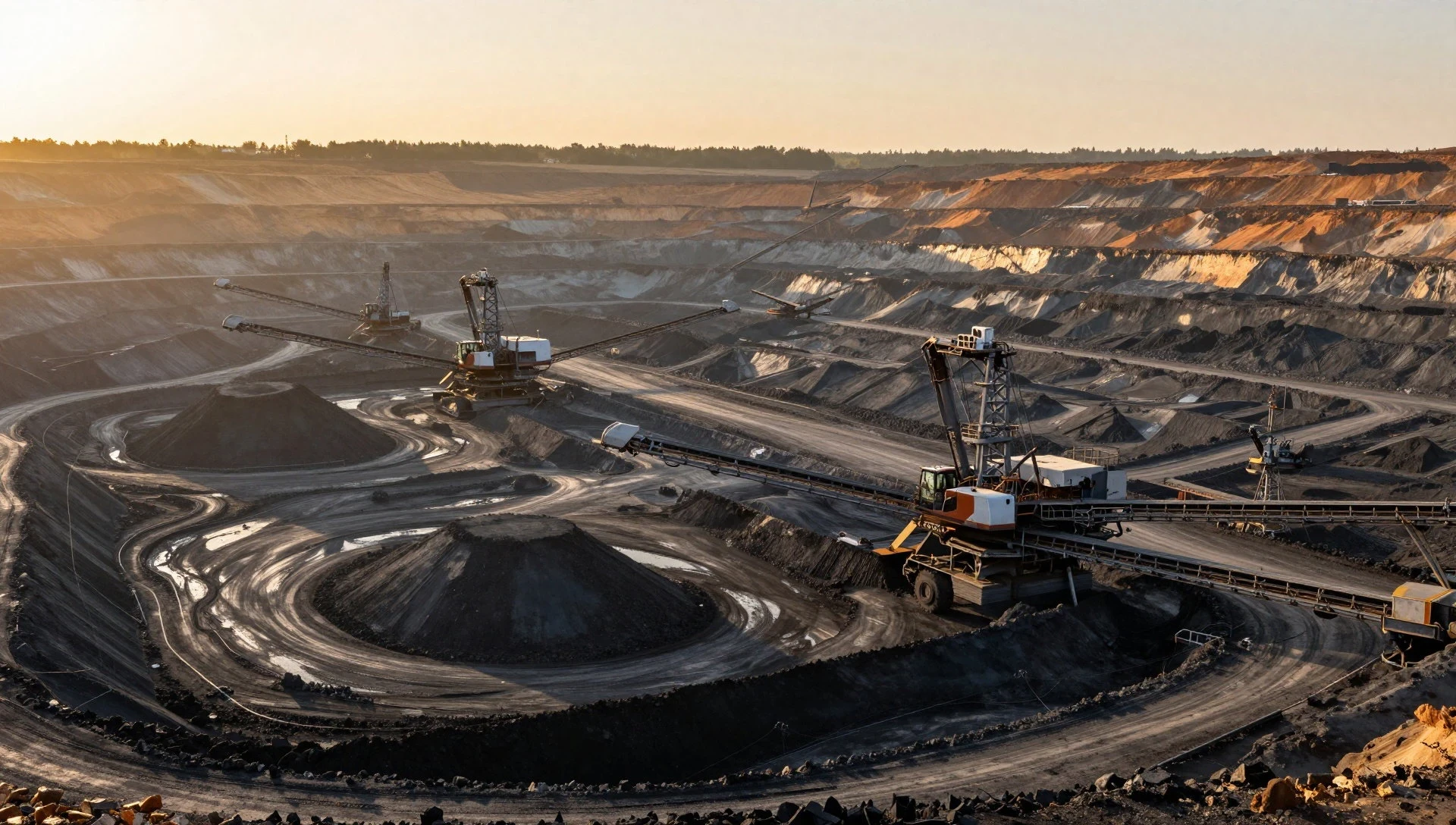
The approval granted by India's securities regulator to Mahanadi Coalfields for an initial public offering marks a consequential moment in the slow, deliberate opening of the country's state-owned mining complex to public capital. Mahanadi Coalfields, a subsidiary of the giant state-owned producer Coal India Limited, has now cleared the regulatory gate that governs how Indian companies raise money from ordinary investors. The decision, first reported by Reuters, permits the unit to proceed toward a listing, though the report offered no guidance on the size of the offering, the timing of the share sale, or the price band that will eventually be attached to it. That silence is itself informative, because it tells us the approval is a procedural milestone rather than a finished transaction.
What makes this development worth close attention is the wider architecture it sits inside. Coal India has for years been the single largest supplier of the fuel that still generates the majority of India's electricity, and its subsidiaries operate as quasi-sovereign entities with enormous land holdings, workforces, and environmental obligations. Listing one of those subsidiaries is not merely a fundraising exercise; it is a governance experiment. Public shareholders bring disclosure requirements, independent scrutiny, and a market-based valuation that state ownership alone never imposes. The regulator's clearance therefore signals that the government is willing to let a portion of its coal apparatus be priced by the market rather than by administrative fiat.
For readers trying to understand why a coal subsidiary's listing matters in an era of energy transition, the answer lies in the tension between legacy fuel and future capital. India continues to add renewable capacity at speed, yet its thermal fleet remains essential for baseload reliability, and the coal sector's finances directly affect electricity tariffs, industrial competitiveness, and state revenues. An IPO of Mahanadi Coalfields would create a listed vehicle whose share price becomes a daily referendum on the value of coal assets. This analysis examines the regulatory process, the strategic logic, the financial implications, and the risks that will shape how this offering unfolds.
On This Page
- The Regulatory Pathway Behind the Approval
- Mahanadi Coalfields and the Coal India Structure
- Financial Implications for Coal India and the Market
- Energy Transition, Coal Demand, and Strategic Risk
- What the Approval Signals About India's Reform Direction
- Conclusion: A Procedural Step With Substantive Consequences
TL;DR India's markets regulator has approved an initial public offering for Mahanadi Coalfields, a subsidiary of state-owned Coal India, clearing the way for a planned listing without disclosing size, timing, or pricing. The approval is a procedural milestone in the government's broader effort to monetise state mining assets and subject them to market discipline. It carries significant implications for Coal India's valuation, for India's coal-dependent power economy, and for the credibility of the country's disinvestment programme. Investors should watch for the draft red herring prospectus, the price band, and the extent of the government's stake sale, since those details will determine whether the offering becomes a genuine price discovery event or a cautious, controlled float.
The Regulatory Pathway Behind the Approval
An IPO approval in India is not a single event but the culmination of a structured sequence administered by the Securities and Exchange Board of India, commonly known as SEBI. A company seeking to list must first file a draft red herring prospectus, a dense document that discloses its business model, financial statements, litigation history, related-party transactions, and risk factors. SEBI then reviews that filing, raises observations, and requires clarifications before granting clearance. Only after those observations are resolved can the company proceed to the actual share sale, which itself involves book-building, anchor investor allocation, and a mandatory retail quota. The Reuters report confirms the clearance stage, not the launch.
This distinction matters enormously for anyone tracking the transaction. Regulatory approval removes the principal legal obstacle, but it does not guarantee that the offering will happen on any particular timetable. Market conditions, valuation disagreements between the government and its bankers, and the internal politics of disinvestment can all delay or reshape a listing after approval. Historically, several Indian state-owned enterprises have received clearance and then waited months before launching, sometimes re-filing entirely when market sentiment soured. The absence of size, timing, and pricing details in the report is therefore consistent with a process that has cleared its formal hurdle but has not yet committed to a date.
How SEBI's Clearance Mechanism Works
SEBI's review is designed to protect retail investors by ensuring that disclosure is complete and that claims made in the prospectus are verifiable. The regulator does not judge whether a company is a good investment; it judges whether the information provided is adequate for an investor to make that judgment independently. For a state-owned mining subsidiary, this means the prospectus must address land acquisition disputes, environmental clearances, rehabilitation obligations, and the complex contractual relationships with its parent. These are precisely the areas where public sector entities have historically been least transparent, so the disclosure burden is substantial.
The clearance also triggers continuing obligations that extend far beyond the listing day. A listed Mahanadi Coalfields would need to publish quarterly results, disclose material events promptly, maintain an independent board composition, and submit to the scrutiny of proxy advisers and institutional investors. For a company accustomed to the reporting rhythms of a government department, this is a cultural shift as much as a financial one. The regulator's approval is thus the entry point to a permanent regime of transparency, not a one-time permission slip.
The Disinvestment Context
India's disinvestment programme has long relied on listing subsidiaries and selling minority stakes as a way to raise revenue without surrendering control. The government typically retains a majority holding while floating enough shares to create a liquid market and a public valuation benchmark. This approach has been used across railways, insurance, power, and defence, with mixed results. When the underlying business is strong and the valuation attractive, listings have drawn substantial institutional demand; when the business faces structural headwinds or the pricing appears aggressive, subscriptions have languished and shares have traded below their issue price.
Mahanadi Coalfields occupies an unusual position within this pattern. It is a profitable, cash-generating producer with large reserves, which makes it more attractive than many loss-making public sector candidates. But it is also exposed to the long-term decline of thermal coal, to environmental litigation, and to the political sensitivities of mining in Odisha. The government must therefore balance the desire for a strong valuation against the risk that an aggressive price band alienates the very investors it needs to build a credible order book.
We Also Published
Mahanadi Coalfields and the Coal India Structure
Coal India Limited operates as a holding company overseeing several regional subsidiaries, each responsible for mining in a defined geography. Mahanadi Coalfields, headquartered in Odisha, is among the largest of these units and is responsible for substantial reserves in the Mahanadi valley. Its output feeds power stations, cement plants, and industrial users across eastern and central India. Because Coal India's subsidiaries are legally distinct entities, listing one of them creates a separate share class with its own valuation, its own minority shareholders, and its own board accountability, even though the parent retains control.
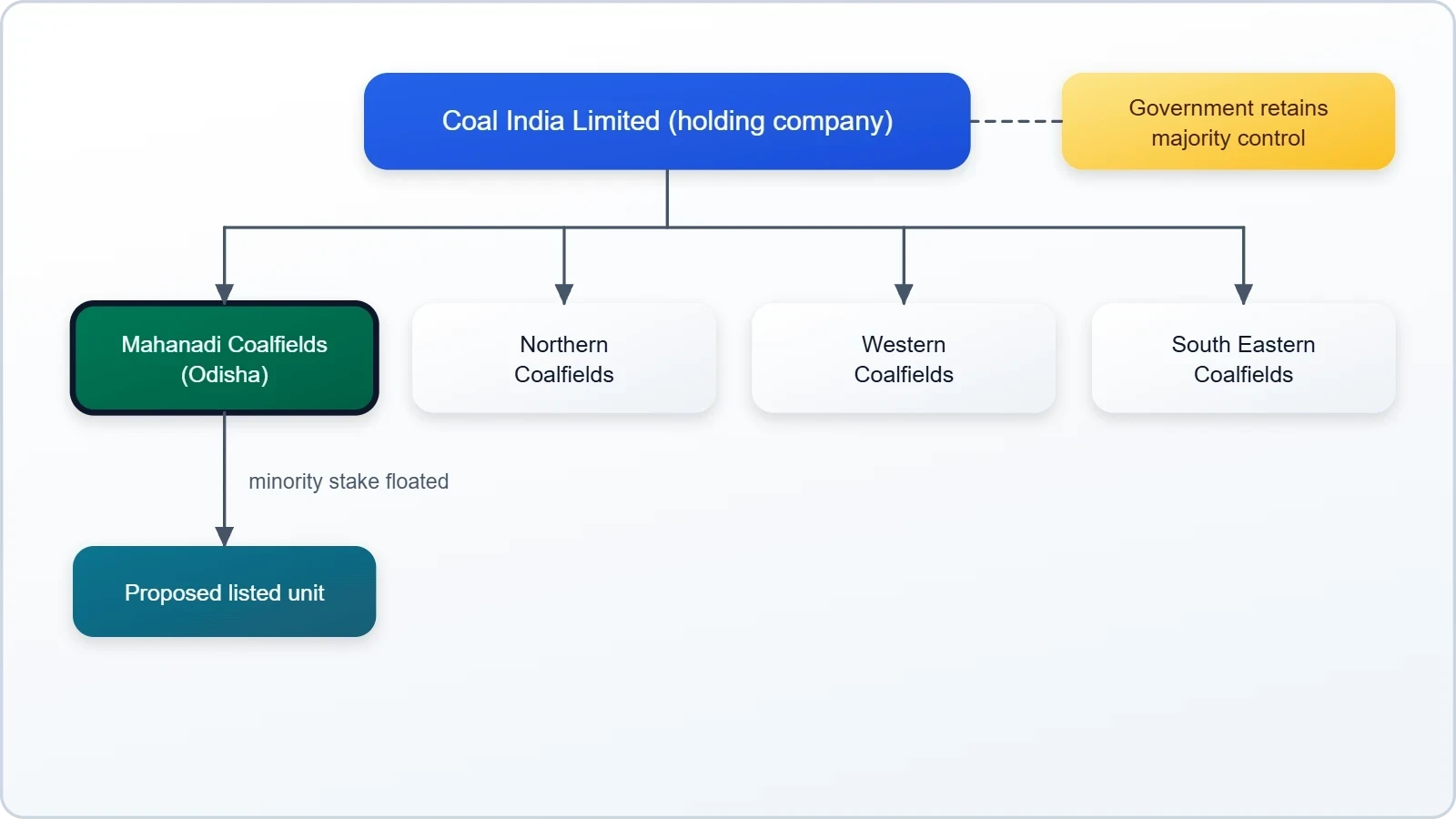
This structure has a particular financial logic. Coal India as a whole trades at a valuation that investors often describe as a conglomerate discount, meaning the market values the sum of its parts at less than their individual worth might justify. Listing a strong subsidiary can crystallise that hidden value by giving the market a direct comparison. If Mahanadi Coalfields lists at a premium to the implied valuation embedded in Coal India's share price, the parent's own stock may re-rate upward. This is the classic sum-of-the-parts argument, and it is one of the most persuasive reasons for the government to pursue subsidiary listings rather than simply selling shares in the parent.
Operational Profile and Reserve Base
Mahanadi Coalfields' operational strength rests on large, mechanised open-cast mines with relatively low extraction costs and long reserve lives. These characteristics make it one of the more efficient producers in the Coal India family, and efficiency translates directly into margins when coal prices are stable. The company also benefits from proximity to major consumption centres and from established rail linkages that move fuel to power plants. For an investor, these are the fundamentals that underpin any valuation exercise, and they explain why this particular subsidiary was selected for a listing ahead of less profitable peers.
Yet the operational profile also carries embedded risks that a prospectus must disclose. Open-cast mining requires extensive land, and land acquisition in India is politically fraught, involving rehabilitation of displaced communities and protracted legal disputes. Environmental clearances can be challenged, and mining operations are subject to periodic scrutiny over air and water pollution. These factors do not disqualify the asset, but they mean that the valuation must discount for regulatory and social friction, which is precisely the kind of discipline that public listing imposes.
The Parent-Subsidiary Relationship
A listed subsidiary of a state-owned parent faces a distinctive governance challenge: the controlling shareholder is also the government, which sets policy, appoints directors, and determines coal pricing in ways that can conflict with minority shareholder interests. Investors in Mahanadi Coalfields would therefore be buying into a company whose commercial decisions are shaped by public policy. The prospectus must address how related-party transactions with Coal India will be conducted, how transfer pricing for coal sales will be determined, and what protections exist for minority holders when the parent's interests diverge from the subsidiary's.
These questions are not academic. In several past listings of public sector subsidiaries, minority investors have complained that the parent captured value through favourable supply arrangements or that policy directives overrode commercial logic. A credible IPO will need to demonstrate that Mahanadi Coalfields has genuine operational autonomy and that its board includes directors capable of representing minority interests. The strength of those governance arrangements will materially affect the price investors are willing to pay.
Financial Implications for Coal India and the Market
The most immediate financial consequence of a Mahanadi Coalfields listing would be the creation of a transparent valuation benchmark for a major slice of Coal India's asset base. Analysts who currently estimate the worth of Coal India's subsidiaries through discounted cash flow models would gain an actual market price to anchor their assumptions. If that price exceeds the implied value in Coal India's own shares, the parent's stock becomes a candidate for re-rating. Conversely, if the subsidiary lists at a discount, it would expose the conglomerate discount as justified rather than artificial, which could pressure the parent's valuation in the opposite direction.
There is also a direct cash dimension. The government, as the ultimate owner, would receive proceeds from the stake sale, which flow into the disinvestment budget and help fund public expenditure. For Coal India itself, a subsidiary listing does not automatically raise new capital unless the offering includes a fresh issue of shares rather than a pure offer for sale by the existing owner. The distinction between these two structures is critical: an offer for sale transfers existing shares to the public and raises money for the seller, while a fresh issue raises money for the company. The Reuters report does not specify which structure is planned.
Valuation Benchmarks and Market Sentiment
Coal India's shares have historically traded at modest earnings multiples compared with private sector peers, reflecting investor concerns about the long-term future of thermal coal, government control, and the company's large cash balances that are not always deployed efficiently. A subsidiary listing could challenge that discount if Mahanadi Coalfields demonstrates stronger growth prospects or better capital discipline than the parent. Market sentiment toward coal equities has also shifted as energy security concerns have reasserted themselves, giving thermal coal producers a more favourable narrative than they enjoyed during the peak of the energy transition enthusiasm.
Yet sentiment is fickle, and the pricing of the offering will be the decisive variable. If the government prices the issue conservatively, leaving value on the table for public investors, the listing is likely to be well received and could lift the parent. If it prices aggressively to maximise proceeds, the shares may struggle after listing, damaging confidence in future disinvestment. The history of Indian public sector IPOs offers examples of both outcomes, and the government's bankers will be acutely aware of that record when they set the band.
Implications for Retail and Institutional Investors
For retail investors, a coal subsidiary offering presents a rare opportunity to own a direct stake in a large resource asset with predictable cash flows. Indian IPO rules reserve a portion of every offering for retail applicants, and coal companies have historically attracted strong retail interest because of their dividend-paying reputation. However, retail investors must weigh the long-term structural risk that thermal coal demand may decline as renewable energy expands, alongside the nearer-term reality that coal remains indispensable to the grid. The investment case depends heavily on the time horizon and the price paid.
Institutional investors, particularly domestic mutual funds and insurance companies, will focus on governance, dividend policy, and the parent's track record of respecting minority shareholders. Foreign investors may be constrained by environmental, social, and governance mandates that limit exposure to coal, which could reduce demand from that segment and affect pricing. The composition of the eventual shareholder base will therefore reflect a complex interplay of financial return, policy signals, and ethical screening, and the prospectus will need to address these investor concerns directly.
- 01
- 02
- 03
- 04
Energy Transition, Coal Demand, and Strategic Risk
Any valuation of a coal subsidiary must confront the central strategic question of the coming decades: how long will thermal coal remain a dominant fuel in India's electricity mix? India has committed to ambitious renewable energy targets and is adding solar and wind capacity at a rapid pace, yet coal still accounts for roughly three-quarters of electricity generation. The government has consistently argued that coal will remain necessary for baseload power and energy security even as renewables grow, and that position is unlikely to change abruptly given the scale of the grid and the intermittency of renewable sources.
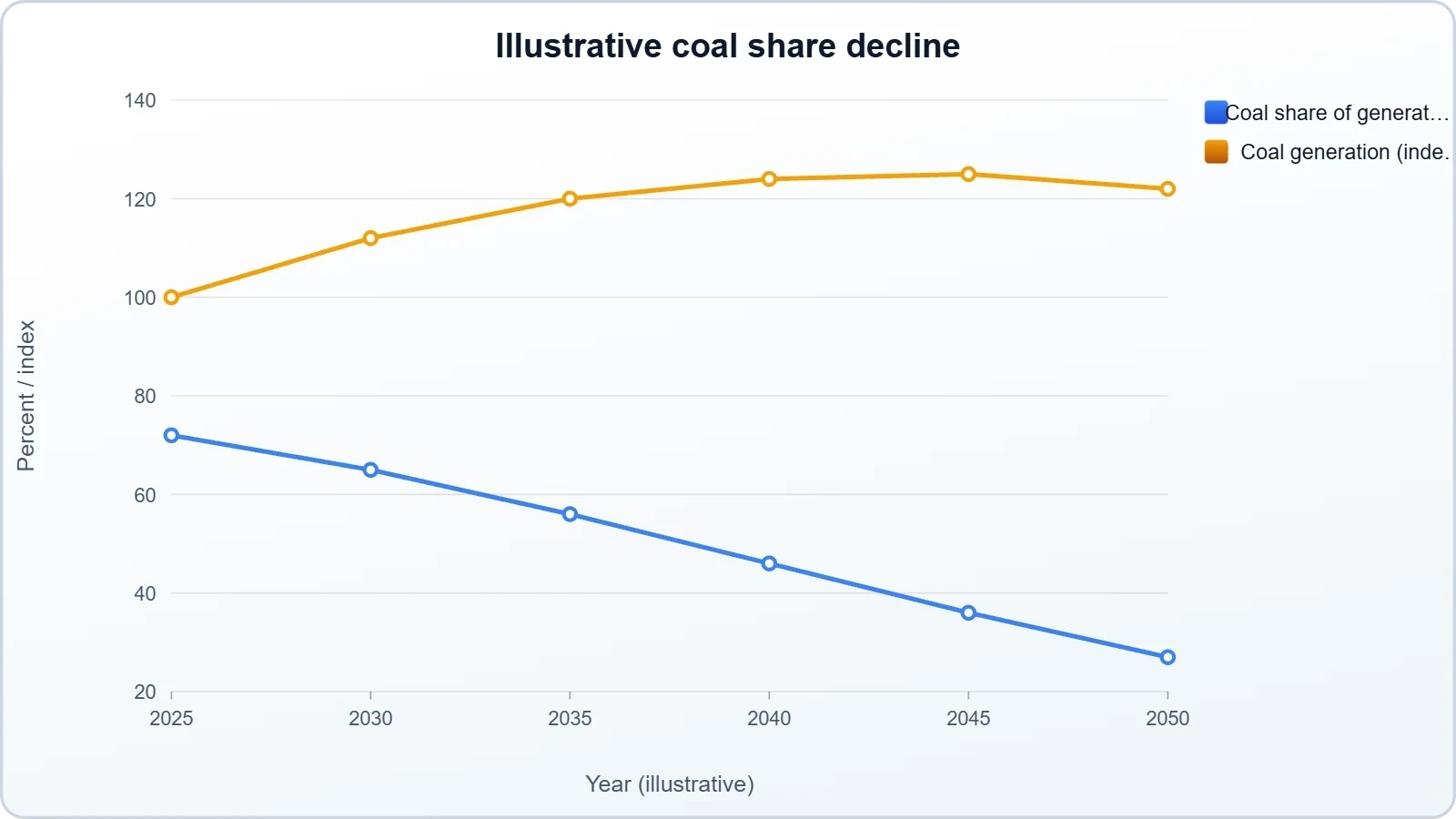
For investors, this creates a nuanced picture. Coal demand in India may continue to grow in absolute terms for years even as its share of the generation mix declines, which means producers can remain profitable while facing a long-term structural headwind. The valuation of a coal company therefore depends on assumptions about the pace of that decline, the trajectory of coal prices, and the company's ability to manage environmental liabilities. A public listing forces these assumptions into the open, which is arguably its greatest benefit: it subjects the coal business to the discipline of explicit, market-tested expectations rather than vague official projections.
Environmental Liabilities and Regulatory Scrutiny
Mining companies carry environmental obligations that can be substantial and unpredictable. Land reclamation, water treatment, dust suppression, and compliance with pollution norms all require ongoing expenditure, and failures can trigger penalties or operational shutdowns. For a listed entity, these liabilities must be quantified and disclosed, and investors will demand that adequate provisions be made. The prospectus will need to address pending environmental litigation, the status of clearances for operating mines, and the company's record of compliance with regulatory conditions attached to those clearances.
Beyond formal liabilities, there is reputational risk. Institutional investors with sustainability mandates may decline to participate in a coal offering regardless of financial attractiveness, and public scrutiny of the mining sector has intensified in recent years. This does not prevent a listing, but it narrows the pool of potential buyers and can affect the price the government is able to achieve. The strategic risk is therefore not only about future coal demand but also about the changing preferences of the capital markets that will price the asset.
Energy Security and Policy Support
Coal's political economy in India is powerful. The fuel supports millions of jobs, directly and indirectly, and underpins the finances of several states through royalties and taxes. Any policy that threatened coal production abruptly would face intense resistance, which gives producers a degree of implicit policy support. This support is a genuine asset for investors, because it reduces the risk of sudden regulatory shocks. However, it also means that coal companies may be shielded from market signals that would otherwise force faster adaptation, creating a different kind of long-term risk.
The government's stated approach has been to expand coal production while simultaneously building renewables, a dual-track strategy that seeks to avoid shortages without abandoning the transition. For Mahanadi Coalfields, this translates into continued demand for its output in the medium term, with the long-term outlook dependent on how quickly storage, grid flexibility, and alternative generation can displace thermal capacity. Investors will need to form their own view on that timeline, and the listing will give them a vehicle through which to express it.
What the Approval Signals About India's Reform Direction
Beyond the specifics of one company, the regulator's clearance carries a broader signal about the direction of Indian economic policy. Successive governments have promised to reduce the state's footprint in commercial enterprises, and listing subsidiaries is one of the few mechanisms that delivers on that promise without provoking the political backlash that outright privatisation can trigger. By floating a minority stake while retaining control, the government can claim reform while preserving strategic oversight. The Mahanadi Coalfields approval fits squarely within this template, and its progress will be read as a barometer of how seriously the current disinvestment agenda is being pursued.
The timing of the approval also matters. Global capital flows into emerging markets are sensitive to interest rate cycles, commodity prices, and geopolitical risk, and a coal offering must compete for attention with other investment opportunities. If the listing proceeds during a period of strong commodity prices and robust equity markets, it is likely to attract healthy demand. If it is launched into a downturn, the government may need to accept a lower valuation or postpone the sale. The approval gives the government optionality, and how it exercises that option will reveal its priorities.
Precedents from Other Public Sector Listings
India has accumulated a substantial record of listing state-owned enterprises, from insurance companies to railway financiers to power producers. The lessons from those offerings are instructive. Listings that were priced attractively and backed by credible governance reforms tended to perform well and encouraged further disinvestment. Those that were priced aggressively or launched with unresolved governance concerns often underperformed, deterring retail investors and complicating subsequent offerings. The Mahanadi Coalfields transaction will be judged against this history, and the government's bankers will be conscious of the reputational stakes.
A successful listing would also strengthen the case for listing other Coal India subsidiaries, potentially creating a family of listed coal companies with distinct valuations. That outcome would deepen the market for energy equities in India and give investors a more granular way to express views on the sector. Conversely, a poorly received offering could stall the programme and leave the government reliant on other, less transparent methods of raising resources from its mining assets.
Governance Reform as the Real Test
The most meaningful test of the listing will not be the first-day share price but the quality of governance that follows. Public ownership brings disclosure, but disclosure only matters if it is accurate and timely, and independent directors only matter if they are genuinely independent. Investors will watch whether Mahanadi Coalfields publishes robust quarterly results, whether related-party transactions are conducted at arm's length, and whether the board resists policy directives that harm minority value. If those standards are met, the listing will have achieved something more durable than a one-time cash infusion.
Governance reform in state-owned enterprises is slow and uneven, and a single listing will not transform the culture of an entire sector. But each credible float raises the benchmark against which other public entities are measured, and over time that pressure can produce meaningful change. The regulator's approval is therefore best understood as the opening of a test rather than the delivery of a result, and the market will render its verdict over years rather than days.
Conclusion: A Procedural Step With Substantive Consequences
The regulator's approval of an IPO for Mahanadi Coalfields is, on its face, a routine administrative milestone in a long process. Yet it carries substantive consequences that extend well beyond the company itself. It opens the possibility that a major coal asset will be priced by public markets, that Coal India's hidden value will be tested against an actual benchmark, and that the government's disinvestment rhetoric will be measured against a concrete transaction. The absence of details on size, timing, and pricing means the story is far from complete, but the direction of travel is now clear.
For investors, the practical takeaway is to watch the sequence of disclosures that will follow. The draft prospectus will reveal the company's financials, its legal exposures, and its governance arrangements. The price band will reveal the government's valuation expectations. The subscription data will reveal whether the market shares those expectations. Each of these steps will provide information that is currently unavailable, and each will shape the eventual outcome. The approval is the beginning of a process of discovery, not the end of one.
For the broader debate about India's energy future and the role of the state in the economy, the listing offers a rare opportunity to observe how markets and policy interact in a sector that sits at the intersection of both. Coal remains central to India's power system, and the way its producers are financed and governed will influence how smoothly the country manages the transition to a more diversified energy mix. Whether Mahanadi Coalfields becomes a model of transparent public ownership or another cautionary tale will depend on decisions that have not yet been made.
From our network :
- The Hidden Cost of AI Convenience: Why Over-Permissioned Agents Are a Security Time BombDiscover why AI agents with excessive permissions create dangerous single points of failure, and learn how implementing least privilege principles can protect your organization from exploitation.
- University Language Proficiency Exams: Why Institutional Tests Demand Different Preparation Than IELTS and TOEFLDiscover why university-specific language proficiency examinations differ fundamentally from IELTS and TOEFL, and learn strategic preparation approaches for institutional assessment success.
- Live Online English Classes for Kids: Do They Actually Reduce Anxiety?A ten-week study reveals that synchronous online English classes can significantly reduce child language anxiety while improving listening and reading skills. Discover what makes these programs effective and how parents can select the right one.
- Committed Mediterranean Precipitation Decline: Why Emissions Cuts Alone Cannot Restore Winter RainsNew NOAA research reveals that Mediterranean winter rains may decline irreversibly even with emissions cuts. Explore the science of committed climate change and regional impacts.
- How AI Agents Will Change the Way We Manage Personal FinancesExplore how AI agents are transforming personal finance through automated budgeting, bill payment, and investment management, while examining the critical security protocols and governance frameworks required for safe deployment.
- CISA’s Ten-Advisory Wave: Why Generic Patching Fails in OT and How to Build Product-Specific PlaybooksCISA released ten ICS advisories in one week, exposing critical infrastructure risks. Generic patching fails in OT. Learn to build product-specific remediation playbooks.
- The Final Descent: How ESA Retired the Legendary Cluster Constellation After 24 Years of Space Weather ScienceAfter 24 years mapping Earth’s magnetosphere, ESA’s Cluster mission concluded with a precisely controlled reentry over the South Pacific. This analysis explores the scientific legacy, engineering decisions, and debris mitigation principles behind one of space exploration’s most responsible retirements.
- Mobile Learning and VR in English: What Global Evidence Reveals About Effective Language TechnologyA systematic review across 14 countries reveals which language-learning technologies genuinely work. Mobile learning, AI, and VR show measurable benefits when pedagogically integrated. This evidence-based guide helps educators and learners select technology that delivers real return on investment.
- Forbidden Matrix Patterns and Visible Lattice Points: A Geometric DictionaryExplore how multidimensional 0–1 matrices encode geometric truths, linking forbidden patterns to visible lattice points and hypergraph theory, with applications in combinatorics and computational geometry.
RESOURCES
- India's markets regulator approves Coal India unit Mahanadi ...reuters.com5 hours ago ... India's capital markets regulator has approved state-run miner Coal India's unit Mahanadi Coalfields' IPO, in what is expected to be…
- Sebi approves Coal India unit Mahanadi Coalfields IPOm.economictimes.com5 hours ago ... India's capital markets regulator has approved state-run miner Coal India's unit Mahanadi Coalfields' IPO, in what is expected to be…
- Pfizer-BioNTech COVID-19 vaccine gains full U.S. regulatory approvalreuters.comAug 23, 2021 ... ... regulator on Monday granted full approval to the Pfizer Inc(PFE. ... India's markets regulator approves Coal India unit Mahanadi…
- India's markets regulator approves Coal India unit Mahanadi ...economictimes.indiatimes.com5 hours ago ... Coal India's Mahanadi Coalfields has just secured approval for an upcoming IPO, set to launch soon. This offering will potentially…
- ETMarkets - Xx.com4 hours ago ... India's capital markets regulator has approved state-run miner #CoalIndia's unit Mahanadi Coalfields' IPO, in what is expected to be one…
- Coal India unit Mahanadi Coalfields gets SEBI nod for IPO - VCCirclevccircle.com3 hours ago ... India's capital markets regulator has approved state-run miner Coal India's unit Mahanadi Coalfields' IPO, in what is expected to be…
- Sebi approves Mahanadi Coalfields IPO as Coal India plans 10 ...business-standard.com4 hours ago ... India's capital markets regulator has approved state-run miner Coal India's unit Mahanadi Coalfields' IPO, in what is expected to be…
- Coal India unit Mahanadi Coalfields wins IPO approval in Indiatradersunion.com5 hours ago ... India's equity market continues to draw large listings as regulators clear another major state-backed share sale. The approval for Mahanadi ...
- Coal India to sell 10% stake in unit Mahanadi Coalfields' IPOmining.comSep 1, 2026 ... ... Mahanadi Coalfields through the fully owned subsidiary's initial public offering, draft papers filed with the market regulator showed. State ...
- 01
- 02
- 03
- 04
- 05
- 06
- 07
- 08
0 Comments