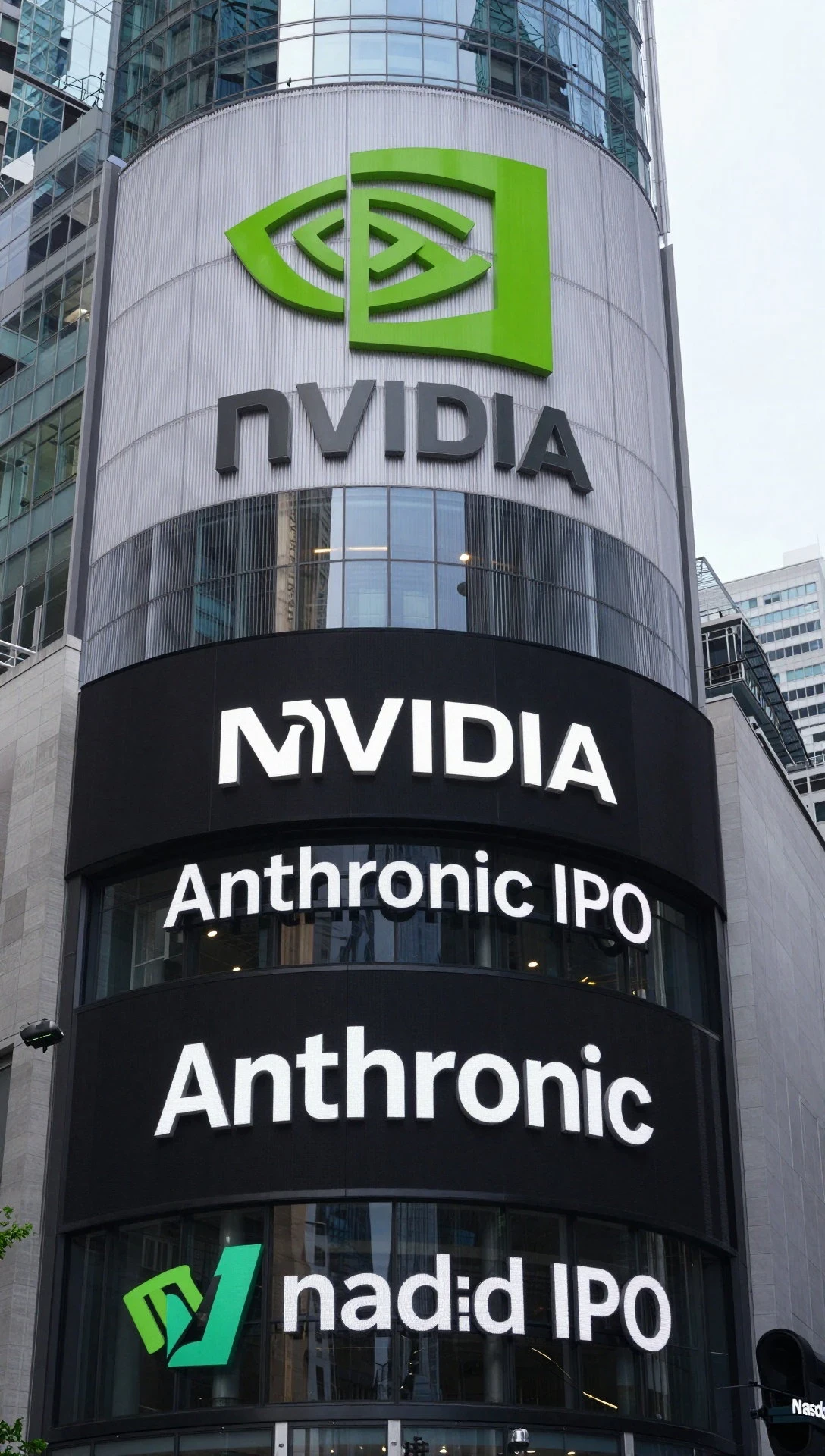
Equity futures tied to the Nasdaq pointed modestly higher on Wednesday, November 18, 2026, as technology shares found their footing after a stretch of restless trading. The immediate catalyst is a familiar one: Nvidia's quarterly results, due after the closing bell, which have become the closest thing this market has to a sector-wide referendum on artificial intelligence demand.
Yet the session carries a second, less familiar variable — the planned initial public offering of Anthropic, an event that transforms a routine earnings vigil into a broader test of whether public investors will pay up for AI exposure directly.
What makes this moment instructive is the convergence of two very different pricing mechanisms. Nvidia's report is a backward-looking verification exercise, measuring whether the enormous capital expenditure commitments announced across hyperscale cloud providers are translating into realized silicon revenue.
On This Page
The Anthropic listing, by contrast, is a forward-looking valuation exercise with almost no public comparables, forcing institutional allocators to construct fresh frameworks for businesses whose revenue trajectories are steep but whose cost structures remain opaque. Together they frame the central question of the cycle: is AI spending disciplined investment or speculative excess?
Trading desks describe the prevailing mood as deliberate rather than enthusiastic. Volumes have thinned, options positioning has shifted toward protective structures, and portfolio managers appear content to hold fire until both data points land. That restraint is itself a signal.
After a year in which AI-linked equities repeatedly defied valuation gravity, the market is demanding evidence rather than narrative, and the two events on Wednesday's calendar supply precisely the kind of evidence that cannot be argued away.
TL;DR Nasdaq futures edged higher as technology shares stabilized ahead of two pivotal events: Nvidia's quarterly earnings and Anthropic's planned IPO. Nvidia's results will test whether AI infrastructure demand remains intact, while the Anthropic listing will gauge public-market appetite for direct AI exposure. Traders are holding positions steady, awaiting confirmation before committing capital. The dual catalyst matters because it shifts the market's focus from sentiment to verification, and the outcome will likely set the tone for AI-linked valuations well into 2027.
The Dual Catalyst Reshaping Wednesday's Session
Two events rarely arrive on the same day with such complementary force. Nvidia's earnings speak to the physical layer of the AI economy — chips, networking, and the data-center buildout that underpins every model training run. Anthropic's IPO speaks to the application layer, where model developers monetize capability through enterprise contracts and API access. Watching both simultaneously gives investors an unusually complete read on the value chain.
Why Nvidia Remains the Sector's Bellwether
Nvidia's quarterly report has evolved from a semiconductor event into a macroeconomic indicator. Its data-center segment revenue functions as a proxy for hyperscaler capital expenditure, and guidance revisions ripple through suppliers, memory manufacturers, and power infrastructure providers alike. Analysts will scrutinize backlog visibility and gross margin trajectory as closely as headline revenue, since margin compression would signal pricing pressure entering the supply chain.
The deeper question concerns durability. Several large customers have signaled multi-year procurement commitments, which supports near-term visibility but complicates the read on cyclicality. If Nvidia guides conservatively while reporting strong current-quarter results, the market may interpret that as prudent sandbagging rather than demand deterioration. Conversely, aggressive guidance paired with soft margins would raise uncomfortable questions about competitive intensity.
Anthropic's IPO as an Appetite Barometer
The Anthropic offering carries weight beyond its own valuation. As one of the most prominent frontier model developers, its reception will establish the reference price for an entire cohort of private AI companies waiting in the queue. Institutional demand, anchor investor participation, and the eventual first-day trading range will all be read as verdicts on whether public markets are prepared to underwrite long-duration AI risk.
Pricing mechanics deserve particular attention. Unlike mature software listings, Anthropic lacks a long public revenue history, meaning underwriters must lean heavily on forward projections and comparable private-round valuations. That structure invites volatility. A strong debut would validate private marks across the sector; a weak one would force a repricing conversation that extends well beyond a single company's balance sheet.
Reading the Pre-Earnings Calm in Tech Shares
The relative calm in technology shares is not indifference; it is positioning discipline. After repeated episodes of sharp intraday reversals around prior Nvidia reports, traders have learned that pre-event conviction is expensive. Reduced volume and compressed ranges reflect a market that has deliberately deferred decision-making, preserving optionality until the two data points resolve the near-term uncertainty.
Volatility Compression and Options Positioning
Implied volatility in major technology indices has drifted lower into the event window, a pattern consistent with traders selling premium rather than buying protection. That behavior cuts both ways. It signals confidence that outcomes will land within expected bands, but it also leaves the market vulnerable to outsized moves if either event surprises, since thin hedging reduces the cushioning effect of offsetting flows.
Skew metrics tell a similar story. Demand for downside puts has moderated, suggesting investors are less concerned about a sharp drawdown than about missing an upside re-rating. When skew flattens ahead of a binary catalyst, it usually means the marginal participant is underweight and anxious about being left behind, which can amplify any positive surprise.
Institutional Flows and Sector Rotation
Beneath the index-level calm, sector rotation continues quietly. Capital has been migrating from crowded mega-cap AI names toward adjacent beneficiaries — power generation, cooling infrastructure, and networking equipment — where valuations appear less stretched relative to earnings visibility. This rotation does not necessarily signal a loss of faith in AI leadership; it reflects a search for exposure with better risk-adjusted entry points.
Institutional allocators also face a structural constraint: concentration limits. Many portfolios are already near their maximum permissible weight in the largest technology names, forcing incremental AI exposure into second-tier suppliers or, increasingly, into primary issuance such as the Anthropic offering. That dynamic explains why the IPO matters disproportionately to large funds seeking exposure they cannot obtain through existing holdings.
Nvidia's Numbers and the AI Demand Question
Every Nvidia report now carries an implicit question that transcends the company itself: is the AI buildout still accelerating, plateauing, or normalizing? The answer determines not only semiconductor valuations but also the capital expenditure plans of cloud providers, the earnings outlook for memory suppliers, and the viability of power infrastructure projects predicated on sustained data-center growth.
Data-Center Revenue as the Core Metric
Data-center segment revenue remains the single most watched line item. It captures demand from hyperscalers building training clusters and enterprises deploying inference capacity. Sequential growth rates matter more than absolute figures, since deceleration from elevated levels can trigger outsized multiple compression even when revenue continues to expand in nominal terms.
Backlog disclosure provides the forward-looking complement. Multi-quarter visibility, if reaffirmed, would support the argument that AI infrastructure spending is contractual rather than discretionary. Any softening in backlog commentary would be read as an early warning that customers are digesting prior purchases, a pattern that historically precedes cyclical corrections in semiconductor demand.
Guidance, Margins, and Supply Chain Signals
Gross margin trajectory reveals competitive dynamics that revenue alone obscures. Sustained margins near recent levels would indicate pricing power remains intact despite rising competition from custom silicon programs at major customers. Compression, by contrast, would suggest the market is maturing faster than suppliers anticipated, with implications for the entire ecosystem's profitability assumptions.
Supply chain commentary offers a secondary read. Commentary on advanced packaging capacity, high-bandwidth memory availability, and lead times signals whether constraints persist or ease. Easing constraints typically precede margin normalization, while persistent bottlenecks support pricing. Investors will parse these details carefully, since they often foreshadow trends visible in supplier results a quarter later.
Anthropic's Listing and the Public AI Appetite Test
Anthropic's IPO represents something the AI trade has lacked: a direct, publicly traded claim on frontier model development. Until now, public investors accessed the theme indirectly through chips, cloud infrastructure, or power suppliers. A successful listing would create a new asset class, allowing portfolios to express views on model capability and enterprise adoption without routing through hardware exposure.
Valuation Frameworks for a New Asset Class
Traditional software multiples struggle with frontier model developers. Revenue growth is steep but gross margins are shaped by compute costs that fluctuate with training intensity and inference volume. Analysts must therefore blend subscription-style recurring revenue assumptions with infrastructure cost curves, producing valuation ranges far wider than conventional enterprise software comps would suggest.
Comparable-company analysis offers limited guidance because few public firms combine research intensity, capital requirements, and enterprise contract structures in similar proportion. Underwriters will likely anchor on private funding rounds, adjusting for liquidity premium and public-market volatility. The resulting range will be scrutinized as a template for the cohort of AI developers expected to follow.
Implications for the Private AI Cohort
The listing's reception will reverberate through private markets immediately. A strong debut validates existing marks and encourages further issuance; a tepid one forces venture investors to reconsider exit timelines and may prompt down-round conversations at companies with similar profiles. Either outcome accelerates the normalization of AI valuations toward public-market discipline.
Strategic implications extend beyond capital raising. Public listing imposes disclosure obligations that reveal unit economics previously shielded from scrutiny. Competitors, customers, and regulators will gain visibility into pricing, retention, and compute expenditure. That transparency may prove as consequential as the capital itself, reshaping competitive dynamics across the model development landscape.
- 01
- 02
- 03
- 04
We Also Published
What the Two Events Reveal About AI Market Maturity
Viewed together, the earnings report and the listing mark a transition point. The AI trade is moving from a phase defined by narrative and total addressable market projections toward one governed by disclosed economics. That shift does not diminish the theme's importance; it changes the criteria by which participants are judged, rewarding execution over storytelling and cash generation over ambition.
From Narrative to Verification
For two years, AI equities advanced on the strength of a compelling story about productivity transformation. That story remains plausible, but markets eventually demand accounting. Nvidia's report supplies verification at the hardware layer; Anthropic's listing supplies it at the model layer. Together they establish whether the narrative has begun converting into measurable financial reality.
This maturation carries implications for volatility. Verification events produce binary outcomes, and binary outcomes produce sharp repricing. Investors should expect wider dispersion between winners and laggards as the market discriminates more finely. Broad thematic baskets may underperform concentrated positions in companies that demonstrate durable economics rather than mere exposure.
Positioning for a Post-Verification Market
Portfolio construction must adapt to a market that rewards specificity. Rather than owning AI as a monolithic theme, allocators are increasingly separating infrastructure, model development, and application layers, each with distinct risk profiles and valuation drivers. That granularity demands more research but offers better risk control than broad thematic exposure.
Liquidity management also deserves attention. Event clusters like Wednesday's can produce correlated moves across ostensibly unrelated holdings, temporarily overwhelming diversification benefits. Maintaining dry powder and avoiding leverage into binary catalysts remain prudent disciplines, particularly when implied volatility has compressed and the cost of being wrong has risen.
The Road Ahead for AI-Linked Equities
Wednesday's twin catalysts will not resolve the AI debate, but they will sharpen it. Nvidia's guidance sets the tone for infrastructure spending through the next several quarters, while Anthropic's trading debut establishes a public benchmark for model developers. Together they provide the market with something it has lacked: a common factual foundation for valuation arguments that have long rested on projection.
Signals to Monitor Beyond the Headlines
Beyond the headline numbers, several secondary indicators merit attention. Supplier commentary on order visibility, cloud provider capex revisions, and power purchase agreements tied to data-center expansion all offer corroborating evidence. Divergence between these signals and headline results often reveals more about underlying demand than the reported figures themselves.
Options markets will also provide real-time feedback. Post-event implied volatility term structure, skew adjustments, and open interest migration reveal how institutions reposition after the data lands. These technical signals frequently anticipate fundamental revisions by several weeks, making them valuable for investors seeking early indications of sentiment shifts.
Balancing Opportunity and Discipline
The opportunity set remains substantial, but the margin for error has narrowed. Companies with genuine competitive moats, visible revenue, and disciplined capital allocation will likely command premium valuations, while speculative names lacking economic substance face sustained pressure. That bifurcation is characteristic of markets transitioning from thematic enthusiasm to fundamental accountability.
Discipline, therefore, becomes the defining virtue. Investors who resist the temptation to extrapolate single-quarter results into permanent trends, and who maintain diversified exposure across the AI value chain, are better positioned to navigate the volatility that verification events inevitably produce. The story remains compelling; the accounting now matters equally.
From our network :
- Committed Mediterranean Precipitation Decline: Why Emissions Cuts Alone Cannot Restore Winter RainsNew NOAA research reveals that Mediterranean winter rains may decline irreversibly even with emissions cuts. Explore the science of committed climate change and regional impacts.
- How AI Agents Will Change the Way We Manage Personal FinancesExplore how AI agents are transforming personal finance through automated budgeting, bill payment, and investment management, while examining the critical security protocols and governance frameworks required for safe deployment.
- Forbidden Matrix Patterns and Visible Lattice Points: A Geometric DictionaryExplore how multidimensional 0–1 matrices encode geometric truths, linking forbidden patterns to visible lattice points and hypergraph theory, with applications in combinatorics and computational geometry.
- Live Online English Classes for Kids: Do They Actually Reduce Anxiety?A ten-week study reveals that synchronous online English classes can significantly reduce child language anxiety while improving listening and reading skills. Discover what makes these programs effective and how parents can select the right one.
- University Language Proficiency Exams: Why Institutional Tests Demand Different Preparation Than IELTS and TOEFLDiscover why university-specific language proficiency examinations differ fundamentally from IELTS and TOEFL, and learn strategic preparation approaches for institutional assessment success.
- Mobile Learning and VR in English: What Global Evidence Reveals About Effective Language TechnologyA systematic review across 14 countries reveals which language-learning technologies genuinely work. Mobile learning, AI, and VR show measurable benefits when pedagogically integrated. This evidence-based guide helps educators and learners select technology that delivers real return on investment.
- The Final Descent: How ESA Retired the Legendary Cluster Constellation After 24 Years of Space Weather ScienceAfter 24 years mapping Earth’s magnetosphere, ESA’s Cluster mission concluded with a precisely controlled reentry over the South Pacific. This analysis explores the scientific legacy, engineering decisions, and debris mitigation principles behind one of space exploration’s most responsible retirements.
- The Hidden Cost of AI Convenience: Why Over-Permissioned Agents Are a Security Time BombDiscover why AI agents with excessive permissions create dangerous single points of failure, and learn how implementing least privilege principles can protect your organization from exploitation.
- CISA’s Ten-Advisory Wave: Why Generic Patching Fails in OT and How to Build Product-Specific PlaybooksCISA released ten ICS advisories in one week, exposing critical infrastructure risks. Generic patching fails in OT. Learn to build product-specific remediation playbooks.
RESOURCES
- Wall Street ends sharply lower on AI jitters ahead of Nvidia ... - Reutersreuters.com17 hours ago ... ... earnings report on Tuesday and Anthropic's initial public offering later in the week ... Nvidia results, Anthropic IPO. By…
- Wall Street ends sharply lower on AI jitters ahead of Nvidia results ...finance.yahoo.com19 hours ago ... Equity Futures Down Pre-Bell as Markets Await Nvidia Earnings, Anthropic IPO · PREMIUM. MT Newswires • 11h ago. NVDA ·…
- Stocks end lower ahead of Nvidia earnings and Anthropic IPOreuters.com2 days ago ... O ticker. "The success of the IPO, along with Nvidia's earnings, will definitely be the barometer for whether the (stock…
- Nasdaq falls more than 2%, extending slide to third day as Nvidia ...cnbc.com2 hours ago ... Another key test for the trade this week is Anthropic's initial public offering. The AI giant is eyeing a roughly…
- Wall Street ends sharply lower on AI jitters ahead of Nvidia results ...ca.finance.yahoo.com19 hours ago ... ... earnings report on Tuesday and Anthropic's initial public offering later in the week. The risk-off sentiment gathered momentum as…
- GLOBAL MARKETS-Asian shares fall before Nvidia earnings ...fidelity.com2 days ago ... Nikkei falls 0.6%, Nasdaq futures bounce 0.5%. * Nvidia ( NVDA ) earnings on Tuesday, Anthropic IPO on Thursday. *…
- Nasdaq 100 Forecast: NDX rises ahead of Nvidia earnings - StoneXstonex.com1 day ago ... U.S. stocks – Nvidia earnings and Anthropic IPO in focus. U.S. stocks are pointing to a mixed open, with Nasdaq…
- Nasdaq 100 Tumbles for Third Day With Nvidia Earnings on Horizonbloomberg.com19 hours ago ... “The week begins with a defensive tone ahead of two critical tests for the AI trade – Nvidia earnings and…
- S&P 500, Nasdaq futures fall ahead of Nvidia earnings, Anthropic IPOkitco.com1 day ago ... Nov 16 (Reuters) - Futures tracking the S&P 500 and the Nasdaq 100 slid on Monday as AI-related stocks faced…
- Nasdaq 100 Forecast: NDX falls ahead of Nvidia's earnings ...stonex.com1 day ago ... Nvidia reports on Tuesday and Anthropic IPO's on Thursday/ Friday; US Treasury yields remain elevated, with a 10-year above 5.1%.…
- Stock Futures Rise Ahead of Nvidia Earnings and Anthropic IPOic.com1 day ago ... ... Nvidia's highly anticipated earnings report and a potentially record-breaking public market debut by Anthropic. Nasdaq-100 futures rose 0.6 ...
- Dow Jones Futures Fall, Techs Tumble As Jensen Huang Mulls ...investors.com1 day ago ... Dow Jones futures: Nvidia earnings are due as Jensen Huang reportedly mulls a return. The Anthropic IPO is ahead.
- Dow, S&P 500, Nasdaq Futures Mixed Ahead Of Much-Anticipated ...es.tradingview.com13 hours ago ... ... Nvidia Earnings, Anthropic IPO: SLS, BABA, JPM, OMER In Focus ... U.S. stock futures traded mixed overnight late Monday…
- NVIDIA Corporation Common Stock (NVDA) - Nasdaqnasdaq.comKey PointsThe entire semiconductor sector sold off today ahead of Nvidia earnings. ... Anthropic IPO: 5 Big Ways It Could Boost NVIDIA Stock. Anthropic's…
- Nvidia Earnings, Anthropic IPO Ahead in New Test for AI Economywsj.com1 day ago ... Key quotes: “They need a dramatic shake-up,” Bessent said on Fox News Channel's “Sunday Morning Futures. ... Nasdaq exchange on…
- 01
- 02
- 03
- 04
- 05
- 06
- 07
- 08
0 Comments