
When American voters delivered a divided verdict in the 2026 midterm elections, the reaction on Wall Street arrived with unusual speed and clarity. Within a single trading session, the Dow Jones Industrial Average climbed nearly three percent — its strongest day in more than a year — while the Nasdaq and the S&P 500 each advanced roughly one and a half percent. Yet the more telling signal came from the currency pits, where the dollar slid to a one-month low against a basket of major trading partners and weakened sharply against the yen and the Swiss franc, the traditional refuges investors seek when political certainty evaporates.
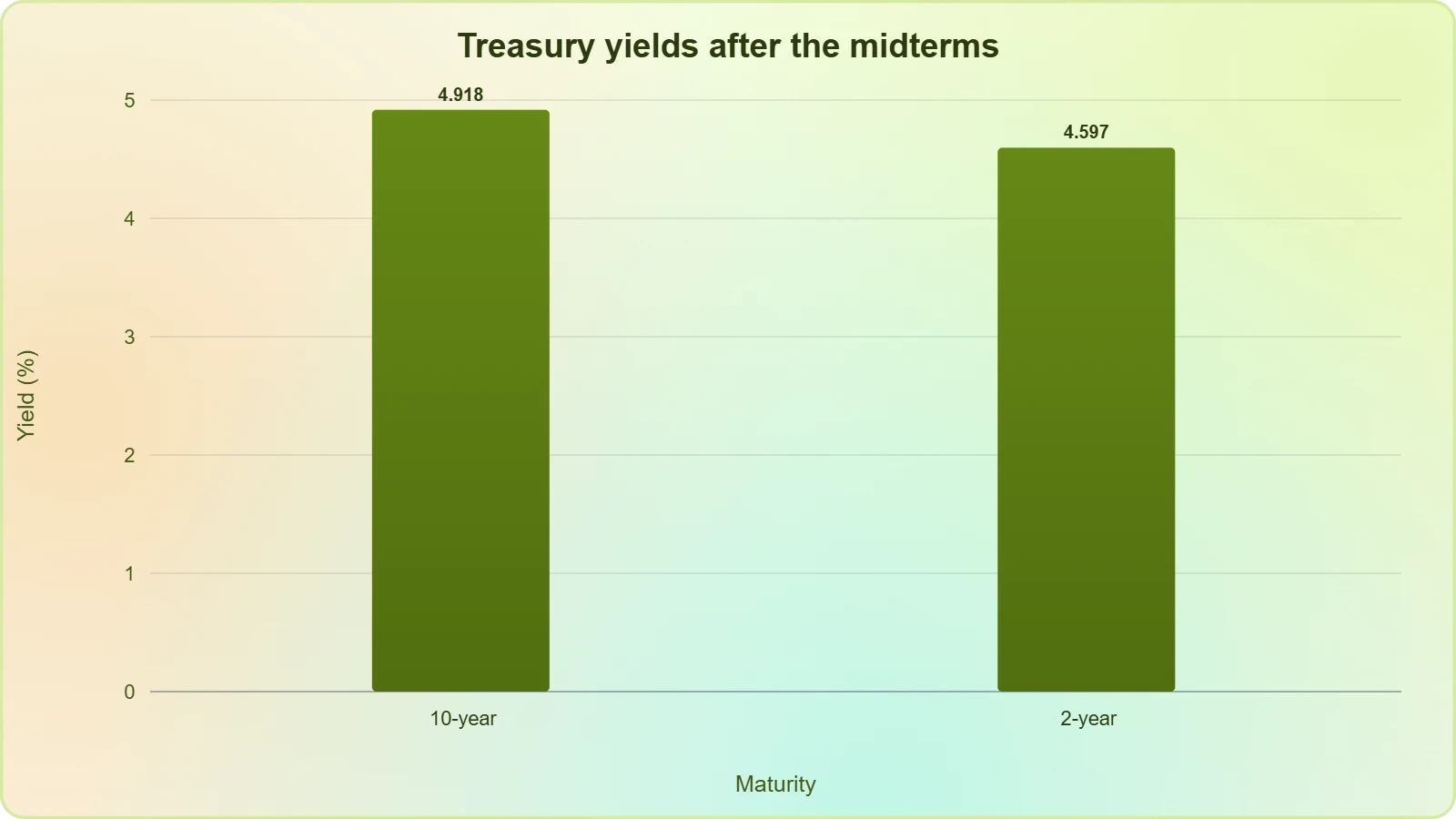
This divergence between surging equities and a softening currency tells a story that goes well beyond a single election night. Markets were not simply celebrating a Democratic win; they were repricing the probability that President Donald Trump's policy agenda would face meaningful legislative checks over the remaining two years of his term. Treasury yields fell as money flowed into government bonds, with the ten-year yield dropping 4.7 basis points to 4.918 percent and the two-year yield easing 3.7 basis points to 4.597 percent. Oil slipped below the symbolic hundred-dollar threshold as traders reassessed the trajectory of the conflict with Iran.
What follows is a structured examination of how political outcomes transmit themselves through equity indices, currency pairs, sovereign bond markets, and individual corporate valuations. The analysis draws on the specific market movements recorded on that November Wednesday, the commentary of strategists at IG and XTB, and the broader historical pattern of divided government in the United States. The aim is to show how investors translate electoral arithmetic into portfolio decisions, and why the dollar, rather than the stock ticker, often serves as the most honest barometer of political risk.
On This Page
- The Election Result and the Anatomy of a Relief Rally
- Safe-Haven Flows, Precious Metals, and the Oil Repricing
- The Musk Exposure: SpaceX, Tesla, and AI Scrutiny
- Bond Markets, Yield Curves, and the Safety Trade
- Historical Parallels and the Divided Government Playbook
- Reading the Signal Beneath the Headlines
TL;DR Democratic midterm victories in November 2026 triggered a sharp rally in US equities, with the Dow gaining nearly three percent, while the dollar fell to a one-month low and Treasury yields declined as investors priced in legislative gridlock and reduced policy risk. Safe-haven currencies and precious metals benefited, European markets rose broadly, and clean energy and bank stocks led gains. Meanwhile, companies tied to Elon Musk — SpaceX and Tesla — fell as investors anticipated heightened scrutiny of AI consolidation under a Democrat-controlled Congress.
The Election Result and the Anatomy of a Relief Rally
The immediate market response to the midterm results was a textbook relief rally, but its composition deserves careful unpacking. Futures had pointed to a lower open earlier in the session, which means the buying pressure emerged after voters' choices became unambiguous. Democrats captured Senate seats in Texas, Iowa, North Carolina, and South Carolina — states that had long been considered Republican strongholds. That breadth, rather than the raw seat count, is what moved institutional money. When opposition victories extend into traditionally safe territory, portfolio managers must revise their assumptions about how much legislative resistance the White House will encounter.
Why Divided Government Often Pleases Equity Investors
Equity markets have historically displayed a counterintuitive preference for divided government. The logic rests on the observation that legislative gridlock reduces the probability of abrupt regulatory change, surprise tax measures, or disruptive fiscal experiments. When one party controls the presidency and both chambers, policy volatility rises; when power is split, the status quo tends to prevail. The Dow's near three percent jump reflected this calculus directly. Investors were not endorsing Democratic policies so much as discounting the likelihood of aggressive executive action on tariffs, antitrust, and industrial policy over the next two years.
Axel Rudolph, chief technical analyst at the trading platform IG, framed the result in precisely these terms. He argued that the scale of Republican losses would raise questions about Trump's ability to push his agenda through over the remainder of his term. Markets, he noted, were already reacting — the dollar under pressure, gold and silver attracting safe-haven flows. This is the essential mechanism: elections do not move markets because of ideology, but because they alter the distribution of possible future policies. A narrower path to legislative change compresses that distribution, and compressed uncertainty is what equity investors reward.
The Currency Signal That Equities Cannot Hide
The dollar's decline is the more nuanced indicator. A weaker greenback against the yen and the Swiss franc — both classic uncertainty hedges — suggests that global capital was not uniformly optimistic. It was rotating. Money left dollar-denominated assets at the margin and sought currencies associated with stability during political ambiguity. The pound and euro both gained against the dollar, reinforcing the impression of a broad, rather than bilateral, repricing. When a currency falls while its domestic stock market rises, the message is usually that foreign investors are hedging their exposure rather than abandoning it outright.
Government bond markets confirmed the same story from a different angle. Yields fall when prices rise, and the drop in both the ten-year and two-year Treasury yields indicated genuine demand for US sovereign debt. That is not the behavior of investors fleeing American assets; it is the behavior of investors seeking safety within them. The distinction matters enormously for interpreting the session. A true capital flight would have pushed yields higher alongside a falling currency. Instead, yields and the dollar moved in the same direction, which points to a domestic political risk premium rather than a loss of confidence in US creditworthiness.
Safe-Haven Flows, Precious Metals, and the Oil Repricing
Beyond the headline index moves, the session revealed a coherent rotation into defensive assets. Gold and silver benefited as investors sought stores of value insulated from political noise, a pattern IG's Rudolph explicitly identified. The Swiss franc and Japanese yen strengthened for the same reason. These are not speculative positions; they are insurance. When the political outlook becomes less predictable, the cost of that insurance falls in relative terms because the alternative — holding a currency exposed to policy shifts — becomes more expensive. The simultaneous strength of precious metals and weakness of the dollar is one of the cleanest confirmations that political risk, not growth optimism, drove part of the day's trading.
Why Brent Crude Broke Below One Hundred Dollars
Oil's decline below one hundred dollars a barrel for the first time since early October added another layer to the interpretation. Traders were explicitly weighing how the election results might affect the war in Iran. A Congress less aligned with the White House could constrain the executive's freedom to escalate or extend military engagement, which in turn reduces the geopolitical premium embedded in crude prices. Energy markets are acutely sensitive to perceived conflict risk, and any signal that hostilities might be contained tends to push prices lower. The move was modest in absolute terms but symbolically significant, marking a shift in how traders priced Middle Eastern instability.
It is worth noting that Trump himself took to social media to claim credit for the stock market rise, describing it as a record high. This rhetorical move is familiar in modern political communication, but it sits awkwardly beside the currency and bond signals. A president can claim ownership of an equity rally while the foreign exchange market quietly registers doubt about his legislative leverage. The divergence between what politicians say about markets and what markets say about politicians is one of the most reliable features of financial commentary, and this session offered a particularly vivid illustration of that gap.
The European Spillover and Sector Leadership
European markets participated enthusiastically in the rally, which is itself informative. London's FTSE 100 gained 1.8 percent, Germany's Dax rose 2.2 percent, France's Cac 40 added 2 percent, and Italy's FTSE MiB climbed 2.2 percent. The leadership within those indices was even more revealing. Bank stocks rose 2.8 percent, Denmark's Vestas Wind Systems jumped nearly 5 percent, and Ørsted soared 7.4 percent. These are precisely the sectors most exposed to Trump-era policy hostility — financial regulation and clean energy incentives. Their outperformance suggests investors were pricing in reduced risk of adverse policy action from Washington, not a change in European fundamentals.
The clean energy reaction deserves particular attention. Wind developers have operated under persistent uncertainty about US tax credits and permitting regimes. Any expectation that a Democrat-controlled chamber could block hostile legislative changes reduces the discount rate applied to long-duration renewable projects. That is why Ørsted's 7.4 percent surge outpaced the broader market. Similarly, banks benefited from the expectation that aggressive deregulatory or retaliatory measures might be tempered. The pattern confirms that the rally was fundamentally about policy risk compression rather than about economic growth expectations, which barely featured in strategist commentary.
The Musk Exposure: SpaceX, Tesla, and AI Scrutiny
Not every corner of the market shared in the optimism. Kathleen Brooks, UK research director at XTB, observed that SpaceX was down 5 percent in premarket trading and Tesla was lower by more than 4 percent. Her explanation was pointed: Elon Musk is viewed unfavorably by many Democrats, and investors were reacting to expectations that a Democrat-controlled Congress could mean greater scrutiny for AI companies. That scrutiny, in turn, could raise doubts about a merger involving two of Musk's companies. The detail that Musk contributed $446 million to Republican-aligned political action committees and groups during the midterms adds a layer of political economy to the corporate analysis.
Political Contributions as a Market Variable
The scale of Musk's political spending makes his companies unusually sensitive to electoral outcomes. When a single individual deploys nearly half a billion dollars in support of one party's candidates, the investing public reasonably treats that individual's corporate empire as exposed to the other party's oversight. This is not speculation about retaliation; it is a straightforward assessment of regulatory risk. Congressional committees can summon executives, request documents, and shape the public narrative around mergers and antitrust questions. For a company like SpaceX, whose government contracts are substantial, the composition of oversight committees matters materially to valuation.
Tesla's decline reflects a similar logic, compounded by the fact that the electric vehicle maker's fortunes are intertwined with federal incentive structures and regulatory frameworks. A Congress less sympathetic to the administration's approach could revisit tax credits, safety investigations, or autonomous driving approvals. Investors do not need certainty about specific legislation to reprice a stock; they only need a shift in the probability distribution. The four percent decline in Tesla and the five percent premarket drop in SpaceX are best understood as the market assigning a higher probability to adverse regulatory attention over the coming two years.
The Broader AI Consolidation Question
The reference to a merger involving two of Musk's companies connects the election result to one of the defining corporate themes of the decade: the consolidation of artificial intelligence capabilities. A Democrat-controlled Congress is widely expected to take a more skeptical view of large-scale AI mergers, particularly where a single owner controls multiple frontier labs, data pipelines, and distribution platforms. Investors who had priced in a permissive antitrust environment must now adjust. This is why the AI angle matters beyond Musk personally; it signals that the entire sector's consolidation calculus may shift under divided government.
For portfolio managers, the practical implication is that political exposure must be assessed at the level of individual ownership structures, not just sectors. Two AI companies with identical revenue profiles can carry very different political risk if one is owned by a major political donor and the other is not. This is a relatively recent development in equity analysis, and it complicates traditional factor models. The November session demonstrated that markets are now capable of pricing political affiliation as a distinct risk factor, separate from regulation, taxation, or macroeconomic conditions.
We Also Published
- 01
- 02
- 03
- 04
Bond Markets, Yield Curves, and the Safety Trade
The Treasury market's response deserves its own examination because it clarifies the nature of the risk being priced. The ten-year yield fell 4.7 basis points to 4.918 percent, while the two-year yield dropped 3.7 basis points to 4.597 percent. Both moves reflect rising bond prices, which means investors were actively buying US government debt. In periods of genuine crisis, the opposite can occur: foreign holders sell, yields spike, and the currency collapses simultaneously. That did not happen here. Instead, the yield decline alongside a softer dollar suggests a domestic reassessment of policy risk rather than a loss of faith in US fiscal credibility.
Reading the Curve for Political Signals
The slightly larger decline in the ten-year yield relative to the two-year yield flattened the curve marginally. This is a subtle but meaningful signal. Long-dated yields are more sensitive to expectations about fiscal policy, inflation, and long-run growth, while short-dated yields track near-term central bank expectations. A larger drop at the long end implies that investors were revising down their expectations for fiscal expansion or inflationary policy over the coming years. Divided government reduces the probability of large new spending programs or unfunded tax cuts, which in turn lowers the long-run inflation premium embedded in longer maturities.
This interpretation aligns with the equity reaction. If investors expected stronger growth, they would typically sell bonds and push yields higher. Instead, they bought bonds while buying stocks, a combination that only makes sense when the dominant driver is reduced uncertainty rather than improved fundamentals. The bond market, in other words, was not forecasting a boom; it was pricing a more constrained policy environment. That is a fundamentally different signal from the one equities appeared to send, and reconciling the two is essential for anyone interpreting the session accurately.
Safe-Haven Currencies and the Flight to Quality
The yen and the Swiss franc strengthened, and both are classic beneficiaries of uncertainty. Investors buy them when they want exposure to currencies backed by current-account surpluses and stable institutions, particularly during periods when the political direction of a major economy is in question. The pound and euro also gained against the dollar, which broadened the impression of a general dollar softening rather than a narrow pair-specific move. When multiple currencies appreciate against the dollar simultaneously, the driver is usually a reassessment of US political or monetary conditions rather than idiosyncratic factors in each counterparty.
Gold and silver's gains complete the picture. Precious metals typically rise when real yields fall and when investors seek assets with no counterparty risk. The combination of lower nominal yields, a weaker dollar, and stronger metals is a coherent safe-haven configuration. It tells us that a meaningful portion of the day's capital flows was defensive rather than opportunistic. Equity investors celebrated the election result, but a parallel cohort of investors was quietly buying protection. Both reactions are rational; they simply reflect different time horizons and different sensitivities to political risk.
Historical Parallels and the Divided Government Playbook
Investors with long memories will recognize the pattern. Midterm elections frequently produce a counter-trend reaction in which the incumbent party loses ground and markets rally on the expectation of gridlock. The 2018 midterms, the 2010 midterms, and the 1994 Republican revolution all produced variations on this theme. What distinguishes the 2026 episode is the speed and clarity of the currency response. In earlier cycles, the dollar's reaction was often muted or delayed. Here, the greenback reached a one-month low within a single session, suggesting that foreign exchange traders had already been positioning for a possible Democratic surge and accelerated their adjustments once the result was confirmed.
What the Historical Record Suggests
The historical record offers a caution against overinterpreting any single session. Equity rallies driven by political relief often fade as investors refocus on earnings, interest rates, and growth. The Dow's three percent gain was impressive, but it occurred in a context where futures had earlier pointed lower, indicating that positioning rather than fundamental reassessment drove part of the move. The more durable signal is likely to be found in sector rotation and in the currency market, where changes tend to reflect genuine shifts in the perceived distribution of policy outcomes rather than short-term trading flows.
There is also the question of what divided government actually delivers. Gridlock can be stabilizing, but it can also produce fiscal standoffs, debt-ceiling brinkmanship, and delayed appointments that impair institutional functioning. Markets tend to price the benign version of gridlock first and discover the frictions later. The bond market's flattening curve hints at this awareness. Investors bought long-dated Treasuries not because they expected prosperity, but because they expected less fiscal expansion. That is a defensive posture dressed in optimistic clothing, and it warrants attention as the new congressional term approaches.
Positioning for a Two-Year Horizon
For investors constructing portfolios over a two-year horizon, the practical lessons are threefold. First, political risk should be assessed at the level of individual ownership and donor relationships, not merely at the sector level. Second, currency markets often provide the cleanest read on political risk because they are less constrained by equity positioning and more sensitive to cross-border capital flows. Third, the combination of falling yields and a falling dollar is a specific configuration that historically precedes periods of policy uncertainty rather than periods of strong growth. Recognizing that configuration early can inform both hedging decisions and sector allocations.
The clean energy and banking sectors illustrate how policy-sensitive industries can reprice rapidly when the legislative outlook shifts. Conversely, the AI and defense-adjacent names tied to prominent political donors demonstrate that idiosyncratic political exposure can overwhelm sector tailwinds. A disciplined approach treats these as separate risk factors and sizes positions accordingly. The November session was, in effect, a live demonstration of how quickly markets can reclassify assets when the political backdrop changes, and it offers a template for interpreting future electoral events.
Reading the Signal Beneath the Headlines
The most valuable takeaway from the November session is methodological rather than directional. Markets do not respond to elections as verdicts on ideology; they respond to changes in the probability distribution of future policy. When Democrats won Senate seats in Texas, Iowa, North Carolina, and South Carolina, the probability that the administration could legislate freely fell. That single change explains the equity rally, the dollar decline, the Treasury yield drop, the oil repricing, and the divergence in Musk-linked stocks. Each market was pricing the same underlying variable through a different lens, and the coherence of the resulting pattern is what makes the session analytically useful.
Investors who focus only on the Dow's three percent gain will miss the more important information embedded in the currency and bond markets. The dollar's one-month low and the decline in Treasury yields tell us that capital was hedging, not celebrating. The strength of gold, silver, the yen, and the Swiss franc confirms the defensive undercurrent. And the specific weakness in SpaceX and Tesla reminds us that political exposure is now a company-level variable, not merely a sectoral one. Taken together, these signals describe a market that is cautiously optimistic about gridlock while remaining alert to the frictions it can produce.
As the new congressional term takes shape, the questions that matter will be concrete: which committees will oversee AI consolidation, whether clean energy incentives survive, how the Iran conflict evolves under divided leadership, and whether fiscal deadlines become confrontations. Each of these will transmit through the same channels observed in November. The session was not an ending but a preview, and the investors who read it correctly will be those who treat markets as information systems rather than scoreboards. The dollar, the yield curve, and the metals complex spoke more honestly than any index ticker, and their message deserves to be heard above the celebratory noise.
From our network :
- Forbidden Matrix Patterns and Visible Lattice Points: A Geometric DictionaryExplore how multidimensional 0–1 matrices encode geometric truths, linking forbidden patterns to visible lattice points and hypergraph theory, with applications in combinatorics and computational geometry.
- CISA’s Ten-Advisory Wave: Why Generic Patching Fails in OT and How to Build Product-Specific PlaybooksCISA released ten ICS advisories in one week, exposing critical infrastructure risks. Generic patching fails in OT. Learn to build product-specific remediation playbooks.
- Live Online English Classes for Kids: Do They Actually Reduce Anxiety?A ten-week study reveals that synchronous online English classes can significantly reduce child language anxiety while improving listening and reading skills. Discover what makes these programs effective and how parents can select the right one.
- Mobile Learning and VR in English: What Global Evidence Reveals About Effective Language TechnologyA systematic review across 14 countries reveals which language-learning technologies genuinely work. Mobile learning, AI, and VR show measurable benefits when pedagogically integrated. This evidence-based guide helps educators and learners select technology that delivers real return on investment.
- University Language Proficiency Exams: Why Institutional Tests Demand Different Preparation Than IELTS and TOEFLDiscover why university-specific language proficiency examinations differ fundamentally from IELTS and TOEFL, and learn strategic preparation approaches for institutional assessment success.
- The Hidden Cost of AI Convenience: Why Over-Permissioned Agents Are a Security Time BombDiscover why AI agents with excessive permissions create dangerous single points of failure, and learn how implementing least privilege principles can protect your organization from exploitation.
- The Final Descent: How ESA Retired the Legendary Cluster Constellation After 24 Years of Space Weather ScienceAfter 24 years mapping Earth’s magnetosphere, ESA’s Cluster mission concluded with a precisely controlled reentry over the South Pacific. This analysis explores the scientific legacy, engineering decisions, and debris mitigation principles behind one of space exploration’s most responsible retirements.
- Committed Mediterranean Precipitation Decline: Why Emissions Cuts Alone Cannot Restore Winter RainsNew NOAA research reveals that Mediterranean winter rains may decline irreversibly even with emissions cuts. Explore the science of committed climate change and regional impacts.
- How AI Agents Will Change the Way We Manage Personal FinancesExplore how AI agents are transforming personal finance through automated budgeting, bill payment, and investment management, while examining the critical security protocols and governance frameworks required for safe deployment.
RESOURCES
- Resources will be updated soon.
- 01
- 02
- 03
- 04
- 05
- 06
- 07
- 08
0 Comments