
On a November morning in Washington, newly elected members of the House of Representatives file into a modest room on Capitol Hill and fix their eyes on a screen that will display a sequence of numbers. Those digits carry no electoral weight whatsoever; they are lottery results, drawn to determine the order in which the incoming class will select its offices. It is one of the quieter rituals of American political life, yet it reveals a great deal about how Congress organizes itself, how seniority and chance interact, and how a freshman legislator's first weeks in power are shaped by forces entirely beyond the ballot box.
The tradition, reported by The Washington Post as the House freshman class prepared to pick offices for the 2026 session, dates back decades and persists because it solves a genuinely difficult allocation problem with a mechanism everyone can accept. Office space in the congressional complex is finite, uneven in quality, and freighted with symbolic meaning, so House administrators long ago concluded that a public drawing was fairer than any alternative built on influence or negotiation. The lottery transforms a potentially corrosive scramble into a brief, orderly ceremony, and in doing so it quietly reinforces the institutional norms that let a fractious body function.
What follows examines the mechanics of the freshman office lottery, the geography and hierarchy of House office buildings, and the strategic calculations that newly elected members make once their number is called. It also considers why a procedure so mundane has become a durable Washington tradition, and what the ritual signals about fairness, seniority, and the small human dramas that accompany the transfer of power in the world's oldest continuous representative assembly.
On This Page
TL;DR Newly elected members of Congress gather on Capitol Hill to watch a screen display lottery numbers, not election results, that set the order in which they will choose their House offices. The drawing is a long-standing Washington tradition designed to allocate scarce and unequal office space fairly among freshmen who share equal standing on arrival. The resulting sequence shapes a legislator's first months: proximity to leadership, access to committee rooms, and the symbolic prestige of a suite all hinge on a random number. This analysis explains the mechanics, the real estate hierarchy, and the strategic thinking behind the ritual.
The Mechanics of the Freshman Office Lottery
The lottery is administered by the House's administrative offices, typically through the Office of the Chief Administrative Officer, which oversees the assignment of member office space across the congressional campus. Before the drawing, staff compile the roster of incoming members and confirm eligibility, since a member whose election is still contested or whose seating is delayed may be handled separately. On the appointed day, the freshmen assemble, and a random sequence is generated and displayed, often with the theatrical flourish of a screen or a physical drawing device. Each member then receives a number that determines their position in the selection queue.
The order matters because the queue is strictly sequential: the member holding number one chooses first from the full inventory of available suites, and each subsequent member selects from what remains. In practice, the process unfolds over several days rather than a single sitting, with members consulting staff, touring candidate spaces, and weighing trade-offs before committing. House administrators publish the available inventory in advance, so members arrive with ranked lists and contingency plans. The drawing itself is brief, but the selection that follows is a compressed exercise in real estate strategy conducted under the gaze of colleagues and, occasionally, reporters.
Why Randomness Replaced Seniority for Freshmen
Freshmen arrive in Congress as equals in a formal sense: none has yet accumulated seniority, committee assignments, or the informal standing that comes with years of service. A lottery preserves that equality at the moment it matters most, preventing early arrivals, personal connections, or campaign prominence from determining who gets the best space. The alternative, letting members negotiate or bid, would reward exactly the advantages the institution prefers to neutralize during a freshman's first days. Random allocation also avoids the appearance of favoritism, a consideration that carries weight in a body whose legitimacy depends on public confidence.
Seniority reasserts itself soon enough. Returning members typically retain their existing offices, and members who have served longer hold priority when vacancies open. The lottery therefore functions as a temporary equalizer, a brief window in which chance rather than tenure governs outcomes. That design reflects a broader institutional logic: Congress distributes scarce goods through rules that are transparent, replicable, and difficult to manipulate, and the office lottery is one of the clearest examples of that principle in action.
The Administrative Machinery Behind the Drawing
Behind the visible ceremony sits a substantial administrative apparatus. Staff must inventory every available suite, verify square footage, note accessibility features, and account for the needs of members with specific requirements, such as proximity to committee rooms or accommodations for staff size. The Chief Administrative Officer coordinates with the Architect of the Capitol, whose office maintains the buildings and tracks vacancies as departing members vacate space. The result is a constantly shifting map of available offices that must be reconciled with the lottery sequence in real time.
Members also receive guidance on the practical dimensions of selection: how many staff a suite can hold, whether it includes a private bathroom or a hearing room, and how far it sits from the Capitol itself. These details rarely appear in press coverage, yet they determine whether a freshman can run an effective office. The lottery, in other words, is the public face of a logistical operation that touches nearly every aspect of a new member's transition into legislative life.
We Also Published
The Real Estate Hierarchy of Capitol Hill
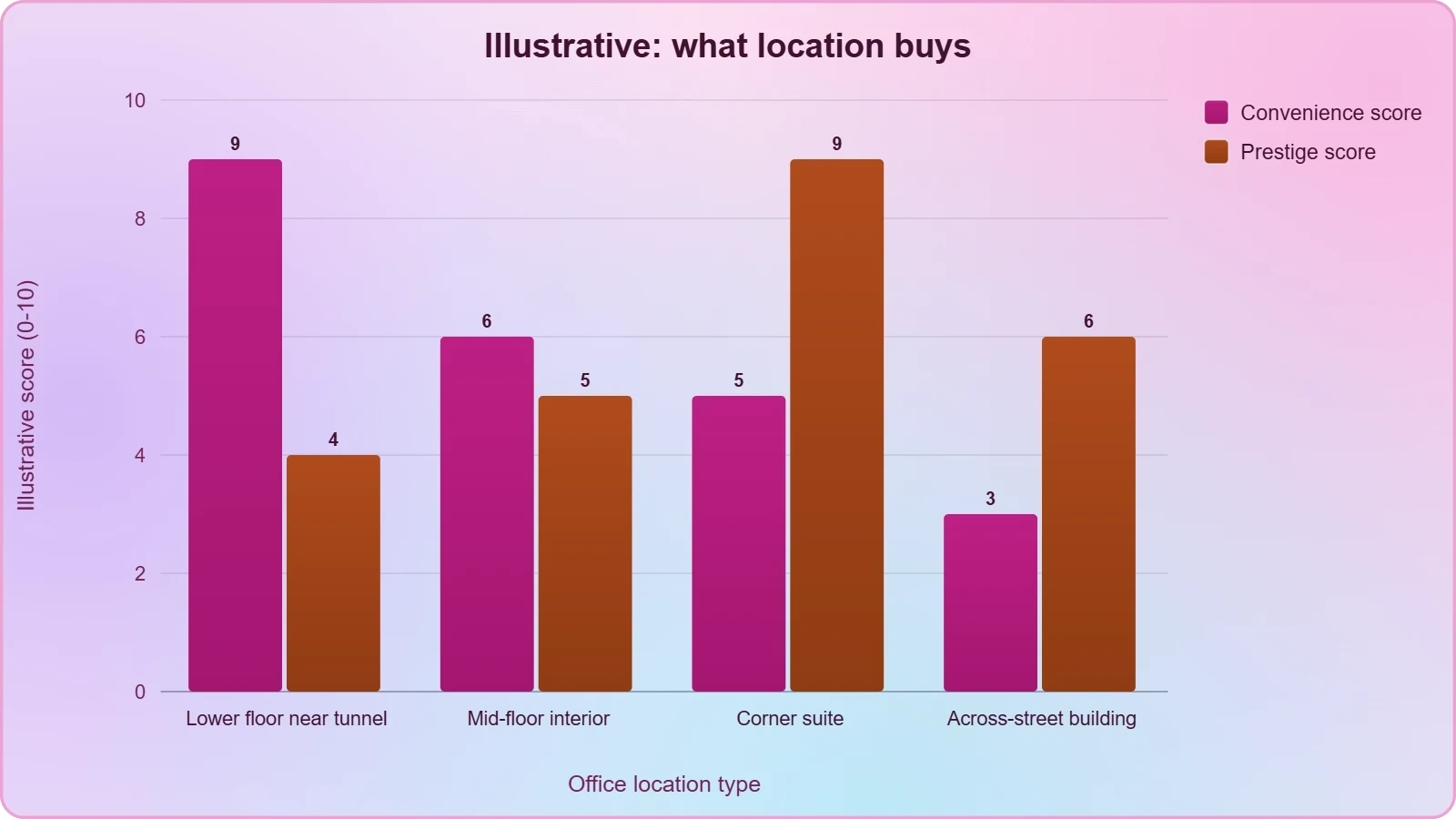
House office space is distributed across a cluster of buildings whose names are familiar to anyone who follows Washington: the Cannon, Longworth, and Rayburn House Office Buildings, with the Ford building added in recent decades. Each has its own character and its own hierarchy. Rayburn, the largest, houses the Speaker's suite and many committee offices, and it carries the greatest prestige. Longworth sits closest to the Capitol and offers convenience. Cannon, the oldest, possesses historic charm but smaller rooms. Ford, across the street, is newer but farther from the floor, a trade-off that matters on nights of late votes.
Within each building, location matters as much as size. A suite on a lower floor near the elevators and the tunnel system saves a member precious minutes on the way to votes. A corner office with natural light signals status. Proximity to committee rooms can shape a member's daily rhythm, while distance from leadership can mean either obscurity or independence, depending on the member's ambitions. Freshmen quickly learn to read the building map the way seasoned staff do, weighing square footage against commute time and prestige against practicality.
Building by Building: Prestige, Proximity, and Practicality
The Rayburn building's reputation rests on its scale and its association with power. Its corridors host committee hearings, leadership offices, and the constant traffic of lobbyists and staff. A freshman assigned there gains visibility but may also find the space competitive and the rents, in the form of staff allocation, higher. Longworth's appeal is proximity: members can walk to the Capitol in minutes, a genuine advantage during tightly scheduled vote series. Cannon offers history and, for some, a certain romance, though its older infrastructure can complicate modern office needs.
Ford represents a different calculus. Its newer construction provides modern amenities and larger staff spaces, but its location across the street adds a few minutes to every Capitol trip. For a member focused on constituent services and committee work rather than floor maneuvering, that distance may be acceptable. The choice, in the end, reflects a member's theory of how to be effective in Congress, whether through visibility, convenience, or the quiet efficiency of a well-run office.
What Square Footage Really Buys a Freshman
Square footage translates directly into staff capacity, and staff capacity translates into legislative output. A member with a larger suite can house more legislative assistants, caseworkers, and schedulers, expanding the office's ability to draft bills, respond to constituents, and manage a public profile. A smaller office forces hard choices about which functions to prioritize. The lottery therefore allocates not just space but the practical means of doing the job, which is why members approach it with more seriousness than the ceremony's lighthearted tone might suggest.
Beyond capacity, the physical office shapes a member's public identity. A well-appointed suite can host meetings, receptions, and constituent groups, projecting competence and accessibility. A cramped office limits those possibilities. Freshmen who draw low numbers often find themselves weighing a larger space in a less prestigious building against a smaller one in a prime location, a decision that mirrors the broader trade-offs of legislative life.
Strategy, Symbolism, and the Psychology of the Draw
For a newly elected member, the lottery is a first lesson in the limits of individual control. Campaigns reward planning, discipline, and the belief that effort determines outcomes; the drawing introduces an element of pure chance into a career built on calculated ambition. Watching a screen display a number that will shape the next two years of daily working life can be humbling, and members often describe the moment with a mixture of amusement and resignation. The ritual teaches, gently, that Congress is a collective institution in which individual preferences must yield to shared rules.
The psychology extends to the selection itself. Members arrive with spreadsheets, ranked lists, and advice from senior staff, but the sequential nature of the process means that plans must adapt in real time. A member who expected a particular suite may find it claimed by someone three places ahead. The ability to pivot, to reassess priorities under pressure, and to accept a good outcome rather than hold out for a perfect one are precisely the skills that legislative life demands, and the lottery rehearses them in miniature.
Reading the Room: Status, Signals, and Office Politics
Office assignments carry symbolic weight that extends beyond the member's own satisfaction. Staff, lobbyists, and journalists learn to read the building map, and a prime suite can signal a member's standing or ambition. Freshmen who secure space near leadership may find themselves drawn into informal conversations that shape legislative strategy. Those assigned to distant corridors may need to work harder to maintain visibility. The lottery thus distributes not only square footage but also the subtle advantages of proximity, and members are keenly aware of the difference.
Yet the symbolism cuts both ways. A member who chooses a practical, well-run office over a prestigious but cramped one may earn a reputation for seriousness. Over time, effectiveness in Congress depends far more on staff quality, committee work, and constituent service than on the view from the window. The lottery's importance is real but temporary, a first chapter rather than the whole story of a member's tenure.
From Lottery Number to Legislative Identity
The office a freshman selects becomes the setting for the work that defines a career: the morning staff meetings, the constituent casework, the drafting sessions that turn an idea into a bill. A well-chosen space supports that work; a poorly chosen one creates friction that compounds over time. Members who draw low numbers have the luxury of optimizing, while those who draw high numbers must make the best of what remains. In either case, the office becomes a home base from which a legislative identity gradually takes shape.
Veterans often recall their freshman lottery with nostalgia, remembering the cramped suite or the unexpected corner office that launched their service. The ritual marks a transition from candidate to legislator, from campaigning to governing. It is a small ceremony, but it carries the weight of a beginning, and it reminds even the most ambitious newcomer that Congress is an institution with its own rhythms, its own hierarchies, and its own enduring traditions.
- 01
- 02
- 03
- 04
A Washington Tradition Rooted in Fairness
The office lottery belongs to a family of congressional rituals that substitute procedure for conflict. Like the drawing of committee assignments or the rotation of committee chairs, it reflects an institutional preference for rules that are visible, predictable, and difficult to game. Washington is often portrayed as a city of influence and backroom deals, and the lottery offers a counterexample: a moment when the most powerful newcomers in the country submit to a random number generator and accept the result without complaint. That acceptance is itself a form of institutional loyalty.
The tradition also connects modern members to generations of predecessors. Freshmen have drawn numbers in one form or another for decades, and the ceremony's persistence through changes in leadership, technology, and political climate speaks to its utility. It is cheap to administer, easy to explain, and broadly perceived as fair, qualities that make it resistant to reform. In a body where almost everything is contested, the lottery endures because no one has a strong reason to replace it.
How Other Institutions Allocate Scarce Space
Congress is not alone in facing the problem of allocating desirable space among equals. Universities assign dormitory rooms by lottery, hospitals allocate parking and office space through rotation, and courts distribute cases through random assignment. Each system reflects a similar judgment: when demand exceeds supply and no objective merit ranking applies, randomization preserves fairness and reduces conflict. The House lottery is a particularly visible example of a general administrative principle, and its longevity suggests the principle works.
Comparisons with other institutions also highlight what is distinctive about Congress. The stakes are higher, the participants more powerful, and the results more public. A member who draws a poor number must accept the outcome in front of colleagues and, potentially, the press. That visibility reinforces compliance, since complaining about a fair lottery would damage a member's reputation more than a suboptimal office ever could.
What the Ritual Reveals About Congress
The lottery exposes a side of Congress rarely seen in partisan coverage: a workplace where members cooperate on mundane logistics, follow shared rules, and accept outcomes that disadvantage them personally. These small acts of institutional trust underpin the larger functioning of the legislature. If members could not agree on how to allocate offices, the prospects for agreement on budgets, appropriations, and legislation would be dim indeed. The ritual is trivial in itself but instructive in what it implies about the culture of the institution.
It also humanizes the people who serve there. Freshmen arrive with ambitions and anxieties, and the lottery reduces them, briefly, to participants in a shared rite. The screen displays a number, the room reacts, and the work of governing begins. In an era of intense political polarization, that moment of common experience is worth noting, a reminder that even in a divided Congress, some things are still decided by drawing lots.
The Freshman Year and the Shape of a Career
The office lottery is the first of many allocation decisions that will define a member's early career. Committee assignments, subcommittee slots, floor time, and leadership opportunities all follow similar patterns of scarcity and rule-bound distribution. Freshmen who learn to navigate the lottery with grace, accepting outcomes and building relationships across the aisle, often find that the same skills serve them well in the legislative arena. The drawing is a small test of temperament, and temperament matters in a body where cooperation is essential and grudges are costly.
Over time, the office becomes less important than the work conducted within it. Members who build strong staff teams, master their committee portfolios, and serve constituents diligently earn influence regardless of their suite's location. The lottery determines a starting position, not a final destination. Veterans understand this, which is why they often counsel freshmen not to overinvest in the outcome of a random draw. The real work of Congress happens in hearings, negotiations, and constituent meetings, not in the view from the window.
Advice Veterans Give New Members
Experienced members tend to offer practical counsel: prioritize staff space over personal office size, choose proximity to committee rooms if your portfolio demands it, and do not underestimate the value of a short walk to the floor. They also advise freshmen to build relationships with colleagues in their building, since informal networks often matter more than formal titles. The lottery, they suggest, is best treated as a logistical detail rather than a verdict on a member's standing, and the members who internalize that advice tend to settle into their roles more quickly.
Veterans also warn against the temptation to trade offices or negotiate side deals, practices that can create resentment and undermine the fairness the lottery is designed to protect. The institution's norms discourage such maneuvering, and members who respect the process earn credibility. In a body where reputation is currency, the way a freshman handles a disappointing draw can be as telling as the office itself.
Looking Ahead to the 2026 Session
As the 2026 freshman class settles into its chosen offices, the lottery will fade into memory, replaced by the daily demands of legislating. Yet the ritual will recur with each new Congress, a small constant in a changing institution. Its persistence reflects a durable insight: when scarce goods must be distributed among equals, a transparent random process can preserve harmony better than any alternative. The House will continue to draw numbers, watch the screen, and choose, and the tradition will carry forward the same quiet lesson about fairness and acceptance.
For observers of Congress, the lottery offers a reminder that governance consists of countless small decisions as well as grand debates. The way an institution handles the mundane, from office assignments to parking spaces, reveals its character as surely as its handling of legislation. The freshman office lottery is a modest ritual, but it belongs to the larger story of how American democracy organizes itself, one random number at a time.
Why the Lottery Endures
The freshman office lottery has survived because it solves a real problem with minimal cost and maximal legitimacy. Any alternative, whether seniority-based, merit-based, or negotiated, would generate disputes that consume time and goodwill. Randomization sidesteps those disputes by making the outcome impersonal. Members may dislike their number, but they cannot plausibly claim unfairness, and that perception of fairness is what allows the institution to move on to more consequential matters. The lottery is efficient precisely because it is boring.
Its endurance also reflects a deeper truth about Congress: the institution depends on shared acceptance of procedures that occasionally disadvantage individual members. The lottery is a small-scale rehearsal of that principle, and its persistence across sessions suggests the principle remains sound. As long as office space is scarce and members arrive as equals, the drawing will continue, and freshmen will gather to watch the screen, accept their number, and begin the work of representing their constituents.
From our network :
- University Language Proficiency Exams: Why Institutional Tests Demand Different Preparation Than IELTS and TOEFLDiscover why university-specific language proficiency examinations differ fundamentally from IELTS and TOEFL, and learn strategic preparation approaches for institutional assessment success.
- Mobile Learning and VR in English: What Global Evidence Reveals About Effective Language TechnologyA systematic review across 14 countries reveals which language-learning technologies genuinely work. Mobile learning, AI, and VR show measurable benefits when pedagogically integrated. This evidence-based guide helps educators and learners select technology that delivers real return on investment.
- Forbidden Matrix Patterns and Visible Lattice Points: A Geometric DictionaryExplore how multidimensional 0–1 matrices encode geometric truths, linking forbidden patterns to visible lattice points and hypergraph theory, with applications in combinatorics and computational geometry.
- The Hidden Cost of AI Convenience: Why Over-Permissioned Agents Are a Security Time BombDiscover why AI agents with excessive permissions create dangerous single points of failure, and learn how implementing least privilege principles can protect your organization from exploitation.
- CISA’s Ten-Advisory Wave: Why Generic Patching Fails in OT and How to Build Product-Specific PlaybooksCISA released ten ICS advisories in one week, exposing critical infrastructure risks. Generic patching fails in OT. Learn to build product-specific remediation playbooks.
- Live Online English Classes for Kids: Do They Actually Reduce Anxiety?A ten-week study reveals that synchronous online English classes can significantly reduce child language anxiety while improving listening and reading skills. Discover what makes these programs effective and how parents can select the right one.
- The Final Descent: How ESA Retired the Legendary Cluster Constellation After 24 Years of Space Weather ScienceAfter 24 years mapping Earth’s magnetosphere, ESA’s Cluster mission concluded with a precisely controlled reentry over the South Pacific. This analysis explores the scientific legacy, engineering decisions, and debris mitigation principles behind one of space exploration’s most responsible retirements.
- Committed Mediterranean Precipitation Decline: Why Emissions Cuts Alone Cannot Restore Winter RainsNew NOAA research reveals that Mediterranean winter rains may decline irreversibly even with emissions cuts. Explore the science of committed climate change and regional impacts.
- How AI Agents Will Change the Way We Manage Personal FinancesExplore how AI agents are transforming personal finance through automated budgeting, bill payment, and investment management, while examining the critical security protocols and governance frameworks required for safe deployment.
RESOURCES
- Beginner's luck: Freshmen leave it to chance at House office lotteryrollcall.com15 hours ago ... -elect John Cowan, R-Ga., was the first to pick a number. The first neurosurgeon to be elected to Congress, Cowan…
- Luck of the draw: Huge freshman class competes in House office ...cronkitenews.azpbs.org18 hours ago ... Email. Democrat JoAnna Mendoza of Arizona's 6th Congressional District holds up her lottery chip, No. 37 ...
- Day 10 / Final day of Freshman Orientation: Since 1908, new ...facebook.comNov 21, 2024 ... ... Congress, placing in the freshman lottery for the 10th district seat. ... office will be located in the Longworth…
- Lady Luck and the Office Lottery | US House of Representativeshistory.house.govJan 10, 2019 ... The House allowed freshmen to pick their rooms. ... Steve Knight of California claimed his winning number in the 114th…
- House Office Moves: Suite Stakes | Architect of the Capitolaoc.govThey are separated by congressional class and pull numbers over a five-day lottery. Freshman Members then select an office from those remaining during a…
- New lawmakers play a Capitol Hill game, with prime office space as ...washingtonpost.com12 hours ago ... For incoming freshmen, the ritual of the House office lottery makes their wins feel real ... “No matter what office…
- How do new House members pick their offices? - KCRAkcra.com17 hours ago ... Getting elected to Congress takes hard work, but for freshman lawmakers arriving on Capitol Hill, choosing an office comes down…
- Bennett, Hamawy score big in congressional office lottery; Mullock ...newjerseyglobe.com23 hours ago ... The office lottery is a longstanding congressional tradition that concludes freshman orientation. Incoming House members are called in ...
- Incoming representatives choose their new digs during House office ...csmonitor.comNov 19, 2014 ... In Congress, where seniority means everything, freshman ... Wednesday was office lottery day for 57 incoming freshmen in the US…
- Congressional office lottery - Wikipediaen.wikipedia.orgThe office lottery for the United States House of Representatives determines the order in which incoming representatives can choose rooms in the ...
- High Stakes for House Freshmen: The Office Lotterynytimes.comNov 30, 2018 ... Of everything the 85 newly elected representatives had endured in the last two weeks of congressional orientation — welcoming parties,…
- Thrill, agony in House office lottery - POLITICOpolitico.comNov 30, 2012 ... (Rayburn's offices were unavailable.) Members who had served in Congress before had first dibs, as did incoming freshmen who've already…
- A Birthday Present and a Strikeout: The Freshman Office Lotterynotus.org21 hours ago ... 1 chip during the freshman room lottery for newly elected members of Congress. ... House office buildings. An online portal…
- The 7 Luckiest and Unluckiest Freshman Members of Congressabcnews.comNov 20, 2014 ... Members-Elect Try Their Luck at Congressional Office LotteryWatch incoming House freshman hoping for a lucky draw dance, backflip and cheer ...
- House office lottery inspires back flips on Capitol Hill - CBS Newscbsnews.comNov 20, 2014 ... Most people these days aren't doing backflips for Congress. But an aide to Rep.-elect Gwen Graham, D-Florida, wanted to make…
- 01
- 02
- 03
- 04
- 05
- 06
- 07
- 08
0 Comments