
The North Atlantic right whale occupies a precarious position in the modern conservation landscape, a species whose survival is now measured not merely in absolute numbers but in the delicate arithmetic of births and deaths. A research finding reported in November 2026 identified inbreeding as a contributing factor behind the persistently low calf production that has frustrated recovery efforts for this critically endangered population. The conclusion, circulated through Canadian news coverage, points to a biological mechanism that compounds the familiar catalogue of ship strikes, fishing gear entanglement, and habitat disruption. What makes the finding consequential is its implication that the species may be caught in a genetic feedback loop, where scarcity itself erodes the capacity to rebound.
Understanding why inbreeding matters requires attention to the mechanics of genetic diversity within a small, isolated population. When the breeding pool contracts, related individuals are more likely to mate, and the resulting offspring inherit reduced variation across immune and reproductive genes. This loss of heterozygosity can translate into lower fertility, weaker offspring, and higher rates of developmental failure. For a population already reduced to a few hundred individuals, each unsuccessful pregnancy represents a compounding loss. The 2026 report did not quantify these effects in granular detail, yet its central claim aligns with a broader scientific consensus that genetic factors now operate alongside direct human threats in shaping the species' trajectory.
The story also illustrates a recurring tension in conservation journalism: a significant scientific conclusion arrives through a brief news item, stripped of methodological detail, researcher commentary, and the statistical scaffolding that would allow readers to weigh the evidence. The report noted the finding without specifying how many calves had been born recently, what other factors might be involved, or how the researchers isolated inbreeding from confounding variables. This is not a criticism of the scientists but an observation about how environmental science reaches the public. The task of interpretation falls to readers and analysts who must situate a fragmentary headline within the larger body of evidence on right whale recovery.
On This Page
- The Genetic Arithmetic of a Shrinking Population
- Layered Threats: How Inbreeding Compounds Existing Pressure
- Reading the Science Through the Headline
- Conservation Strategy in an Era of Genetic Constraint
- What the Finding Means for Endangered Species Management
- The Wider Ecological and Ethical Context
- Conclusion: A Signal That Demands Sustained Attention
TL;DR A November 2026 research finding identifies inbreeding as a factor in the low birth rates of North Atlantic right whales, an endangered species already stressed by ship strikes, entanglement, and habitat pressure. The conclusion suggests that genetic diversity loss now functions as an independent drag on recovery, creating a feedback loop in which small population size reduces reproductive success, which in turn keeps the population small. The news report conveyed the headline finding without methodological detail, researcher comment, or calf-count data, leaving the precise magnitude of the inbreeding effect an open question. The episode underscores how genetic science increasingly informs endangered species management, and why conservation strategy must account for inherited biological constraints alongside direct human threats.
The Genetic Arithmetic of a Shrinking Population
Population genetics offers a sobering framework for understanding what happens when a species contracts below a critical threshold. The effective population size, which measures the number of individuals actually contributing offspring to the next generation, is typically far smaller than the raw census count. For North Atlantic right whales, whose total numbers hover in the low hundreds, the effective breeding pool may be smaller still, concentrating relatedness among the survivors. When relatives mate, offspring inherit paired copies of deleterious recessive alleles, a phenomenon known as inbreeding depression. The consequences manifest across fertility, survival, and disease resistance, and they accumulate generation by generation unless new genetic material enters the pool.
Inbreeding Depression and Reproductive Failure
Inbreeding depression is not a single defect but a statistical pattern: as relatedness between parents increases, the fitness of their offspring declines across multiple traits. In marine mammals, documented effects include reduced sperm quality, irregular oestrous cycles, lower conception rates, and elevated mortality among calves. For right whales, where a successful pregnancy requires a gestation of roughly a year and calf survival through the first vulnerable seasons, even modest reductions in conception probability can translate into years of lost recruitment. The 2026 finding places inbreeding within this established framework, suggesting that the species' reproductive shortfall is not solely a matter of insufficient food or disturbance but also of inherited biological constraint.
Measuring Relatedness in Wild Cetaceans
Detecting inbreeding in wild whales requires sophisticated tools, principally genetic sampling through skin biopsies collected via remote darting, combined with photographic identification catalogues that track individual animals across decades. Researchers can then reconstruct pedigrees and estimate relatedness between breeding pairs. The analytical challenge is considerable: sample sizes are small, generations are long, and the population's history of exploitation in the nineteenth and twentieth centuries complicates reconstruction of baseline diversity. The 2026 conclusion rests on this kind of genetic inference, and while the news report omitted the technical detail, the underlying methodology reflects decades of accumulated cetacean genetics research.
Layered Threats: How Inbreeding Compounds Existing Pressure
No single factor explains the North Atlantic right whale's failure to recover, and the inbreeding finding must be read against a dense background of anthropogenic hazards. Ship strikes remain a leading cause of mortality, particularly along the busy shipping lanes of the eastern seaboard. Fishing gear entanglement, especially in lobster and crab pot lines, imposes chronic injury and lethal drag on swimming animals. Ocean noise from vessel traffic and seismic surveys disrupts communication and foraging. Climate-driven shifts in the distribution of copepods, the whale's primary prey, have pushed the animals into new waters, often outside protected zones. Inbreeding adds a further layer, one that operates from within the biology of the species itself.
Entanglement, Vessel Strikes, and Habitat Shift
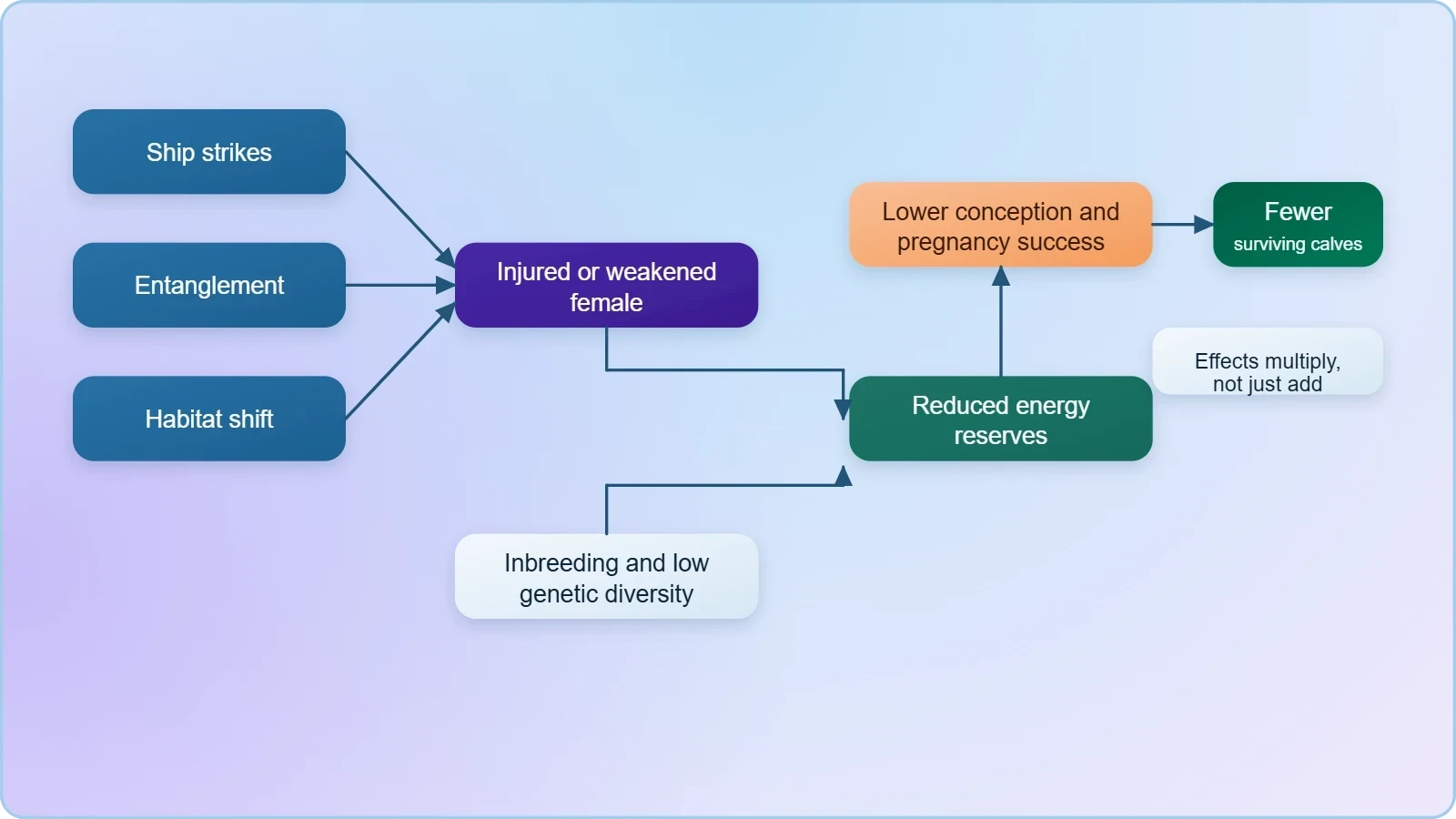
The interaction between these threats is not merely additive but multiplicative. A female weakened by entanglement may have reduced energy reserves, lowering her probability of conceiving or carrying a pregnancy to term. A calf born to an inbred mother may face compromised immune function, making it more vulnerable to disease during its first migration. Meanwhile, warming waters have altered the timing and location of copepod blooms, forcing whales to travel farther and expend more energy in pursuit of food. Each stressor erodes the margin of resilience, and the genetic factor narrows that margin further by reducing the biological capacity to absorb shocks.
The Feedback Loop of Small Numbers
What distinguishes the inbreeding hypothesis is its self-reinforcing character. A small population produces few calves; fewer calves mean fewer unrelated mates in the next generation; greater relatedness among mates depresses reproductive success further. This positive feedback loop, sometimes described as an extinction vortex, is a recognised pattern in conservation biology. Breaking the cycle requires either a sustained reduction in external mortality sufficient to let the population grow through the bottleneck, or, in extreme cases, genetic rescue through managed intervention. The 2026 finding does not prescribe a solution, but it sharpens the case for aggressive reduction of human-caused mortality while the genetic buffer still permits recovery.
Reading the Science Through the Headline
The news item that carried the inbreeding finding is itself instructive about the ecology of scientific communication. It reported the conclusion, noted the species' endangered status, and included a photograph of a right whale in Cape Cod Bay, yet it supplied no calf counts, no researcher quotes, and no conservation group reaction. The report appeared alongside unrelated stories on a Canadian news website, a placement that reflects the routine compression of environmental science into brief wire-style coverage. For the analyst, this raises a methodological caution: a headline conclusion is a pointer to a body of research, not a substitute for it. The responsible response is to treat the finding as a signal warranting further inquiry rather than a settled verdict.
What the Report Did Not Say
Absences in reporting are often as revealing as presences. The item did not specify how many calves had been born in recent seasons, which matters because calf counts fluctuate and a single poor year does not establish a trend. It did not identify the researchers, their institution, or the journal in which the work appeared, information that would allow readers to assess the study's rigour. It did not address alternative explanations, such as nutritional stress from prey scarcity or sublethal entanglement effects, which could independently depress birth rates. Nor did it include comment from conservation organisations, who might have contextualised the finding within ongoing policy debates over vessel speed rules and gear modifications.
The Role of Specialist and Generalist Media
This pattern is familiar in environmental coverage, where generalist outlets prioritise accessibility over technical completeness, while specialist publications provide the methodological depth that generalist readers rarely encounter. Neither approach is inherently deficient; they serve different functions within a media ecosystem. The difficulty arises when a fragmentary report becomes the sole basis for public understanding of a complex scientific question. For readers seeking to engage seriously with right whale conservation, the path forward involves triangulating across sources: the original study, the specialist press, and the regulatory documents that translate science into policy. The 2026 headline is a starting point, not a conclusion.
Conservation Strategy in an Era of Genetic Constraint
If inbreeding now constrains right whale recovery, conservation strategy must adapt to a reality in which reducing mortality, while necessary, may not be sufficient. The traditional toolkit, vessel speed restrictions, gear modifications, and seasonal area closures, targets external threats and remains indispensable. Yet a population whose reproductive capacity is internally limited may need additional measures. These could include continued genetic monitoring to track diversity trends, research into assisted reproductive technologies, and, in the most extreme scenario, consideration of genetic rescue through carefully managed introduction of individuals from related populations. Each option carries ethical and ecological complications that demand transparent deliberation.
Vessel Rules, Gear Innovation, and Seasonal Closures
Regulatory responses to right whale mortality have evolved considerably over the past two decades. Seasonal speed restrictions in key habitats reduce the lethality of collisions, though compliance and enforcement remain uneven. Ropeless and on-demand fishing gear, designed to eliminate the vertical lines that entangle whales, has advanced from prototype to limited deployment, but cost and operational practicality slow adoption. Dynamic management areas, which close waters where whales are detected in real time, offer flexibility but depend on robust surveillance. These measures address the external half of the problem; their effectiveness is amplified if the population retains enough genetic diversity to convert reduced mortality into successful reproduction.
Genetic Rescue and Its Ethical Boundaries
Genetic rescue, the deliberate introduction of new genetic material into a small population, is a contested intervention. In some terrestrial species, such as the Florida panther, it produced measurable recovery. For right whales, the closest related population is the North Pacific right whale, itself critically endangered, making translocation logistically and ethically fraught. The alternative is to accept that the species must recover with the diversity it retains, which places a premium on protecting every breeding female and every viable calf. The 2026 finding does not resolve this debate, but it clarifies the stakes: the genetic clock is running, and management decisions taken in the coming decade will shape whether recovery remains biologically possible.
- 01
- 02
- 03
- 04
We Also Published
What the Finding Means for Endangered Species Management
The right whale case carries implications that extend well beyond a single species. As human activity fragments habitats and isolates populations, inbreeding becomes a generalised concern for endangered wildlife, from mountain gorillas to island birds to freshwater fish. Conservation biology has increasingly integrated genetic data into management planning, recognising that demographic recovery without genetic recovery is fragile. The 2026 finding adds a concrete marine example to this body of theory, demonstrating that even a well-studied, heavily protected species can face internal biological limits. For policymakers, the lesson is that species recovery plans must budget for genetic monitoring and, where necessary, for interventions that address diversity loss directly.
Lessons for Population Viability Analysis
Population viability analysis, the modelling framework used to project extinction risk, has long incorporated inbreeding depression as a parameter. The right whale finding reinforces the importance of calibrating that parameter with empirical data rather than generic assumptions. When models treat inbreeding as a minor correction, they may overestimate recovery timelines and understate the urgency of intervention. Conversely, models that incorporate realistic inbreeding effects can reveal thresholds below which recovery becomes improbable without genetic rescue. The analytical task is to refine these models with species-specific evidence, which requires sustained investment in genetic sampling and long-term demographic monitoring.
The Precautionary Principle in Practice
Where scientific certainty is incomplete, the precautionary principle counsels action to avoid irreversible harm. The inbreeding finding, even in its headline form, strengthens the case for precautionary management: reducing vessel speeds, accelerating ropeless gear adoption, and expanding protected areas are justified not only by direct mortality data but by the need to preserve the genetic buffer that remains. Waiting for definitive proof of inbreeding depression's magnitude before acting would risk foreclosing options. The responsible posture is to treat the genetic constraint as a reason for greater urgency, not as an excuse for paralysis pending further study.
The Wider Ecological and Ethical Context
Beyond the technical questions of genetics and modelling, the right whale's predicament raises broader questions about humanity's relationship with slow-reproducing, long-lived species. These animals, which can live for decades and whose females produce a calf only every several years, are poorly equipped to absorb rapid environmental change. Their biology evolved in a world without container ships, synthetic fishing line, or industrial noise. The inbreeding finding is, in this sense, a symptom of a deeper mismatch: a species whose evolutionary tempo is glacial confronting pressures that operate on the timescale of decades. Conservation, at its most ambitious, is an attempt to slow the human tempo enough to let the biological one keep pace.
Slow Reproduction as an Evolutionary Strategy
Right whales invest heavily in each offspring, and that strategy pays dividends in stable environments where adult survival is high. But it becomes a liability when adult mortality rises, because the population cannot replace lost breeders quickly. A female killed by a ship strike may represent decades of lost reproductive potential, and the loss is compounded if her calves have not yet reached maturity. This asymmetry between slow reproduction and fast mortality is the core demographic problem, and inbreeding intensifies it by reducing the success of the few pregnancies that do occur. The species is caught between an evolutionary inheritance that assumes stability and an environment that delivers disruption.
Public Attention and the Politics of Charisma
The right whale enjoys a measure of public affection that many endangered species lack, a charisma that can translate into political pressure for protective measures. Yet attention is fickle, and a brief news item about inbreeding may not sustain the sustained engagement that recovery requires. The challenge for conservation advocates is to convert episodic coverage into durable public and legislative commitment. The 2026 finding offers an opportunity: it frames the species' plight in terms that are both scientifically compelling and intuitively graspable, a population so small that its members are running out of unrelated partners. Whether that framing translates into action depends on factors beyond the science itself.
Conclusion: A Signal That Demands Sustained Attention
The 2026 finding that inbreeding contributes to low birth rates in North Atlantic right whales is, in isolation, a single data point conveyed through a brief news report. Situated within the broader scientific literature, however, it represents a meaningful addition to the understanding of why this species has failed to recover despite decades of protective measures. The finding directs attention to an internal biological constraint that operates alongside, and interacts with, the external threats of ship strikes, entanglement, and prey disruption. It suggests that the species' predicament is not merely a matter of reducing human-caused mortality but of preserving the genetic capacity to convert survival into reproduction. That distinction matters for how conservation resources are allocated and how recovery timelines are projected.
For readers and analysts, the episode also serves as a reminder of the interpretive work that environmental journalism requires. A headline conclusion, stripped of methodology and context, is a starting point rather than an endpoint. The responsible response is to seek out the underlying research, to weigh alternative explanations, and to recognise that scientific findings about endangered species arrive within a policy landscape shaped by competing interests. The right whale's future will be determined by decisions about vessel speeds, fishing gear, and habitat protection, but it will also be shaped by whether the species retains enough genetic diversity to respond to those decisions. The inbreeding finding makes that second condition visible, and visibility is the first step toward action.
From our network :
- University Language Proficiency Exams: Why Institutional Tests Demand Different Preparation Than IELTS and TOEFLDiscover why university-specific language proficiency examinations differ fundamentally from IELTS and TOEFL, and learn strategic preparation approaches for institutional assessment success.
- Committed Mediterranean Precipitation Decline: Why Emissions Cuts Alone Cannot Restore Winter RainsNew NOAA research reveals that Mediterranean winter rains may decline irreversibly even with emissions cuts. Explore the science of committed climate change and regional impacts.
- The Final Descent: How ESA Retired the Legendary Cluster Constellation After 24 Years of Space Weather ScienceAfter 24 years mapping Earth’s magnetosphere, ESA’s Cluster mission concluded with a precisely controlled reentry over the South Pacific. This analysis explores the scientific legacy, engineering decisions, and debris mitigation principles behind one of space exploration’s most responsible retirements.
- Mobile Learning and VR in English: What Global Evidence Reveals About Effective Language TechnologyA systematic review across 14 countries reveals which language-learning technologies genuinely work. Mobile learning, AI, and VR show measurable benefits when pedagogically integrated. This evidence-based guide helps educators and learners select technology that delivers real return on investment.
- The Hidden Cost of AI Convenience: Why Over-Permissioned Agents Are a Security Time BombDiscover why AI agents with excessive permissions create dangerous single points of failure, and learn how implementing least privilege principles can protect your organization from exploitation.
- Live Online English Classes for Kids: Do They Actually Reduce Anxiety?A ten-week study reveals that synchronous online English classes can significantly reduce child language anxiety while improving listening and reading skills. Discover what makes these programs effective and how parents can select the right one.
- Forbidden Matrix Patterns and Visible Lattice Points: A Geometric DictionaryExplore how multidimensional 0–1 matrices encode geometric truths, linking forbidden patterns to visible lattice points and hypergraph theory, with applications in combinatorics and computational geometry.
- How AI Agents Will Change the Way We Manage Personal FinancesExplore how AI agents are transforming personal finance through automated budgeting, bill payment, and investment management, while examining the critical security protocols and governance frameworks required for safe deployment.
- CISA’s Ten-Advisory Wave: Why Generic Patching Fails in OT and How to Build Product-Specific PlaybooksCISA released ten ICS advisories in one week, exposing critical infrastructure risks. Generic patching fails in OT. Learn to build product-specific remediation playbooks.
RESOURCES
- Scientists find possible explanation for North Atlantic right whales ...globalnews.ca19 hours ago ... Scientists find possible explanation for North Atlantic right whales' low birth rates ... inbreeding. Tim Frasier, a professor at Saint ...
- Effects of inbreeding on reproductive success in endangered North ...royalsocietypublishing.orgJul 31, 2024 ... Abstract. Only approximately 356 North Atlantic right whales (Eubalaena glacialis) remain. With extremely low levels of genetic diversity, ...
- Researchers say inbreeding is causing North Atlantic right whales to ...thecanadianpressnews.ca18 hours ago ... This is a stark contrast to most other marine mammals, Frasier said, who typically give birth at their maximum rates.…
- As Right Whale Population Plummets, Focus Turns To Their Falling ...wbur.orgAug 21, 2018 ... As Right Whale Population Plummets, Focus Turns To Their Falling Birth Rates ... North Atlantic right whale may lie in…
- Aquarium Right Whale Scientist Philip Hamilton co-leads major US ...neaq.org... North Atlantic right whale, the Canadian government announced today. Called ... With inbreeding suspected as a major factor in the species' low birth…
- Reproductive parameters of the North Atlantic right whalejournal.iwc.intUsing maximum and minimum population estimates for the entire period, mean values for gross annual reproductive rate were 0.36 and 0.49 respectively, and the ...
- North Atlantic right whale Species Status Assessment - NY.Govextapps.dec.ny.govJun 3, 2025 ... As previously discussed, North. Atlantic right whales are experiencing a declining body size, a potential factor of low birth rates…
- Canada-U.S. team looks to genomics to guide North Atlantic right ...genomeatlantic.caJul 22, 2021 ... With inbreeding suspected as a major factor in the species' low birth rate ... rate of North Atlantic right whales…
- NORTH ATLANTIC RIGHT WHALE (Eubalaena glacialis)fisheries.noaa.govMay 16, 2023 ... The low diversity in North Atlantic right whales might indicate inbreeding, but no definitive conclusion can be reached using current…
- Scientists are one step closer to understanding why the critically ...facebook.com7 hours ago ... North Atlantic right whale population sees record birth rate. Ocean ... Every year, scientists agonize over low birth rates. Sadly ...
- NORTH ATLANTIC RIGHT WHALE (Eubalaena glacialis)fisheries.noaa.govDeclining body sizes are a potential contributor to low birth rates over the past decade. Stewart et al. (2022) found that larger whales had…
- Is inbreeding a problem for endangered whales? - Baleines en directbaleinesendirect.orgNov 26, 2020 ... He is currently trying to assess the rate of inbreeding present in North Atlantic right whales and the consequences for…
- Scientists find possible explanation for North Atlantic right whales ...ca.news.yahoo.com19 hours ago ... Scientists find possible explanation for North Atlantic right whales' low birth rates ... inbreeding. Tim Frasier, a professor at Saint ...
- News - Right Whale Genomerightwhalegenomes.caDec 22, 2024 ... Research project examines the genes of endangered North Atlantic right whales to understand low reproductive rates. Saint Mary's ...
- NORTH ATLANTIC RIGHT WHALE (Eubalaena glacialis) - NOAAmedia.fisheries.noaa.govFeb 14, 2019 ... Further, the small population size and low annual reproductive rate of right whales suggest that human sources of mortality have…
- 01
- 02
- 03
- 04
- 05
- 06
- 07
- 08
0 Comments