
Cricket Australia's decision to close the investigative chapter on "sandpapergate" while opening a new, independent forum for testimony represents a delicate institutional balancing act. The governing body has confirmed it will not reopen its probe into the 2018 ball-tampering episode that scarred the sport's reputation, yet it will convene a former judge-led forum where players and staff can finally share their accounts of what unfolded in Cape Town. The forum, expected to conclude within roughly a month, carries no new penalties and is framed as a mechanism for closure rather than punishment. This dual posture—firm on the investigative record, flexible on the human record—defines the entire controversy.
The scandal's revival owes much to batter Usman Khawaja's autobiography, which reopened wounds many assumed had healed. Khawaja's claims, including an allegation attributed to current captain Pat Cummins, prompted David Warner to accuse Cricket Australia of a flawed original investigation that failed to interview all players. Chief executive Todd Greenberg has acknowledged the past week was exceptionally difficult for the sport, while insisting the original investigation remains complete and confidential. Interim chairman David Boon describes the forum as a chance to move forward rather than relitigate. The tension between transparency and confidentiality sits at the heart of this story.
What follows examines the institutional logic, the competing narratives, and the governance questions that this episode raises for cricket and for sports administration more broadly. The analysis weighs Cricket Australia's stated intentions against the criticisms levelled by players, explores why the original 2018 findings remain contested, and considers what a non-punitive forum can realistically achieve. It also situates the controversy within wider debates about accountability, player welfare, and the durability of institutional trust in professional sport.
On This Page
- The Anatomy of a Scandal That Refuses to Fade
- Institutional Logic Behind the No-Reopening Decision
- The Forum's Design and Its Credibility Test
- Reputation, Trust, and the Wider Sporting Landscape
- Comparing Governance Responses Across Sporting Scandals
- What the Episode Reveals About Institutional Trust
- Conclusion: A Test of Institutional Character
TL;DR Cricket Australia will not reopen its investigation into the 2018 Cape Town ball-tampering scandal, but will establish an independent, former-judge-led forum for players and staff to share their accounts within roughly a month, with no new penalties attached. The decision follows Usman Khawaja's autobiography reviving claims about the plot, David Warner's criticism of the original probe, and Pat Cummins's alleged comments. Chief executive Todd Greenberg says the original investigation is complete and will stay confidential, while interim chairman David Boon frames the forum as a path forward. The episode exposes enduring tensions between transparency, confidentiality, and institutional trust in professional cricket.
The Anatomy of a Scandal That Refuses to Fade
The 2018 Cape Town Test was supposed to be a footnote in cricket's long history, a regrettable incident swiftly adjudicated and punished. Instead, it has become a recurring reference point for how sporting institutions handle misconduct, memory, and reconciliation. The original Cricket Australia investigation concluded that only then-captain Steve Smith, vice-captain David Warner, and player Cameron Bancroft knew of the plan to alter the ball with sandpaper. All three were sent home and banned, and the matter appeared closed. Yet the persistence of unanswered questions—about who else knew, what was said, and how the probe was conducted—has kept the episode alive across multiple news cycles.
That persistence is instructive. Scandals rarely close cleanly when the investigative process is perceived as incomplete or when testimony remains sealed. The decision not to reopen the probe, combined with the creation of a forum, reflects an awareness that the official record and the lived record have diverged. Cricket Australia is effectively acknowledging that its 2018 findings settled the disciplinary question but not the historical one. The forum becomes a space where the gap between those two records might be narrowed, even if it cannot be fully closed.
Why the Original Findings Remain Contested
Critics of the 2018 investigation argue that its scope was too narrow and its methods insufficiently inclusive. Warner's assertion that not all players were interviewed strikes at the credibility of any finding that only three individuals were complicit. When a governing body concludes that knowledge of a coordinated act was confined to a handful of senior figures, the burden of proof rests heavily on the thoroughness of the process. If key voices were never heard, the conclusion invites scepticism regardless of its formal completeness. This is the structural weakness that Khawaja's book has exploited.
Confidentiality compounds the problem. Greenberg has stated the original investigation will not be made public because of confidentiality obligations, a defensible legal position that nonetheless frustrates public understanding. Players who feel misrepresented cannot easily test their accounts against a sealed record. The result is a stalemate in which the institution defends a process it cannot fully display, while participants assert grievances they cannot fully substantiate. The forum is an attempt to break that stalemate without formally reopening the case.
The Role of Memoir and Public Testimony
Khawaja's autobiography demonstrates how personal narrative can reopen institutional questions years after formal proceedings conclude. A memoir is not evidence in the legal sense, but it is a powerful catalyst for public scrutiny, particularly when it attributes claims to figures of standing such as Cummins. The book shifted the conversation from what the investigation found to what players experienced and observed. In doing so, it exposed the limits of a disciplinary process that prioritised closure over completeness, and it forced Cricket Australia to respond to a narrative it could not control.
This dynamic is familiar across sport and public life: the memoir, the interview, the documentary become alternative tribunals where official accounts are challenged. Institutions that rely solely on sealed reports risk losing the narrative contest to those willing to speak publicly. Cricket Australia's forum can be read as an attempt to reclaim some of that narrative ground by offering a structured, credible setting for testimony—one that carries the authority of a former judge rather than the informality of a book launch.
We Also Published
Institutional Logic Behind the No-Reopening Decision
Cricket Australia's refusal to reopen the investigation is not simply an act of institutional self-protection, though it will be read that way by critics. It reflects a legal and procedural reality: reopening a closed investigation years later, without new admissible evidence, risks undermining the finality of disciplinary processes across the sport. Greenberg's insistence that the original investigation is complete signals a commitment to procedural closure. The forum, by contrast, is designed to operate outside the disciplinary framework, allowing testimony without triggering fresh sanctions or legal exposure for participants or the governing body.
This separation of functions—investigation versus reconciliation—is a recognisable governance pattern. Truth and reconciliation commissions, workplace reviews, and independent inquiries often distinguish between establishing facts for punishment and creating space for testimony. Cricket Australia appears to be borrowing from that playbook, offering players a structured hearing without conceding that the original findings were wrong. Whether this distinction will satisfy players who feel the record is incomplete remains the central question, and it is one the forum's design and leadership will heavily influence.
Confidentiality as Shield and Constraint
Confidentiality serves two masters in this episode. It protects participants who may fear reputational or professional consequences from speaking, and it shields the governing body from scrutiny of its investigative methods. Greenberg has framed confidentiality as a legal necessity, and there is merit in that position: employment investigations routinely carry confidentiality obligations that persist after conclusion. But confidentiality also prevents the public from assessing whether the original probe was as thorough as claimed, leaving critics to rely on inference and anecdote rather than documented process.
The forum's stated aim of being "as transparent as possible while protecting confidentiality" captures this tension precisely. Transparency and confidentiality are not opposites so much as competing priorities that must be calibrated case by case. If the forum produces a public report that summarises themes without naming individuals, it may achieve a workable balance. If it produces only a private record, it risks being dismissed as a gesture. The credibility of the exercise will depend on how that calibration is handled.
Player Welfare and the Cost of Silence
Beyond governance, the episode raises questions about player welfare. Greenberg described the past week as very difficult for the sport and for everyone involved, a recognition that unresolved controversies impose real psychological costs on current and former players. Warner's public criticism and Khawaja's disclosures suggest that silence has not been healing. A forum that allows players to share experiences in a protected setting may serve a therapeutic function even if it produces no new disciplinary outcomes, and that function should not be dismissed as secondary.
Sporting institutions are increasingly expected to treat mental health and player wellbeing as core responsibilities rather than optional extras. The forum can be understood as an extension of that expectation: a recognition that the people at the centre of a scandal are not merely witnesses or subjects but individuals whose careers and reputations were shaped by events they did not fully control. Whether the forum delivers on that promise depends on its independence, its leadership, and the willingness of participants to engage candidly.
The Forum's Design and Its Credibility Test
The credibility of any reconciliation exercise rests on its independence, its mandate, and the standing of those who lead it. Cricket Australia has indicated the forum will be led by a former judge, a choice that signals seriousness and lends procedural authority. A judicial figure brings experience in weighing testimony, managing confidentiality, and producing findings that withstand scrutiny. The expected one-month timeframe, however, is tight for a process involving multiple participants with complex and conflicting recollections, and that compression may limit how deeply the forum can probe.
Equally important is the mandate. A forum that cannot compel testimony, cannot issue findings of fault, and cannot recommend sanctions operates on moral rather than legal authority. Its influence will depend on voluntary participation and on whether players believe their accounts will be taken seriously. If key figures decline to appear, the exercise risks appearing one-sided. If they appear but feel unheard, it risks deepening resentment. The design must therefore balance inclusivity with manageability, and confidentiality with the public's legitimate interest in understanding what happened.
Independence and the Appearance of Appeasement
Greenberg has explicitly denied that the forum is meant to appease any individual, insisting the goal is for the game to move on from events that caused widespread pain. That denial is necessary but not sufficient. Perceptions of appeasement arise when a process is announced shortly after public criticism and appears tailored to quiet a specific voice. To counter that perception, the forum must demonstrate that its scope is principled rather than personalised—open to all relevant participants, governed by clear terms of reference, and capable of producing outcomes that are not predetermined.
The choice of a former judge helps here, because judicial independence is a recognised currency. But independence is also a matter of institutional distance: the closer the forum appears to Cricket Australia's leadership, the more its findings will be discounted. Publishing the terms of reference, disclosing the forum's composition, and committing in advance to a public summary of themes would strengthen its standing. These are modest transparency measures that could substantially improve the forum's reception among players and the public alike.
What a Non-Punitive Process Can Realistically Achieve
A forum without penalties cannot deliver justice in the retributive sense, and it should not be judged against that standard. What it can deliver is a more complete historical record, an opportunity for participants to be heard, and a structured basis for the sport to move forward. Those outcomes have real value, particularly in a case where the disciplinary process concluded years ago and reopening it would raise difficult questions about finality and double jeopardy. The forum's success should be measured against these achievable aims rather than against an unattainable standard of full accountability.
Realism also counsels patience. Reconciliation processes rarely produce immediate resolution; their effects unfold over time as testimony is absorbed and institutional practices adjust. If the forum prompts Cricket Australia to review how it conducts investigations, how it communicates with players, and how it supports those affected by scandals, it will have achieved something substantive. The risk is that it becomes a symbolic gesture that changes nothing—a risk that depends entirely on follow-through.
Reputation, Trust, and the Wider Sporting Landscape
Cricket's global standing depends heavily on perceptions of integrity, and ball-tampering strikes at the heart of that perception. The 2018 scandal damaged Cricket Australia's reputation not only because the act occurred but because the response was widely seen as either too harsh or too narrow, depending on the observer. Reopening the wound through a forum carries reputational risk, but so does appearing to suppress testimony. The governing body is navigating between two forms of damage, and its choices will be watched closely by other sports facing similar reckonings with past misconduct.
The episode also illustrates how sporting governance has evolved since 2018. Expectations of transparency, player voice, and institutional accountability have risen across professional sport, driven by social media, athlete activism, and a broader cultural shift toward questioning authority. A decision that might have passed without comment a decade ago now invites sustained scrutiny. Cricket Australia's forum is, in part, an adaptation to that changed environment—an acknowledgement that silence is no longer a viable strategy for institutions facing contested histories.
Lessons for Sports Administration
The most transferable lesson is that investigative closure and reputational closure are different things. An investigation can conclude while public doubt persists, particularly when its methods or scope are questioned. Institutions that treat a final report as the end of the matter often find that the matter returns, amplified by memoir, media, and player testimony. Building in mechanisms for ongoing dialogue—such as a forum—can provide a release valve that formal processes lack, provided the mechanism is credible and not merely cosmetic.
A second lesson concerns the treatment of players as stakeholders rather than subjects. Investigations that treat athletes purely as witnesses or defendants miss the reality that they are professionals whose careers and wellbeing are affected by institutional decisions. Involving players in the design of review processes, or at least consulting them on terms of reference, can improve both the quality of evidence and the perceived legitimacy of outcomes. Cricket Australia's forum is a belated step in that direction, and its reception will indicate how much trust remains to be rebuilt.
The Path Ahead for Cricket Australia
The coming weeks will test whether the forum can deliver on its promise. Key indicators include the calibre and independence of its leadership, the willingness of central figures such as Warner and Cummins to participate, and the transparency of its eventual output. If the forum produces a credible public summary that acknowledges differing accounts without adjudicating blame, it may achieve its aim of helping the sport move forward. If it produces silence or a document that reads as institutional self-justification, the controversy will likely resurface.
Greenberg's framing—that the goal is for the game to move on from events that caused widespread pain—sets a clear benchmark. Moving on requires more than declaring the matter closed; it requires evidence that lessons have been learned and that those affected feel heard. The forum is an opportunity to demonstrate both. Whether Cricket Australia seizes it will determine not only how this episode is remembered but how the organisation is judged in its handling of future controversies.
- 01
- 02
- 03
- 04
Comparing Governance Responses Across Sporting Scandals
Ball-tampering is not the only integrity crisis to test a governing body's capacity for accountability. Cycling's doping era, athletics' corruption scandals, and football's governance failures each prompted reviews, reforms, and reckonings with contested histories. What distinguishes the better responses is a willingness to separate the disciplinary process from the broader project of institutional learning. Bodies that treated reviews as opportunities to examine culture, not merely individual conduct, tended to emerge with stronger legitimacy than those that treated them as reputational containment exercises.
Cricket Australia's approach fits this pattern imperfectly. The decision not to reopen the investigation limits the forum's capacity to establish new facts, but the forum's independence and its focus on testimony could still generate cultural insight. The comparison suggests that the forum's value will depend less on whether it produces new findings of fault and more on whether it produces a candid account of how a professional team came to plan and conceal ball-tampering. That is a cultural question as much as a disciplinary one.
Accountability Models and Their Limits
Accountability in sport typically operates through three channels: disciplinary sanctions, public reporting, and cultural reform. The 2018 process delivered sanctions decisively but reporting was limited and cultural reform was left implicit. The forum addresses the reporting and cultural channels, albeit without the power to impose new sanctions. This division of labour is pragmatic, but it means the forum cannot satisfy those who believe additional individuals should face consequences. Its success therefore depends on whether the public and players accept that the disciplinary chapter is genuinely closed.
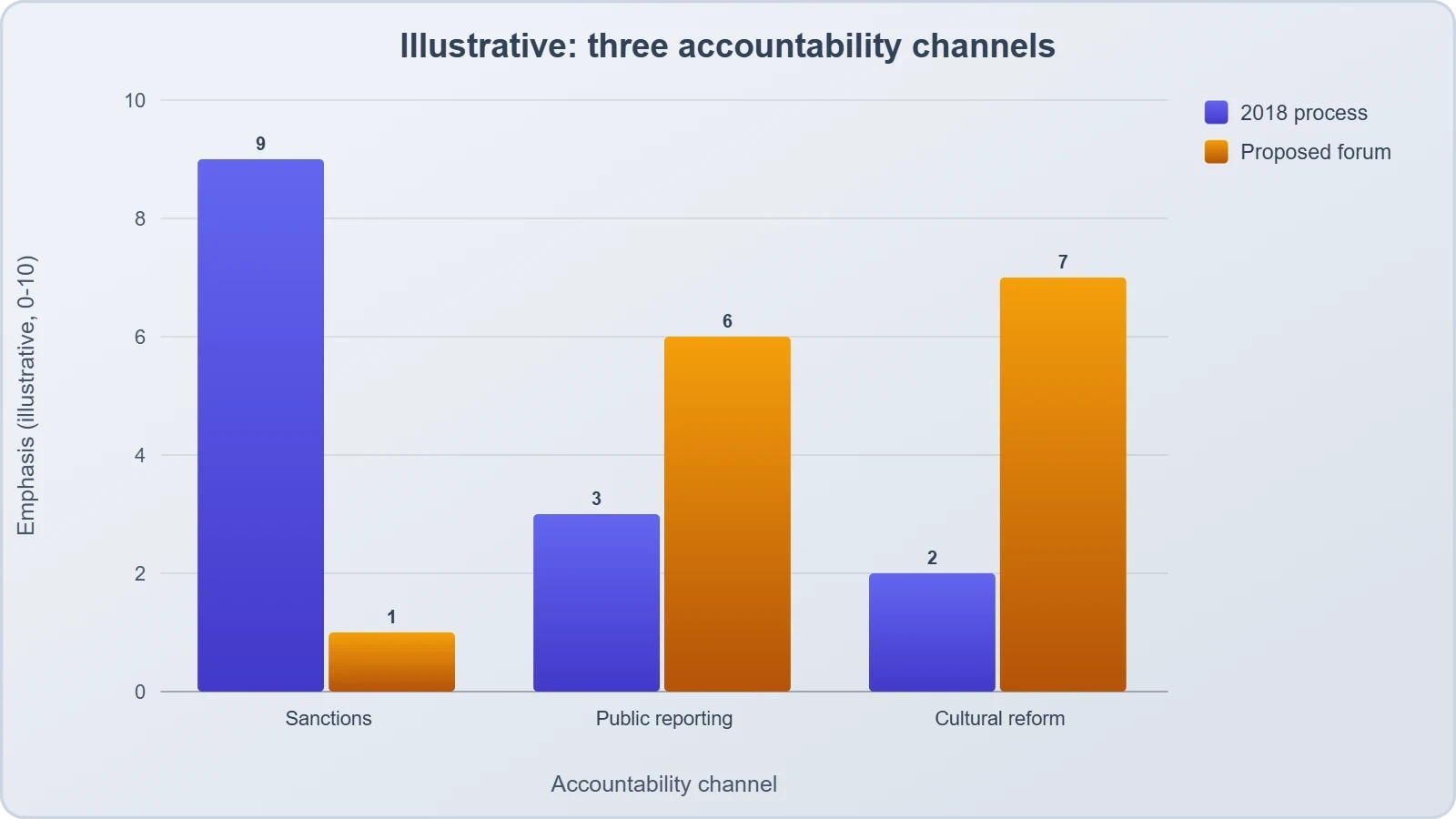
Acceptance is more likely if the forum demonstrates that the original process was sound, or at least that its limitations are understood and addressed. A candid acknowledgement that not every player was interviewed, if true, would do more for credibility than a defence of the process. Institutions often fear conceding procedural imperfection, but in reconciliation contexts, admission of limitation is frequently the price of trust. Cricket Australia's willingness to make that admission will be a telling signal.
Media, Memory, and the Durability of Controversy
The media environment ensures that controversies have long afterlives. Khawaja's book generated coverage that no press release could match, and Warner's response amplified it further. In this environment, institutions cannot rely on formal closure to end public discussion. They must engage with the narrative, correct inaccuracies where they exist, and accept that some questions will persist. The forum is a structured way of engaging rather than ignoring, and that is preferable to silence even if it cannot guarantee resolution.
Memory in sport is selective but durable. Fans remember scandals through the moments that defined them—the sandpaper, the press conference, the bans—and those images outlast reports and reforms. Cricket Australia cannot erase that memory, but it can shape how it is interpreted. A forum that treats participants with respect and produces an honest account may gradually shift the story from one of cover-up to one of reckoning. That shift, however gradual, is the most realistic goal available.
What the Episode Reveals About Institutional Trust
At its core, the sandpapergate revival is a story about trust—how it is lost, how it is contested, and how difficult it is to rebuild. Cricket Australia's original investigation was designed to establish facts and allocate responsibility, and it did so with unusual speed and severity. But trust is not restored by severity alone; it requires a sense that the process was fair, thorough, and honest about its limits. The forum is an implicit admission that those conditions were not fully met, even if the governing body will not say so directly.
The players' willingness to speak publicly, through memoir and interview, reflects a belief that the official record is incomplete. That belief is itself a form of institutional critique, and it will not be resolved by a forum that merely repeats the original findings. For trust to be rebuilt, the forum must demonstrate that it is genuinely listening, that it is willing to acknowledge complexity, and that its conclusions are not predetermined. These are demanding conditions, but they are the conditions under which reconciliation becomes possible rather than performative.
Balancing Finality and Openness
Every institution faces a version of this dilemma: when to close a matter and when to keep it open. Closing too early breeds resentment and invites recurrence; closing too late paralyses decision-making and prolongs uncertainty. Cricket Australia has chosen a middle path—closing the disciplinary matter while opening a testimonial one. That choice is defensible, but it places a heavy burden on the forum to deliver something meaningful. If it does, the middle path will look prudent; if it does not, it will look like avoidance dressed as process.
The balance is especially delicate because the original sanctions were severe. Reopening the investigation could imply that those penalties were unjust or incomplete, a conclusion with significant implications for the individuals punished and for the governing body's own credibility. The forum avoids that implication by focusing on experience rather than fault. Whether that distinction holds up under public scrutiny is uncertain, but it is a coherent attempt to reconcile competing imperatives rather than a simple evasion.
The Human Dimension Beneath the Procedure
Beneath the procedural questions lies a human story about young athletes caught in a moment of poor judgment and institutional pressure. The sanctions ended careers and reshaped lives, and the debate over who knew what is also a debate over who bears responsibility for a culture that made such a plan conceivable. A forum that focuses only on individual recollections may miss the systemic dimension, but a forum that ignores individual experience will lack the texture needed to understand what happened. The best outcome would address both.
Greenberg's acknowledgement that the past week was very difficult for everyone involved is a reminder that institutions are composed of people who feel the weight of these events. That acknowledgement does not resolve the controversy, but it sets a tone that is more conducive to reconciliation than defensiveness. If the forum carries that tone into its proceedings, it may achieve more than its limited mandate suggests. If it reverts to institutional self-protection, the cycle of recurrence will likely continue.
Conclusion: A Test of Institutional Character
The sandpapergate forum is a modest instrument asked to carry a heavy burden. It cannot reopen the investigation, cannot impose penalties, and cannot compel participation. What it can do is offer a credible, independent setting in which those involved can be heard, and in doing so, help the sport reckon with a chapter it has never fully closed. Whether that is enough depends on how seriously Cricket Australia treats the exercise and how willing players are to engage with it in good faith.
The episode ultimately tests institutional character. Institutions reveal themselves not in their formal findings but in how they handle contested memory, how they treat those affected, and whether they are willing to acknowledge complexity rather than retreat into defensiveness. Cricket Australia has chosen a path that is neither full transparency nor full closure. Its success will be judged over months and years, by whether the forum produces genuine insight and whether the lessons it yields are embedded in how the sport governs itself.
From our network :
- Forbidden Matrix Patterns and Visible Lattice Points: A Geometric DictionaryExplore how multidimensional 0–1 matrices encode geometric truths, linking forbidden patterns to visible lattice points and hypergraph theory, with applications in combinatorics and computational geometry.
- Mobile Learning and VR in English: What Global Evidence Reveals About Effective Language TechnologyA systematic review across 14 countries reveals which language-learning technologies genuinely work. Mobile learning, AI, and VR show measurable benefits when pedagogically integrated. This evidence-based guide helps educators and learners select technology that delivers real return on investment.
- Live Online English Classes for Kids: Do They Actually Reduce Anxiety?A ten-week study reveals that synchronous online English classes can significantly reduce child language anxiety while improving listening and reading skills. Discover what makes these programs effective and how parents can select the right one.
- CISA’s Ten-Advisory Wave: Why Generic Patching Fails in OT and How to Build Product-Specific PlaybooksCISA released ten ICS advisories in one week, exposing critical infrastructure risks. Generic patching fails in OT. Learn to build product-specific remediation playbooks.
- University Language Proficiency Exams: Why Institutional Tests Demand Different Preparation Than IELTS and TOEFLDiscover why university-specific language proficiency examinations differ fundamentally from IELTS and TOEFL, and learn strategic preparation approaches for institutional assessment success.
- Committed Mediterranean Precipitation Decline: Why Emissions Cuts Alone Cannot Restore Winter RainsNew NOAA research reveals that Mediterranean winter rains may decline irreversibly even with emissions cuts. Explore the science of committed climate change and regional impacts.
- The Final Descent: How ESA Retired the Legendary Cluster Constellation After 24 Years of Space Weather ScienceAfter 24 years mapping Earth’s magnetosphere, ESA’s Cluster mission concluded with a precisely controlled reentry over the South Pacific. This analysis explores the scientific legacy, engineering decisions, and debris mitigation principles behind one of space exploration’s most responsible retirements.
- How AI Agents Will Change the Way We Manage Personal FinancesExplore how AI agents are transforming personal finance through automated budgeting, bill payment, and investment management, while examining the critical security protocols and governance frameworks required for safe deployment.
- The Hidden Cost of AI Convenience: Why Over-Permissioned Agents Are a Security Time BombDiscover why AI agents with excessive permissions create dangerous single points of failure, and learn how implementing least privilege principles can protect your organization from exploitation.
RESOURCES
- Is Cricket Australia re-opening investigation into Sandpapergate ...sports.yahoo.com11 hours ago ... Is Cricket Australia reopening the Sandpapergate investigation? CA ruled out a fresh probe and launched a new forum after Usman…
- Sandpapergate: Cricket Australia to open forum for players, rules out ...aljazeera.com6 hours ago ... Cricket Australia has ruled out reopening an investigation into the 2018 ball-tampering scandal but said it would launch an independent…
- Cricket Australia sets up 'safe space' for players to ... - Yahoo Sportssports.yahoo.com11 hours ago ... Cricket Australia has launched an independent "forum" for players and staff involved in the sandpapergate scandal to share their version…
- Cricket Australia announces 'safe setting' to investigate ...the-independent.com8 hours ago ... Cricket Australia announces 'safe setting' to investigate sandpapergate scandal ... Cricket Australia (CA) has set up an independent forum ...
- Cricket Australia holds sandpapergate forum behind closed doorsfacebook.com13 hours ago ... As would any investigation in any sport or business, of even any criminal investigation. We are entitled to the findings,…
- Tom Morris - Xx.com13 hours ago ... Understand Cricket Australia won't be re-opening an investigation into Sandpapergate, but it will be providing an independent forum for ...
- Usman Khawaja Reacts Live to Sandpapergate Forum Announcementfacebook.com8 hours ago ... KHAWAJA: “I HAVE SOME QUESTIONS." Usman Khawaja reacts live on Fox Cricket and Kayo Sports after Cricket Australia announces an ...
- Cricket Australia's 'Sandpapergate' forum has a problem - Politicopolitico.com12 hours ago ... Cricket Australia's confidential forum may leave fans in the dark as former Deputy PM Michael McCormack says it is time…
- Chris Rowbottom - Xx.com13 hours ago ... No fresh investigation into sandpapergate, but Cricket Australia will facilitate an independent forum for players who wish to share any ...
- Australia's Bancroft says 'whole team' knew about 'Sandpapergate'afp.com5 hours ago ... ... Cricket Australia ruled out reopening their investigation into "Sandpapergate". CA instead said an independent forum would be launched for ...
- Cricket Australia sets up 'safe space' for players to ... - Yahoo Sportsca.sports.yahoo.com12 hours ago ... Cricket Australia has launched an independent "forum" for cricketers and staff involved in the sandpapergate scandal to share their version ...
- Cricket Australia CEO Todd Greenberg and David Boon announce ...abc.net.au11 hours ago ... Cricket Australia has announced a new forum for players and staff to discuss the infamous Sandpapergate scandal, but whether it…
- Cricket Australia rules out reopening 'Sandpapergate' probeuk.sports.yahoo.com13 hours ago ... Cricket Australia on Wednesday ruled out reopening an investigation into the 2018 ball-tampering scandal but will launch an independent ...
- Cricket Australia CEO Todd Greenberg and David Boon announce ...reddit.com13 hours ago ... r/CricketAus - Cricket Australia CEO Todd Greenberg and David Boon announce Sandpapergate forum for ... investigation. This is all very ...
- Latest Sports News - page 3 | DAZN News UKdazn.comLatest sports news from DAZN News UK, featuring the latest news, analysis & insights, as well as exclusive interviews & stories. - page 3.
- 01
- 02
- 03
- 04
- 05
- 06
- 07
- 08
0 Comments