Universities across the United States have quietly begun experimenting with one of the more imaginative answers to two pressing problems at once: the isolation of older adults and the housing insecurity of students. A small but growing number of institutions operate programs that place students inside retirement communities, where they live alongside residents rather than merely visiting them for volunteer hours. The arrangement is deliberately reciprocal. Students receive subsidized or free accommodation in exchange for a set number of hours each week spent engaging with residents, and the communities gain a steady infusion of youthful energy, conversation, and practical help that paid staff cannot always supply.
The model matters because it reframes what student housing can be. Rather than treating dormitories as warehouses for the young, these programs treat shelter as a lever for social connection across generational lines. For universities, the appeal is partly financial, since campus housing is scarce and expensive in many cities. For retirement communities, the appeal is existential, because loneliness among older residents is a documented health risk that no medication fully addresses. The original NPR audio segment that surfaced this story did not name specific universities or quantify participation, which is precisely why the underlying concept deserves closer examination rather than a passing mention.
What follows is an analytical reading of the idea itself: how intergenerational housing works in practice, why institutions on both sides of the arrangement find it attractive, what the evidence from comparable models suggests, and where the risks lie. The discussion draws on the broader landscape of intergenerational living programs, university-community partnerships, and the economics of senior housing to fill in the gaps the original report left open. The goal is not to celebrate the concept uncritically but to understand the mechanics, the trade-offs, and the conditions under which such programs genuinely serve both populations.
On This Page
TL;DR A cluster of universities now runs programs that let students live inside retirement communities, trading weekly hours of companionship and practical support for reduced or waived housing costs. The arrangement addresses two distinct crises simultaneously: student housing shortages and elder isolation. Success depends on careful screening, clear expectations, privacy protections, and genuine reciprocity rather than one-sided volunteerism. The model is not a universal solution, but it demonstrates that housing policy and social connection policy can be designed together rather than in separate silos.
The Architecture of Intergenerational Housing Programs
Intergenerational housing programs are best understood as structured exchanges rather than charity. A university negotiates an agreement with a retirement community, typically a continuing care retirement community or an assisted living campus, to reserve a handful of units for enrolled students. In return, each student commits to a defined weekly quota of interaction, often somewhere between four and twelve hours, which may include shared meals, evening conversation, technology tutoring, escorted walks, or organized activities. The structure resembles a residency with obligations, and the obligations are what distinguish it from ordinary renting.
The operational details vary considerably. Some programs embed students in independent living wings where residents are largely self-sufficient; others place them near memory care units with stricter protocols. Selection processes usually involve applications, interviews, and background checks, because the communities are accepting a duty of care toward vulnerable adults. Orientation sessions teach students about dementia communication, fall risks, and confidentiality. The most mature programs assign a staff coordinator whose sole job is managing the student-resident interface, which signals that the arrangement is treated as a program rather than an informal perk.
How the Exchange Is Structured
Most programs formalize the exchange through a written agreement that specifies hours, conduct expectations, and termination conditions. Students typically pay a nominal rent or nothing at all, and the value of the forgone rent is treated as compensation for service. This framing has legal consequences, since labor law, tax treatment, and liability insurance all depend on whether the arrangement is classified as a service contract, a scholarship, or a lease. Universities that have run these programs longest tend to keep the service element modest precisely to avoid triggering employment obligations.
The scheduling dimension is often underestimated. Students carry irregular academic calendars, exam periods, and holiday breaks, while retirement communities operate on continuous daily rhythms. A program that works in October can strain in December. Effective programs build in substitute coverage, allow hour banking across semesters, and maintain a reserve of students large enough that absences do not leave residents without expected company. The design challenge is less about goodwill than about logistics, and the programs that endure are the ones that treat scheduling as a first-class problem.
The Populations on Both Sides
On the student side, participants are rarely the stereotypical undergraduates. Many programs attract graduate students, international students facing acute housing costs, and older returning students who find the environment familiar. On the resident side, the population skews toward independent living residents who are socially motivated but physically limited, a group for whom loneliness is common yet mobility outside the campus is difficult. The fit between these two groups is often better than intuition suggests, because both are navigating transitions and both benefit from predictable social contact.
The demographic context sharpens the stakes. Populations in most developed economies are aging rapidly, and the share of older adults living alone has risen for decades. Simultaneously, rental costs in university cities have outpaced student incomes. These two curves, one demographic and one economic, are what make the intergenerational housing idea more than a novelty. It is a structural response to structural pressures, and its persistence will depend on whether institutions can scale it beyond a handful of pilot placements.
Why Universities and Retirement Communities Both Gain
The university's incentive is straightforward and increasingly urgent. Student housing in many college towns has become a binding constraint on enrollment, and construction of new dormitories is slow, capital-intensive, and politically fraught. A partnership with an existing retirement campus requires no new construction at all. The university effectively borrows underused residential capacity in exchange for programming labor it already has in abundance. For administrators facing housing waitlists, the arithmetic is compelling, even if the number of placements remains small relative to total demand.
The retirement community's incentive is subtler but arguably stronger. Loneliness among older adults is associated with elevated risks of cardiovascular disease, cognitive decline, and mortality, and operators of senior living campuses are increasingly evaluated on resident wellbeing rather than merely on care metrics. A resident who has a student to talk with at dinner is a resident less likely to withdraw. Operators also report recruitment benefits, since prospective residents and their adult children respond favorably to campuses that feel alive rather than sealed off from the surrounding world.
The Economics of Subsidized Co-Living
From a pure cost perspective, the exchange is efficient because it monetizes two forms of slack simultaneously. The retirement community has vacant units during periods of turnover and underused common spaces. The student has time and social energy but limited cash. Matching them converts idle capacity and idle hours into housing and companionship respectively, without a large cash transfer. The implicit hourly value of the arrangement can be estimated by dividing the market rent of a comparable unit by the required service hours, which typically yields a figure competitive with ordinary student employment.
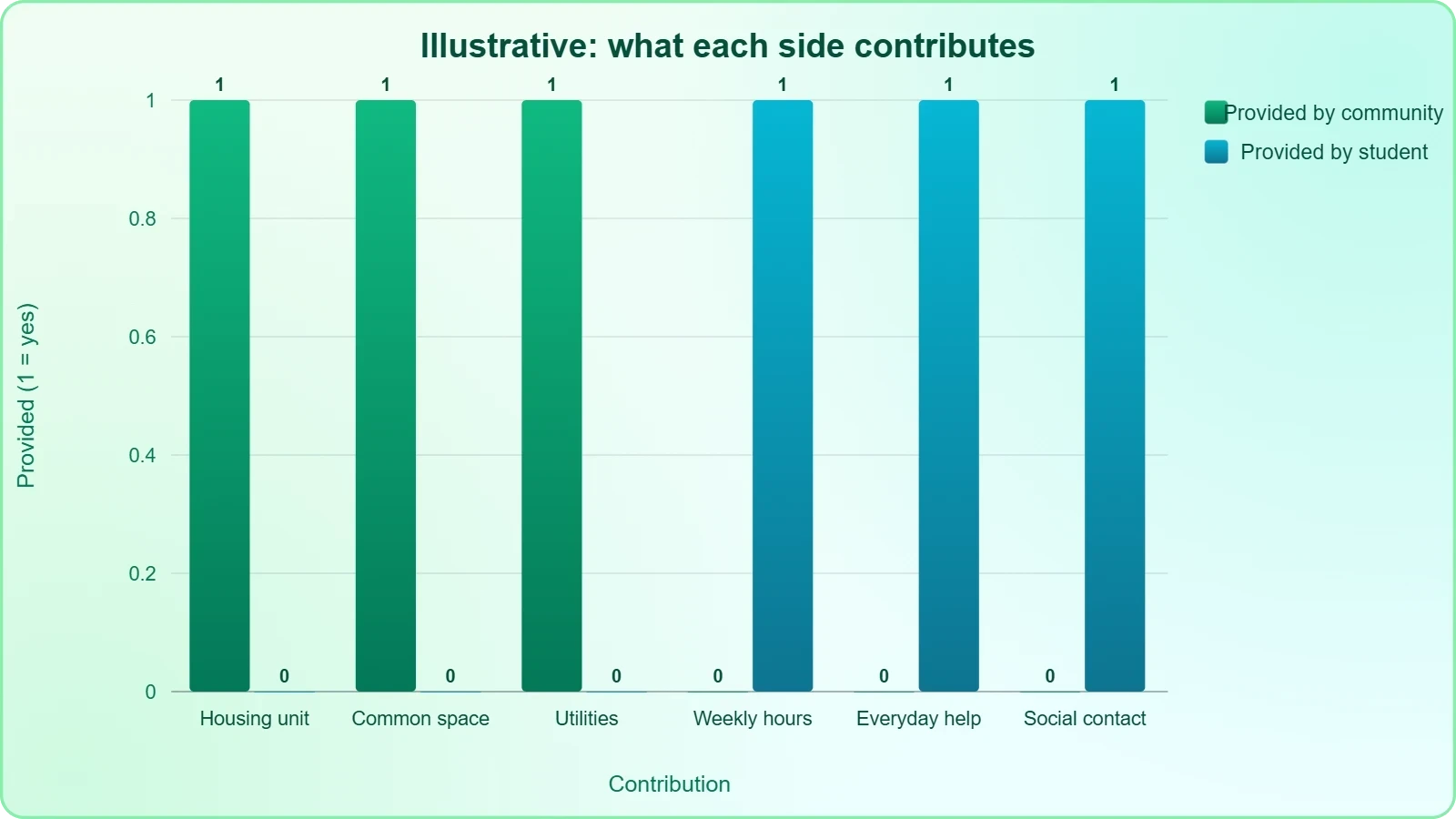
That calculation also exposes the model's fragility. If market rents fall or if student labor becomes more valuable elsewhere, the implicit wage embedded in the exchange can drift below prevailing alternatives, and participation declines. Programs therefore tend to work best in high-cost housing markets where the rent subsidy is substantial. In inexpensive markets, the same hours spent in a paid job may cover rent more easily, which explains why the model has concentrated in expensive metropolitan areas rather than spreading uniformly.
Social Outcomes and the Evidence Base
Formal evaluations of these programs remain thin, which is one reason the original reporting was brief. What evidence exists comes largely from adjacent models: intergenerational co-housing, senior villages with volunteer support, and university-affiliated lifelong learning communities. These studies generally report improvements in resident mood and perceived social support, alongside modest gains in student satisfaction and reduced housing stress. The effects are real but not transformative, and researchers caution against overstating them given small sample sizes and selection bias among participants.
The more interesting finding concerns reciprocity. Programs framed as service obligations tend to produce transactional relationships, while programs framed as shared living produce genuine friendships. Residents who feel they are receiving charity disengage; residents who feel they are hosts and mentors invest. This suggests that program design should emphasize mutual contribution, perhaps by having residents offer skills, mentorship, or practical help in return. The strongest versions of the model treat students as neighbors with obligations rather than as volunteers with housing discounts.
Risks, Safeguards, and the Question of Power
Any arrangement that places young adults in close proximity to frail older adults carries inherent risks, and pretending otherwise would be irresponsible. The most obvious concerns are financial exploitation, where a student might borrow money or influence a will, and physical safety, where a resident with cognitive impairment might wander or fall. Programs mitigate these through background checks, clear prohibitions on financial transactions between students and residents, and reporting obligations. The safeguards are not decorative; they are the price of admission for operating inside a care environment.
There is also a subtler power asymmetry. Students need housing desperately, and residents may be lonely enough to accept arrangements they would otherwise question. A program that relies on mutual desperation rather than mutual interest can drift toward exploitation in either direction. The corrective is transparency: written terms, independent oversight, and a genuine option to exit without penalty. Programs that treat the student as a tenant with rights and the resident as a person with autonomy, rather than as a volunteer and a beneficiary respectively, tend to avoid the worst outcomes.
Privacy, Consent, and Care Boundaries
Retirement communities are not ordinary apartment buildings. Residents may have medical conditions, cognitive impairments, or family situations that are private, and students living on site will inevitably observe some of it. Programs therefore need explicit confidentiality rules and training on what to do when a resident appears unwell. The boundary between neighborly concern and unlicensed caregiving is thin, and students should never be positioned as substitutes for professional staff. Clear escalation protocols protect both parties and reassure families who may be uneasy about young strangers living near vulnerable relatives.
Consent runs in both directions as well. Residents should be able to decline participation without social penalty, and students should be able to withdraw from uncomfortable situations without jeopardizing their housing. The best programs build these options into the agreement rather than leaving them to informal negotiation. This is unglamorous administrative work, but it is precisely the kind of work that determines whether an intergenerational housing scheme survives its first difficult incident or collapses under a single lawsuit.
Scaling Limits and Institutional Commitment
It is important to be honest about scale. Even the most established programs place a few dozen students at most, which is a rounding error against the housing needs of a large university. The model is a demonstration, not a solution. Its value lies in proving that the two populations can coexist productively and in generating evidence that policymakers can use. Treating it as a substitute for building housing or funding elder care would be a category error, and advocates who oversell it risk discrediting a genuinely useful idea.
Scaling also requires institutional commitment that outlasts a single administrator's tenure. Programs wither when the champion who launched them moves on, because the coordination labor is invisible in budgets until it disappears. Durable programs embed the arrangement in formal agreements, assign permanent staff, and publish outcomes so that successors inherit a functioning system rather than a personal project. The lesson from comparable university-community partnerships is consistent: informal goodwill is necessary but never sufficient.
Comparative Models Around the World
Intergenerational housing is not an American invention, and looking abroad clarifies which elements are essential and which are cultural accidents. In the Netherlands, student residences have been placed inside nursing homes for years, with students receiving free rooms in exchange for roughly thirty hours of monthly companionship. In Spain and France, similar schemes pair students with older homeowners who have spare bedrooms, addressing both housing costs and elder isolation. These European variants tend to be organized by municipalities or nonprofits rather than universities, which changes the accountability structure considerably.
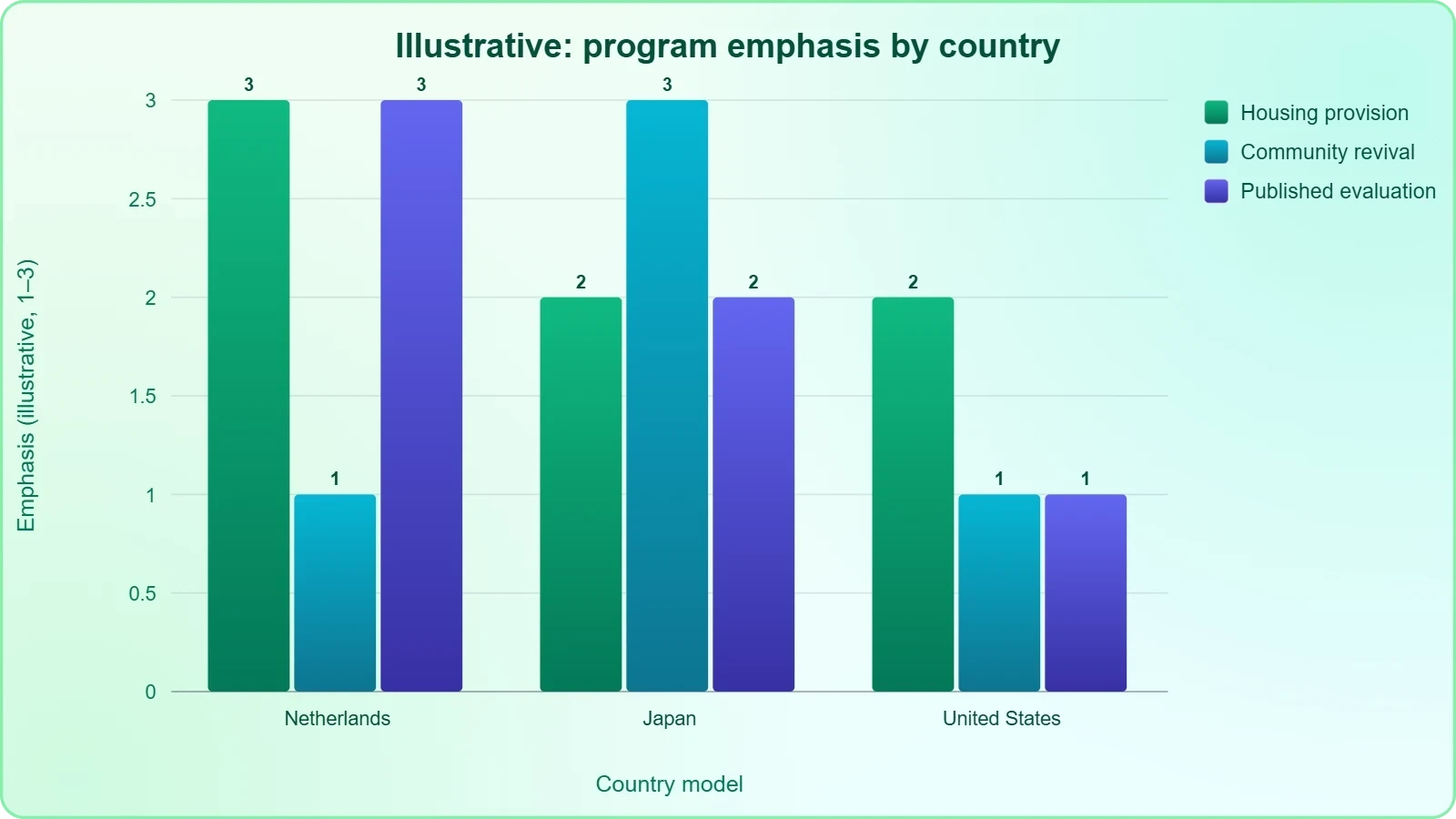
Japan offers a different model, where universities and local governments collaborate on mixed-generation housing in depopulating regions, using students as a partial answer to community decline. The common thread across all these examples is that the arrangement is treated as social infrastructure rather than a private transaction. Where governments or nonprofits anchor the program, it tends to survive changes in university leadership. Where it depends entirely on a single institution's initiative, it tends to be fragile. The institutional home matters as much as the design.
What Transfers and What Does Not
The transferable elements are the exchange structure, the screening protocols, and the reciprocity framing. The non-transferable elements are cultural attitudes toward aging, the legal treatment of liability, and the specifics of housing markets. A model that works in a country with strong public elder care may fail where families expect to provide care themselves. A model that works in a high-rent city may be pointless in a low-rent one. Comparative analysis is useful precisely because it forces program designers to identify which assumptions are local and which are structural.
There is also a lesson about measurement. European programs often publish participation counts and resident satisfaction scores, which allows for comparison and improvement. American programs are more likely to operate quietly without evaluation, which limits learning. The absence of data is not neutral; it means that failures are invisible and successes cannot be replicated. Any institution considering such a program should commit to measurement from the outset, even if the metrics are modest.
Lessons for Institutional Design
The clearest lesson is that intergenerational housing works best when it is designed as housing first and programming second. Students need a decent place to live, and residents need neighbors rather than visitors. When the housing is an afterthought and the programming is the main event, the arrangement feels like a volunteer placement with a bed attached, and it attracts participants for the wrong reasons. When the housing is genuine and the programming is a natural consequence of proximity, the relationships tend to form organically and endure.
A second lesson concerns selection. Programs that screen students purely for enthusiasm tend to produce inconsistent results, while programs that screen for reliability, emotional maturity, and genuine interest in older adults produce better outcomes. This is not about finding saints; it is about finding people who will show up on a rainy Tuesday in February. Reliability is a better predictor of program success than charisma, and selection criteria should reflect that unglamorous reality.
We Also Published
What the Model Reveals About Housing and Aging Policy
The deeper significance of these programs is diagnostic rather than prescriptive. They reveal that housing policy and aging policy are usually designed in separate rooms by separate agencies with separate budgets, even though the problems they address are entangled. A student who cannot afford rent and a widow who cannot find company are both victims of a system that treats shelter as a commodity and care as a private burden. Intergenerational housing is interesting because it refuses that separation, even if only at small scale.
It also exposes the limits of volunteerism as a substitute for public investment. Programs that rely on student goodwill to fill gaps in elder care and housing supply are performing a service that markets and governments have failed to provide. That is admirable, but it is not a substitute for building more housing or funding professional care. The risk is that a successful pilot becomes an excuse for inaction, allowing policymakers to point at a dozen placements and claim the problem is being addressed.
Policy Levers That Would Help
Several modest policy changes could make these programs easier to operate without expanding them into substitutes for public provision. Clarifying the tax and labor status of service-linked housing would remove a major legal uncertainty. Adjusting zoning rules to permit mixed-age residential arrangements would allow more communities to participate. Funding independent evaluation would generate the evidence that currently does not exist. None of these measures is expensive, and together they would lower the barriers that currently keep the model confined to a handful of institutions.
Liability reform deserves particular attention. Retirement communities hesitate to host students largely because of insurance and duty-of-care concerns, not because they doubt the benefits. Clear statutory guidance on the boundaries of responsibility, combined with standard screening protocols, would reduce the perceived risk. The goal is not to eliminate liability but to make it predictable, so that operators can price it and proceed. Predictability, more than subsidy, is what unlocks institutional participation.
The Human Dimension Beneath the Policy
Beneath the policy analysis sits a simpler observation. Older adults and young adults are often segregated by design, living in separate buildings, separate neighborhoods, and separate social worlds, even when they share the same city. That segregation is not natural; it is the product of zoning, housing markets, and institutional habits. Programs that place students in retirement communities are modest experiments in reversing it, and their value may lie less in the housing they provide than in the relationships they make possible.
The residents who participate often describe the students not as helpers but as reminders that the world continues. The students, in turn, describe the residents as sources of perspective that their peers cannot provide. These are not measurable outcomes in any rigorous sense, but they are the reason the programs persist despite their administrative burdens. Any honest assessment has to hold both truths at once: the model is small and limited, and it also produces something that neither universities nor retirement communities can manufacture on their own.
Reading the Original Report Critically
The NPR segment that prompted this analysis was deliberately brief, and its brevity is itself informative. It reported that universities run programs allowing students to live in retirement communities, without naming institutions, quantifying participation, or describing activities. That level of abstraction is common in broadcast journalism, where a two-minute segment cannot carry the detail of a written investigation. But it also means that listeners were given a concept without the evidence needed to evaluate it, which is precisely the gap that written analysis can fill.
A critical reading should note what the report did not claim. It did not assert that the programs are widespread, that they solve housing shortages, or that they measurably improve health outcomes. It simply noted their existence. Readers inclined to skepticism should resist the temptation to dismiss the idea on the basis of a thin report, and readers inclined to enthusiasm should resist the temptation to generalize from it. The honest position is that the concept is real, the scale is small, and the evidence is incomplete.
What Further Reporting Should Establish
Several questions would sharpen the picture considerably. How many institutions operate such programs, and how many students do they serve? What are the contractual terms, and how are disputes resolved? What do residents say about the experience, and do their families share that assessment? What happens when a student violates expectations, and what happens when a resident does? These are unglamorous questions, but they are the ones that determine whether a program is a genuine innovation or a well-meaning gesture.
There is also a question about who is not represented. Programs that place students in retirement communities may inadvertently select for students who are comfortable with older adults, which is not a random sample. Residents who participate may be the most socially engaged members of their communities, leaving the most isolated untouched. Understanding these selection effects is essential before drawing conclusions about the model's broader potential, and it requires data that currently does not exist in any systematic form.
Why the Story Still Matters
Despite its thinness, the story matters because it points at a genuine structural possibility. Most housing policy assumes that different generations should live apart, and most aging policy assumes that older adults should be served by professionals rather than neighbors. Intergenerational housing programs challenge both assumptions, and they do so in a way that is concrete, affordable, and already operating. That combination is rare enough to deserve attention, even when the evidence is preliminary and the scale is modest.
The most useful response is neither celebration nor dismissal but curiosity disciplined by skepticism. Ask what the programs actually do, what they cost, who benefits, and who is excluded. Ask whether the arrangement would survive without a charismatic founder. Ask what would happen if the housing market shifted. These questions do not diminish the idea; they clarify it. And clarity, rather than enthusiasm, is what allows a promising experiment to become a durable institution.
From our network :
- CISA’s Ten-Advisory Wave: Why Generic Patching Fails in OT and How to Build Product-Specific PlaybooksCISA released ten ICS advisories in one week, exposing critical infrastructure risks. Generic patching fails in OT. Learn to build product-specific remediation playbooks.
- Forbidden Matrix Patterns and Visible Lattice Points: A Geometric DictionaryExplore how multidimensional 0–1 matrices encode geometric truths, linking forbidden patterns to visible lattice points and hypergraph theory, with applications in combinatorics and computational geometry.
- The Hidden Cost of AI Convenience: Why Over-Permissioned Agents Are a Security Time BombDiscover why AI agents with excessive permissions create dangerous single points of failure, and learn how implementing least privilege principles can protect your organization from exploitation.
- The Final Descent: How ESA Retired the Legendary Cluster Constellation After 24 Years of Space Weather ScienceAfter 24 years mapping Earth’s magnetosphere, ESA’s Cluster mission concluded with a precisely controlled reentry over the South Pacific. This analysis explores the scientific legacy, engineering decisions, and debris mitigation principles behind one of space exploration’s most responsible retirements.
- University Language Proficiency Exams: Why Institutional Tests Demand Different Preparation Than IELTS and TOEFLDiscover why university-specific language proficiency examinations differ fundamentally from IELTS and TOEFL, and learn strategic preparation approaches for institutional assessment success.
- Live Online English Classes for Kids: Do They Actually Reduce Anxiety?A ten-week study reveals that synchronous online English classes can significantly reduce child language anxiety while improving listening and reading skills. Discover what makes these programs effective and how parents can select the right one.
- How AI Agents Will Change the Way We Manage Personal FinancesExplore how AI agents are transforming personal finance through automated budgeting, bill payment, and investment management, while examining the critical security protocols and governance frameworks required for safe deployment.
- Committed Mediterranean Precipitation Decline: Why Emissions Cuts Alone Cannot Restore Winter RainsNew NOAA research reveals that Mediterranean winter rains may decline irreversibly even with emissions cuts. Explore the science of committed climate change and regional impacts.
- Mobile Learning and VR in English: What Global Evidence Reveals About Effective Language TechnologyA systematic review across 14 countries reveals which language-learning technologies genuinely work. Mobile learning, AI, and VR show measurable benefits when pedagogically integrated. This evidence-based guide helps educators and learners select technology that delivers real return on investment.
RESOURCES
- Resources will be updated soon.
- 01
- 02
- 03
- 04
- 05
- 06
- 07
- 08
0 Comments