When Egypt's President Abdel Fattah El-Sisi addressed a World Economic Forum gathering, his message was deliberately spare yet strategically loaded: development work continues despite global challenges. That single sentence, reported by Ahram Online without elaboration on the project or the specific pressures involved, carries more weight than its brevity suggests. It signals continuity, confidence, and a refusal to let external shocks dictate domestic economic direction.
Understanding why such a statement matters requires reading between the diplomatic lines. Egypt sits at the intersection of currency pressure, import dependency, regional instability, and heavy infrastructure spending, a combination that would force most governments into retrenchment. Instead, the presidency chose a public forum to reaffirm forward motion. The framing is as much about investor psychology and sovereign credibility as it is about concrete construction timelines or budget allocations.
This analysis unpacks the meaning behind the remark, the economic and geopolitical context that gives it substance, and the measurable indicators that will determine whether the promise holds. It examines Egypt's development model, the financing architecture behind it, the regional pressures shaping decisions, and the benchmarks observers should track.
On This Page
- The Strategic Meaning of a Deliberately Brief Statement
- Egypt's Development Model Under Macroeconomic Pressure
- Geopolitical Headwinds and Regional Risk Exposure
- Reading the Statement Through an Economic Lens
- Financing the Continuation: Capital Flows and Reform Conditions
- Benchmarks That Will Test the Promise
- What the Statement Ultimately Reveals
The goal is to move past the headline and understand what "development continues" actually implies for a nation of more than 110 million people navigating a difficult decade.
TL;DR Egypt's President told the World Economic Forum that national development work continues despite global challenges, a concise statement of continuity rather than detail. The remark reflects a deliberate strategy of projecting sovereign stability to investors and partners while Egypt manages currency pressure, inflation, debt service, and regional risk. Its credibility rests on infrastructure delivery, external financing flows, private-sector participation, and the pace of structural reform. This analysis maps the statement's economic logic, the financing behind Egypt's development agenda, the geopolitical headwinds involved, and the indicators that will reveal whether the promise translates into durable progress.
The Strategic Meaning of a Deliberately Brief Statement
Presidential remarks at multilateral economic forums are rarely casual. Every sentence is calibrated for multiple audiences simultaneously: domestic citizens seeking reassurance, foreign investors weighing risk, multilateral lenders monitoring reform compliance, and regional rivals assessing resolve. El-Sisi's formulation performs all four functions at once, asserting momentum without committing to specifics that could later be scrutinized or contradicted.
Why Brevity Functions as Diplomatic Strategy
By declining to name the project or enumerate the challenges, the statement avoids creating measurable benchmarks that critics or markets could hold against the government. It preserves flexibility while still communicating intent. In sovereign communication, ambiguity is often a feature rather than a flaw, allowing a leader to signal direction without exposing detailed timelines to public verification.
The phrase "despite global challenges" also performs quiet work. It acknowledges difficulty without accepting blame, framing external conditions as the source of pressure rather than domestic policy choices. This rhetorical positioning is common among emerging-market leaders managing simultaneous inflation, currency adjustment, and debt obligations while maintaining public confidence in the national trajectory.
The Audience Behind the Message
The World Economic Forum setting matters enormously. Davos-style gatherings concentrate the attention of institutional investors, sovereign wealth funds, and development finance institutions. Speaking there signals that Egypt remains open for business and integrated into global capital markets, a message aimed squarely at the foreign direct investment and portfolio flows the economy requires.
Domestically, the same words serve a different purpose. They reassure citizens that austerity and price pressures are transitional rather than permanent, and that the state retains a coherent plan. The dual audience explains why the statement emphasizes continuity over detail: specificity would serve one constituency while creating vulnerabilities with the other.
Egypt's Development Model Under Macroeconomic Pressure
Egypt has pursued an infrastructure-led growth model for more than a decade, anchored by megaprojects spanning transport, energy, housing, and water management. The New Administrative Capital, expanded metro and rail networks, desalination capacity, and renewable energy installations represent the visible face of this strategy. The logic holds that large public investment crowds in private activity and raises long-run productivity.
That model has faced severe stress. Currency devaluations, elevated inflation, and a heavy external debt service burden have compressed fiscal space. Import restrictions introduced to protect reserves disrupted industrial supply chains. The statement that development continues is therefore a claim about prioritization under constraint, not an assertion that resources are abundant or that trade-offs have disappeared.
Financing Architecture and External Dependence
Egypt's development agenda depends heavily on external financing. The International Monetary Fund program, Gulf sovereign deposits and investments, multilateral development bank lending, and bilateral support together underwrite the external position. Each tranche carries conditions or expectations, from exchange-rate flexibility to subsidy reform and state-enterprise divestment.
This dependence shapes what "continuing development" can realistically mean. Projects aligned with lender priorities, particularly those supporting energy transition, water security, and private-sector expansion, attract financing more readily. Projects with weaker commercial justification face longer delays. The statement thus implies selective continuation rather than uniform acceleration across the portfolio.
Inflation, Currency, and Household Strain
Macroeconomic stabilization has imposed real costs on Egyptian households. Successive devaluations raised the local-currency price of imported goods, food, and fuel, driving inflation to levels that eroded purchasing power. Subsidy adjustments added further pressure. Development spending must be justified politically against these immediate household concerns.
This tension explains the emphasis on continuity. A government managing popular frustration cannot easily announce a pause in national projects without signaling loss of control. Framing development as ongoing, even while fiscal consolidation proceeds, preserves the narrative that sacrifice today funds national capability tomorrow. The credibility of that narrative depends on visible delivery.
We Also Published
Geopolitical Headwinds and Regional Risk Exposure
The "global challenges" referenced in the statement extend well beyond economics. Egypt borders Libya, Sudan, and the Gaza Strip, and sits adjacent to Red Sea shipping lanes that carry a substantial share of global trade. Conflict and instability in any of these theaters imposes direct costs through refugee flows, security expenditure, and disrupted maritime commerce.
Red Sea shipping disruptions have been particularly consequential. Attacks on commercial vessels forced rerouting around the Cape of Good Hope, raising freight costs and reducing Suez Canal transit revenue, a critical source of foreign currency. When a major revenue stream becomes volatile, financing development becomes materially harder and the political premium on projecting stability rises.
Water Security and the Nile Dispute
Egypt's development strategy is inseparable from water security. The Grand Ethiopian Renaissance Dam has been a decade-long source of tension over Nile flow management. Any reduction in downstream water availability threatens agricultural output, hydropower generation, and the viability of new irrigation-dependent projects, making diplomacy a core economic instrument.
This dimension explains why development rhetoric often carries a sovereignty subtext. Investment in desalination, water recycling, and irrigation efficiency is framed as strategic self-sufficiency rather than mere infrastructure. The statement that work continues implicitly asserts that external pressures, including upstream water politics, will not dictate Egypt's internal development timetable.
Strategic Autonomy Between Major Powers
Egypt manages relationships with the United States, the European Union, China, Russia, and Gulf states simultaneously, extracting investment and diplomatic support from each. This balancing act supports development financing but invites scrutiny. Western partners attach governance and human-rights conditions; Gulf partners prioritize commercial returns; China finances construction with fewer political strings.
Maintaining this equilibrium requires careful messaging. A statement at a Western-dominated economic forum affirming development continuity reassures investors without signaling alignment. It positions Egypt as a stable, investable partner pursuing its own national program, a posture designed to keep capital flowing from multiple directions despite competing geopolitical pressures.
Reading the Statement Through an Economic Lens
Stripped of diplomatic packaging, the statement is a claim about the relationship between external shocks and domestic policy autonomy. Egypt is asserting that its development trajectory is internally determined, not hostage to global conditions. Whether that claim holds depends on measurable variables that analysts can track over successive quarters.
The economic lens also reveals what the statement does not say. It does not announce new spending, new borrowing, or new partnerships. It does not quantify progress or acknowledge setbacks. This restraint is consistent with a communication strategy that prioritizes narrative stability over transparency, a choice with both political benefits and credibility risks.
What "Development Continues" Means Operationally
Operationally, continuation implies that committed projects retain funding, that contractors are paid, and that construction timelines advance. It implies that external financing tranches remain on schedule and that reform milestones tied to them are met. It also implies that the state can absorb higher input costs without abandoning priority works.
These conditions are testable. Satellite imagery, contract awards, budget execution data, and lender disbursement records all provide evidence. The statement's credibility will therefore be judged not by its rhetoric but by whether capital expenditure, foreign direct investment, and infrastructure completion rates hold steady through the next fiscal cycle.
The Credibility Gap and Investor Perception
Emerging-market investors discount optimistic official narratives. They look for consistency between stated intentions and observable fiscal and monetary behavior. A government that claims continuity while delaying payments to contractors or accumulating arrears sends a contradictory signal that markets punish through wider spreads and reduced appetite.
Egypt's challenge is to close the gap between communication and execution. Sovereign credibility compounds over time: each delivered project and honored commitment lowers future borrowing costs. Conversely, repeated gaps between announcement and delivery raise risk premiums. The WEF statement is thus a small deposit in a credibility account that requires continuous funding.
- 01
- 02
- 03
- 04
Financing the Continuation: Capital Flows and Reform Conditions
No development program of Egypt's scale can proceed on domestic savings alone. External capital, whether concessional, commercial, or sovereign, is the binding constraint. The statement's implicit promise is that Egypt can still attract that capital despite the challenges it acknowledges, a claim that depends on reform credibility and geopolitical relevance.
Multilateral programs provide anchor financing but come with conditionality. Gulf support offers flexibility but is influenced by strategic calculations and oil price cycles. Private capital seeks returns and predictability. Balancing these sources requires a policy mix that satisfies disparate stakeholders, a demanding exercise in economic diplomacy that shapes what development actually gets built.
The Role of Gulf Sovereign Support
Gulf states have repeatedly provided deposits, direct investments, and asset purchases that stabilize Egypt's external position. This support reflects strategic alignment and commercial interest rather than pure philanthropy. It buys time and confidence but does not substitute for productivity-enhancing reform or a durable improvement in the current account.
Relying on friendly sovereign capital creates a form of dependence that constrains policy independence. Recipients must maintain political relationships and offer attractive investment terms. The development program therefore reflects not only domestic priorities but also the preferences of external patrons, a reality that shapes project selection and financing structures.
Private Sector Participation and Structural Reform
Sustained development ultimately requires a vibrant private sector generating jobs and tax revenue. Egypt has committed to reducing the state's economic footprint, divesting assets, and leveling the playing field for private firms. Progress on these commitments influences both lender confidence and the willingness of foreign companies to invest.
Implementation has been uneven. State-owned enterprises retain significant advantages, and regulatory unpredictability deters some investors. The statement that development continues is therefore also a claim about reform momentum. Without credible private-sector expansion, public investment alone cannot deliver the employment growth a young, growing population requires.
Benchmarks That Will Test the Promise
Assessing whether development genuinely continues requires disciplined observation over time. Single statements and quarterly fluctuations reveal little. The relevant question is whether the structural conditions supporting investment, productivity, and external balance improve across successive cycles, and whether the state's capacity to execute projects strengthens rather than erodes.
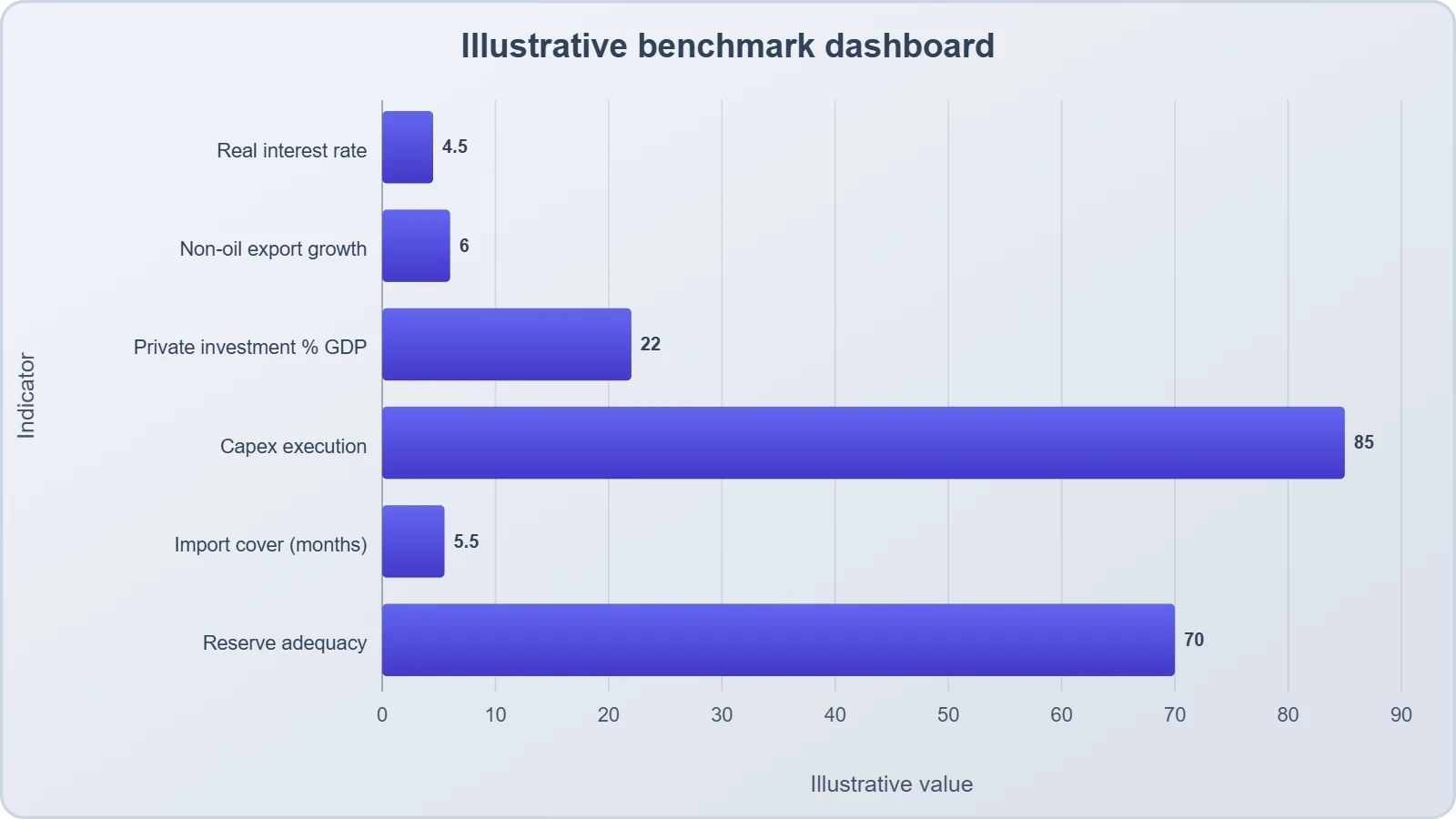
Several indicators deserve particular attention. Real interest rates determine whether domestic savings flow to productive uses. Non-oil export growth reveals diversification progress. Private investment as a share of GDP indicates whether the state-led model is transitioning toward broader participation. Each metric connects directly to the credibility of continuity claims.
Growth, Employment, and Demographic Pressure
Egypt's population growth creates an imperative for rapid job creation. Development projects that do not generate employment at scale risk failing the demographic test. Labor force participation, particularly among women and youth, and the quality of newly created jobs are therefore central to evaluating whether development delivers inclusive outcomes.
Growth composition matters as much as headline rates. Construction-heavy expansion produces temporary employment and imported inputs. Manufacturing, services, and tradable sectors generate durable jobs and foreign currency. A shift toward the latter would substantiate the claim that development is progressing in a sustainable direction rather than merely continuing in volume.
External Balance and Reserve Adequacy
Reserve adequacy determines a country's ability to absorb shocks without abrupt adjustment. Egypt's reserves, supported by external financing and remittances, provide a buffer but remain sensitive to portfolio flows and commodity prices. Import cover ratios and the trajectory of the current account are therefore essential monitoring variables.
Remittances from Egyptian workers abroad constitute a major and relatively stable inflow, but they respond to Gulf labor market conditions and exchange-rate incentives. Tourism receipts add volatility. Diversifying the external account through exports and services would reduce vulnerability and strengthen the foundation on which development spending rests.
What the Statement Ultimately Reveals
The remark is best understood as an act of narrative management in a constrained environment. It tells investors that Egypt remains committed to growth, tells citizens that national direction is intact, and tells partners that external pressure will not force retreat. Each message is strategically rational, and together they form a coherent posture of controlled optimism.
Yet narrative alone cannot build infrastructure or service debt. The statement's significance lies in what it commits Egypt to proving. By asserting continuity publicly, the government has raised the cost of visible reversal. That creates accountability pressure, however indirect, and gives analysts a clear standard against which to measure subsequent performance.
Continuity as a Test of Institutional Capacity
Development continuity is ultimately an institutional question. Can ministries execute projects on schedule? Can state enterprises be reformed without destabilizing employment? Can regulators provide predictable rules that attract private capital? These capabilities determine whether a presidential statement describes reality or merely aspiration.
Institutional strengthening is slower and less visible than ribbon-cutting, but it is the foundation on which durable development rests. Egypt's long-term trajectory will depend less on any single forum appearance than on whether administrative capacity, fiscal discipline, and policy consistency improve across successive governments and economic cycles.
The Broader Lesson for Emerging Economies
Egypt's situation mirrors that of many emerging economies managing development ambitions amid external shocks. The common challenge is to sustain investment while maintaining macroeconomic stability and social cohesion. Communication plays a genuine role in that balancing act, shaping expectations that influence investment decisions and currency behavior.
The lesson is that credible continuity requires more than assertion. It demands transparent reporting, measurable milestones, and consistent follow-through. Governments that master this discipline earn lower risk premiums and more durable capital flows. Those that rely on rhetoric alone eventually face the market's correction, however reassuring their public statements may sound.
From our network :
- Mobile Learning and VR in English: What Global Evidence Reveals About Effective Language TechnologyA systematic review across 14 countries reveals which language-learning technologies genuinely work. Mobile learning, AI, and VR show measurable benefits when pedagogically integrated. This evidence-based guide helps educators and learners select technology that delivers real return on investment.
- How AI Agents Will Change the Way We Manage Personal FinancesExplore how AI agents are transforming personal finance through automated budgeting, bill payment, and investment management, while examining the critical security protocols and governance frameworks required for safe deployment.
- The Final Descent: How ESA Retired the Legendary Cluster Constellation After 24 Years of Space Weather ScienceAfter 24 years mapping Earth’s magnetosphere, ESA’s Cluster mission concluded with a precisely controlled reentry over the South Pacific. This analysis explores the scientific legacy, engineering decisions, and debris mitigation principles behind one of space exploration’s most responsible retirements.
- Forbidden Matrix Patterns and Visible Lattice Points: A Geometric DictionaryExplore how multidimensional 0–1 matrices encode geometric truths, linking forbidden patterns to visible lattice points and hypergraph theory, with applications in combinatorics and computational geometry.
- Live Online English Classes for Kids: Do They Actually Reduce Anxiety?A ten-week study reveals that synchronous online English classes can significantly reduce child language anxiety while improving listening and reading skills. Discover what makes these programs effective and how parents can select the right one.
- CISA’s Ten-Advisory Wave: Why Generic Patching Fails in OT and How to Build Product-Specific PlaybooksCISA released ten ICS advisories in one week, exposing critical infrastructure risks. Generic patching fails in OT. Learn to build product-specific remediation playbooks.
- University Language Proficiency Exams: Why Institutional Tests Demand Different Preparation Than IELTS and TOEFLDiscover why university-specific language proficiency examinations differ fundamentally from IELTS and TOEFL, and learn strategic preparation approaches for institutional assessment success.
- Committed Mediterranean Precipitation Decline: Why Emissions Cuts Alone Cannot Restore Winter RainsNew NOAA research reveals that Mediterranean winter rains may decline irreversibly even with emissions cuts. Explore the science of committed climate change and regional impacts.
- The Hidden Cost of AI Convenience: Why Over-Permissioned Agents Are a Security Time BombDiscover why AI agents with excessive permissions create dangerous single points of failure, and learn how implementing least privilege principles can protect your organization from exploitation.
RESOURCES
- Ahram Online on X: "Egypt pressing ahead with development project ...x.com4 hours ago ... Egypt pressing ahead with development project despite global challenges: El-Sisi at WEF meeting https://t.co/HEnvcusB1K.
- Egypt pressing ahead with development project despite global ...english.ahram.org.egEgypt pressing ahead with development project despite global challenges: El-Sisi at WEF meeting. Ahram Online , Tuesday 17 Nov 2026. President Abdel Fattah ...
- Davos 2026: Special address by Abdel Fattah El-Sisi, President of ...weforum.orgJan 21, 2026 ... Our world today faces monumental challenges on the development path. ... WEF to Convene Meeting with President El-Sisi and Top…
- Ahram Online - News, Business, Culture, Sports & Multimedia from ...english.ahram.org.egEgypt pressing ahead with development project despite global challenges: El-Sisi at WEF meeting. President Abdel Fattah El-Sisi affirmed on Tuesday that Egypt ...
- Egypt's Sisi Addresses National and Regional Challengesweforum.orgJan 22, 2015 ... Davos-Klosters, Switzerland, 22 January 2015 – President Abdelfattah Said Hussein Sisi of Egypt, speaking at the 45th World Economic Forum ...
- World Economic Forum Davos 2026presidency.egJan 22, 2026 ... ... Egypt's economic reform program as a fundamental ... President El-Sisi highlighted Egypt's vision for achieving comprehensive development ...
- President El-Sisi Participates in World Economic Forum High-Level ...presidency.eg5 hours ago ... ... challenges the Egyptian ... The President also highlighted Egypt's growing role in implementing development projects across African countries.
- World Economic Forum - Facebookfacebook.comJan 15, 2026 ... ... President Abdelffatah El Sisi . AbdelFattah Elsisi ... Egypt, President AbdulFattah Elsisi discusses global development challenges.
- MACROECONOMIC STABILITY, STRUCTURAL REFORMS ...mped.gov.eghensive global development and growth, explore the challenges facing global development ... Witnessed by Egypt's President H.E. Abdel Fattah El-Sisi and.
- El-Sisi urges dialogue, peaceful settlement of conflicts as only path ...egypttoday.comJan 21, 2026 ... El-Sisi made the remarks during a special dialogue session at the World Economic Forum in Davos, Switzerland on Wednesday, attended…
- H.E. Dr. Rania Al-Mashat ... - Ministry of International Cooperationmoic.gov.egJan 27, 2026 ... President Abdel Fattah El-Sisi assured major global companies that the private sector is the main driver of development in Egypt.…
- 2025 Investment Climate Statements: Egypt - State Departmentstate.govPresident El-Sisi called for a national ... international commercial disputes and limited challenges of arbitration awards in the Egyptian judicial system.
- Meet Egypt's New Cabinet Under Sisi - Atlantic Councilatlanticcouncil.orgJun 17, 2014 ... ... development, issues that are particularly relevant to Egypt's economic agenda. ... International Development Consulting (CID). She has ...
- 01
- 02
- 03
- 04
- 05
- 06
- 07
- 08
0 Comments