Oil markets rarely move on a single headline, and the session of Tuesday, November 17, 2026, proved instructive precisely because two powerful forces pulled in opposite directions. Brent crude futures slipped 78 cents, or 0.8%, to settle at $91.66 a barrel, while US West Texas Intermediate fell 73 cents, or 0.9%, to $84.99.
The proximate cause was not a collapse in demand but a quiet, consequential recovery in Middle East export flows that is steadily loosening the tightness that defined the preceding months.
Beneath that modest price decline sits a far more significant structural story. The International Energy Agency signalled on Friday that the global oil market will swing back into surplus in the fourth quarter of this year, as regional exports recover faster than worldwide demand despite persistent attacks on shipping.
On This Page
- The Supply-Demand Rebalancing Behind the Price Decline
- Geopolitical Risk and the Strait of Hormuz Constraint
- OPEC+ Quotas and the 2027 Production Framework
- Strategic Petroleum Reserve Drawdowns and Inventory Stress
- Analyst Perspectives and the Shape of the Forward Curve
- Implications for Consumers, Refiners and Investors
- Conclusion: A Market Repricing Risk Without Resolving It
That forecast reframes the entire debate: the question is no longer whether supply can keep pace, but how quickly the market must absorb the return of barrels that conflict had temporarily removed from circulation.
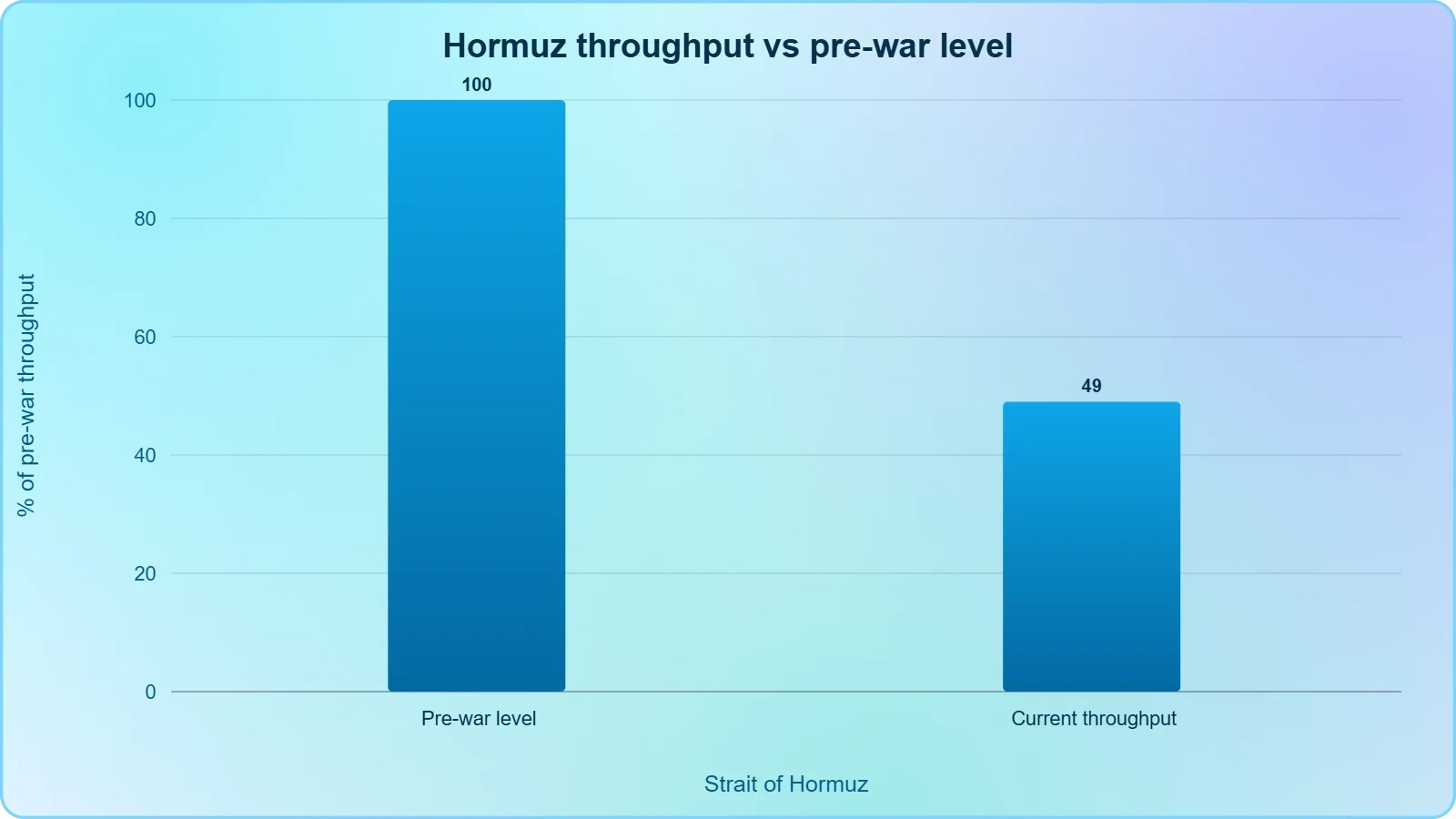
Yet the geopolitical backdrop has not softened. Attacks on US bases in Bahrain and disruptions in the Strait of Hormuz continue to inject uncertainty into a critical export artery, and throughput through that chokepoint reportedly stands at only 49% of pre-war levels.
This analysis examines how traders are pricing that contradiction, why the risk premium has taken a back seat, and what the coming OPEC+ decisions and depleted strategic reserves imply for the months ahead.
TL;DR Oil prices fell modestly as recovering Middle East exports and an anticipated fourth-quarter surplus outweighed lingering fears over tanker attacks and regional conflict. Brent settled at $91.66 and WTI at $84.99, with analysts attributing the decline to supply catching up with demand rather than any easing of geopolitical tension. The risk premium from the US-Iran conflict persists but is currently subordinate to fundamentals. Strait of Hormuz throughput remains at just 49% of pre-war levels, and US strategic reserves have fallen to 276.4 million barrels, the lowest since 1982. OPEC+ meets on November 29 to set 2027 output policy.
The Supply-Demand Rebalancing Behind the Price Decline
The decline in crude benchmarks reflects a market recalibrating around fundamentals rather than capitulating to fear. Tim Waterer, chief analyst at KCM Trade, identified the shift in the supply-demand balance as the principal driver pushing prices lower. When supply begins to catch up with demand, the marginal barrel loses its scarcity premium, and prices adjust accordingly. That adjustment is orderly, not panicked, which itself signals a maturing market response.
Why Recovering Exports Matter More Than Headlines
Middle East export volumes are climbing back toward normalised levels, and that recovery carries more weight in pricing models than episodic security incidents. Every additional cargo that clears a terminal reduces the buffer that traders must hold against disruption. The IEA's Friday assessment formalised what physical traders had already sensed: the fourth quarter will bring surplus, not scarcity, and positioning must reflect that reality.
This does not mean the market is comfortable. Analysts describe flows as picking up while the system remains under stress, with supply chains, inventories, refining capacity and spare production all vulnerable. The surplus is real but fragile, built on routes and logistics that remain exposed to interruption. Prices therefore decline with caution rather than conviction, and volatility stays embedded in the curve.
The IEA Forecast and Its Market Consequences
The IEA's projection of a fourth-quarter surplus represents a meaningful pivot from earlier expectations of persistent tightness. Surplus conditions typically compress the backwardation structure of futures curves, encouraging consumers to defer purchases and producers to protect market share. For refiners, the shift alters margin calculations; for exporters, it sharpens competition for destination market share across Asia and Europe.
Markets digest such forecasts gradually. The modest single-session declines in Brent and WTI suggest traders are accepting the surplus thesis without abandoning risk hedges entirely. The forecast does not eliminate uncertainty; it reorders priorities. Fundamentals now lead, and geopolitics influences the pace of adjustment rather than its direction, which is precisely the hierarchy analysts have described.
Geopolitical Risk and the Strait of Hormuz Constraint
Geopolitical risk has not vanished from oil pricing; it has been demoted. Waterer observed that the risk premium stemming from the US-Iran conflict remains present but is currently taking a back seat to supply fundamentals. That phrasing is precise and revealing. A premium that takes a back seat is dormant, not extinguished, and it can reclaim the driver's position the moment physical flows falter.
Attacks, Chokepoints and the 49% Throughput Reality
The Strait of Hormuz remains the single most consequential chokepoint in global energy logistics, and its current condition is sobering. ANZ analysts noted that throughput stands at only 49% of pre-war levels, meaning roughly half the normal volume must find alternative routes or wait. Attacks on US bases in Bahrain and continued shipping disruptions explain why normalisation has stalled despite recovering export totals.
This partial restoration creates a peculiar market condition. Headline export figures improve, supporting the surplus narrative, yet the underlying logistics network operates far below capacity and under constant threat. Traders must therefore price a market that is simultaneously looser in aggregate and more fragile in structure, a combination that suppresses rallies without eliminating tail risk.
Why Alternative Routes Carry Hidden Costs
ANZ's assessment that current supply flows are unsustainable over the longer term deserves careful attention. More oil must travel alternative routes that are themselves exposed to Iranian disruption or logistics constraints, meaning the redundancy is expensive and imperfect. Pipelines, bypass corridors and rerouted tankers all add cost per barrel and lengthen delivery times, eroding the efficiency gains that normally accompany surplus.
The market's stress is therefore structural rather than cyclical. Inventories, refining capacity and spare production all sit in vulnerable positions, and each additional barrel forced onto a secondary route tightens the system elsewhere. A surplus measured in aggregate barrels can coexist with acute regional scarcity, and that duality explains why prices fall modestly rather than sharply.
We Also Published
OPEC+ Quotas and the 2027 Production Framework
Attention now turns to the institutional machinery that will govern supply beyond the current quarter. An online meeting convened on Monday to review members' maximum sustainable production capacity, a technical exercise with profound commercial consequences. Those capacity assessments will anchor the output quotas that OPEC+ sets for 2027 and beyond, determining how the anticipated surplus is managed rather than merely endured.
The Capacity Review and Its Strategic Purpose
Maximum sustainable capacity is the reference point from which every quota is derived, and disagreements over it have historically triggered friction within the alliance. Reviewing capacity before setting 2027 policy allows the group to align baselines with current geological and infrastructural realities. For members seeking larger quotas, the review is an opportunity; for rivals, it is a negotiation to be watched closely.
The wider OPEC+ group, including allies led by Russia, is due to meet on November 29 to decide 2027 output policy. That gathering will test the coalition's cohesion at a moment when surplus conditions reward discipline and punish cheating. If quotas are set too generously, the surplus deepens and prices weaken further; if too tightly, market share migrates to non-member producers.
Balancing Market Share Against Price Support
Every OPEC+ decision balances two competing objectives: defending price levels and retaining market share. In surplus conditions, the temptation to defend price through restraint collides with the incentive for individual members to exceed quotas quietly. The group's credibility therefore depends on monitoring and compliance mechanisms as much as on the headline production figure itself.
Russia's participation adds another layer of complexity, given its own export logistics and revenue needs. A coalition that includes diverse producers with differing fiscal breakeven points will always struggle to present a unified front. The November 29 meeting will reveal how much discipline the group can muster when the market no longer provides the scarcity that once made cooperation easy.
Strategic Petroleum Reserve Drawdowns and Inventory Stress
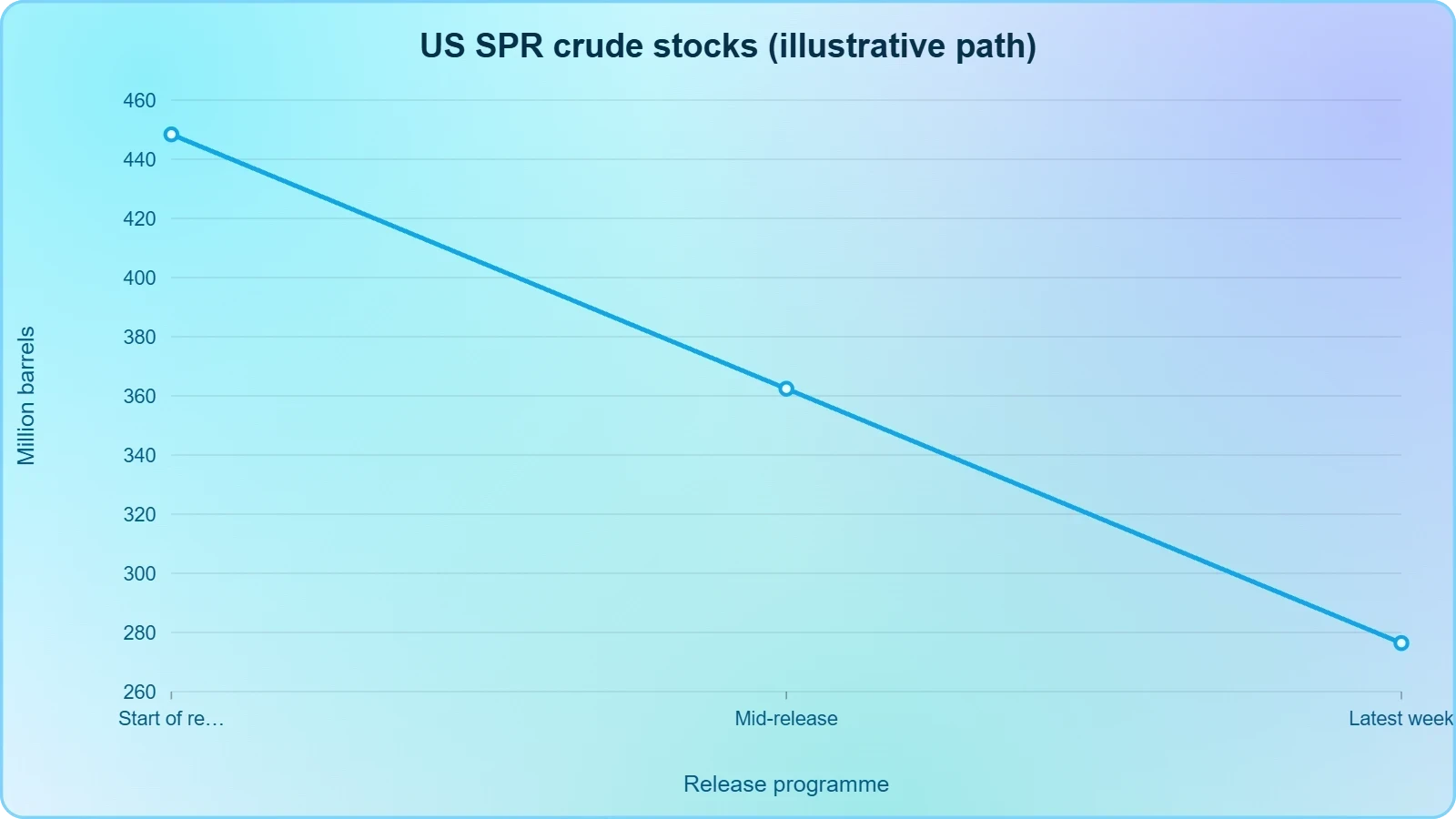
Inventory data adds a further dimension that traders cannot ignore. US crude oil stocks in the Strategic Petroleum Reserve fell to 276.4 million barrels last week, the lowest level since August 1982, according to Department of Energy figures.
These drawdowns form part of a US agreement to release 172 million barrels from the facility, a policy commitment with lasting consequences for the nation's buffer against future shocks.
The Lowest Reserve Level Since 1982
A reserve at its lowest point in more than four decades represents a strategic vulnerability that markets price implicitly. The SPR exists to cushion supply emergencies, and its depletion reduces the government's capacity to intervene during a genuine crisis. Traders understand that a thinner buffer means future disruptions would transmit more directly into spot prices and physical premiums.
The drawdowns also interact with the surplus narrative in subtle ways. Releases add barrels to commercial circulation, reinforcing downward pressure on prices in the near term. Yet once the agreed volume is exhausted, that artificial supply disappears, and the market must rely solely on production and exports. The transition from policy-driven supply to organic supply will be closely watched.
What Depleted Buffers Mean for Volatility
Reduced strategic inventories typically raise the market's sensitivity to shocks. When a buffer is ample, disruptions are absorbed; when it is thin, disruptions are transmitted. The current combination of depleted reserves, constrained Hormuz throughput and stressed refining capacity creates a system with limited absorptive capacity, which argues for elevated volatility even amid surplus conditions.
This is the paradox at the heart of the current market. Prices are falling because supply is recovering, yet the architecture supporting that supply is unusually fragile. Any escalation in the Gulf, any further attack on shipping, or any logistical failure along alternative routes could reverse the decline swiftly. The surplus provides relief, not immunity.
Analyst Perspectives and the Shape of the Forward Curve
Professional commentary converges on a single theme: fundamentals have regained primacy, but the geopolitical premium has been deferred rather than deleted. Waterer's observation that the risk premium is taking a back seat captures the consensus. ANZ's warning that flows are unsustainable over the longer term supplies the counterweight, reminding traders that the current equilibrium rests on improvised logistics.
Reading the Consensus Among Trading Houses
Analysts across trading houses broadly agree that supply is catching up with demand, yet they diverge on durability. Some see the surplus as the beginning of a sustained easing cycle; others view it as a temporary artefact of rerouted barrels and reserve releases. The disagreement matters because it determines whether the forward curve prices persistent softness or a snapback.
Market structure offers clues. When nearby contracts weaken relative to later ones, the curve signals comfort with current supply. When the reverse occurs, it signals anxiety about future availability. The modest declines in both benchmarks suggest traders are leaning toward comfort, but the thinness of the moves indicates limited conviction in either direction.
Scenarios for the Coming Quarters
Three broad scenarios frame the outlook. In the first, exports continue recovering, OPEC+ maintains discipline, and the surplus deepens, pushing prices gradually lower. In the second, a Gulf escalation restores the risk premium abruptly, reversing recent declines. In the third, logistics constraints bind before production does, keeping prices range-bound despite headline surplus.
The probability distribution across these scenarios depends heavily on events that cannot be forecast with precision. What can be said is that the market's tolerance for disruption has narrowed as buffers have thinned. Each scenario carries distinct implications for refiners, hedgers and exporters, and prudent positioning requires acknowledging all three rather than committing to one.
Implications for Consumers, Refiners and Investors
The consequences of this rebalancing extend well beyond trading desks. Lower crude prices ease input costs for refiners and transport operators, though the benefit is unevenly distributed. Consumers may see modest relief at the pump if the decline persists, while producers face tighter margins and must reassess capital spending plans for the coming year.
Downstream Margins and Consumer Pass-Through
Refining economics respond to both crude costs and product demand, and the current environment is ambiguous. Cheaper feedstock helps margins, but surplus conditions can compress product cracks if demand growth lags. The net effect depends on regional dynamics, with Asian refiners likely benefiting more than their European counterparts given differing capacity utilisation.
Pass-through to consumers is rarely immediate or complete. Retail fuel prices adjust with lags, and taxation absorbs a substantial share of the final price in most economies. A decline of less than one percent in benchmark crude translates into marginal savings at the pump, meaningful over months but invisible in any single week's receipts.
Positioning for a Fragile Surplus
Investors holding energy exposure must weigh the surplus thesis against the fragility of the supply architecture. Producers with low breakeven costs are better positioned than high-cost operators, and integrated majors offer more resilience than pure exploration plays. Hedging strategies that lock in current price levels may prove prudent given the asymmetric risks.
The broader lesson is that surplus and vulnerability can coexist. A market can be well supplied in aggregate while remaining acutely exposed to disruption at specific nodes. Portfolios and policies built on the assumption of stable, ample supply should incorporate the possibility that the current calm reflects deferred risk rather than resolved risk.
Conclusion: A Market Repricing Risk Without Resolving It
The session of November 17, 2026, will be remembered less for its modest price declines than for what those declines revealed. Brent at $91.66 and WTI at $84.99 reflect a market that has chosen to prioritise recovering supply over persistent security threats. That choice is rational given the IEA's surplus forecast, yet it is also provisional, contingent on flows continuing to normalise.
What emerges is a portrait of a market managing a fragile equilibrium. Middle East exports are recovering, but Hormuz throughput remains at 49% of pre-war levels. Strategic reserves sit at their lowest since 1982. OPEC+ must decide 2027 quotas on November 29 amid surplus conditions that reward discipline. Each element supports lower prices today while embedding risk for tomorrow.
The professional takeaway is clear. Fundamentals have reclaimed the driver's seat, and the geopolitical premium has been deferred rather than deleted. Traders, refiners and investors should treat the current softness as conditional, recognising that the same vulnerabilities that once pushed prices higher remain intact beneath the surface. A surplus is not a resolution; it is a reprieve.
From our network :
- The Hidden Cost of AI Convenience: Why Over-Permissioned Agents Are a Security Time BombDiscover why AI agents with excessive permissions create dangerous single points of failure, and learn how implementing least privilege principles can protect your organization from exploitation.
- CISA’s Ten-Advisory Wave: Why Generic Patching Fails in OT and How to Build Product-Specific PlaybooksCISA released ten ICS advisories in one week, exposing critical infrastructure risks. Generic patching fails in OT. Learn to build product-specific remediation playbooks.
- Forbidden Matrix Patterns and Visible Lattice Points: A Geometric DictionaryExplore how multidimensional 0–1 matrices encode geometric truths, linking forbidden patterns to visible lattice points and hypergraph theory, with applications in combinatorics and computational geometry.
- The Final Descent: How ESA Retired the Legendary Cluster Constellation After 24 Years of Space Weather ScienceAfter 24 years mapping Earth’s magnetosphere, ESA’s Cluster mission concluded with a precisely controlled reentry over the South Pacific. This analysis explores the scientific legacy, engineering decisions, and debris mitigation principles behind one of space exploration’s most responsible retirements.
- Mobile Learning and VR in English: What Global Evidence Reveals About Effective Language TechnologyA systematic review across 14 countries reveals which language-learning technologies genuinely work. Mobile learning, AI, and VR show measurable benefits when pedagogically integrated. This evidence-based guide helps educators and learners select technology that delivers real return on investment.
- Live Online English Classes for Kids: Do They Actually Reduce Anxiety?A ten-week study reveals that synchronous online English classes can significantly reduce child language anxiety while improving listening and reading skills. Discover what makes these programs effective and how parents can select the right one.
- Committed Mediterranean Precipitation Decline: Why Emissions Cuts Alone Cannot Restore Winter RainsNew NOAA research reveals that Mediterranean winter rains may decline irreversibly even with emissions cuts. Explore the science of committed climate change and regional impacts.
- How AI Agents Will Change the Way We Manage Personal FinancesExplore how AI agents are transforming personal finance through automated budgeting, bill payment, and investment management, while examining the critical security protocols and governance frameworks required for safe deployment.
- University Language Proficiency Exams: Why Institutional Tests Demand Different Preparation Than IELTS and TOEFLDiscover why university-specific language proficiency examinations differ fundamentally from IELTS and TOEFL, and learn strategic preparation approaches for institutional assessment success.
RESOURCES
- Oil Prices Recover as Strait of Hormuz Shipping Risks Persist - WSJwsj.comOct 6, 2026 ... Oil prices fell Tuesday as traders assessed recovering Middle East crude exports ...
- Oil prices settle down 2.5% on signs Middle East exports recoveringfinance.yahoo.comSep 29, 2026 ... Crude oil exports from Middle East producers have rebounded in September to 16.328 million barrels per day, the highest since…
- Oil Prices Lower On G-7 Fuel Release Plan - WSJwsj.comOct 2, 2026 ... Both have been lower through the morning as Middle Eastern export figures appear to be recovering. European gasoil futures, a…
- Oil settles lower as recovering Middle East exports bolster surplus ...reuters.com2 days ago ... Summary. Goldman Sachs expects Brent supply surplus to weigh on prices next year; Six tankers caught fire in Strait of…
- U.S. crude oil declines to $85 a barrel on recovering Middle ... - CNBCcnbc.com1 day ago ... Oil prices are falling as forecasts project a surplus in oil ... U.S. crude oil declines to $85 a barrel…
- Oil Slides as Middle East Exports Recover, Brent Settles at US$102.59riotimesonline.comSep 30, 2026 ... Oil prices fell Tuesday: Brent settled at US$102.59, down 2.6%, and WTI at US$89.38 as Gulf exports hit a war-time…
- Oil prices fall as crude exports recover at Saudi Arabia's Red Sea portscnbc.comSep 28, 2026 ... Satellite imagery has confirmed a "major operational recovery" at Saudi Arabia's Yanbu export terminal, according to Kpler. · Exports from…
- Oil Prices Rise Despite Middle East Export Recovery | OilPrice.comoilprice.comOct 25, 2026 ... Middle Eastern oil exports are recovering, with Hormuz flows reaching 11.7 million bpd in October, approaching pre-war levels despite ...
- Will Oil Prices Decline as Middle East Supply Recovers?goldmansachs.comOct 16, 2026 ... Given the recovery in exports from the Middle East, why is the price of oil still so high? A barrel…
- Oil Prices Fall Below $90 as Trump Signals Reduced Risk of New ...energynow.comNov 9, 2026 ... Global crude surplus: Recovering Middle East exports and increased production elsewhere could place further pressure on prices. Saudi ...
- Oil prices fall as Middle East exports recover and supply surplus loomsrivieraradio.mc1 day ago ... Oil prices fell on Monday, 16 November, as recovering shipments from the Middle East and expectations of a global supply…
- Oil prices retreat as Middle East supply concerns ease amid ...ogj.comSep 21, 2026 ... Oil prices fell on Monday, Sept.21, with Brent extending its retreat from recent highs, as recovering Saudi crude exports and…
- Why oil is still above $US100 despite Middle East exports recoveringcommbank.com.auOct 7, 2026 ... Oil exports from the Middle East have climbed back towards pre-war levels, but tighter supply elsewhere and concerns the recovery…
- It will take 12-18 months for Middle East exports to recover, once the ...icis.comApr 12, 2026 ... “Much bigger than what we had in the 1970s, the oil price shocks. It ... Prices are therefore unlikely to…
- Oil Prices Fall as Saudi Arabia Resumes Red Sea Exportsspragueenergy.comSep 30, 2026 ... Recap: The oil market traded lower on Tuesday on signs of recovering crude exports from the Middle East, with the…
- 01
- 02
- 03
- 04
- 05
- 06
- 07
- 08
0 Comments