Financial markets rarely react to a single headline; they react to the slow accumulation of uncertainty that reshapes how capital is priced across borders. The renewed friction between Washington and Beijing over technology policy belongs to that second category, a structural pressure rather than a passing shock.
Investors watching the November 2026 trading sessions saw familiar symptoms: cautious positioning, defensive rotation, and a quiet repricing of risk in sectors most exposed to cross-border supply chains.
What makes this episode instructive is not the volatility itself but what it reveals about the architecture of global commerce. Semiconductors, advanced computing, and the machinery of artificial intelligence have become instruments of statecraft, and the companies that build them now operate inside a policy environment that changes faster than any quarterly earnings cycle.
On This Page
- The Anatomy of a Market That Feels Unsettled
- From Tariffs to Technology: How the Dispute Evolved
- Transmission Channels: How Tension Reaches Portfolios
- Sector Exposure: Who Feels the Pressure Most
- Policy Responses and the Cost of Decoupling
- What Investors Should Monitor Next
- The Broader Economic Consequences
- Conclusion: Navigating Persistent Uncertainty
Understanding the market's unease requires looking past the index moves and into the mechanics of trade restrictions, capital flows, and corporate contingency planning.
This analysis examines the forces behind the tension, the channels through which it reaches portfolios, and the practical signals investors and executives should monitor. It treats the Reuters market report as a starting point rather than a conclusion, expanding on the structural dynamics that give the headline its weight and outlining how the situation may evolve across technology, trade, and monetary policy.
TL;DR Rising US-China technology tensions have reintroduced uncertainty into global markets, with investors monitoring supply chains, export controls, and capital flows for signs of deeper disruption. The dispute extends beyond tariffs into semiconductors, AI infrastructure, and data governance, making it a structural rather than cyclical risk. Markets are repricing exposure to companies with concentrated cross-border dependencies, while policymakers balance national security against economic cost. The full economic impact remains unresolved, but the direction of travel favors continued volatility, selective decoupling, and a premium on supply-chain resilience across technology-intensive sectors.
The Anatomy of a Market That Feels Unsettled
Market unease is a measurable phenomenon even when it appears intangible. It surfaces in wider credit spreads, elevated volatility indices, reduced liquidity in risk assets, and a preference for defensive sectors over growth narratives. When the Reuters report described markets as unsettled, it captured a mood shaped by months of accumulated policy friction rather than a single event, and that distinction matters for how investors should respond.
Reading the Signals Beneath the Headlines
Volatility indices across major exchanges tend to rise when policy uncertainty compounds earnings uncertainty. Technology stocks, which carry high valuations justified by future cash flows, are especially sensitive to discount-rate shifts and regulatory risk. A modest increase in perceived risk can translate into outsized moves in these names, which is why broad indices often appear calm while sector-level turbulence tells a different story.
Currency and bond markets frequently register tension before equities do. A strengthening dollar against the yuan, widening sovereign spreads, and flows into short-duration government debt all suggest investors are hedging exposure to a prolonged dispute. These signals deserve more attention than daily index movements because they reflect institutional positioning rather than retail sentiment, and institutions move first when policy risk escalates.
Why Technology Sits at the Center
Technology is no longer a sector within the economy; it is the connective tissue of the economy. Advanced chips power logistics, finance, healthcare, and defense, which means restrictions on their trade ripple far beyond semiconductor companies. When governments treat chip design and fabrication as strategic assets, every downstream industry inherits a measure of geopolitical exposure it did not previously carry.
The concentration of leading-edge manufacturing in a handful of firms and geographies amplifies this vulnerability. A single export control decision can redirect billions in capital expenditure and force multinationals to redesign supply chains that took decades to build. That structural fragility explains why markets react sharply to technology policy news even when the immediate economic impact appears limited.
We Also Published
From Tariffs to Technology: How the Dispute Evolved
The US-China dispute began as a trade argument about deficits and tariffs, but it has matured into a contest over technological primacy. Export controls on advanced semiconductors, restrictions on investment in sensitive sectors, and reciprocal measures on critical minerals represent a shift from commercial negotiation to strategic competition. Each round of restrictions narrows the space for compromise and raises the cost of doing business across the Pacific.
The Policy Instruments in Play
Modern economic statecraft relies on a toolkit far broader than tariffs. Entity lists, export licensing regimes, outbound investment screening, and data localization requirements allow governments to target specific technologies and firms with precision. These instruments are harder to negotiate away than tariffs because they are framed as national security measures rather than trade concessions, which makes them durable features of the landscape.
Reciprocal responses compound the complexity. When one side restricts access to chipmaking equipment, the other may limit exports of rare earths or critical minerals used in batteries and electronics. This tit-for-tat dynamic creates a cycle where each measure invites a countermeasure, and the cumulative effect is a gradual thickening of barriers that neither side can easily dismantle.
Alliances and the Broader Geopolitical Frame
The dispute is not bilateral in practice. Allied economies with strong semiconductor industries face pressure to align with one side or the other, and their choices reshape global supply chains. Export control coordination among like-minded governments extends the reach of restrictions well beyond the two principal parties, drawing Europe, Japan, and South Korea into the strategic calculus.
For investors, this means country exposure analysis must now include technology policy alignment. A company headquartered in a neutral jurisdiction may still face restrictions if its products incorporate controlled technology or if its customers fall under licensing requirements. The geography of risk has become more granular, and portfolio construction must reflect that complexity.
Transmission Channels: How Tension Reaches Portfolios
Geopolitical tension reaches financial markets through identifiable channels, and mapping them clarifies which assets are most exposed. Supply-chain disruption, earnings uncertainty, currency volatility, and shifts in risk appetite each transmit policy risk into prices. Investors who understand these channels can distinguish temporary noise from structural repricing and adjust exposure accordingly rather than reacting to every headline.
Supply Chains and Earnings Visibility
Companies with concentrated manufacturing dependencies face the sharpest earnings uncertainty. A firm sourcing advanced components from a single region must either absorb higher costs, relocate production, or accept delivery delays, and each option compresses margins. Analysts respond by widening their estimate ranges, which raises the discount rate applied to future earnings and depresses valuations even before any actual disruption occurs.
Inventory strategies reveal how seriously management teams take the risk. Firms that historically ran lean inventories are now holding buffer stock of critical components, a shift that ties up working capital but reduces exposure to sudden restrictions. This behavior is visible in balance-sheet data and offers a leading indicator of which companies expect prolonged disruption rather than a temporary spat.
Capital Flows and Currency Dynamics
Cross-border investment flows respond quickly to policy signals. When restrictions on outbound investment tighten, venture capital and private equity allocations to affected sectors decline, and the financing environment for early-stage technology firms becomes more constrained. This affects valuations across the innovation ecosystem, from startups to listed incumbents that rely on acquisition pipelines for growth.
Currency markets translate these flows into price movements. A stronger dollar against the yuan reflects both relative interest-rate expectations and demand for safe-haven assets during periods of tension. For multinationals, currency volatility adds a layer of earnings uncertainty on top of operational risk, complicating hedging decisions and making guidance more conservative than underlying demand might justify.
Sector Exposure: Who Feels the Pressure Most
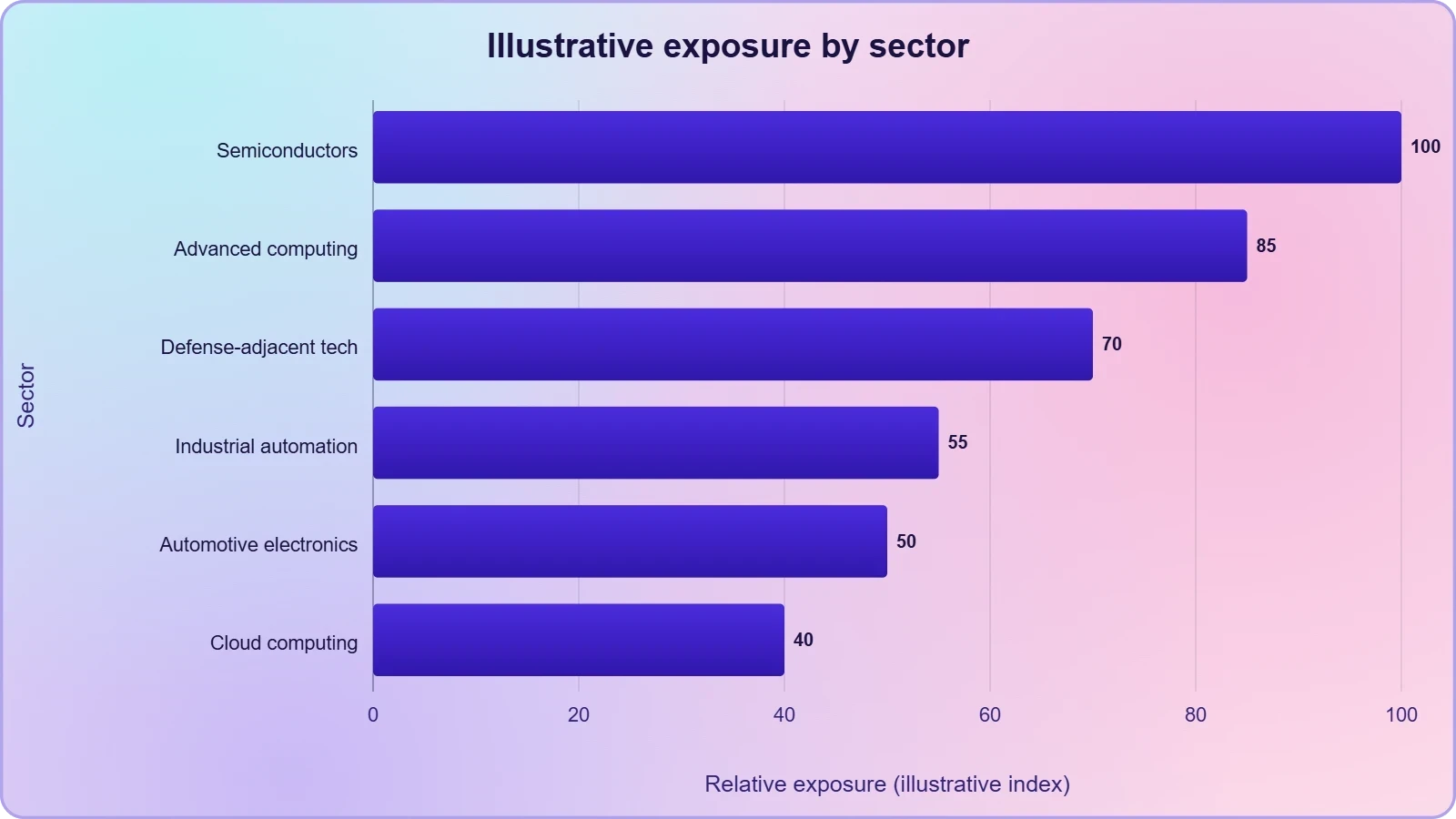
Not all sectors carry equal exposure to technology tension, and the distribution of risk has shifted as the dispute has broadened. Semiconductors sit at the epicenter, but industrial automation, automotive electronics, cloud computing, and defense-adjacent technology all face indirect effects. Mapping exposure by sector helps investors identify where repricing is most likely and where resilience may be undervalued.
Semiconductors and Advanced Computing
Semiconductor firms face the most direct exposure because their products are the explicit target of export controls. Leading-edge fabrication requires equipment from a small number of suppliers, and restrictions on that equipment constrain capacity expansion plans. Companies with diversified geographic footprints and domestic manufacturing incentives are better positioned than those concentrated in a single region.
Advanced computing, including AI accelerators and high-performance processors, faces additional scrutiny because of dual-use concerns. Governments worry that advanced chips could enhance military capabilities, which justifies tighter controls but also creates incentives for domestic alternatives. The long-term effect may be a more fragmented market with higher costs and slower innovation diffusion across borders.
Adjacent Industries and Second-Order Effects
Automotive manufacturers depend on a steady supply of semiconductors for vehicle electronics, and disruptions translate into production delays and inventory imbalances. Industrial automation firms face similar exposure, while cloud providers must navigate data localization requirements that affect infrastructure planning. These second-order effects are often underestimated because they emerge gradually rather than through a single dramatic event.
Defense and aerospace companies occupy a different position, benefiting from increased government spending on domestic technology capabilities while facing supply-chain constraints on specialized components. The net effect varies by firm, which is why sector-level analysis must give way to company-specific assessment when evaluating exposure to the dispute.
Policy Responses and the Cost of Decoupling
Governments on both sides face a difficult trade-off between strategic security and economic efficiency. Restrictions that protect sensitive technology also raise costs for domestic industries and invite retaliation that harms exporters. The result is a gradual, uneven decoupling rather than a clean separation, with policymakers calibrating measures to minimize collateral damage while maintaining strategic pressure.
Industrial Policy and Domestic Investment
Subsidies for domestic semiconductor manufacturing, tax incentives for research and development, and public investment in advanced packaging facilities represent a coordinated effort to reduce dependence on foreign suppliers. These programs are expensive and slow to deliver results, but they signal a long-term commitment that shapes corporate investment decisions and capital allocation across the industry.
The effectiveness of industrial policy depends on execution as much as funding. Building a fabrication facility requires specialized labor, equipment, and supply chains that cannot be created overnight. Countries that invest in workforce development and supplier ecosystems alongside capital projects are more likely to achieve durable capacity, while those focused solely on headline announcements may see limited returns.
Diplomatic Channels and Their Limits
Diplomatic engagement continues even as restrictions tighten, but the scope for compromise is narrow. National security framing limits the concessions available to negotiators, and domestic political pressure discourages any appearance of weakness. The result is a pattern of periodic dialogue without substantive resolution, which markets interpret as persistent uncertainty rather than imminent crisis.
Multilateral institutions offer a venue for managing disputes but lack enforcement power over technology policy. Their role is largely informational, providing data and analysis that inform national decisions. Investors should treat diplomatic signals as indicators of tone rather than predictors of outcomes, since the structural drivers of the dispute remain intact regardless of temporary easing.
What Investors Should Monitor Next
Monitoring the right indicators is more valuable than reacting to every development. Export control announcements, corporate guidance revisions, inventory data, and currency movements each provide information about the trajectory of the dispute. A disciplined framework for tracking these signals helps investors distinguish noise from meaningful shifts in the risk landscape.
Leading Indicators and Early Warnings
Corporate earnings calls often reveal more than official statements. When management teams discuss supply-chain diversification, inventory buffers, or licensing challenges, they are signaling expectations about future restrictions. Aggregating these disclosures across an industry can produce an early warning system that precedes formal policy announcements by several quarters.
Trade data offers another window into the dispute's intensity. Shifts in export volumes for semiconductor equipment, rare earths, and advanced components reveal how restrictions are affecting actual commerce. Persistent declines in specific categories suggest structural decoupling, while temporary dips followed by recovery indicate tactical maneuvering rather than a permanent shift.
Portfolio Construction in a Fragmented World
Diversification now requires attention to policy exposure alongside traditional risk factors. Companies with domestic manufacturing, diversified supplier bases, and limited reliance on controlled technology are better positioned to weather disruption. Investors who incorporate these criteria into portfolio construction may sacrifice some growth potential but gain resilience against policy-driven shocks.
Hedging strategies also deserve reconsideration. Currency hedges, sector rotation, and allocations to defensive assets can offset some exposure, but no strategy eliminates policy risk entirely. The practical approach is to size positions according to conviction about a company's ability to adapt, recognizing that adaptation takes time and that markets often price disruption before it fully materializes.
The Broader Economic Consequences
Beyond portfolio effects, the dispute carries consequences for global growth, inflation, and the structure of international commerce. Higher costs for technology inputs feed into producer prices, while reduced trade flows slow productivity gains from specialization. These effects accumulate gradually, but their direction is clear and their magnitude depends on how far decoupling proceeds.
- 01
- 02
- 03
- 04
Growth, Inflation, and Productivity
Fragmented supply chains raise costs because they sacrifice economies of scale and require duplicate capacity. The inflationary effect is modest in any single year but compounds over time, complicating central bank efforts to manage price stability. Productivity growth also suffers as resources shift from efficient production to strategic redundancy, a trade-off policymakers accept for security reasons.
The growth impact is uneven across economies. Countries deeply integrated into technology supply chains face larger adjustments, while those with domestic alternatives or diversified trade relationships experience milder effects. Emerging markets that positioned themselves as neutral manufacturing hubs may benefit from relocation of production, though capturing that opportunity requires investment in infrastructure and skills.
The Shape of Global Commerce Ahead
The likely trajectory is neither complete decoupling nor a return to previous integration. Instead, expect a patchwork of restrictions, exceptions, and regional arrangements that vary by technology and by relationship. Companies will operate in a world where compliance is complex, supply chains are redundant, and strategic considerations influence commercial decisions more than at any point in recent decades.
This environment rewards firms that invest in visibility across their supply networks and maintain flexibility to shift sourcing when policy changes. It also favors investors who analyze policy risk as a first-order factor rather than a tail event. The market unease described in the Reuters report is a rational response to this new reality, not a temporary lapse in confidence.
Conclusion: Navigating Persistent Uncertainty
The market unease captured in the Reuters report reflects a rational assessment of a dispute that has become structural rather than episodic. Technology policy now shapes capital allocation, supply-chain design, and corporate strategy in ways that will persist regardless of temporary diplomatic easing. Investors who treat this as a passing phase risk mispricing the assets most exposed to policy risk.
The practical response is disciplined monitoring and deliberate diversification. Understanding transmission channels, tracking leading indicators, and assessing company-level exposure provide a more reliable foundation than reacting to headlines. In a world where technology and geopolitics are inseparable, the premium on analytical rigor has rarely been higher, and the cost of ignoring policy risk has rarely been clearer.
From our network :
- CISA’s Ten-Advisory Wave: Why Generic Patching Fails in OT and How to Build Product-Specific PlaybooksCISA released ten ICS advisories in one week, exposing critical infrastructure risks. Generic patching fails in OT. Learn to build product-specific remediation playbooks.
- Committed Mediterranean Precipitation Decline: Why Emissions Cuts Alone Cannot Restore Winter RainsNew NOAA research reveals that Mediterranean winter rains may decline irreversibly even with emissions cuts. Explore the science of committed climate change and regional impacts.
- Live Online English Classes for Kids: Do They Actually Reduce Anxiety?A ten-week study reveals that synchronous online English classes can significantly reduce child language anxiety while improving listening and reading skills. Discover what makes these programs effective and how parents can select the right one.
- Forbidden Matrix Patterns and Visible Lattice Points: A Geometric DictionaryExplore how multidimensional 0–1 matrices encode geometric truths, linking forbidden patterns to visible lattice points and hypergraph theory, with applications in combinatorics and computational geometry.
- The Final Descent: How ESA Retired the Legendary Cluster Constellation After 24 Years of Space Weather ScienceAfter 24 years mapping Earth’s magnetosphere, ESA’s Cluster mission concluded with a precisely controlled reentry over the South Pacific. This analysis explores the scientific legacy, engineering decisions, and debris mitigation principles behind one of space exploration’s most responsible retirements.
- Mobile Learning and VR in English: What Global Evidence Reveals About Effective Language TechnologyA systematic review across 14 countries reveals which language-learning technologies genuinely work. Mobile learning, AI, and VR show measurable benefits when pedagogically integrated. This evidence-based guide helps educators and learners select technology that delivers real return on investment.
- The Hidden Cost of AI Convenience: Why Over-Permissioned Agents Are a Security Time BombDiscover why AI agents with excessive permissions create dangerous single points of failure, and learn how implementing least privilege principles can protect your organization from exploitation.
- University Language Proficiency Exams: Why Institutional Tests Demand Different Preparation Than IELTS and TOEFLDiscover why university-specific language proficiency examinations differ fundamentally from IELTS and TOEFL, and learn strategic preparation approaches for institutional assessment success.
- How AI Agents Will Change the Way We Manage Personal FinancesExplore how AI agents are transforming personal finance through automated budgeting, bill payment, and investment management, while examining the critical security protocols and governance frameworks required for safe deployment.
RESOURCES
- Global maritime trade suffers as US-China trade tensions ... - UNCTADunctad.orgOct 30, 2019 ... ... market uncertainty and short-term cyclical factors,” said Shamika N. Sirimanne, director of UNCTAD's division on technology and logistics.
- A comprehensive study of geopolitical and equity market uncertainty ...sciencedirect.comFocuses on the semiconductor sector amid U.S.–China tech tensions. •. Shows U.S. markets react faster to geopolitical risk than Asian markets. •. Confirms ...
- Trade policy uncertainty looms over global markets - UNCTADunctad.orgSep 1, 2025 ... ... uncertainty mostly limited to episodes like Brexit, COVID-19 or US–China trade tensions. But in 2025, with weakened rules and…
- The U.S.-China Trade Relationship: What's Behind the Competition?cfr.orgMay 15, 2026 ... The United States and China, the world's two biggest economies, are facing considerable trade tensions, with implications for the global…
- World Economic Outlook Update, July 2019: Still Sluggish Global ...imf.orgJul 18, 2019 ... Against a difficult backdrop that included intensified US-China trade and technology tensions as well as prolonged uncertainty on Brexit ...
- Is There a Connection Between the Sino-US Tensions and Global ...erl.scholasticahq.comNov 21, 2025 ... While the political and economic dimensions of this rivalry have been extensively studied, its implications for global energy market uncertainty ...
- Sluggish Global Growth Calls for Supportive Policiesimf.orgJul 23, 2019 ... Dynamism in the global economy is being weighed down by prolonged policy uncertainty as trade tensions remain heightened despite the…
- The Future of Taiwan in U.S.-China Technology Competitiondigichina.stanford.eduApr 6, 2021 ... ... U.S.–China technology tensions. ... TSMC alone dominates the manufacturing phase, capturing over half of the global foundry market.
- The rise of techno-geopolitical uncertainty: Implications of the United ...pmc.ncbi.nlm.nih.gov... technology MNEs gravely facing geopolitical tensions, particularly between the US and China. ... market shares from both the US and China (market ...
- US-China Trade Tensions and Clean Energy Investment in Third ...energypolicy.columbia.eduOct 30, 2025 ... “China Briefing 24 July 2025: EU-China Climate Statement; World's Largest Megadam; Clean-Tech Exports.” Carbon Brief, July 24, 2025. https ...
- Technology trade under uncertainty: sectoral heterogeneity across ...link.springer.comOct 6, 2026 ... The COVID-19 pandemic, escalating US-China trade tensions, armed conflicts in the Middle East and Ukraine, and the rising complexity of…
- Why trade tensions are a 'storm cloud' over financial marketsweforum.orgApr 17, 2025 ... US tariffs have upended international trade and caused volatility in global markets. The uncertainty, experts say, holds significant ...
- Private bank CIOs shift strategies as market uncertainty growspwmnet.comMar 18, 2025 ... ... tensions and economic uncertainty unsettle global markets. After two years of strong gains, driven by US mega-cap tech stocks,…
- Trump's US-China Trade War: Economic Strategy or Strategic Risk?behorizon.orgFeb 14, 2025 ... The conflict threatens to accelerate economic decoupling and reshape the global trading system, introducing long-term uncertainty. Retaliation ...
- Clean energy and the fragile supply chain: lessons from U.S.-China ...frontiersin.orgNov 6, 2025 ... ... China trade tensions (UCT), and economic policy ... Closest predecessors include work linking uncertainty and energy/clean-tech markets ...
- 01
- 02
- 03
- 04
- 05
- 06
- 07
- 08
0 Comments