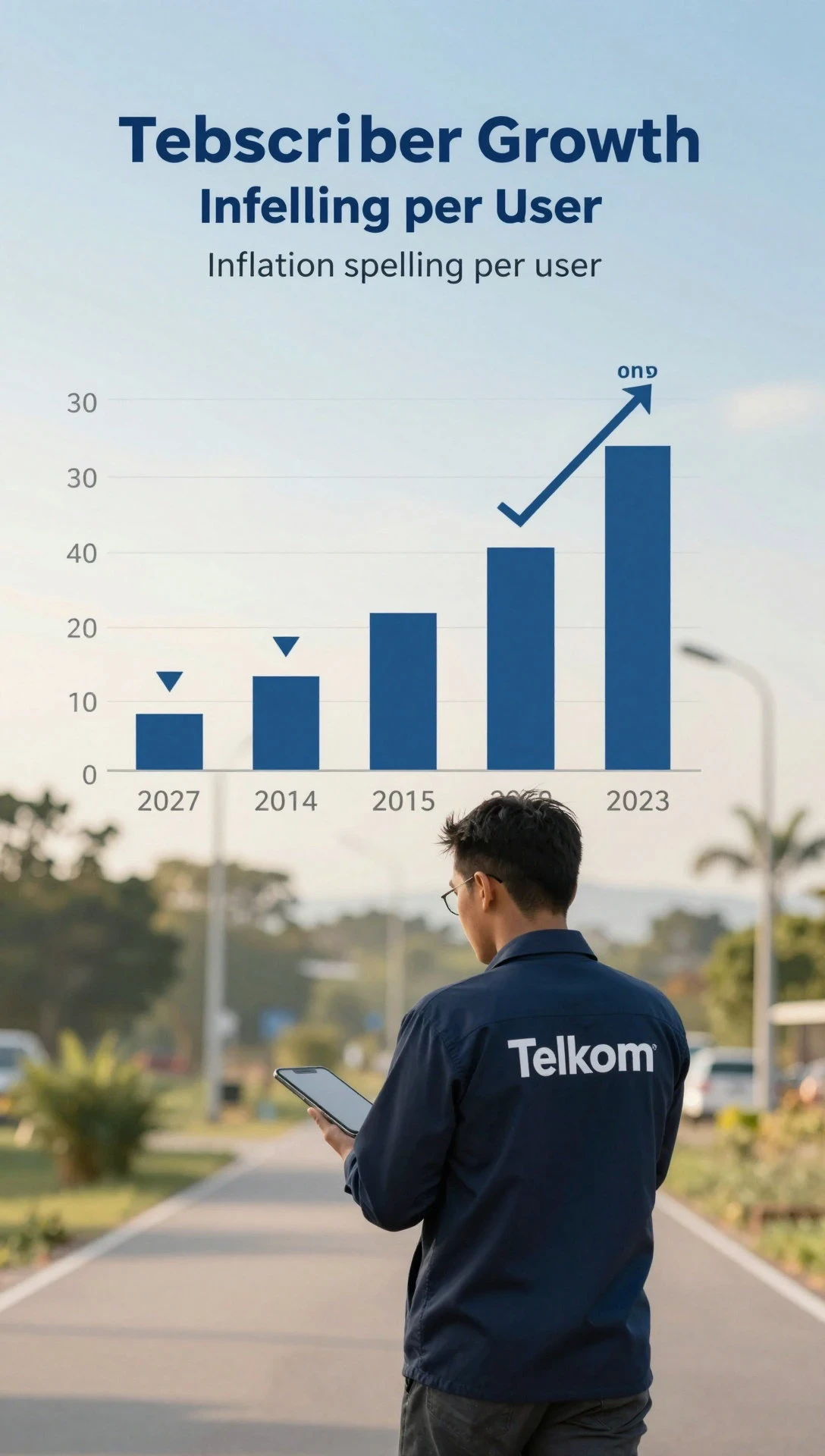
Telkom's latest subscriber figures present a paradox that defines modern telecommunications economics: the operator added almost two million new connections while simultaneously watching revenue per user erode under the weight of persistent inflation. Growth in headline customer numbers rarely tells the full story, and this case is no exception. The gap between acquiring subscribers and monetising them has become the central tension for carriers operating in price-sensitive emerging markets.
What makes the Telkom disclosure instructive is how cleanly it isolates two opposing forces. On one side sits volume expansion, the traditional metric boards celebrate and analysts reward. On the other sits wallet compression, where households squeezed by rising food, fuel and electricity costs trim discretionary telecom spending first. When both forces appear in the same quarterly narrative, investors must decide which signal carries more weight for long-term cash generation.
This analysis unpacks the mechanics behind subscriber growth without spending growth, examines how inflation transmits through telecom revenue lines, and situates Telkom's position within South Africa's broader connectivity market. It also considers what management can realistically do when demand for data keeps rising but the ability to pay for it does not keep pace.
On This Page
TL;DR Telkom added nearly two million subscribers, yet average spending per customer declined as inflation compressed household budgets. The divergence illustrates a structural challenge across telecom markets: subscriber acquisition is cheap relative to monetisation, and when real incomes fall, usage growth does not automatically convert into revenue growth. Operators must defend margins through pricing architecture, cost discipline and higher-value service bundles rather than relying on connection counts alone.
The Subscriber Growth Paradox in Telecom Economics
Telecom operators have long treated subscriber additions as the headline proof of commercial health. Networks scale, market share shifts, and regulators take notice when connection counts climb. Yet connection counts measure reach, not value. A subscriber who joins a network but spends progressively less each month can dilute margins even as the customer base expands, creating a growth illusion that flatters quarterly presentations.
Why Volume and Value Diverge
The divergence between volume and value stems from how telecom demand behaves under economic stress. Connectivity has become essential, so consumers rarely cancel outright. Instead they downgrade: smaller data bundles, deferred upgrades, prepaid top-ups stretched further, and fixed-line or fibre subscriptions renegotiated or shared across households. Each decision preserves the connection while shrinking the revenue attached to it.
Telkom's nearly two million additions likely reflect a mix of prepaid uptake, promotional pricing and possibly market share gains from competitors. But the accompanying decline in spending per user suggests the new cohort skews toward lower-ARPU segments, while existing customers simultaneously economise. Both effects compound, producing subscriber growth that arrives with a revenue headwind rather than a tailwind.
The ARPU Signal Investors Should Watch
Average revenue per user, or ARPU, is the metric that translates subscriber counts into economic reality. A rising subscriber base paired with falling ARPU means the incremental customer is worth less than the average existing one. Over time, this arithmetic drags blended ARPU downward and forces operators to run faster simply to stand still on revenue.
Analysts typically decompose ARPU into usage volume and effective price per unit. When inflation raises operating costs but competitive pressure and consumer fragility prevent price increases, the effective price per megabyte falls. Telkom's situation mirrors this pattern: more people connected, more data consumed in aggregate, but less money collected per connection each month.
We Also Published
How Inflation Transmits Through Telecom Revenue
Inflation reaches telecom operators through two distinct channels, and Telkom's disclosure touches both. The first is consumer-side: when food, transport and energy absorb a larger share of household income, telecom spending becomes a variable cost that families actively manage downward. The second is operator-side: network energy, spectrum fees, equipment and labour all cost more, compressing margins from the expense line.
The Consumer Wallet Squeeze
South African households have faced sustained pressure from electricity tariffs, fuel prices and food inflation. Telecom services sit in a discretionary-adjacent category: essential enough to retain, flexible enough to reduce. Consumers respond by migrating from postpaid to prepaid, buying smaller bundles, using Wi-Fi offload more aggressively, and delaying device upgrades that historically anchored higher-value contracts.
This behaviour explains why subscriber counts can rise while spending falls. New connections may come from price-sensitive segments entering the market through low-cost prepaid offers, while existing customers trade down. The net effect is a customer base that is broader but shallower, generating less revenue per head than the operator's cost structure was designed to support.
Cost Inflation on the Operator Side
Simultaneously, Telkom faces its own inflation problem. Network operations are energy-intensive, and electricity price increases in South Africa have consistently outpaced headline inflation. Battery backup, generator fuel and infrastructure maintenance add further cost. Wage settlements, spectrum obligations and technology refresh cycles compound the pressure, leaving little room to absorb ARPU declines without margin damage.
The arithmetic is unforgiving. If revenue per user falls while cost per user holds steady or rises, operating leverage works in reverse. Each additional subscriber then contributes less incremental margin than the last, and the growth story becomes a profitability question rather than a scale story. Management must therefore pursue efficiency with the same urgency as acquisition.
Telkom's Position in South Africa's Connectivity Market
Telkom occupies a distinctive position in South African telecommunications. It carries a legacy fixed-line heritage, a substantial mobile operation, and a wholesale fibre and infrastructure business that supplies other operators. This mix means its fortunes are tied not only to consumer mobile spending but also to enterprise connectivity, wholesale agreements and the pace of fixed-mobile substitution across the economy.
Competitive Dynamics and Market Share
The South African mobile market is dominated by larger players with deeper capital reserves and broader retail footprints. Telkom's growth strategy has leaned on value pricing, data-led propositions and wholesale access arrangements. Adding nearly two million subscribers signals that this approach resonates with cost-conscious consumers, particularly in prepaid segments where price sensitivity is highest.
However, value-led acquisition carries an inherent ARPU penalty. Customers attracted by aggressive pricing are, by definition, more price-sensitive and quicker to trade down when budgets tighten. Competitors face the same inflation, but those with stronger premium and enterprise mixes may absorb consumer weakness more comfortably. Telkom's challenge is to convert volume into stickiness.
Fixed, Mobile and Wholesale Interplay
Telkom's wholesale and fibre assets provide a partial hedge against consumer mobile weakness. Enterprise connectivity contracts, backhaul agreements and open-access fibre arrangements generate revenue less exposed to household wallet pressure. If consumer ARPU declines, wholesale growth can offset some of the damage, provided the infrastructure business maintains utilisation and pricing discipline.
The strategic question is capital allocation. Every rand invested in consumer acquisition must compete with investment in fibre reach, enterprise solutions and network quality. When subscriber growth arrives without commensurate revenue, the case for shifting emphasis toward higher-value segments strengthens. Telkom's portfolio breadth gives it options that pure mobile operators lack.
- 01
- 02
- 03
- 04
Strategic Responses to Shrinking Spend per User
Operators cannot reverse household inflation, but they can influence how much of a constrained wallet they capture. The strategic playbook centres on pricing architecture, bundle design, retention economics and cost transformation. Telkom's response will determine whether the two million new subscribers become a durable revenue base or a churn-prone statistic that inflates headline numbers without strengthening the business.
Pricing Architecture and Bundle Design
Effective pricing architecture segments customers by willingness to pay rather than by legacy product lines. Smaller, frequent top-ups suit cash-constrained prepaid users, while converged bundles bundling mobile, data and fixed services raise switching costs for households that can still afford them. The goal is to meet customers where their budgets are without abandoning value capture entirely.
Bundle design also shapes perceived value. When a customer receives more data, entertainment or device financing within a fixed monthly outlay, the effective price per unit falls while the headline price holds. This preserves revenue optics and reduces churn, though it requires careful cost management to avoid margin erosion. Telkom's content and device partnerships become relevant levers here.
Retention, Churn and Cost Discipline
Acquisition costs are incurred once; retention economics compound over years. If inflation-driven downgrades accelerate churn, the cost of replacing departed customers rises precisely when revenue per customer is weakest. Retention programmes that offer targeted discounts, loyalty benefits or flexible payment terms can protect lifetime value more efficiently than broad price cuts.
Cost discipline completes the response. Network sharing, energy efficiency, digital customer service and automation of routine processes all reduce cost per subscriber. When ARPU falls, the operator that lowers its cost-to-serve fastest preserves margin. Telkom's legacy cost base makes this both harder and more urgent than for leaner competitors.
Reading the Numbers: What Analysts Should Track
Headline subscriber counts invite simplistic conclusions. A more rigorous reading requires decomposing the base by segment, tracking ARPU by product line, and monitoring the relationship between data consumption growth and revenue growth. Telkom's disclosure, while brief, points to exactly this analytical discipline: the company is growing connections while its customers grow more frugal.
Decomposing ARPU and Usage Trends
Analysts should separate ARPU movements into volume, price and mix effects. If usage per subscriber rises while revenue per subscriber falls, the effective price per unit is collapsing, which signals competitive intensity or deliberate promotional strategy. If usage itself falls, the issue is demand weakness. Each diagnosis implies a different management response and a different valuation implication.
Mix effects matter equally. A shift toward prepaid and lower-tier plans lowers blended ARPU mechanically, even if pricing within each tier holds. Telkom's nearly two million additions likely carry this mix signature. Investors should ask how much of the ARPU decline is compositional versus behavioural, because the two have very different persistence profiles.
Valuation Implications and Investor Signals
Telecom valuations rest on cash flow durability, and cash flow depends on the spread between revenue per user and cost per user. When that spread narrows, multiples compress regardless of subscriber momentum. Telkom's shares will therefore respond more to ARPU stabilisation and margin guidance than to connection counts, a pattern visible across emerging-market carriers facing similar pressures.
The forward-looking signal to watch is whether management guides toward ARPU recovery through mix improvement or accepts lower ARPU as the price of scale. The first path requires premium and enterprise traction; the second demands relentless cost efficiency. Clarity on this strategic choice, more than the subscriber headline, will determine how the market prices Telkom's growth.
The Wider Lesson for Emerging-Market Telecoms
Telkom's experience is not unique to South Africa. Across emerging markets, operators are discovering that subscriber growth and revenue growth have decoupled. Inflation, currency pressure and constrained household budgets mean connectivity demand rises while the ability to pay for it stagnates. The companies that navigate this environment successfully will be those that treat monetisation, not acquisition, as the primary strategic problem.
Comparisons Across Emerging Markets
Similar patterns appear in markets from Nigeria to Indonesia, where prepaid-heavy bases and inflation-sensitive consumers produce the same divergence. Operators respond with micro-bundles, agent networks and digital top-ups that match irregular cash flows. The common thread is adaptation to affordability: revenue follows the customer's wallet rhythm, not the operator's billing cycle.
Regulators also shape outcomes. Spectrum pricing, universal service obligations and wholesale access rules influence cost structures and competitive intensity. In markets where regulators prioritise affordability, operators face sharper ARPU pressure but broader adoption. Telkom's environment reflects this tension between social connectivity goals and commercial sustainability.
Long-Term Outlook and Structural Shifts
Over the longer horizon, structural shifts may ease the pressure. Fixed-wireless access, fibre expansion and enterprise digitalisation create higher-value revenue pools. As economies recover and real incomes stabilise, deferred upgrades and suppressed spending may reverse, releasing pent-up demand. The operators positioned with quality networks and diversified portfolios will capture that recovery most effectively.
For now, the discipline is clear. Subscriber growth without spending growth is a warning, not a triumph. Telkom's nearly two million additions demonstrate market relevance; the accompanying decline in customer spending demonstrates economic reality. Reconciling the two through pricing intelligence, cost transformation and portfolio balance is the work that will define the next phase of its story.
From our network :
- Mobile Learning and VR in English: What Global Evidence Reveals About Effective Language TechnologyA systematic review across 14 countries reveals which language-learning technologies genuinely work. Mobile learning, AI, and VR show measurable benefits when pedagogically integrated. This evidence-based guide helps educators and learners select technology that delivers real return on investment.
- Forbidden Matrix Patterns and Visible Lattice Points: A Geometric DictionaryExplore how multidimensional 0–1 matrices encode geometric truths, linking forbidden patterns to visible lattice points and hypergraph theory, with applications in combinatorics and computational geometry.
- The Final Descent: How ESA Retired the Legendary Cluster Constellation After 24 Years of Space Weather ScienceAfter 24 years mapping Earth’s magnetosphere, ESA’s Cluster mission concluded with a precisely controlled reentry over the South Pacific. This analysis explores the scientific legacy, engineering decisions, and debris mitigation principles behind one of space exploration’s most responsible retirements.
- CISA’s Ten-Advisory Wave: Why Generic Patching Fails in OT and How to Build Product-Specific PlaybooksCISA released ten ICS advisories in one week, exposing critical infrastructure risks. Generic patching fails in OT. Learn to build product-specific remediation playbooks.
- Committed Mediterranean Precipitation Decline: Why Emissions Cuts Alone Cannot Restore Winter RainsNew NOAA research reveals that Mediterranean winter rains may decline irreversibly even with emissions cuts. Explore the science of committed climate change and regional impacts.
- How AI Agents Will Change the Way We Manage Personal FinancesExplore how AI agents are transforming personal finance through automated budgeting, bill payment, and investment management, while examining the critical security protocols and governance frameworks required for safe deployment.
- University Language Proficiency Exams: Why Institutional Tests Demand Different Preparation Than IELTS and TOEFLDiscover why university-specific language proficiency examinations differ fundamentally from IELTS and TOEFL, and learn strategic preparation approaches for institutional assessment success.
- Live Online English Classes for Kids: Do They Actually Reduce Anxiety?A ten-week study reveals that synchronous online English classes can significantly reduce child language anxiety while improving listening and reading skills. Discover what makes these programs effective and how parents can select the right one.
- The Hidden Cost of AI Convenience: Why Over-Permissioned Agents Are a Security Time BombDiscover why AI agents with excessive permissions create dangerous single points of failure, and learn how implementing least privilege principles can protect your organization from exploitation.
RESOURCES
- Telkom picks up almost 2m subscribers – but users spending less as ...news24.com7 hours ago ... ... subscribers – but users spending less as inflation bites. 4h ... Telkom has reported accelerating subscriber growth, but revenue…
- Integrated Report - Telkom Groupgroup.telkom.co.zaJul 15, 2026 ... revenue growth. In our fixed connectivity business, fibre revenue increased by 10.3%, supported by 8.7% subscriber growth and ARPU expansion.
- GCFO's report on financial performance - Telkom Integrated Reporttelkom-reports.co.zaMobile data revenue rose by 10.5%, supported by strong subscriber growth. ... inflation that may pressure consumer spending and increase our diesel costs.
- Telkom Group Annual Results FY2025group.telkom.co.zaJun 9, 2025 ... users, primarily driven by strong growth in pre-paid subscriptions. ... by the optimisation of mobile roaming costs driven by lower…
- Highlights - Telkom Indonesiatelkom.co.idMar 31, 2025 ... Nonetheless, IndiHome B2C revenue still grew 1.3% YoY, with net customer additions of approximately 230K subscribers in 1Q25. *) By…
- securities and exchange commission - SEC.govsec.govTo support sustainable business growth, Telkom has continued to strengthen its ... This is demonstrated by the impressive growth of IndiHome's B2C customer ...
- Highlights - Telkom Indonesiatelkom.co.idengaged in Data service as shown by the number of Data user, Data payload and payload per Data user. ... customer needs and long-term…
- Efficiency analysis of telecommunications companies in Southeast ...journal.uii.ac.idWhereas the output variables (w) were revenue, number of subscribers and. ARPU (Average Revenue Per User). ... growth of inflation variables and the value ...
- Telecomsmaalot.co.ilJan 19, 2026 ... revenue growth offset by higher churn and slowing subscriber growth; we expect industry ... A decline in inflation may increase…
- Telecom company says revenue, EBITDA and net profit all grew in ...facebook.comOct 21, 2026 ... Telkom's stronger cash generation helped lift free ... increase in mobile subscriptions rather than higher average revenue per user (ARPU).
- External themes shaping our strategy - Telkom Integrated Reporttelkom-reports.co.zaHowever, underlying pressures on food, electricity and fuel prices may affect inflation. Stronger growth would require improved government spending and fixed ...
- Sub-Saharan Africa faces slower growth as US-Iran war raises costsreuters.comApr 8, 2026 ... "You shouldn't take this to mean that, in fact, West Africa is probably going to be okay when it comes…
- Telkom SA earnings grow as mobile users reach 23Mconnectingafrica.comJun 10, 2025 ... 78 billion ($160 million) this year from R424 million ($24 million) last year, driven by cost-optimization initiatives and revenue growth.
- Link Telkom Price Increase - Wits Universitywits.ac.za... growth was generated by the increase in mobile subscribers. ... of estimates of probable inflation in the operator's costs (often measured by the…
- 01
- 02
- 03
- 04
- 05
- 06
- 07
- 08
0 Comments