
When a single news cycle can erase roughly $430 billion from the world's most valuable company, the market is not merely repricing earnings — it is repricing trust. Nvidia, the semiconductor giant whose graphics processors became the indispensable engine of the artificial intelligence boom, found itself at the centre of a governance storm after reports surfaced alleging that its chief executive, Jensen Huang, had a personal relationship with a woman identified as Alice Huang, whom United States officials reportedly believe may have been engaged in espionage on behalf of Beijing. The allegation, still unproven and firmly denied by Chinese authorities, moved from tabloid intrigue to boardroom crisis within days, and the company's share price responded with the kind of violence usually reserved for missed guidance or regulatory shock.
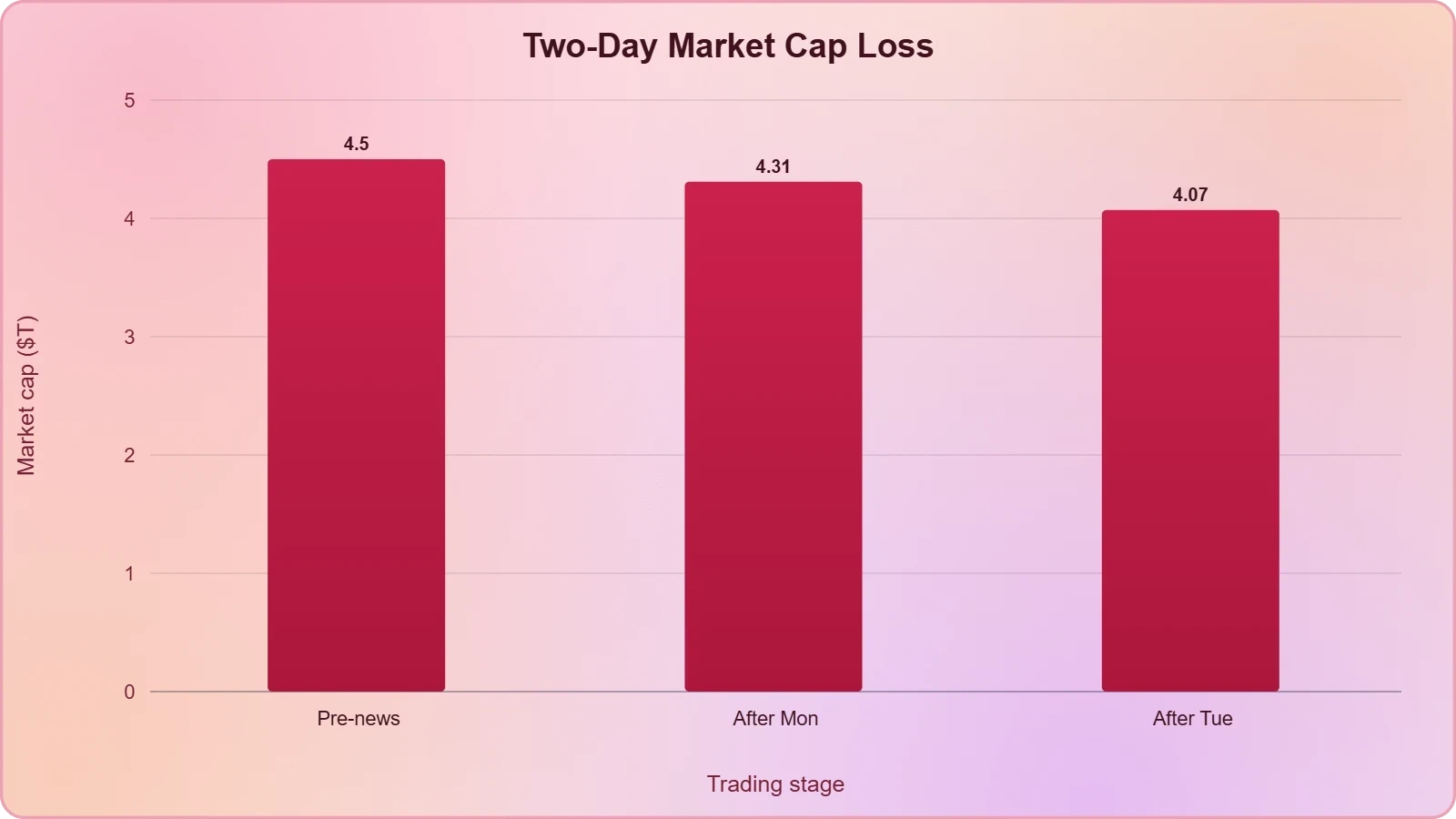
The numbers tell a story of their own. Nvidia shares fell 4.27% on Monday and a further 5.5% on Tuesday, dragging the company's market capitalisation from approximately $4.50 trillion to around $4.07 trillion. That is a paper loss of about $430 billion in a matter of sessions — a figure larger than the annual gross domestic product of many mid-sized nations. What makes the episode analytically interesting is that no product was recalled, no revenue warning was issued, and no regulator filed a charge. The sell-off was driven almost entirely by uncertainty about leadership integrity, national security exposure, and the adequacy of internal controls at a company whose chips sit at the heart of the geopolitical contest between Washington and Beijing.
Nvidia's board responded by retaining Wachtell, Lipton, Rosen & Katz, one of the most formidable corporate law firms in the United States, to conduct what it described as a thorough and independent investigation into the circumstances of the relationship. The choice of counsel is itself a signal. Wachtell is the firm corporations call when the stakes are existential rather than routine, and its 2022 engagement by Twitter to compel Elon Musk to complete his $44 billion takeover remains a benchmark for high-stakes corporate combat. This analysis examines the financial mechanics of the drawdown, the governance questions the board must answer, the geopolitical backdrop of semiconductor espionage, and what the episode reveals about how markets price reputational and security risk in the AI era.
On This Page
TL;DR Nvidia lost approximately $430 billion in market value across two trading sessions after reports alleged that chief executive Jensen Huang had a relationship with a woman US officials suspect of Chinese espionage. Shares fell 4.27% on Monday and 5.5% on Tuesday, cutting the company's valuation from about $4.50 trillion to roughly $4.07 trillion. The board has retained Wachtell, Lipton, Rosen & Katz for an independent investigation, while Beijing denies running an espionage operation. The episode demonstrates how quickly markets now reprice governance, national security, and leadership-integrity risk at systemically important technology firms, even absent any operational or financial deterioration.
The Anatomy of a $430 Billion Drawdown
Market capitalisation is an accounting identity — share price multiplied by shares outstanding — but the movement of that identity over forty-eight hours reflects something closer to a collective psychological repricing. Nvidia entered the episode valued at roughly $4.50 trillion, a figure that already embedded extraordinary expectations about AI infrastructure spending, data centre demand, and the company's near-monopoly position in accelerated computing. When the espionage reports broke, investors did not revise their models for chip shipments or gross margins. They revised their assessment of tail risk, and at a valuation of four and a half trillion dollars, even a modest increase in perceived tail risk translates into hundreds of billions of dollars of destroyed equity value.
The two-day sequence is instructive. Monday's 4.27% decline represented the initial shock — the market digesting a headline that was serious but unverified. Tuesday's 5.5% fall, larger than the first, indicated that the story had survived the overnight news cycle and had been corroborated in sufficiently credible outlets to warrant genuine institutional repositioning. When the second day of selling is heavier than the first, it typically signals that long-only funds, not just momentum traders, are reducing exposure. That distinction matters enormously for how the drawdown should be interpreted and for how quickly the stock might recover once clarity emerges.
Why the Second Day Mattered More
In event-driven equity analysis, the persistence of a shock beyond the first session is the critical diagnostic. A single-day drop can be attributed to algorithmic reaction, stop-loss cascades, or headline-driven volatility. A second, deeper decline implies that fundamental holders have begun to reassess. Nvidia's Tuesday fall of 5.5% — larger than Monday's 4.27% — suggests that institutional investors used the overnight period to consult counsel, review compliance exposure, and reduce position sizes before the story developed further. That behaviour is rational rather than panicked, and it explains why the aggregate loss reached the $430 billion mark so swiftly.
There is also a mechanical dimension worth noting. Nvidia's extraordinary market capitalisation means that even small percentage moves generate enormous absolute numbers. A 1% decline at a $4.5 trillion valuation destroys $45 billion of shareholder wealth — roughly the entire market value of a large-cap industrial company. This arithmetic amplifies the psychological impact of headlines and makes Nvidia uniquely sensitive to reputational shocks. The same leverage that made the company's rise spectacular makes its drawdowns spectacular, and investors who hold the stock must accept that governance events will be priced in billions rather than millions.
The Difference Between Price and Value
It is essential to distinguish between the market's estimate of Nvidia's worth and the underlying cash-generating capacity of the business. Nothing in the espionage reports suggests that demand for Nvidia's accelerators has fallen, that its manufacturing relationships have been disrupted, or that its intellectual property has been compromised in a manner disclosed to investors. The drawdown is therefore a repricing of risk premium rather than a revision of intrinsic value. Historically, such dislocations have created opportunities for long-horizon investors, provided the governance questions are resolved credibly and the leadership remains intact.
Yet the distinction cuts both ways. If the investigation ultimately reveals lapses in executive vetting, security protocols, or disclosure practices, the reputational damage could prove durable and could invite regulatory scrutiny from bodies such as the Securities and Exchange Commission or the Committee on Foreign Investment in the United States. Markets are forward-looking, and the $430 billion decline can be read as investors assigning a meaningful probability to adverse findings. The recovery path therefore depends less on semiconductor demand than on the credibility and speed of the board's investigation.
We Also Published
Wachtell, Lipton and the Architecture of Independent Inquiry
The decision to retain Wachtell, Lipton, Rosen & Katz tells us a great deal about how Nvidia's board is framing the crisis. Wachtell is not a general-purpose law firm; it is a specialist in existential corporate moments, renowned for takeover defence, activist response, and board-level crisis management. Its engagement signals that the board intends to treat the allegations as a governance emergency requiring privileged, independent fact-finding rather than a public relations problem to be managed through statements. That posture is prudent, because an investigation conducted by outside counsel carries far greater credibility with regulators, institutional shareholders, and foreign governments than any internal review could.
The scope of the mandate will be scrutinised closely. A genuinely thorough inquiry must examine how Alice Huang came to be associated with Nvidia, what role she held, what access she had to sensitive information, how executive relationships are vetted under the company's compliance framework, and whether any disclosure obligations were triggered. It must also assess whether the company's insider-risk and foreign-influence controls were adequate for an organisation whose technology is classified as strategically sensitive by multiple governments. The answers will determine not only whether individual misconduct occurred but whether Nvidia's systems failed at a structural level.
The Wachtell Precedent and What It Signals
Wachtell's most celebrated recent engagement — advising Twitter in 2022 as it sought to compel Elon Musk to honour his $44 billion acquisition agreement — illustrates the firm's willingness to enter adversarial, high-visibility situations where legal strategy and public perception are inseparable. That precedent matters here because it demonstrates the firm's capacity to operate under intense media scrutiny while preserving the integrity of its analysis. For Nvidia's board, the message to shareholders is clear: the inquiry will not be a cosmetic exercise, and the company is prepared to absorb short-term reputational discomfort in exchange for a defensible conclusion.
Independent counsel also provides a legal shield. Under Delaware corporate law, directors who rely in good faith on the advice of qualified outside experts are afforded substantial protection against claims of breached fiduciary duty. By retaining Wachtell, the board is simultaneously investigating the facts and insulating itself against future litigation from shareholders who might allege that it failed to respond adequately. This dual function is standard practice at the highest levels of corporate governance, and its presence here suggests that Nvidia's directors understand the gravity of the moment.
Leadership Continuity and the Succession Question
Any serious investigation into a chief executive's personal conduct inevitably raises the succession question, however premature it may seem. Jensen Huang is not merely a chief executive; he is the public face of the AI revolution and the architect of Nvidia's platform strategy. His departure, voluntary or otherwise, would represent a far larger shock to the company's valuation than the current drawdown. Investors are therefore pricing two distinct scenarios: one in which the investigation clears the leadership and the stock recovers, and one in which it does not. The gap between those scenarios accounts for much of the volatility observed.
Boards facing this dilemma typically pursue a dual-track approach — supporting the incumbent publicly while quietly reviewing contingency plans. Nvidia's board has so far chosen the first path, expressing confidence in the investigation rather than in the executive personally. That careful phrasing preserves optionality. If findings are benign, the leadership is vindicated; if they are not, the board has not pre-committed itself to a position it may later need to abandon. This is textbook crisis governance, and its execution will be watched closely by every major technology company with exposure to China.
Espionage, Semiconductors, and the Geopolitical Fault Line
The allegations cannot be understood outside the broader contest over semiconductor technology. Nvidia's chips are the scarce input for advanced artificial intelligence, and access to them is treated by Washington as a matter of national security. Export controls have already restricted the sale of high-end accelerators to China, and both governments regard the semiconductor supply chain as strategic terrain. In that environment, any suggestion that a foreign intelligence service penetrated the leadership circle of the world's most important chip designer is not a private scandal but a geopolitical event with implications for allied governments, defence procurement, and the future of technology export policy.
Beijing's denial of the allegations is diplomatically routine but substantively significant. China has consistently rejected accusations of industrial espionage while simultaneously pursuing an aggressive programme of technological self-sufficiency. The credibility of the denial will be assessed not only by Nvidia's investigators but by US intelligence agencies, congressional committees, and allied capitals. For Nvidia, the challenge is that it must navigate a legal investigation in one jurisdiction while managing commercial relationships and regulatory obligations in another. The company's exposure to the Chinese market, though constrained by export controls, remains material to its long-term outlook.
The Strategic Value of Chip Design Knowledge
To understand why espionage allegations against a chip company carry such weight, one must appreciate what resides inside Nvidia's organisation beyond its products. The company's competitive advantage rests on proprietary architectures, software ecosystems such as CUDA, and deep relationships with foundries and hyperscale customers. Information about future chip designs, manufacturing timelines, and customer commitments is among the most valuable commercial intelligence in the world. A penetration of the executive circle, if confirmed, would represent a serious breach not merely of corporate confidentiality but of the technological advantage on which Western AI leadership partly depends.
Governments have responded to this reality by tightening controls around semiconductor talent and information. The United States has restricted the movement of engineers with advanced chip expertise, expanded export licensing requirements, and increased scrutiny of foreign investment in technology firms. Nvidia sits at the intersection of all these measures. Its investigation therefore has implications beyond its own share price: findings could inform congressional oversight, shape future legislation on corporate security obligations, and influence how allied governments treat technology executives with foreign personal ties.
Market Contagion and the AI Trade
Nvidia is not an isolated stock; it is the bellwether of the entire artificial intelligence investment thesis. When its valuation falls by $430 billion, the shock propagates through semiconductor suppliers, data centre operators, cloud providers, and the broader technology indices. Investors who hold diversified AI exposure through exchange-traded funds or sector portfolios experience the drawdown indirectly, and the resulting risk-off sentiment can depress valuations across the complex. This contagion channel explains why the episode attracted attention far beyond Nvidia's immediate shareholder base and why the board's response carries systemic importance.
The deeper question is whether the AI trade can withstand governance shocks of this magnitude. The sector's valuations rest on assumptions about sustained capital expenditure, which in turn depend on confidence in the companies building the infrastructure. If investors begin to apply a permanent governance discount to AI leaders, the cost of capital for the entire sector rises. That is the scenario the board must avoid, and it explains why the investigation's credibility matters not only to Nvidia but to the wider market ecosystem that has grown around its success.
How Markets Price Reputation and Security Risk
Traditional valuation models treat reputation as an intangible that resists quantification. Modern markets, however, have developed sophisticated mechanisms for pricing it, and the Nvidia episode offers a case study in how quickly those mechanisms activate. The $430 billion decline can be decomposed into several components: a discount for leadership uncertainty, a premium for national security exposure, an allowance for potential regulatory action, and a liquidity effect as risk-managed funds reduce positions. Each component is estimable in principle, and together they explain why the market's reaction was so large relative to the underlying uncertainty.
Behavioural finance adds a further layer. Investors are demonstrably more sensitive to losses framed as integrity failures than to losses framed as operational setbacks. A missed earnings estimate is forgiven within a quarter; a governance scandal lingers in the discount rate for years. This asymmetry reflects the difficulty of verifying whether a reputational problem has been fully resolved. Markets can observe chip shipments and revenue, but they cannot observe the quality of a board's oversight or the integrity of an executive's personal relationships. In the absence of verifiable information, investors apply a blanket discount that persists until credible evidence emerges.
- 01
- 02
- 03
- 04
The Governance Discount and Its Persistence
Empirical research on corporate scandals suggests that governance discounts persist far longer than operational discounts. Studies of firms that experienced fraud, executive misconduct, or regulatory sanction consistently find that valuation multiples remain depressed for years after the event, even when financial performance recovers. The mechanism is straightforward: investors cannot easily verify that governance has improved, so they continue to demand a risk premium. For Nvidia, this implies that even a favourable investigation outcome may not fully restore the pre-news valuation immediately. The company will need to demonstrate durable improvements in controls to earn back the discount.
There is a countervailing consideration, however. Nvidia's strategic position is so dominant that investors may be willing to look past governance concerns if the AI spending cycle remains robust. The company's customers have few alternatives for advanced accelerators, and switching costs are enormous. This bargaining power provides a buffer that most companies lack. The net effect will depend on the balance between the persistence of governance discounts and the strength of Nvidia's competitive moat — a balance that will become clearer as the investigation progresses.
Lessons from Comparable Corporate Crises
History offers instructive parallels. Companies that have faced sudden reputational shocks — whether from executive misconduct, data breaches, or accounting irregularities — typically experience an initial sharp decline followed by a period of elevated volatility and, eventually, either recovery or permanent impairment. The determining factor is almost always the credibility of the institutional response. Firms that commissioned genuinely independent investigations, disclosed findings transparently, and implemented structural reforms recovered faster than those that managed the crisis defensively. Nvidia's choice of Wachtell suggests its board understands this pattern and intends to follow the recovery playbook.
The comparison with technology-sector precedents is particularly apt. When major platform companies have faced allegations of foreign influence or data misuse, the market's reaction has depended less on the severity of the allegation than on the perceived adequacy of the response. Investors reward transparency and punish obfuscation. If Nvidia's investigation concludes with a clear, well-documented account of what happened and what has changed, the reputational discount should narrow. If it concludes with ambiguity or legalistic evasion, the discount will persist and may deepen as regulators and journalists continue to probe.
The Wider Economic Calendar and Market Context
The Nvidia story broke against a busy macroeconomic backdrop that amplified its market impact. European Central Bank President Christine Lagarde was scheduled to participate in a panel discussion at the Paris Peace Forum, an appearance that investors monitored for signals about the eurozone's monetary trajectory. US weekly mortgage approval data was also due, providing a read on the resilience of the American housing market under elevated borrowing costs. These events, ordinarily capable of moving markets on their own, were overshadowed by the single-stock drama at Nvidia, illustrating how idiosyncratic governance shocks can dominate the macro narrative in concentrated equity markets.
In the United Kingdom, Chancellor John Healey was due to be questioned by the Treasury committee about the budget, a session that carried particular weight given the fiscal pressures facing the government. Currency markets were attentive to the pound's reaction, and the FTSE's composition meant that the Nvidia shock transmitted only partially to London. This divergence between US and UK market reactions highlights an important structural point: the concentration of technology mega-caps in American indices makes them far more vulnerable to single-company governance events than European or British benchmarks, where financial and industrial sectors carry greater weight.
Index Concentration as a Systemic Vulnerability
The episode exposes a structural vulnerability in modern equity markets: the extraordinary concentration of benchmark indices in a handful of technology mega-caps. Nvidia alone represents a substantial share of the S&P 500 and an even larger share of the Nasdaq-100. When a single company of that weight experiences a governance shock, passive investors across the world are affected regardless of their views on the company. This concentration transforms idiosyncratic risk into systemic risk, and it explains why regulators and central banks have begun to pay closer attention to index composition and passive fund exposure.
For investors, the practical implication is that diversification within technology has become illusory. Holding a broad technology fund provides little protection when the largest constituents move together, and governance shocks at one mega-cap can drag down the entire sector. The Nvidia episode is a reminder that portfolio construction must account for concentration risk explicitly, whether through factor tilts, equal-weight strategies, or allocations to sectors less dependent on a single company's fortunes. The mathematics of index weights, not the merits of any individual stock, determine much of the modern investor's exposure.
Currency, Rates, and the Safe-Haven Reflex
Governance shocks at major corporations typically trigger a modest safe-haven reflex, and this episode was no exception. When $430 billion of equity value evaporates in two days, some of that capital seeks the dollar, Treasuries, or gold, depending on the prevailing macro regime. The magnitude of the flow depends on whether the shock is perceived as idiosyncratic or systemic. Because Nvidia's troubles were company-specific, the safe-haven bid remained contained, but the episode nonetheless contributed to a risk-off tone that affected currency and rate markets alongside the equity sell-off.
The interaction with monetary policy is subtle. A single-company shock does not alter the trajectory of interest rates, but it can influence the timing of risk positioning ahead of central bank communications. Investors who had been adding equity exposure ahead of Lagarde's appearance may have paused, and the resulting liquidity withdrawal amplified the Nvidia decline. These second-order effects are difficult to quantify but real, and they illustrate how corporate governance events intersect with the macroeconomic calendar in ways that neither corporate lawyers nor central bankers fully control.
What Comes Next for Nvidia and Its Shareholders
The path forward hinges on three variables: the speed and credibility of the Wachtell investigation, the clarity of the findings, and the board's willingness to act on them. Speed matters because uncertainty is costly; every week without resolution sustains the governance discount. Credibility matters because a report that appears defensive will be discounted by markets and pursued by regulators. Willingness to act matters because findings that implicate senior leadership will require difficult decisions about succession, disclosure, and remediation. The board's handling of these three variables will determine whether the $430 billion loss proves temporary or permanent.
Shareholders, for their part, face a familiar dilemma. Selling locks in losses and forfeits exposure to what remains the most important company in the AI economy. Holding requires tolerance for further volatility and faith in the board's independence. Institutional investors with fiduciary duties will likely engage privately with the board, seeking assurances about process and timeline, while public pension funds and activist holders may press for greater transparency. The outcome of this engagement will shape corporate governance standards for technology companies facing similar crises in the future.
Signals to Monitor in the Coming Weeks
Investors seeking to track the resolution of this episode should focus on a small number of observable signals. The first is the pace of the investigation: a swift, well-scoped inquiry that concludes within weeks would suggest the allegations are either unfounded or narrowly contained. The second is the tone of board communications: language that emphasises independence and transparency will be rewarded, while defensive or evasive statements will extend the discount. The third is regulatory activity: any indication that the SEC, CFIUS, or congressional committees have opened inquiries would materially raise the risk profile.
Beyond the company itself, the episode offers a broader lesson about the fragility of valuation in concentrated markets. A single governance shock at one company can erase hundreds of billions of dollars and unsettle the entire AI investment thesis. That fragility is not a reason to avoid the sector, but it is a reason to size positions carefully, diversify across risk factors, and maintain a clear-eyed view of the difference between a company's operational excellence and its institutional resilience. Nvidia's chips may remain indispensable; its governance will now be tested in public.
The Long-Term Institutional Question
Ultimately, the Nvidia episode raises a question that extends beyond any single company: are the governance structures of the world's most valuable technology firms adequate for the geopolitical environment in which they now operate? These companies manage critical infrastructure, influence democratic discourse, and sit at the centre of national security competition. Yet their boards are often composed of executives and investors with limited experience in intelligence, security, or foreign policy. The gap between the strategic significance of these firms and the expertise of their overseers is a structural vulnerability that the Nvidia crisis has made visible.
Addressing that gap will require more than a single investigation. It will require boards to add directors with security and geopolitical expertise, to strengthen executive vetting and foreign-influence controls, and to treat national security risk as a standing board agenda item rather than an occasional crisis. Companies that make these changes will be better positioned to absorb future shocks; those that do not will remain exposed to the kind of sudden, enormous repricing that Nvidia experienced. The $430 billion lesson is expensive, but it is also instructive, and the industry would be wise to learn from it.
From our network :
- University Language Proficiency Exams: Why Institutional Tests Demand Different Preparation Than IELTS and TOEFLDiscover why university-specific language proficiency examinations differ fundamentally from IELTS and TOEFL, and learn strategic preparation approaches for institutional assessment success.
- The Final Descent: How ESA Retired the Legendary Cluster Constellation After 24 Years of Space Weather ScienceAfter 24 years mapping Earth’s magnetosphere, ESA’s Cluster mission concluded with a precisely controlled reentry over the South Pacific. This analysis explores the scientific legacy, engineering decisions, and debris mitigation principles behind one of space exploration’s most responsible retirements.
- Mobile Learning and VR in English: What Global Evidence Reveals About Effective Language TechnologyA systematic review across 14 countries reveals which language-learning technologies genuinely work. Mobile learning, AI, and VR show measurable benefits when pedagogically integrated. This evidence-based guide helps educators and learners select technology that delivers real return on investment.
- Forbidden Matrix Patterns and Visible Lattice Points: A Geometric DictionaryExplore how multidimensional 0–1 matrices encode geometric truths, linking forbidden patterns to visible lattice points and hypergraph theory, with applications in combinatorics and computational geometry.
- CISA’s Ten-Advisory Wave: Why Generic Patching Fails in OT and How to Build Product-Specific PlaybooksCISA released ten ICS advisories in one week, exposing critical infrastructure risks. Generic patching fails in OT. Learn to build product-specific remediation playbooks.
- How AI Agents Will Change the Way We Manage Personal FinancesExplore how AI agents are transforming personal finance through automated budgeting, bill payment, and investment management, while examining the critical security protocols and governance frameworks required for safe deployment.
- The Hidden Cost of AI Convenience: Why Over-Permissioned Agents Are a Security Time BombDiscover why AI agents with excessive permissions create dangerous single points of failure, and learn how implementing least privilege principles can protect your organization from exploitation.
- Committed Mediterranean Precipitation Decline: Why Emissions Cuts Alone Cannot Restore Winter RainsNew NOAA research reveals that Mediterranean winter rains may decline irreversibly even with emissions cuts. Explore the science of committed climate change and regional impacts.
- Live Online English Classes for Kids: Do They Actually Reduce Anxiety?A ten-week study reveals that synchronous online English classes can significantly reduce child language anxiety while improving listening and reading skills. Discover what makes these programs effective and how parents can select the right one.
RESOURCES
- Nvidia's value tumbles by $430bn since spy allegations, as major ...theguardian.com9 hours ago ... Introduction: Nvidia, down $430bn, hires major US law firm to investigate alleged Chinese spy affair. Good morning, and welcome to…
- Nvidia faces deepening scrutiny over China chip ties, CEO affairreuters.com1 day ago ... What spy allegations could mean for Nvidia and Jensen Huang ... Nvidia loses about $430 billion in market value over…
- Nvidia shares slide as US tech giant investigates CEO's affair ... - BBCbbc.com3 days ago ... US stock markets do not open until 14:30 GMT, so the full impact of the investigation into Jensen Huang's affair…
- Nvidia shares fall as it probes alleged Chinese spy scandalft.com2 days ago ... Announcing its investigation on Sunday, Nvidia said that it ... market valuation from roughly $1tn in 2023 to $4.5tn today.…
- Nvidia stock falls after investigation into CEO, bucking market rallycnn.com2 days ago ... The drop erased roughly $192 billion from Nvidia's market value. Nvidia shares (NVDA) are down 25% since their peak a…
- Nvidia shares sink while stock market surgesnbcnews.com2 days ago ... Nvidia announced it had opened an investigation into CEO Jensen Huang's relationship with an alleged Chinese spy.
- Nvidia stock falls again in fallout from alleged CEO China spy affaircnbc.com1 day ago ... ... market cap during afternoon trading, but bounced back to close above that level. Nvidia last cleared the $4 trillion…
- Nvidia and Huang face lawsuit alleging investors were misled about ...pbs.org22 hours ago ... A shareholder has sued Nvidia and CEO Jensen Huang, accusing them of deceiving investors about Huang's affair with a purported…
- Nvidia stock: Jensen Huang affair with alleged Chinese spy probedcnbc.com2 days ago ... Nvidia said its board has launched an independent investigation following the reports that Huang was the target of a "foreign…
- Nvidia Lost Almost $200 Billion in Market Value on One Day as ...finance.yahoo.com1 day ago ... Nvidia CEO Jensen Huang admits affair as company launches investigation into foreign spy claims. CNN Business • 2d ago. NVDA ...
- Nvidia stock falls 5% on premarket spy investigation - Facebookfacebook.com2 days ago ... ... alleged Chinese spy. Nvidia has lost more than $200,000,000,000 in market capitalization. May be an image of text ·…
- As Nvidia faces market value losses amid controversy ... - Instagraminstagram.com13 hours ago ... As Nvidia faces market value losses amid controversy surrounding CEO Jensen Huang's alleged relationship, a new report by a media…
- Nvidia loses US$430 billion in market value amid spy allegations ...facebook.com16 hours ago ... MITI investigating allegation Nvidia's AI chips moved to Malaysia from Singapore | New Straits Times. 17 reactions ·. 5 comments.…
- Nvidia loses US$430 billion in market value amid spy allegations ...thesun.myNvidia lost about US$430 billion in market value over two sessions as allegations involving CEO Jensen Huang and a suspected Chinese spy triggered a…
- Nvidia stock drops 3%, extending decline on report alleged Chinese ...finance.yahoo.com1 day ago ... Nvidia stock drops 3%, extending decline on report alleged Chinese spy linked to Nvidia CEO aided $7.5 billion in China…
- 01
- 02
- 03
- 04
- 05
- 06
- 07
- 08
0 Comments