Magadh is one of those names that refuses to stay buried in the excavation reports of archaeologists. Long after the Mauryan and Gupta empires dissolved into the sediment of history, the word itself kept circulating through the languages, songs, and self-descriptions of ordinary people across the Gangetic plain. To speak of Magadh today is not merely to invoke a vanished kingdom; it is to recognize a living cultural signature that has shaped how millions of Indians name their land, their speech, and their sense of belonging. The persistence of this name offers a rare window into how political geography outlives political power.
The story matters because modern discussions of Indian heritage tend to privilege monuments and dynasties over the quieter, more durable inheritance carried in language. Magadh's legacy survives less in stone than in the everyday vocabulary of Bihar and its neighbours, in the Magahi tongue that still threads through rural markets and family kitchens, and in the literary imagination that has drawn on Pataliputra and Rajgir as symbols of intellectual authority. Understanding this inheritance requires looking past the textbook chronology of kings and battles toward the cultural grammar that ordinary communities have preserved without ceremony or institutional support.
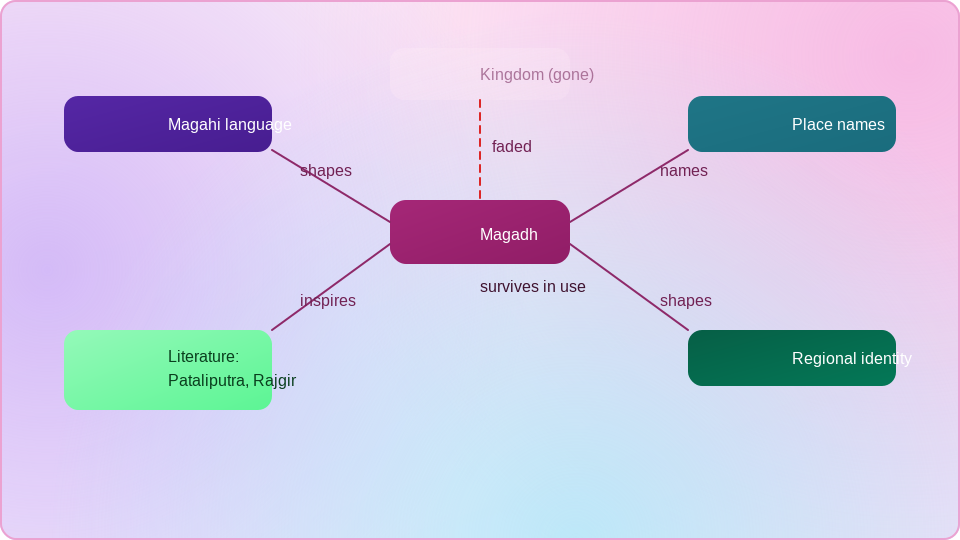
What follows is an interpretive reading of that inheritance. It examines how a regional name becomes a cultural keyword, how language carries political memory, and why the idea of Magadh continues to inform debates about identity, literature, and regional pride in contemporary India. The argument is deliberately opinionated: old kingdoms do not truly die, they are absorbed into the vocabulary of the people who inherit their soil, and the case of Magadh demonstrates this process with unusual clarity.
On This Page
TL;DR Magadh survives as a cultural and linguistic presence long after its political extinction. The name persists in the Magahi language, in regional identity across Bihar and adjoining areas, and in literary and historical imagination that treats Pataliputra and Rajgir as symbols of civilizational depth. This analysis argues that such persistence reveals a broader pattern: kingdoms endure not through institutions but through language, memory, and the everyday self-description of communities. Recognizing Magadh's afterlife reframes how we understand Indian cultural continuity and the relationship between political power and cultural longevity.
The Historical Arc of Magadh and Its Cultural Afterlife
Magadh entered recorded history as one of the sixteen great mahajanapadas of ancient India, occupying the fertile heartland of what is now southern Bihar. Its trajectory from a modest regional power to the seat of the Mauryan and Gupta empires gave the name an almost mythic weight, associating it with statecraft, scholarship, and the earliest experiments in subcontinental unification. Yet the more instructive story lies in what happened after the great dynasties receded, when the name continued to circulate among people who had never seen a Mauryan edict and would never read one.
From Mahajanapada to Imperial Heartland
The rise of Magadh illustrates how geography and intellectual culture can converge to produce political dominance. Rajgir, the earlier capital, and Pataliputra, the later metropolis, anchored a region whose riverine connectivity and agricultural surplus supported large armies and larger ambitions. More significantly, the region became a crucible of religious and philosophical innovation, hosting the ministries of the Buddha and Mahavira and later the administrative genius of Chanakya. This concentration of intellectual capital gave Magadh a prestige that outlasted its military fortunes and embedded the name in the vocabulary of authority itself.
When the imperial centres shifted and new dynasties rose elsewhere, the administrative apparatus dissolved, but the cultural capital did not. The name Magadh continued to designate the region and its people in inscriptions, literature, and popular speech. This is a familiar pattern in Indian history: political structures are fragile and transient, while the names attached to places acquire a durability that no dynasty can command. The transition from kingdom to cultural reference point was gradual, unplanned, and remarkably complete, which is precisely why it deserves closer attention than the conventional chronicle of rulers allows.
Why the Name Outlived the Throne
Names of places survive because they are useful. A kingdom's name becomes a shorthand for a territory, a people, a dialect, and a set of associations that later generations find convenient to invoke. Magadh served all these functions simultaneously, allowing poets, pilgrims, and peasants to reference a shared geography without requiring a shared government. The name became a container into which successive eras poured new meanings, from Buddhist sacred geography to colonial-era antiquarianism to modern regional politics, and each addition reinforced rather than replaced the original reference.
This durability also reflects the decentralised nature of cultural transmission in South Asia. Language, folklore, and ritual travel through families and villages rather than through official channels, and they are therefore immune to the collapse of states. A dynasty falls, but a grandmother still tells stories set in Rajgir, and a farmer still calls his speech Magahi. The throne is irrelevant to this process, which explains why the cultural afterlife of Magadh has proven so much more resilient than the political entity that first gave the name its prominence.
Magahi as a Living Carrier of Memory
Language is the most reliable archive of cultural continuity, and Magahi demonstrates this with particular force. Spoken by millions across Bihar and neighbouring states, it preserves phonological and lexical features that connect it to the broader Magadhan language family, which includes Bhojpuri, Maithili, and Bengali. The very name of the language encodes its geography: Magahi is the speech of Magadh, and to speak it is to inhabit a linguistic territory that predates modern state boundaries by many centuries. This continuity is not merely antiquarian; it shapes how speakers understand their place in the world.
The Linguistic Geography of the Magadhan Family
The Magadhan branch of the Indo-Aryan family offers a striking illustration of how political history and linguistic history diverge. The languages descended from the Magadhi Prakrit spread across eastern India, and their shared features reflect a common origin in the cultural sphere of ancient Magadh. Yet the modern boundaries of these languages do not correspond to any ancient kingdom's borders, and the speakers of Magahi, Bhojpuri, and Maithili do not form a single political community. Language preserves the memory of a shared cultural space even as politics fragments it into separate administrative units.
This divergence is instructive. It suggests that the cultural influence of Magadh operated through networks of trade, pilgrimage, and scholarship rather than through administrative decree. The Prakrit languages spread because they were useful for communication across a wide region, not because a king commanded their use. When the political centre shifted, the linguistic inheritance remained, carried by ordinary speakers who had no stake in dynastic politics. The result is a linguistic landscape that still bears the imprint of ancient Magadh, visible to anyone who studies the region's speech patterns with care.
Oral Tradition, Folklore, and Everyday Speech
Beyond formal linguistics, Magahi carries a rich body of oral literature that preserves historical memory in narrative form. Folk songs, proverbs, and ritual recitations frequently reference places and figures associated with Magadh, embedding historical consciousness in forms that require no literacy and no institutional patronage. A wedding song may invoke a river or a city whose significance stretches back centuries, and the singer need not know the chronology to transmit the memory. This is how old kingdoms survive: not in archives but in the mouths of people who have inherited stories they did not choose.
The everyday speech of the region also preserves a sense of place that formal history often overlooks. Terms for land, kinship, and occupation carry connotations shaped by generations of life in the Gangetic plain, and these connotations constitute a kind of cultural geography that maps onto the ancient territory of Magadh. When a speaker uses a particular word for a type of soil or a pattern of rainfall, they are drawing on knowledge accumulated over centuries. This linguistic inheritance is fragile, vulnerable to displacement by standardised languages and urban migration, but it remains a living connection to the region's deep past.
Literature, Memory, and the Literary Imagination of Magadh
Writers have long treated Magadh as more than a setting; it functions as a moral and intellectual reference point. From ancient Buddhist and Jain texts that situate their narratives in the region's cities to modern Hindi and Magahi literature that invokes Pataliputra as a symbol of statecraft and learning, the name carries an accumulated weight of association. This literary inheritance shapes how readers imagine the region even if they have never visited it, creating a shared imaginative geography that operates independently of administrative boundaries or contemporary political disputes.
Pataliputra and Rajgir as Literary Symbols
Pataliputra and Rajgir occupy distinct but complementary positions in the literary imagination. Pataliputra represents the apex of political power and administrative sophistication, the city where Chanakya's treatise on statecraft took shape and where empires were governed. Rajgir, by contrast, evokes spiritual seeking and philosophical debate, the hills where the Buddha taught and where rival schools contested the nature of existence. Together they form a symbolic pair that allows writers to explore the relationship between power and wisdom, a tension that remains central to how Indian culture understands its own past.
Modern writers have drawn on these symbols in varied ways. Some invoke Pataliputra to critique contemporary governance, contrasting the imagined rigour of ancient administration with present-day dysfunction. Others turn to Rajgir as a symbol of intellectual independence, a reminder that the region once hosted debates that shaped the spiritual history of Asia. These literary uses demonstrate how a historical place becomes a rhetorical resource, available to writers who may know little of the actual archaeology but who understand the associations the name carries. The symbol outlives the site.
Regional Identity in Contemporary Writing
Contemporary Magahi and Hindi writing has increasingly turned to regional identity as a subject rather than a backdrop. Authors write about the texture of life in small towns and villages, using local speech patterns and cultural references that assume familiarity with the region's history. This literature does not merely describe Magadh; it performs a kind of cultural assertion, insisting that the region's specificities matter and that its stories deserve to be told in their own idiom. The result is a body of work that keeps the name alive by embedding it in narratives of ordinary life rather than imperial grandeur.
This literary turn has political implications without being narrowly political. By writing in and about Magahi, authors challenge the assumption that cultural significance flows only from metropolitan centres. They assert that a region with a deep history has a continuing claim on attention, and they do so through the quiet accumulation of stories rather than through manifesto or polemic. This is perhaps the most durable form of cultural preservation: not the museum display but the living text, read and discussed by people who recognize their own world in its pages.
Regional Identity and the Politics of Naming
The name Magadh carries political charge in contemporary India, even when it is invoked in seemingly neutral contexts. Regional movements, cultural organisations, and educational institutions have all drawn on the name to assert a distinctive identity within the larger framework of Bihar and the Hindi belt. This is not unique to Magadh, but the region's unusually deep historical associations give the name a resonance that newer regional labels lack. To claim Magadh is to claim a lineage that stretches back to the foundations of Indian civilisation, and that claim has consequences.
Magadh Within the Idea of Bihar
The relationship between Magadh and Bihar is layered and sometimes tense. Bihar as a political unit is a colonial-era construction, while Magadh as a cultural reference is far older. This temporal mismatch creates a certain friction: the region can be presented as the authentic core of the state, the source of its historical prestige, or alternatively as one among several distinct cultural zones that the state contains. Politicians and cultural entrepreneurs have used the name in all these ways, and the resulting discourse reveals how regional identities are constructed through selective appeals to the past.
This is not merely an academic question. Debates over language policy, educational curricula, and cultural funding all involve implicit judgments about which regional inheritances deserve recognition. When Magahi is described as a dialect rather than a language, or when the region's history is subsumed under a generic narrative of Bihar, the effect is to diminish a specific cultural inheritance. Advocates for the region's heritage argue that recognizing Magadh's distinctiveness enriches rather than fragments the state, and that cultural pluralism is a source of strength rather than a threat to unity.
Language Recognition and Cultural Assertion
The campaign for recognition of Magahi as a scheduled language illustrates how cultural memory becomes a contemporary political demand. Speakers of the language point to its literary tradition, its distinct grammatical structure, and its millions of speakers as grounds for official recognition. Opponents argue that such recognition would fragment administrative coherence or that the language is adequately served by existing arrangements. Beneath these arguments lies a deeper question about whether cultural continuity deserves institutional support or whether it should be left to the informal mechanisms that have preserved it thus far.
The outcome of such debates matters beyond the region itself. India's language politics are a laboratory for questions about how modern states accommodate deep cultural diversity, and the case of Magahi offers a concrete example of the tensions involved. Recognizing the language would affirm that the cultural inheritance of Magadh has contemporary value, not merely antiquarian interest. It would also acknowledge that the millions who speak it are custodians of a tradition that deserves the same respect accorded to more prominent languages, a proposition that seems difficult to dispute on principle.
Similar Posts
- 01
- 02
- 03
- 04
How Old Kingdoms Live On in Modern Culture
The case of Magadh invites a broader reflection on how ancient political entities persist in contemporary life. They do so through language, through place names, through literary allusion, and through the unexamined assumptions that shape how communities describe themselves. This persistence is rarely deliberate; it is the byproduct of ordinary cultural transmission, and it operates below the threshold of official commemoration. Understanding it requires attention to the mundane rather than the monumental, to the words people use rather than the monuments they preserve.
Beyond Monuments: The Everyday Inheritance
Heritage discourse tends to privilege the visible and the monumental, but the most durable inheritances are often invisible. A dialect, a folk song, a naming convention, a recipe: these carry historical memory in forms that resist both destruction and commodification. Magadh survives in such forms far more than in the excavated ruins that attract tourists and scholars. This is not to dismiss the value of archaeology, but to insist that the cultural legacy of a region is broader than its material remains and requires different methods of appreciation and preservation.
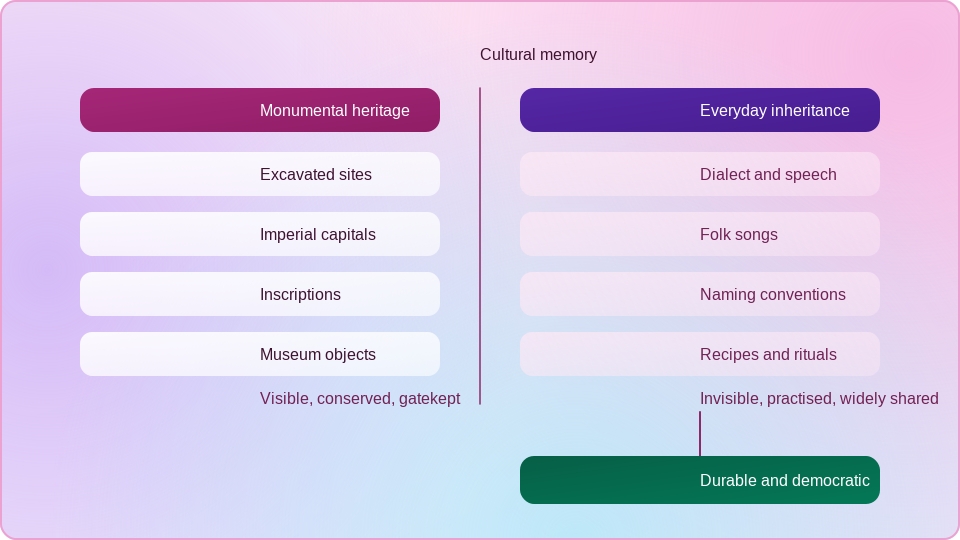
The everyday inheritance is also more democratic than the monumental. Anyone can speak a language or sing a song, regardless of education or income, and the transmission of cultural memory through such practices does not depend on institutional gatekeepers. This gives the cultural legacy of Magadh a vitality that official heritage programmes often lack. It also means that the legacy is vulnerable in ways that monuments are not: a language can be lost within a generation if transmission is interrupted, and the loss is far less visible than the collapse of a building.
Lessons for Cultural Preservation
The lesson for cultural preservation is that attention must be paid to the informal mechanisms that sustain living traditions. Language revitalisation, support for local literature, and recognition of regional cultural forms are not peripheral concerns but central to the survival of the inheritance that ancient kingdoms have bequeathed. Magadh's persistence is a testament to the resilience of these mechanisms, but resilience is not invulnerability. The name survives because people continue to use it, and it will continue to survive only as long as that use is sustained by communities that find it meaningful.
This suggests a different approach to heritage than the one that dominates public policy. Rather than treating the past as a collection of objects to be conserved, we might treat it as a set of practices to be supported. Funding for Magahi literature, support for folk performers, and recognition of regional languages in education would do more for the legacy of Magadh than any number of restored monuments. The old kingdom lives on in its language and its stories, and the most effective way to honour that legacy is to ensure that the people who carry it have the resources to continue.
Conclusion: The Name That Refuses to Fade
Magadh endures because it is useful, because it is embedded in language, and because communities continue to find meaning in it. The kingdom is gone, but the name remains as a shorthand for a region, a speech, and a cultural inheritance that millions of people carry without ceremony. This is how old kingdoms live on: not through the preservation of their institutions but through the persistence of their names in the mouths of ordinary people. The case of Magadh is not unique, but it is unusually clear, and it repays the attention of anyone interested in how culture outlives power.
The implication is that cultural continuity is not a matter of conservation alone but of active use. A name survives because people say it, a language survives because people speak it, and a tradition survives because people practice it. The legacy of Magadh is secure only insofar as the communities that inherit it continue to find it valuable, and that value is sustained by recognition, by resources, and by the simple fact of being taken seriously. The old kingdom asks nothing of us but attention, and it has earned far more than it usually receives.
From our network :
- The Final Descent: How ESA Retired the Legendary Cluster Constellation After 24 Years of Space Weather ScienceAfter 24 years mapping Earth’s magnetosphere, ESA’s Cluster mission concluded with a precisely controlled reentry over the South Pacific. This analysis explores the scientific legacy, engineering decisions, and debris mitigation principles behind one of space exploration’s most responsible retirements.
- How AI Agents Will Change the Way We Manage Personal FinancesExplore how AI agents are transforming personal finance through automated budgeting, bill payment, and investment management, while examining the critical security protocols and governance frameworks required for safe deployment.
- Committed Mediterranean Precipitation Decline: Why Emissions Cuts Alone Cannot Restore Winter RainsNew NOAA research reveals that Mediterranean winter rains may decline irreversibly even with emissions cuts. Explore the science of committed climate change and regional impacts.
- Mobile Learning and VR in English: What Global Evidence Reveals About Effective Language TechnologyA systematic review across 14 countries reveals which language-learning technologies genuinely work. Mobile learning, AI, and VR show measurable benefits when pedagogically integrated. This evidence-based guide helps educators and learners select technology that delivers real return on investment.
- The Hidden Cost of AI Convenience: Why Over-Permissioned Agents Are a Security Time BombDiscover why AI agents with excessive permissions create dangerous single points of failure, and learn how implementing least privilege principles can protect your organization from exploitation.
- CISA’s Ten-Advisory Wave: Why Generic Patching Fails in OT and How to Build Product-Specific PlaybooksCISA released ten ICS advisories in one week, exposing critical infrastructure risks. Generic patching fails in OT. Learn to build product-specific remediation playbooks.
- Forbidden Matrix Patterns and Visible Lattice Points: A Geometric DictionaryExplore how multidimensional 0–1 matrices encode geometric truths, linking forbidden patterns to visible lattice points and hypergraph theory, with applications in combinatorics and computational geometry.
- Live Online English Classes for Kids: Do They Actually Reduce Anxiety?A ten-week study reveals that synchronous online English classes can significantly reduce child language anxiety while improving listening and reading skills. Discover what makes these programs effective and how parents can select the right one.
- University Language Proficiency Exams: Why Institutional Tests Demand Different Preparation Than IELTS and TOEFLDiscover why university-specific language proficiency examinations differ fundamentally from IELTS and TOEFL, and learn strategic preparation approaches for institutional assessment success.
RESOURCES
- Nivedita Tiwari on Xx.comOct 28, 2026 ... Magahi is more than a language; it is the living cultural heritage of ancient Magadh. Rooted in the legacy of…
- The Intangible Cultural Legacy of Magadh - IJFMRijfmr.comregional languages which is a rich and valid heritage of artistic culture. ... Singh, Ram Prasad, Magahi Lokgeet ke vrihad sangrah Magahi Aakadmi, Patna,…
- Preservation of Magahi Language in India - Springer Naturelink.springer.comApr 24, 2019 ... It is the language of the people of Magah, formerly known as Magadha ... (Cultural background of Magahi folk literature).…
- The word 'Magahi' derives from the region's name 'Magah' which is a ...instagram.comNov 18, 2025 ... ... magadh, bihar, bihar politics, bihar languages] #bihar #bhojpuri ... [Magadh, Bihar, ancient Magadh, Magadh heritage, Bihar culture, Magahi ...
- Magahis - Wikipediaen.wikipedia.orgMagahis are an Indo-Aryan ethnolinguistic group native to the Magadh region of the East Indian states of Bihar and Jharkhand. Magahi culture is rich…
- (PDF) Magahi and Magadh: Language and People - Academia.eduacademia.eduThe paper discusses that once a history of Magadh constituted the history of India. The paper also attempts to discuss the people and culture…
- Presenting: Magadh!! The Magahi-speaking cultural area of Bihar is ...instagram.comFeb 9, 2024 ... [Magadh, Bihar, ancient Magadh, Magadh heritage, Bihar culture, Magahi ... magahi , bhojpuri, south bihar, bihari languages] . . #viral ...
- Magadh's history and cultural significance - Facebookfacebook.comDec 17, 2025 ... The Magadha language, also known as Magahi, is an Indo-Aryan language spoken in India, particularly in the states of Bihar…
- Does Bhojpuri spoken along the borders of Mithila and Magadh ...reddit.comApr 29, 2025 ... No, Bhojpuri is the divergent one out of Magahi, Maithili, Angika, Bajjika, Tharu and other non-Sadanic languages. This can be…
- Should Bihar be divided into smaller states like Magadh & Mithila to ...quora.comJun 8, 2018 ... ... Magadh & Mithila to prosper and retain its cultural heritage & language? ... magahi and maithili culture than poorvanchal…
- The Dialects of Bihar: A Living Heritage of Language and Cultureghumobihar.comOct 6, 2026 ... Bhojpuri: The Expressive Voice of Western Bihar · Maithili: A Language with a Rich Literary Heritage · Magahi: The Voice…
- The Legacy Of Feminine Vibes In Folk Cultureijcrt.orgMay 5, 2025 ... They are an intangible legacy of our past , basically framed under regional languages which is a rich ... Veena…
- What is it like to know that your Culture/Language is doomed to go ...reddit.comMay 15, 2026 ... But, now we are on the verge of losing Magahī and our culture (while it's sister languages and cultures like…
- Lost souls of Bihar 's languages - Amader Bangla - Quoraamaderbangla.quora.comActually Magahi is a widely spoken language in Bihar, particularly in the Magadha ... Do u think that without Magahi the culture of magadh…
- Magahi Translator | Polytranslatorpolytranslator.comThe cultural legacy of Magahi is woven deeply into the fabric of Indian history and the broader Indo-Aryan language family. It carries the weight…
Related By Tags
- 01
- 02
- 03
- 04
- 05
- 06
- 07
- 08
0 Comments