
The Supreme Court's interim order of November 20, 2026, permitting the lighting of a lamp atop the Thirupparankundram hill on
day represents a carefully calibrated exercise of judicial restraint rather than a resolution of the underlying dispute. By framing the permission as a "limited one-time arrangement," a Bench headed by
signalled that the Court was granting immediate relief without endorsing the broader theological and legal claims that had accumulated around the 'Deepathoon' — the sacred lamp structure at the heart of the controversy. The distinction matters enormously, because the Madras High Court had gone considerably further in its January 6 judgment, upholding the right to light the lamp as an essential religious practice. The Supreme Court's decision to stay those conclusive findings while allowing the ritual itself to proceed creates a deliberate legal asymmetry: the act is permitted, but the principle behind it remains unresolved.
The case sits at the intersection of several contested legal doctrines that Indian courts have grappled with for decades. Essential religious practice jurisprudence, the constitutional protection of religious denominations under Articles 25 and 26, the limits of interim judicial intervention in matters of faith, and the administrative machinery of temple governance all converge on a single hill in
. The State of Tamil Nadu appealed to the Supreme Court, and the Bench issued notice on those appeals while crafting an interim arrangement that distributes responsibility across multiple authorities. The Devasthanam retains exclusive authority over who may light the lamp, the Madurai District Collector serves as nodal officer, the Commissioner of Madurai Police must provide a security ring, and the Centre has been directed to supplement arrangements with CRPF personnel if required. Each of these provisions reflects a conscious attempt to prevent the one-time permission from becoming an unregulated precedent.
What makes the order particularly instructive is the Court's explicit acknowledgment of the danger it was navigating. Justice Kumar observed that the Bench was aware of the risks of allowing a one-time arrangement to crystallise into precedent, while simultaneously noting that two separate High Court Benches had already permitted the lighting. That tension — between the practical need to honour an imminent festival and the institutional duty to avoid premature doctrinal commitment — defines the order's character. The Madurai District Collector had earlier warned that the High Court's reasoning could trigger "an avalanche of claims fixing religious character to unrelated objects," a concern that clearly informed the Supreme Court's decision to stay the conclusive findings while preserving the ritual for a single occasion.
The Supreme Court's November 20, 2026 interim order on the Thirupparankundram Deepathoon controversy is best understood as a study in judicial minimalism under festival pressure. A Bench led by Justice Aravind Kumar permitted the lighting of the lamp on Karthigai Deepam day as a "limited one-time arrangement," while simultaneously staying the Madras High Court's conclusive January 6 findings that had upheld the ritual as an essential religious practice. The Court issued notice on the State's appeals, meaning the substantive legal questions remain open. This dual gesture — granting the immediate devotional act while refusing to bless the doctrinal foundation — is the order's defining feature, and it deserves careful unpacking.
The dispute itself is deceptively narrow. At issue is whether a lamp may be lit on the 'Deepathoon,' a sacred structure atop the Thirupparankundram hill in Madurai, on the festival day of Karthigai Deepam. Yet the legal architecture surrounding that question is expansive, touching essential religious practice doctrine, the constitutional rights of denominations, the administrative control of temple affairs, and the precedential weight of interim orders. The State of Tamil Nadu challenged the High Court's judgment, and the Supreme Court's response was neither a clean affirmance nor a clean reversal. Instead, it constructed a tightly bounded permission with named custodians, security protocols, and an explicit refusal to settle the principle.
Understanding this order requires attention to what the Court did not say as much as to what it did. By staying the conclusive findings, the Bench preserved the State's ability to argue that the High Court overreached in declaring the lamp-lighting an essential practice. By allowing the ritual once, it avoided the spectacle of judicial intervention blocking an imminent festival. And by distributing operational responsibility across the Devasthanam, the District Collector, the Police Commissioner, and the Central Reserve Police Force, it insulated the Court from the logistical consequences of its own permission. The following analysis examines each of these dimensions in turn.
On This Page
- The Factual and Procedural Backdrop of the Deepathoon Dispute
- Anatomy of the Interim Order: Permissions, Stays, and Safeguards
- Essential Religious Practice Doctrine and Its Limits
- Security Architecture and Administrative Coordination
- Precedent, Interim Relief, and the Festival Calendar
- Broader Implications for Religious Disputes in India
- Reading the Order as a Whole: Judicial Craft and Institutional Restraint
TL;DR On November 20, 2026, the Supreme Court permitted the lighting of a lamp on the 'Deepathoon' at Thirupparankundram hill in Madurai on Karthigai Deepam day as a strictly limited one-time arrangement, while staying the Madras High Court's January 6 judgment that had upheld the ritual as an essential religious practice. The Bench headed by Justice Aravind Kumar issued notice on the State's appeals, assigned exclusive team-selection authority to the Devasthanam, designated the Madurai District Collector as nodal officer, mandated a police security ring, and authorised CRPF supplementation if needed. The order balances festival exigency against precedential risk, leaving the core constitutional question unresolved pending final hearing.
The Factual and Procedural Backdrop of the Deepathoon Dispute
The Thirupparankundram hill near Madurai carries layers of religious significance that long predate the present litigation. The 'Deepathoon' is a lamp structure positioned on the hill, and the act of lighting it on Karthigai Deepam day carries devotional weight for those who regard the site as sacred. The controversy acquired legal form when the question arose whether the lighting constituted an essential religious practice entitled to constitutional protection, and whether administrative objections to the ritual could withstand that claim. The Madras High Court addressed the matter in a judgment dated January 6, and its conclusion — that the right to light the lamp was indeed an essential practice — became the immediate trigger for the State's appeal to the Supreme Court.
Procedurally, the Supreme Court faced a compressed timeline. Karthigai Deepam fell on November 24, 2026, only four days after the Friday hearing. The State sought a stay of the January 6 judgment and simultaneously asked the Court to address whether the lamp could be lit on the forthcoming festival day. This dual request forced the Bench to separate two questions that the High Court had treated as one: the immediate practical question of the November 24 ritual, and the enduring legal question of whether the practice is essential. The Court's answer was to grant the first while deferring the second, a split that defines the order's structure and its strategic logic.
The High Court's Essential Practice Finding
The Madras High Court's January 6 judgment rested on the determination that lighting the lamp on the Deepathoon qualified as an essential religious practice. Under Indian constitutional jurisprudence, practices deemed essential to a religion receive heightened protection under Articles 25 and 26, and courts have historically been cautious about second-guessing doctrinal determinations. The High Court's finding therefore carried significant weight, because it converted a contested ritual into a constitutionally shielded entitlement. That characterisation is precisely what the State challenged before the Supreme Court, arguing that the High Court had overstepped in fixing religious character onto a structure whose status was itself disputed.
The essential practice doctrine has attracted sustained scholarly and judicial criticism for requiring secular courts to adjudicate theological questions they are poorly equipped to answer. Yet it remains operative law, and the High Court applied it to reach a conclusion favourable to the ritual's proponents. The Supreme Court's decision to stay the conclusive findings rather than the operative permission is a nuanced manoeuvre: it leaves the High Court's reasoning formally intact for the purposes of the interim arrangement while removing its precedential force pending appeal. This preserves the State's appellate position without disrupting the festival, a balance that reflects the Bench's evident sensitivity to both institutional and devotional considerations.
The State's Appeal and the Collector's Warning
The State's appeal was fortified by a striking administrative intervention. The Madurai District Collector cautioned that the High Court's decision could trigger "an avalanche of claims fixing religious character to unrelated objects," a warning that framed the judgment as a systemic risk rather than a discrete ruling. That argument resonates with a familiar judicial anxiety: once a court declares a particular object or practice essential, the declaration becomes a template for litigants seeking similar recognition elsewhere. The Collector's formulation gave the Supreme Court a principled basis for limiting the judgment's reach without directly repudiating the High Court's reasoning, and the Bench's stay of the conclusive findings suggests the warning found traction.
This dimension of the dispute illustrates how administrative concerns can shape constitutional litigation. The Collector's warning was not a legal argument in the strict sense, but it articulated a consequence that courts take seriously: the downstream effects of doctrinal expansion. By staying the conclusive findings, the Supreme Court effectively accepted that the High Court's reasoning carried risks beyond the immediate parties. The State's appeal thus gained traction not merely on the merits of the essential practice question but on the broader institutional concern that premature doctrinal commitment could generate a wave of analogous claims across Tamil Nadu and beyond.
Anatomy of the Interim Order: Permissions, Stays, and Safeguards
The operative portion of the Supreme Court's order can be read as three distinct instruments bundled into a single document. The first is a permission: the lamp may be lit on November 24, 2026, as a limited one-time arrangement. The second is a stay: the conclusive findings of the Madras High Court's January 6 judgment are suspended, meaning the essential practice determination no longer carries binding force. The third is a notice: the Court has formally taken up the State's appeals, ensuring the substantive questions will receive full adjudication. Each instrument serves a different function, and their combination produces an outcome that is neither victory nor defeat for either side.
The permission addresses the immediate devotional calendar. Karthigai Deepam is a fixed festival, and judicial proceedings cannot be accelerated to accommodate it. By allowing the lighting once, the Court prevented its own docket from becoming the instrument of devotional deprivation. The stay addresses the precedential danger. Had the High Court's essential practice finding been left undisturbed, it would have functioned as authority in future disputes, potentially inviting the very avalanche the Collector feared. The notice addresses the institutional obligation. By formally admitting the appeals, the Court signalled that the matter is now squarely before it and will be decided on the merits in due course.
Why "Limited One-Time Arrangement" Is Doing Heavy Lifting
The phrase "limited one-time arrangement" is not incidental drafting; it is the load-bearing concept of the entire order. By characterising the permission as an arrangement rather than a right, the Court avoided any implication that the lighting enjoys constitutional protection. An arrangement is administrative and contingent; a right is doctrinal and enduring. The distinction allows the Court to permit the ritual without conceding the legal premise that the High Court had embraced. Justice Kumar's observation that the Bench was aware of the dangers of allowing once becoming a precedent underscores that the wording was chosen with precedential consequences firmly in mind.
This technique has a respectable pedigree in Indian constitutional practice. Courts frequently grant interim relief in terms that expressly disclaim any expression of opinion on the merits, precisely to prevent the relief from acquiring precedential weight. The Deepathoon order follows that template but adds a temporal limitation — "one-time" — that is unusually explicit. The combination of "limited" and "one-time" creates a double lock: the permission is confined to a single occasion and to a single festival, and it carries no implication for future years or future objects. Whether that lock holds under subsequent litigation is a question the Court has deliberately left open.
The Significance of Staying the Conclusive Findings
The stay of the conclusive findings is the order's most consequential element for the State. Had the Supreme Court permitted the lamp while leaving the High Court's essential practice determination intact, the State's appeal would have been substantially undermined, because the doctrinal foundation would have remained in place even as the ritual proceeded. By staying the findings, the Bench preserved the State's ability to argue that the High Court erred in its essential practice analysis. The stay does not reverse the High Court; it suspends the binding effect of its conclusions pending the Supreme Court's own determination, a standard interim measure that nonetheless carries significant practical weight.
For the ritual's proponents, the stay is a setback wrapped in a concession. They secured the lighting for November 24, but they lost the doctrinal endorsement that the High Court had provided. The essential practice question now returns to the Supreme Court's docket without a favourable lower court finding anchoring the argument. This is the price of the compromise, and it explains why the order cannot be characterised as a clean win for either party. The Court has given each side something it wanted while withholding something it sought, a classic interim allocation of risk pending final adjudication.
Essential Religious Practice Doctrine and Its Limits
The Deepathoon dispute cannot be understood without situating it within the essential religious practice doctrine, a jurisprudential framework that Indian courts have developed and contested for over half a century. Under this doctrine, courts determine whether a particular belief or practice is essential to a religion, and practices so identified receive protection under Articles 25 and 26 of the Constitution. The doctrine's difficulty is obvious: it requires secular judges to make theological determinations, a task for which their training offers limited preparation. Critics have long argued that the doctrine invites judicial overreach into matters of faith, while defenders contend that some adjudicative standard is unavoidable when religious claims collide with state regulation.
The Madras High Court's January 6 judgment applied this doctrine to conclude that lighting the lamp on the Deepathoon is an essential practice. That conclusion, if left undisturbed, would have placed the ritual beyond the reach of administrative objection. The Supreme Court's stay of the conclusive findings therefore does more than suspend a single ruling; it reopens a doctrinal question that the High Court had resolved. The Bench's evident discomfort with the precedential implications of the High Court's reasoning reflects a broader judicial wariness about expanding the essential practice category, particularly where the object in question is a structure rather than a text or an established rite.
Competing Benches and Doctrinal Uncertainty
Justice Kumar's observation that two separate High Court Benches had allowed the lighting introduces a layer of complexity that the interim order does not fully resolve. When multiple Benches reach the same conclusion, the appearance of settled law is strengthened, and a litigant opposing that conclusion faces a heavier burden. Yet the Supreme Court treated the concurrence of two Benches not as a reason for deference but as a factor to be weighed against the precedential risk. The order thus acknowledges the High Court's position without treating it as dispositive, a stance that preserves the Court's freedom to depart from the lower court's reasoning at final hearing.
The existence of competing Benches also raises questions about the internal coherence of the High Court's approach. If two Benches independently found the practice essential, the reasoning may be more robust than a single judgment would suggest. But if the concurrence rested on different premises, the doctrinal foundation may be less stable than the outcome implies. The Supreme Court's stay effectively puts these questions back in play, and the final hearing will have to address not only whether the High Court was right but whether its reasoning can be reconciled across Benches. That is a demanding analytical task, and the interim order wisely declines to prejudge it.
The Avalanche Concern and Precedential Risk
The Collector's "avalanche" warning deserves close attention because it articulates a structural concern that transcends the Deepathoon dispute. Essential practice determinations are, by their nature, portable: a finding that one object or ritual is essential creates a template that litigants elsewhere can invoke. The Collector's fear was that the High Court's judgment would become such a template, generating claims that various unrelated objects possess religious character and therefore merit protection. Whether or not that fear was empirically well-founded, it identified a genuine feature of the doctrine: its capacity to proliferate. The Supreme Court's stay responds directly to that feature by removing the judgment's precedential force.
This concern also illuminates why the Court chose the "limited one-time arrangement" formulation rather than a broader permission. A general permission would have implied that the practice enjoys some measure of legal recognition, which in turn could have been cited in future disputes. A one-time arrangement, by contrast, is self-consuming: it exhausts itself on November 24 and leaves nothing behind for litigants to invoke. The Court's drafting is thus responsive to the avalanche concern at the level of language, not merely at the level of outcome. That is a sophisticated piece of judicial craftsmanship, and it explains why the order's wording has attracted as much attention as its substance.
Security Architecture and Administrative Coordination
The Supreme Court's order is notable for the specificity with which it allocates operational responsibility. The Devasthanam is granted exclusive authority to decide the members of the team that will light the lamp on November 24. The Madurai District Collector is designated nodal officer for the event. The Commissioner of Madurai Police must provide a ring of security. The Union Government is directed to supplement security arrangements with CRPF personnel if required. This four-part allocation is unusual in its granularity, and it reflects the Court's awareness that a permission without operational scaffolding could produce disorder, which would in turn undermine the very arrangement the Court had authorised.
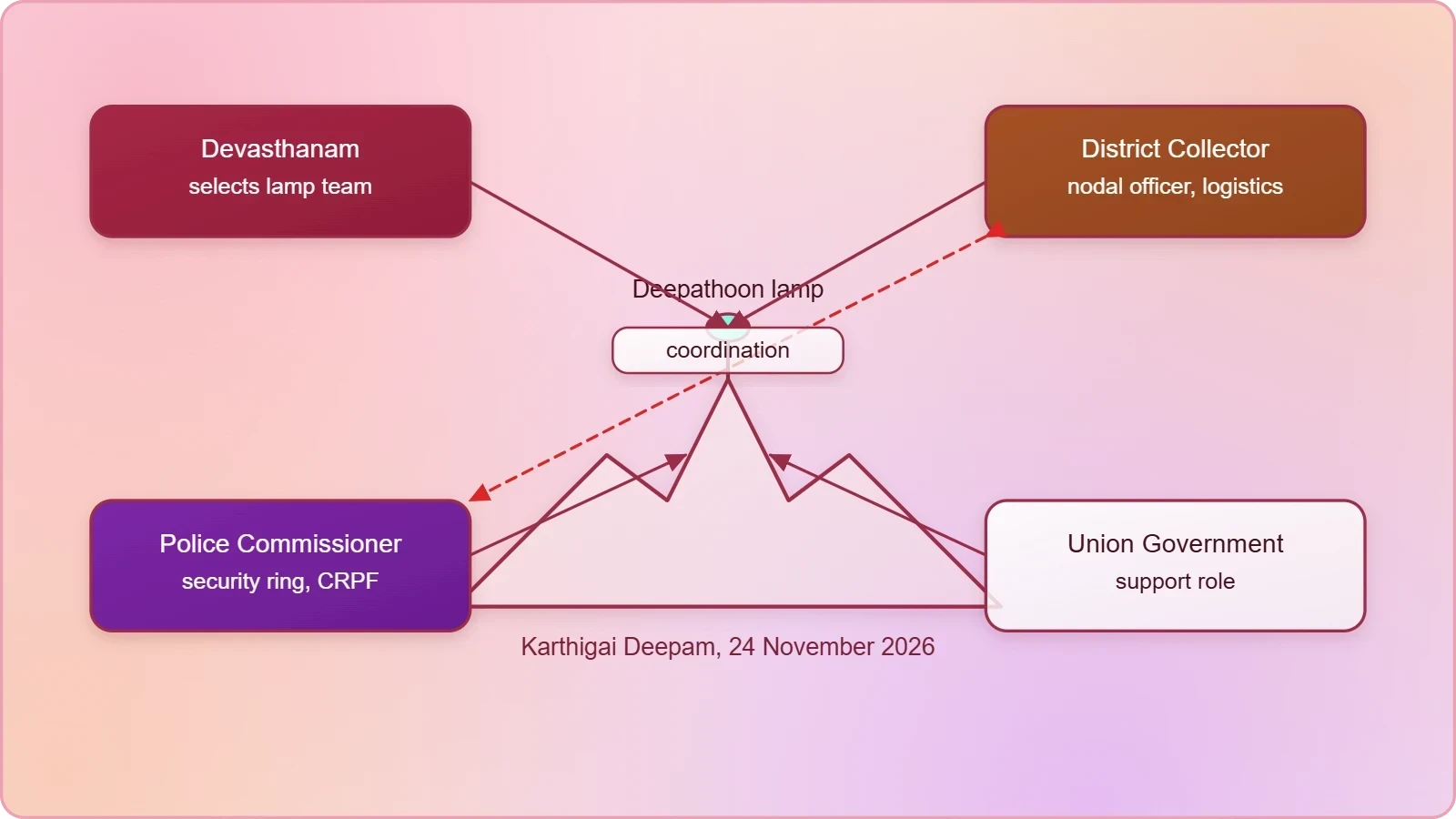
The choice of the Devasthanam as the exclusive arbiter of team membership is particularly significant. By vesting that authority in the temple administration rather than in the state government or the police, the Court respected the religious character of the ritual while simultaneously avoiding any implication that the state was endorsing the practice. The Devasthanam acts as a religious body making a religious decision, and the Court's order treats that decision as outside the scope of administrative review for the purposes of the one-time arrangement. This is a careful separation of religious and secular authority, and it mirrors the constitutional division of labour that the essential practice doctrine itself attempts to maintain.
The Collector as Nodal Officer
Designating the District Collector as nodal officer places a senior civil servant at the centre of the event's coordination. The Collector's role is administrative rather than religious: the officer ensures that logistics, permissions, and inter-agency communication function smoothly. This choice has practical advantages, because the Collector commands the district machinery and can convene the relevant departments at short notice. It also has symbolic significance, because it signals that the event is being treated as a matter of public administration rather than as an exclusively religious occasion. The Collector's earlier warning about the avalanche of claims adds a layer of irony to the assignment, since the officer who cautioned against the High Court's reasoning is now tasked with making the one-time arrangement work.
The nodal officer model is familiar from disaster management and large public events, where a single point of coordination prevents the fragmentation of responsibility. By adopting that model, the Court imported a governance technique into the religious domain, and the import is not merely technical. It establishes a chain of accountability that runs from the Devasthanam through the Collector to the police and, if necessary, to the central government. If something goes wrong on November 24, the order makes it possible to identify who was responsible for what. That accountability structure is itself a safeguard against the precedential risk the Court was trying to contain.
Police and CRPF Deployment
The direction that the Commissioner of Madurai Police provide a ring of security acknowledges the public-order dimension of the event. A hilltop ritual attended by devotees requires crowd management, traffic control, and perimeter security, and the police are the appropriate agency for those tasks. The further direction that the Centre supplement arrangements with CRPF personnel if required introduces a federal backstop, recognising that local resources may be insufficient if attendance is large or if tensions arise. The conditional phrasing — "if required" — leaves the assessment to the authorities on the ground, preserving flexibility while establishing the principle that central assistance is available.
The security provisions also serve a less obvious function: they reassure the Court that the permission will not produce the disorder that could discredit the arrangement. Interim orders that authorise contested events are vulnerable to being judged by their consequences, and a well-secured event is less likely to generate the incidents that would invite reconsideration. By specifying the security architecture in advance, the Court insulated its permission from foreseeable operational failure. This is prudent judicial administration, and it reflects an understanding that the credibility of interim relief depends partly on the conditions attached to it.
- 01
- 02
- 03
- 04
We Also Published
Precedent, Interim Relief, and the Festival Calendar
The Deepathoon order raises a question that recurs whenever courts confront time-bound religious events: how should the judicial calendar interact with the festival calendar? Karthigai Deepam is not a movable date; it falls when it falls, and no litigant can ask the sun to wait. The Supreme Court's response was to compress its own deliberation into an interim order that granted the immediate relief while deferring the principle. This is a familiar technique, but it carries a familiar risk: interim orders that accommodate festivals can, over time, accumulate into a de facto pattern that shapes the final determination. The Court's explicit "one-time" language is an attempt to prevent that accumulation.
The risk is not hypothetical. When courts repeatedly grant interim permissions for religious events, the permissions can acquire a momentum of their own, and the final hearing may find itself constrained by the practical expectations that the interim orders have created. The Deepathoon order anticipates this dynamic by refusing to characterise the permission as a right and by staying the findings that would have given the permission a doctrinal anchor. Whether these precautions will prove sufficient is a question for the final hearing, but the Court has at least identified the danger and taken steps to mitigate it. That is more than many interim orders attempt.
Interim Orders as Precedent: The Doctrinal Debate
Indian courts have long debated whether interim orders can function as precedent. The orthodox position is that they cannot, because they decide nothing finally and express no concluded view on the merits. The practical position is more complicated: interim orders are cited, distinguished, and relied upon, and their reasoning can influence subsequent decisions even when their operative provisions are temporary. The Deepathoon order's careful language reflects an awareness of this gap between doctrine and practice. By labelling the permission a "limited one-time arrangement," the Court has tried to ensure that the order cannot be cited as authority for anything beyond November 24, 2026.
The stay of the conclusive findings reinforces this strategy. If the High Court's essential practice determination had remained in force, it would have been citable as precedent regardless of the interim permission, and the Supreme Court's own order would have sat alongside a binding lower court ruling. By staying the findings, the Court removed that possibility and ensured that the only operative judicial statement on the merits is the High Court's judgment in its suspended form. The result is a legal landscape in which the ritual is permitted but the principle is unmoored, a configuration that maximises the Court's freedom at the final hearing.
What the Final Hearing Must Resolve
The final hearing will have to address at least three questions. First, whether the Madras High Court was correct to hold that lighting the lamp on the Deepathoon is an essential religious practice. Second, whether the Collector's avalanche concern identifies a genuine doctrinal problem that warrants limiting the High Court's reasoning. Third, whether the concurrence of two High Court Benches strengthens or complicates the essential practice finding. Each question is analytically distinct, and the Court's resolution of one will not necessarily determine the others. The interim order has preserved the Court's ability to address them separately, which is one of its quieter virtues.
The hearing will also have to consider the broader implications of the case for the essential practice doctrine itself. If the Court affirms the High Court's approach, it will reinforce the doctrine's application to objects and structures, not merely to texts and rites. If it reverses, it will narrow the doctrine's reach and lend support to the view that courts should be more cautious about declaring practices essential. Either outcome would have consequences beyond Thirupparankundram, and the Court is presumably aware that its final judgment will be read as a statement about the doctrine's future, not merely about a single hill in Madurai.
Broader Implications for Religious Disputes in India
The Deepathoon controversy is a local dispute with national resonance. Across India, courts are regularly asked to determine whether particular practices, structures, or rituals qualify as essential to a religion, and each determination carries consequences for the communities involved and for the state's regulatory authority. The Supreme Court's handling of the Thirupparankundram case offers a template for managing such disputes when a festival deadline looms: permit the immediate act, stay the doctrinal findings, impose operational safeguards, and reserve the principle for final hearing. Whether that template will be followed in future cases depends on how the final judgment in this one turns out, but the interim order has at least demonstrated that the approach is available.
The order also illustrates the value of administrative input in constitutional litigation. The Collector's avalanche warning gave the Supreme Court a concrete, consequence-based reason to limit the High Court's reasoning, and the Court's response was shaped by that input. This is a reminder that constitutional cases are not decided in a vacuum; they are embedded in administrative realities that courts ignore at their peril. The Deepathoon order's careful allocation of operational responsibilities reflects an awareness that the permission would be judged by how it was implemented, not merely by how it was reasoned. That awareness is a mark of institutional maturity.
Balancing Devotional Rights and Public Order
The tension between devotional rights and public order is a constant in Indian religious litigation, and the Deepathoon order manages it through procedural design rather than doctrinal pronouncement. By assigning the Devasthanam exclusive authority over team membership, the Court respected the ritual's religious character. By designating the Collector as nodal officer and mandating police and CRPF security, it addressed the public-order dimension. The two sets of provisions operate in parallel, neither subordinating the other, and the arrangement as a whole treats devotional practice and public administration as compatible rather than competing. That is a notable achievement in a dispute where the two had been framed as adversaries.
The order's emphasis on security also carries a cautionary message. A permission granted without adequate safeguards could produce disorder, and disorder could be cited in future cases as evidence that such permissions are unwise. By building the safeguards into the permission itself, the Court protected the arrangement from its own potential failure modes. This is a defensive posture, but it is a defensible one: the Court is not endorsing the practice, only ensuring that its one-time authorisation does not become a cautionary tale. The distinction between endorsement and administration is central to the order's logic, and it will remain central at the final hearing.
Lessons for Future Festival-Related Litigation
Future litigants will study the Deepathoon order for guidance on how to frame festival-related claims. The proponents succeeded in securing the ritual for November 24, but they lost the doctrinal endorsement they had obtained from the High Court. The State succeeded in staying the conclusive findings, but it failed to prevent the lighting altogether. Neither side achieved a clean victory, and the order's structure suggests that clean victories may be unavailable when a festival deadline compresses the judicial timeline. The lesson is that interim relief in such cases is likely to be partial, conditional, and explicitly temporary, and litigants should calibrate their expectations accordingly.
The order also suggests that the wording of interim relief matters as much as its substance. The phrase "limited one-time arrangement" will be scrutinised in future cases, and its success in preventing precedential spillover will depend on how subsequent courts interpret it. If the phrase is treated as a model, it could become a standard formula for festival permissions, which would be a significant development in Indian interim relief practice. If it is treated as a one-off, its influence will be confined to this case. Either way, the Deepathoon order has contributed a distinctive formulation to the vocabulary of Indian constitutional remedies, and that contribution deserves attention.
Reading the Order as a Whole: Judicial Craft and Institutional Restraint
Taken as a whole, the Supreme Court's November 20 order is a compact essay in judicial craft. It grants relief without conceding principle, imposes safeguards without endorsing the underlying claim, and preserves the Court's freedom to decide the merits on a full record. The Bench's awareness of the dangers of allowing once becoming a precedent is stated openly, and the order's language is calibrated to neutralise that danger. The result is an interim measure that functions as a holding pattern, keeping the ritual alive while keeping the doctrine open. For a dispute that had generated considerable heat, the order's coolness is itself a notable feature.
The order also demonstrates the value of institutional restraint in cases where religious sentiment and legal doctrine intersect. The Court could have resolved the essential practice question definitively, but it chose not to, and that choice reflects a recognition that the question deserves a fuller hearing than a festival deadline permits. By issuing notice on the State's appeals, the Bench ensured that the matter will return for comprehensive adjudication. By staying the conclusive findings, it prevented the High Court's reasoning from hardening into authority in the interim. And by permitting the lighting once, it avoided the appearance of judicial hostility to devotional practice. Each element of the order serves a distinct institutional purpose, and together they produce a result that is greater than the sum of its parts.
The Court's Institutional Voice
Justice Kumar's pronouncement is notable for its candour. Acknowledging the dangers of allowing once becoming a precedent is not a standard formulation, and its inclusion signals that the Bench wanted its concerns on the record. The acknowledgment also serves a practical function: it warns future litigants that the one-time permission should not be cited as authority for broader claims. By stating the concern openly, the Court pre-empts the very misuse it fears. This is a rhetorical strategy as much as a legal one, and it reflects an understanding that interim orders are read by audiences beyond the immediate parties, including future litigants and future Benches.
The order's institutional voice is also visible in its allocation of responsibilities. By naming the Devasthanam, the Collector, the Police Commissioner, and the Union Government, the Court speaks to each of them directly, creating a web of accountability that extends beyond the courtroom. This is not the voice of a court that intends to supervise the event itself; it is the voice of a court that intends to ensure the event is supervised by those with the capacity to do so. The distinction is important, because it allows the Court to authorise the ritual without taking on the operational burden that authorisation would otherwise entail. That is a sophisticated division of labour, and it is characteristic of the order's overall approach.
What Remains Unresolved
For all its craft, the order leaves the central question unresolved: whether lighting the lamp on the Deepathoon is an essential religious practice. The High Court said yes; the Supreme Court has suspended that answer without replacing it. The final hearing will have to supply the missing determination, and its outcome will shape the doctrine's application to objects and structures for years to come. In the meantime, the one-time arrangement will proceed on November 24, and the Devasthanam, the Collector, the police, and possibly the CRPF will implement it. The ritual will be performed, the principle will remain open, and the Court will have bought itself the time it needs to decide the matter properly.
That is, in the end, what interim orders are for. They manage the interval between the filing of an appeal and its final disposition, and they do so under constraints that make perfection impossible. The Deepathoon order manages that interval with unusual care, and its careful wording will be studied by litigants and judges alike. Whether it succeeds in preventing the one-time permission from becoming a precedent will depend on how future courts read it, but the order has done what it can. It has permitted the ritual, protected the record, and preserved the principle for a fuller hearing. In the annals of Indian interim relief, that is a substantial achievement.
From our network :
- Committed Mediterranean Precipitation Decline: Why Emissions Cuts Alone Cannot Restore Winter RainsNew NOAA research reveals that Mediterranean winter rains may decline irreversibly even with emissions cuts. Explore the science of committed climate change and regional impacts.
- The Hidden Cost of AI Convenience: Why Over-Permissioned Agents Are a Security Time BombDiscover why AI agents with excessive permissions create dangerous single points of failure, and learn how implementing least privilege principles can protect your organization from exploitation.
- Mobile Learning and VR in English: What Global Evidence Reveals About Effective Language TechnologyA systematic review across 14 countries reveals which language-learning technologies genuinely work. Mobile learning, AI, and VR show measurable benefits when pedagogically integrated. This evidence-based guide helps educators and learners select technology that delivers real return on investment.
- CISA’s Ten-Advisory Wave: Why Generic Patching Fails in OT and How to Build Product-Specific PlaybooksCISA released ten ICS advisories in one week, exposing critical infrastructure risks. Generic patching fails in OT. Learn to build product-specific remediation playbooks.
- Forbidden Matrix Patterns and Visible Lattice Points: A Geometric DictionaryExplore how multidimensional 0–1 matrices encode geometric truths, linking forbidden patterns to visible lattice points and hypergraph theory, with applications in combinatorics and computational geometry.
- Live Online English Classes for Kids: Do They Actually Reduce Anxiety?A ten-week study reveals that synchronous online English classes can significantly reduce child language anxiety while improving listening and reading skills. Discover what makes these programs effective and how parents can select the right one.
- How AI Agents Will Change the Way We Manage Personal FinancesExplore how AI agents are transforming personal finance through automated budgeting, bill payment, and investment management, while examining the critical security protocols and governance frameworks required for safe deployment.
- University Language Proficiency Exams: Why Institutional Tests Demand Different Preparation Than IELTS and TOEFLDiscover why university-specific language proficiency examinations differ fundamentally from IELTS and TOEFL, and learn strategic preparation approaches for institutional assessment success.
- The Final Descent: How ESA Retired the Legendary Cluster Constellation After 24 Years of Space Weather ScienceAfter 24 years mapping Earth’s magnetosphere, ESA’s Cluster mission concluded with a precisely controlled reentry over the South Pacific. This analysis explores the scientific legacy, engineering decisions, and debris mitigation principles behind one of space exploration’s most responsible retirements.
RESOURCES
- Lighting of Karthigai Deepam | Deepathoon to be lit as one-time ...scobserver.in9 hours ago ... ... Deepathoon on the Thiruparankundram Hill as a temporary one-time arrangement. ... Petitioners sought an interim stay on the Madras…
- Supreme Court allows lighting of lamp on 'Deepathoon ... - The Hinduthehindu.com10 hours ago ... ... Deepathoon' as an essential practice. Updated - November 20, 2026 03 ... Pronouncing the interim order, Justice Kumar said…
- Jawahirullah MH on X: "Supreme Court's Interim Order on ...x.com9 hours ago ... Is it actually a Deepathoon meant for religious worship, or is it a ... It is particularly important that the…
- Supreme Court Allows One-Time Karthigai Deepam At ... - LawBeatlawbeat.in9 hours ago ... Supreme Court Allows One-Time Karthigai Deepam At Thirupparankundram Deepathoon On November 24 ... religious practice, the authority of the ...
- LawBeat on Xx.com10 hours ago ... BREAKING | Thiruparankundram Deepathoon row Supreme Court stays the Madras High Court order permitting lamp lighting at the Deepathoon ...
- Thiruparankundram lamp lighting: Appeal filed in Supreme Court ...instagram.comJan 27, 2026 ... The outcome will be important in determining how courts examine customary religious practices and competing claims involving religious ...
- The Supreme Court has permitted the lighting of Karthigai Deepam ...facebook.com3 hours ago ... ... Deepathoon on Thiruparankundram Hill on November 24 as an interim arrangement ... essential or long-standing religious practice. Furthermore, the ...
- Inside India's Courtrooms⚖️ The Supreme Court steps ... - Instagraminstagram.com10 hours ago ... The Supreme Court steps in on the Thiruparankundram Deepathoon ... Despite right to practise one's religion being a fundamental right ...
- The entire top of the hill belongs to the dargah... - Facebookfacebook.com7 hours ago ... In a long-running dispute over religious practices on the #Thiruparankundram hill in #Madurai, the #SupremeCourt refused to interfere with a…
- SC stays Madras HC order, allows 'one-time' Deepathoon lightingthenewsminute.com10 hours ago ... The Supreme Court clarified that the permission was not a final endorsement of the claimed customary practice and that its…
- Dr. Krishnasamy Urges TN Govt to Fully Implement SC Order on ...simplicity.in6 hours ago ... Krishnasamy on Friday urged the Tamil Nadu government to fully implement the Supreme Court's interim ... Deepathoon as an essential…
- One-time permission only: Court allows lamp lighting on TN hillindianexpress.com9 hours ago ... The Supreme Court, in an interim order on Friday, permitted lighting of the lamp on the 'deepathoon' (lamp pillar) atop…
- SC permits temple team to light Deepam atop hill - AP7AMap7am.com5 hours ago ... The Supreme Court has permitted the lighting of the Karthigai Deepam at Thiruparankundram hill as a one-time measure. The interim…
- SC permits lighting Karthigai Deepam lamp at TN hill temple - Rediffrediff.com8 hours ago ... The Supreme Court has issued a crucial interim order allowing the traditional Karthigai Deepam lamp to be lit on November…
- 01
- 02
- 03
- 04
- 05
- 06
- 07
- 08
0 Comments