
A decade after the United Kingdom voted to leave the European Union, the political and economic arithmetic of that decision has come under renewed scrutiny. The 2016 referendum was fought with unusual bitterness, splitting families, workplaces and entire communities along lines that mapped onto deeper questions of identity, sovereignty and national belonging. What was presented as a binary choice between Leave and Remain soon revealed itself as something far more complicated, because the exit agreements negotiated by successive governments satisfied neither camp fully. Ten years on, the conversation has shifted from whether Brexit should be reversed to how far the relationship can be rebuilt without reopening old wounds.
The immediate catalyst for this renewed debate is a UK-EU summit in Brussels, after which Prime Minister Andy Burnham returned with a package of agreements covering trade facilitation, youth mobility and carbon levies. Burnham framed the deal as a first step in rebuilding "the bridges that were broken all those years ago," language that carefully avoids the word rejoin while pointing unmistakably in that direction. The agreements are modest in scope but symbolically significant, because they acknowledge that the trading relationship with the EU remains the UK's most consequential economic link. For a country that spent nearly half a century inside the bloc, the practical costs of distance have proved harder to absorb than the political rhetoric suggested.
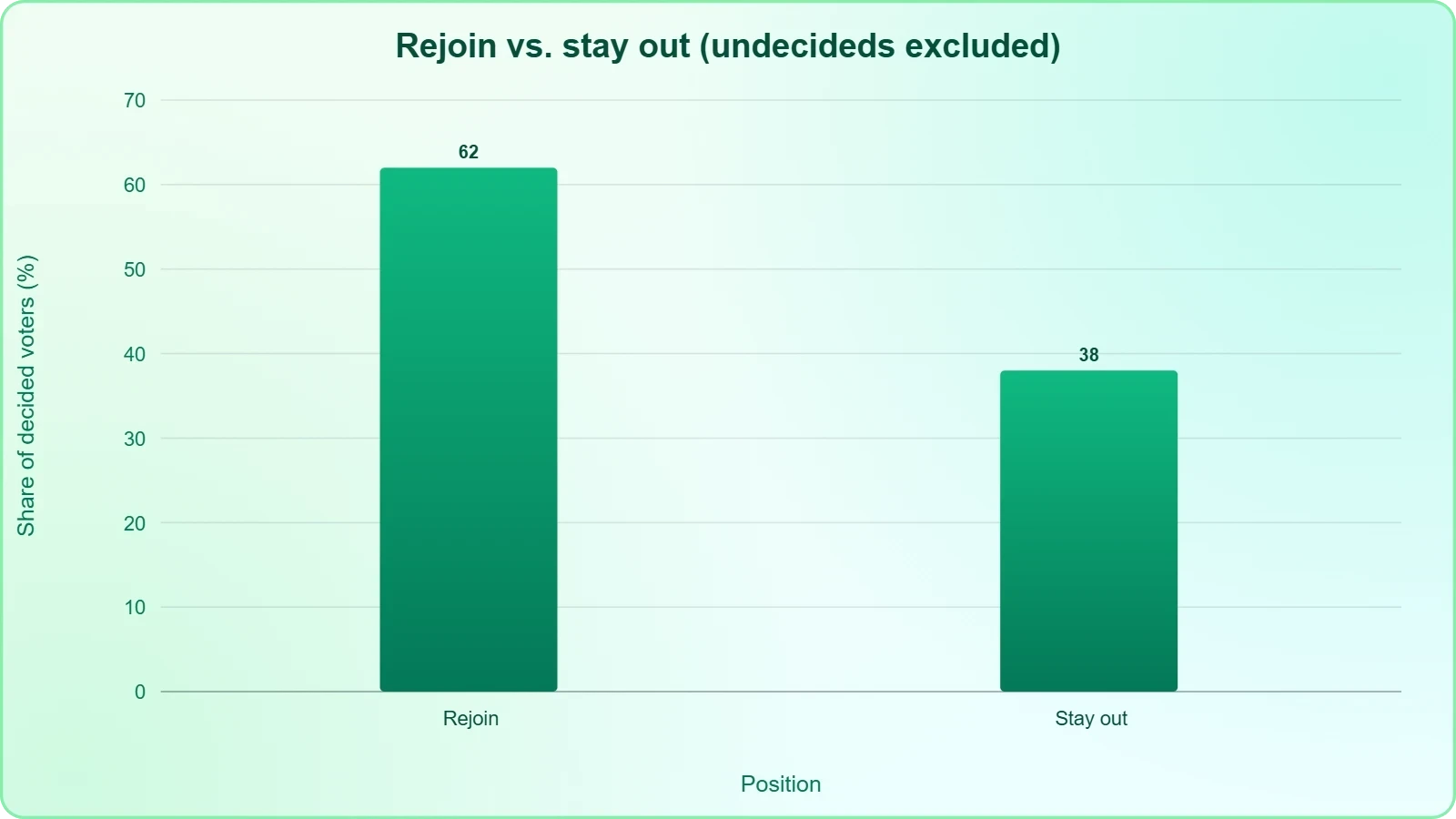
Public opinion has moved in a direction that would have seemed improbable in the aftermath of the vote. Polling analyst Sir John Curtice reports that, once undecided respondents are excluded, roughly 62 percent of Britons favour rejoining against 38 percent who prefer to stay out. That margin is not a mandate for immediate accession, but it is a clear signal of buyer's remorse. The question now facing Westminster is not whether the country regrets Brexit, but what a credible path back might look like when the EU itself has changed, when trust remains fragile, and when the domestic politics of reversal are as divisive as the original campaign.
On This Page
- The Economic Ledger of a Decade Outside the Bloc
- Reading the Polls: A Nation That Changed Its Mind
- The Brussels Summit: Anatomy of a Reset Deal
- Identity, Sovereignty and the Unfinished Argument
- The Mechanics of Return: What Rejoining Would Actually Require
- What Comes Next: Scenarios for the UK-EU Relationship
- Lessons for Democratic Governance Beyond Britain
TL;DR Ten years after the 2016 Brexit referendum, the United Kingdom is reassessing its relationship with the European Union. A new UK-EU summit deal covering trade, youth mobility and carbon levies, brokered by Prime Minister Andy Burnham, marks a tentative step toward re-engagement. Polling suggests around 62 percent of decided voters now favour rejoining, yet the path back is complicated by unresolved identity politics, EU institutional change and the absence of a clear accession roadmap. This analysis examines the economics, the polling, the diplomatic mechanics and the domestic constraints shaping what commentators call "Breturn."
The Economic Ledger of a Decade Outside the Bloc
Any honest assessment of Brexit must begin with the trade data, because the economic case was the battlefield on which the referendum was partly won and lost. The EU remains the UK's largest trading partner by a wide margin, and leaving the single market and customs union introduced paperwork, border checks and regulatory friction that exporters had never previously encountered. Small and medium-sized enterprises bore a disproportionate share of the burden, since larger firms could absorb compliance costs while smaller ones often withdrew from European markets altogether. The promised trade deals with third countries arrived, but they did not compensate for the depth of access that membership had provided.
Friction Costs and the Customs Burden
Customs formalities, rules-of-origin documentation and sanitary checks on agricultural goods added layers of cost that economists had warned about during the campaign. Studies of trade flows in the years since departure have consistently found a measurable decline in goods exports to the EU relative to plausible counterfactuals, with services less affected but still hampered by the loss of passporting rights in financial services. The Office for Budget Responsibility has repeatedly revised its long-run productivity assumptions downward, attributing a portion of the shortfall to reduced trade intensity. These are not abstract numbers; they translate into slower wage growth and weaker investment across regions that voted heavily for Leave.
The Political Economy of Regret
Regret is rarely purely economic, and the British case illustrates how material losses interact with questions of status and self-image. Communities that backed departure often did so on the promise of restored sovereignty and control over borders, yet the practical experience of the past decade has been one of diminished influence rather than enhanced autonomy. The UK now negotiates with Brussels from outside the room where rules are made, accepting standards it no longer shapes. That asymmetry has become a recurring theme in parliamentary debates, where even committed Brexiteers acknowledge that the terms of engagement have proved less favourable than advertised.
We Also Published
Reading the Polls: A Nation That Changed Its Mind
Sir John Curtice's figure of 62 percent favouring rejoin against 38 percent preferring to stay out, once undecideds are stripped away, represents one of the most durable shifts in British polling history. The movement has been gradual rather than dramatic, driven less by converts than by demographic turnover and by the consolidation of Remain-leaning sentiment among younger voters. What makes the number politically potent is its stability across multiple pollsters and methodologies, which suggests a genuine structural realignment rather than a temporary reaction to any single government's performance. Yet polling intention and political reality are separated by a wide gap of institutional and diplomatic obstacles.
The Composition of Rejoin Sentiment
Support for rejoining is strongest among voters under forty, urban professionals and those with degree-level qualifications, while opposition remains concentrated among older voters and in regions that received substantial structural funding from Brussels yet voted to leave. This inversion, where beneficiaries of EU investment became its fiercest critics, has fascinated political scientists for a decade. It points to the primacy of cultural and identity-based motivations over narrow economic self-interest, a pattern observed in populist movements across Europe and North America. Any rejoin campaign would therefore need to address the sense of dislocation that drove departure, not merely present a balance-sheet argument.
Why Polling Does Not Equal Policy
A durable polling lead does not automatically translate into a mandate for accession, because the machinery of re-entry is far more demanding than the machinery of exit. Rejoining would require acceptance of the euro in principle, participation in Schengen arrangements, and submission to the full acquis communautaire, none of which commands majority support even among rejoin voters. The EU itself has little appetite for a protracted negotiation that could destabilise its own internal politics, particularly with enlargement candidates already in the queue. Brussels officials have signalled openness to deepened cooperation but caution against treating the UK as a special case entitled to bespoke terms.
The Brussels Summit: Anatomy of a Reset Deal
The summit between Prime Minister Burnham and European Commission President Ursula von der Leyen produced agreements in three principal areas, each calibrated to deliver tangible benefits without triggering the domestic backlash that full membership would provoke. Easing trade restrictions addresses the most visible friction facing exporters, while expanded youth mobility offers a politically palatable substitute for the free movement that ended in 2020. The carbon levy provisions, though technical, matter enormously for energy-intensive industries that have faced competitive disadvantage relative to EU counterparts operating under the same emissions framework. Together they constitute what diplomats describe as a reset rather than a reunion.
Trade Facilitation and the Border Question
Reducing trade restrictions typically involves mutual recognition of conformity assessments, simplified rules of origin and streamlined veterinary protocols for agri-food products. Each of these measures chips away at the friction introduced by the Trade and Cooperation Agreement, which established a bare-bones relationship far thinner than single-market access. The political genius of the approach lies in its incrementalism: each concession can be presented as a technical improvement rather than a strategic reversal, allowing ministers to claim they are honouring the referendum result while quietly rebuilding the architecture of integration. Whether that framing survives contact with a sceptical press and opposition benches remains to be seen.
Youth Mobility as a Diplomatic Bridge
Youth mobility schemes allow young people to live and work across borders for defined periods, and they have become the EU's preferred instrument for rebuilding people-to-people links with the UK. For British universities and employers, the arrangement restores access to a talent pool that had narrowed sharply after free movement ended. For Brussels, it creates a generation of Europeans and Britons with shared professional and social ties, which is precisely the kind of soft infrastructure that sustains political relationships over decades. Critics on both sides note that mobility is not the same as membership, but its symbolic value in normalising cross-Channel careers should not be underestimated.
Identity, Sovereignty and the Unfinished Argument
Beneath the technical language of trade facilitation and carbon pricing lies an argument about national identity that the referendum exposed but never resolved. Leave and Remain became ciphers for competing visions of Britain's place in the world, and the campaign's intensity, marked by the murder of a sitting MP, revealed how deeply those visions clashed. A decade later, the cultural fault lines remain, even as the economic debate has tilted decisively toward the rejoin side. Politicians who attempt to reopen the question must navigate a landscape where voters hold simultaneously a belief that Brexit was a mistake and a reluctance to revisit the divisions it caused.
The Memory of a Bitter Campaign
Trauma has a long half-life in democratic politics, and the 2016 campaign left scars that constrain what is politically sayable. Families reportedly split over where members stood, and friendships cooled as each side accused the other of bad faith. The murder of Jo Cox during the campaign lent the debate a gravity that made subsequent discussions feel dangerous, and many voters now associate the topic with unpleasantness rather than civic duty. Any leader proposing a second referendum or accession application must reckon with the fear that reopening the question could reignite the same visceral conflict, with unpredictable consequences for social cohesion.
Sovereignty Reconsidered
The sovereignty argument that powered Leave has been complicated by the experience of rule-taking without representation. Outside the EU, the UK must accept standards for market access without shaping them, a position that many Brexiteers find uncomfortable. This paradox, where formal legal sovereignty coexists with substantive regulatory impotence, has become a central theme in the rejoin debate. Defenders of departure argue that democratic accountability to Westminster matters more than influence in Brussels, but that case is harder to sustain when trade policy is set by a bloc the country no longer helps govern. The argument has not been settled; it has merely changed venue.
- 01
- 02
- 03
- 04
The Mechanics of Return: What Rejoining Would Actually Require
Rejoining the European Union is not a single decision but a sequence of demanding commitments, each with its own domestic political price. An applicant must accept the full body of EU law, including the euro as the eventual currency and participation in the Schengen area, though opt-outs have historically been available to the UK and might be negotiated again. The Article 49 accession process involves unanimous approval from all member states, meaning any single government could delay or veto the application. Given the EU's current enlargement agenda, which includes several Western Balkan states and Ukraine, the institutional bandwidth for a British return is genuinely constrained.
Article 49 and the Unanimity Trap
The legal pathway back runs through Article 49 of the Treaty on European Union, which governs accession by new members. Unanimity among the twenty-seven national governments gives every capital a potential veto, and several member states have domestic constituencies with little enthusiasm for readmitting a large, wealthy and historically awkward partner. Spain's sensitivities over Gibraltar, France's concerns about budget rebates and fishing rights, and Eastern European preferences for deepening integration among existing members all complicate the picture. A British application would therefore need to be preceded by extensive bilateral diplomacy, not simply a referendum mandate.
Opt-Outs and the Terms of Return
The UK previously held opt-outs from the euro, Schengen and parts of justice and home affairs, and any return would likely seek to preserve some of these arrangements. Brussels, however, has grown less tolerant of differentiated integration since the UK's departure, viewing bespoke deals as a source of institutional complexity and political resentment. A rejoin negotiation would therefore involve hard bargaining over the terms, with the EU likely demanding commitments on defence spending, climate targets and budget contributions as the price of readmission. The outcome would almost certainly be less favourable than the membership the UK surrendered in 2020.
What Comes Next: Scenarios for the UK-EU Relationship
The most probable trajectory is neither full rejoin nor permanent estrangement but a gradual, treaty-by-treaty deepening of cooperation that stops short of membership. Each summit produces incremental agreements on trade, mobility, research collaboration or defence, and each agreement normalises the idea that the UK and EU share interests that transcend the terms of departure. This "Breturn by stealth" approach allows politicians to deliver tangible benefits without triggering the identity conflict that a formal accession bid would unleash. It is slow, unglamorous and vulnerable to political disruption, but it may be the only path that commands durable consent.
The Incrementalist Path
Incrementalism has a respectable diplomatic pedigree, having been used by the EU itself to bind candidate countries closer over years before formal accession. For the UK, the logic runs in reverse: each sectoral agreement reduces the cost of distance and rebuilds habits of cooperation that Brexit eroded. Defence and security cooperation, where shared threat perceptions are strongest, may prove the most fertile ground, followed by research funding and student exchange. The risk is that incrementalism becomes a permanent limbo, delivering neither the economic benefits of membership nor the political clarity that either full exit or full return would provide.
Risks of Reopening the Question
A premature push for a rejoin referendum could backfire spectacularly, energising a defensive Leave coalition and producing a second narrow majority for departure that would settle the question for a generation. The 2016 result was decided by a margin of roughly 1.3 million votes, and the structural forces that produced it, including cultural anxiety and distrust of metropolitan elites, have not disappeared. Prudent rejoin advocates therefore counsel patience, focusing on demonstrating the benefits of cooperation rather than demanding an immediate vote. The politics of return will be won or lost on whether the country can be persuaded that re-engagement is a pragmatic choice rather than a repudiation of its own democratic history.
Lessons for Democratic Governance Beyond Britain
The British experience offers a case study in how referendums can settle a question procedurally while leaving it substantively unresolved. A binary vote on a complex institutional relationship compressed decades of policy into a single choice, and the resulting mandate proved impossible to implement in the clean form that campaigners had promised. Other democracies contemplating similar plebiscites would do well to study how the gap between campaign rhetoric and governing reality eroded public trust. The lesson is not that referendums are illegitimate, but that their design must account for the complexity of the decisions they purport to make.
Referendums and Institutional Complexity
When a question involves trade, regulation, migration and sovereignty simultaneously, voters cannot meaningfully weigh the components against one another. The Brexit ballot offered no mechanism for expressing preferences about the single market versus the customs union, or about freedom of movement versus market access, yet these distinctions determined the outcome's economic consequences. Deliberative processes, multi-option ballots and post-referendum implementation commissions are among the institutional innovations that scholars have proposed to address this gap. Britain's decade of drift illustrates the cost of ignoring such design questions, both for the country and for the credibility of direct democracy itself.
The Durability of Trade Relationships
Geography and supply chains create economic relationships that outlast political campaigns, and the EU-UK trading link has proved remarkably resilient despite the friction introduced in 2020. Firms have adapted, sometimes by relocating operations, sometimes by absorbing compliance costs, and the volume of trade remains substantial. This durability cuts both ways: it limits the damage of departure, but it also means that the benefits of re-engagement are incremental rather than transformative. Politicians promising dramatic gains from either exit or return are overselling what any single treaty change can deliver in an economy as deeply integrated as Europe's.
The British debate over "Breturn" is ultimately a story about the limits of any single political decision to settle questions that are inherently ongoing. Trade relationships, security cooperation and cultural ties evolve continuously, and no referendum can freeze them in place. What the past decade has demonstrated is that departure and return are not opposite poles but points on a spectrum of engagement, and that the most durable arrangements are those built incrementally with broad consent. Whether Britain eventually rejoins or settles into a permanently close but separate relationship, the lesson for other nations is that institutional choices should be made with humility about what they can deliver and honesty about what they cannot.
From our network :
- The Final Descent: How ESA Retired the Legendary Cluster Constellation After 24 Years of Space Weather ScienceAfter 24 years mapping Earth’s magnetosphere, ESA’s Cluster mission concluded with a precisely controlled reentry over the South Pacific. This analysis explores the scientific legacy, engineering decisions, and debris mitigation principles behind one of space exploration’s most responsible retirements.
- How AI Agents Will Change the Way We Manage Personal FinancesExplore how AI agents are transforming personal finance through automated budgeting, bill payment, and investment management, while examining the critical security protocols and governance frameworks required for safe deployment.
- Committed Mediterranean Precipitation Decline: Why Emissions Cuts Alone Cannot Restore Winter RainsNew NOAA research reveals that Mediterranean winter rains may decline irreversibly even with emissions cuts. Explore the science of committed climate change and regional impacts.
- Forbidden Matrix Patterns and Visible Lattice Points: A Geometric DictionaryExplore how multidimensional 0–1 matrices encode geometric truths, linking forbidden patterns to visible lattice points and hypergraph theory, with applications in combinatorics and computational geometry.
- Mobile Learning and VR in English: What Global Evidence Reveals About Effective Language TechnologyA systematic review across 14 countries reveals which language-learning technologies genuinely work. Mobile learning, AI, and VR show measurable benefits when pedagogically integrated. This evidence-based guide helps educators and learners select technology that delivers real return on investment.
- University Language Proficiency Exams: Why Institutional Tests Demand Different Preparation Than IELTS and TOEFLDiscover why university-specific language proficiency examinations differ fundamentally from IELTS and TOEFL, and learn strategic preparation approaches for institutional assessment success.
- Live Online English Classes for Kids: Do They Actually Reduce Anxiety?A ten-week study reveals that synchronous online English classes can significantly reduce child language anxiety while improving listening and reading skills. Discover what makes these programs effective and how parents can select the right one.
- The Hidden Cost of AI Convenience: Why Over-Permissioned Agents Are a Security Time BombDiscover why AI agents with excessive permissions create dangerous single points of failure, and learn how implementing least privilege principles can protect your organization from exploitation.
- CISA’s Ten-Advisory Wave: Why Generic Patching Fails in OT and How to Build Product-Specific PlaybooksCISA released ten ICS advisories in one week, exposing critical infrastructure risks. Generic patching fails in OT. Learn to build product-specific remediation playbooks.
RESOURCES
- Potential re-accession of the United Kingdom to the European Unionen.wikipedia.orgThe trend of the poll data shows that, over time, support for Brexit has waned, while public opinion in the UK has gradually moved…
- 10 years after divisive Brexit referendum, UK weighs a 'Breturn' to ...aljazeera.com2 hours ago ... On Friday, in a joint news conference with Ursula von der Leyen, president of the European Commission, following the latest…
- After Brexit, Britain's Government Floats 'Breturn' - WSJwsj.com4 hours ago ... U.K. Prime Minister Andy Burnham wants the country to consider rejoining the European Union to bolster the British economy.View more.…
- Bre-entry may be the next drama to grip the European Unioneconomist.comMay 21, 2026 ... But rejoining the EU seems to resonate with many British voters, a majority of whom think leaving was a mistake.…
- Brexit referendum 'possible' in Labour election manifesto, says Andy ...bbc.comSep 30, 2026 ... French President Emmanuel Macron said it would be "very good news" if the UK wanted to rejoin the EU, while…
- Nine years after the EU referendum, where does public opinion ...yougov.comJun 19, 2025 ... Britain having a closer relationship with the European Union, without rejoining the European Union, the Single Market, or the Customs…
- Will Burnham's ideas for UK-Europe ties lead from Brexit to Breturn?tomorrowsaffairs.comOct 7, 2026 ... ... UK might seek to rejoin the European Union it voted to quit a decade ago. Following up on a…
- Petition: Start negotiations now to Rejoin the EU - UK Parliamentpetition.parliament.uk10 years after the Brexit referendum and 6 years after leaving the EU, it is clear to us that Brexit isn't working. We believe…
- Asking for a Euro perspective on the UK rejoining the EU. - Redditreddit.comJan 10, 2026 ... (Brexit was one of the reasons I left UK, born there with deep family roots).
- Burnham opens door to 'Breturn,' UK's return to EU - LeMonde.frlemonde.frOct 2, 2026 ... It is clearly premature to speak of a "Breturn," or the United Kingdom's return to the European Union, 10 years…
- If the UK wants to rejoin the European Union, it first needs to ...ecfr.euJun 17, 2026 ... But, as in most previous British debates about “Europe”, this is Europe with the Europe left out. The discussion is…
- Will Britain's next prime minister reverse Brexit? - Voxvox.comJun 23, 2026 ... It's been 10 years since Britons voted to leave the European Union ... Two-thirds of EU citizens back the UK…
- A decade after the Brexit vote, Europe has moved on even if Britain ...theguardian.comJun 24, 2026 ... ... European Commission's UK taskforce, said the EU has got used to Brexit. ... with “a positive spirit” if the…
- Could the UK really return to the EU? | Heinrich Böll Stiftungeu.boell.orgOct 6, 2026 ... Britain's new prime minister has said that Brexit was a mistake and Britain should have a much closer relationship with…
- UK PM Burnham sows seeds of "Breturn" that could excite marketsreuters.comOct 1, 2026 ... ... with the European Union — including the possibility of rejoining. It ... Sterling and UK GDP in the decade…
- 01
- 02
- 03
- 04
- 05
- 06
- 07
- 08
0 Comments