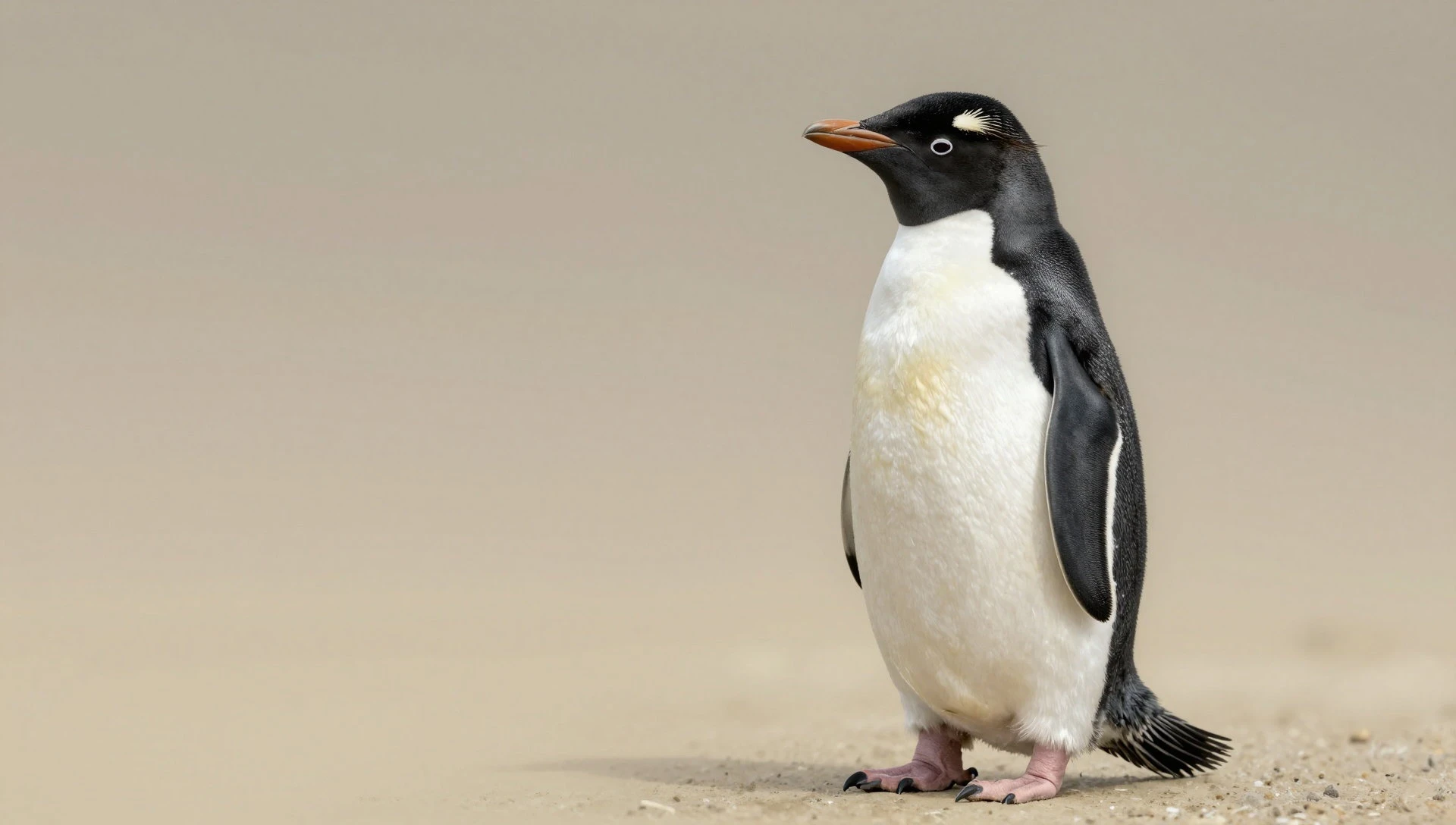
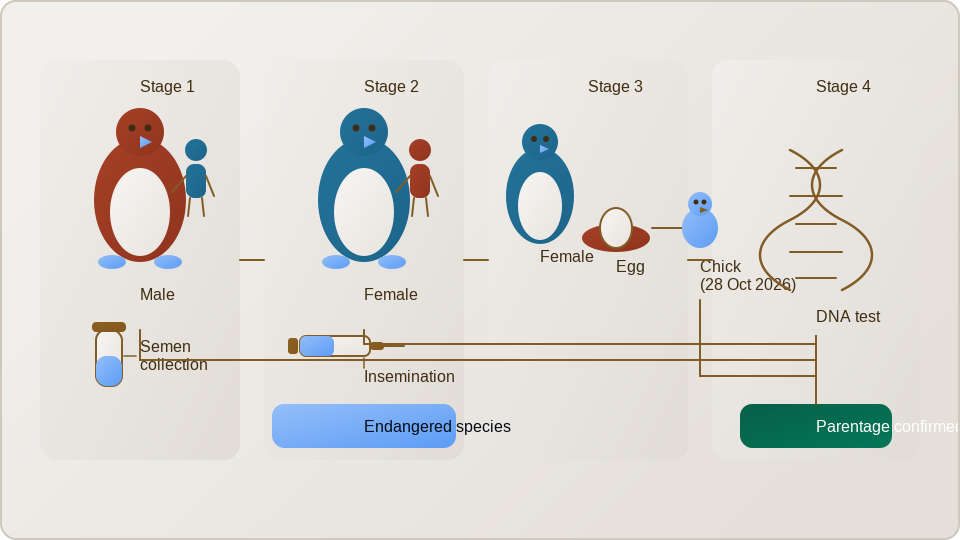
On 27 November 2026, Adventure World, a marine and wildlife theme park in Shirahama, Wakayama Prefecture, disclosed that it had produced a northern rockhopper penguin chick through artificial insemination — a result the facility describes as the first confirmed instance of its kind anywhere in the world. The announcement, delivered at a press conference on the Friday preceding the disclosure, rested on DNA testing that verified the chick hatched on 28 October was indeed conceived through the procedure rather than by natural pairing. For a species listed as endangered, the confirmation carries weight well beyond a single hatchling.
The chick's progress has been closely monitored since hatching, and the numbers tell a reassuring story. At the time of the briefing it weighed 561 grams, roughly nine times its birth weight, a growth trajectory that veterinarians and keepers regard as a strong indicator of healthy development. Northern rockhopper penguins are instantly recognisable by the vivid yellow plumes that crown their heads, a feature that has made them a favourite among visitors even as wild populations face mounting pressure from climate shifts, fisheries competition and disease.
What makes the result notable is not merely the birth itself but the technical ground it breaks. Artificial insemination in penguins has long been regarded as exceptionally difficult, owing to the birds' physiology, their sensitivity to handling and the narrow windows in which the procedure can succeed. Adventure World, which maintains approximately 470 penguins across ten species — the largest such collection in Japan — has spent years refining these techniques, and now intends to extend the method toward endangered emperor penguins. Park director Koji Imazu framed the achievement as a step-by-step commitment rather than a finish line.
On This Page
TL;DR Adventure World in Shirahama, Wakayama Prefecture, has confirmed the world's first artificial breeding of an endangered northern rockhopper penguin via artificial insemination, verified by DNA testing after a chick hatched on 28 October 2026. The chick is thriving at 561 grams, roughly nine times its hatch weight. The park, home to about 470 penguins from ten species, developed the technically demanding procedure over years and now hopes to apply it to endangered emperor penguins, positioning captive breeding as a meaningful conservation tool.
The Science Behind a World-First Penguin Birth
Artificial insemination in birds is not a novel concept in poultry science, but applying it to penguins introduces a distinct set of obstacles. Penguins are monogamous in the wild, form strong pair bonds, and respond poorly to the stress of restraint and handling. Their reproductive cycles are tightly synchronised with seasonal cues, and the window during which a female is receptive is brief. Success therefore depends on precise timing, careful husbandry and a deep familiarity with individual birds — conditions that a large, experienced collection like Adventure World's is unusually well placed to meet.
Why the Procedure Is Technically Demanding
The difficulty begins with the collection and preservation of viable semen, which must be handled within narrow temperature and time parameters to retain fertility. Insemination itself requires the female to be positioned safely and calmly, a task that demands skilled keepers and often months of habituation. Because penguins are prone to stress-related illness, every intervention carries risk. The park's achievement reflects not a single breakthrough but an accumulation of incremental refinements across many breeding seasons, each one tested against the health and behaviour of the birds involved.
Verification matters as much as the procedure. Claims of artificial breeding are only credible when genetic evidence rules out natural conception, and the park's reliance on DNA testing addresses precisely that concern. By confirming parentage through genetic analysis, Adventure World has produced a result that can withstand scientific scrutiny and serve as a reference point for other facilities. This evidentiary rigour is what elevates the announcement from an institutional curiosity to a documented contribution to conservation science.
The Role of DNA Confirmation
DNA testing in captive breeding programmes serves two purposes: it establishes parentage and it guards against inbreeding, which is a persistent hazard in small populations. For a species as genetically constrained as the northern rockhopper, maintaining accurate pedigrees is essential to any long-term breeding strategy. The confirmation that the October chick was conceived through the procedure therefore does double duty — it validates the technique and it enriches the genetic record of the captive population, providing data that future breeding decisions can build upon.
Beyond the laboratory, the confirmation carries institutional weight. Zoos and aquariums operate under increasing scrutiny from conservation bodies and the public alike, and claims of breeding success are expected to be substantiated. A verified world-first gives Adventure World a defensible basis for sharing its methods, publishing results and collaborating with international partners. It also sets a benchmark against which other facilities can measure their own efforts, accelerating the spread of proven practice across the captive-breeding community.
Adventure World and Japan's Penguin Husbandry Tradition
Adventure World occupies a distinctive position in Japanese zoological practice. Located on the coast of Wakayama Prefecture, the park has built its reputation on marine and avian collections, and its penguin holdings are the largest in the country by a considerable margin. Maintaining roughly 470 birds across ten species requires industrial-scale logistics — climate-controlled habitats, dedicated veterinary capacity, and a keeper corps trained to observe subtle changes in behaviour and health. That infrastructure is precisely what makes ambitious reproductive research feasible in the first place.
A Collection of Unusual Scale
Scale confers advantages that smaller facilities simply cannot replicate. With hundreds of birds, a park can study variation across individuals, identify the most receptive candidates for procedures, and absorb the occasional setback without jeopardising the wider population. It can also generate the longitudinal data that reproductive science depends upon — records of cycles, pairings, weights and outcomes accumulated over years. Adventure World's collection is therefore not merely an attraction but a research asset, one that underpins the credibility of its breeding claims.
Japan more broadly has a long and sophisticated tradition of aquarium and zoo science, with institutions that have contributed to captive breeding programmes for species ranging from sea turtles to migratory birds. This national context matters: the expertise required for artificial insemination is not built in isolation but through networks of keepers, veterinarians and researchers who share methods and results. Adventure World's announcement should be read as a product of that ecosystem as much as an individual institutional triumph.
From Visitor Attraction to Conservation Laboratory
Theme parks and aquariums occupy an ambiguous position in conservation discourse. They are commercial enterprises, dependent on ticket sales, yet many also function as genuine centres of research and as genetic reservoirs for species under threat in the wild. Adventure World's penguin programme illustrates this duality: the same birds that draw families to Shirahama are also subjects of a scientific effort with implications for endangered populations elsewhere. Recognising that overlap is essential to any fair assessment of what such institutions contribute.
The park's stated ambition to extend the technique to emperor penguins sharpens this point. Emperor penguins are among the most iconic and most vulnerable of Antarctic species, with projections suggesting significant population decline under current climate trajectories. Captive breeding cannot substitute for protecting wild habitat, but it can preserve genetic diversity and provide insurance against catastrophic loss. If the rockhopper result proves transferable, the conservation value could be substantial — though the park is careful to describe the path as incremental.
Conservation Stakes for the Northern Rockhopper
The northern rockhopper penguin inhabits some of the most remote and windswept islands on Earth, breeding on Tristan da Cunha, Gough Island and Amsterdam Island in the southern oceans. Its population has fallen sharply over recent decades, a decline attributed to shifts in marine food webs, competition with commercial fisheries, disease outbreaks and the increasing frequency of extreme weather events. Classified as endangered, the species exemplifies the pressures bearing down on seabirds globally, and its trajectory has alarmed conservation biologists for years.
A Species Under Pressure
Remote island breeders are notoriously difficult to monitor, and the rockhopper's isolation complicates both research and intervention. Population estimates rely on periodic surveys that can miss rapid declines, and the drivers of mortality often operate far from the breeding colonies themselves, in ocean currents and foraging grounds that shift with climate patterns. Conservation therefore depends on multiple strategies working in parallel: marine protected areas, fisheries regulation, disease surveillance and, where feasible, captive assurance populations that can safeguard genetic material against sudden catastrophe.
Captive breeding programmes are sometimes dismissed as marginal, yet for species facing acute and compounding threats they can provide a genuine buffer. A genetically diverse captive population offers a reservoir from which reintroduction or reinforcement might one day draw, and it generates the husbandry knowledge that such efforts require. The rockhopper chick at Adventure World is a single bird, but it represents a capability — the ability to reproduce an endangered species under managed conditions — that did not previously exist with confirmed success.
What a Single Chick Signifies
It is tempting to overstate the significance of one hatchling, and equally tempting to dismiss it. The honest assessment lies between: a single birth does not reverse a species' decline, but a proven technique changes what is possible. Artificial insemination can circumvent the pairing failures that plague small captive groups, allow genetic material to be exchanged between facilities without transporting animals, and preserve lineages when natural reproduction stalls. Each of these capabilities compounds over time, and their availability is what distinguishes a managed programme from a passive collection.
The park's leadership has been careful to frame the result in these measured terms. Koji Imazu's language — improving the technique, continuing efforts step by step — reflects an understanding that conservation breeding is a long game measured in generations rather than headlines. That restraint is itself noteworthy in an era of breathless scientific announcements, and it lends credibility to the park's longer-term ambitions, including the eventual application of the method to emperor penguins.
Similar Posts
- 01
- 02
- 03
- 04
Emperor Penguins and the Road Ahead
The most consequential implication of the rockhopper result lies in what it might enable next. Emperor penguins, the tallest and heaviest of all living penguin species, present a considerably harder problem for captive breeding. They are large, slow to mature, sensitive to environmental conditions, and notoriously difficult to maintain in captivity at all. Any programme aiming to reproduce them artificially would demand facilities, expertise and patience on a scale that few institutions could sustain — which is precisely why a proven technique in a related species matters.
Why Emperor Penguins Present a Harder Problem
Emperor penguins breed during the Antarctic winter, enduring temperatures and darkness that no captive environment reproduces faithfully. Their reproductive cycles are long, their chicks dependent for extended periods, and their physiological tolerances narrow. Transferring a technique validated on rockhoppers to emperors is therefore not a simple substitution but a research programme in its own right, requiring adaptation of every step from semen handling to incubation. The park's stated hope is realistic only as a multi-year endeavour with uncertain intermediate milestones.
Yet the conservation logic is compelling. Emperor penguins face projections of severe decline as sea ice retreats, and their dependence on stable fast ice for breeding makes them acutely vulnerable to warming. International discussions have increasingly treated the species as a climate-change emblem, and any tool that could help maintain a captive population or preserve genetic diversity deserves serious examination. The rockhopper chick is a first step on a path whose endpoint remains distant but is no longer purely hypothetical.
Ethics, Oversight and Public Trust
Reproductive technology in animal collections raises legitimate ethical questions that institutions must answer transparently. Interventions carry welfare risks for individual birds, and the purpose of breeding — conservation, research or visitor appeal — should be clearly articulated. Adventure World's decision to submit its result to DNA verification and to announce it publicly, with specific figures and dates, reflects a commendable openness. Public trust in conservation breeding depends on exactly this kind of verifiable disclosure rather than promotional claims.
Oversight bodies, both national and international, will have a role in assessing how the technique is applied going forward. Standards for animal welfare, genetic management and record-keeping exist precisely to prevent well-intentioned programmes from causing harm. If Adventure World's method spreads to other facilities, as successful techniques tend to do, the accompanying governance will determine whether the conservation benefits outweigh the costs. The park's measured public posture suggests an awareness of that responsibility.
Reading the Announcement in Context
Scientific announcements of "world firsts" invite scepticism, and rightly so. The phrase is often deployed loosely, and the underlying achievement can shrink under scrutiny. In this instance, however, the claim is unusually well bounded: a specific species, a specific procedure, a specific hatch date, and independent genetic verification. The park has not claimed that artificial insemination in penguins is easy, nor that the result solves the species' conservation problems. It has claimed a documented first, supported by evidence, and framed future work as incremental. That is a defensible position.
Separating Substance from Spectacle
The media environment around conservation news tends to reward drama over nuance. Headlines about a "miracle chick" obscure the years of unglamorous work — record-keeping, veterinary monitoring, failed attempts — that precede any success. Readers would do well to hold both ideas simultaneously: the birth is genuinely significant as a technical milestone, and it is genuinely modest as a conservation intervention. Neither framing alone captures the reality, and institutions that encourage the more measured reading deserve credit for doing so.
There is also a broader lesson about how scientific capability accumulates. Breakthroughs in reproductive biology rarely arrive as sudden flashes; they emerge from institutions with the patience to invest in unglamorous infrastructure and the discipline to document results rigorously. Adventure World's penguin collection, built over decades, provided the substrate for this achievement. The lesson applies well beyond zoology: durable capability is usually the product of sustained institutional commitment rather than individual genius or lucky accident.
What to Watch Next
Several developments will determine whether this result proves consequential. First, whether the technique can be replicated — by Adventure World in subsequent seasons and by other facilities with comparable collections. Second, whether the park publishes detailed methodology, allowing independent assessment and refinement. Third, whether any progress is made toward the emperor penguin ambition, which remains the most ambitious element of the stated plan. Each of these will be observable over the coming years, and each will test the credibility of the initial claim.
For now, the record stands: a northern rockhopper chick, hatched on 28 October 2026, weighing 561 grams and growing steadily, confirmed by DNA analysis as the product of artificial insemination. It is a small bird with a large symbolic footprint, and its significance will be measured not by the headlines it generated but by what the technique it represents goes on to accomplish. Conservation is a discipline of accumulated small victories, and this is one of them.
From our network :
- The Hidden Cost of AI Convenience: Why Over-Permissioned Agents Are a Security Time BombDiscover why AI agents with excessive permissions create dangerous single points of failure, and learn how implementing least privilege principles can protect your organization from exploitation.
- CISA’s Ten-Advisory Wave: Why Generic Patching Fails in OT and How to Build Product-Specific PlaybooksCISA released ten ICS advisories in one week, exposing critical infrastructure risks. Generic patching fails in OT. Learn to build product-specific remediation playbooks.
- Committed Mediterranean Precipitation Decline: Why Emissions Cuts Alone Cannot Restore Winter RainsNew NOAA research reveals that Mediterranean winter rains may decline irreversibly even with emissions cuts. Explore the science of committed climate change and regional impacts.
- The Final Descent: How ESA Retired the Legendary Cluster Constellation After 24 Years of Space Weather ScienceAfter 24 years mapping Earth’s magnetosphere, ESA’s Cluster mission concluded with a precisely controlled reentry over the South Pacific. This analysis explores the scientific legacy, engineering decisions, and debris mitigation principles behind one of space exploration’s most responsible retirements.
- Mobile Learning and VR in English: What Global Evidence Reveals About Effective Language TechnologyA systematic review across 14 countries reveals which language-learning technologies genuinely work. Mobile learning, AI, and VR show measurable benefits when pedagogically integrated. This evidence-based guide helps educators and learners select technology that delivers real return on investment.
- Forbidden Matrix Patterns and Visible Lattice Points: A Geometric DictionaryExplore how multidimensional 0–1 matrices encode geometric truths, linking forbidden patterns to visible lattice points and hypergraph theory, with applications in combinatorics and computational geometry.
- University Language Proficiency Exams: Why Institutional Tests Demand Different Preparation Than IELTS and TOEFLDiscover why university-specific language proficiency examinations differ fundamentally from IELTS and TOEFL, and learn strategic preparation approaches for institutional assessment success.
- Live Online English Classes for Kids: Do They Actually Reduce Anxiety?A ten-week study reveals that synchronous online English classes can significantly reduce child language anxiety while improving listening and reading skills. Discover what makes these programs effective and how parents can select the right one.
- How AI Agents Will Change the Way We Manage Personal FinancesExplore how AI agents are transforming personal finance through automated budgeting, bill payment, and investment management, while examining the critical security protocols and governance frameworks required for safe deployment.
RESOURCES
- World's first artificially bred endangered penguin bornwww3.nhk.or.jp17 hours ago ... ... bred an endangered northern rockhopper penguin through artificial insemination. It says it is the first confirmed case in the…
- Japan zoo breeds endangered penguin by artificial insemination in ...asia.nikkei.com1 day ago ... TANABE, Japan (Kyodo) -- A Japanese zoo said Friday it has succeeded in breeding an endangered northern rockhopper penguin by…
- Japan zoo breeds endangered penguin by artificial insemination in ...facebook.com1 day ago ... This news report from CTV+ covers an aquarium in Sichuan Province, China, that has successfully bred penguins on its own.
- Japan's zoo claims world first in artificial breeding of endangered ...kz.kursiv.media1 day ago ... The Adventure World zoo in Japan announced the successful breeding of an endangered northern rockhopper penguin through artificial insemination.
- Japan Zoo Succeeds in World-1st Rare Penguin Artificial Inseminationnippon.com1 day ago ... ... breeding the endangered northern rockhopper penguin through artificial insemination. The penguin, known scientifically as Eudyptes moseleyi ...
- How Artificial Insemination Helps Zoos Save Penguinsnatureworldnews.com24 hours ago ... ... penguin artificial insemination works, notable successes and the limits of captive breeding. ... insemination worked for endangered penguins ...
- Nikkei Asia on X: "Japan zoo breeds endangered penguin by ...x.com1 day ago ... Japan zoo breeds endangered penguin by artificial insemination in world 1st https://t.co/TmLW4I6F85.
- Japanese Park Breeds an Endangered Northern Rockhopper ...natureworldnews.com1 day ago ... A Japanese park says a northern rockhopper penguin chick was conceived by artificial insemination, a DNA-confirmed first for this endangered ...
- Kyodo News | Japan on X: "New on Japan Wire: TANABE, Japan - Xx.com2 days ago ... ... breeding an endangered northern rockhopper penguin by artificial insemination for the first time in the world, having confirmed the…
- Japanese park first to breed rare penguin by artificial inseminationnationthailand.com11 hours ago ... ... breed an endangered northern rockhopper penguin using artificial insemination. The procedure resulted in a single chick that hatched on ...
- A world first! Successful artificial insemination using frozen sperm ...en-61698.site-translation.com... breeding and contribute to the preservation of the endangered Southern rockhopper penguin species in the wild. About the Southern rockhopper penguin.
- Japan zoo breeds endangered penguin by artificial inseminationreddit.com1 day ago ... Japan zoo breeds endangered penguin by artificial insemination in world first Read more at straitstimes.com.
- Reproductive physiology of the female Magellanic penguin ...sciencedirect.com... artificial insemination (AI) every 4–7 ... Many species of seabirds, including the only penguin species breeding on the African continent, are threatened with ...
- World's first successful artificial insemination of southern rockhopper ...kobe-u.ac.jpJun 28, 2016 ... ... breeding habits of southern rockhopper penguins and develop the technology for their artificial insemination. In spring 2015 the group ...
- Endangered Species and Artificial Insemination: A Natural Fit?faunalytics.orgSep 12, 2015 ... Meanwhile, captive breeding—and the captivity of wild animals in general—raises a wide range of concerns. Since this article was published,…
Related By Tags
- 01
- 02
- 03
- 04
- 05
- 06
- 07
- 08
0 Comments