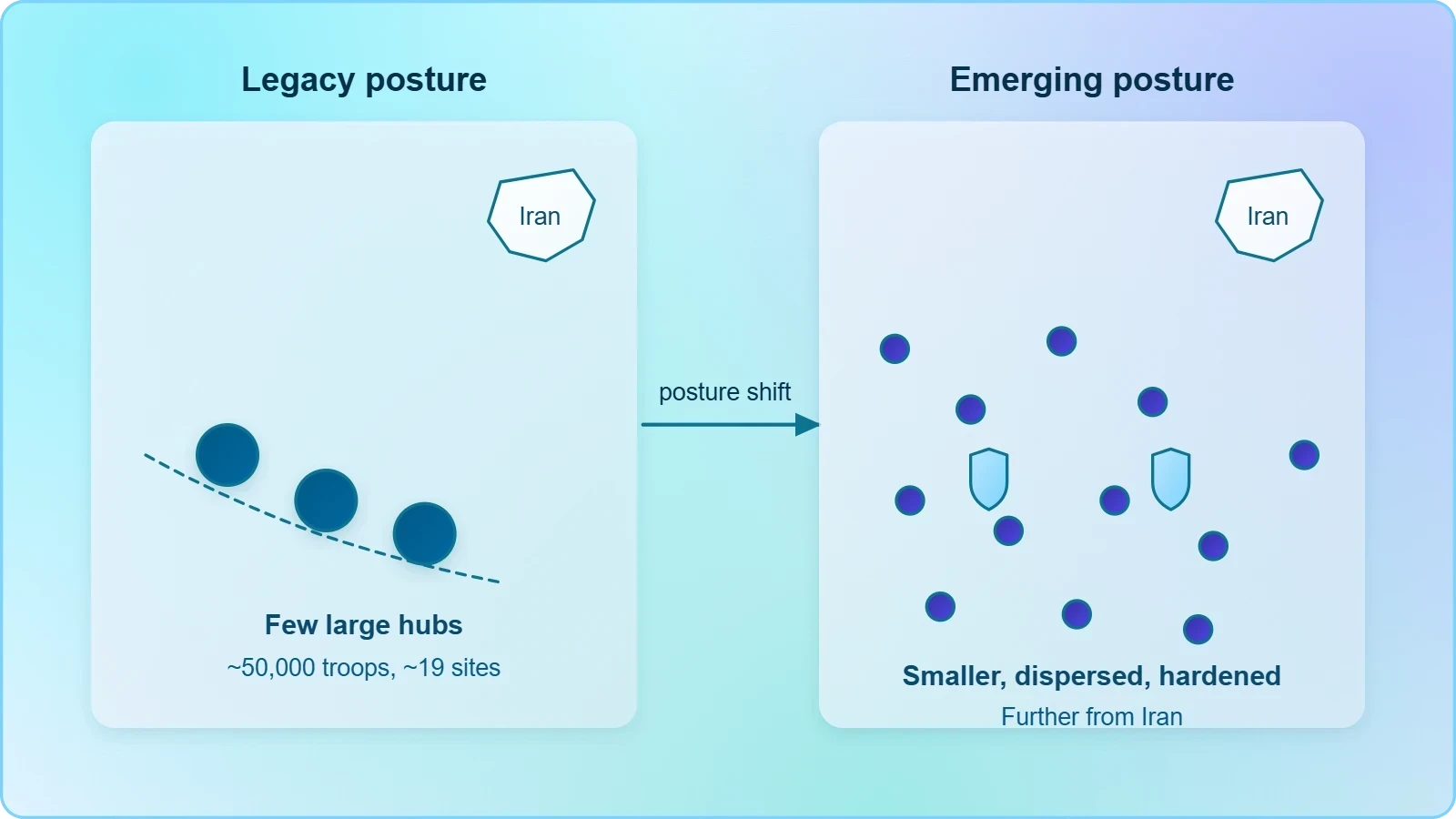
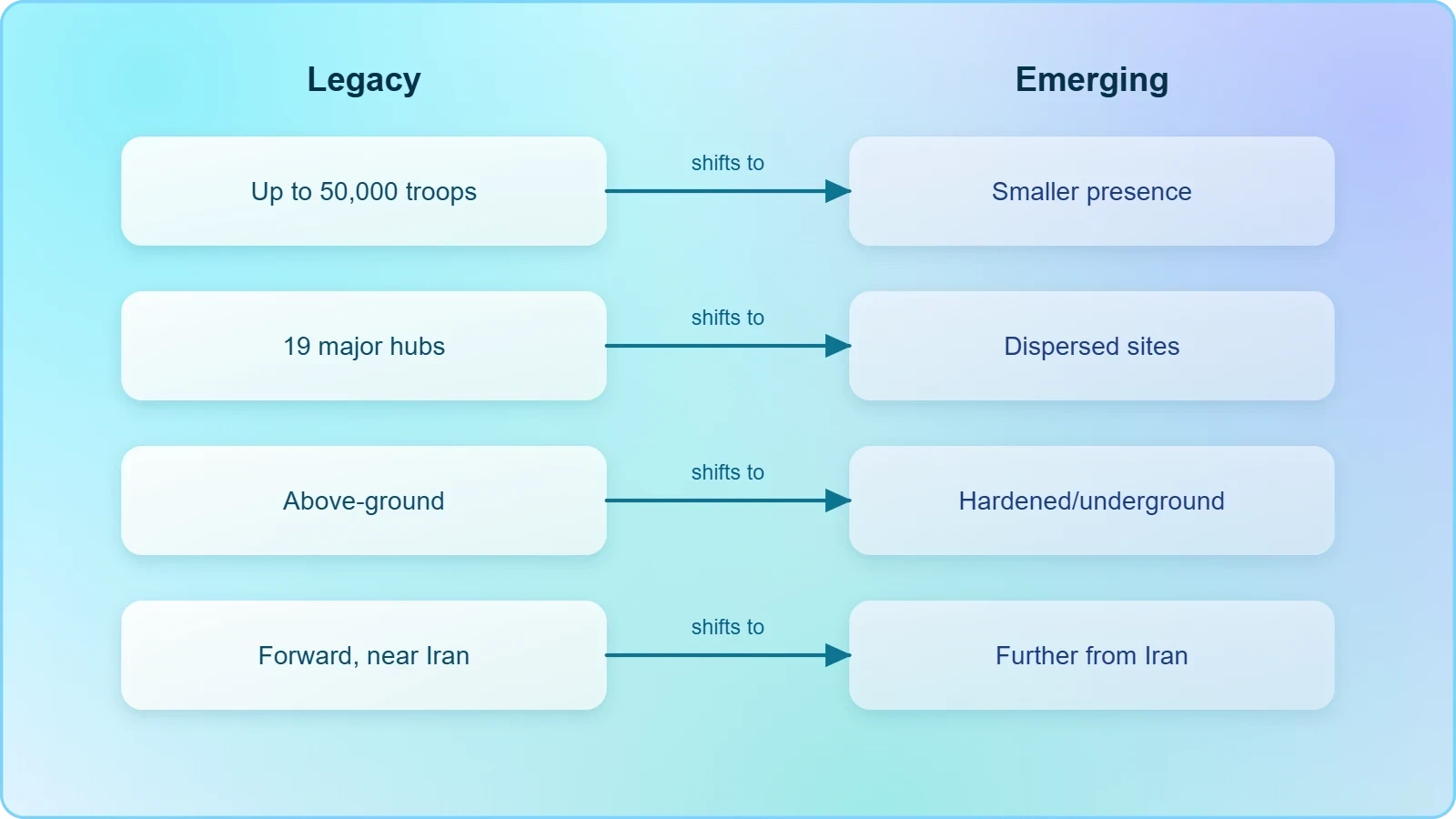
The United States has spent the better part of three decades assembling one of the most elaborate force-posture architectures in modern military history, anchoring roughly 50,000 personnel and some 19 major installations across Bahrain, Jordan, Saudi Arabia, Qatar, and the wider Gulf littoral. That architecture was designed for a different era of conflict—one of air superiority, predictable adversaries, and fixed bases that could absorb punishment while projecting power outward. The tenth month of the US-Israel war on Iran has subjected that assumption to a brutal stress test, and the results are forcing strategists in Washington to reconsider not merely where American forces stand, but whether the permanent, concentrated footprint that defined the post-1991 order can survive the precision-weapon age at all.
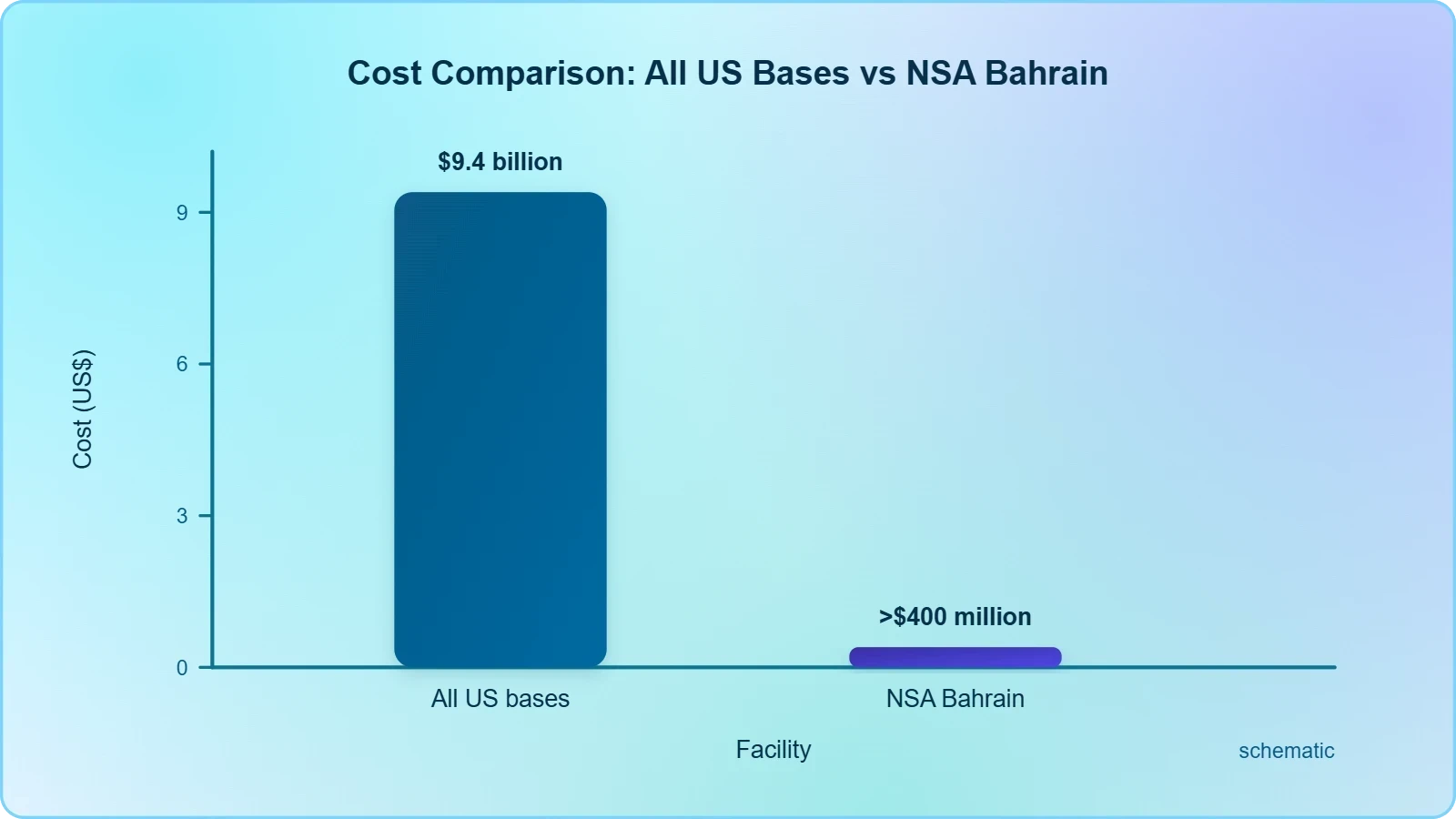
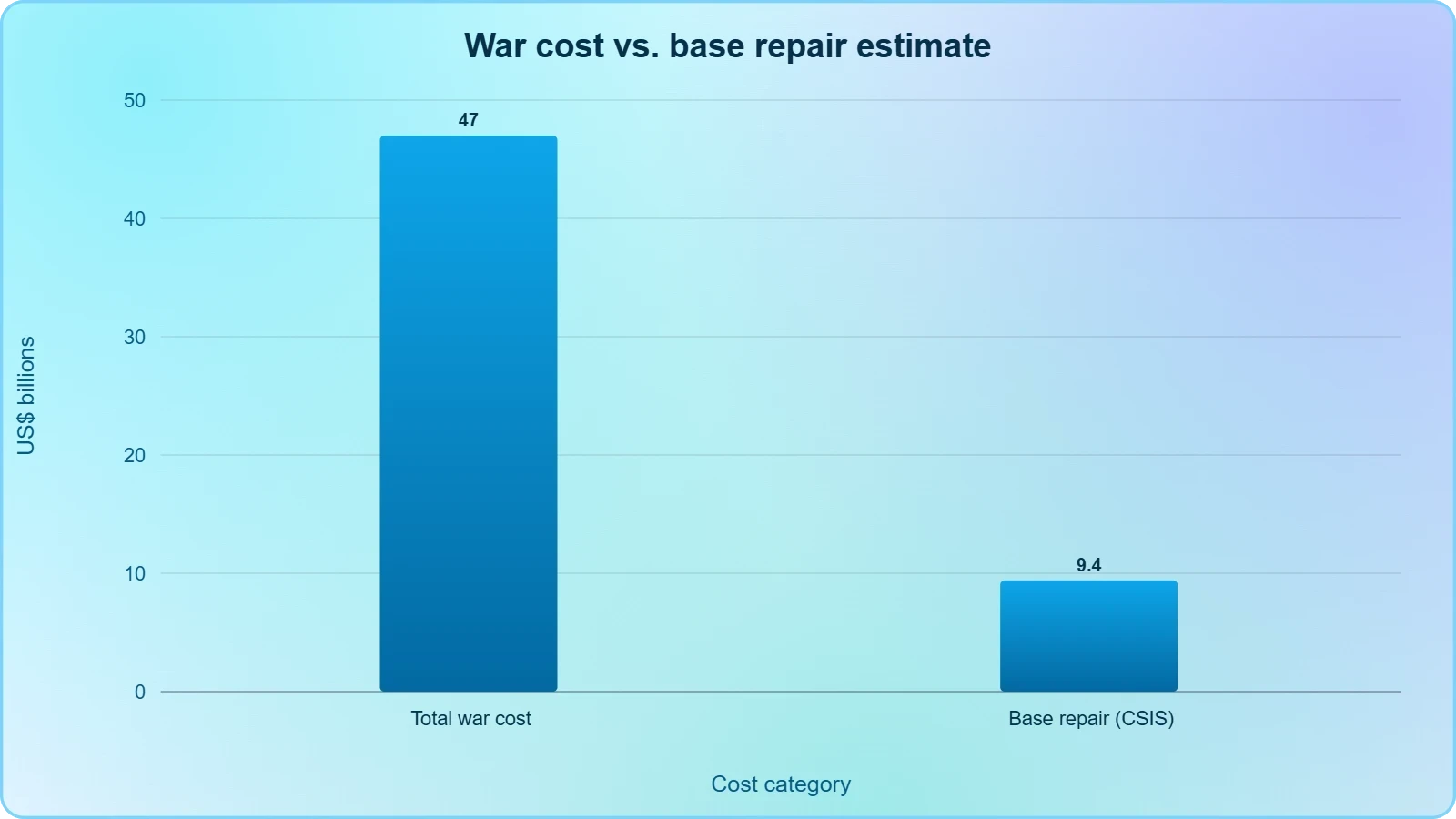
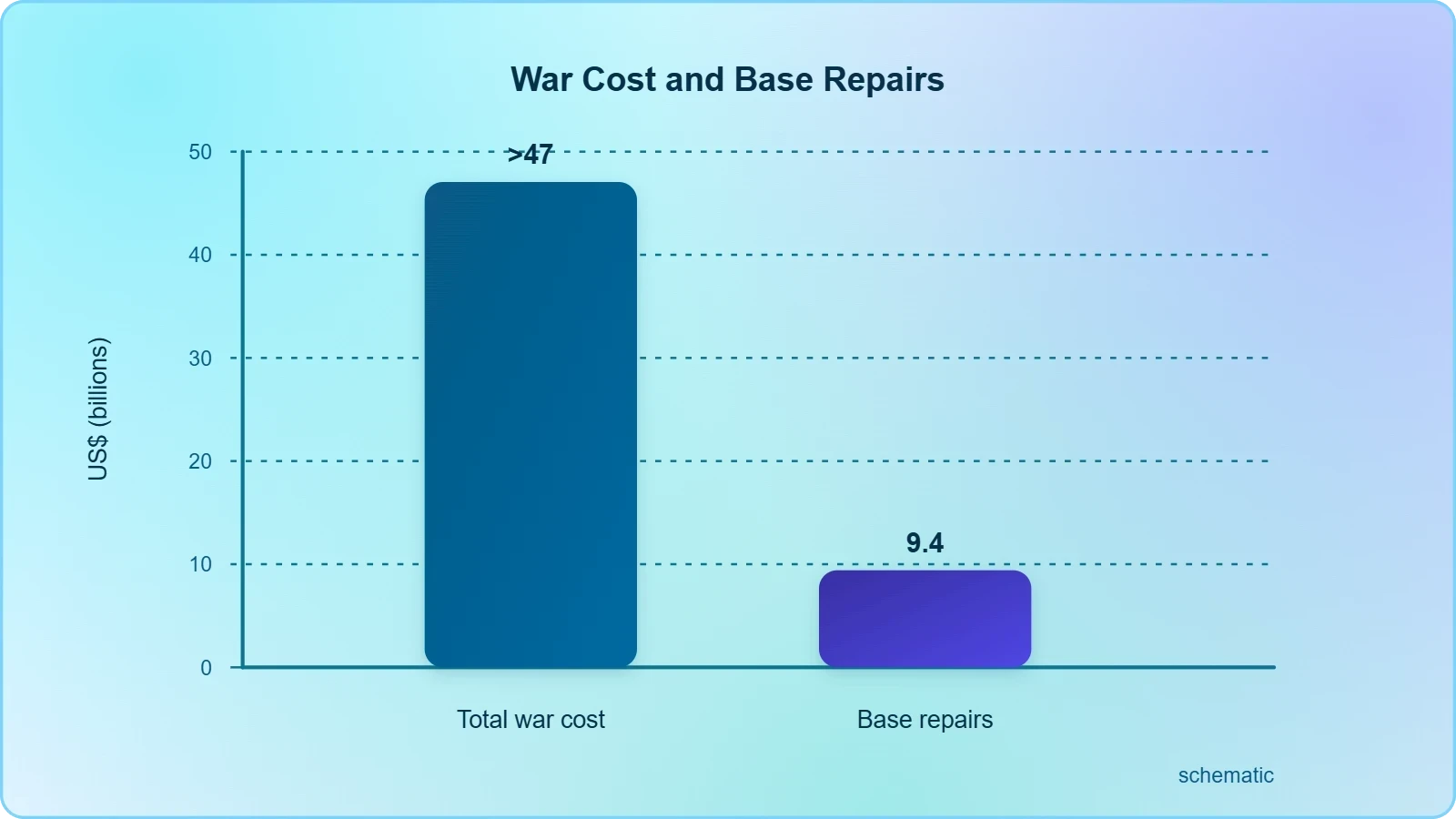
What has emerged from the conflict is a portrait of vulnerability that is both physical and conceptual. Iranian attacks since February 28 have damaged hundreds of structures across the theater, and the Center for Strategic and International Studies estimates that repairing the wreckage at US bases alone could approach $9.4 billion. Naval Support Activity Bahrain, the home of the Fifth Fleet and the symbolic heart of American naval power in the Gulf, absorbed serious damage early in the war, with repair costs projected above $400 million. A Department of Defense inspector general report in September confirmed the loss of dozens of aircraft, including F-35A and F-15E fighter jets, while Pentagon figures put the cumulative cost of the war beyond $47 billion by October. These are not abstract ledger entries; they are the measurable price of defending fixed positions against an adversary that has learned to reach them.
The strategic consequence, as analysts at Brookings and CSIS describe it, is a likely transition toward a posture that is "smaller, more dispersed, more hardened, and generally further away from Iran." That phrase, offered by Brookings senior fellow Michael O'Hanlon, captures a doctrinal shift with implications far beyond the Pentagon's force-sizing tables. It touches the sovereign calculations of host nations, the economics of Gulf real estate and defense procurement, and the credibility of American security guarantees that regional partners have built their foreign policies around. Understanding this shift requires examining the damage itself, the reconstruction calculus, and the longer geopolitical ripples that will shape the Middle East long after the shooting stops.
On This Page
- The Anatomy of a Vulnerable Force Posture
- The Reconstruction Calculus and the Limits of Rebuilding
- Dispersal, Hardening, and the New Geometry of Deterrence
- Host Nations and the Politics of a Shrinking Footprint
- The Wider Strategic Consequences Beyond the Gulf
- Conclusion: A Posture Transformed by Evidence
TL;DR The US-Israel war on Iran has exposed the fragility of America's concentrated, permanent military footprint in the Middle East, where roughly 50,000 troops and 19 major installations have absorbed hundreds of Iranian strikes since February 28. With repair costs at US bases estimated near $9.4 billion, war costs exceeding $47 billion by October, and dozens of aircraft lost, analysts expect Washington to move toward a smaller, more dispersed, and more hardened posture—possibly relocating flagship facilities such as Naval Support Activity Bahrain and the Combined Air Operations Center at Al Udeid underground. The shift will reshape host-nation relationships, regional deterrence, and the physical map of American power in the Gulf.
The Anatomy of a Vulnerable Force Posture
For most of the post-Cold War period, American military planners treated the Middle East as a theater where access mattered more than survivability. Large, permanent installations offered logistics depth, command-and-control coherence, and visible reassurance to partners. The assumption was that no regional adversary could sustain the kind of precision strike campaign needed to threaten these hubs simultaneously. The war with Iran has invalidated that assumption with unusual clarity, demonstrating that a determined state actor can impose costs across multiple bases at once, degrading infrastructure, aircraft, and the psychological confidence that underpins deterrence. The result is a posture that now looks less like a shield and more like a collection of high-value targets awaiting the next salvo.
The Scale of Physical Damage
The damage inventory compiled since February 28 reads like a catalog of vulnerabilities rather than a battle report. Hundreds of structures across the theater have been struck, ranging from hangars and fuel depots to command facilities and housing. The Department of Defense inspector general's September findings confirmed the loss of dozens of aircraft, including front-line F-35A and F-15E fighters, which represents not only hardware loss but a blow to the sortie-generation capacity that underwrites American air dominance. Each destroyed airframe carries a replacement cost measured in tens of millions of dollars and a training pipeline measured in years, compounding the immediate financial toll with a longer readiness deficit that will persist well after reconstruction begins.
Naval Support Activity Bahrain stands as the most symbolically charged casualty. As the home of the Fifth Fleet, it anchors American naval presence in the Gulf and the broader Central Command area of responsibility. Early-war damage there, with repair estimates exceeding $400 million, signaled that even the most established and defended facilities are not immune to sustained attack. The concentration of command, logistics, and personnel functions at a single coastal location—long a convenience for efficiency—now appears as a liability that adversaries can exploit with relatively modest expenditure of precision munitions, forcing a rethinking of how naval power is based and sustained in contested waters.
The Financial Ledger of Attrition
By October, Pentagon figures placed the total cost of the war above $47 billion, a figure that encompasses munitions expended, operations conducted, and damage sustained. The CSIS estimate of $9.4 billion for repairing base infrastructure alone illustrates how quickly the physical toll compounds. These numbers matter not merely as accounting; they shape congressional appetite for sustained operations, influence allied burden-sharing negotiations, and constrain the resources available for modernization elsewhere. A war fought to protect a posture has begun to consume the very resources that posture was meant to preserve, a paradox that defense economists will study for years as a case of strategic overextension in the precision-strike era.
We Also Published
The Reconstruction Calculus and the Limits of Rebuilding
Mark Cancian, a senior adviser at CSIS, has articulated the practical logic that will govern the post-war period: rebuilding is unlikely until the war ends, and even then, not every struck site will be restored. This is a departure from the instinct that has guided American base recovery in previous conflicts, where the default assumption was full restoration. The new calculus weighs the cost of reconstruction against the likelihood of renewed attack, and in several cases the arithmetic favors abandonment or relocation over repair. The question facing planners is not whether the United States can rebuild, but whether rebuilding the same facilities in the same places makes strategic sense when the adversary has demonstrated both the intent and the capacity to strike them again.
Selective Restoration and Strategic Abandonment
The prospect that some damaged sites will simply not be rebuilt carries profound implications for host nations. A base that is abandoned signals a recalibration of American commitment, even if Washington insists otherwise. Conversely, a base that is rebuilt underground or relocated signals a long-term intention to stay, albeit in a different form. Cancian's expectation that facilities like the Bahrain headquarters and the Combined Air Operations Center at Al Udeid may be moved underground reflects a hardening imperative that will drive engineering decisions for a generation. Underground command facilities are expensive, slow to build, and difficult to expand, but they offer survivability that above-ground structures cannot match against precision munitions.
The Al Udeid Combined Air Operations Center is particularly consequential because it coordinates air power across the entire theater. Relocating such a facility underground would require years of construction and significant investment, but the alternative—leaving a critical node exposed to attack—has been rendered untenable by the war's evidence. The same logic applies to naval command functions in Bahrain, where the concentration of leadership and communications infrastructure at a single coastal site represents a single point of failure that adversaries have already exploited. The shift underground is not merely a construction project; it is an admission that the previous model of basing assumed a level of safety that no longer exists.
The Temporal Problem of Post-War Planning
Reconstruction cannot begin in earnest until the conflict ends, which creates a temporal gap during which the United States must operate with degraded infrastructure and reduced capacity. Cancian's observation that rebuilding awaits a ceasefire or a more stable situation highlights a structural problem: the war's duration is not controlled by Washington, and every month of continued conflict adds to the damage inventory while deferring the recovery. This creates a compounding dynamic in which the posture degrades faster than it can be restored, potentially forcing interim workarounds—temporary facilities, allied-hosted alternatives, or reliance on naval and expeditionary platforms—that may themselves become permanent features of the new posture.
Dispersal, Hardening, and the New Geometry of Deterrence
O'Hanlon's formulation—smaller, more dispersed, more hardened, and generally further away from Iran—describes a posture that trades concentration for survivability. Dispersal reduces the value of any single target and forces an adversary to expend more munitions to achieve the same effect. Hardening, whether through underground construction or reinforced structures, raises the cost of each successful strike. Distance from Iran reduces warning time for defenders but also reduces the number of facilities within easy reach of short- and medium-range systems. Together, these principles point toward a force posture that is less visible, less symbolic, and more resilient, but also less reassuring to partners who have relied on the tangible presence of American power as a deterrent signal.
The Trade-Offs of Dispersal
Dispersal is not a cost-free strategy. Spreading forces across more locations multiplies the logistics burden, complicates command and control, and increases the personnel required to sustain operations. Each additional site requires its own security, communications, and supply chain, and the aggregate cost can exceed that of a smaller number of large, efficient hubs. The war has demonstrated that efficiency and survivability are in tension, and the new posture will resolve that tension in favor of survivability, accepting higher operating costs and greater managerial complexity as the price of resilience. This shift will reshape procurement priorities, favoring mobile and modular systems over fixed infrastructure and emphasizing redundancy across the theater.
The human dimension of dispersal deserves equal attention. Spreading personnel across more sites means more isolated deployments, more rotational churn, and potentially greater strain on service members and their families. The social and psychological costs of a dispersed posture are rarely captured in strategic analyses, but they influence retention, readiness, and the political sustainability of overseas commitments. A military that is smaller and more dispersed may be more survivable, but it will also be more demanding on the individuals who man it, and that burden will shape recruitment and retention debates for years to come.
Hardening as Strategic Signal
Moving command facilities underground is expensive and slow, but it also sends a signal that the United States intends to remain in the region for the long term. A hardened facility cannot be quickly abandoned, and its construction represents a commitment of resources that adversaries can read as evidence of staying power. This signaling function may be as important as the physical protection it provides, particularly for partners who worry that American attention is shifting toward other theaters. The underground command center becomes a tangible answer to the question of whether Washington will still be present in a decade, even as the overall footprint shrinks and disperses.
Host Nations and the Politics of a Shrinking Footprint
The countries that host American forces—Bahrain, Qatar, Jordan, Saudi Arabia, and others—will experience the posture shift as a direct challenge to their own strategic calculations. For decades, these partnerships have been built on the assumption that a large, permanent American presence would deter adversaries and underwrite regional stability. A smaller, more dispersed, and more distant footprint changes that bargain. Host governments must now weigh whether the remaining presence provides sufficient reassurance, whether they need to diversify their security relationships, and how to manage domestic constituencies that may view a reduced American role as either a welcome assertion of sovereignty or an alarming sign of abandonment.
The Bahrain and Qatar Cases
Bahrain and Qatar occupy particularly sensitive positions because they host the two most consequential command nodes in the theater. Bahrain's Fifth Fleet headquarters and Qatar's Al Udeid airbase are not merely military facilities; they are anchors of bilateral relationships that have shaped these small states' foreign policies for decades. If command functions relocate underground or partially disperse, the host nations will need to negotiate new terms that reflect the changed physical and strategic reality. The negotiations will touch on sovereignty, cost-sharing, and the political symbolism of foreign troops on national soil, and they will unfold against a backdrop of heightened regional uncertainty that makes every concession more consequential.
For Bahrain, the damage to Naval Support Activity and the prospect of partial relocation raise questions about the future of a relationship that has been central to the kingdom's security since independence. For Qatar, the possibility that the Combined Air Operations Center could move underground or be reconfigured creates both an opportunity to deepen the partnership through infrastructure investment and a risk that the facility's strategic value to Qatar diminishes if it becomes less visible. Both governments will seek assurances that the United States remains committed, even as Washington's physical presence becomes less imposing and more dispersed across the region.
Regional Perceptions and Deterrence Credibility
Deterrence is as much a psychological phenomenon as a physical one, and the visible shrinkage of American presence will be read by allies and adversaries alike as a signal about American resolve. Iran may interpret a smaller footprint as evidence that its attacks succeeded in pushing the United States back, potentially encouraging further pressure. Gulf partners may interpret the same shift as a warning that American protection is becoming more conditional and less automatic. Managing these perceptions will require careful diplomacy and sustained engagement, because the credibility of deterrence depends on the belief that the United States will remain engaged even when its forces are less concentrated and less visible than before.
The Wider Strategic Consequences Beyond the Gulf
The posture shift in the Middle East will reverberate well beyond the region's borders. A smaller American footprint in the Gulf affects the global force-management calculus, potentially freeing resources for other theaters or, alternatively, signaling a broader retrenchment that allies in Europe and Asia will study closely. The war's costs—$47 billion and counting, with $9.4 billion in base repairs—will shape budget debates and force modernization priorities for years. The conflict has also provided a live demonstration of how precision-strike capabilities can threaten fixed infrastructure, a lesson that militaries worldwide will absorb and apply to their own basing assumptions, from the Pacific to the Baltic.
Lessons for Global Basing Doctrine
The Middle East experience offers a case study in the vulnerability of concentrated, permanent basing that will influence how the United States and its allies think about facilities everywhere. The principles of dispersal, hardening, and distance are not region-specific; they apply wherever an adversary possesses precision-strike capabilities and the intent to use them. The Pacific theater, where large bases in Japan and Guam face a comparable threat environment, will likely see accelerated adoption of these principles. The war has thus functioned as an unintended experiment whose results will inform basing decisions globally, even as the specific circumstances of the Gulf remain unique.
Allied militaries are watching closely because the lessons apply to their own facilities as well. European NATO members, many of which host American forces and maintain their own concentrated bases, will need to consider whether their infrastructure is resilient against the kinds of attacks that damaged US sites in the Gulf. The war has thus accelerated a broader conversation about the survivability of fixed military infrastructure in an era of precision munitions, a conversation that will shape defense procurement and construction budgets across the alliance for the next decade and beyond.
The Long Shadow of the Conflict
The war's tenth month has produced a strategic inflection point whose full consequences will not be clear for years. The shift toward a smaller, more dispersed, and more hardened posture is likely to proceed gradually, shaped by ceasefire negotiations, host-nation politics, and budget constraints. But the direction is set, and the assumptions that underpinned the previous posture have been discredited by events. The Middle East that emerges from this conflict will be one in which American power is less visible, more resilient, and more carefully calibrated to the threats of the precision-strike age—a transformation that will define the region's security landscape for a generation.
Conclusion: A Posture Transformed by Evidence
The war on Iran has done more than damage buildings and aircraft; it has invalidated a set of assumptions that shaped American military posture for a generation. The concentration of forces at a small number of large, fixed installations was a rational response to the threats of an earlier era, but it has proven ill-suited to an adversary armed with precision munitions and the will to use them. The shift toward a smaller, more dispersed, more hardened, and more distant posture is not a retreat but an adaptation, driven by the evidence of ten months of conflict and the counsel of analysts who have studied the damage closely. The United States will remain in the Middle East, but it will do so differently.
That difference will be felt most acutely by the host nations whose territories have hosted American forces for decades, and by the service members who will operate from more numerous, more isolated, and more heavily protected sites. It will be felt in defense budgets strained by $47 billion in war costs and $9.4 billion in repairs, and in the strategic calculations of allies and adversaries who will read the posture shift as a signal about American resolve. The full shape of the new posture will emerge only after a ceasefire and years of construction, but the direction is clear, and the Middle East that emerges will be one in which American power is less visible, more resilient, and more carefully calibrated to the precision-strike age.
From our network :
- Live Online English Classes for Kids: Do They Actually Reduce Anxiety?A ten-week study reveals that synchronous online English classes can significantly reduce child language anxiety while improving listening and reading skills. Discover what makes these programs effective and how parents can select the right one.
- CISA’s Ten-Advisory Wave: Why Generic Patching Fails in OT and How to Build Product-Specific PlaybooksCISA released ten ICS advisories in one week, exposing critical infrastructure risks. Generic patching fails in OT. Learn to build product-specific remediation playbooks.
- Mobile Learning and VR in English: What Global Evidence Reveals About Effective Language TechnologyA systematic review across 14 countries reveals which language-learning technologies genuinely work. Mobile learning, AI, and VR show measurable benefits when pedagogically integrated. This evidence-based guide helps educators and learners select technology that delivers real return on investment.
- The Final Descent: How ESA Retired the Legendary Cluster Constellation After 24 Years of Space Weather ScienceAfter 24 years mapping Earth’s magnetosphere, ESA’s Cluster mission concluded with a precisely controlled reentry over the South Pacific. This analysis explores the scientific legacy, engineering decisions, and debris mitigation principles behind one of space exploration’s most responsible retirements.
- How AI Agents Will Change the Way We Manage Personal FinancesExplore how AI agents are transforming personal finance through automated budgeting, bill payment, and investment management, while examining the critical security protocols and governance frameworks required for safe deployment.
- The Hidden Cost of AI Convenience: Why Over-Permissioned Agents Are a Security Time BombDiscover why AI agents with excessive permissions create dangerous single points of failure, and learn how implementing least privilege principles can protect your organization from exploitation.
- University Language Proficiency Exams: Why Institutional Tests Demand Different Preparation Than IELTS and TOEFLDiscover why university-specific language proficiency examinations differ fundamentally from IELTS and TOEFL, and learn strategic preparation approaches for institutional assessment success.
- Committed Mediterranean Precipitation Decline: Why Emissions Cuts Alone Cannot Restore Winter RainsNew NOAA research reveals that Mediterranean winter rains may decline irreversibly even with emissions cuts. Explore the science of committed climate change and regional impacts.
- Forbidden Matrix Patterns and Visible Lattice Points: A Geometric DictionaryExplore how multidimensional 0–1 matrices encode geometric truths, linking forbidden patterns to visible lattice points and hypergraph theory, with applications in combinatorics and computational geometry.
RESOURCES
- U.S. Forces in the Middle East: Mapping the Military Presencecfr.orgJun 23, 2025 ... Tehran has retaliated with an intercepted missile strike aimed at a U.S. military base in Qatar. Iranian state media claimed…
- After Iran war damage, US may close some Middle East bases for ...csmonitor.comSep 29, 2026 ... America's military footprint in the Middle East is shrinking, as the U.S. assesses its role in Gulf conflicts following extensive…
- Pentagon weighing smaller U.S. military presence in Gulf once Iran ...washingtonpost.comAug 18, 2026 ... The Pentagon is evaluating its military footprint in the Middle East in an early sign of the Iran war's potential…
- The Coming Debate Over the US Military Presence in the Gulfmei.eduNov 2, 2026 ... ... Security, US Policy in the Middle East, Gulf and Arabian Peninsula, Iran, Israel. Share. X · Facebook · LinkedIn…
- After Iran, US signals major security shift in the Middle Eastresponsiblestatecraft.orgAug 31, 2026 ... After six months of war with Iran, the efforts suggest that the U.S. ... U.S. military footprint without it looking…
- Pentagon eyes smaller US military presence in Gulf after Iran waraa.com.trAug 18, 2026 ... Washington Post says conflict could reshape US military footprint across Middle East | Anadolu.
- A Strategic Disaster that Devalues U.S. Military Prowesscarnegieendowment.orgAug 31, 2026 ... In an interview, former ambassador Charles Freeman assesses the Trump administration's war against Iran.
- The Pentagon is evaluating its military footprint in the Middle East in ...facebook.comAug 18, 2026 ... Pentagon weighing smaller U.S. military presence in Gulf once Iran war ends. The analysis, according to officials and others famil...…
- As Cease-Fire With Iran Wavers, US Expands Its Military Footprintrferl.orgApr 28, 2026 ... The United States has deployed a third aircraft carrier to the Middle East, significantly boosting its capabilities, despite a cease-fire ...
- In offices across the military and in the intelligence community, there ...facebook.comSep 8, 2026 ... S. military presence in the Middle East, including potentially pulling troops away from vulnerable Persian Gulf bases after the Iran…
- The Future of US Basing in the Gulf After the 2026 Iran Warstimson.orgSep 2, 2026 ... By Middle East Program Team. For more than three decades, the United States' military presence in the Gulf has rested…
- Small, Distributed, and Secure: A New Basing Architecture for the ...warontherocks.comDec 16, 2020 ... ... Middle East is the ongoing threat to U.S. forces by Iranian missiles. ... The United States can reduce its…
- Iran war puts future US military presence in Middle East in questionthehill.comSep 17, 2026 ... “I think the reality is that even if the Pentagon would like to keep military forces in the Middle East…
- US Mulls Shrinking Military Footprint in Gulf As a Result of War on Iranjinsa.orgAug 18, 2026 ... McKenzie said that the current US basing system in the Middle East ... later, the counter-insurgencies the US waged in…
- War by Proxy: Iran's Growing Footprint in the Middle East - CSIScsis.orgMar 11, 2019 ... In Iraq, the 2011 withdrawal of U.S. forces was helpful to Iran, particularly with an Iraqi government that welcomed Iranian…
- 01
- 02
- 03
- 04
- 05
- 06
- 07
- 08
0 Comments