
The 2026 edition of the Lowy Institute's Asia Power Index has delivered a finding that reframes the strategic conversation across the Indo-Pacific: the aggregate power gap between the United States and China in Asia has narrowed to the smallest margin recorded since the index was first published. This is not a single-year anomaly but the culmination of a steady drift that has been visible in the data for nearly a decade. The report, released in November 2026, measures comprehensive power across eight functional areas and twenty-seven indicators, covering military capability, economic relationships, diplomatic influence, cultural reach, resilience, and future resources. What makes this year's result consequential is the direction of causation the authors identify. The narrowing, they argue, owes more to American missteps and distraction than to any dramatic Chinese breakthrough.
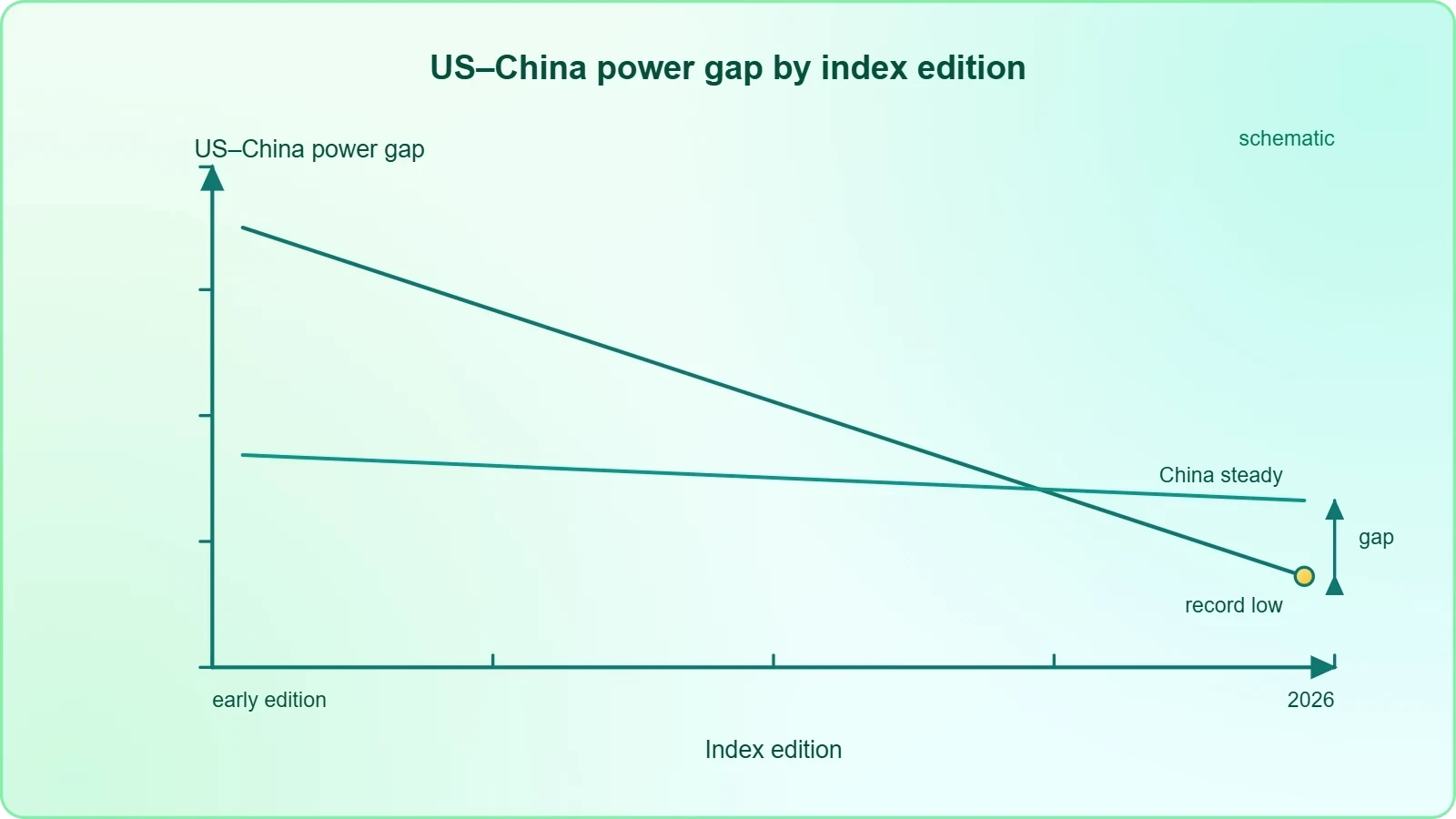
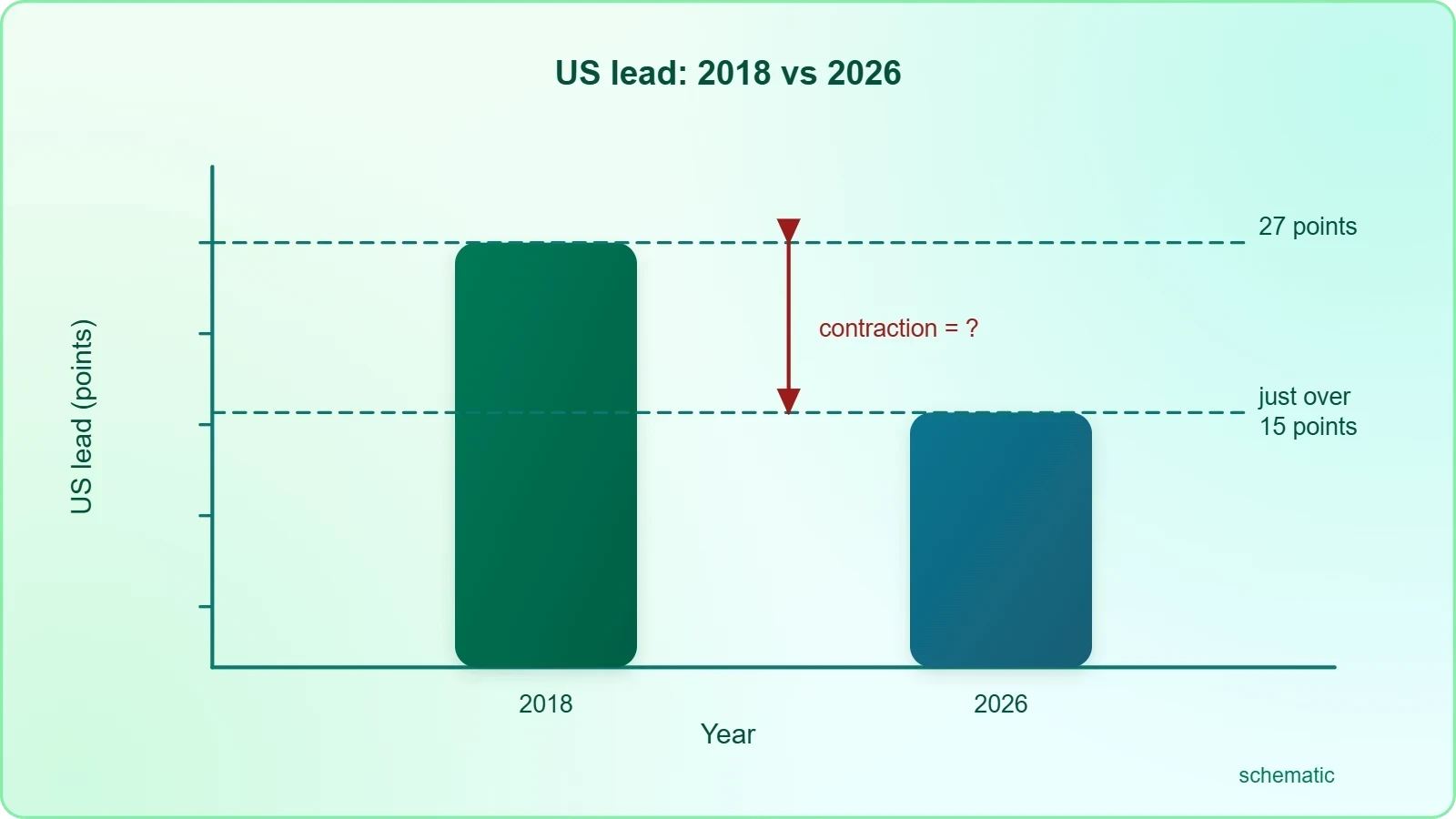
The immediate drivers of the American decline are concrete and traceable. The Trump administration's conflict with Iran absorbed attention and military resources that would otherwise have flowed to the Pacific, and it depleted stocks of long-range missiles that underpin deterrence credibility in the western Pacific. Simultaneously, Washington pressed allies to shoulder more of their own defence burdens while signalling a preference for fewer joint exercises with South Korea. Survey respondents across the region described the United States as distracted and disengaged. China, by contrast, held steady on most measures while improving military capability, cultural influence, and state resilience. It now ranks first for economic relationships and diplomatic influence, ahead of the United States, and its military capability deficit has shrunk from twenty-seven points in 2018 to just over fifteen.
Beyond the bilateral headline, the index captures a region under mounting strain. Australia slipped one place to sixth, behind Russia, with Prime Minister Anthony Albanese perceived as more effective at advancing economic interests than diplomatic ones. India's influence strengthened. South-East Asia confronted compounding pressures: disruption to global energy supplies from the Middle East conflict and the closure of the Strait of Hormuz pushed up fuel and fertiliser prices, constraining food and agricultural production. Government effectiveness declined in nearly every South-East Asian country, with Singapore, Myanmar, and Laos the exceptions. The picture is one of a region where the distribution of power is shifting faster than the institutions and alliances designed to manage it.
On This Page
- What the Asia Power Index Actually Measures
- The Iran Conflict and the Depletion of American Deterrence
- China's Steady Gains and the Limits of the Advance
- Australia, India, and the Shifting Regional Order
- Energy Chokepoints, Food Security, and Governance Under Strain
- Reading the Trend: What the Narrowing Gap Means for Policy
- Methodological Caveats and the Limits of Composite Indices
TL;DR The Lowy Institute's 2026 Asia Power Index records the smallest US-China power gap in Asia since the series began, with Washington still leading overall but losing ground due to the Iran conflict, depleted missile stocks, and pressure on allies. China held steady and improved military, cultural, and resilience scores, ranking first for economic relationships and diplomatic influence. Australia fell to sixth behind Russia, India gained, and South-East Asia faced energy, food, and governance pressures. The authors attribute the narrowing primarily to US missteps rather than Chinese advances.
What the Asia Power Index Actually Measures
The Asia Power Index is not a simple ranking of military budgets or GDP figures. It is a composite instrument that attempts to capture the full spectrum of national power as it is exercised within the Asian region, weighting eight functional areas that range from hard military capability to the softer currencies of cultural influence and diplomatic reach. Each functional area is built from multiple indicators, and the index deliberately measures power as it is projected into Asia rather than as it is held globally. That methodological choice matters enormously, because it means a country can be powerful in absolute terms yet score modestly if its attention and resources are directed elsewhere.
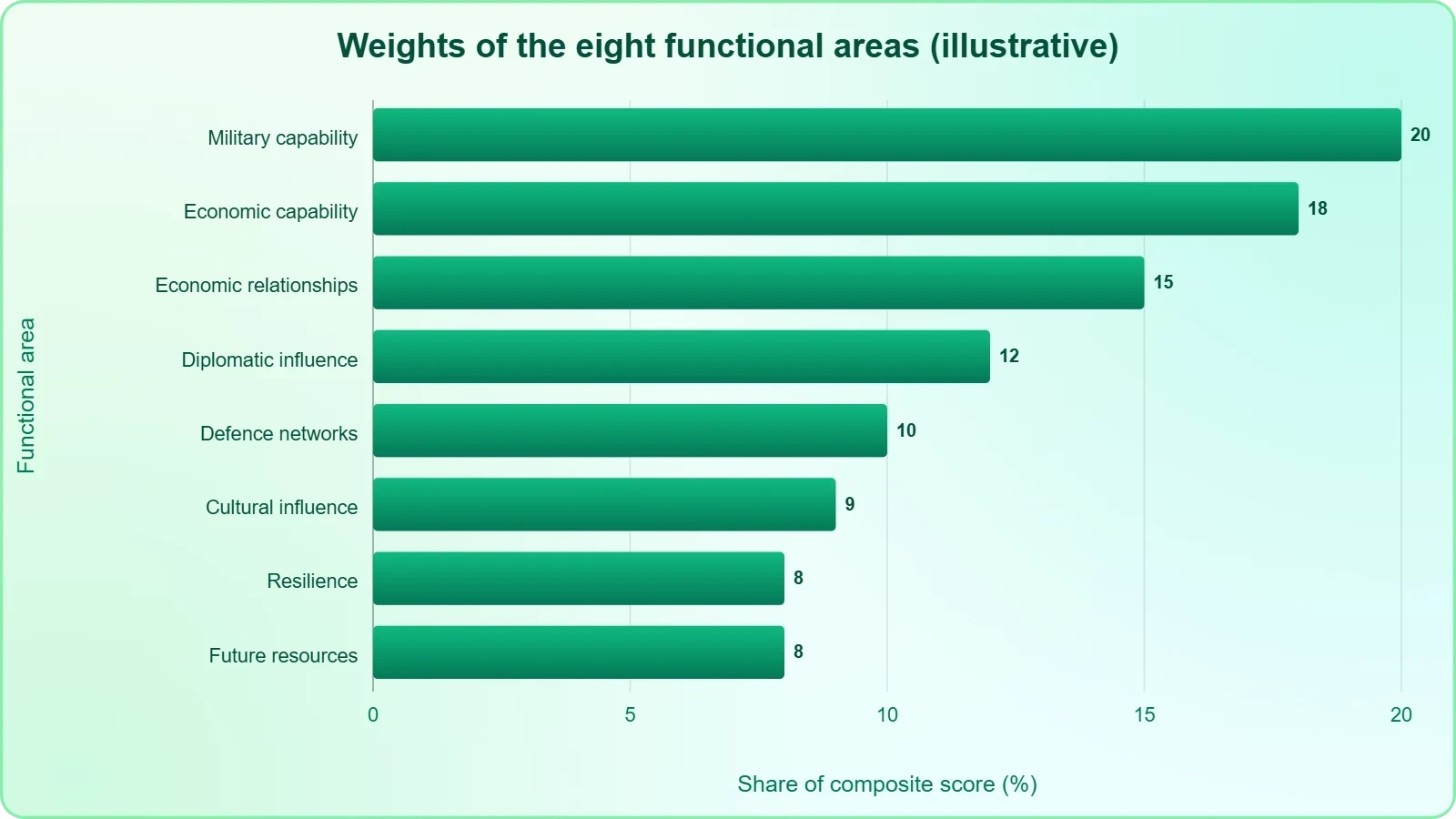
The index covers twenty-seven economies across the region, from the major powers down to smaller states whose influence is largely confined to their immediate neighbourhoods. Its eight functional areas are military capability, economic capability, economic relationships, diplomatic influence, cultural influence, resilience, future resources, and defence networks. Each is scored on a scale from zero to one hundred, and the aggregate score is a weighted composite. The weighting reflects the authors' judgment about which dimensions of power matter most in the Asian context, and it is periodically revised to reflect changing strategic realities. This year's edition incorporates adjustments that reflect the growing salience of supply-chain resilience and energy security.
The eight functional areas and their relative weight
Military capability carries the heaviest weight in the composite, which is why the shrinking American lead in this dimension is so consequential. Economic capability and economic relationships together account for a substantial share, reflecting the centrality of trade and investment flows to regional influence. Diplomatic influence, cultural influence, and resilience carry moderate weights, while future resources and defence networks round out the framework. The index's authors are explicit that no single indicator determines a country's score, and that the composite is designed to resist the temptation to reduce power to a single number. Nevertheless, the aggregate scores provide a useful shorthand for tracking relative position over time.
The methodology has attracted both praise and criticism since the index was first published. Supporters value its breadth and its consistency across years, which allows for meaningful longitudinal comparison. Critics argue that composite indices inevitably embed subjective judgments about weighting and that the survey component introduces perception bias. The authors acknowledge these limitations openly, noting that the index is a tool for understanding trends rather than a precise measurement of power. What the 2026 edition demonstrates is that even with these caveats, the directional signal is clear: the United States is losing ground in Asia, and China is holding or gaining it.
Why the survey component shapes the narrative
A distinctive feature of the Asia Power Index is its reliance on an elite perceptions survey, which asks policymakers, analysts, and business leaders across the region to assess the influence of major powers. This year, respondents described the United States as distracted and disengaged, a characterization that carries weight beyond the raw numbers. Perceptions shape behaviour: allies who believe Washington is distracted may hedge, diversify their partnerships, or reduce their willingness to align on contentious issues. The survey thus functions as both a measurement tool and a leading indicator of future alignment shifts.
The perception data also complicates the story of Chinese gains. China's improvements in military capability, cultural influence, and resilience are measurable, but its diplomatic influence score benefits partly from the contrast with a perceived American retreat. The authors are careful to note that the narrowing gap is driven more by US missteps than by Chinese advances, a distinction that matters for how the trend should be interpreted. If the gap is closing because one player is stepping back rather than because the other is sprinting forward, the trajectory could reverse if American attention returns. That is the central uncertainty the report leaves unresolved.
We Also Published
The Iran Conflict and the Depletion of American Deterrence
The report identifies the Trump administration's conflict with Iran as a pivotal factor in the 2026 decline. The diversion of attention and resources away from the Pacific is the most visible cost, but the more consequential effect is the depletion of US long-range missile stocks. These munitions are the backbone of American deterrence credibility in the western Pacific, where distances are vast and the ability to strike at range underpins the entire force posture. When inventories are drawn down in one theatre, the signal sent to allies and adversaries in another is unmistakable. The index's authors treat this not as a temporary logistical inconvenience but as a structural erosion of capability that takes years to reverse.
The conflict also consumed diplomatic bandwidth at a moment when sustained engagement in Asia was most needed. Senior officials who would otherwise have been cultivating relationships in Tokyo, Seoul, Canberra, and New Delhi were absorbed by Middle East crisis management. The report notes that this distraction was visible to regional partners, who factored it into their assessments of American reliability. The perception of distraction is self-reinforcing: allies who believe Washington is elsewhere may delay commitments, hedge their positions, or seek alternative security guarantees. Over time, these individual decisions aggregate into a measurable shift in alignment, which is precisely what the index's survey component captures.
Allied burden-sharing and the exercise signal
Washington's pressure on allies to spend more on their own defence is, in isolation, a defensible policy. Successive American administrations have argued that European and Asian partners free-ride on US security guarantees, and there is a legitimate case for greater burden-sharing. But the report suggests that the manner and context of this pressure in 2026 had unintended consequences. When combined with a call for fewer joint exercises with South Korea, the message received in Seoul and elsewhere was not one of partnership rebalanced but of commitment retrenched. Joint exercises are not merely military training; they are visible rituals of alliance solidarity that reassure partners and signal resolve to adversaries.
The South Korea signal was particularly damaging because it came at a moment of heightened tension on the Korean peninsula. Reducing the scale or frequency of joint exercises can be read as a concession to Pyongyang or as a signal that Washington's commitment to Seoul's defence is conditional. Either interpretation undermines deterrence. The report's authors do not argue that the administration intended this outcome, but they do argue that the perception mattered. In the index's survey, respondents across the region cited the exercise decision as evidence of American disengagement. The lesson is that in alliance management, the signal sent by a decision often matters more than the decision's operational content.
How missile stockpiles translate into regional credibility
Long-range precision munitions are the currency of modern deterrence in the Pacific. The ability to hold adversary assets at risk from standoff distances is what allows the United States to reassure allies without permanently basing large ground forces in forward positions. When stockpiles are depleted, the credibility of that reassurance declines, even if the underlying intent remains unchanged. Allies and adversaries alike track inventory levels through open-source analysis and intelligence assessments, and they adjust their behaviour accordingly. The report's emphasis on missile stocks is therefore not a technical footnote but a central element of its argument about American decline.
Rebuilding these stockpiles is a slow and expensive process. Defence industrial bases cannot surge overnight, and production lines for advanced munitions are constrained by specialized components, skilled labour, and long lead times. The report implies that the United States faces a multi-year window in which its deterrence posture in Asia is thinner than it was before the Iran conflict. That window coincides with a period of Chinese military modernization, creating a convergence of factors that explains why the military capability gap has narrowed so sharply. The index's authors are careful not to overstate the trend, but they are clear that the direction is unfavourable.
China's Steady Gains and the Limits of the Advance
China's performance in the 2026 index is best described as steady rather than spectacular. It held its position on most measures and improved in three areas: military capability, cultural influence, and resilience. It ranks first for economic relationships and diplomatic influence, ahead of the United States, a position that reflects the depth of its trade ties across the region and the reach of its diplomatic network. These are genuine achievements, and they matter. But the report is careful to note that China's gains do not fully explain the narrowing gap. The authors attribute the closing primarily to American missteps, which implies that China's advance is real but incremental rather than transformative.
The distinction is important for how the trend should be read. If China were surging across every dimension, the implication would be a fundamental shift in the regional balance of power. What the data actually show is a China that is consolidating its position while the United States creates openings through distraction and inconsistency. That is a more contingent story, and it carries a different set of policy implications. It suggests that the trajectory is not locked in and that American attention, if redirected, could arrest or reverse the narrowing. It also suggests that China's gains are partly relational, dependent on the contrast with a retreating superpower rather than on intrinsic momentum.
Economic relationships and diplomatic reach
China's first-place ranking for economic relationships reflects the gravitational pull of its market and the density of its supply-chain linkages across Asia. For most countries in the region, China is the largest trading partner, the largest source of infrastructure finance, and an increasingly important source of investment. These ties translate into influence because they create dependencies and shape the incentive structures within which smaller states make decisions. The index captures this through indicators that measure trade flows, investment stocks, and the breadth of economic agreements. China's diplomatic influence score benefits from a similarly broad network of embassies, consulates, and multilateral engagements.
The diplomatic dimension is where China's steady approach pays dividends. Unlike the United States, which has seen its attention pulled toward the Middle East, China has maintained a consistent presence across the region. Its officials travel, its leaders host, and its institutions engage. This consistency is itself a form of power, because it signals reliability and staying power. The report does not suggest that China is universally trusted or admired, but it does suggest that its persistence is being noticed and factored into regional calculations. In a contest for influence, showing up consistently is a meaningful advantage.
Military modernization and cultural influence
China's military capability score has improved, contributing to the contraction of the American lead from twenty-seven points in 2018 to just over fifteen in 2026. This improvement reflects sustained investment in naval power, missile forces, and the supporting infrastructure of power projection. The index measures capability rather than intent, but the capability itself shapes the strategic environment. A China with a more capable military can contest American freedom of action in the western Pacific, raise the costs of intervention, and reassure partners who might otherwise look to Washington for security. The improvement is incremental but cumulative, and it compounds over time.
Cultural influence is a less intuitive dimension of power, but the index treats it seriously. China's score has improved, reflecting expanded cultural diplomacy, educational exchanges, media reach, and the appeal of its development model in parts of the region. Cultural influence is slow-moving and difficult to measure precisely, but it matters because it shapes the soft environment in which hard power operates. A country whose language, media, and cultural products are widely consumed enjoys advantages in persuasion and agenda-setting. China's gains here are modest but real, and they contribute to the overall picture of a power that is steadily building the full spectrum of influence.
- 01
- 02
- 03
- 04
Australia, India, and the Shifting Regional Order
The 2026 index records a modest but symbolically significant shift in the middle of the rankings. Australia's overall power score fell slightly, and it dropped one place to sixth, behind Russia. The fall is not dramatic in absolute terms, but the symbolism of falling behind Russia in an Asian power index is uncomfortable for Canberra. The report notes that Prime Minister Anthony Albanese was seen as more effective at advancing Australia's economic interests than its diplomatic interests in Asia. That assessment suggests a government that has prioritized trade and investment relationships over the harder work of strategic diplomacy, and it implies that Australia's regional influence is not keeping pace with its economic weight.
India's influence strengthened, continuing a trajectory that has been visible in recent editions of the index. New Delhi's gains reflect its economic growth, its diplomatic activism, and its growing role as a security partner for countries across the Indo-Pacific. India's advantage is that it is not a status quo power in the same way as the United States or China; it can position itself as an alternative partner without carrying the baggage of a superpower rivalry. The report does not quantify India's gains in detail, but the direction is clear. In a region where the two largest powers are locked in competition, India's relative independence is an asset.
Australia's economic diplomacy versus strategic diplomacy
Australia's position in the index is shaped by a tension between its economic interests and its strategic commitments. China is its largest trading partner, and the relationship has stabilized after years of friction. At the same time, Australia is a treaty ally of the United States and a member of the AUKUS arrangement. Managing this dual identity requires diplomatic skill, and the report's assessment suggests that Canberra has been more successful on the economic side than the strategic side. The perception that Albanese is more effective at advancing economic interests than diplomatic ones is a warning sign, because in a contested region, economic diplomacy without strategic diplomacy is incomplete.
The drop behind Russia is partly an artefact of the index's methodology, which measures power as projected into Asia. Russia's energy exports, military presence, and diplomatic activity in the region give it a score that may seem disproportionate to its overall global position. But the ranking still matters because it shapes perceptions. Australia's influence in Asia depends on being seen as a serious, engaged, and capable partner. Falling behind Russia in a regional power index undermines that perception, even if the underlying reality is more nuanced. The report's authors do not dwell on the point, but the implication is clear enough.
India's rising influence and South-East Asia's pressures
India's strengthening influence is one of the more encouraging findings in the 2026 edition. New Delhi has expanded its diplomatic footprint, deepened defence ties with partners across the region, and positioned itself as a credible alternative to Chinese infrastructure finance. Its Act East policy, now more than a decade old, has produced tangible results in connectivity, trade, and security cooperation. The index captures these gains in its diplomatic influence and economic relationships scores. India still trails the major powers by a wide margin, but its trajectory is upward, and that matters in a region where the balance of power is shifting.
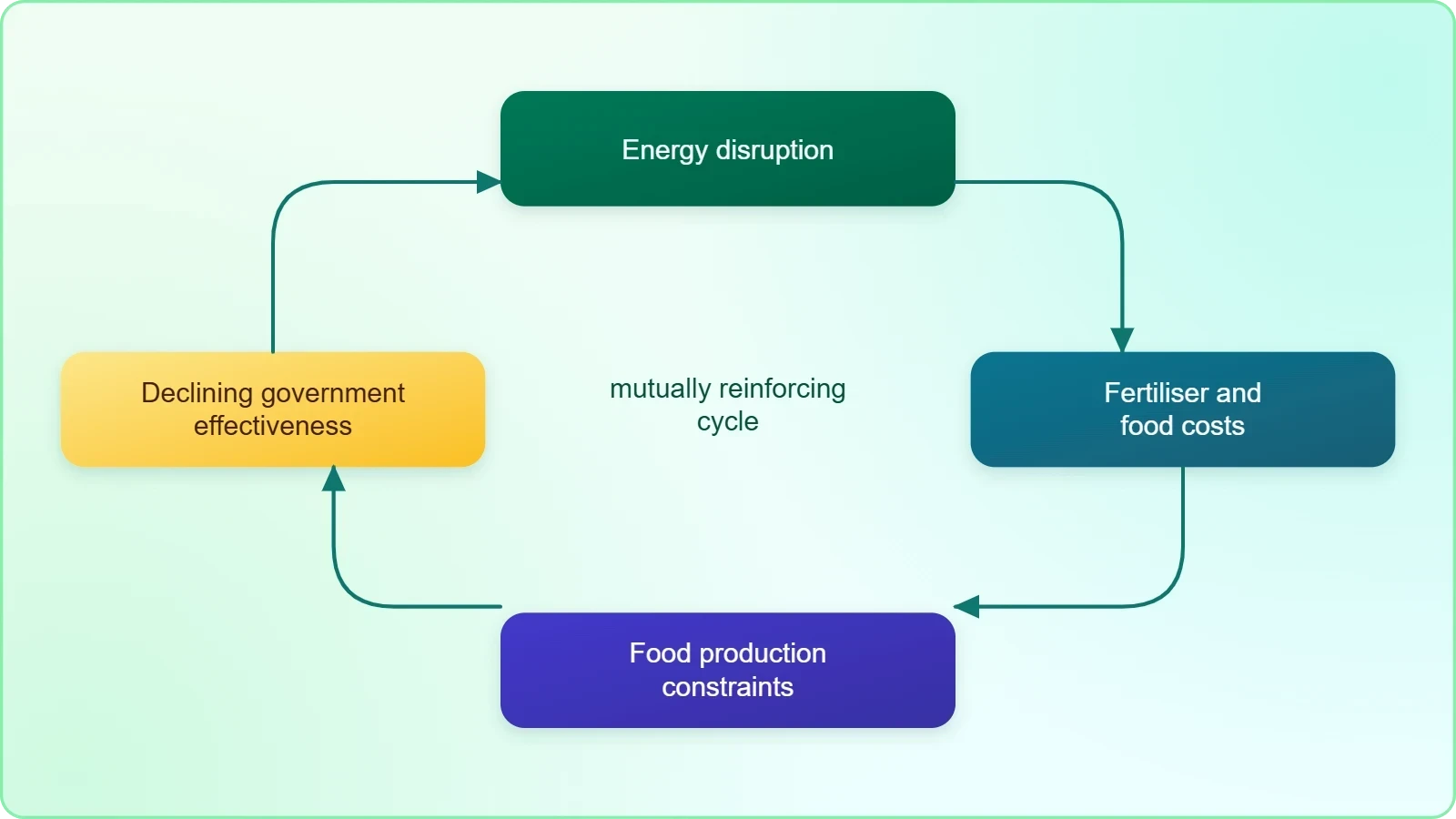
South-East Asia, by contrast, faces mounting geopolitical pressure. The report notes that disruption to global energy supplies from the Middle East conflict and the closure of the Strait of Hormuz raised fuel and fertiliser prices, which in turn constrained food and agricultural production. These are not abstract geopolitical developments; they translate into higher costs for farmers, higher prices for consumers, and fiscal strain for governments. The region's economies are deeply integrated into global supply chains, and disruptions at key chokepoints propagate quickly. The index captures this through its resilience and economic capability indicators, and the picture is one of a region under strain.
Energy Chokepoints, Food Security, and Governance Under Strain
The closure of the Strait of Hormuz and the broader disruption to global energy supplies from the Middle East conflict feature prominently in the report's assessment of South-East Asia. The strait is the world's most important oil chokepoint, and its closure would send shockwaves through energy markets, raising prices for fuel, fertiliser, and the many products derived from petrochemicals. For South-East Asian economies, the effects are direct and immediate. Higher fuel costs raise transport and production expenses, while higher fertiliser prices constrain agricultural output. The report notes that these pressures in turn affect food security, creating a cascade of consequences that reaches from farmers' fields to urban households.
The index's resilience indicators capture how well countries absorb these shocks. The picture is mixed. Some economies have diversified their energy sources, built strategic reserves, and strengthened social safety nets. Others have not, and they face sharper adjustments. The report's finding that government effectiveness declined in nearly all South-East Asian countries, with Singapore, Myanmar, and Laos the exceptions, is particularly striking. Government effectiveness is a measure of the state's capacity to formulate and implement policy, and its decline suggests that the region's institutions are struggling to manage the compounding pressures they face. The exceptions are instructive: Singapore's high capacity is well known, while Myanmar and Laos are outliers whose inclusion may reflect specific methodological factors.
Why the Strait of Hormuz matters for Asian food systems
The connection between the Strait of Hormuz and Asian food systems runs through fertiliser. Natural gas is a key input for nitrogen-based fertilisers, and disruptions to energy supplies raise the cost of production. Higher fertiliser prices translate into higher food prices, which hit poor households hardest. The report's authors are right to highlight this chain of causation, because it illustrates how geopolitical events in one region can have profound consequences in another. South-East Asia is particularly exposed because its agricultural sector is labour-intensive, its populations are relatively young and growing, and its fiscal buffers are limited. A sustained disruption to energy supplies would test the region's resilience in ways that are difficult to overstate.
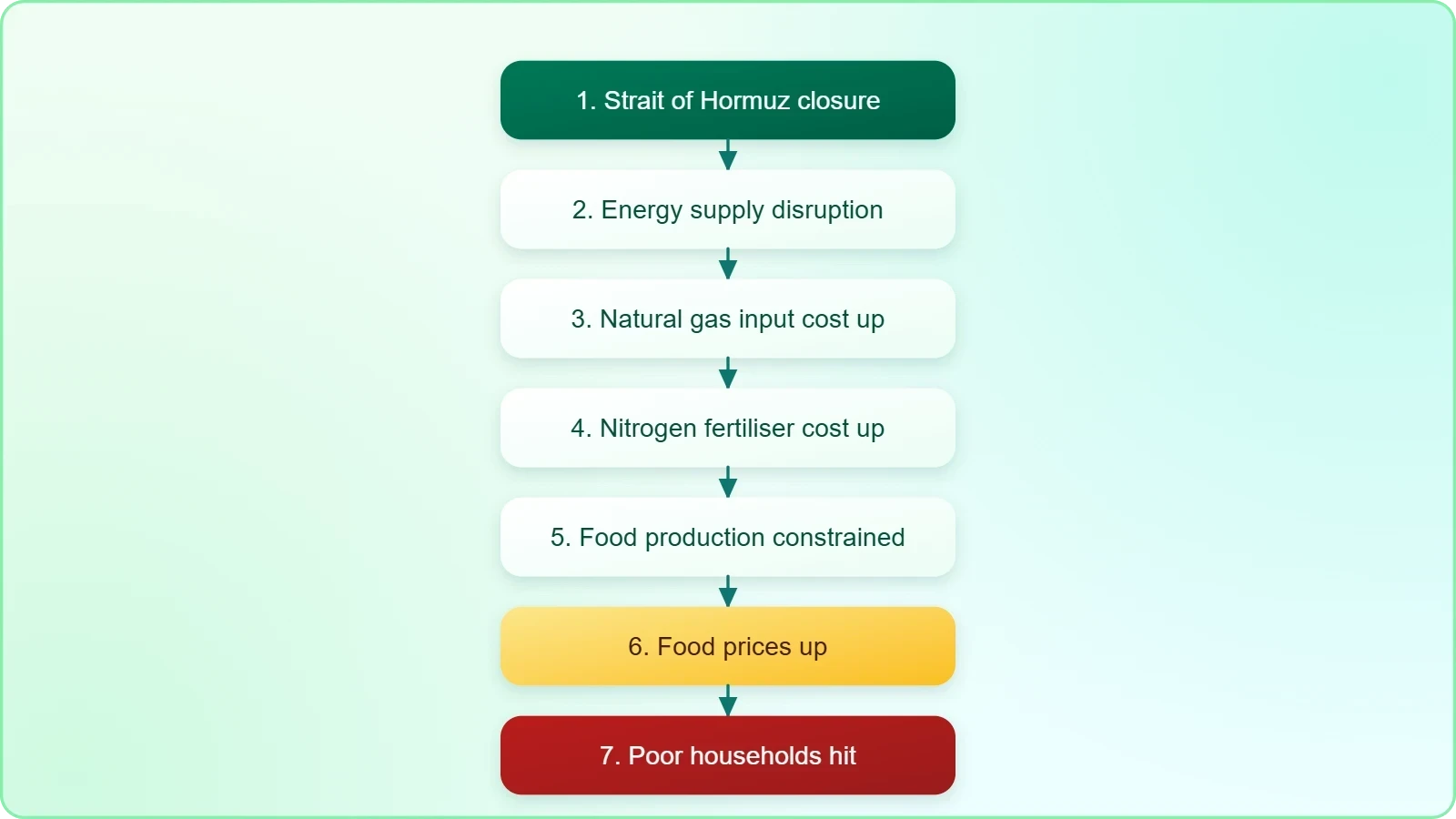
The report does not quantify the economic impact in detail, but the qualitative assessment is clear. Energy disruption, fertiliser costs, food production constraints, and declining government effectiveness form a mutually reinforcing cycle. Governments that are less effective are less able to cushion shocks, which in turn undermines their legitimacy and effectiveness. The cycle is difficult to break, and it creates openings for external actors who can offer resources, investment, or alternative supply arrangements. China is well positioned to play this role, given its economic reach and its willingness to engage across the region. The United States, distracted elsewhere, is less so.
Government effectiveness and the resilience gap
The finding that government effectiveness declined in nearly all South-East Asian countries is one of the more sobering elements of the 2026 report. Government effectiveness is not a measure of democratic quality or political freedom; it is a measure of the state's capacity to deliver. A government that can build infrastructure, collect taxes, regulate markets, and respond to crises effectively scores well, regardless of its political system. The decline across the region suggests that states are struggling to keep pace with the demands placed upon them, whether from economic shocks, demographic change, or geopolitical pressure. The three exceptions, Singapore, Myanmar, and Laos, are a heterogeneous group that defies easy generalization.
Singapore's high score is unsurprising given its reputation for administrative excellence and its substantial fiscal reserves. Myanmar's inclusion as an exception is more puzzling and may reflect the specific indicators used or the baseline against which change is measured. Laos, similarly, is an outlier whose inclusion may reflect methodological factors rather than a dramatic improvement in governance. The broader point stands: most of South-East Asia is experiencing a decline in state capacity at precisely the moment when capacity is most needed. That is a recipe for fragility, and it is likely to shape the region's trajectory in the years ahead.
Reading the Trend: What the Narrowing Gap Means for Policy
The central analytical claim of the 2026 Asia Power Index is that the narrowing gap between the United States and China is driven more by American missteps than by Chinese advances. This claim deserves careful attention because it carries a specific policy implication: the trend is contingent and potentially reversible. If the United States redirects attention to Asia, rebuilds its munitions stockpiles, and reassures its allies through consistent engagement, the gap could stabilize or widen again. The report does not predict that this will happen, but it identifies the levers that would make it possible. The question is whether Washington has the political will and the strategic focus to pull them.
The alternative reading is less optimistic. If the United States remains distracted by conflicts elsewhere, if its domestic politics continue to pull it inward, and if its allies lose confidence in its staying power, the narrowing could accelerate. The index's survey component suggests that perceptions are already shifting, and perceptions have a way of becoming self-fulfilling. Allies who believe Washington is disengaged may hedge, diversify, or accommodate Beijing. Each individual decision is rational, but the aggregate effect is a further erosion of American influence. The report does not resolve this uncertainty, but it provides the data with which to track it.
Alliance management and the credibility premium
Alliances are the primary instrument through which the United States projects power in Asia. The report's findings on allied burden-sharing and joint exercises suggest that alliance management has become more difficult. Pressuring allies to spend more is not inherently wrong, but it must be paired with visible commitment. When allies hear demands for greater spending alongside signals of reduced engagement, they draw predictable conclusions. The credibility premium that the United States has historically enjoyed in Asia depends on the perception that its commitments are durable. That perception is not self-sustaining; it requires constant cultivation through exercises, visits, and consistent messaging.
The South Korea exercise decision is a case study in how not to manage an alliance. Reducing joint exercises may have been intended as a confidence-building measure toward Pyongyang, but the signal received in Seoul and across the region was one of weakening commitment. The report's authors do not argue that the decision was wrong in principle, but they do argue that its effects were damaging. The lesson for policymakers is that in alliance management, the perception of commitment matters as much as the substance. A decision that saves resources in the short term can cost credibility in the long term, and credibility is the currency of deterrence.
What the index reveals about the future of Asian order
The broader significance of the 2026 index lies in what it reveals about the trajectory of the Asian order. The post-Cold War era, in which the United States was the undisputed dominant power in the region, is giving way to a more contested environment. China's steady gains, combined with American distraction, have produced a distribution of power that is more balanced than at any point since the index began. This does not mean that China has become the region's dominant power; the United States still leads overall. But it does mean that the margin is thinner, and that the assumptions that underpinned regional stability for decades can no longer be taken for granted.
For the countries of Asia, the implication is that hedging will become more attractive. Smaller states that once relied on American security guarantees while trading with China will face harder choices. Some will deepen their ties with Washington; others will accommodate Beijing; most will try to do both. The index captures this hedging behaviour indirectly through its survey component, and the results suggest that the region is already adjusting. The future of the Asian order will be determined not only by the actions of the great powers but by the accumulated choices of the many smaller states that navigate between them.
Methodological Caveats and the Limits of Composite Indices
No assessment of the Asia Power Index would be complete without acknowledging its methodological limitations. Composite indices inevitably involve judgments about which dimensions of power matter, how they should be weighted, and how they should be measured. The Lowy Institute is transparent about its choices, but transparency does not eliminate subjectivity. A different set of weights would produce a different ranking, and reasonable analysts can disagree about whether military capability should carry the weight it does or whether economic relationships deserve more. The index is best understood as a structured framework for thinking about power rather than a precise measurement of it.
The survey component introduces a further layer of complexity. Elite perceptions are shaped by media coverage, diplomatic messaging, and the cognitive biases of respondents. A year of negative headlines about American disengagement can produce a survey result that overstates the underlying shift. Conversely, a year of positive coverage can produce an overly rosy assessment. The index's authors are aware of these risks and use multiple indicators to cross-check survey findings against material data. But the survey remains an important input, and its findings should be read with appropriate caution. The perception of decline can become real decline if it changes behaviour, but the causal chain is not automatic.
Why the directional signal still matters
Despite these caveats, the directional signal from the 2026 index is clear and consistent with other sources of evidence. The narrowing of the US-China gap is not an artefact of a single indicator or a single year's survey. It reflects a multi-year trend that has been visible across multiple editions of the index and is corroborated by independent analyses of military balance, trade flows, and diplomatic engagement. The report's authors are careful not to overstate their conclusions, but they are confident in the direction of travel. That confidence is warranted, and it should inform how policymakers and analysts think about the region's future.
The value of the index lies precisely in its ability to track trends over time. A single year's data point is less important than the trajectory it describes, and the trajectory here is one of gradual American erosion and steady Chinese consolidation. Whether that trajectory continues depends on choices made in Washington, Beijing, and the capitals of the region. The index does not determine those choices, but it provides the information with which they can be made. In that sense, it is a public good: a shared framework for understanding a region whose balance of power is shifting in ways that will shape the global order for decades to come.
From our network :
- How AI Agents Will Change the Way We Manage Personal FinancesExplore how AI agents are transforming personal finance through automated budgeting, bill payment, and investment management, while examining the critical security protocols and governance frameworks required for safe deployment.
- Mobile Learning and VR in English: What Global Evidence Reveals About Effective Language TechnologyA systematic review across 14 countries reveals which language-learning technologies genuinely work. Mobile learning, AI, and VR show measurable benefits when pedagogically integrated. This evidence-based guide helps educators and learners select technology that delivers real return on investment.
- The Hidden Cost of AI Convenience: Why Over-Permissioned Agents Are a Security Time BombDiscover why AI agents with excessive permissions create dangerous single points of failure, and learn how implementing least privilege principles can protect your organization from exploitation.
- University Language Proficiency Exams: Why Institutional Tests Demand Different Preparation Than IELTS and TOEFLDiscover why university-specific language proficiency examinations differ fundamentally from IELTS and TOEFL, and learn strategic preparation approaches for institutional assessment success.
- Committed Mediterranean Precipitation Decline: Why Emissions Cuts Alone Cannot Restore Winter RainsNew NOAA research reveals that Mediterranean winter rains may decline irreversibly even with emissions cuts. Explore the science of committed climate change and regional impacts.
- Live Online English Classes for Kids: Do They Actually Reduce Anxiety?A ten-week study reveals that synchronous online English classes can significantly reduce child language anxiety while improving listening and reading skills. Discover what makes these programs effective and how parents can select the right one.
- CISA’s Ten-Advisory Wave: Why Generic Patching Fails in OT and How to Build Product-Specific PlaybooksCISA released ten ICS advisories in one week, exposing critical infrastructure risks. Generic patching fails in OT. Learn to build product-specific remediation playbooks.
- The Final Descent: How ESA Retired the Legendary Cluster Constellation After 24 Years of Space Weather ScienceAfter 24 years mapping Earth’s magnetosphere, ESA’s Cluster mission concluded with a precisely controlled reentry over the South Pacific. This analysis explores the scientific legacy, engineering decisions, and debris mitigation principles behind one of space exploration’s most responsible retirements.
- Forbidden Matrix Patterns and Visible Lattice Points: A Geometric DictionaryExplore how multidimensional 0–1 matrices encode geometric truths, linking forbidden patterns to visible lattice points and hypergraph theory, with applications in combinatorics and computational geometry.
RESOURCES
- Resources will be updated soon.
- 01
- 02
- 03
- 04
- 05
- 06
- 07
- 08
0 Comments