Volkswagen Group's disclosure of a €5.86 billion operating loss for the third quarter of 2026 lands with unusual force, not merely because of its scale but because of what it signals about the fragility beneath Europe's industrial crown. The Wolfsburg-based giant, long treated as the dependable engine of German manufacturing, has now posted its heaviest quarterly deficit since the 2015 Dieselgate emissions scandal, a comparison the company would surely prefer to avoid. The immediate trigger was a writedown tied to its Porsche unit, a marque that has historically functioned as the group's profit sanctuary and brand halo rather than a source of balance-sheet strain.
What makes this result analytically significant is the layered nature of the pressure. A single impairment charge can be absorbed by a manufacturer of Volkswagen's scale, but when it arrives alongside tariff exposure, intensifying Chinese competition, and the costly mechanics of electrification, the writedown becomes a symptom rather than an isolated event. The company's terse disclosure, offering the headline figure without granular segment detail, leaves analysts to reconstruct the underlying narrative from surrounding European business reporting. That reticence itself is telling, since transparency tends to expand when results flatter and contract when they do not.
The broader context matters enormously here. European automakers are navigating a structural transition that rewards capital discipline and punishes legacy cost bases, and Volkswagen carries one of the heaviest legacy structures in the industry. Brussels is simultaneously drafting a "Made in Europe" framework intended to insulate domestic carmakers from Chinese encroachment, a policy direction that has already unsettled global suppliers who fear retaliatory friction. This analysis examines the loss from multiple angles: the Porsche writedown's mechanics, the Dieselgate echo, tariff and competitive dynamics, and what the quarter reveals about European industrial policy.
On This Page
- The Anatomy of a €5.86 Billion Quarterly Loss
- The Dieselgate Echo: A Benchmark Nobody Wants to Match
- Tariffs, Trade, and the Squeeze on European Automakers
- Reading the Silence: What Volkswagen Did Not Say
- Strategic Implications for Volkswagen and European Industry
- Valuation, Risk, and the Investor Perspective
- Conclusion: A Quarter That Clarifies the Stakes
TL;DR Volkswagen Group reported a €5.86 billion operating loss for the third quarter of 2026, its worst quarterly result since the 2015 Dieselgate scandal, driven by a writedown linked to its Porsche unit. The loss arrives amid mounting pressure on European automakers from tariffs, Chinese competition, and the capital demands of electrification, while the EU develops a "Made in Europe" plan to shield domestic manufacturers. The disclosure was notably sparse on segment detail, leaving analysts to infer the underlying operational picture. The quarter underscores how legacy cost structures and brand-dependent profitability can amplify a single impairment into a systemic signal about European industrial competitiveness.
The Anatomy of a €5.86 Billion Quarterly Loss
An operating loss of this magnitude demands careful decomposition, because the headline number conflates at least two distinct phenomena: an accounting impairment and underlying operational performance. The Porsche-related writedown represents a revaluation of assets whose carrying value no longer aligns with expected future cash flows, a technical adjustment that flows through the income statement but does not necessarily reflect cash leaving the business. Yet impairments are never purely technical; they encode management's revised expectations about brand equity, demand trajectories, and the returns available on prior investment.
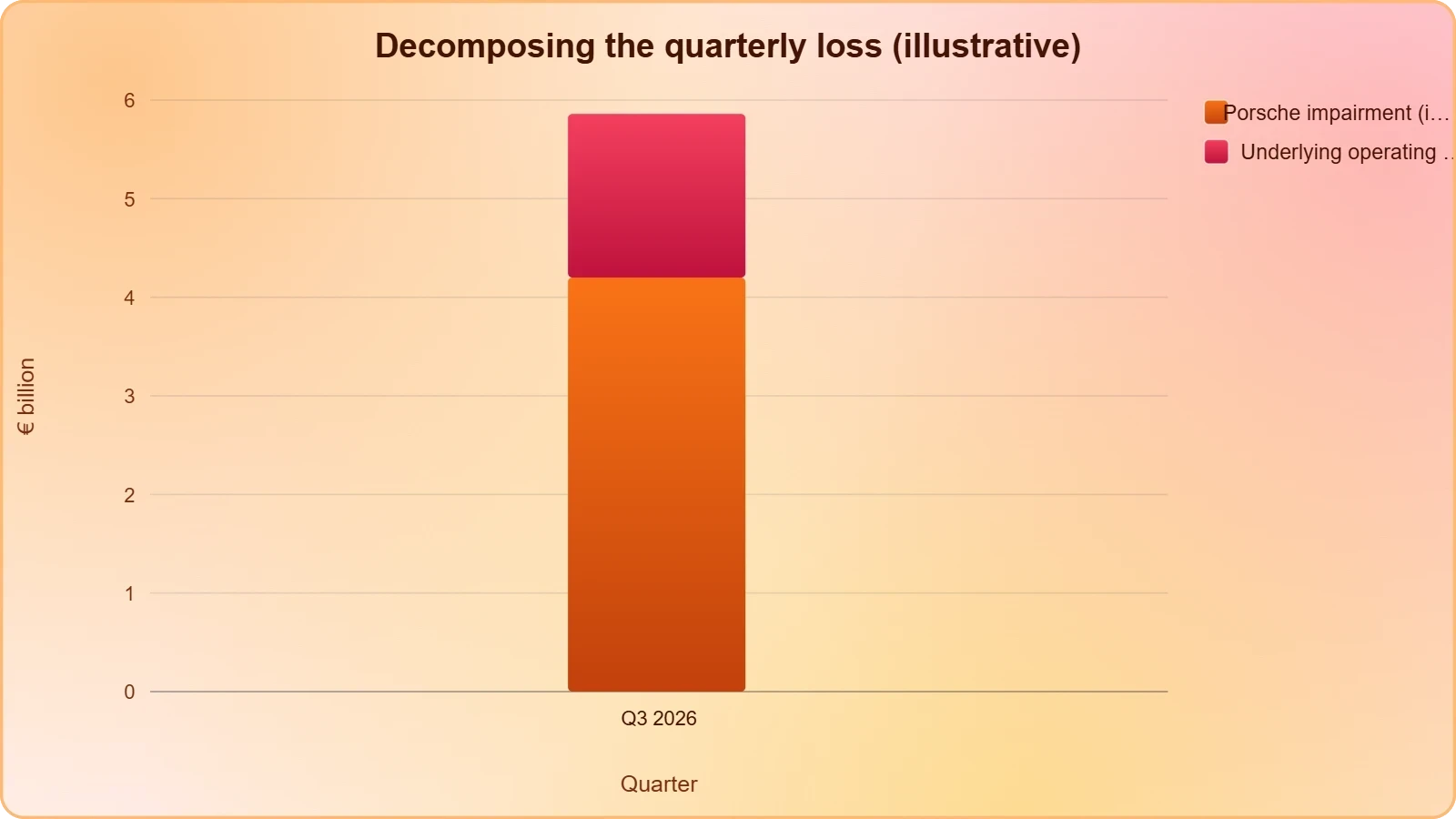
Volkswagen's decision to disclose the figure within a broader European business roundup, rather than through a dedicated and detailed earnings release, is itself an analytical datum. Companies typically control the narrative around bad news through extensive contextualization, and the absence of that apparatus suggests either that details remain unsettled or that management prefers minimal scrutiny of segment-level performance. For investors and analysts, this creates an information vacuum that markets tend to fill with conservative assumptions, which can amplify share price volatility well beyond the accounting impact itself.
Accounting Mechanics Behind the Porsche Writedown
Impairment testing under international accounting standards requires entities to compare carrying amounts against recoverable value, defined as the higher of fair value less costs of disposal and value in use. When discount rates rise, growth assumptions soften, or regulatory constraints tighten, the present value of projected cash flows can fall below book value, triggering a writedown. For a premium marque like Porsche, the sensitivity is pronounced because its valuation rests heavily on long-dated cash flow projections tied to pricing power and volume assumptions in key markets.
The strategic irony is considerable. Porsche has long been positioned as Volkswagen's margin engine, the brand that subsidizes the group's mass-market operations and funds electrification investment across the portfolio. A writedown at that unit therefore carries symbolic weight beyond its euro value, suggesting that even the group's strongest asset faces revised expectations. Analysts will watch closely for whether the impairment reflects cyclical demand softness, structural shifts in luxury vehicle economics, or specific issues such as model cycle timing and electrification transition costs.
Why the Headline Figure Understates the Underlying Pressure
Operating losses of this scale rarely emerge from a single cause, and the Porsche writedown should be read as an accelerant rather than the sole origin of the deficit. Volkswagen's mass-market brands operate in segments where margins are thin, competition is fierce, and fixed costs are stubbornly high. When volume assumptions weaken simultaneously across multiple brands, the operating leverage that amplifies profits in good years reverses with equal force, converting modest revenue shortfalls into disproportionate earnings damage.
Currency movements, raw material costs, and the expense of maintaining parallel combustion and electric vehicle production lines all compound the arithmetic. The group's extensive manufacturing footprint across Germany and beyond carries labor agreements and capacity commitments that cannot be adjusted quickly. Each of these factors individually is manageable; their convergence within a single quarter is what transforms a writedown into a €5.86 billion loss and prompts uncomfortable questions about the durability of the group's current operating model.
The Dieselgate Echo: A Benchmark Nobody Wants to Match
Any comparison to 2015 carries heavy freight in corporate memory. Dieselgate was not merely a financial event; it was a reputational rupture that cost Volkswagen billions in fines and settlements, reshaped its governance, and forced a wholesale strategic pivot toward electrification. The scandal demonstrated how a single integrity failure could cascade through regulatory, legal, and commercial dimensions simultaneously. Invoking that benchmark now, even implicitly through the phrase "worst since," frames the current loss within a narrative of recurring crisis rather than cyclical fluctuation.
The distinction matters for how stakeholders interpret the quarter. Dieselgate was a self-inflicted wound rooted in deliberate misconduct, whereas the Porsche writedown reflects market and accounting realities that management can attribute to external conditions. Yet both events share a common thread: they expose vulnerabilities in a business model that depends on premium brand profitability to offset structural weaknesses elsewhere. When the premium cushion deflates, the underlying economics of the group become visible in ways that flatter periods conceal.
Reputational Capital and Investor Confidence
Reputational capital accumulates slowly and erodes quickly, and Volkswagen's history has made investors unusually sensitive to signals of institutional stress. A loss of this magnitude, disclosed with minimal elaboration, invites speculation about what remains unreported. Analysts will scrutinize forthcoming filings for evidence of further impairments, covenant implications, or dividend sustainability questions. Rating agencies, whose assessments determine borrowing costs across a capital-intensive industry, will weigh whether this quarter represents a transient shock or the beginning of a sustained earnings deterioration.
The governance dimension also deserves attention. Volkswagen's supervisory board structure, with significant stakeholder representation, can slow decisive restructuring and complicate the communication of bad news. When disclosure is terse, the burden of interpretation shifts to external parties who lack access to internal projections. That asymmetry tends to produce conservative market pricing, which in turn raises the cost of capital precisely when the company can least afford it. Confidence, once dented, becomes an expensive commodity to rebuild.
What the 2015 Comparison Reveals About Structural Fragility
The parallel to 2015 is instructive less for the events themselves than for the pattern they reveal. In both instances, Volkswagen's exposure stemmed from concentration risk: dependence on diesel technology in one case, dependence on premium brand profitability in the other. Diversification across brands and markets provides the appearance of resilience, but when the profit centers cluster around a narrow set of premium assets, the group's true risk profile is more concentrated than its revenue base suggests. That structural insight transcends any single quarter's results.
Investors should therefore read the €5.86 billion figure as a diagnostic rather than a verdict. It identifies where the group's earnings architecture is most exposed and raises questions about whether the current portfolio configuration remains fit for a landscape defined by electrification, software competition, and geopolitical fragmentation. The answer will determine whether this quarter is remembered as a trough or as an early warning of a longer adjustment.
We Also Published
Tariffs, Trade, and the Squeeze on European Automakers
Volkswagen's loss did not emerge in a vacuum, and the tariff environment forms an essential part of the explanatory backdrop. European automakers face layered trade barriers across key export markets, raising the effective cost of vehicles sold abroad and compressing margins that were already thin in mass-market segments. Tariffs function as a tax on competitiveness, and for manufacturers with extensive cross-border supply chains, the cumulative burden extends beyond finished vehicles to components that cross borders multiple times before assembly.
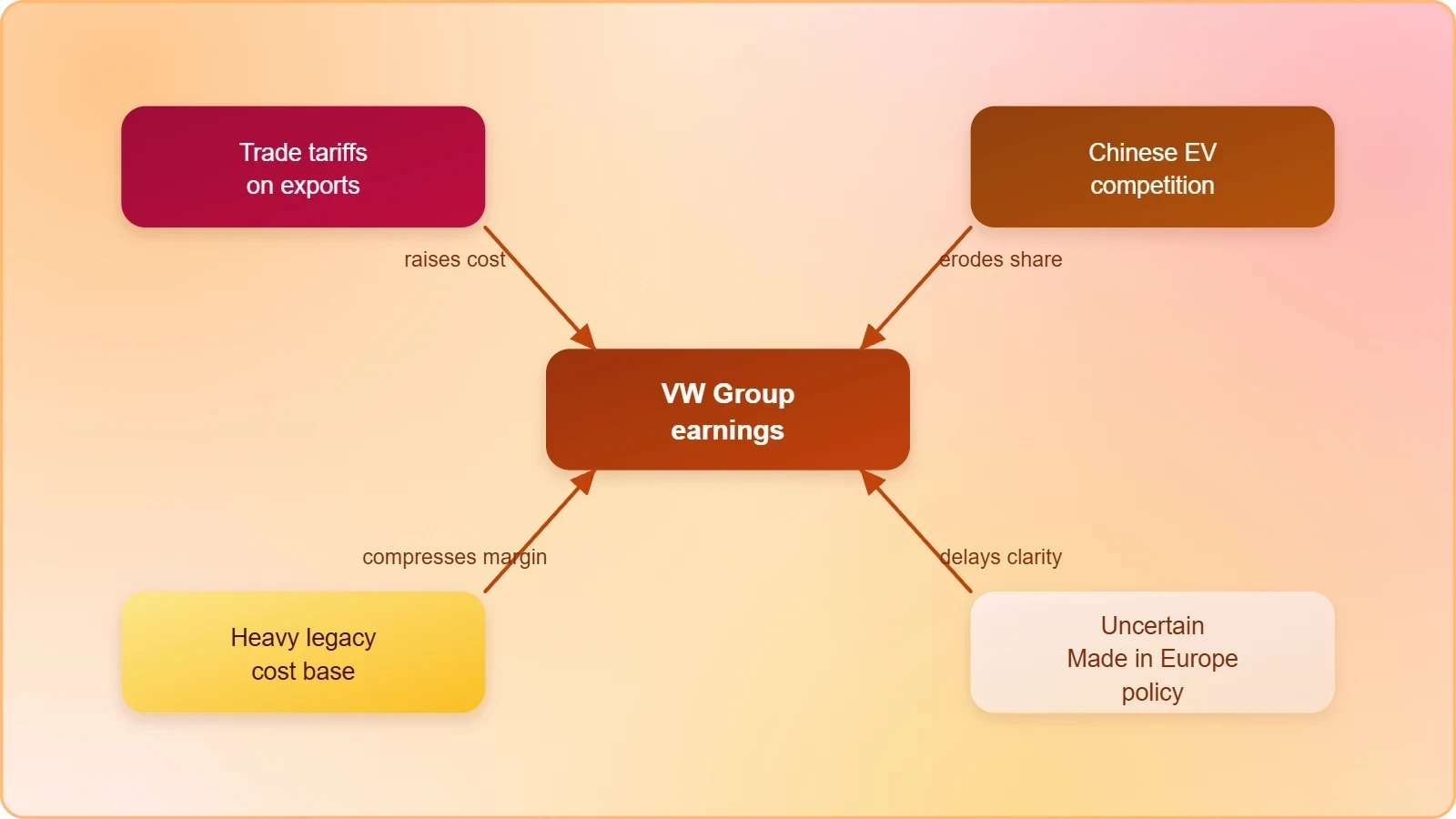
The competitive dimension is equally consequential. Chinese manufacturers have expanded aggressively into European and global markets, leveraging cost advantages, vertical integration in battery production, and rapid model cycles. For incumbents carrying legacy cost structures, matching that pace requires capital investment that competes directly with shareholder returns and debt service. The result is a classic squeeze: pricing pressure from below, tariff costs from above, and a capital-intensive transition in between that offers no cheap exit.
The "Made in Europe" Policy and Its Uncertainties
Brussels' developing "Made in Europe" plan aims to shield domestic carmakers from Chinese competition through local-content requirements, subsidies, or trade measures. The policy logic is straightforward: preserve manufacturing capacity and employment in a sector that anchors European industrial output. Yet the execution is fraught with tension. Global suppliers, many of whom operate across multiple regions, have expressed concern that protectionist measures could invite retaliation, disrupt established supply relationships, and raise costs for the very manufacturers the policy intends to support.
For Volkswagen specifically, the policy environment introduces strategic ambiguity. Protection at home may cushion market share, but it does little for export competitiveness or for the group's extensive operations outside Europe. Moreover, local-content rules can constrain sourcing flexibility precisely when cost discipline is most needed. The company must therefore plan against multiple policy scenarios simultaneously, a planning burden that itself consumes management attention and capital that might otherwise fund product development.
Competitive Dynamics Reshaping the Sector
The competitive landscape has shifted from a stable oligopoly toward something more fluid and unforgiving. Chinese entrants have demonstrated that electric vehicle economics can be mastered at lower price points, challenging the assumption that incumbents' brand equity provides durable pricing power. Simultaneously, software-defined vehicles have introduced a new axis of competition where traditional manufacturing excellence offers limited advantage. Volkswagen's scale, once an unalloyed strength, now cuts both ways: it provides resources for transformation while imposing coordination costs that nimble competitors avoid.
These dynamics explain why a single writedown resonates so widely. It arrives at a moment when the industry's rules are being rewritten and when every incumbent's strategic assumptions are under review. The question facing Volkswagen is not whether it can absorb one bad quarter, but whether its operating model can generate sufficient returns to fund transformation while defending market position against competitors unencumbered by legacy obligations.
- 01
- 02
- 03
- 04
Reading the Silence: What Volkswagen Did Not Say
Corporate disclosure is a strategic act, and the shape of what is omitted often reveals as much as what is stated. Volkswagen's summary provided the headline loss and its proximate cause without segment breakdowns, cash flow implications, or forward guidance. For a company of this size, such brevity is unusual in a dedicated earnings context, though less so when results are embedded within a broader news roundup. The effect, whether intended or not, is to defer scrutiny and control the pace at which detail enters public discourse.
Analysts will compensate by triangulating from adjacent data: peer results, registration figures, pricing trends, and supplier commentary. This reconstruction process is imperfect but informative, and it often surfaces questions management would prefer to address on its own timetable. The risk is that speculation fills the vacuum with narratives more damaging than the underlying facts, particularly when the company's recent history has conditioned observers to expect unwelcome surprises.
Information Asymmetry and Market Interpretation
Markets price uncertainty, not just outcomes, and sparse disclosure increases the uncertainty premium investors demand. When a company reports a large loss without granular explanation, the rational response is to assume the worst plausible scenario until evidence suggests otherwise. This dynamic can produce share price reactions disproportionate to the actual economic damage, and it can persist until management provides the detail that resolves ambiguity. For Volkswagen, the cost of silence may therefore exceed the cost of candor.
The governance implications extend beyond investor relations. Supervisory boards, labor representatives, and political stakeholders all depend on timely, accurate information to discharge their responsibilities. When disclosure is compressed, internal accountability mechanisms may also be strained. The question is not whether Volkswagen will eventually provide detail, since regulatory obligations ensure it will, but whether the intervening period of ambiguity serves the company's interests or merely postpones an uncomfortable reckoning.
Signals to Watch in Coming Filings
Several indicators will reveal whether this quarter represents a transient impairment or a deeper deterioration. The first is whether further writedowns appear across other brands, which would suggest group-wide valuation reassessment rather than a Porsche-specific issue. The second is cash flow performance, since impairments are non-cash but operating losses often are not. The third is dividend policy, where any adjustment would signal management's own assessment of earnings durability. Finally, capital expenditure guidance will indicate whether transformation spending remains on track or faces deferral.
Each of these signals carries interpretive weight beyond its nominal value. A stable dividend alongside a large impairment, for instance, would suggest confidence in recovery, while a cut would imply the opposite. Similarly, maintained capital expenditure signals commitment to the electric transition, whereas deferral would raise questions about competitive positioning. Investors should treat the next detailed filing as the true test of whether the third quarter was an accounting event or an operational inflection.
Strategic Implications for Volkswagen and European Industry
The strategic questions confronting Volkswagen extend well beyond balance-sheet repair. The group must simultaneously defend market share in mass segments, preserve premium brand equity, fund electrification, and manage a complex stakeholder landscape. These objectives compete for the same capital and management attention, and the Porsche writedown suggests that even the group's strongest profit center cannot be treated as an inexhaustible resource. Prioritization, always difficult in large organizations, becomes unavoidable when the financial cushion thins.
At the industry level, the quarter raises questions about the sustainability of Europe's automotive manufacturing footprint. If the continent's largest carmaker struggles to generate adequate returns through a cyclical downturn, smaller manufacturers with less diversified portfolios face even starker choices. Consolidation, capacity reduction, and strategic partnerships may all enter the conversation, though each carries political and employment consequences that make decisive action difficult in the European context.
Portfolio Rationalization and Capital Allocation
Volkswagen's multi-brand structure, spanning volume marques, premium names, and commercial vehicles, was designed to capture economies of scale and market coverage. In practice, it also creates complexity, overlapping development costs, and internal competition for resources. A writedown at Porsche may accelerate debate about whether the portfolio remains optimally configured or whether selective divestment, simplification, or deeper platform sharing would release capital and sharpen accountability. Such decisions are politically sensitive given Germany's stakeholder model.
Capital allocation discipline becomes the central test. Every euro directed toward one brand or technology is a euro unavailable elsewhere, and the opportunity cost rises as financial flexibility narrows. Management must weigh near-term profitability against long-term positioning, a trade-off that markets often judge harshly in either direction. The credibility of the group's capital allocation framework will depend on whether subsequent quarters demonstrate improved returns or merely stabilized losses.
Policy, Employment, and the European Industrial Base
Volkswagen's fortunes are entangled with European industrial policy in ways that few companies can match. The group's employment footprint, supplier network, and political significance make it a de facto instrument of regional economic strategy. Consequently, its financial difficulties become policy problems, inviting government intervention, subsidy discussions, and trade measures that shape the competitive environment for all participants. The "Made in Europe" initiative is partly a response to this entanglement, though its effectiveness remains unproven.
The employment dimension adds urgency. Manufacturing jobs carry political weight, and restructuring decisions at Volkswagen reverberate through national and European politics. This creates a tension between the operational flexibility needed for competitiveness and the social obligations embedded in the stakeholder model. Resolving that tension will require negotiation among management, labor, and government, and the outcome will influence not only Volkswagen's future but the broader viability of European automotive manufacturing.
Valuation, Risk, and the Investor Perspective
For investors, the central question is whether the current loss represents a trough from which earnings recover or a step down to a structurally lower profitability plateau. The distinction determines whether the shares represent value or a value trap. Impairments often mark the point of maximum pessimism, after which expectations reset and comparisons become easier. But that pattern holds only when the underlying business stabilizes; if operating pressures persist, the impairment merely acknowledges a deterioration that continues.
Risk assessment must therefore extend beyond the reported figure to the group's capacity to generate cash through a full cycle. Volkswagen's capital intensity, pension obligations, and debt load mean that earnings volatility translates into balance-sheet sensitivity. Investors should model scenarios across demand, pricing, and policy outcomes rather than anchoring on a single quarter. The dispersion of plausible outcomes is wide, and position sizing should reflect that uncertainty rather than a point estimate of recovery.
Scenario Analysis and Earnings Durability
A disciplined scenario framework considers at least three paths: rapid stabilization, prolonged pressure, and structural reset. In the stabilization case, the writedown proves conservative, demand recovers, and margins normalize, making current valuations attractive. In the prolonged-pressure case, tariffs and competition persist, requiring successive impairments and dividend restraint. In the structural-reset case, the group undertakes significant portfolio and capacity changes, sacrificing near-term earnings for long-term viability. Each scenario implies different valuation multiples and different time horizons for recovery.
The probability weights assigned to these scenarios depend on factors largely outside management's control, including trade policy, Chinese competitive intensity, and European demand. That dependence on exogenous variables argues for humility in forecasting and for attention to balance-sheet resilience rather than earnings optimism. Companies that survive transitions are those with the liquidity and flexibility to adapt, and investors should prioritize those attributes when the outlook is genuinely uncertain.
Comparative Positioning Within the Sector
Volkswagen's difficulties are not unique, and relative performance may matter more than absolute results. Peers face similar tariff and competitive pressures, though their exposure varies with geographic mix, brand positioning, and capital structure. A manufacturer with stronger premium concentration may suffer more from luxury demand softness, while one with greater China exposure faces different risks. Comparative analysis helps isolate company-specific issues from sector-wide headwinds, which is essential for attributing the loss correctly.
The sector's collective trajectory will also shape Volkswagen's options. If peers demonstrate successful transitions, capital markets may extend patience; if the sector broadly disappoints, patience will be scarce and valuations compressed across the board. Volkswagen's scale provides some insulation, but it also raises the bar for demonstrating progress. The group must show not only that it can absorb this quarter's loss but that it can outperform a challenging sector baseline.
Conclusion: A Quarter That Clarifies the Stakes
The €5.86 billion loss is best understood not as an isolated accounting event but as a clarifying moment for Volkswagen and for European industry more broadly. It makes visible the dependencies that flatter periods obscure: reliance on premium brand profitability, exposure to trade policy, and the capital burden of a transition that offers no pause. The comparison to Dieselgate is uncomfortable precisely because it reminds observers that Volkswagen has navigated existential challenges before, and that survival has historically required painful adaptation rather than incremental adjustment.
What happens next will be determined by decisions made over the coming quarters, not by the writedown itself. Management's willingness to provide detail, the credibility of its capital allocation choices, and the policy environment in Brussels and beyond will collectively determine whether this quarter marks a trough or a turning point. For investors, the appropriate response is disciplined scenario analysis rather than reactive positioning. For policymakers, the lesson is that industrial strategy must account for the financial fragility of even its largest champions.
From our network :
- How AI Agents Will Change the Way We Manage Personal FinancesExplore how AI agents are transforming personal finance through automated budgeting, bill payment, and investment management, while examining the critical security protocols and governance frameworks required for safe deployment.
- The Hidden Cost of AI Convenience: Why Over-Permissioned Agents Are a Security Time BombDiscover why AI agents with excessive permissions create dangerous single points of failure, and learn how implementing least privilege principles can protect your organization from exploitation.
- The Final Descent: How ESA Retired the Legendary Cluster Constellation After 24 Years of Space Weather ScienceAfter 24 years mapping Earth’s magnetosphere, ESA’s Cluster mission concluded with a precisely controlled reentry over the South Pacific. This analysis explores the scientific legacy, engineering decisions, and debris mitigation principles behind one of space exploration’s most responsible retirements.
- Live Online English Classes for Kids: Do They Actually Reduce Anxiety?A ten-week study reveals that synchronous online English classes can significantly reduce child language anxiety while improving listening and reading skills. Discover what makes these programs effective and how parents can select the right one.
- Committed Mediterranean Precipitation Decline: Why Emissions Cuts Alone Cannot Restore Winter RainsNew NOAA research reveals that Mediterranean winter rains may decline irreversibly even with emissions cuts. Explore the science of committed climate change and regional impacts.
- University Language Proficiency Exams: Why Institutional Tests Demand Different Preparation Than IELTS and TOEFLDiscover why university-specific language proficiency examinations differ fundamentally from IELTS and TOEFL, and learn strategic preparation approaches for institutional assessment success.
- Forbidden Matrix Patterns and Visible Lattice Points: A Geometric DictionaryExplore how multidimensional 0–1 matrices encode geometric truths, linking forbidden patterns to visible lattice points and hypergraph theory, with applications in combinatorics and computational geometry.
- Mobile Learning and VR in English: What Global Evidence Reveals About Effective Language TechnologyA systematic review across 14 countries reveals which language-learning technologies genuinely work. Mobile learning, AI, and VR show measurable benefits when pedagogically integrated. This evidence-based guide helps educators and learners select technology that delivers real return on investment.
- CISA’s Ten-Advisory Wave: Why Generic Patching Fails in OT and How to Build Product-Specific PlaybooksCISA released ten ICS advisories in one week, exposing critical infrastructure risks. Generic patching fails in OT. Learn to build product-specific remediation playbooks.
RESOURCES
- Resources will be updated soon.
- 01
- 02
- 03
- 04
- 05
- 06
- 07
- 08
0 Comments